


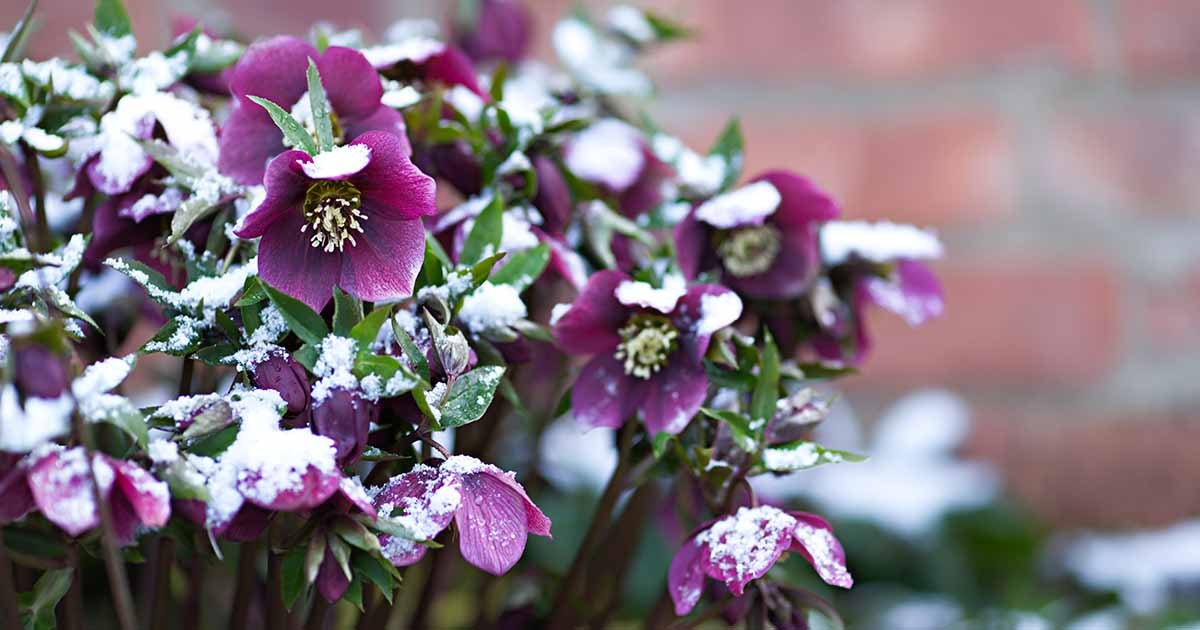
By the mid-1850s, the hybridization of various species as ornamental specimens was well underway across Europe.

It wasn’t until the 19th Century that hellebores made their way into American gardens, courtesy of Cornell University botanist Liberty Hyde Baily, whose Cyclopedia of American Horticulture described eight species well suited to home gardening.
By the 20th Century, other noteworthy Philadelphia region gardens, including the Scott Arboretum at Swarthmore College, and Winterthur, the DuPont estate, had impressive ornamental collections.
Because of their ease of cultivation, early bloom time, and longevity, today’s hellebores are in great demand.
To enjoy hellebores at their best, select locations that are sheltered from the summer sun, and give them room to naturalize.

Consider planting sites that can be comfortably viewed through windows, or near entryways, so you don’t to go strolling about the frozen grounds to appreciate them.
If you’re a winter-hardy soul, you may like to scatter plants along wooded paths, beneath deciduous trees and shrubbery, and in the shadow of structures like walls and fences, where they can be discovered and celebrated.
A Note of Caution:
It is important to note that like many ornamentals, hellebores are toxic to people and pets.
In addition, skin contact may cause irritation, so gardening gloves are a must when you are handling these plants.
How to Grow
Hellebores require loamy soil that is moist but drains well, with an ideal pH of 7.0 to 8.0. You may want to conduct a soil test and amend according to the recommendations.
They also do best planted under deciduous trees that provide at least partial shade in summer months. You need to avoid placements that expose plants to strong, drying winds.

New plants should be provided with about an inch of water per week in the absence of rain.
You want the soil to maintain even moisture, but not become oversaturated. Once established, additional water is only necessary during dry spells.
Fertilization is not necessary, simply maintain the loamy soil, amending it each spring with rich organic material to provide a fertile growing medium.
Hellebores are long-lived, and each year they get bigger and produce more flowers.
You can expect at least 10 productive years for your investment, given proper soil and moisture, and a hospitable location.
Don’t have a large yard or garden? No problem. Hellebores can also be grown in containers.
Cultivars to Select
Now that you know all about this ornamental perennial, let’s take a quick look at some cultivars for your garden.
We know that the species Lenten rose is H. orientalis. However, the ones we find for sale are usually H. x hybridus.

That is because most cultivars are hybrids, bred for optimal color and performance in the US.
Hellebores are fascinating because even in their native land, a single species may exhibit a variety of different characteristics.
When breeders cross these already variable natives with other species or hybrids, the result is a dazzling array of options.
You can learn more about the different types of hellebores in our guide.
Here are a few of my favorite cultivars to get started:
Onyx Odyssey
Double-flowered ‘Onyx Odyssey’ is a standout in the late winter garden. Imagine the contrast between a light coating of white snow and the deep purple-black blooms.
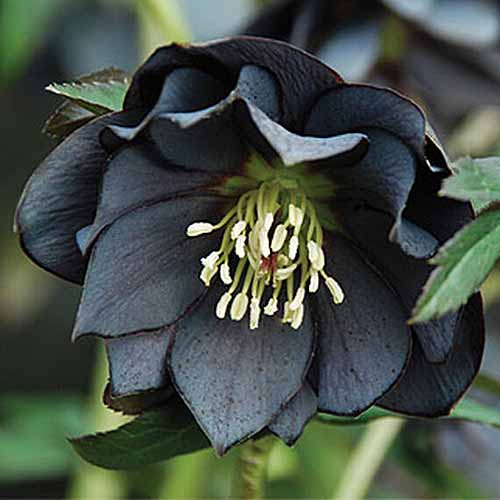
You can plant in a swath with lighter colors for contrast.
Find potted plants available at Burpee.
Painted Bunting
If dark-and-moody isn’t your style, try ‘Painted Bunting,’ with its single blooms featuring creamy white sepals and deep red throats and veining.
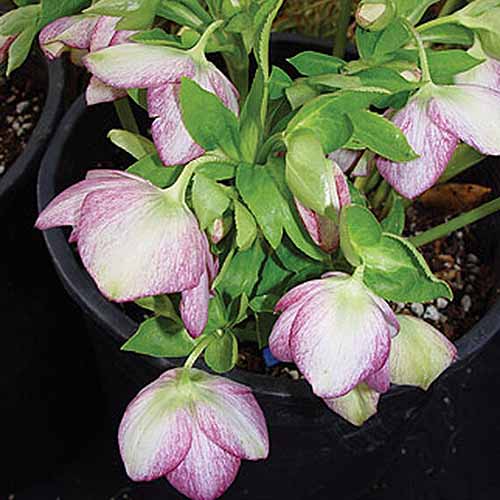
Plant together with ‘Onyx Odyssey’ for a dramatic light-and-dark display.
You can find potted plants available at Burpee.
Wedding Party Bridesmaid
‘Wedding Party Bridesmaid’ is a standout cultivar that features double flowers in white with dark pink picotee edges and veining.
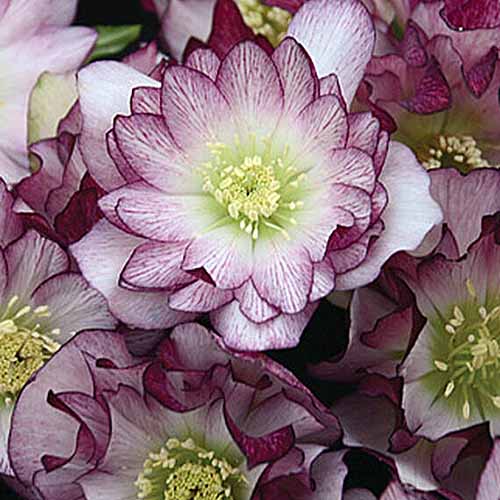
Find potted plants available at Burpee.
Maintenance
Keep the garden weeded to deter pests and inhibit disease. Snip off spent flower stems at their base to promote foliar growth post-bloom.
If you want to divide plants, do so in late winter or early fall. This is not a necessity, unless clumps don’t have room to naturalize or you want to propagate new plants.

Late fall is the time to prune the old foliage to the ground to make way for next spring’s new growth.
Some folks leave the foliage in place because it is evergreen, but in locales with harsh winters, the leaves often end up floppy and brown, and spoil the appearance of spring’s new blossoms.
In addition, old foliage may harbor pests and diseases that winter over, so it may be wise to cut the stems back to the ground.

