


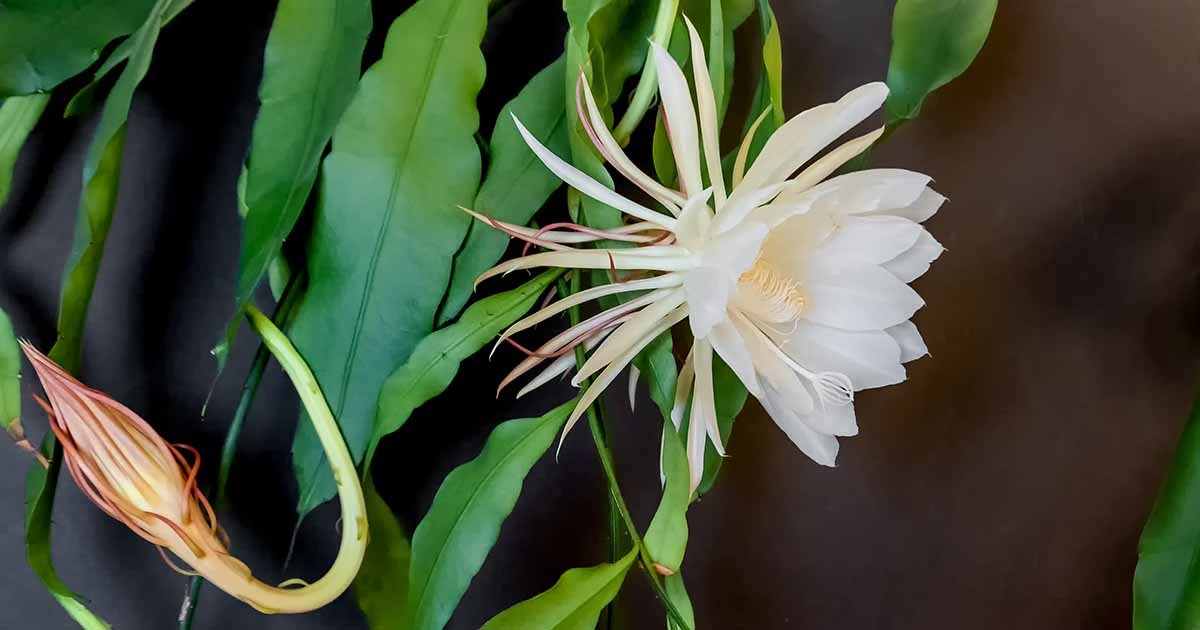
Humidity
In their natural habitats, ambient humidity would fulfill a portion of their moisture needs, so water vapor is an important element of the environment for these cacti.
Epiphyllums will be happiest in conditions with at least 50 percent humidity.
There are a few different ways you can increase relative humidity, if needed. Misting the foliage with water from a spray bottle is an easy, low budget way to start.
Another method is to situate your houseplants in groupings to create a more humid microclimate.
Finally, if you want to step up your efforts a bit, using a humidifier near orchid cacti is an excellent way to help raise relative humidity.
Fertilizing
Starting about a month after flowering, begin fertilizing your orchid cactus with a gentle, balanced fertilizer to encourage foliage growth.
Young orchid cacti that are not expected to bloom can be fertilized this way starting a bit earlier, in early spring.
Dr. Earth’s Pump and Grow Indoor House Plant Food is a gentle fertilizer with a ratio of 1-1-1 (NPK) that will help nourish the cactus and encourage foliage growth.

Dr. Earth’s Pump and Grow Indoor House Plant Food
You’ll find a 16-ounce pump container of Dr. Earth’s Pump and Grow Indoor House Plant Food available for purchase at Arbico Organics.
This or a similar product can be applied every two weeks from spring through autumn.
And to encourage blooming, switch to a low-nitrogen fertilizer in late autumn, then stop fertilizing during winter.
Be sure to follow the manufacturer’s instructions for application.
Any fertilizers with NPK ratios higher than 10-10-10 should be diluted.
Species and Cultivars
Choosing which type of epiphyllum to grow is lots of fun – there are so many choices!
Epiphyllums are sold as potted plants, rooted cuttings, or unrooted cuttings.

Some nurseries sell specimens that have been identified by their species or cultivar name, while others may just offer selections labeled as “white,” “yellow,” or “red,” in reference to bloom colors.
Now, let’s start looking at a few options!
Ackermannii
Commonly known as “red orchid cactus,” Disocactus ackermannii was formerly classified as an Epiphyllum species.
It’s still commonly referred to as E. ackermannii, which is considered a synonym.
This spring-blooming species bears red flowers that reach up to six inches across, remaining on the plant for a few days.
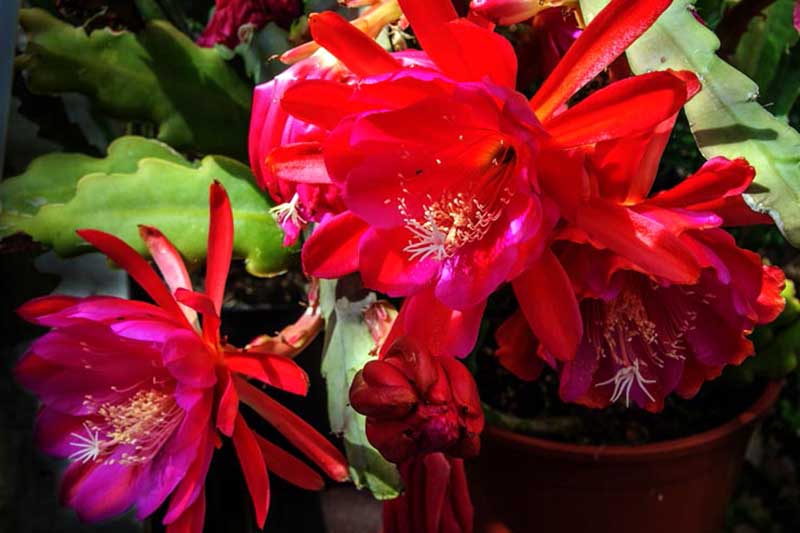
Stems range from seven inches to three feet long and have prominent veins and undulating margins.
D. ackermannii received the Royal Horticultural Society’s Award of Garden Merit in 2012.
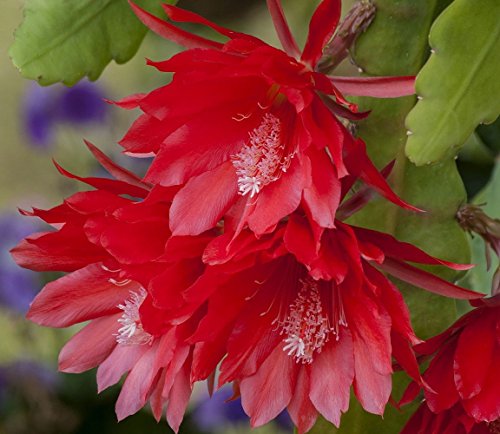
D. Ackermannii Red Orchid Cactus
You’ll find red-flowered D. ackermannii plants in six-inch pots available from Hirt’s Gardens Store via Amazon.
Fishbone
Disocactus anguliger, formerly classified as Epiphyllum anguliger is also known as zig zag or ric rac cactus.
This epiphyte grows up to 18 inches tall and 36 inches wide with unique zig-zagging stems that trail out of hanging baskets or over the sides of pots.
It features large yellow and white flowers that are trumpet-shaped with elongated, funnel-shaped petals.
Learn more about growing fishbone cactus here.
Guatemalense
Commonly known as “curly locks orchid cactus,” this naturally occurring subspecies has undulating stems that look like big, wavy locks of hair on older specimens.
Stems have a prominent midvein.
Classified as Epiphyllum hookeri ssp. guatemalense but also sometimes as E. guatemalense, this member of the Epiphyllum genus produces white blooms.
This variety is also sometimes called “curly sue” or Epiphyllum guatemalense ‘Monstrose.’
Oxypetalum
“Queen of the night” is the common name for the most well-known member of the Epiphyllum genus, E. oxypetalum.
This orchid cactus species, also known as “Dutchman’s pipe cactus,” has funnel-shaped, night-blooming flowers that can reach over seven inches wide.

The showy, fragrant blooms are white with gold sepals, and are short-lived, lasting one night only.
E. oxypetalum has stems that can reach up to 10 feet or more.
This species is also known as “lady of the night,” and “night-blooming cereus.” It shares those two names, as well as “queen of the night” with a few types of desert cacti that are members of the Cereus genus, such as C. peruvianus.
You’ll want to be sure you choose the right “queen of the night” for your purposes, since these two types of cacti have different care needs.
You’ll find a queen of the night epiphyllum in two-gallon pots available from Planet Desert.
Maintenance
In general, species plants bloom in the spring, while hybrids bloom in summer or fall.
Epiphyllums can take between three and seven years to produce blooms, depending on the species or cultivar and the growing conditions.

There are several steps you can take to encourage blooming.
First, make sure the cactus is in an appropriately sized pot.
For epiphyllums to set blooms, they need to have enough light. Exposing plants to some direct sunlight in the morning will encourage blooming.

