


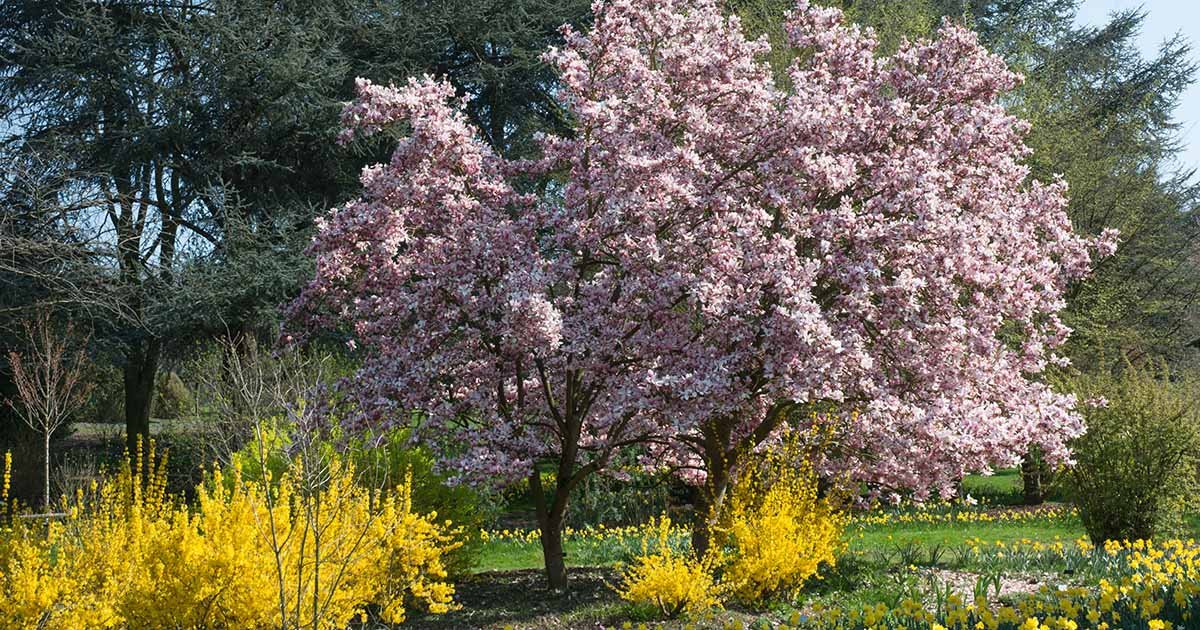
16. Hellebore
Hellebore, Helleborus spp., is a large genus of winter- to spring-blooming flowers known best for their nodding heads and ability to bloom even in the snow.
Colors range from pinks and purples to whites, yellows, and greens. There may be a single row of sepals or an additional inner row of petals, as in varieties known as “doubles.”

Foliage is deeply divided in palmate (radiating), or pedate (foot-like) fashion. It ranges from deciduous, matte, soft-textured, light green leaves to evergreen, shiny, leathery, dark green leaves.
Hellebore thrives in part to full shade with organically rich, well-draining soil that has a neutral to slightly alkaline pH.
There are six classifications of hellebores encompassing approximately 20 species.
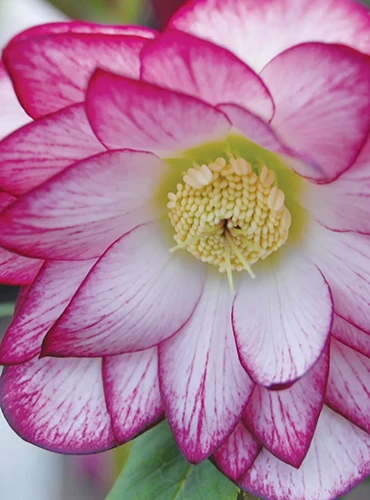
Winter Jewels® ‘Peppermint Ice’
Heights range from 12 to 18 inches, making it suitable for mid-bed or border placements. It also looks lovely in a drift all its own.
Hellebore exhibits exceptional winter hardiness and frost tolerance in Zones 4 to 9.
Find Winter Jewels® ‘Peppermint Ice’ plants now from Burpee. This is a double pale pink and white variety with dark pink edges called “picotee.”
Learn how to grow hellebores here.
17. Pigsqueak
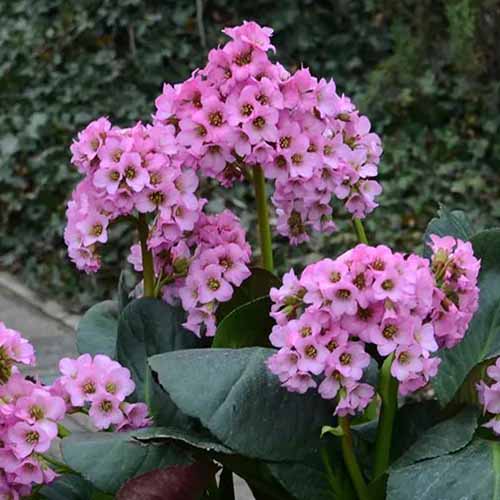
Pigsqueak, Bergenia cordifolia, has panicles, or drooping clusters, of dark pink blossoms.
The leaves are shiny, leathery, and heart-shaped, and arranged in rosettes. They squeak if you rub them, hence the name.

New spring growth has red stems, and the foliage is evergreen, deepening to burgundy in the fall.
This is a ground-covering plant that grows in dense clumps from seeds or fleshy rhizomes.
It’s taller than most, topping out at 12 to 18 inches. Give it room to roam on sloped areas where it can both beautify the landscape and inhibit erosion at the same time.
Cultivate in full to part shade with average soil, a slightly acidic to neutral pH, and good drainage. Pigsqueak thrives in Zones 3 to 8.
See our article on flowering ground covers for other seasonal bloomers.
Find pigsqueak plants now from Nature Hills Nursery.
Read more about growing bergenia here.
Shrubs
Early shrubs contribute much to the season’s watercolor look, with sensual blossoms in soft hues.
Here are some glorious plants for that mid-space between the canopy of trees budding above, and the blooming bulbs and perennials below.
18. Dwarf Flowering Almond
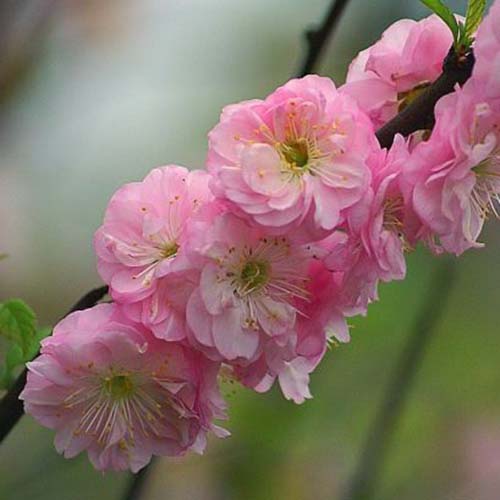
Dwarf flowering almond, Prunus glandulosa, has abundant pink to white single- or double-petal blossoms along its many stems.
After blooming, serrated light green deciduous leaves appear.

This shrub does best in full sun to partial shade with organically rich soil that drains well. The pH may vary from slightly acidic to neutral.
Perhaps the most noteworthy cultivar is ‘Rosea Plea,’ aka ‘Sinensis.’
It is a pink double variety with the freeform shape and four- to five-foot height typical of the species.
For your best chance of success, cultivate this shrub in Zones 4 to 8.
Find ‘Rosea Plena’ plants now from Nature Hills Nursery.
19. Flowering Quince
Flowering quince, Chaenomeles speciosa, is a large deciduous shrub that bears small yellow-green edible fruit that you may like to make into jam, jelly, or preserves.
The blossoms are similar to those of a cherry tree, and have salmon-pink to red single or double petals.
The foliage consists of shiny, oval leaves that appear as the flowers drop. The branches are dense and often thorny.

There are varieties suitable for Zones 4 to 9. Provide full sun to part shade, with average, acidic soil that drains well.
The overall shape tends to be rounded. Average heights are between six and 10 feet. Best uses include hedging and stand-alone plantings.
‘Scarlet Storm’ is a particularly attractive variety with double-petal dark crimson flowers that bloom on four- to five-foot shrubs. This cultivar has no thorns.
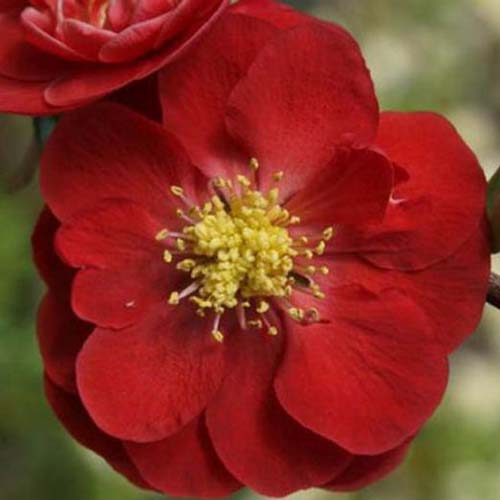
Find Double Take™ ‘Scarlet Storm’ quince plants now from Nature Hills Nursery. Choose from a sprinter (starter) pot, quart container, or #3 container.
Read more about growing flowering quince here.
20. Forsythia
Forsythia, Forsythia x intermedia, aka border forsythia, is a tall, deciduous shrub with slender, arching branches dotted with yellow blossoms.
Flowers spring directly from the stems, nodding their star-shaped yellow heads before most other blooms have awakened.

Narrow elliptical leaves sometimes appear before the flowers fall.
Best suited to Zones 5 to 8, forsythia grows to a mature height of eight to 10 feet, with a slightly rounded shape. The leaves may turn bronze in the fall.
You can use this plant for hedging. Prune it to the height of your choice, or leave it to its own devices.
Or, give it room to spread its arching branches like fountains of yellow in a large drift of its own.
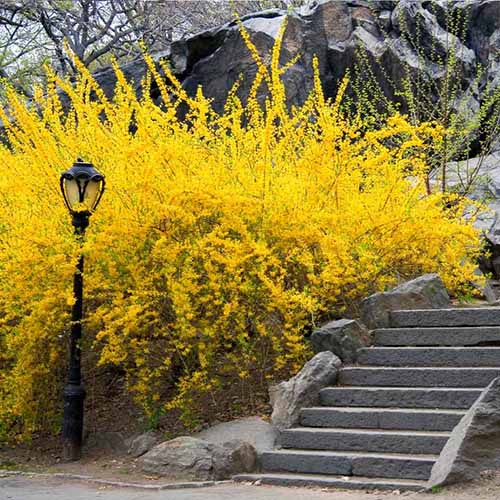
It’s also attractive lining walkways and fences, especially with bright bulbs and perennials in the foreground.
Find forsythia plants now from Fast Growing Trees in one-, two-, and three-gallon pots.
Read more about growing forsythia here.
21. Fothergilla
Fothergilla, Fothergilla x intermedia, has sweetly scented white flowers that resemble bottle brushes.
The foliage consists of small, elliptical leaves with prominent diagonal veining.

To grow this plant, select a full sun to part shade location. The soil should be acidic, organically rich, and well-draining.
Fothergilla varieties vary in height. Some dwarf types grow three to five feet tall, while larger ones can reach six to 10 feet at maturity.
Most varieties are suitable for growing in Zones 4 to 8.
In addition to the pretty flowers, fothergilla provides lovely fall color in shades of orange, red, and yellow.
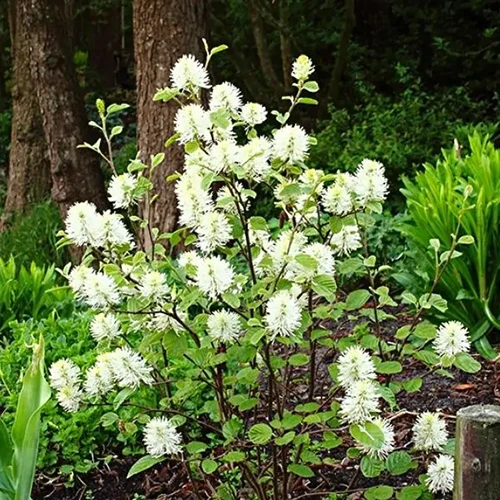
The ‘Mount Airy’ cultivar is an early type best suited to Zones 5 to 8.
It reaches a height of three to five feet at maturity. Use it for loose hedging along walkways, fences, and property perimeters.
Place it in the back of beds with bulbs and perennials in the foreground.
Find ‘Mount Airy’ in #3 containers from Nature Hills Nursery.
Find more tips on fothergilla care here.
22. Japanese Camellia
Japanese camellia, Camellia japonica, aka the rose of winter, has flowers that resemble flouncy, cottage garden English roses.
It comes in shades of pink, purple, red, white, and yellow. The smooth, shiny, oval foliage is evergreen in Zones 7 to 9, where it grows best.

For cultivation, provide a location with part to full shade that is sheltered from strong winds. The soil should be acidic, organically rich, and well-draining.
There are numerous cultivars with mature heights ranging from seven to 12 feet tall. The Japanese varieties grow a bit more slowly than other types.
One you may like is ‘Korean Fire.’ It has rose-red flowers and tops out at 10 to 12 feet tall.
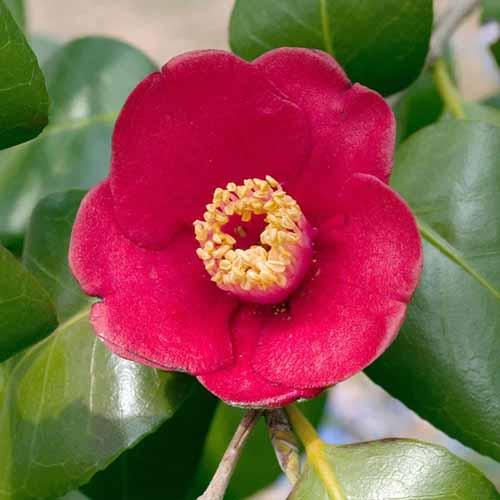
Find ‘Korean Fire’ plants now from Fast Growing Trees in one-gallon pots.
Learn more about growing camellia here.
23. Korean Spice Viburnum
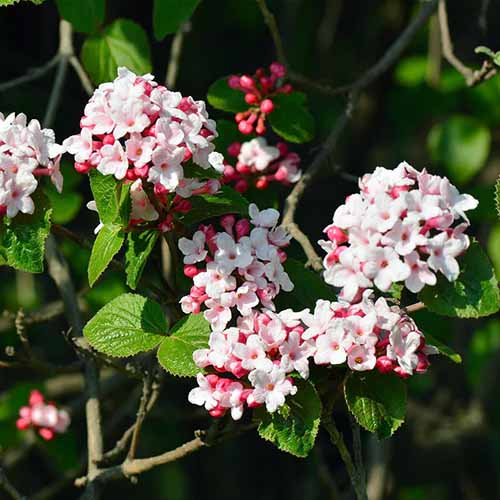
Korean spice viburnum, Viburnum carlesii, has reddish buds that open to showy, rounded clusters of tiny white flowers, similar to those of hydrangea.
They have a spicy scent.

The foliage consists of elliptical leaves with prominent veining, sometimes tinged with red. They deepen to a delightful bronze color in fall.
To grow viburnum, choose a site in full sun to part shade with average, slightly alkaline soil that drains well.
With a mature height of four to six feet, these plants thrive in Zones 4 to 7.
You are likely to come across named cultivars and unnamed, “generic” varieties as you shop.
Find Korean spice viburnum plants now from Fast Growing Trees in three-gallon containers.
Check out our guide to growing viburnum here.
24. Pussy Willow
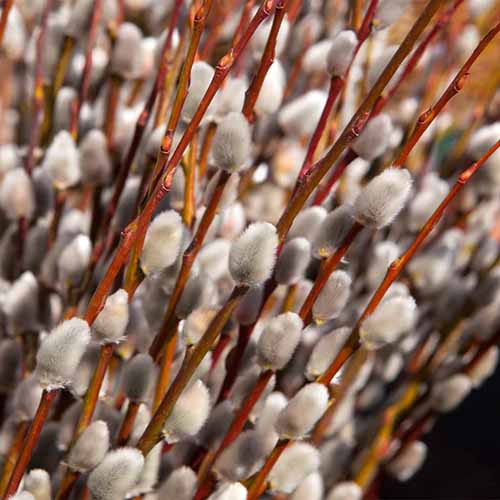
Pussy willow, Salix caprea, can grow as a shrub or a small tree. The long, bare stems of male plants bear furry gray and white catkins for intriguing early season interest.

Find a spot with full sun to part shade for growing pussy willow. I had a beautiful small tree at one time, on the south side of my house.
It provided me with armloads of long stems for stunning floral arrangements.
Pussy willow reaches a mature height of 15 to 25 feet tall. By trimming the new canes (fresh spring stems) each year, I was able to maintain a manageable size.
To grow as a tree, trim away the side branches to establish a trunk. Plant bulbs and perennials around your tree for a pleasing focal point.
For cultivation as a bush, allow the lower branches to remain. This is a useful option for property perimeter plantings, hedgerows, or specimen planting in an island bed of its own.
Pussy willow requires soil that is acidic, organically rich, and well-draining. It thrives best in Zones 4 to 8, where it grows quickly.
In addition to Salix caprea, there’s a North American native variety, Salix discolor, with smaller flowers.
Find pussy willow plants now from Fast Growing Trees in a variety of sizes.
Learn about growing pussy willow here.
25. Spring Heath
Spring heath, Erica x darleyensis, is also known as winter heath.
It’s an evergreen ground cover with multiple overlapping stems that bear rows of tiny bright pink to red cylindrical flowers. The foliage consists of bright green needles.

Spring heath prefers full sun and organically rich, well-draining, acidic soil. However, it has a high tolerance for poor acidic soil, as well.
Heights range from 12 to 15 inches tall at maturity.

