


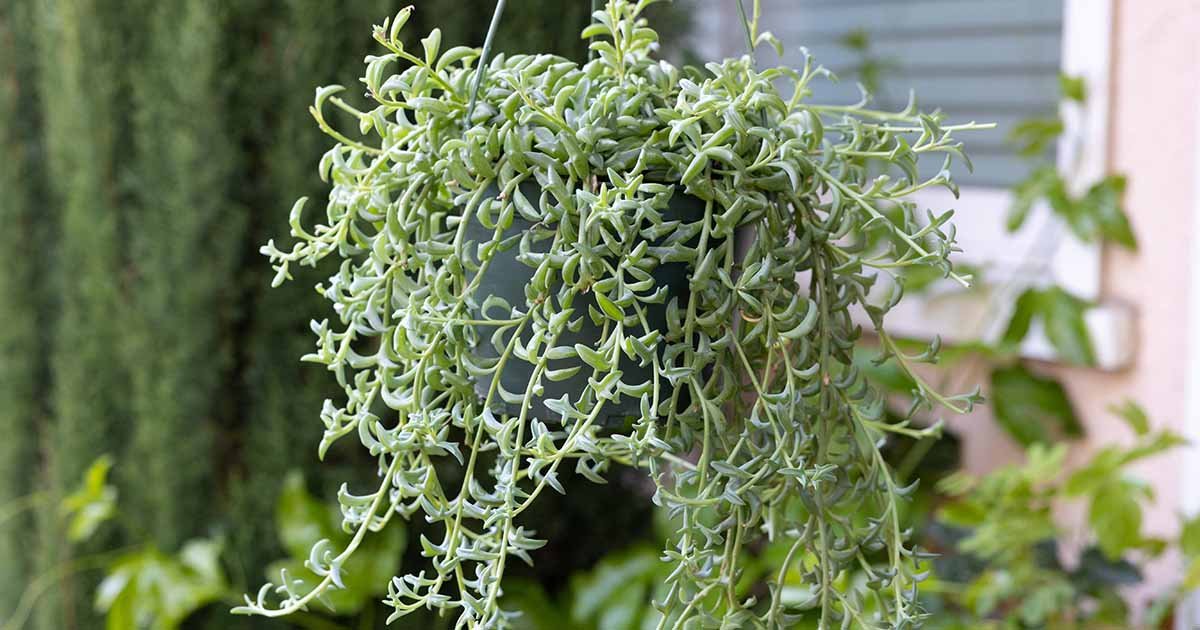
How to Grow
The key to success with any plant is to understand its cultural requirements as determined by its native environment, and to try to replicate them at home.

In this case, we have a succulent that does not grow in the wild, and so we should consider the requirements of the parents from which it originates.
Climate
As a hybrid of two succulent species native to the South African Cape Province region, string of dolphins is genetically wired for hot, dry summers and wet, mild winters.
An average home environment with temperatures of 60 to 80°F and humidity in the 30- to 50-percent range is suitable.
This is a frost-tender hybrid that declines with cold temperatures.
If yours vacations outdoors in the summer, be sure to bring it back inside before the nights dip into the 50s, well before the first frost.
Light
Indoors, x B. delphinatifolius requires bright, indirect sunlight for effective photosynthesis, the process of converting light to energy that keeps foliage vibrant.

A position about three feet from a south- or east-facing window is ideal. Avoid direct exposure that can scorch the foliage.
If you like to place your plants outdoors in the summer, choose a location with full sun to part shade for optimal health.
Soil
As with many types of succulents, string of dolphins prefers slightly acidic to neutral soil with a pH between 6.5 and 7.0.
It should be gritty for fast drainage. A cactus and succulent mix is the best choice for houseplant cultivation.
Hoffman Organic Cactus and Succulent Soil blends compost, peat moss, and sand with limestone for the appropriate pH balance, resulting in a slightly acidic, rapidly draining substrate.

Hoffman Organic Cactus and Succulent Soil
Hoffman Organic Cactus and Succulent Soil is available from Hoffman via Amazon.
Water
Use the “soak and dry” method of watering for best results. Allow the soil to dry out completely before thoroughly saturating it with water.
Moisture needs are greatest during the spring and summer growing season, during fall and winter dormancy you’ll need to water less often.
Fertilizer
It’s not necessary to fertilize and overfeeding can cause the dolphin-like foliage to become misshapen.
If you choose to feed, apply a balanced liquid succulent fertilizer at a quarter strength once a month during the spring and summer months.
A product like Dr. Earth Succulence is ideal. It’s mild, with an NPK ratio of 1-1-2, formulated for succulents.

You can find Dr. Earth Succulence in 16-ounce bottles available at Arbico Organics.
Where to Buy
While it is not one of the more common succulents, you are likely to find x B. delphinatifolius available from specialty nurseries and those that carry a wide selection of succulents.

Find string of dolphins in four- and six-inch starter pots, and bare root specimens available at Planet Desert.
Maintenance
The stems of a dolphin succulent grow rapidly.
If you find they are getting “leggy,” with longer spaces than usual between the leaves, you can prune to promote more compact, branching growth.

Use clean shears to cut just below a leaf node to stimulate lateral growth from that point. You may want to use the cutting to propagate new plants as discussed below.
Repotting is an infrequent maintenance task best done during dormancy in late winter to early spring.
When the roots protrude from the drainage hole, or there is no longer an inch of space between the foliage and pot rim for easy watering, select a pot one size larger than the current vessel.
Do not water the day before repotting. You’ll want the soil dry so you can loosen and remove most of it before replanting in fresh cactus and succulent potting mix.
Fill the bottom third of the new container with soil. Settle the root mass in the pot at the original depth.

