


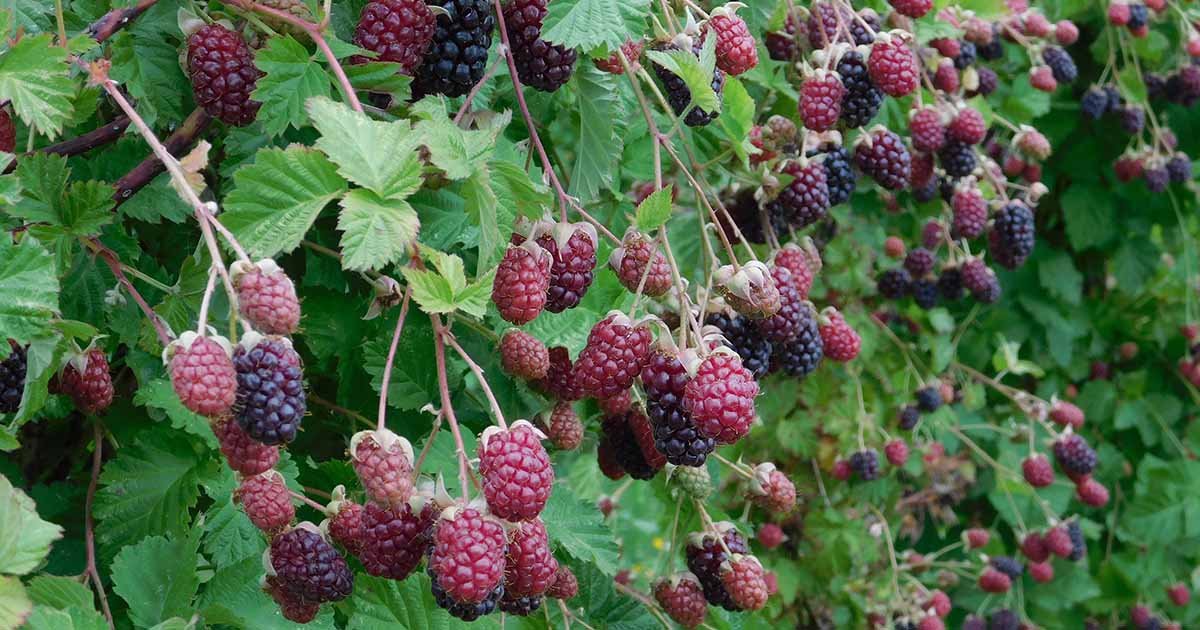
Rubus x ‘Marion’
If you ever visit Oregon, be prepared to fall in love with the local hero: the marionberry. It’s everywhere.
At every restaurant, grocery store, and tourist shop.
In the summer, when the 33 million-plus pounds of local marionberries are ripening, Oregonians are stuffing their faces with cobbler, pie, ice cream, beer, and shakes.
It’s not just Oregon that’s enraptured. The marionberry is arguably the most popular trailing blackberry in the world, and for good reason.
The berries are big and juicy, with an earthy berry sweetness that is ideal for just about any dish. Locals call it the “cabernet of blackberries.”
Technically, the name is Rubus x ‘Marion’ but you’ll see it styled as “marionberry” and “marion berry.”

We link to vendors to help you find relevant products. If you buy from one of our links, we may earn a commission.
However it is spelled, this blackberry cultivar somehow improves on the luscious flavor of the original fruit. It’s a bit like a blend between a raspberry and a blackberry.
Because the fruit is juicy and soft, it’s almost impossible to find sold fresh outside of the state of Oregon.
Most marionberries are shipped frozen or processed. So what do you do if you crave the sweet zing of the fresh fruits? Grow your own!
That’s exactly what we’re about to help you do, and here’s what we’ll talk about to that end:
The marionberry is a hybrid of two types of blackberry: the Chehalem and the Olallie berry.
These berries are hybrids themselves, with a bit of the North American native berry Rubus ursinus, some of the highly invasive Himalayan blackberry (R. armeniacus) and a dash of red raspberry (R. idaeus).

To be specific, the marionberry has 44 percent of R. ursinus, 25 percent of R. armeniacus, and six percent of R. idaeus in its genetic makeup.
Don’t worry, it’s not potentially invasive like the Himalayan blackberry.
There are no escaped marionberries in Oregon, and that’s because they don’t grow from seed and they don’t propagate from the buds on the roots like Himalayan blackberries do.
Quick Look
Common name(s): Marion, marionberry
Plant type: Trailing perennial cane berry
Hardiness (USDA Zone): 6-9
Native to: Oregon
Bloom time / season: Summer bearing
Exposure: Full sun
Soil type: Slightly sandy to slightly clay, well-draining
Soil pH: 5.6-6.5, slightly acidic
Time to maturity: 2 years
Spacing: 4 feet
Mature size: 20 feet long by one foot tall (without support)
Water Needs: Moderate
Taxonomy
Order: Rosales
Family: Rosaceae
Genus: Rubus x
Cultivar: ‘Marion’
The marionberry was bred by Oregon State University agricultural scientist Dr. George Waldo in Corvallis, Oregon, in 1948.
Corvallis, by the way, is in Marion County, which is where the berry derives its name. That’s right, it has no relation to the famous former Washington D.C. mayor Marion Barry.
It was released to the public in 1956 in cooperation with the USDA Agricultural Research Service and quickly rocketed to stardom in the state.

Marion County still produces 90 percent of the world’s crops, and if you visit Corvallis in August, you’ll be surrounded by more marionberry goodness than you thought possible.
The flavor is earthy, sweet, with just a bit of tang, the seeds are tiny, and the receptacle is narrow.

