


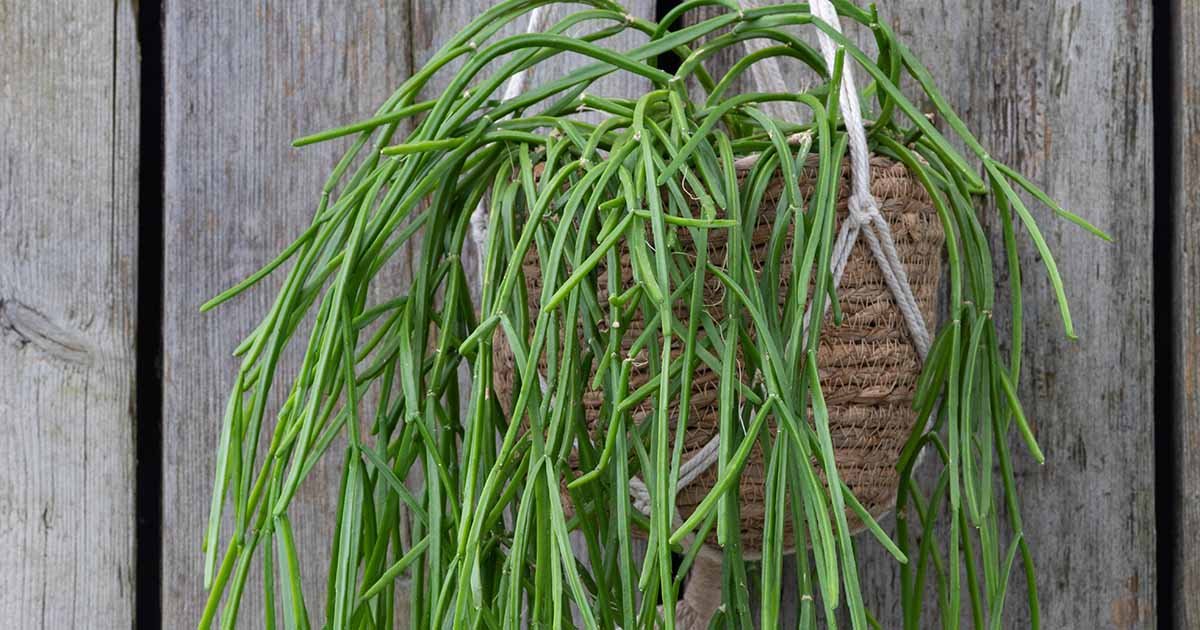
Rhipsalis baccifera
Mistletoe cactus (Rhipsalis baccifera) is an epiphytic stem succulent with a branching growth habit that clings to rocks or trees for support in the wild.
R. baccifera is not only an unusual looking cactus; it’s the only one with native habitat outside the Americas.
It’s endemic to the Caribbean, Central and South America, Madagascar, Southern Africa, and Sri Lanka. It is also considered an endangered species in southern Florida.

We link to vendors to help you find relevant products. If you buy from one of our links, we may earn a commission.
Mistletoe cactus, aka spaghetti cactus is named for the white to pinkish berries that bear some resemblance to the festive holiday foliage that has become synonymous with a Christmas kiss.
However, the similarity ends there.
Christmas mistletoe (Viscum and Phoradendron species) is a toxic, leathery-leafed parasite with a rounded form that grows on host trees, depriving them of water and food.
Mistletoe cactus features string-like, leafless, cylindrical stems called cladodes, usually green but shading to red in harsh sunlight.
Read on for all you need to know to enjoy this unique cactus indoors as a houseplant.
Here’s what we’ll cover:
The stems are segmented and angular, yet they cascade gracefully.
At each stem joint and tip, small greenish-white flowers bloom in late winter to early spring, followed by translucent white berries.
Mature dimensions are 48 to 72 inches long and 12 to 24 inches wide, for a substantial specimen that shows well in hanging planters.
Quick Look
Common name(s): Mistletoe cactus, spaghetti cactus
Plant type: Epiphytic cactus
Hardiness (USDA Zone): 9-11 (outdoors)
Native to: Caribbean, Central and South America, Madagascar, Southern Africa, Southern Florida, Sri Lanka
Bloom time / season: Late winter to spring
Exposure: Bright, indirect sunlight indoors; dappled sunlight outdoors
Soil type: Cactus and succulent soil plus coconut coir chips; sandy loam outdoors, well-draining
Soil pH: 6.0-7.0, slightly acidic to neutral
Mature size: 48-72 inches long by 12-24 inches wide
Best uses: Hanging planter, houseplant
Taxonomy
Order: Caryophyllales
Family: Cactaceae
Genus: Rhipsalis
Species: Baccifera
There is also a naturally occurring subspecies, mouse tail cactus, R. baccifera subsp. horrida.
This one has shorter, thicker stems with spines, similar fruits, yellowish, white, or greenish flowers, and an average length of about 20 inches.
Another plant you may encounter is red mistletoe cactus, Pseudorhipsalis ramulosa, formerly Rhipsalis ramulosa.

The red species co-evolved with our subject plant, but it has characteristics distinct enough to warrant classification in a separate genus.
Its flattened, ribbon-like green stems turn red in direct sunlight. Whitish-green flowers appear along the stem margins, followed by red berries.
Cultural requirements are similar for all three of these plants.
How to Grow
Mistletoe cactus is native to rainforest regions and accustomed to temperatures in the 60 to 80°F range. Unlike desert cacti, it thrives in regions with high humidity.

