


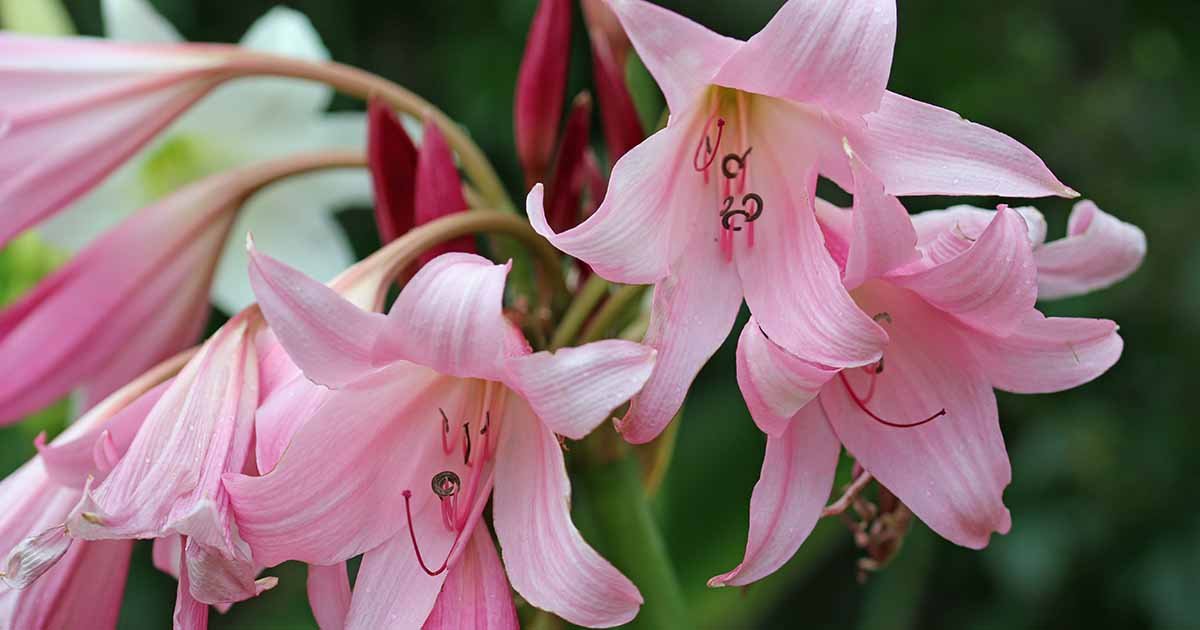
Crinum spp.
With large, showy flowers and a sweetly spicy scent, crinum lilies (Crinum spp.) are sensational for adding dramatic flair to many garden settings!
Each bulb offers two or three successive flower scapes, and each scape is topped in generous umbels that develop handsome trumpet-shaped blooms.
Colors are mostly in reddish tones such as apricot, burgundy, mauve, pink, scarlet, and white.
While each flower has a short life of only a couple of days, mature bulbs produce heavily laden umbels that bloom for weeks!

We link to vendors to help you find relevant products. If you buy from one of our links, we may earn a commission.
Tough and low-maintenance, the robust bulbs develop large roots that regularly produce offsets, creating impressive stands of glossy green strappy foliage with multiple flower scapes.
Plants are long-lived perennials in mild climates, and when grown undisturbed, can last for generations. Some develop jumbo-sized bulbs that weigh as much as 20 pounds!
Outside of their hardiness range, crinum lilies can be enjoyed in large containers and moved into a sheltered spot protected from winter cold.
Does your garden need a splash of these striking, perfumed blooms? Then let’s uncover how to grow and care for crinum lilies!
Here’s what’s up ahead:
Members of the Amaryllis family with over 100 species, crinum lilies are long-lived perennial bulbs, but they are not true lilies.
They are known by several other common names including cemetery plant and cape, spider, or swamp lily.

Native to Africa, the Americas, Asia, and Australia, Crinum species are prized for the large and perfumed blooms that flower mostly in summer and into fall, although some open in mid or late spring.
Quick Look
Common name(s): Crinum lily, cemetery plant, cape, spider, or swamp lily.
Plant type: Perennial flowering bulb
Hardiness (USDA Zone): 7-11
Native to: Africa, Asia, Australia, and the Americas
Bloom time / season: Summer
Exposure: Full sun
Soil type: Organically-rich, well draining
Soil pH: 6.0-7.0, slightly acidic to neutral
Time to maturity: 2-3 years for flowers
Mature size: 3-4 feet tall by 2-7 feet wide (depending on species)
Best uses: Containers, foundations, mass plantings, erosion control, and coastal or water gardens
Taxonomy
Order: Asparagales
Family: Amaryllidaceae
Genus: Crinum
Species: Americanum, x amibile, asiaticum, bulbispermum, x powellii, mooreii
The spreading clumps of long, lush foliage spread two to seven feet and scapes reach three to four feet tall, depending on the variety.
Many species and cultivars sport large, funnel-like blooms. However, some varieties like the spider lily (C. asiaticum) feature distinctively thin, wispy petals.

Hardy in Zones 7 to 11, all varieties thrive in full sun to partial shade and are highly adaptable to a range of soil conditions.
As the bulbs grow they also spread via offsets or “pups,” reliably developing into robust clumps with decent drought tolerance.
Exuding laid back elegance, crinum lilies are dependable garden performers that add eye-catching appeal to beds, borders, and containers or massed into drifts.
And they’re a stellar choice for erosion control on banks or hills with the boisterous bulbs and large roots perfect for soil stabilization.

Some species, including varieties of the popular starry-flowered native swamp lily (C. americanum), are well-suited for growth in aquatic locations with still waters or wet soil conditions, such as bogs, creek banks, marshes, pond edges, and swamps.

