


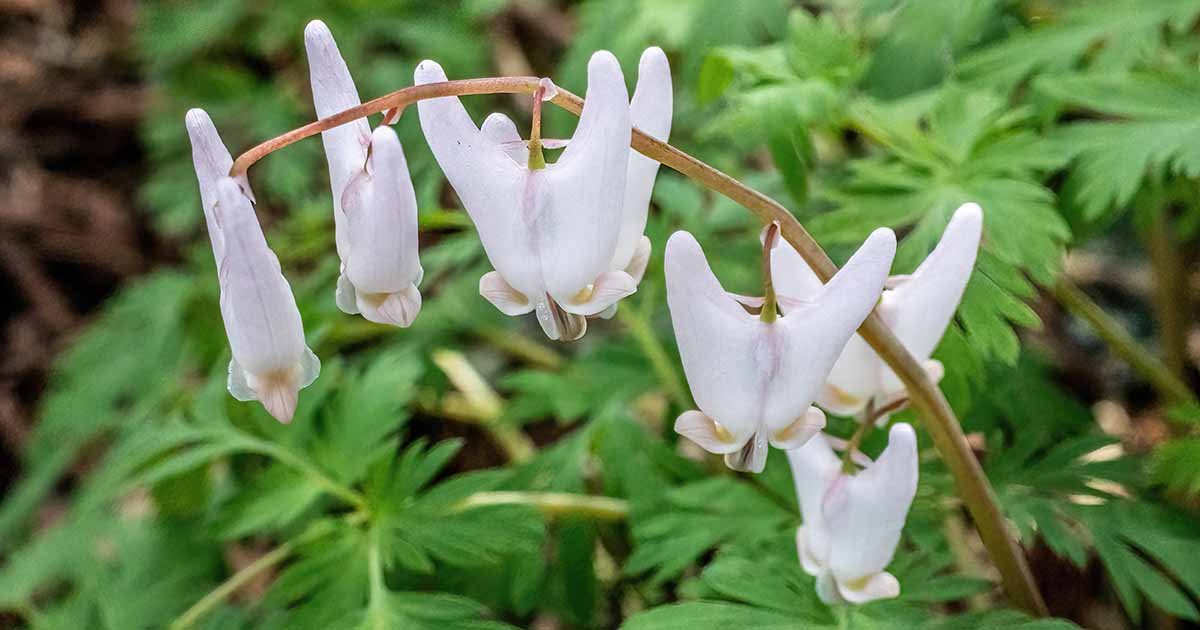
Water
These wildflowers are accustomed to consistent moisture and need the same in cultivation.
Provide an inch of water per week, including rain, beginning in early spring when the first leaves sprout.

Water over the soil and not the leaves to avoid prolonged moisture that may promote fungal disease.
Dutchman’s breeches is not drought tolerant and will fail to thrive without even moisture. In the event of a dry spell, use a moisture meter and water when the top inch of soil is dry.
You can discontinue watering after the plant has finished flowering, when the foliage withers and fades away.
Fertilizer
Dutchman’s breeches plants thrive in the nutrient-rich humus of the forest floor.
No fertilizer is needed for wildflowers grown in fertile soil in the appropriate Zones. Feeding plants unnecessarily may result in leggy stems and poor blooming.
Where to Buy
When shopping for Dutchman’s breeches, you may find potted specimens at local native plant sales. Online, seeds and dormant bare roots are readily available.
Seed packets should bear the current growing season’s date.

These from Everwilde Farms are packed fresh in resealable gold foil packets for optional long-term storage.
Dutchman’s breeches seeds are available from Everwilde Farms via Amazon.
Maintenance
Other than maintaining even moisture, there is little to do to care for D. cucullaria in the landscape.

Post-bloom, the foliage turns yellow and withers, fading away without the need for pruning or disposal.
If you have overcrowded colonies, naturalized clusters of Dutchman’s breeches plants, you can thin them during fall dormancy, as discussed below.
Propagation
To start, you’ll need seeds, dormant bare roots, divisions of existing specimens, or nursery starter plants. Let’s discuss.
From Seed
Direct sow seeds into the landscape in late summer to early fall. Seeds require winter cold-moist stratification and will sprout by the second spring after sowing.

Scatter several every six inches and barely cover them with soil.
Mist the soil lightly each day to keep it evenly moist but not soggy.
Alternatively, you can start seeds indoors in late summer to early fall, six months before the last spring frost date for your region.
Place the seeds in moist sand and maintain a consistent temperature of 80°F for 12 weeks, followed by 12 weeks at 40°F. If they fail to germinate, you may repeat the stratification process.
After stratification, sow one to three seeds in three-inch starter pots filled three-quarters full of sterile seed-starting soil.
Maintain even moisture without oversaturation.

