



In the garden, it’s easy to observe the beautiful flora above the soil line, but have you ever been curious about what’s happening below it?
With the right soil test kit, you’ll no longer have to wonder – you’ll know exactly what’s going on in terms of pH, nutritional makeup, and more!
If you’ve been in the gardening game for long enough, then I’m sure you know just how important soil is for the health and aesthetic success of plants.

We link to vendors to help you find relevant products. If you buy from one of our links, we may earn a commission.
When the soil is just what the (plant) doctor ordered, plants are that much more beautiful and robust.
But for plants sitting in subpar conditions, staying healthy and pretty can be a real uphill battle.
If your plant needs more from the medium that it sits in, then amending the soil is the first step.
Well, make that the second step, actually… Step numero uno is to actually know said soil. And what better way to do so than with a soil test kit?
In this roundup, we’ll cover a handful of the best soil test kits on the market. By the end, you’ll have more than enough information to choose the product that’s best for you!
Here’s the lineup, alphabetized for your browsing convenience:
11 of the Best Soil Test Kits
A decent amount of options, wouldn’t you say?
If selecting the best fit for your needs fills you with extreme paralysis-by-analysis, fear not! We’ve included a handy-dandy buying guide, which should help you out.
1. Garden Tutor pH Strips
For some gardeners, pH is all they care to know about. If you’re one of these folks, the Garden Tutor pH-measuring strips from Botaniworld are all you’ll need.
With 100 strips per bottle, you have enough materials to measure pH to your heart’s content.
Specifically calibrated for testing soil, each strip is capable of detecting a pH value within the 3.5 to 9.0 range.
Sporting three colored squares each, it’s easy to compare the results with a chart on the bottle’s exterior for easy pH value identification.
For the actual test, simply collect a representative soil sample, put it in a cup, add water, and dip a strip in.
Three seconds later, remove the strip, shake it up a bit, and presto! You’ll have the pH value within a minute.
Included with the strips is a 16-page pH testing handbook, which fills gardeners in on just how much lime or sulfur you need to apply to amend soil if you wish to attain a certain pH.
Speaking as a former plant science student who had to calculate this sort of thing as part of my homework, the inclusion of this handbook is a huge plus, trust me.
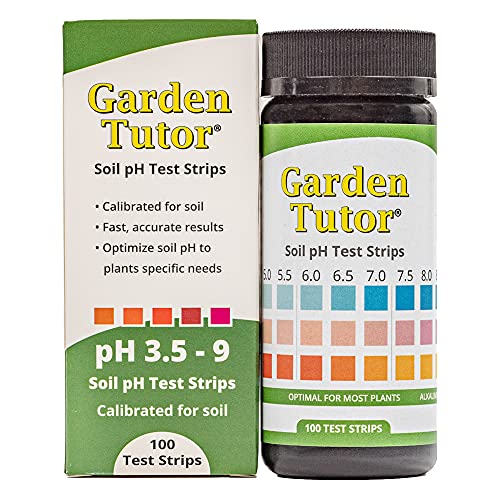
Having trouble telling exactly what colors your pH strip results are? No problem!
If you email a picture of your used pH strip to the good folks over at Garden Tutor, they’ll have a look-see and tell you exactly what your pH result is.
Not 100 percent satisfied with your order? If you return the product within 30 days of purchase, Botaniworld will refund your money in full, and even cover return shipping!
Find some strips for yourself at Amazon.
2. Garden Tutor Texture Jar and Handbook Kit
From the makers of the above pH strips comes a way of testing your soil’s texture! The Garden Tutor brand certainly knows how to keep rolling out the hits, that’s for sure.
It can be tough to quantify the exact proportion of sand, silt, and clay within a soil’s profile… at least, it used to be. Now, thanks to this product, it’s never been easier!
Fill the small plastic jar up to the fill line with soil, add some dishwasher detergent and water, put the lid on, then shake it all up.
In a few hours, your sample’s sand, silt, and clay particles will all be in separate, measurable layers.
From there, you can quickly determine its texture by punching your values into Garden Tutor’s helpful online calculator.
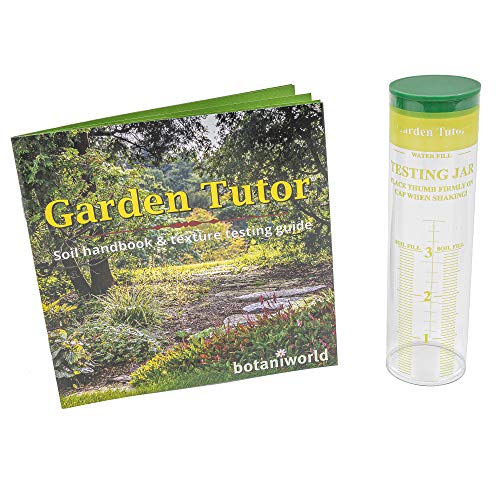
Garden Tutor Texture Jar and Handbook Kit
For guidance on what to do once you know your soil’s texture, the included 12-page healthy soil handbook gives you some pointers. I gotta say, these guys really put the “Tutor” in “Garden Tutor!”
Botaniworld offers the same return and refund policy for this product as they do for the above pH strips.
If you’re jonesing to know your soil texture, scratch that itch and make your purchase now on Amazon.
3. LaMotte Garden Guide Kit
Need to know a bit more than just the pH? Try this Garden Guide soil testing kit from LaMotte.
This kit allows you to not only find the pH within a 4.0 to 8.0 range, but it also allows you to determine whether your soil contains low, medium, or high quantities of nitrogen, phosphorus, and potassium.
At first glance, testing with this kit may look difficult and confusing, but don’t worry. The provided instructions will help you get a hang of the process, which only takes mere minutes to complete.
Once you have your values, the included color charts and three educational booklets – a Garden Guide Manual, a Study of Soil Science Handbook, and the LaMotte Soil Handbook – provide valuable insight on your results and what to do next.
The kit itself includes plastic test tubes with caps, pipettes, measuring spoons, and a test tube cleaning brush, along with enough testing material for 30 pH tests and 15 tests apiece for nitrogen, phosphorus, and potassium.
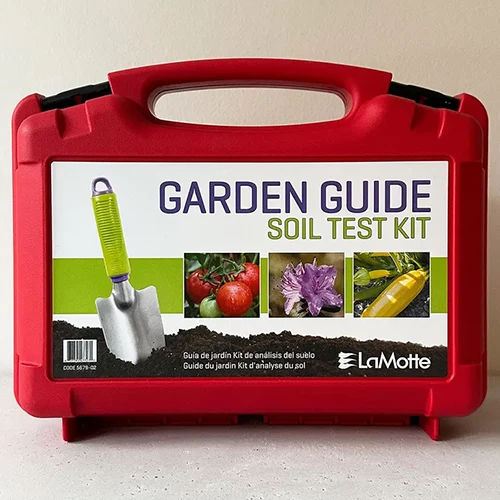
It all comes in an attractive and durable plastic case, secured with a wraparound zipper and easy to carry via a thin handle.
If you love the science lab look, then you’ll be overjoyed by the aesthetic of this kit.
Make sure to use the product safely and with caution, as it includes chemical reagents such as sodium acetate, hydrochloric acid, and acetic acid.
Interested in this kit? You can buy one today from Arbico Organics.
4. Luster Leaf 1602 Kit
Don’t want to treat your soil analysis like a science experiment? Fair enough.
If simplicity and convenience are what you’re looking for, then how about giving the Luster Leaf 1602 test kit a go?
With the Luster Leaf 1602, you can test for pH, nitrogen, phosphorus, and potassium – each test comes with its own patented color comparator system, and enough capsules for five tests each.
Depending on how quickly the soil settles, you could have results in minutes or within 24 hours.
At first glance, the lineup of these color-coded comparators with their assorted capsules may look more like a biohacker’s supplement regimen than something you’d use to test your flower beds.
But the contents of these capsules, when applied to the collected sample and mixed with water, will really help demystify the contents of your soil.
Once the soil sample settles, all you have to do is check it against the color comparison bars displayed next to the test chamber.
The pH can be measured from a scale of 4.5 to 7.5, while the NPK results are listed in the following terms: “Surplus,” “Sufficient,” “Adequate,” “Deficient,” and “Depleted.” Easy and effective!
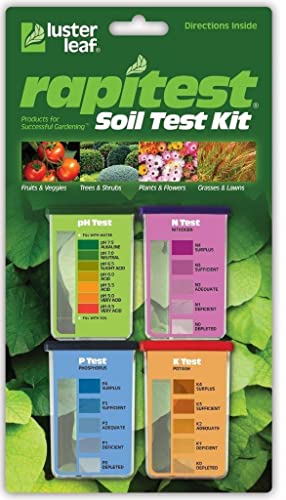
To make the process even easier, a pipette and testing instructions are included, along with a guide to the pH needs of 400-plus plants!
And this product also includes recommendations for amending the soil to boost nutrition and steer the pH level in the exact direction that you’d like.
Buy the Luster Leaf 1602 Kit in 20-test or 40-test quantities on Amazon.
5. Luster Leaf 1605 Digital Kit
It’s the 21st century, after all… so we might as well test our soil accordingly. And in the modern day, that means going digital.
With the Luster Leaf 1605 digital kit, no longer must you rely on the naked eye to glean results.
You collect and mix your sample similarly to how you would with the Luster Leaf 1602, but rather than compare its hue against an adjacent color comparator, you simply stick the container into the device’s Optical Soil Test Chamber.
From there, you hit the button for the metric you wish to check, and voila!
The Luster Leaf 1605, powered by three included coin cell 1.55-volt batteries, recognizes the hue and displays the result via an LED indicator light on the front of the device.
There’s less room for error with the digital version than there may be for 1602 users who opt to go analog.
Color-coded test tubes are included, one each for pH, N, P, and K. Five test capsules are included for each nutrient, and 10 for testing pH.
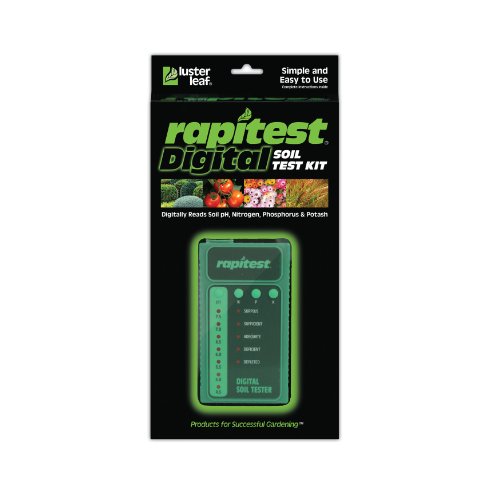
A pipette is also included, as well as a storage dock for keeping all the test tubes upright.
The product comes with instructions and a testing booklet, which simplify the entire process, provide amendment recommendations, and list the pH needs for hundreds of plants!
This product has a one-year warranty against manufacturing defects, and can be sent back to the folks at Luster Leaf for repair or replacement during this time.
Buy yours now on Amazon.
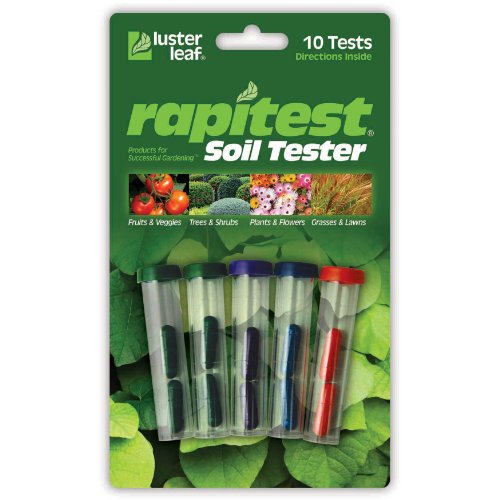
6. Luster Leaf Rapitest 1609CS
One of our most minimalist options, the Luster Leaf 1609CS Rapitest is perfect for when you need to complete a fast test solely in just one or two spots.
The product is pretty spartan – all that’s included is a color-coded test tube for pH, N, P, and K testing.
Four pH testing capsules are included, and two capsules for each of the key plant macronutrients.
After readying your samples in their respective tubes, simply compare them to the included color chart.
The pH can be measured in whole numbers in the 5.0 to 8.0 range, while each macronutrient receives a rating of “High,” “Medium,” “Low,” or “Very Low.”
Instructions are included that help with both the testing process and any necessary amendments afterwards.
The results of this test aren’t as specific as what’s provided by some of the other products in our roundup.
But if “approximate” is all you need, then the Luster Leaf 1609CS Rapitest is the perfect choice.
If this product meets your needs, then head on over to Amazon to pick one up.
7. Luster Leaf Professional Kit
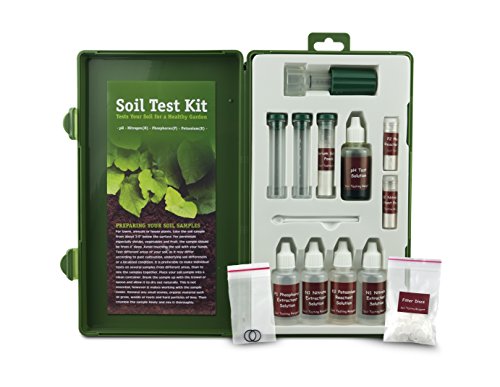
If you’re fond of the Luster Leaf brand, yet yearn for the lab-style chemical mixing and awesome plastic case included with the LaMotte kit, the ultimate soil-testing love-child of the two can be found in the Professional Kit from Luster Leaf.
Contained within its sturdy green case are plastic test tubes, filter discs, o-rings, a stirring stick, and the necessary chemical solutions for detecting pH levels and NPK concentrations with scientific precision.
Also included are simple, yet detailed instructions that provide more than enough info to use the kit effectively, as well as how to add amendments to the soil afterwards if necessary.
In typical Luster Leaf fashion, a list of plants and their preferred pH levels is provided, along with a general gardening guide.
This is a wonderful choice for those who want to cultivate their inner chemistry nerd alongside their green thumb!
Be careful to exercise caution, as the chemical reagents included with this kit are reactive and potentially dangerous.
Depending on the version you buy, the pH, N, P, and K can be checked a total of 10, 20, or 50 times.
You can buy a Professional Kit from Luster Leaf with 40, 80, or 200 total tests from Amazon.
8. MicroBiometer Professional Lab-Grade Kit
If Neil Armstrong ever got his hands on the microBIOMETER® professional lab-grade kit from Prolific Earth Sciences, he might utter something along the lines of, “one small step for a home gardener, one giant leap for home microbial biomass testing.”
Given their importance in the soil food web, certain microbes are an insightful indicator of soil health.
Before this product was available, analyzing your soil’s microbial content was a difficult, slow, and expensive process, and one that usually required a laboratory.
But now, checking for microbial populations is easy, quick, and (relatively) inexpensive.
The kit comes with a plethora of scientific testing paraphernalia, from extraction vials to reagent packets.
After checking a sample of compost or garden soil, you’ll find its total microbial biomass, the biomass ratio of fungi to bacteria, and how both stack up to the average values that Prolific Earth Sciences has collected from hundreds of test results.

MicroBiometer Professional Lab-Grade
These results indicate just how your gardening practices are impacting your soil biomass – for better or worse. Included results cards will make documentation a cinch.
There’s an app for everything these days, and the microBIOMETER® is no exception.
With the app you can scan your results and upload them to the cloud, which can help you monitor the progression of your site’s microbial biomass over time.
The product comes with enough material for 10 microbial analyses, and can be purchased from Amazon.
9. MySoil Kit
There’s wisdom in leaving comprehensive soil analyses to the professionals, but gardeners can be a very DIY bunch.
The MySoil® kit offers the perfect blend of doing it yourself and relying on experts.
After registering your product, simply follow the instructions and place your sample in the provided container.
From there, use the prepaid shipping envelope to mail your sample back to the folks at Predictive Nutrient Solutions Inc., who will have your results available online in six to eight days.
If you ever get stuck, a dedicated customer support team has your back every step of the way.
The results are very comprehensive.
Along with pH and NPK, you’ll find out your sample’s concentration of nine micronutrients: calcium, magnesium, sulfur, iron, manganese, boron, copper, zinc, and sodium.
On top of all that, you’ll receive tailored fertilizer recommendations, both organic and synthetic.

If you second-guess your own soil-testing abilities, then having someone else complete the analysis for you will definitely take the pressure off… while still providing answers!
And this kit provides a look at micronutrients in the soil that many other tests don’t.
This bad boy is available on Amazon.
10. SoilKit
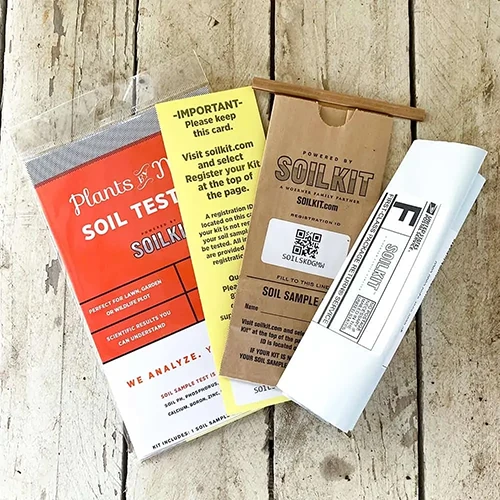
Similar to MySoil®, the SoilKit™ lets the pros do the heavy lifting. Well, not literally… You’ll need to heft the actual sample yourself, obviously.
With the SoilKit™, you register your product, collect the sample in the included bag, and mail it off in the pre-paid envelope to the AgriTech Corp. lab for analysis.
After your sample is analyzed, you’ll be able to view the results on your online SoilKit dashboard in one to two business days.
These results include the pH, buffer pH, organic matter, cation exchange capacity, and the concentration of boron, calcium, copper, iron, potassium, magnesium, manganese, phosphorus, and zinc.
Nitrogen isn’t included, as the makers of SoilKit™ point out that a soil’s nitrogen concentrations can vary significantly between the time of sample collection and lab testing.
For guidance on what to do next, exact amendments and fertilizer recommendations are also provided.
Trying to go above and beyond just the pH and nutrient breakdowns with an easy-to-use product? Give the SoilKit™ a try!
This kit is available from Plants by Mail.
11. Soil Savvy Kit
The third member of our trio of mail-in kits, the Soil Savvy™ kit is another solid product, rounding out the unofficial trilogy – and our roundup – in style.
Much like “Return of the Jedi,” this kit rehashes some familiar themes.
You collect your sample with a provided scoop, stick it into the included jar, package it up into the provided pre-paid envelope, mail it in to the UNIBEST lab, and check seven to 10 days later for your results, either online or via email.
Said results include total nitrogen, phosphorus, potassium, calcium, magnesium, sulfur, sodium, iron, manganese, zinc, copper, boron, aluminum, and the pH level, along with definitions of each and how they affect your plants.
But Soil Savvy™ won’t leave you hanging with facts and figures, sans direction – you’ll receive some organic and synthetic fertilizer recommendations for getting your garden’s nutrition to optimal levels as well.
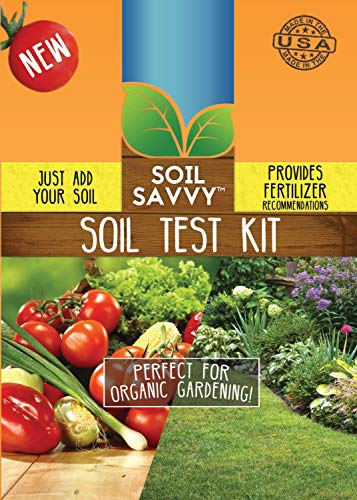
One feature to highlight is the nitrogen testing with this product: ammonium and nitrate concentrations are listed in test results, along with total nitrogen levels.
Does the Soil Savvy™ kit sound appealing? Then let your fingers walk you over to Amazon.
How To Choose the Right Soil Test Kit for You
Whoo, boy. There are a lot of options here. But which to pick?
By knowing exactly what you need, you’ll have a better idea of what to choose.
What You’re Testing For
Is there a certain soil metric that you’re looking to find? Every metric has its place, but some are more useful to ascertain than others, especially at the amateur or hobbyist level.

Let’s briefly go over some common metrics:
Put simply and practically, the pH level indicates just how acidic or basic the soil is, which heavily influences the availability of certain nutrients.

