


How to Grow
German bearded irises are easygoing provided that you put them in the right soil and light exposure.
Light
While some iris species will tolerate a bit of shade, German varieties need full sun.
They will survive in partial shade but the flowering will be greatly reduced and they can be susceptible to pest and disease problems.
So choose a location with plenty of sunshine. In super hot regions, a little afternoon shade won’t hurt.
Soil
Unlike some of its relatives, which thrive in soggy soil, German irises need well-draining soil.
They won’t tolerate standing water. While they won’t tolerate wet roots, the plants are a bit more forgiving when it comes to soil composition.
A bit of sand, or a touch of clay is fine, so long as the soil is humus-rich and the drainage is on point.
Feel free to amend the soil to improve its texture and remove any big rocks. Just don’t add mulch to the top of the rhizomes. This will invite rot.
The soil should ideally be slightly acidic to neutral, with a pH between 6.0 and 7.0 for best flowering.
Water
Not only do German irises prefer well-draining soil, but they can even tolerate drought. When providing water, wait until the soil is almost completely dry before adding more.
The exception is with plants or rhizomes that you’ve just put into the ground. Keep these lightly moist for the first year.
Fertilizer
Feed once a year after all of the flowers have faded using a flower-focused fertilizer.
I’d highly recommend that you do a soil test before feeding, because overfertilizing can lead to poor flowering and stress.
A soil test will tell you how much fertilizer to use and what nutrients your soil is lacking.
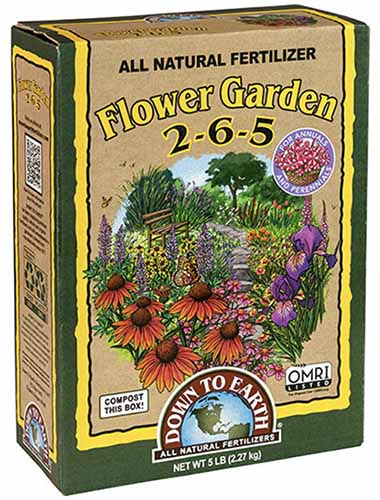
If you prefer not to test, pick up something like Down to Earth’s Flower Garden food in one- or five-pound boxes at Arbico Organics and follow the manufacturer’s directions for application.
Cultivars to Select
When you’re out shopping, you will probably encounter some interesting terms used to categorize these plants.
First, they will be categorized by size.
- Miniature dwarf (up to eight inches)
- Standard dwarf (eight to 15 inches)
- Intermediate (16 to 27 inches)
- Miniature tall (16 to 25 inches)
- Border (16 to 27 inches)
- Tall (over 28 inches)
Then they will be described by color.
Bicolor has contrasting standards and falls, bitone has different shades of the same color standards and falls, plicata has spotting, dots, or stippling.
Self is all one color, amoena is white, and variegata has yellow standards and purple, red, or maroon falls.
You can learn more about iris classification here.
Here are some of my favorite cultivars:
Bernice’s Legacy
‘Bernie’s Legacy’ certainly is a looker! The overall hue is wine red, but it’s accented with ruby, garnet, cinnamon, and persimmon.
Not only are red irises a bit unusual, but this is also a reblooming variety.
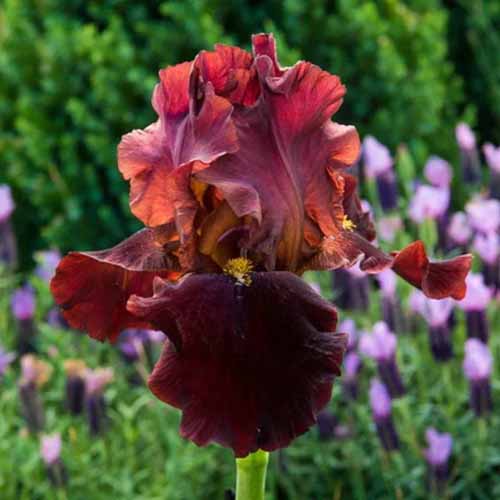
It’s a tall type that can reach an astounding three feet in height.
You can find ‘Bernice’s Legacy’ in one-gallon containers available at Nature Hills.
Black Suited
Irises are known for having some extremely dark flowers and ‘Black Suited’ is one of the darkest.
The color is so inky purple that it looks almost pure black. It also has a hint of musky floral fragrance, which kicks it to the top of my cut flower list!
This self-colored tall type grows up to three feet tall. It was bred in 2000 out of ‘Black Tie Affair’ and ‘Before the Storm’ by noted hybridizer Sterling U. Innerst.
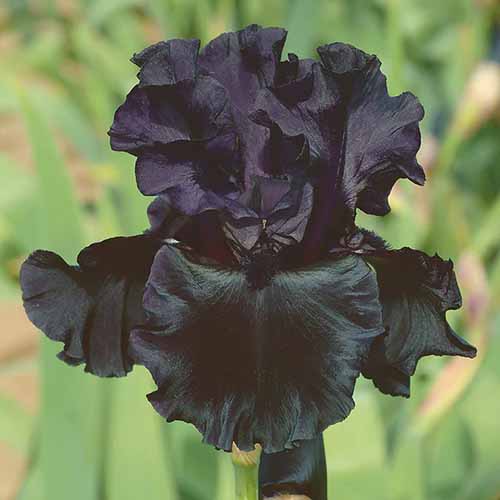
‘Black Suited’ was awarded honorable mention by the American Iris Society in 2003.
You can find ‘Black Suited’ bulbs available at Eden Brothers.
Bounce
Sweet, stunning ‘Bounce’ has a delicate fragrance but a bold look.
The standards are a deep rose to garnet hue and the falls have a garnet-amethyst color with cinnamon-bronze accents and a bright violet stripe down the center.
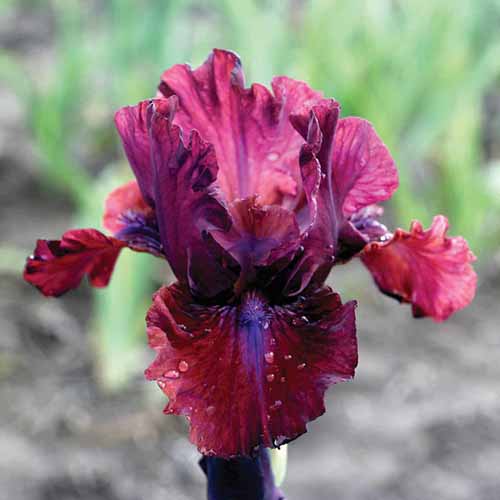
This intermediate type grows about 25 inches tall and was bred by Australian hybridizer Barry Blyth in 2003 out of ‘Gaelic Jig’ and ‘Wee Stroll.’
Snag yours from Eden Brothers.
Cybergrape
There’s purple and then there’s purple. ‘Cybergrape’ is a hyper-colored iris that practically glows with blue-purple standards, violet-purple falls, and a light blue beard.
The petals have heaps and heaps of ruffles, adding to the elegant appearance.
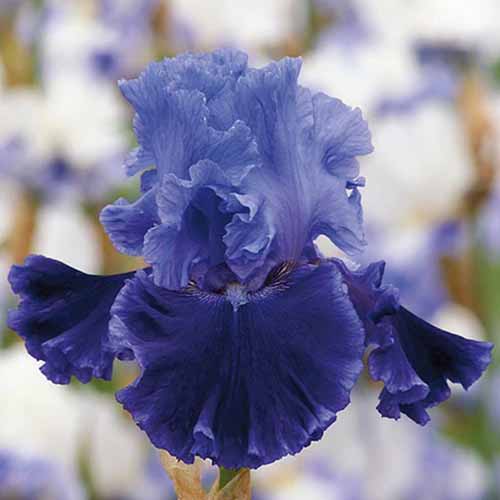
It was bred by Schreiner’s Iris Gardens in 2016 out of ‘Royal Snowcap’ and ‘Sea Power,’ and was awarded an honorable mention by the American Iris Society in 2021.
Eden Brothers carries ‘Cybergrape’ bulbs in packets of various sizes.
Maui Surf
With a deep blue-lavender hue, ‘Maui Surf’ brings to mind the ocean waters of Hawaii at sunset.
This tall type grows up to 26 inches in height with self coloring. The petals are all heavily ruffled.
It was bred by J. Terry Aiken in 1990 out of ‘Memorable’ and ‘Orbiter,’ two garden stalwarts.
‘Maui Surf’ is such a beautiful and reliable bloomer that it nabbed the coveted Royal Horticultural Society’s Award of Garden Merit in 2004.
Pure As Gold
Is yellow your thing? Then you won’t find a better option than ‘Pure As Gold.’
It features heavily ruffled, golden yellow self blossoms that stand atop stately 33-inch tall stems. This one is a rebloomer that gives you a second show in autumn.
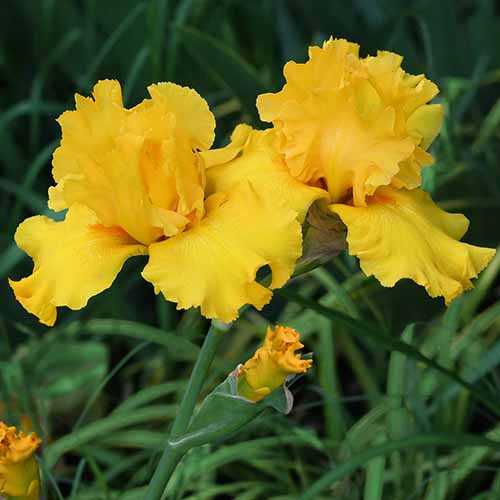
California hybridizer William and Marilyn Maryott brought this beauty into the world in 1993 after crossing ‘Radiant Energy’ and ‘Sound of Gold.’
It snagged the American Iris Society’s honorable mention in 1995 and the Award of Merit in 1999. You can find ‘Pure As Gold’ available at Nature Hills Nursery.
Starring
All eyes are turned to the garden stage as ‘Starring’ takes on her role.
Bred by hybridizer Joseph Ghio of California out of an unnamed seedling and ‘Bay View’ in 2000, it nabbed the American Iris Society’s Award of Merit in 2004, Favorite Guest in 2004, and the highest award, the Wister Medal, in 2007.
So what makes it so special? It starts with the pure white standards and amps things up with near-black, purple falls with hints of indigo between the veins.
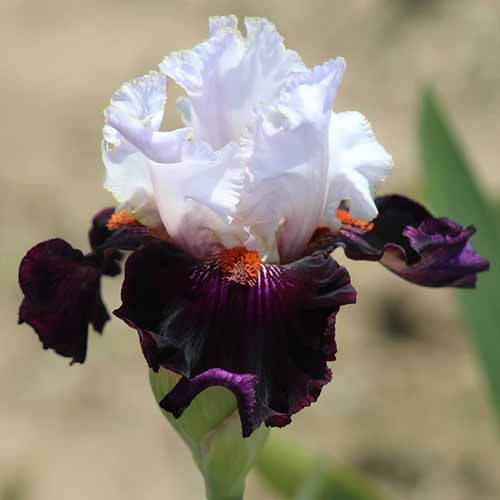
All this is topped off with a brick red beard. This tall type grows to three feet in height, adding to its commanding presence.
If your garden needs a star, pop over to Eden Brothers to pick up some bulbs for fall planting.
Maintenance
After the flowers fade, cut off the stalks at the base. This helps redirect the energy into the roots rather than into developing seeds. Strong roots mean stronger leaf and flower growth.
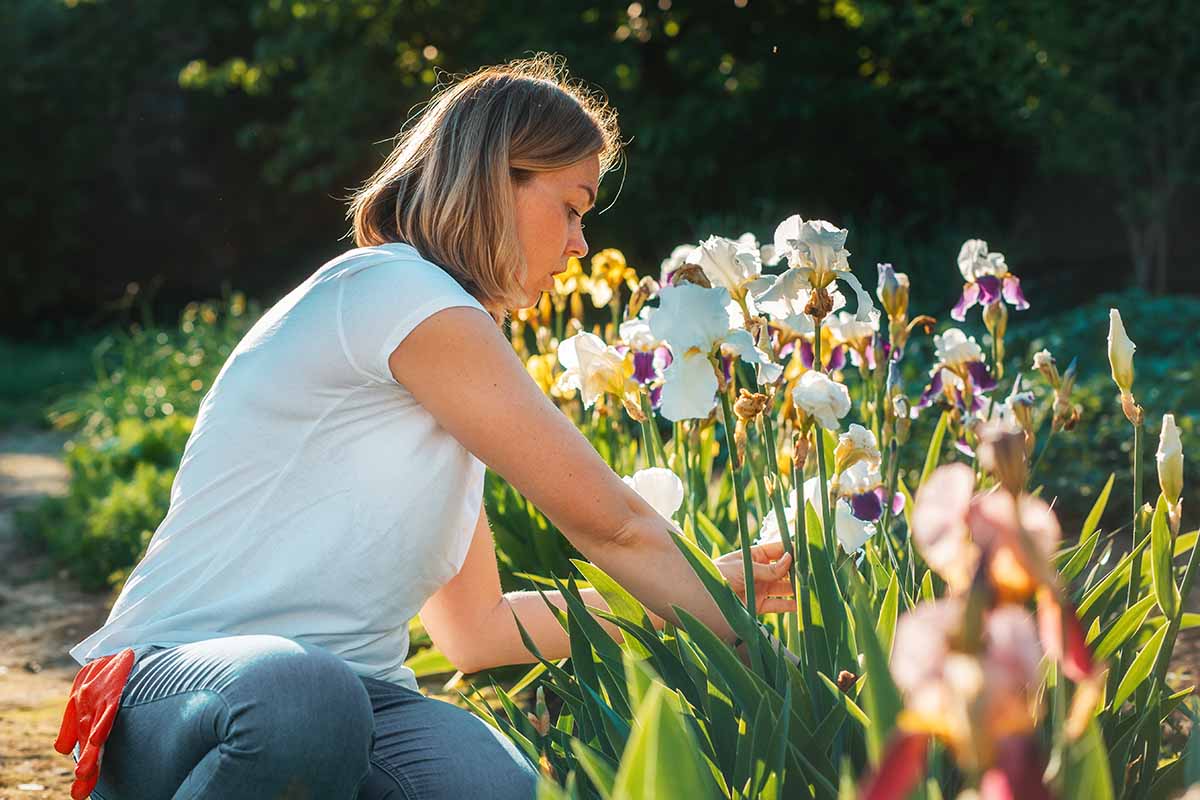
In areas where snow accumulates, cut the leaves back to about four to six inches tall in the late fall.
You don’t strictly have to divide the rhizomes, but it will certainly result in better flowering.
Each year, the plant will develop more rhizomes and when they become crowded, flowering and leaf growth is greatly reduced.
If the flowers are looking a bit disappointing, make sure the rhizomes aren’t too deep and that the plants aren’t in too much shade.
Sometimes, you’ll plant in full sun, but as trees grow larger or a neighbor plants a new shrub, suddenly the sun exposure is different.

