


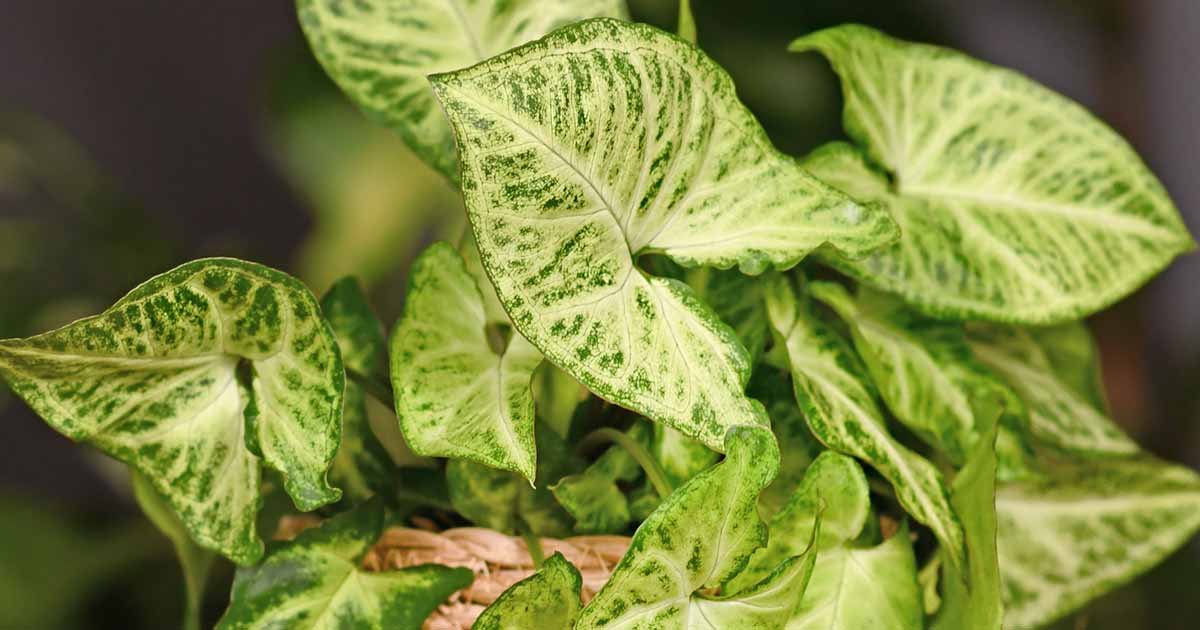
Arrowhead plants are epiphytic, starting their lives in the trees in the wild, and sending out runners along branches as they expand.
They can even send stems down into the soil to act as trunks if they need additional support.

In the right conditions, they blossom with large, fleshy spathes covered in tiny flowers, and then produce red berries.
Depending on the cultivar, a happy specimen can grow up to six feet tall indoors.
How to Grow
Arrowhead plants are versatile, making lovely potted plants as well as being gorgeous in hanging containers.

Because they’re epiphytic, you can also train one to grow up a moss-covered pole, or plant one in a moss-filled basket. They also make nice additions to a dish garden.
Don’t place your arrowhead plants in full sun. You can gradually introduce them to a few hours of morning sunlight, but they do best if you keep them in bright but indirect light.

In the wild, these plants are protected from the sun by the canopy of the trees that they’re growing on. That’s the sort of environment that you want to recreate.
Additionally, they grow in humid areas where they receive a lot of rain. Your job is to try to recreate these tropical conditions.
Add water to the potting medium when the top half-inch has dried out.

It’s easy to determine when more water is needed. Just stick your finger in the soil. When it feels dry about halfway to your first knuckle, it’s time for more water.
Reduce watering so that the top inch or two of soil is allowed to dry out first in the fall and winter.
Arrowhead plants like consistent feeding throughout the growing season. Fertilize the soil once a month with liquid houseplant food diluted by half.
Organic Indoor Plant Food by the Grow Co., available at Amazon, is an excellent option. Just reduce what’s recommended for use by the manufacturer by half, by diluting it with water.

Don’t fertilize in the fall or winter.
Having said all that, arrowhead plants are incredibly adaptable, especially if you change their conditions gradually – they will adapt to less water, less sunlight, or lower humidity.
But if you want the biggest, fullest plant possible, try to give them what they crave.
Cultivars to Select
The range of arrowhead plant cultivars is astounding. They have varying leaf sizes and shapes, and an incredible variety of colors, both solid and variegated.

The leaves can range from pale pink to deep green, and they may feature accents of white, cream, yellow, rust, or red.
‘Merry Maria’ is a lovely option. It has glossy leaves that start out salmon pink before fading to medium green.
‘White Butterfly’ features broad leaves that are pale green with dark green edges.
Other common cultivars include ‘Pink Fairy,’ with splashes of dark pink in the centers, and ‘Golden Allusion,’ which has yellow and green leaves with a pink midvein.
Maintenance
There’s no need to prune unless you notice any dead or yellow leaves.
That said, feel free to give your plant some shape. If you have one vine that’s growing a bit leggy or too long, trim it just beyond the node.
This will encourage the vine to branch out rather than growing longer.

You can trim back to a node at any point when you want to create fuller, thicker growth.
Arrowhead plants are perfectly happy when they are fairly rootbound, but you will need to upgrade the pot a few times as yours matures.
If the roots start to crawl out of the drainage hole, it’s time to go up one pot size.

