


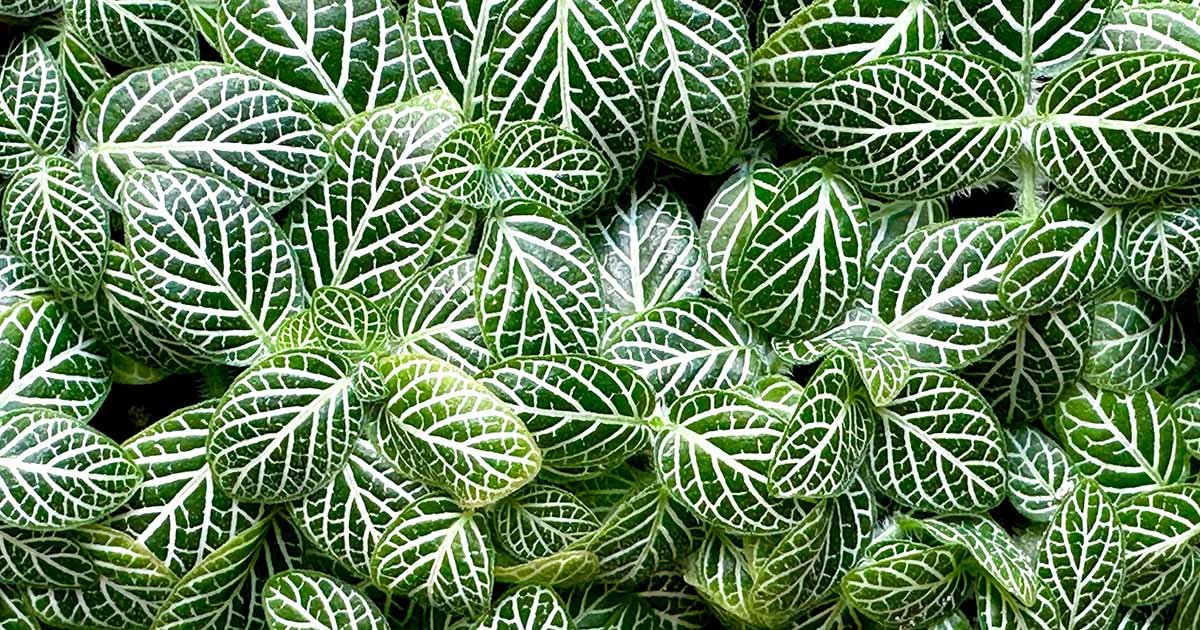

Fittonia spp.
There’s something almost hypnotic about Fittonia leaves. The veining sprawls across each leaf in intricate patterns of white, pink, or red against deep or bright green.
It’s easy to see where the common name “nerve plant” comes from – those veins really do look like a delicate nervous system mapped across the foliage.

We link to vendors to help you find relevant products. If you buy from one of our links, we may earn a commission.
These compact houseplants rarely grow more than six to eight inches tall, which makes them ideal for small spaces, terrariums, or anywhere you need a pop of color without taking up much room.
Native to the tropical rainforests of South America, you’ll also see these sold as mosaic or painted net leaf plants.
Nerve plants are not the easiest houseplants to cultivate and they have a reputation for being a bit fussy. That’s okay, I’m a bit fussy too.
In this guide, I’ll discuss everything you need to know to keep yours thriving. Here’s what I’ll cover:
Fittonia species are creeping evergreen perennials native to the tropical rainforests of Peru, Colombia, Ecuador, Bolivia, and northern Brazil.
On the forest floor, they form dense mats of foliage beneath the canopy thriving in dappled light and constant humidity.

With a prostrate, spreading growth habit, stems trail along the ground or cascade over the edges of containers, rooting at nodes wherever they touch soil.
This makes nerve plants excellent choices for hanging baskets, terrariums, or as tabletop plants.
In USDA Hardiness Zones 10 to 12, they can be grown outdoors as ground cover in shady, protected areas.
The ovate leaves measure two to four inches long with a soft texture and slightly quilted appearance.
The characteristic bold veining creates striking patterns across each leaf – depending on the variety, those veins appear in white, silver, pink, or red against a deep green background.
Though small white flowers may appear on short spikes during summer, they’re fairly insignificant compared to the showy foliage. Indoor specimens rarely flower.
Nerve plants are non-toxic to humans and pets, so I’m quite happy growing these with a curious Labrador retriever in residence. Not like those dumbcanes that I had to rehome.
Quick Look
Common name(s): Nerve plant, fittonia, mosaic plant, painted net leaf
Plant type: Evergreen perennial
Hardiness (USDA Zone): 11-12 (outdoors)
Native to: Tropical rainforests of South America
Bloom time: Summer (rare indoors)
Exposure: Bright, indirect light
Soil type: Moisture retentive, organically-rich, well-draining
Soil pH: 5.5-6.5, slightly acidic
Growth Rate: Moderate
Mature size: 3-8 inches tall by 6-18 inches spread
Best uses: Houseplant, hanging baskets, terrariums, ground cover
Taxonomy
Order: Lamiales
Family: Acanthaceae
Genus: Fittonia
Species: Albivenis, gigantea
The genus was named after Elizabeth and Sarah Fitton, Irish sisters whose book “Conversations on Botany,” published in 1817, helped popularize botanical study among women.
There are two species in the Fittonia genus, F. albivenis and F. gigantea.

F. albivenis is the primary species grown as a houseplant. The specific epithet “albivenis” translates to “white veins,” though modern cultivars come in a rainbow of colors.
Leaf edges are often gently crinkled or wavy, adding to the textural interest.
Nerve plants have earned a reputation as drama queens – they’re notorious for their theatrical wilting when they need water.
The good news is that they bounce back quickly when provided with the necessary moisture, usually within an hour or two.
This predictable behavior actually makes them easier to care for than many houseplants, since they tell you exactly when they need attention.
How to Grow
These tropical natives want conditions that mimic their rainforest home: warmth, humidity, and consistent moisture.
Light
Fittonia species thrive in bright, indirect light. Think of the dappled sunlight filtering through a rainforest canopy.

An east-facing window works well or a spot a few feet back from a south- or west-facing window where they won’t be exposed to harsh rays.
Too much direct sun will scorch the leaves causing them to turn brown and crispy.
Too little light and the plant becomes leggy with stems stretching toward the light source.
If you’re working with low-light conditions, nerve plants can tolerate it better than many tropicals, but the vein coloration may fade.
You may need to use a grow light if natural light is limited.
Temperature and Humidity
This tropical species needs warm temperatures – but not too hot! Keep the temperature between 60 and 80°F for best results.
Nerve plants can tolerate brief dips to around 55°F but if it drops below that, you’ll likely see leaf drop.

Avoid placing them near cold drafts, heating vents, or air conditioning units where temperature fluctuations can cause stress.
The most important aspect of growing nerve plants is that they need at least 50 percent relative humidity and they’re happier closer to 60 or 70 percent.
Dry air causes leaf edges to turn brown and growth slows to a crawl.
There are several ways to boost humidity. A bathroom with decent light is ideal – the steam from showers provides a natural humidity boost.
You can group houseplants together so they create their own microclimate or set the pot on a tray filled with pebbles and water, making sure the pot sits on the pebbles above the water line.
You can also grow Fittonia in a terrarium which provides a humid environment.
Soil
Choose a potting medium that’s moisture-retentive but well-draining.
A peat-based or coco coir mix with added perlite or vermiculite is ideal. The goal is soil that stays evenly moist without becoming waterlogged.
I like Tank’s House Plant Potting Mix which contains a mixture of coco coir, compost, biochar, pumice to help with drainage, and Tank’s organic fertilizer.

Tank’s House Plant Potting Mix
You can find this excellent product available from Arbico Organics in eight- and 16-quart bags.
Make sure whatever container you use has drainage holes. This is non-negotiable as oversaturated soil can lead to root rot.
Because these are shallow-rooted, they do well in wide, shallow pots rather than deep containers.
Water
These houseplants are notorious for their dramatic fainting act when they are thirsty – leaves wilt spectacularly, flopping over like they’ve given up on life.
The good news? Give them a drink and they’ll typically perk up within an hour or two.

However, repeated wilting episodes will eventually damage the plant, causing leaf drop and stunted growth.
Keep the soil consistently moist but not soggy. Water when the top quarter-inch of soil feels dry to the touch.
During the growing season in spring and summer, this might mean watering every few days. In fall and winter when growth slows, you’ll need to water less frequently.
The soil should feel like a well-wrung-out sponge at all times. You can use a moisture meter to guide you.
Use room-temperature water to avoid shocking the roots. See our guide to watering houseplants here.
Fertilizer
Nerve plants aren’t heavy feeders. During spring and summer, you can apply a balanced liquid houseplant fertilizer diluted to half strength every two to four weeks.
In fall and winter, reduce to once a month or skip fertilizing entirely since growth naturally slows.
If you potted in a medium that already has compost or fertilizer, you can skip feeding altogether and just refresh the soil once a year.
Overfertilization can cause salt buildup in the soil, leading to brown leaf tips and edges. You can learn more about fertilizing houseplants here.
Species and Cultivars
As mentioned, the Fittonia genus includes two species but F. albivenis is by far the most common in cultivation.
F. albivenis is divided into two main cultivar groups: Argyroneura, which features white or silver veins, and Verschaffeltii, which displays red or pink veining.
Historically, these were treated as separate species – F. argyroneura and F. verschaffeltii – but taxonomists now recognize them as cultivar groups within a single species.
Modern breeding has produced dozens of named cultivars in various sizes and colors. Here are some standouts:
Most are sold simply labeled by vein color – white, pink, or red – without specific cultivar names.

You can find a pink variety in two-and-a-half-inch pots available from Hirt’s Gardens via Walmart.

If red is more your style, Hirt’s Gardens has specimens in three-inch pots available via Walmart.

Prefer white? Pick up plants in four-inch pots from Florida House Plants via Walmart.
A few named cultivars occasionally show up at specialty nurseries. Here are a few standout options:
Pink Angel
‘Pink Angel’ is a miniature Verschaffeltii Group cultivar that typically reaches just three to four inches tall with a dense, bushy growth habit.

The leaves are small with intense bright pink veining that covers much of the surface. Works well in terrariums and small containers.
Ruby Red
A Verschaffeltii Group selection, ‘Ruby Red’ features dark green leaves with rich crimson veining.

The red coloration is deep and saturated, creating bold contrast against the olive-green background.
White Anne
‘White Anne’ is an Argyroneura Group cultivar with dense white veining that dominates the leaf surface, leaving only thin strips of dark green between the veins.

The overall effect is almost silvery white rather than green.
Maintenance
Pinch back stem tips regularly to encourage bushy growth. Left to their own devices, especially in low light conditions, nerve plants can become leggy.
Pinching just above a leaf node redirects energy into lateral growth, creating a fuller, more dense plant.

You can also remove any yellowed, brown, or damaged leaves as they appear. Just snip them off at the base.
If flower spikes appear, which is not common when grown indoors, most growers pinch them off as flowering takes energy away from foliage production.
You’ll likely need to repot every year or two. If you see roots growing out of the drainage holes, it’s time to pot up.
The best time to do this is in spring, when the plant is actively growing.
Choose a new pot just one to two inches larger in diameter than the current container. Going too large can lead to overly wet soil since there won’t be enough root mass to take up the moisture.
Gently remove the plant, loosen the roots slightly if they’re tightly bound, and place it in the new pot at the same depth it was in the previous container.
Fill in around the roots with fresh potting mix and water well.
If your home is very dusty, wipe leaves gently with a damp cloth occasionally, or give the whole plant a gentle rinse in lukewarm water if it’s small enough to move easily to a sink or shower.
Propagation
One of the joys of growing Fittonia is how easily it propagates. You can create new plants via stem cuttings or division, both of which have high success rates.
Stem Cuttings
In spring or early summer, select a healthy stem with at least two to three leaf nodes.

Use clean, sharp scissors or pruning shears to take a cutting two to four inches long, making your cut just below a node.
Remove the lower leaves from the bottom inch of the stem, leaving two to three leaves at the top.
At this point you have two options: you can root in water or soil.
Set the cutting in a small jar or glass with enough water to cover the nodes but ensure the leaves are not submerged.
Change the water every few days to keep it fresh.
Roots should appear within two to three weeks. When roots reach about an inch long – usually after four to six weeks – pot up the cutting in soil.
If you prefer to propagate in soil, fill a small pot with moist, well-draining potting mix and insert the cutting an inch deep.
Cover the pot with a clear plastic bag or place it in a propagation tray with a humidity dome to maintain moisture. Set it in bright, indirect light.
Keep the soil consistently moist but not waterlogged. You’ll know the cutting has rooted when you see new growth emerging, typically within three to four weeks.
By Division
If you have a mature Fittonia that has outgrown its container you can divide it to produce new plants.

Gently remove the nerve plant from its pot and shake off excess soil so you can see the roots clearly.
Using your hands or a clean knife, separate the root ball into two or three sections, making sure each division has both roots and stems with foliage attached.
Pot each section in its own container with fresh potting mix and water well. Maintain even moisture, but don’t allow the soil to become waterlogged.
New growth should appear within a few weeks.
Pests and Disease
Fittonia species don’t tend to suffer from pests or diseases unless they are stressed by low humidity, overwatering, or lack of light.
Pests
The most common pests that show up are sapsuckers: mealybugs, scale, and spider mites. Fungus gnats can appear in oversaturated conditions.
Fungus Gnats
Fungus gnats are small flies and while the adults don’t do much damage, the larvae feed on organic matter and roots.
Yellow sticky traps catch the adults. You can also drench the soil with diluted neem oil to kill larvae.
Read our guide to managing fungus gnats here.
Mealybugs
Mealybugs appear as white, cottony clusters on stems and leaf axils. They suck sap, causing yellowing and stunted growth.
For light infestations, dab individual insects with a cotton bud dipped in rubbing alcohol.
In the case of a heavy infestation, spray the plant thoroughly with insecticidal soap or neem oil, making sure to coat both sides of leaves and all stems.
Learn more about mealybugs here.
Scale
Scale insects look like small brown or tan bumps on stems and leaves. They’re immobile but damaging – sucking sap and weakening the plant over time.
Remove them manually with a cotton bud dipped in rubbing alcohol, then treat the plant with neem oil or horticultural oil to catch any you missed.
Check out our guide to managing scale to learn more.
Spider Mites
Spider mites are tiny arachnids that create fine webbing between leaves. Leaves may develop stippling and eventually turn brown.
They thrive in dry conditions, which is one reason maintaining humidity is so important.
You’re unlikely to see the pests themselves as they are so small but if you notice webbing, spray the plant with water to knock them off. You can also use neem oil or insecticidal soap.
Disease
Most disease issues stem from too much moisture – either in the soil or on the foliage.
Leaf Spot
Leaf spot can develop when water sits on the foliage for extended periods.
Various fungi and bacteria cause similar symptoms: brown, tan, or black spots on leaves, sometimes with yellow halos.
Water at the soil level rather than from above. Improve air circulation. Remove affected leaves promptly. If the problem persists, treat with neem oil or a copper-based fungicide.
Powdery Mildew
Powdery mildew occasionally shows up as white, powdery patches on the foliage usually in conditions with high humidity but poor air circulation.
Increase air movement, reduce humidity slightly if possible, and treat with neem oil.
Learn more about managing powdery mildew here.
Root Rot
Root rot, caused by various fungi and water molds including Pythium species, is the most serious concern.
It appears as yellowing lower leaves, wilting despite moist soil, and eventually mushy, blackened roots.
If root rot develops, remove the plant from its pot, trim away affected roots with clean scissors, repot in fresh soil, and adjust your watering schedule.
Our guide to managing root rot has more information.
Don’t Lose Your Nerve
Despite their fussy reputation, Fittonia species aren’t actually that difficult to grow when you understand what they need.

Get the humidity right, keep the soil consistently moist but not waterlogged, and provide bright indirect light. You’ll be rewarded with vibrant, patterned foliage that brings tropical flair to small spaces.
Do you grow nerve plants? Share your experiences in the comments section below – and feel free to share a picture!
And to learn more about growing houseplants, add these guides to your reading list next:

