


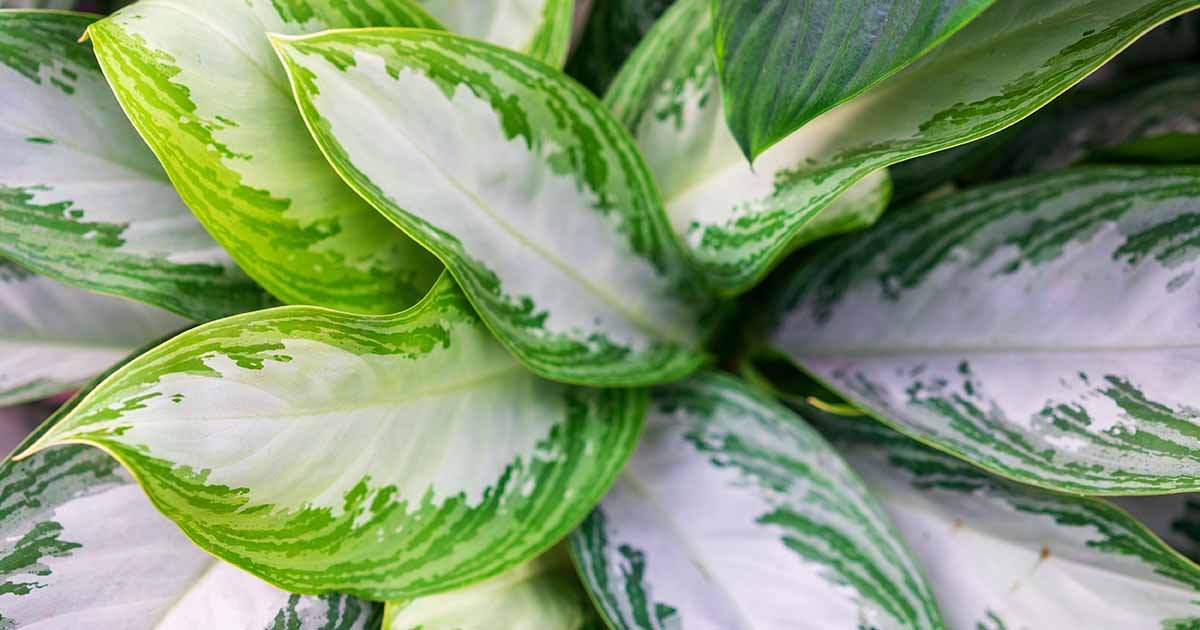


Aglaonema spp.
The Chinese evergreen, Aglaonema, aka Philippine evergreen, or poison dart plant, is an ornamental herbaceous perennial.
The Aglaonema genus includes over 20 different species, and is part of the Araceae, or Arum family.

We link to vendors to help you find relevant products. If you buy from one of our links, we may earn a commission.
Aglaonema species are suited to cultivation outdoors in USDA Hardiness Zones 10 and 11, and may be grown as houseplants in all zones.
In this article, we discuss all you need to know to grow and care for your own Chinese evergreen.
Here’s the agenda:
Note that like many houseplants, Aglaonema species are poisonous to both humans and pets. Under no circumstances should any portion of these plants be consumed.
All species of Aglaonema have an upright, clumping growth habit in their natural habitat, where they stretch toward the dappled sunlight that filters through the rainforest canopy.
In lower light conditions, Chinese evergreen tends to spread wide rather than tall. Indoors, you can expect mature dimensions of one to two feet tall and wide.
Quick Look
Common name(s): Chinese evergreen, Philippine evergreen, poison dart plant
Plant type: Herbaceous perennial
Hardiness (USDA Zone): 10-11 (outdoors)
Native to: Southeast Asia
Bloom time / season: Late summer to early fall (rare indoors)
Exposure: Indirect to low light
Soil type: Organically rich, loose, well-draining
Soil pH: 5.6-6.5, slightly acidic to neutral
Growth Rate: Slow
Mature size: 1-2 feet tall and wide
Best uses: Houseplant (excellent gift or starter plant)
Taxonomy
Order: Alismatales
Family: Araceae
Genus: Aglaonema
Species: Brevispathum, commutatum, costatum, crispum, modestum, nitidum
The leaves are between eight and 12 inches long, and may be green or variegated. Today’s cultivated varieties include combinations of green, pink, red, and white.
Indoors, Aglaonema seldom flowers, but every once in a while, you may be rewarded with an inflorescence – an elongated whitish spadix surrounded by a greenish leaf-like enclosure called a spathe, much like a peace lily.

Some gardeners enjoy seeing the occasional inflorescence. Others snip it off at the base of the stem to trigger a return to foliar growth, and prevent the setting of messy red fruit.
Historically speaking, like many tropical species that made their way to Europe, cuttings of Chinese evergreen likely rode the seas in a British plant hunter’s case.
They were studied and cultivated at Kew Gardens, showcased in royal landscapes, entered into commercial cultivation, and were then exported and welcomed into 18th century Victorian parlors in America as ornamental showpieces.
How to Grow
These tropical plants require organically rich, well-draining, slightly acidic soil with a pH of 5.6 to 6.5. For indoor cultivation, this is easy to achieve with quality potting soil.
This is a tropical plant that prefers temperatures in the 70 to 80°F range during the day, and a minimum range of 65 to 70°F at night.

These houseplants do best with humidity of at least 30 percent. If your home is exceptionally dry, you can group pots to increase the ambient moisture.
Chinese evergreen does poorly in cold and drafty places. It reacts to these conditions by becoming stressed and growing more slowly. And if temperatures plummet to 45°F, it won’t survive.
Chinese evergreen prefers part to full shade. Indoors, it thrives in a locations with bright indirect or diffuse light, such as in proximity to a bright window with a light curtain. It also has a high tolerance for low-light placements.

They also have a high tolerance for low light, especially the green-leaf varieties, as opposed to the variegated types.
When cultivating in bright indirect light, it’s important to keep the soil evenly moist, watering when the top inch or so is dry.
In low-light conditions, let the soil dry out almost completely before watering again.
Use a moisture meter as your guide. Also, try to avoid watering with cold water. Like cold air, it can cause shock and slow growth.
During winter dormancy, growth slows, and you’ll notice that pots dry out slowly. When spring resumes and new shoots sprout, the need for moisture increases.
Spring is also the time to fertilize with a well-balanced liquid or slow-release granular indoor plant food to support lush foliar growth.
Follow the recommendations on the product you choose.
Do not fertilize during winter dormancy.
Cultivars to Select
With numerous cultivated varieties available, you’ll find colors ranging from green to variegated with pink, red, and silvery white, in striking combinations.

As you shop, remember to note that green foliage thrives best in low light conditions, and more colorful cultivars are their brightest in bright indirect light.
Here are a few beauties to whet your appetite:
Osaka
The striking variegated foliage of ‘Osaka,’ aka ‘Spring Snow,’ has prominent narrow dark green margins and white centers splotched with dark green.
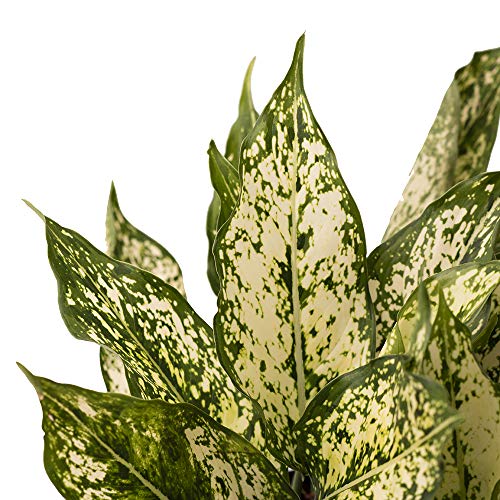
Fresh as a spring rain that melts the last of the winter snow, white equals light when you welcome this refreshing cultivar to your home.
Find ‘Osaka’ now from the American Plant Exchange Store via Amazon in six-inch pots.
Pink Lady Valentine
‘Pink Lady Valentine’ is a raucous riot of bright pink edged in dark green, shades of contrasting colors that play magnificently off one another.
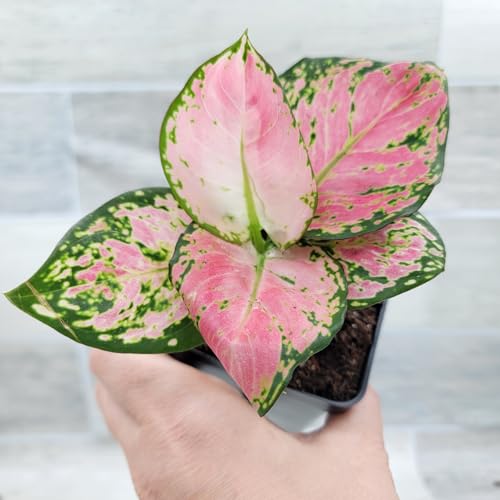
If you want to energize the decor in a low-light corner of your home, this one is sure to sizzle.
Find ‘Pink Lady Valentine’ in three-inch pots available via Amazon.
Silver Bay
‘Silver Bay’ is a variegated type with wide, curvaceous margins of light and dark green embracing center swaths of silvery white.
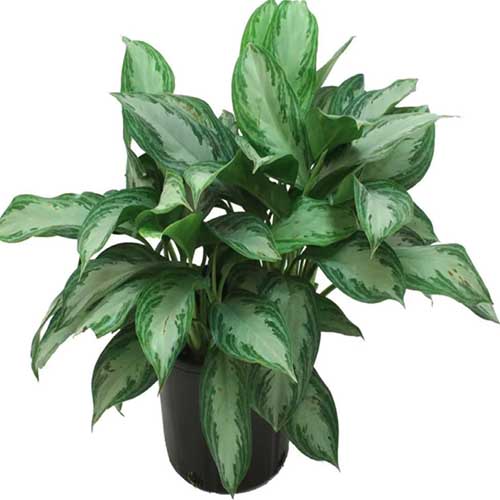
Like love letters artistically wrought by Mother Nature herself, this may well be Mother Nature’s Aglaonema masterpiece.
Find Aglaonema ‘Silver Bay’ now from Costa Farms via Home Depot in nine-inch-deep pots.
Maintenance
From time to time, you may wish to prune leaves that are old and brown, damaged, or affected by pests or disease.

To do so, sanitize pruners in a 10 percent bleach solution (one part bleach to nine parts water), and cut cleanly across the “petioles” or stems of affected leaves, as near to their base as you can.
It’s also a good idea to dust the leaves periodically with a soft cloth. Foliage that is glossy and dust-free is less appealing to the common insect pests we’ll talk about shortly.
Another periodic chore is repotting. Roots protruding from the drainage hole indicate a “root bound” or “pot bound” condition.
When roots no longer have room to grow, they can’t take up food and water efficiently.
You can also transplant the contents of an entire pot to a new one that is two to three inches wider than the current one.

Don’t go too large for two reasons:
- By the time the pot dries out, a plant growing in low light may be in desperate need of water.
- An overly large pot may result in too much energy expended to grow extensive roots instead of lush leaves.
Repot as described in the section on propagating nursery starts above.
It’s okay to reuse potting soil. However, it’s best to refresh it by at least a third with new soil or amendments like peat or compost, to restore depleted nutrients.
Now that we know all about cultivation and care, let’s turn our attention to some of the many varieties available.
Propagation
Chinese evergreen may be started from stem cuttings, division, or from nursery starts.
While it is possible to start from seed, this method is unreliable as collecting seed from a houseplant is virtually impossible as they seldom bloom.
Not to mention, hybrids are likely to produce no seed, or infertile seed.
Let’s look at each option for propagation.
From Stem Cuttings
Sanitize sharp pruners in a 10 percent bleach solution (one part bleach to nine parts water) and rinse them well.
Select a stem to cut. It should be one of the younger basal shoots with a stem about five or six inches long that has two or more leaves.
Cut the stem near its base, just below a node.
Place the stem cutting in a clean container that contains about two inches of water.
Set the container in a location with bright but indirect sunlight.
Change the water daily.
Over the next few weeks, roots should sprout.
Once rooted, transplant to a container six inches in diameter.
Alternatively, you can dip a cut stem in rooting hormone and place it directly in potting soil to develop roots.
By Division
Chinese evergreen has shallow roots that spread sideways and send up new shoots.
The shoots can be divided from the mature main growth to start new ones, while downsizing and rejuvenating the old one.

To start plants by division, you’ll need to unearth a plant, so it’s best done with a mature specimen that’s outgrown its pot and is ready for a new one.
Once out of the pot, lay the entire contents on its side – dirt, foliage, and all.
All around the main growth is a network of roots that have sprouted foliage. You’ll see that they are formed in separate clusters, and these can be separated.
Slice straight down through the roots to separate one or more of these leaf clusters, with roots and stems.
Transplant each to a new pot.
For detailed instructions, see our complete guide to dividing perennials.
From a Nursery Start
You may purchase a little seedling in a tiny pot, or a mature specimen in a larger container.

Choose a container with a diameter that allows for two inches of space from the stem to the inner pot edge around the entire perimeter.
Place a layer of broken crockery bits or pebbles in the bottom of the pot to aid drainage. Add enough potting soil to fill the pot about halfway.
Lay the plant on its side, and rotate, gently squeeze, and tap the bottom and sides of the nursery container to loosen the contents.
If the roots are tightly bound, you can tease them apart, trim an inch or so off the ends, and gently flay them outward.
Settle the plant into the center of the new pot at the same height it was in its original container.
Fill in with potting soil and tamp it into place to secure it in an upright position.
The soil level should be one inch lower than the rim of the container, for easy watering without overflowing.
Pests and Disease
In general, Chinese evergreens are not prone to insect infestation or infection when grown indoors.
However, like other houseplants, it is not immune.
Some pests to watch for are aphids, mealybugs, scale, and spider mites.
These common pests are usually fairly easy to eradicate with an insecticidal soap or organic neem oil. As pests may carry diseases, they should be promptly addressed.
In addition, soilborne nematodes can be a problem with indoor cultivation. These microscopic pests damage roots, and their presence may only be suspected when repotting reveals root deformities.
If they are present, it’s best to remove as much soil as possible from a plant, rinse the roots, remove damaged ones, and repot in a high-quality potting medium with some compost mixed in. The beneficial organisms in the compost help to combat them.

For extensive infestations, take cuttings from unaffected foliage, if there is any, and start over.
Some diseases and physiological ailments to be aware of are:
- Anthracnose, from Colletotrichum fungi
- Bacterial Leaf Spot, from Erwinia chrysanthemi, Pseudomonas cichorii, or Xanthomonas campestris dieffenbachiae bacteria
- Copper Deficiency
- Myrothecium Leaf Spot, from Myrothecium roridum fungi
Both anthracnose and bacterial leaf spot may be avoided by aiming the watering can nozzle at the soil, not the leaves.
Myrothecium leaf spot is usually not a problem when using a well-balanced fertilizer that doesn’t contain an overabundance of nitrogen.
And you’re not likely to see a copper deficiency unless you use an unbalanced fertilizer that has too much potassium and/or phosphorus.
In addition to keeping the foliage dry, try not to over- or under-water, as both can cause leaf yellowing, browning, drying, wilting, and dropping, mimicking disease symptoms.
In addition, conditions that are too wet may cause rotting, and very dry conditions may lead to dehydration, both potentially resulting in death.
Other symptoms that may seem like evidence of an infectious disease include yellowing, wilting, and a failure to thrive in an environment that’s too cold, and crisp, brown leaves that drop because of too much sun exposure.
Given the conditions they prefer, you can remedy and prevent these problems.
Lush and Lovely
With its tropical foliage and high tolerance of low light settings, Chinese evergreen is the perfect choice for livening up low light areas of your home and office.

With this information under your belt, all that remains is to choose your favorite (or favorites) and get growing!
Will it have green leaves, or pink, red, or white variegation? Share your experiences with this plant in the comments section below.
If you found this article informative, we recommend reading the following guides to other easy-care tropical houseplants next:

