


Cultivars to Select
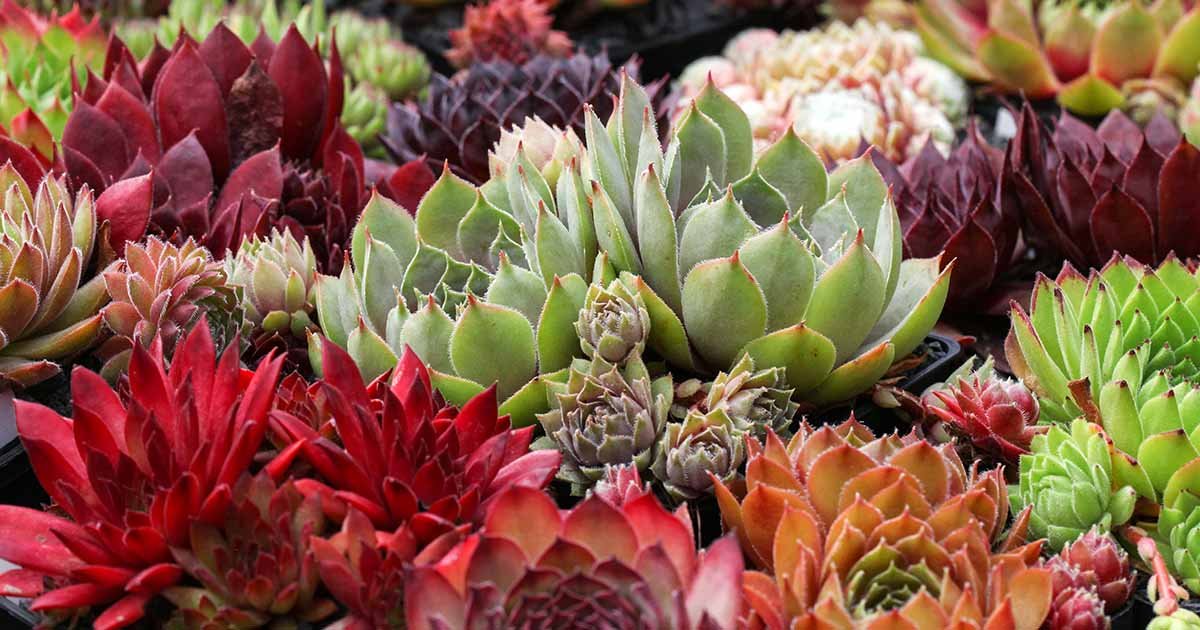
You’ll find plenty of varieties of Sempervivum to fit your style and taste, as long as your style and taste favors rosettes with thick leaves covered with tiny white hairs.
That means they all look more or less the same with a few differences between from one to the next. That’s also called a bad joke.

We’ll take a gander at some of the more familiar varieties, and I’ll keep (most of) the inane commentary to myself.
For even more whimsical and intriguing suggestions, read our roundup of the best varieties of hens and chicks.
Cobweb
S. arachnoideum, commonly called cobweb or spiderweb hens and chicks, is unique for its fine, silvery-white hairs that cover the leaves, creating a web-like appearance.
These webs help to protect the plant from excessive sunlight, trap moisture to reduce water loss, and provide natural insulation.
The plant forms tight evergreen rosettes of pointed leaves with green or reddish coloration, growing up to three inches tall and 12 inches wide.

In late summer, this species produces flower stalks bearing star-shaped blooms in pink, red, or yellow.
You can find cobweb hens and chicks available at Planet Desert in two- and four-inch pots.
Mrs. Giuseppi
‘Mrs. Giuseppi’ forms compact rosettes up to four inches wide with fleshy, pointed leaves.
The foliage displays striking green coloring with contrasting dark red tips, shifting through the seasons from green to rich burgundy-red tones.
This variety produces numerous offsets on very short stolons, quickly spreading to form attractive ground cover.

In summer, the plant sends up flower stalks eight to 10 inches high, with clusters of star-shaped, pinkish-purple flowers.
This hybrid was bred by British horticulturist Giuseppe Giuseppi in the early 20th century.
You can find ‘Mrs. Giuseppi’ in two- and four-inch pots available at Planet Desert.
Ruby Heart
‘Ruby Heart’ forms compact, heart-shaped rosettes of thick, sharply pointed leaves with serrated edges.
The leaves are deep silvery blue-green, developing striking ruby-red tones on their tips and edges during cool winter temperatures.

This cultivar grows up to eight inches tall and 18 inches wide.
It produces pinkish-purple blooms during late spring through summer.
You can find ‘Ruby Heart’ in four-inch pots available from Planet Desert.
Royanum
In pleasing shades of green with purple-tipped rosettes measuring about five inches in diameter, ‘Royanum’ is a common find in the garden center because it’s got that iconic hens and chicks look.

Just as easy to grow as other varieties, the two-tone leaves here make it an easy fit among plants of a variety of other colors.
Maintenance
You don’t need to worry about maintenance here. Caring for your hens and chicks in the long term is about as easy as it gets.

You can weed around the rosettes if you’ve got an obnoxious or aggressive weed creeping in, but you can also leave those couple of sprigs of grass and purslane that are growing in the area if they don’t bother you.
Trust me, they aren’t bothering the plant.
A Note on Flowering
As monocarpic succulents, hens and chicks can produce a lovely flower, but this is also a signal that your plant is finishing its life cycle and about to die.

It’s okay, because the flower produces seeds, and it has surely produced plenty of chicks in its lifetime to carry on the cycle.
Enjoy the flower as a final show of gratitude from your hen and get ready for a new rosette to take its place in the garden.
You can choose whether to remove the fading rosette or simply leave it in place.
You can read more about flowering in Sempervivum plants here.
Propagation
Although it’s possible to grow hens and chicks from seed, it’s incredibly impractical compared to simply collecting a few chicks from a producing hen to propagate.
From Offsets
You’ve got a few options here:
Let your mother “hen” Sempervivum produce tiny babies on its own, and let those babies spread around your garden as they like.
Separated from the mother, they will naturally root in cracks in or spaces between stones, but the chicks are just as happy to grow anywhere you’ve got space for them.

Your other option is to snip a few “chicks” free when they’ve formed roots and place them precisely where you want more to grow.
The safest way to ensure both chick and hen survive is to wait for the runner, or stolon, that attaches them to dry completely and become brittle to the touch before separating the two.

Each runner will produce some tiny leaves that it holds onto while the hen is still supporting the chick. Wait to move the chicks until the leaves die and the runner grows dry, thin, and brittle.
It doesn’t get much easier than that!
Transplanting
You’ll find plenty of Sempervivum options from your local nursery, most of them sold in familiar one-gallon plastic pots. When you take these plants out of their pots, do not be alarmed when most of the soil crumbles!
Hens and chicks don’t have very vigorous root systems.
Dig a shallow hole using your preferred digging tool and nestle the plant inside.
Lightly backfill the hole and give it a good drink of water. Voila, instant gratification.
Pests and Disease
You will be delighted to discover your hens and chicks don’t really face any common pest or disease issues, unless they’re experiencing conditions radically different from what they desire.
As such, Sempervivum is very resistant to insect problems, though in the wrong conditions it might grow stressed and become host to a swarm.
I’ve never experienced an aphid or mealybug infestation on hens and chicks growing in the garden, but it’s happened with every plant I’ve tried growing indoors.

