


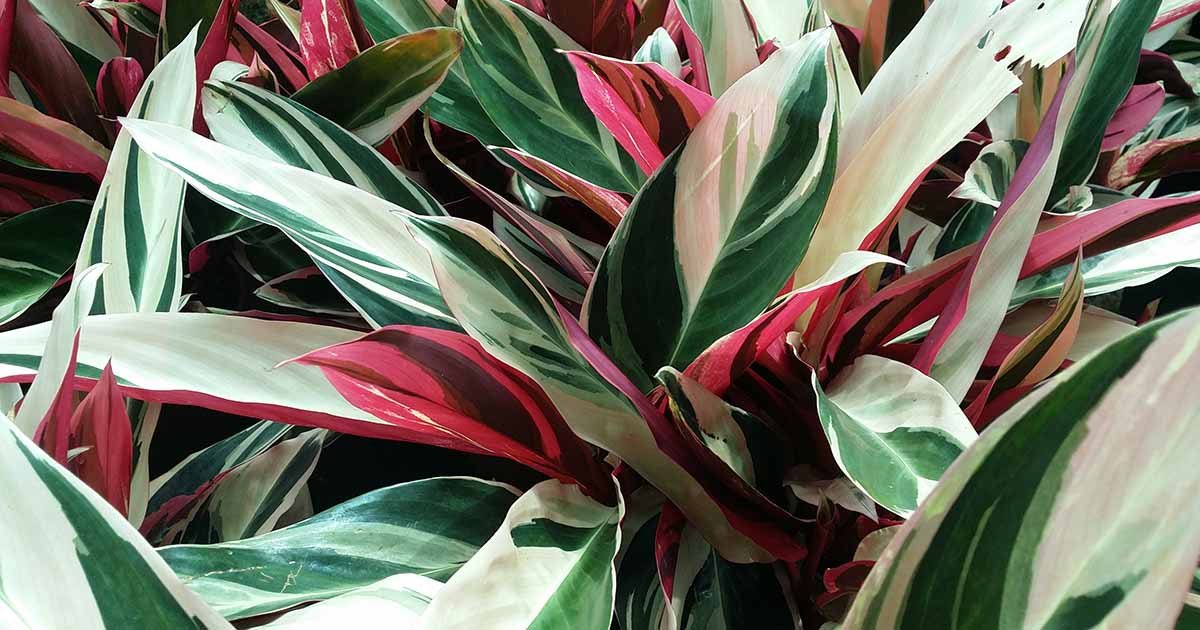
In USDA Hardiness Zones 9b to 11, they can be used as evergreen perennial ground covers, while in areas with colder winters, some gardeners grow them outdoors as summer annuals.
However, keep in mind that since this species originates in a humid, tropical habitat, this variety would be more suited to outside use in Florida than in Arizona.

Prayer plants are nontoxic for both kids and pets, making them safe choices for households with curious children and fur babies.
How to Grow
Stromanthe ‘Triostar’ will grace your home with gorgeous eye-catching foliage if you provide it with the care it prefers. Here’s what you need to know:
Choosing a Specimen
Make sure you get off to a good start by choosing a healthy specimen. Look for one that has no yellowing or brown leaves, and inspect for signs of pests and disease.

Also, check to see that the houseplant is growing in a pot with drainage holes, and is planted in peaty soil to help with water retention.
Light
Ideally, provide your plant with medium indirect light. A little direct sun in the early morning is okay, but avoid hot sun from noon to evening.
Placing your houseplant a few feet from an eastern-facing window should provide the plant with the amount of light it needs.

If your main source of light is a south- or west-facing window, make sure to scoot the ‘Triostar’ back several feet.
Avoid placing it directly on a windowsill and note that in low-light conditions it may lose some of its variegation.
Soil
This stromanthe prefers slightly acidic soil that is rich and peaty.
I like to make my own blend for these houseplants – I use one part coconut coir and one part De La Tank’s Houseplant Mix.
This blend provides a good balance between water retention and drainage.
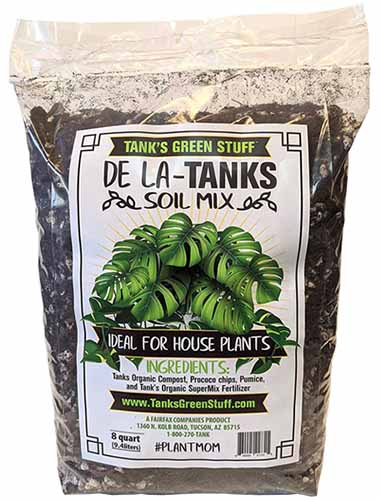
De La Tank Potting Mix is available at Arbico Organics in a variety of package sizes.

And if you need a source for coconut coir, you can find a 10-pound compressed block from Prococo, also available at Arbico Organics.
Temperature
‘Triostar’ can survive temperatures down to freezing (32°F), though its foliage will be killed back.
Rather than pushing it to its limits, try to keep it in the temperature range it prefers – a comfortable 65 to 80°F.
Avoid setting it in a location where it will be exposed to cold drafts or hot, blowing air.
Like all prayer plants, this one is sensitive to temperature fluctuations which can cause the leaves to turn brown.
Water
S. thalia ‘Triostar’ likes to have moist but not soggy soil, so you don’t want to let it dry out much at all.
Although many sources recommend watering ‘Triostar’ as soon as the soil is dry to the touch, when planted in a peaty growing medium, it can be hard to gauge this.
You can use a moisture meter to help guide you.

If your plant has started to wilt or has stopped the daily lowering and raising of its leaves, you have waited too long between waterings.
During winter, you can decrease the frequency of watering.
Like the other prayer plants, ‘Triostar’ is sensitive to contaminants that are frequently found in tap water, so provide rainwater, distilled water, or filtered water instead.

Water deeply, until the liquid runs out of the drainage holes to give it a good soaking.
You may also want to try a method called bottom watering.
Although you’ll want to err on the side of overwatering rather than underwatering, it is possible to damage them with too much water.
Humidity
Triostars require humidity above 50 percent. Indoor heating during winter significantly reduces humidity levels, even in humid climates.

