


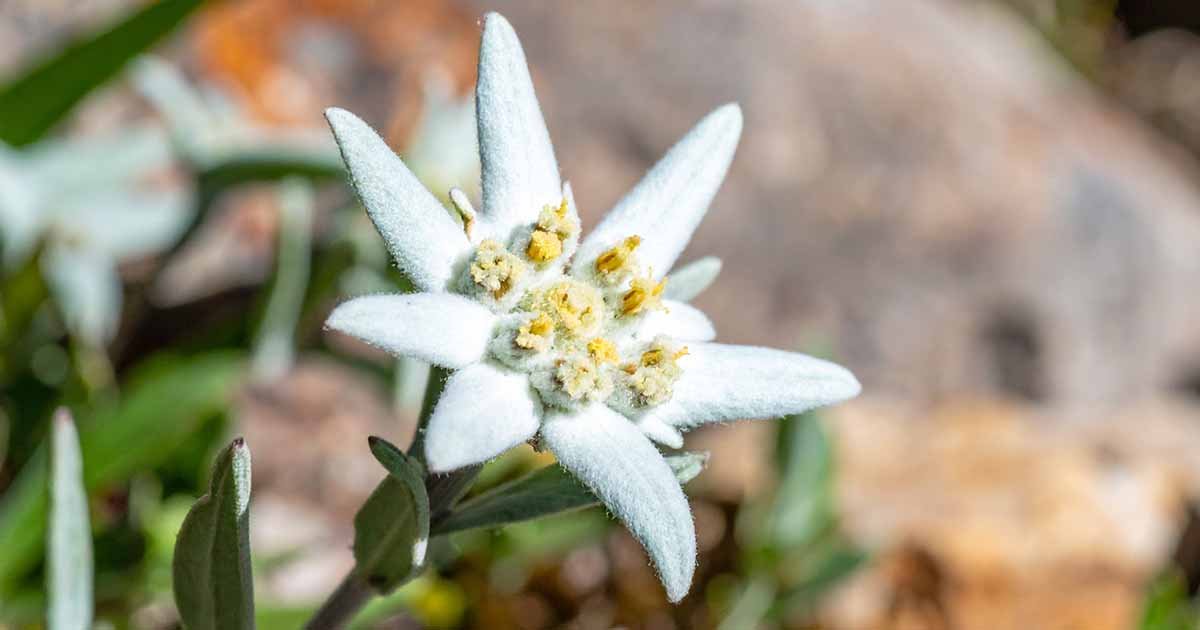

Leontopodium nivale
Edelweiss (ay-del-vyss), Leontopodium nivale, is a high-altitude perennial wildflower made world-famous by Rodgers and Hammerstein’s Broadway musical, The Sound of Music, in which the song “Edelweiss” debuted.
This protected species is the national flower of Austria, the setting for that production.

We link to vendors to help you find relevant products. If you buy from one of our links, we may earn a commission.
Although many gardeners think of it as a white flower, the white petal-like parts are actually leaf-like bracts that surround tiny clusters of yellow florets.
The bracts and silvery-green foliage are covered with a wool-like coating that protects them from harsh UV rays and moisture-depleting winds.
Read on to learn more about how to grow and care for edelweiss.
Here’s what we’ll cover:
In the home garden, edelweiss tends to be a short-lived perennial, with an expected life of two to seven years.
However, while each individual plant may have a relatively short lifespan, the process of naturalizing slowly via seed dispersal and rootstock can extend the life of a colony under optimal growing conditions.
Quick Look
Common name(s): Edelweiss
Plant type: Perennial wildflower
Hardiness (USDA Zone): 4-7
Native to: Mountainous southern Europe
Bloom time / season: Late spring to early fall
Exposure: Full sun
Soil type: Gritty, nutrient-poor, well-draining
Soil pH: 6.5-7.5, slightly acidic to neutral
Time to maturity: 2 years
Mature size: 6-12 inches tall by 6-9 inches wide
Best uses: Bed, container, ground cover, naturalized garden, rock garden, slope
Taxonomy
Order: Asterales
Family: Asteraceae
Genus: Leontopodium
Species: Nivale
Subspecies: Alpinum,nivale
The mature dimensions are six to 12 inches tall with a spread of six to nine inches.
With gritty, well-draining soil, these members of the Asteraceae family do well in containers, and naturalize through beds and rock gardens.
They form an attractive ground cover when mass-planted, and help to control slope erosion.
How to Grow
Edelweiss, German for “noble white,” is a xeromorphic or “water-wise” plant adapted to intense direct sunlight, low humidity, strong winds, and temperatures as low as -20°F to -30°F.

In its native environment the plant dots arid, rocky mountains at 5,900 to 11,200 foot elevations, blooming in cool, dry summer weather.
At lower altitudes, the bracts are grayish-green rather than white.
Suitable Zone 4 to 7 landscapes have cool summers, rather than the hot, humid ones in my region of the northeast.
If you’re gardening in the Pacific Northwest, Colorado Rockies, mountainous New England, or a similar region, with low-humidity and daytime summer temperatures in the 60s and 70s, you are likely to succeed with edelweiss.
Light
In their native habitat, edelweiss plants grow in bright, unfiltered sunlight.

The wool-like coating mentioned is called “tomentum.” It protects the foliage and blossoms from intense ultraviolet light, similar to the “farina” coating on many succulent species.
Growers should select full-sun placements for maximum light exposure.
Soil
Edelweiss prefers a nutrient-poor or lean substrate that is gritty and fast-draining.
And while it is accustomed to the alkaline earth of limestone-rich alpine regions, the plant is adaptable and tolerates a slightly acidic to slightly alkaline pH range of 6.5 to 7.5.
Conduct a soil test and follow recommendations to improve drainage and/or adjust the pH.
Water
During germination, mist to keep the soil consistently moist but not soggy.

Once transplanted into the home landscape, water when the ground is dry to a depth of one to two inches. Use a moisture meter as your guide.
Thereafter, plants are drought tolerant and generally capable of surviving with rainfall alone.
Fertilizer
Edelweiss thrives with minimal nutrients and does not require fertilizer.
An organically-rich environment is likely to hasten vegetative growth, resulting in weak, leggy stems and sparse blooming.
Where to Buy
In addition to the straight species found in the wild, there are numerous cultivated edelweiss varieties bred for better garden suitability, with features such as color options, larger flowers, and a longer bloom period.
Seeds are readily available from specialty wildflower nurseries.
You may see edelweiss listed as L. alpinum which is now considered a synonym for L. nivale subsp. alpinum. There is one other subspecies, L. nivale subsp. nivale.

Species seeds packed for the current growing season are available from CZ Grain via Amazon.
Some cultivars include ‘Blossom of Snow,’ a repeat bloomer producing a showy display in the spring and another in the fall.
‘Blue’ or ‘Pink’ offer white bracts tinged with pink or blue.
‘Edelweiss Giant’ has stems to 18 inches with proportionately larger flowers and foliage.
‘Matterhorn’ is prized for being an early variety with large flowers and repeat blooms throughout the growing season.
Maintenance
Edelweiss requires no pruning. However, you may deadhead spent blossoms before they set seed to prevent unwanted self-sowing.

If you are in a region that doesn’t have snow in the winter, it is beneficial to apply two inches of mulch around plant clumps in the fall.
Avoid burying the crowns, where the stems and roots meet, as doing so may promote root rot.
Remove the mulch when new growth appears in the spring.
Divide plant clumps every three years in the spring to maintain vigor and extend the life of this short-lived perennial species.
Propagation
The best way to establish plants is by starting with seeds, unless you can find nursery potted specimens ready for transplant.

Let’s discuss these propagation options.
From Seed
To begin, purchase a seed packet dated for the current growing season.
- Place the seeds and enough potting soil to cover them in an airtight zippered plastic bag.
- Store the bag in the refrigerator for four to six weeks before the last average frost date for your region.
- After the danger of frost has passed, prepare to direct-sow the seeds outdoors in a location with full sun.
- Dig the soil to a depth of four to six inches. Remove weeds and debris and crumble large soil clumps.
- Germination rates are generally low, so surface-sow about six seeds every six to nine inches.
- Press them lightly into place and mist the soil lightly.
- Continue to mist as needed to keep the soil from drying out, but never let it get soggy.
When the seedlings have two sets of true leaves, thin them to one per interval.
Water when the top inch of soil is dry.
Alternatively, start the seeds indoors four to six weeks before the last average frost date.
- Fill the cells of a well-draining seed-starter tray three-quarters full of gritty, fast-draining succulent potting mix.
- Surface-sow several seeds per cell and press them gently to secure in place.
- Place the starter tray in bright, indirect sunlight.
- Mist the soil lightly and keep it lightly moist during the three to six week germination period.
- When the seedlings have two sets of true leaves, thin them to one per cell.
Next, take a week to acclimate or “harden off” the seedlings to the outdoors.
Start by putting the starter tray in a sheltered location with dappled sunlight for a few hours a day. After four days, move it into full sun for another three days.
Continue to water when the top inch of soil is dry.
Once acclimated to the outdoors, the seedlings are ready for transplant.
Transplanting
To transplant seedlings into the landscape, take note of their depth in the cells or growing pots so you can replicate it in the ground.

The crown, where the stem and roots meet, should sit at or slightly above the soil surface to facilitate water runoff.
Mist the soil in the starter cells the day before so the contents come out easily.
Prepare the soil as described above. Dig a hole the same size as the growing pot.
Settle the contents of each cell into the soil at the original depth. Backfill to hold each seedling firmly upright.
Space the seedlings six to nine inches apart.
To transplant seedlings or nursery plants to new containers, select vessels that are one to two inches wider and deeper than the root mass.
For multiple plants per pot, allow at least six inches between them, and two inches between the outer part of the root mass and the pot, to avoid overcrowding.
Water the day before.
Fill the vessel(s) a third of the way with a succulent potting medium.
Set the seedling or nursery plant at the original depth and backfill with soil.
Water gently but thoroughly immediately after transplanting. This will remove soil air pockets around the roots. And always remember to wet the soil, not the foliage, to inhibit fungal disease.
Pests and Disease
Edelweiss is not prone to pests or disease.
However, sapsucking aphids and spider mites that emerge in early spring may feed on tender shoots.
A light spray with the garden hose may dislodge them, but be gentle, as the fledgling stems are fragile. Follow with an application of organic horticultural neem oil if the infestation persists.
Sapsucking insects are also vectors of a host of plant viruses and are always unwelcome garden visitors.
Where there are adverse conditions, such as humidity, poorly draining soil, and oversaturation, plants are susceptible to crown rot.
Symptoms include foliar lesions, water-soaked stems, and wilting.
Avoid this potentially lethal fungal condition by cultivating in a low-humidity region, providing well-draining soil, and discontinuing supplemental watering after the first year.
“Small and White, Clean and Bright”
Edelweiss, of The Sound of Music fame, is a hardy mountain wildflower that is challenging to cultivate outside its native habitat.

However, in locales that mimic endemic conditions with cool summers, lean, fast-draining soil, and full sun, you may be successful.
Are you in an appropriate Zone 4 to 7 region? If so, add edelweiss to your garden planner today and let the “small and white, clean and bright” blossoms that grace Alpine slopes “bless (your) homeland forever.”
Have you successfully cultivated edelweiss? Please share your tips in the comments section below.
If you enjoyed this article and want to learn about more Alpine perennials, we recommend the following guides next:

