


Water
Too little water and the fruit will drop. If you live in a dry area, a natural mulch like straw, leaves, or grass can help the soil retain water.
Plants need about an inch of water per week, so if you get that through rain, you can sit back and watch your plants grow.
Otherwise, provide irrigation at the ground level. It helps to use a rain gauge to determine how much water your plants are getting so you can supplement accordingly.
Fertilizer
When the plants are young, you don’t need to feed them at all. As they age, you might want to supplement with fertilizer occasionally.
Don’t overfeed your trees with a nitrogen-based fertilizer because this can cause the plant to produce an overabundance of foliage rather than fruiting, or this may result in fruit drop.
Unless a soil test shows a serious deficiency, you should skip fertilizing your trees, or stick with a 10-10-10 (NPK) product applied in the early spring.
Growing Asian persimmons in containers isn’t recommended, and they aren’t likely to fruit that way, though you may be able to keep a dwarf specimen happy in a large container in a warm climate, if you wish to grow it as an ornamental specimen.
Pruning
When trees are young, under five years old, you can prune them annually to develop a strong framework to support the heavy fruits.
At the time of planting, aim for a “vase” configuration. This involves selecting three to five main branches toward the outside of the tree and removing all other branches.
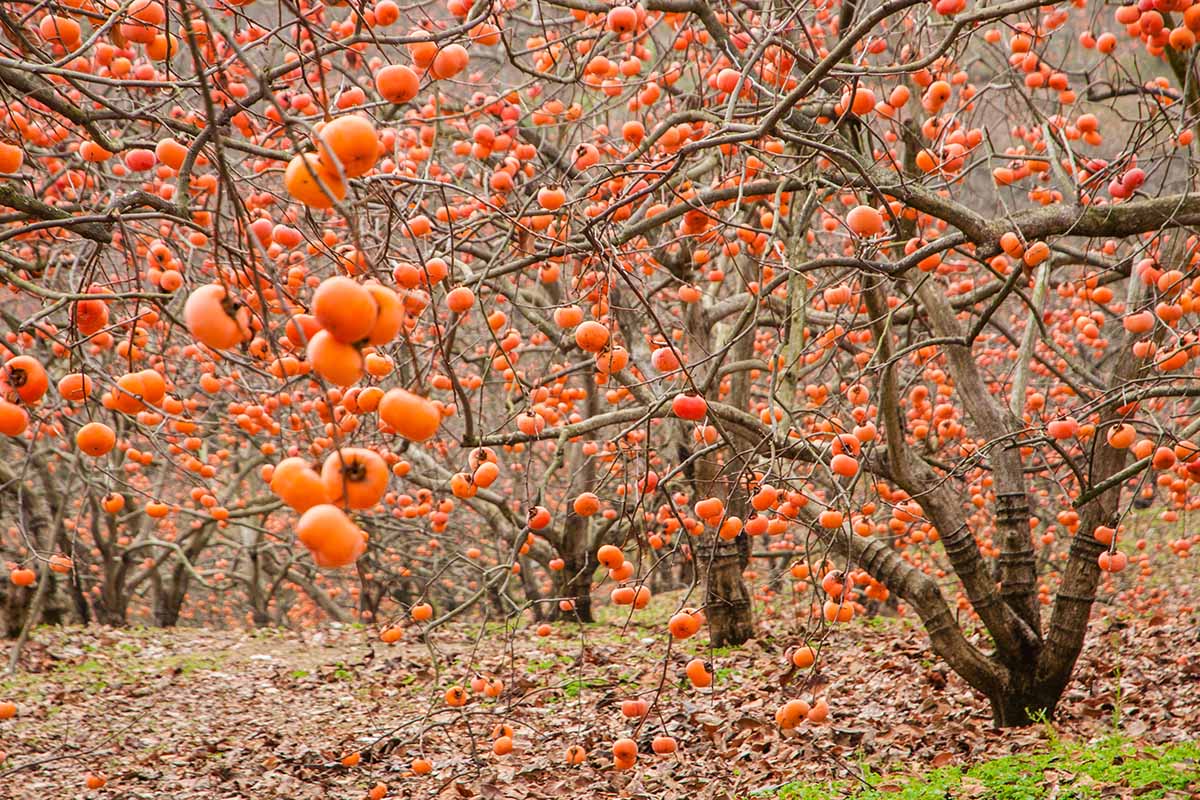
Each year to follow, until trees reach about five years old, thin out half of the new growth while leaving the strong vase shape established by the main branches.
Mature trees over five years old should be pruned in the winter when they are dormant.
Remove any diseased or broken branches, then cut any crossing branches or limbs that have narrow crotches.
Keep in mind that the fruit grows on new wood, so you don’t want to prune once you see new, green growth on the tree. If you do, you may end up with no fruit at all.
Cultivars to Select
There are hundreds of persimmon cultivars out there. We’ll touch on just a few of the most popular here.
If you live in a zone that is on the cooler side of the recommended range for growing Asian persimmons, look for ‘Great Wall,’ ‘Peping,’ and ‘Sheng.’
These cultivars have been bred to be more cold hardy than most, and they can survive temperatures as low as 0°F.
Chocolate
‘Chocolate’ is a pollination-variant astringent type (PVA). It has reddish-orange skin and brown-streaked, jelly-like flesh, which is where it gets its name.
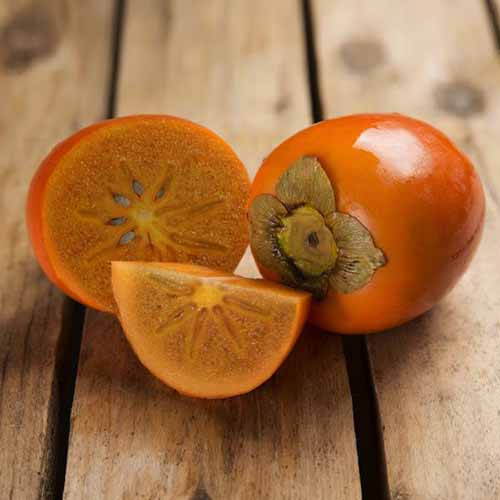
Fruits are ready to harvest in late October to early November, but make sure the fruit has gotten very ripe before digging in.
You can find ‘Chocolate’ trees available from Fast Growing Trees.
Fuyu
‘Fuyu’ means winter in Japanese, and this is one of the most well-known cultivars. The pollination-constant, non-astringent fruit (PCNA) looks similar to a tomato in shape.
As is the case for ‘Jiro’ persimmons, there are multiple types of ‘Fuyu’ persimmons, including ‘Hana,’ ‘Giant,’ and ‘Matsumoto Wase,’ all of which were bud sports of the original ‘Fuyu.’
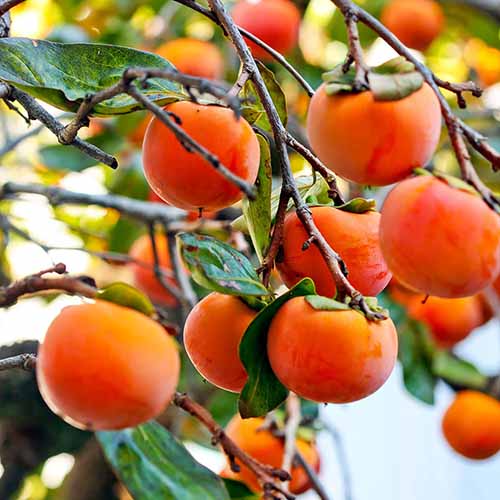
‘Fuyu’ ripens late in the season and is ready to harvest from mid-November through early December.
You can find ‘Fuyu’ available at Fast Growing Trees.
Hachiya
‘Hachiya’ produces fruits with a red skin and jelly-like flesh, shaped like large acorns
They’re ready to harvest from mid-November through mid-December.
This is a pollination-variant astringent type (PCA), and it is popular for drying.
Jiro
‘Jiro’ could be more accurately referred to as a group of cultivars featuring bud sport (a natural mutation) of the classic ‘Jiro’ tree.
Look for ‘Maekawa Jiro’ or ‘Ichikikei Jiro,’ both of which are notable for their medium to large fruit.
This tree produces firm, juicy berries that are medium in size. The fruit is pollination-constant and non-astringent (PCNA).
This is a mid-season variety that’s ready to pick from mid-October through mid-November.
Propagation
There are many ways to start your persimmon tree, and what you choose may depend on your budget and your level of patience.
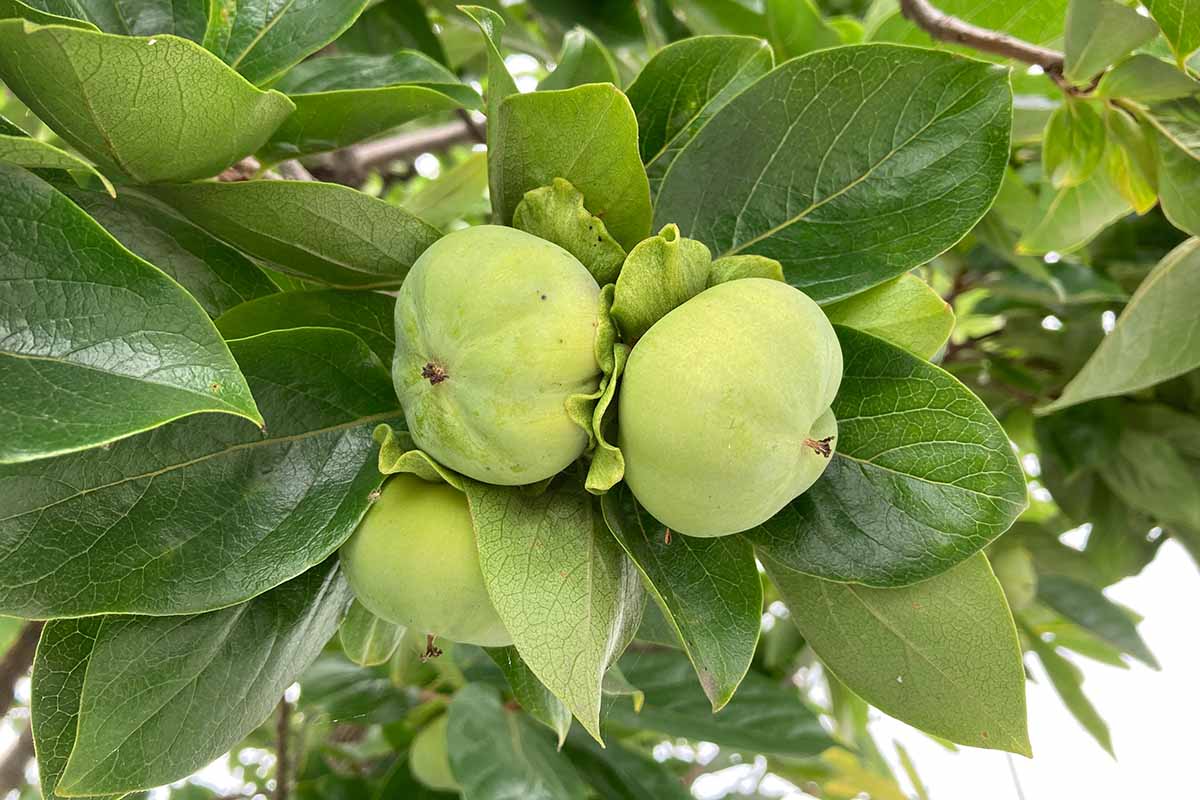
Seeds are cheap, but it will take years before you’re able to dig into your first harvest, and starting plants from seed can be a bit of a challenge.
Also, seeds collected from existing trees will typically not grow true to the parent.
You can always buy a live tree instead, but they aren’t cheap. Still, if you can’t wait to get cooking and enjoying fresh homegrown fruit, this is your fastest option.
Dormant bare root plants are typically more affordable than saplings growing in soil, and this option is somewhere in the middle.
You’ll get fruit faster than you would by starting from seed, though not as quickly as you will if you plant a good-sized live tree to begin with.
From Seed
Persimmon seeds need a period of cold stratification, so start five months before your area’s last spring frost.
Place the seeds in a moistened paper towel inside a glass jar or zip-top bag and refrigerate for three months, keeping the towel from drying out.
Sow each seed two to three inches deep in a three-inch pot of seed starting mix.
Moisten the soil with a spray bottle and keep it moist until the seeds germinate, which takes about six to eight weeks.
A warming mat set to around 70°F speeds things up. Persimmons have a low germination rate, so sow about three times as many seeds as you need.
When the seedlings emerge, give them a sunny window with at least six hours of direct sunlight a day or use a grow light.
When the seedlings reach about four inches tall with at least two true leaves and the danger of frost has passed, harden them off ready for transplanting.
From Cuttings
In spring, take a cutting as thick as a pencil and about 10 inches long.
Remove the leaves from the bottom half, leaving at least two on top. Cut the bottom at a 45-degree angle and dip it in powdered rooting hormone.
Fill a six-inch pot with fresh potting soil, use a pencil or chopstick to make a hole, and insert the twig about halfway.

