


Species and Cultivars
Before you pick a species and start planting, be aware that if you live in a region where the emerald ash borer (EAB) is a problem (more on this below), you might not want to plant an ash at all.
Some municipalities and states are requesting that gardeners do not plant new ash trees because the chances that they will just end up as a host to the pest and help it spread is extremely high.
If you really want to be able to grow ash, pick one that isn’t susceptible to EAB.
Note that mountain ashes (Sorbus ameriana and S. aucuparia) are not true ash trees.
They are usually a bit smaller than Fraxinus species and they produce red berries that birds love.
If you want an option that looks similar to ash but won’t succumb to EAB, these are good choices.
If you live in an area that isn’t troubled by EAB or you want to give it a go, here are some excellent options:
American
The American or white ash (F. americana) is highly susceptible to EAB, but if you’re lucky enough to live somewhere where borers aren’t a problem, it’s a gorgeous species.
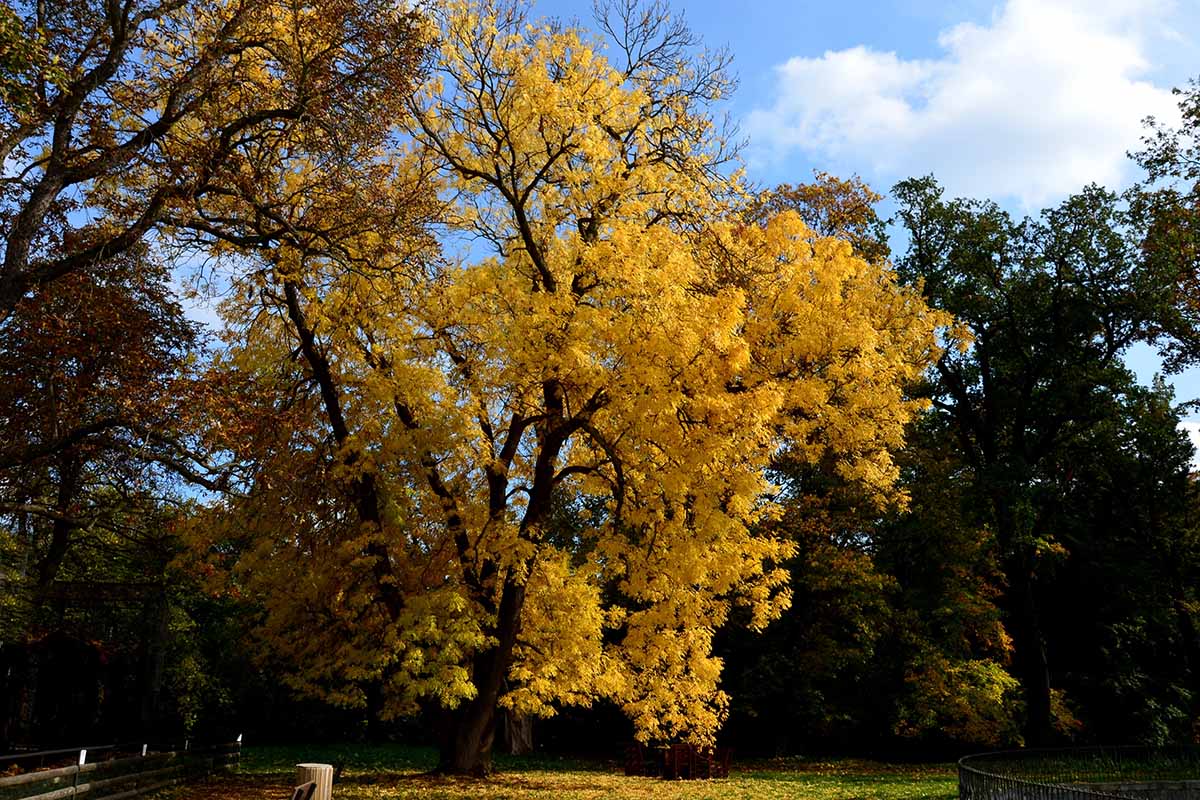
It grows to about 90 feet tall in the right conditions, but typically stays smaller in home gardens.
This species has even been known to grow up to 120 feet tall, making it the largest of the Fraxinus genus in North America.
It’s so popular that many beautiful cultivars have been produced by breeders.
For example, ‘Autumn Blaze’ has vibrant purple fall foliage and ‘Jeffnor’ is much stronger than the species so it’s less likely to be invaded by EAB.
Black
Before we talk about black ashes (F. nigra), it’s important to note that they are highly susceptible to EAB so not a good option for those in infested areas.
Black ash grows indigenously throughout the cool regions of eastern North America. The trees reach about 65 feet tall with a rounded shape.
The bark is particularly attractive. It’s thick and corky with lots of fissures.
Green
While green ashes (F. pennsylvanica) are highly susceptible to EAB, if you don’t live in an area where the pest is a concern, they make a gorgeous addition to the garden.
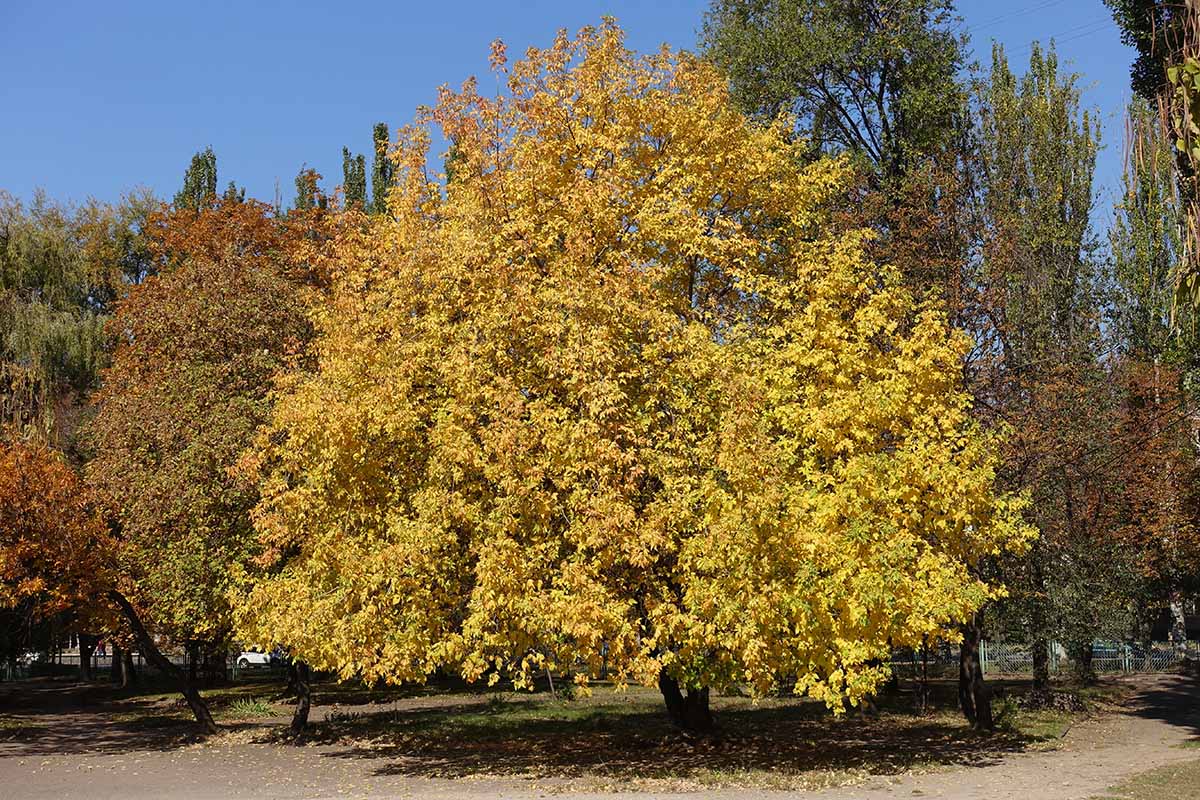
This species can grow to a towering 70 feet tall and half as wide in Zones 4 to 9. Found throughout eastern North America, it’s adaptable to a range of growing conditions.
There are many cultivars available. Urbanite® has a pyramidal shape with compact foliage that turns bronze in the fall.
It can reach up to 50 feet tall and 40 feet wide and has exceptionally thick bark.
‘Marshall’ has an oval shape and grows to 50 feet tall and about 40 feet wide.
Since all cultivars are male, you won’t have to worry about messy seeds. In the fall, the foliage changes to a brilliant yellow.
‘Patmore’ is another male cultivar, so it produces no seeds.
Similar to ‘Marshall,’ it has a pyramidal to round shape, but ‘Patmore’ grows just a bit taller and wider, with slightly darker leaves that turn a similar yellow in the fall.
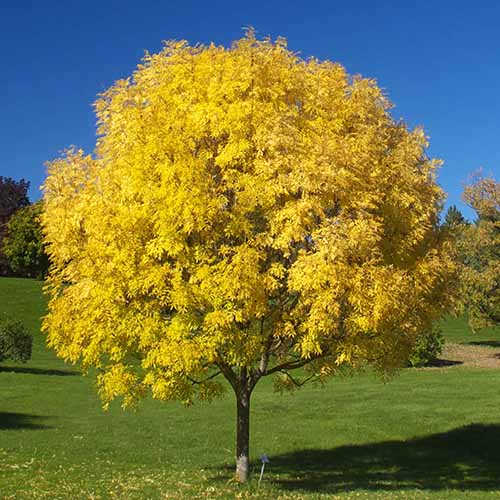
It was grown from a sport of a tree discovered on a street in Vegreville, Alberta, Canada.
You can find ‘Patmore’ available at Fast Growing Trees.
Manchurian
Manchurian (F. mandschurica) has a low susceptibility to EAB, so it’s becoming an increasingly popular ornamental option in North America.
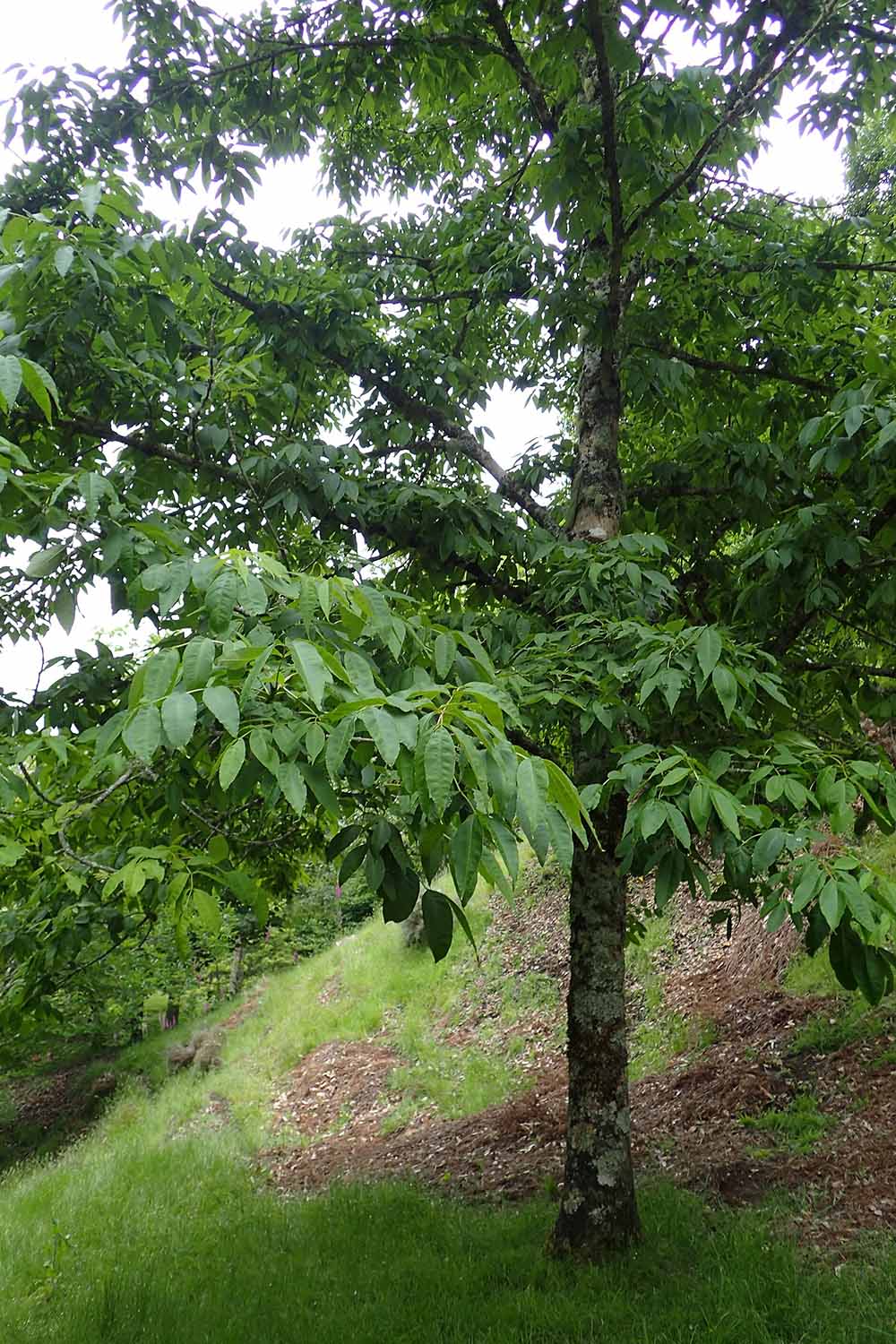
Originally from eastern Asia, it has smooth bark and grows up to 50 feet tall with a lovely rounded shape.
The fall foliage is particularly noteworthy, turning a bright yellow hue. It does best in cooler regions and won’t do well in hot, humid conditions.
Manna or Flowering
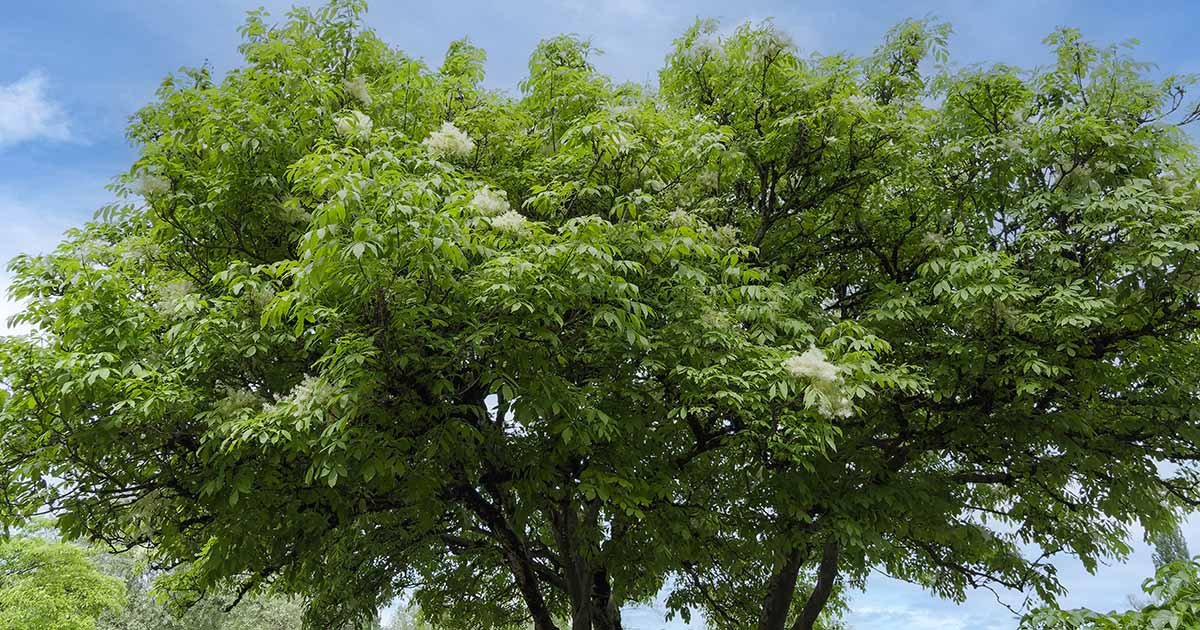
Manna (F. ornus) stands apart from other species because it has large, white, fragrant flowers that look like little clouds hovering around the tree.
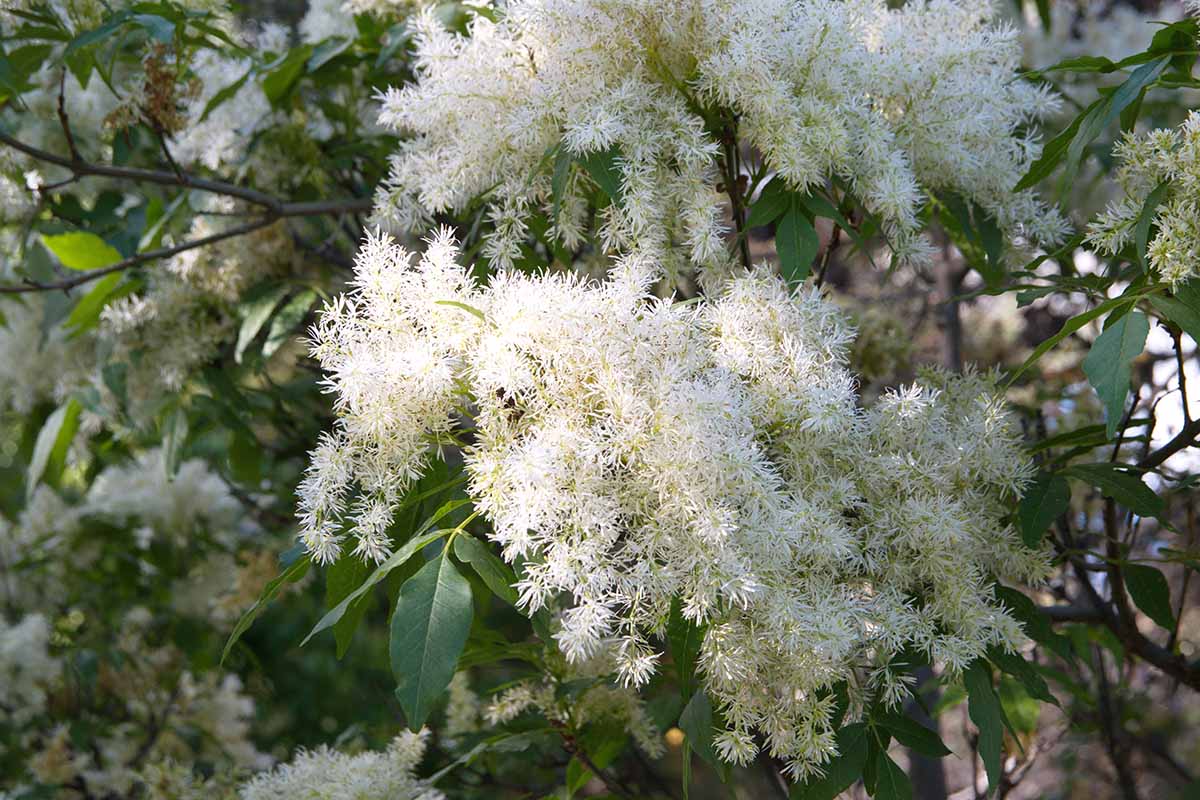
With the flowers follow oversized clusters of seeds, so don’t plant this one near a patio.
This species has low susceptibility to EAB and grows to about 50 feet tall with a nice, rounded habit.
Maintenance
Try to avoid pruning your tree, as this leaves it open to invasion by pests or pathogens. That said, if there is a broken, dead, or diseased branch, it should definitely be removed.
When you cut off branches, cut close to the trunk or main branch and avoid leaving a stump behind.
Cut at a slight angle so the bottom of the cut aligns with the branch collar, which is a lump at the base of the branch. The top of the cut should be flush with the trunk or main branch.
Propagation
It’s possible to grow ash trees from cuttings, but this method is extremely difficult and unreliable, and not really worth the time and effort.
They are easy to grow from seed, but the easiest way to get started is to transplant a sapling from the nursery.
From Seed
Seeds from some ash species need a period of cold, known as stratification, and others don’t.
Take a clue from the environment that the species grows in naturally.
If the tree is native to a region with long, cold winters, stratify the seeds by placing them in moist sand in the refrigerator for three months.
Otherwise, soak the seeds in warm water for 24 hours before planting.
Sow a few seeds in a container filled with potting medium. The pot should ideally be one or two gallons in size. We sow multiple seeds in a pot because some won’t germinate.
Place the pot outdoors in full sun. You might want to place mesh or chicken wire over the pot to protect the seeds from marauding birds or squirrels.
Keep the soil moist at all times.
It can take the seeds up to 18 months to germinate. If you don’t see anything growing within two years, it’s likely that the seeds aren’t viable.
After germination, remove smaller seedlings so that there is just one per pot.
When the seedling reaches about six inches tall, transplant it into the ground.
Transplanting
Nursery saplings and seedlings can go into the ground in spring or fall.
Dig a hole the size of the growing container, or just a bit wider than the pot, but the same depth.
Remove the plant from its container and gently tease out the roots so they’ll grow away from the trunk rather than in a circle.
Place the tree in the ground at the same height as it was in the containers. Fill in around it with the soil you removed.

