Winter can always use some brightening up. Especially if, like me, you spend much of the season indoors, relaxing and catching up on your gardening reading.
A cheery houseplant (or three) might be just the companion you need for your winter rejuvenation. And many species will last for years if you provide them with the proper care.
We link to vendors to help you find relevant products. If you buy from one of our links, we may earn a commission.
Whether your style is neon-lights-bright or understated splashes of pastel, there are species available in all shapes and sizes to brighten up your winter.
I’ve whittled down a list of 23 of my favorite houseplants that add a splash of color – and I bet you’ll find just the one to warm up your home through the colder months.
23 Favorite Colorful Houseplants
Some of these may be familiar, while others may be new to you.
I’ll briefly introduce each of them and offer buying tips for some of my favorite varieties, and provide some information on caring for each of these vibrant houseplants.
1. African Violet
I bet you’re familiar with this old school houseplant. With its fuzzy leaves and dainty little flowers, African violet, Saintpaulia, is unassuming and gently brightens up a home.
Purple is the usual flower color for African violets (hence the name), but along with this popular hue, their blooms also come in white, and in many shades of blue and pink.
Maybe these flowers don’t seem exotic enough for you? Perhaps it’s time to reconsider.
These African natives are available with flowers that are double-blossomed, fringed, or ruffled, and some cultivars have variegated leaves.
Their low-growing forms make them great houseplants for small spaces – just remember to water them regularly and provide them with bright, indirect sunlight.
African Violet
You can find purple African violet plants in four-inch pots available via Walmart.
Find tips on growing and caring for African violets here.
2. Alocasia
Going by many different common names, species in the Alocasia genus will certainly bring an air of drama to your living room.
Also known as kris plant, black shield, elephant ear, or African mask, this houseplant looks as stunning as a sculpture.
The glossy green leaves have large white veins on the topside, while the underside is a deep purple hue. Alocasia can create a fabulous focal point in a home with an eclectic decorating vibe.
Alocasia ‘Black Velvet,’ one of the varieties commonly sold as a houseplant, reaches one to two feet tall and wide.
Alocasia ‘Black Velvet’
It requires bright, indirect light and only the top inch of soil should be allowed to dry out between waterings.
These stunners are available from Fast Growing Trees.
Learn how to grow and care for alocasia here.
3. Anthurium
Also known as flamingo flower, laceleaf, and tailflower, houseplants in the Anthurium genus offer a bright splash of color with their long-lasting red or pink flowers.
Not only are anthurium flowers brightly colored, they are glossy and heart shaped, and will certainly add to a romantic or glamorous decorating style.
With its red and green coloring, this houseplant could make a pleasing addition to your holiday decorating scheme.
Anthuriums will thrive in your home with medium to bright indirect light, as long as you keep on top of watering – it does not like to dry out.
‘Red Heart’
With proper care, anthurium will grow to one and a half feet tall and a foot wide.
‘Red Heart’ anthuriums are available from Fast Growing Trees.
Read more about growing anthurium plants here.
4. Arrowhead Vine
For those who prefer a more understated approach when it comes to color, arrowhead vine (Syngonium podophyllum) offers a soft touch.
Also called arrowhead plant, the leaves vary in shades ranging from light green to light pink, and could be combined nicely with the often shorter-lived poinsettias found at this time of the year.
Arrowhead vine will appreciate a warm, humid spot in your house, with bright, indirect sunlight.
Arrowhead Plant
A vining species, as its name suggests, offer it a hanging basket to trail from or a moss pole to grow on, as its vines can reach up to six inches long.
You can find ‘White Butterfly’ arrowhead plants available from Hirt’s Gardens via Walmart.
Read more about growing arrowhead plants here.
5. Bird of Paradise
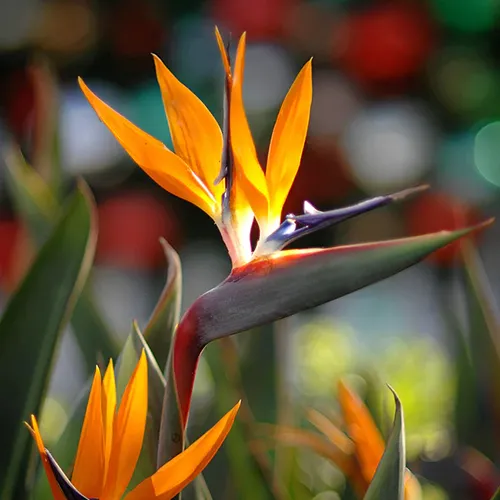
If you’re looking for a bright, tropical burst of color to liven up your interior when it’s cold outside, bird of paradise from the Strelitzia genus might be the houseplant for you.
A taller houseplant, its flashy, beak-shaped flowers in orange, yellow, and blue are held above its lush green foliage on long green stems.
Placed near a sunny window with southern exposure, bird of paradise could be used to create an indoor tropical feel.
Bird of paradise should be given direct sun during the cooler months, and bright, indirect sun during the warmer months. Only allow the top inch of the soil to dry out between waterings.
Orange Bird of Paradise
You’ll find an orange bird of paradise plant in a three-gallon pot available at Fast Growing Trees.
Read more about caring for bird of paradise plants indoors here.
6. Calathea
Calatheas may be among the decorative indoor plants you’ve encountered before that merit renewed attention.
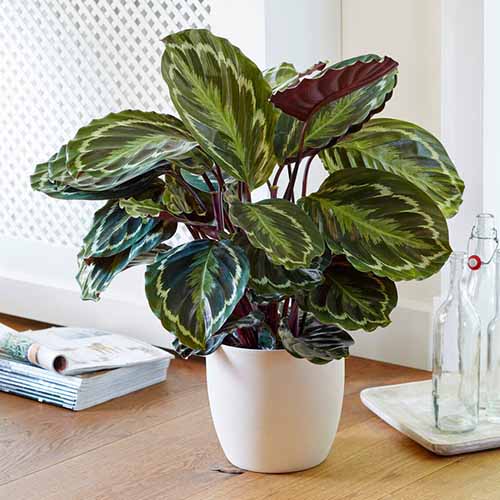
Among the different species of the Calathea genus, commonly called prayer plants, there are many varieties boasting beautifully patterned foliage.
Calathea leaves are geometrically patterned with stripes, splotches, spots, or shading in colors that can include dark and light green with touches of red, purple, or white.
Non-blooming evergreens like this are lovely on their own, or grouped with other houseplants in complementary colors.
Called “prayer plant” because their leaves fold up at night, calatheas prefer warm, humid environments.
Avoid direct sunlight, which will bleach their beautiful leaves. Instead, provide them with indirect light, and remember to keep their soil moist but not soggy.
‘Medallion’
‘Medallion’ is a variety with leaves that look as though they have been created by a painter, and is available in six-inch pots from Fast Growing Trees.
Check out our guide to growing prayer plants to learn more.
7. Chinese Evergreen
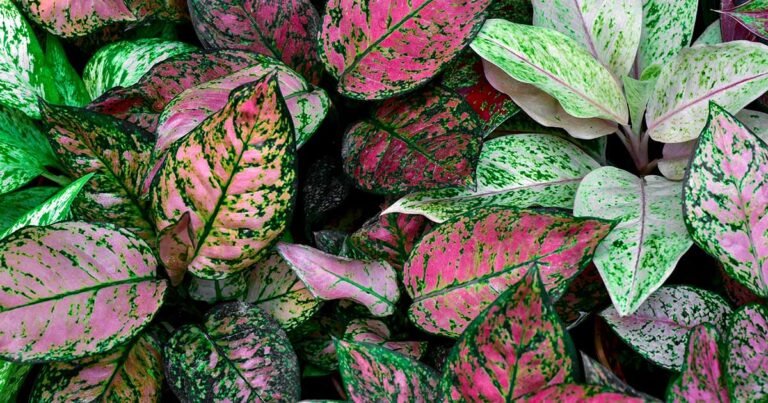
Chinese evergreen, the common name for several species of the Aglaonema genus, is another fairly common houseplant in its green and white form.
But varieties with red leaf veins and margins will surprise you – and might just knock your socks off.
This is another green and red houseplant that would be well-placed among your holiday decor. Keep it around after the festivities are over, to take the edge off the post-holiday blues.
Reaching about one and a half feet tall and wide, Chinese evergreen will thrive in low to bright indirect light.
It should not be allowed to dry out between waterings, but is overall a low maintenance houseplant.
Red Chinese Evergreen
You can find colorful red Chinese evergreen plants with green, yellow, and red mottled leaves available at Fast Growing Trees.
Read more about growing Chinese evergreens.
8. Christmas Cactus
Speaking of the holidays, don’t forget about the bright blooms of Christmas cactuses, members of the Schlumbergera genus.
Those blooms can come in a variety of colors – white, pinks, reds, purples, and even yellows.
A mid-sized decorative houseplant, Christmas cactus will provide a splash of color and texture on a desk or tabletop, or in a hanging basket.
Christmas cacti are undemanding houseplants that will brighten your spirits in the winter months.
Christmas cactus requires bright, indirect light during its growing season and should be watered when the top inch of soil is dry.
To encourage blooming year after year, a special routine of cool temperatures and long nights is required.
You can learn more about this flower-coaxing routine here.
Pink Christmas Cactus
Christmas cacti are among the longest living houseplants, so when you choose yours, make sure you pick a flower color you love.
You can find pink Christmas cactus plants available via Walmart.
Find general care tips for this succulent in our Christmas cactus growing guide.
9. Coleus
You may be more familiar with coleus (Plectranthus scutellarioides) as an annual bedding plant, rather than a houseplant.
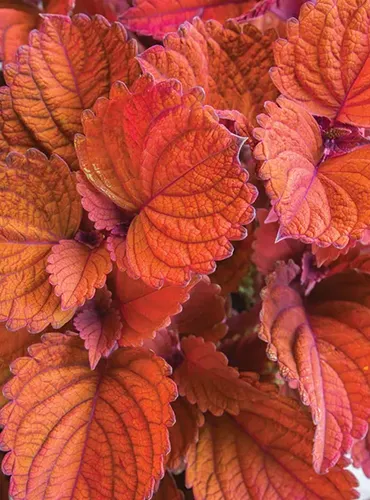
But this vibrant tropical evergreen works well indoors, where it can live for several years, and comes in a dizzying variety of color combinations and patterns.
It’s a low maintenance houseplant, and can handle a range of indirect light situations, from low to bright.
Coleus should not be allowed to dry out completely, but make sure you don’t overwater it either. Its soil should be moist but not waterlogged.
The gorgeous, bright fiery-red foliage on this variety, enticingly called ‘Inferno,’ will bring your home a splash of color.
‘Inferno’
You can find four-plant bundles available from Burpee.
Learn more about caring for coleus as an houseplant.
10. Croton
If you’re looking for a houseplant that’s as colorful as a tropical celebration, croton (Codiaeum variegatum) will be just what you’re looking for.
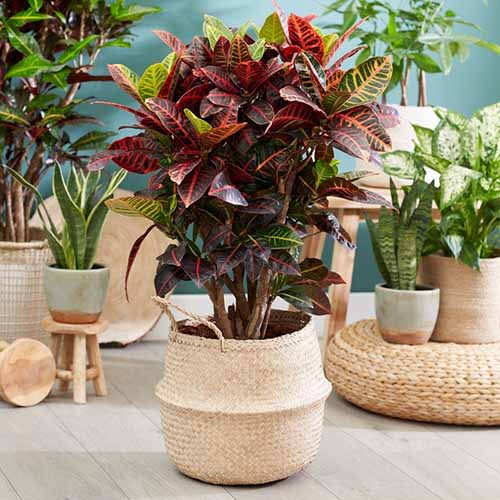
Also called garden croton, these houseplants offer brightly mottled foliage available in a mix of green, yellow, orange, and/or red.
If that’s not enough color for you, there are some rarer varieties that also include pink and purple in the mix.
And the leaves come in many different shapes, so you’re practically guaranteed to find a leaf shape and color combo that will strike your fancy.
Unlike most of the other houseplants in this list, croton does well with some direct sunlight, which will make for better leaf color.
Keep the soil moist but not soggy during the growing season.
With proper care, this beauty can grow up to six feet tall with a five-foot spread – so make sure you are ready to provide it with some room!
‘Petra’
The ‘Petra’ cultivar has wide leaves and the tropical hues that croton is known for.
You’ll find plants in six-inch or three-gallon pots available from Fast Growing Trees.
And read our growing guide to learn about how to care for croton plants.
11. Cyclamen
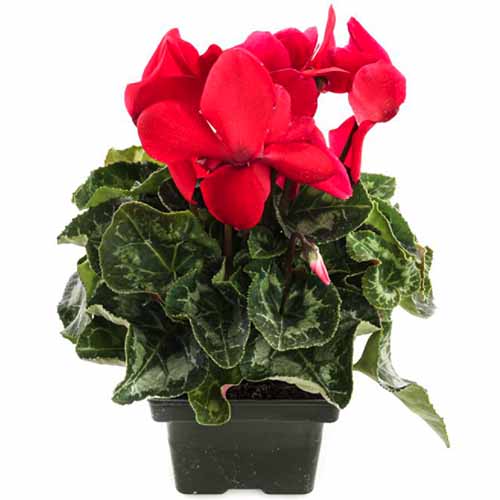
A member of the primrose family, cyclamen (Cyclamen species) is another compact choice that’s ideal for smaller spaces.
Cyclamen is loved for the beauty of both its foliage and its flowers.
Cyclamens have upswept flowers held on dainty stems above heart-shaped leaves. These flowers can be white, pink, red, or purple, and the heart-shaped leaves are often graced with silvery patterns.
This charming houseplant is another good choice for a smaller space – it will only grow to about nine inches tall and wide, and will thrive in bright, indirect sunlight.
Keep your cyclamen’s soil moist – except during its dormant season in the summer, when it should be watered less frequently.
Latinia® Red
Pick up four-inch Latinia® red cyclamen plants in packages of two or four from Home Depot.
Read more about growing and caring for cyclamen houseplants here.
12. Gerbera Daisy
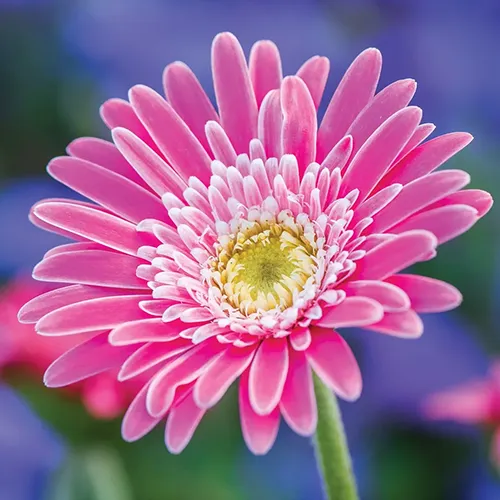
When a young child draws a flower, chances are the flower will look something like the gerbera daisy (Gerbera species).
Gerberas are commonly found in bouquets, but can also grace your home as a live houseplant instead of a cut flower.
The flowers of gerbera daisies will bring a summery cheer to your indoor space.
They are available in almost every color of the rainbow and will grow to about 18 inches high, making for a good tabletop specimen.
Gerbera daisies need a few hours of direct sunlight every day but prefer cooler temperatures.
When kept indoors, a bright eastern window will be the best location for them. Water when the top inch of soil is dry.
‘Garvinea Sweet Memories’
‘Garvinea Sweet Memories’ is a variety with pink flowers, available as a live plant from Burpee.
Find more tips on growing gerbera daisies here.
13. Kalanchoe
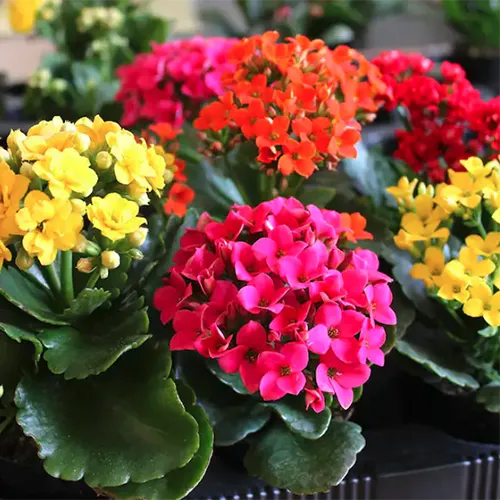
You may be familiar with the green-leaved variety of kalanchoe, a succulent featuring small white, red, pink, orange, yellow, or purple blooms.
However, some varieties of kalanchoe look extremely unusual, with patterned foliage and colorful plantlets growing on their leaf margins.
There are many colorful varieties of this houseplant to tempt the botanically adventurous.
And if you happen to be one of those adventurous souls, kalanchoe may also interest you as a fun horticulture project.
The plantlets that grow on the leaves of kalanchoes can be propagated easily. You can learn more about propagating kalanchoe in our article, propagating succulents in five easy steps.
But keep in mind that these plantlets are very tiny! Gentle handling with tweezers can be helpful.
Flaming Katy
Flaming Katy, K. blossfeldiana, is available in a three-pack assortment of colors, including white, pink, yellow, and orange from Home Depot.
Find more tips on caring for plants in the Kalanchoe genus here.
14. Nerve Plant
Appreciated for its striking foliage, nerve plant is also known as mosaic plant or simply by its genus name, Fittonia.
While the webbed patterns that inspire fittonia’s common name are not nerves but rather highly contrasting leaf veins, this feature is certainly what makes nerve plant attractive.
The leaves of fittonia are mesmerizing – foliage can be light or dark green with white, red, or pink veins.
Fittonia will do well in a terrarium as it thrives in a humid environment.
A grouping of these brightly-colored, low-growing plants nestled around a taller houseplant with striking flowers like anthurium would create a strong visual impact for a holiday display.
Fittonia prefers low to bright, indirect light, should be kept moist, and thrives with an additional source of humidity, such as a humidifier or misting.
Red-Veined Nerve Plant
Fittonia wilts easily but can usually be readily revived by increasing humidity or watering.
If you’re ready to try one of your own, you can purchase a red-veined nerve plant from Hirt’s Gardens via Walmart.
15. Orchid
Orchids, members of the Orchidaceae family, have an undeserved reputation for being difficult houseplants – probably because doting owners provide them with a little too much care.
With their gorgeous blossoms, orchids can be a stunning part of your living decor.
Orchid flowers come in a wide array of sizes and a dazzling spectrum of colors.
You can find orchid blossoms in essentially any color you’re looking for, including delicate whites, brooding blacks, or showy pinks.
There are many different types of orchids, and their care needs will vary. Be sure to look up your specific species so that you can supply it with appropriate light and water.
As an added bonus, many varieties of orchid have blossoms that are not only beautiful, but also delightfully fragrant.
Purple Moth Orchid
If you’re in the market for an orchid to add to your home decor you can find a purple Phalaenopsis in a decorative clay pot available from Green Circle Growers via Walmart.
Read more about growing orchids here.
16. Poinsettia
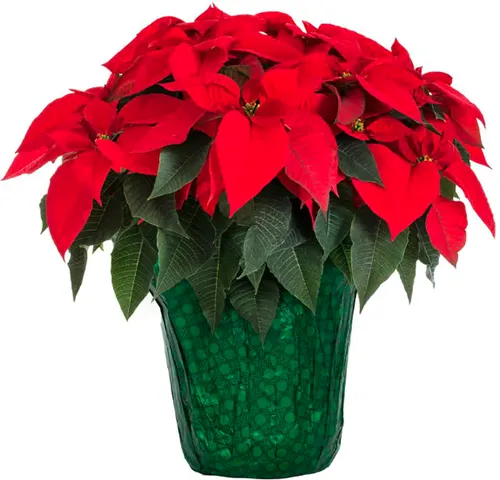
Often treated as disposable holiday decorations, poinsettias (Euphorbia pulcherrima) can be kept on as houseplants that will provide a yearly display of bright color if given the right care.
Beyond the standard red, poinsettias can also be found in hues such as white, pink, purple, orange, yellow, or salmon. Variegated poinsettias offer even more choice.
The poinsettia’s color comes not from its flowers but from bracts – colorful, modified leaves.
To encourage your plant to produce these colorful leaves each year, you’ll have to let it go through a multi-week period of rest with long nights and cooler temperatures, followed by a pre-bloom season of bright sunlight.
You can learn more about this process here.
Poinsettias originate in dry forests in Mexico and Guatamala, so they don’t need as much water as many of the tropical houseplants that you may be familiar with.
Place your poinsettia near a bright window so it gets plenty of indirect sunlight. And make sure to keep it away from drafts – poinsettias prefer steady, warm temperatures between 65 to 75°F.
Poinsettias may be a bit fussy to keep as long-term houseplants, but their showy bracts are worth the trouble.
Red Poinsettia
You can find a red poinsettia in a one-and-a-half-gallon pot wrapped in decorative green foil available from Home Depot.
Read more about growing and caring for poinsettia plants here.
17. Polka Dot Plant
Polka dot plant (Hypoestes phyllostachya) is another one you’ll love for its foliage. It has similar colors and patterns to fittonia, but grows taller and has larger leaves.
The brightly colored leaves of the polka dot plant are mottled white or pink with green veins. This houseplant would brighten up a corner or add texture when arranged in a grouping with some flowering specimens.
It grows to one to two feet tall with a one-foot spread and prefers high humidity. Don’t let it dry out entirely between waterings, but make sure it doesn’t stand in water either.
Regular misting will help it with its humidity needs. Make sure to provide it with medium to bright indirect light.
Pink Polka Dot Plant
If pink is the shade that brightens your days, you can find plants in two-and-a-half-inch pots available from Hirt’s Gardens via Walmart.
18. Rex Begonia
Like alocasia, rex begonias (Begonia rex cultorum) are all about dramatic foliage. Also known as painted-leaf, fancy-leaf, or king begonias, these plants are attention grabbers.
Related to the more mild-mannered wax begonia, rex begonias have strikingly patterned foliage, ranging from splotches to spirals, in mixes of silver, greens, reds, pinks, purples, and black.
These houseplants are fairly demanding. They don’t like wet feet, but require a humid environment, so misting with a spray bottle will be an important part of your care routine.
Make sure to give your rex begonias bright but indirect sunlight.
Rex Begonia
If you’re ready to create some drama with your indoor foliage, you can find red rex begonias in two-and-a-half-inch pots available from Hirt’s Gardens via Walmart.
Find tips on caring for rex begonia plants here.
19. Spiderwort
Spiderwort, a member of the Tradescantia genus, is one of my favorite houseplants, period.
It’s a no muss, no fuss option that’s elegant and so easy to propagate from cuttings. It’s also known as inch plant.
Its trailing foliage comes in various color combos, including solid green, solid dark purple, striped white and green, striped green and purple – or, my favorite, striped green and lilac.
Spiderwort is frequently found in hanging baskets, but you can also feature this fast-growing plant in smaller, decorative tabletop containers.
Let the top inch of the soil dry between waterings. Spiderwort will thrive in a variety of indoor light conditions, from medium to bright indirect sunlight.
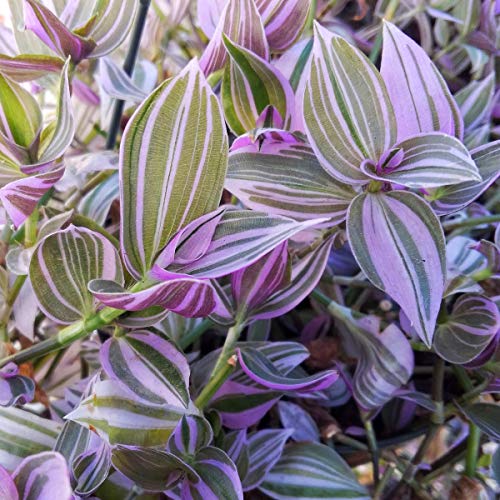
Green and Lilac Spiderwort
You can get your own green and lilac spiderwort in two-and-a-half-inch pots from Kauai Garden via Amazon.
Learn more about growing and caring for spiderwort plants here.
20. Succulents
While the term succulent does not refer to a specific species, genus, or family, these plants are often sold under this term without much further identification.
But that doesn’t mean we should pass them up!
Succulents come in a fascinating variety of colors, shapes, and sizes. Some even have beautiful patterns on their leaves.
They are available in in gorgeous pastels, muted reds, beautiful blues, bright lime greens, and many other hues.
Some of the genera that are commonly sold under the more generic term “succulents” include Sempervivum, Echeveria, and Lithops.
You can learn more about these fascinating plants in our article about 11 easy to care for exotic succulents.