Protestors gathered outside Children’s Hospital Los Angeles in February after President Trump’s executive order to stop federal funding for hospitals that provide gender-affirming care to children.
Robyn Beck/AFP via Getty Images
hide caption
toggle caption
Robyn Beck/AFP via Getty Images
Access to gender-affirming care for transgender youth will be dramatically restricted by the Trump administration under new proposals by the Department of Health and Human Services.
NPR has obtained the draft text of a proposed rule that would prohibit federal Medicaid reimbursement for medical care provided to transgender patients younger than age 18. It also prohibits reimbursement through the Children’s Health Insurance Program or CHIP for patients under age 19.
An additional proposed rule would go even further, blocking all Medicaid and Medicare funding for any services at hospitals that provide pediatric gender-affirming care.
The rules are being prepared for public release in early November, according to an employee at the Centers for Medicare and Medicaid Services. The employee asked that NPR not use their name because they fear professional retribution for speaking to the media without authorization. An HHS spokesperson did not respond to a request for comment about the planned timing of the proposed rules’ release.
A near ban in all states
Both supporters and opponents of transgender rights agree that, taken together, the forthcoming rules could make access to pediatric gender-affirming care across the country extremely difficult, if not impossible. The care is already banned in 27 states.
“These rules would be a significant escalation in the Trump administration’s attack on access to transgender health care,” says Katie Keith, director of the Center for Health Policy and the Law at Georgetown University.
“I think it’s really, really important to note that nothing is changing immediately,” she explains. “These would be proposals that would go out for public comment, it would take months for the Trump administration to issue a final rule, and then, if past is prologue, we would see litigation over whatever the final rules are.”
Administration goals
In his first days in office, President Trump signed an executive order declaring that the United States “will not fund, sponsor, promote, assist, or support the so-called ‘transition’ of a child from one sex to another.”
In the months since, HHS released a report critical of the research that supports access to this care. A federal suicide prevention lifeline specifically for transgender youth was cancelled, as were hundreds of millions of dollars in scientific research funding related to LGBTQ people. Federal health officials warned state Medicaid directors to tread carefully, and the Department of Justice announced subpoenas of some children’s hospitals and threatened providers with prosecution.
“I think these restrictions are very good,” says Terry Schilling of the forthcoming rules. Schilling is president of the American Principles Project, a conservative advocacy group. “It’s going to change the entire transgender industry, and it’s going to take away a lot of their funding streams.”
He points to an opinion poll from the spring, which found 66% of the public opposes Medicaid coverage for this type of care for young people.
“They believe that if you want to get some type of sex-trait modification procedure, you should have to pay for it,” Schilling says. “The American people are fully behind this effort.”
Dramatic new expansion of power
The proposal to condition a hospital’s participation in Medicaid and Medicare on halting gender-affirming care for youth represents an “unprecedented” use of the executive branch’s power to control what medical care is available in hospitals, says Keith.
“Because Medicare is such a significant portion of many hospitals’ revenue,” she explains, the rule would essentially force hospitals to end their gender careprograms for transgender youth. That would mean all of those programs’ patients — whether they have Medicaid or private insurance — would lose access.
This is not how the federal government normally uses this type of rule, Keith says. She served in the Biden administration on the Gender Policy Council, and worked on some “conditions of participation” regulations for Medicare and Medicaid, she says. “They’re so basic — it’s like, you have to have a crash cart [with] enough medicine to help a pregnant woman in crisis.”
Instead of health and safety standards, this proposal would instruct hospitals “to stop offering a certain type of care completely to a certain patient population,” she says.
Law professor Katie Eyer of Rutgers University questions whether such a rule would survive a court challenge. “But if it were successful, I shudder to think what this administration would do with such a tool in their hands,” she says. It could open the door for any White House to withhold all federal funding from hospitals over the provision of medical care that it disfavors.
“The writing has been on the wall that this has been coming,” says Lindsey Dawson, director of LGBTQ Health Policy at KFF, a nonpartisan health research organization.
Yet the timing of the release has been a mystery for months. Notice of both proposed rules — though not the rules themselves — appeared on a government register over the summer, and it’s been unclear why they have yet to be released, Dawson says.
‘An obsessive focus’
The administration’s efforts on transgender issues stretch far beyond health policy and beyond youth. The Federal Trade Commission recently hosted a workshop “on unfair or deceptive trade practices in ‘gender-affirming care’ for minors.” The military forced out transgender servicemembers. Universities have been told their federal funding is contingent on adopting anti-transgender policies on issues like bathroom access.
Even the impending lapse in funding for food assistance, or SNAP, is linked to Democratic support for “gender mutilation procedures,” according to a banner on the Department of Agriculture website.
“It’s endless,” says Eyer. “It really has been an obsessive focus that’s been deployed across the administration.”
The warning letters and cancelled grants and more have had a significant chilling effect. In the states where the care is still legal, many clinics and hospitals have ended their programs for gender-affirming care. If these rules were to take effect, the remaining programs would likely follow suit.
“There are real people behind all this,” says Eyer, who is also the parent of a transgender child. “People are really scared and suffering as a result of this onslaught of attacks on the trans community.”
It’s still legal, although access is shrinking
Gender-affirming care for youth — including puberty blocking medications, hormones, and rarely, surgery — does not actually violate federal law, Eyer notes. And, despite recent political pressure, no major U.S. medical organization has altered their clinical guidance that supports these treatments as appropriate and safe.
Approximately 3% of youth in the U.S. identify as transgender or nonbinary, although not all of them seek medical treatment related to their identity.
Notably, in Utah, a state-commissioned analysis of the evidence recently came to the opposite conclusion as the Trump administration’s transgender report. University of Utah researchers found that there was ample evidence of benefits and safety for these treatments, and wrote that policy restrictions on this care for youth “cannot be justified based on the quantity or quality of medical science findings or concerns about potential regret in the future.”
The draft text of the proposed federal rule obtained by NPR does not mention the Utah analysis, nor does it cite the American Academy of Pediatrics, whose guidelines also support access to the care.
In Eyer’s view, the public release of these rules will offer the opportunity for them to be legally challenged.
“It will be subject to arbitrary and capricious review, and a court will presumably take a close look at the factual basis that actually underlies it,” she says. “That is actually preferable to what we’ve had up until now, which is coercion without law.”
Gardeners work whole year by planting flowers, trimming shrubs and feeling excited about every new bloom.
Christmas is the season where most plants go dormant, but your front yard can be amazing spot where to host holiday celebrations.
The perennials and groundcovers you’ve been nurturing all year add depth to your front yard Christmas décor.
Cool thing about being a gardener is that your front yard gardening and Christmas decorating really complement each other.
Your existing plants give you natural anchors for lights, your pathways guide visitors to your festive displays, and those garden structures you built in summer—like trellises or arbors—suddenly become magical when you wrap them in twinkling lights.
Plus, decorating around your plants is way easier than starting from scratch because the foundation is already there.
Even if you’re a small-time gardener, transforming your front yard for Christmas doesn’t mean covering up your gardening efforts.
It’s about enhancing what’s already there.
37 Front Yard Christmas Decoration Ideas
It’s time to put your creative side on brain on work. Below mentioned décor ideas will contribute enough to get your own décor this festive.
Note: Below images are moidifed using AI
1. Classic Luminous Pathway
Line your front walkway with luminarias or solar-powered stake lights to create a warm, welcoming glow. These simple decorations guide guests to your door while adding a magical ambiance to your entire front yard. You can use traditional paper bag luminarias with sand and candles, or opt for more weather-resistant LED versions that’ll last the entire season.
The beauty of pathway lighting is how it works with your existing landscaping. Space them evenly along both sides of your walkway, or cluster them near garden beds for extra impact. They’re especially stunning when snow falls, creating a fairy-tale effect that makes your front yard look like something out of a holiday movie.
Wrap your existing evergreen shrubs with warm white or multi-coloured string lights to transform them into glowing focal points. This decoration works beautifully because you’re enhancing what’s already there—no need for artificial trees or props. Start from the base and work your way up, weaving lights through the branches for full coverage.
The trick is choosing the right light density for your shrub size. Larger bushes can handle denser lighting, while smaller ones look better with a delicate touch. This approach also protects your plants since you’re not drilling or damaging them, just gently tucking lights into their natural structure.
3. Giant Illuminated Bow on Front Door
Create a showstopping entrance with an oversized bow mounted right on your front door or above it. You can make this yourself with wide outdoor ribbon, or purchase pre-lit versions that add extra sparkle. The bow serves as an instant focal point that draws the eye and announces the holiday season to everyone who passes by.
Choose colors that complement your home’s exterior—classic red and gold work with traditional homes, while silver and blue suit more modern aesthetics. Add matching smaller bows to your porch railings or mailbox to tie the whole look together and create a cohesive design throughout your front yard.
4. Candy Cane Border
Line your driveway, walkway, or garden beds with classic candy cane stakes for a playful, traditional look. These iconic decorations are inexpensive, easy to install, and instantly recognizable. Space them about 2-3 feet apart for the best visual effect, and make sure they’re pushed deep enough into the ground to withstand winter winds.
Candy canes work especially well if you have kids—they love the whimsical touch. You can find them in various sizes, from small 12-inch versions to giant 4-foot ones. Mix different sizes for added interest, or stick with uniform heights for a more polished appearance.
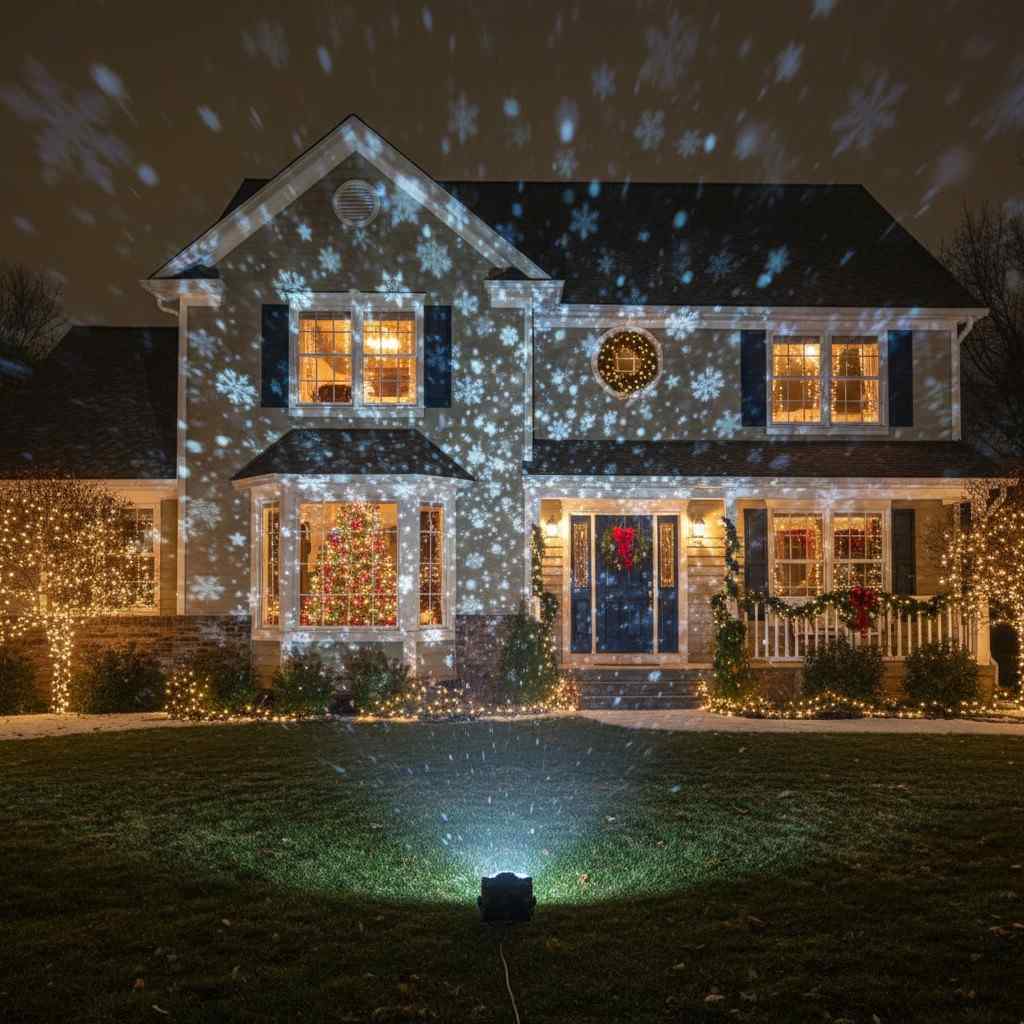
5. Snowflake Light Projector
Mount a snowflake projector on your home or a garden stake to cast moving snowflake patterns across your house facade or lawn. These projectors create dynamic displays without any installation hassle—just plug in and point. They’re perfect for covering large areas quickly and adding movement to your decorations.
The dancing snowflakes create a mesmerizing effect that looks different every time you glance at it. Position the projector to highlight your home’s best architectural features, or aim it at a blank wall for maximum impact. They work beautifully in combination with static decorations, adding that extra layer of magic.
Drape fresh or artificial garland wrapped with lights along your porch railings for classic Christmas elegance. Real garland brings that authentic pine scent, while artificial versions last longer and require less maintenance. Secure it well with zip ties or wire to prevent sagging, and make sure the lights are evenly distributed throughout.
Add accents to your garland with pinecones, ribbons, or ornaments to personalize the look. The combination of greenery and lights creates depth and texture that flat decorations can’t match. This decoration also frames your porch beautifully, making your entire entrance feel wrapped like a gift.
7. Inflatable Christmas Characters
Set up inflatable Santas, snowmen, reindeer, or other holiday characters on your lawn for instant festive impact. These self-inflating decorations are incredibly easy to set up and store, making them perfect for busy gardeners. Choose sizes appropriate for your yard—oversized inflatables work great on large lawns, while smaller ones suit compact spaces better.
Position your inflatables strategically near garden beds or trees so they look integrated into your landscape rather than randomly placed. Most come with built-in lights, so they glow from within at night. Stake them down securely, especially if you live in a windy area, to keep them upright throughout the season.
Place electric candles in each front-facing window for a warm, traditional display that’s visible from the street. This simple decoration creates a cohesive look across your home’s facade and gives off a welcoming glow. Choose battery-operated or plug-in versions with timers so you don’t have to remember to turn them on each evening.
Window candles work particularly well for colonial or traditional-style homes, but they suit almost any architecture. Use matching candle styles in all windows for uniformity, or vary the heights slightly for a more natural appearance. They’re understated yet elegant, perfect if you prefer classic over flashy.
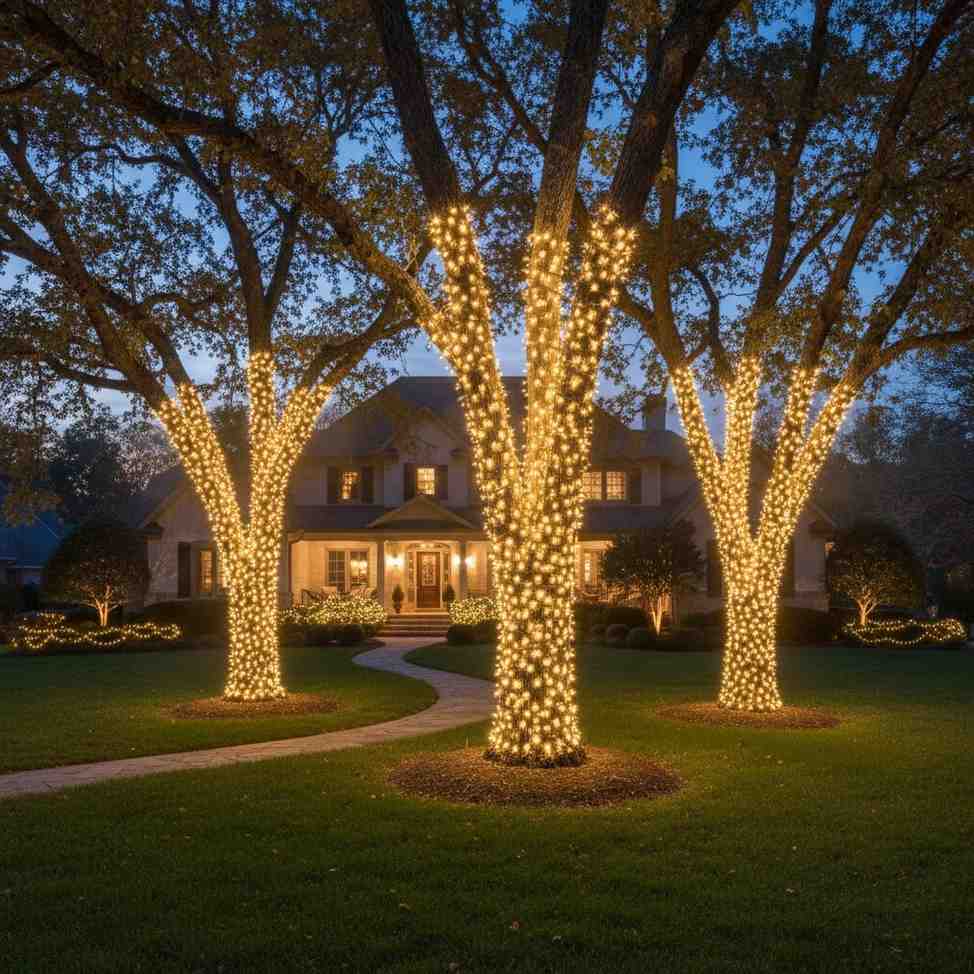
9. Light-Wrapped Tree Trunks
Wrap the trunks of your front yard trees with strings of lights from base to first branches. This technique highlights your mature trees and adds vertical interest to your display. Use warm white lights for an elegant look, or go with colors that match your overall theme. The key is wrapping tightly enough that lights don’t slip but not so tight that you damage the bark.
This decoration creates stunning pillars of light that anchor your entire front yard design. It works especially well if you have multiple trees—wrap them all for a coordinated forest effect. The wrapped trunks also provide ambient lighting that makes your whole yard feel magical without overwhelming your space.
10. Decorative Mailbox Makeover
Transform your mailbox into a Christmas statement piece with garland, ribbons, and small ornaments. Wrap the post with waterproof ribbon or attach a wreath to the mailbox front. Add battery-operated string lights for evening sparkle. This small touch makes a big impact since mailboxes are right at street level where everyone can see them.
Make sure your decorations don’t interfere with mail delivery—keep the door accessible and avoid blocking the flag. Use weatherproof materials since your mailbox is fully exposed to the elements. Coordinate your mailbox decor with your front door decorations for a pulled-together look.
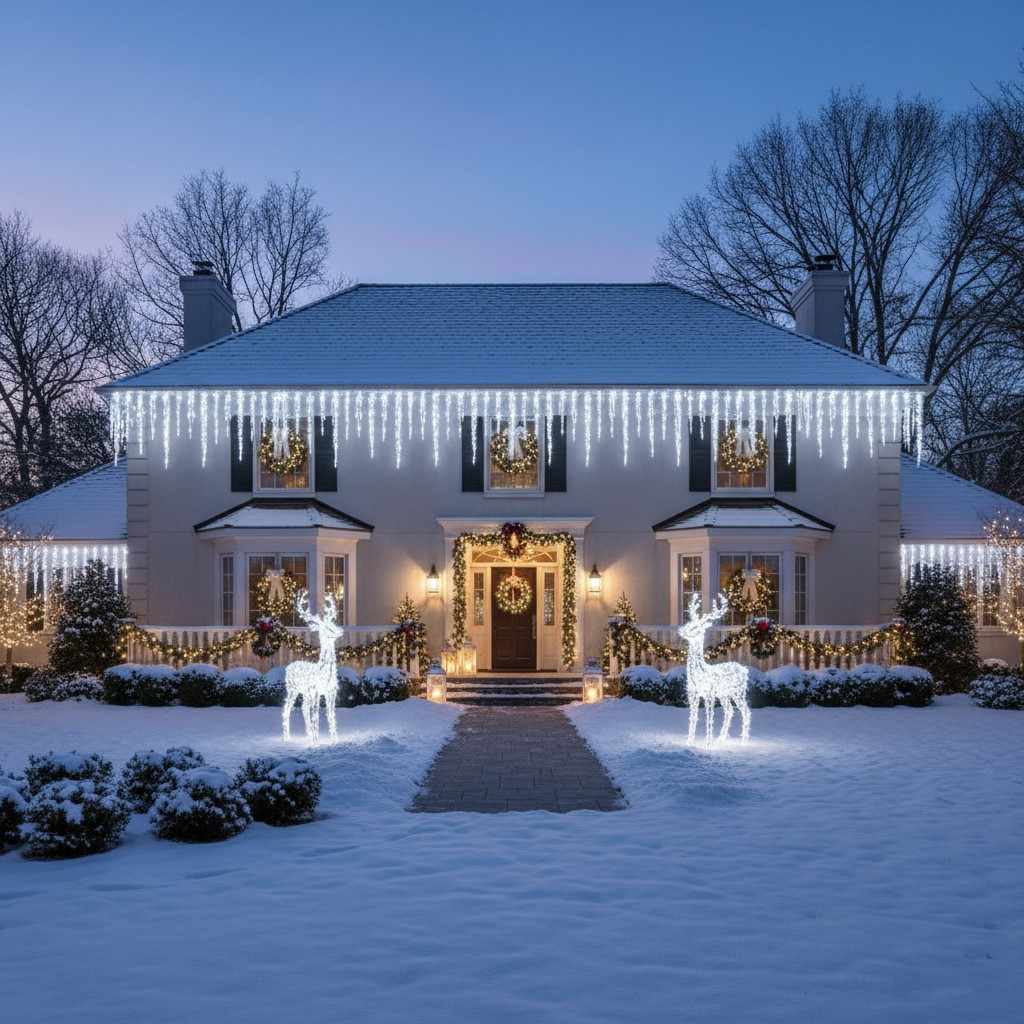
Hang icicle lights along your roofline to mimic the look of real ice formations. These cascading lights create beautiful draping effects that highlight your home’s architecture. Space them evenly and make sure they hang straight for the cleanest look. Use all-white icicle lights for an elegant, winter wonderland effect, or choose colored ones for a more festive vibe.
Installation takes some effort, but the impact is worth it—your home becomes a glowing beacon visible from down the street. Many modern icicle lights come with various lighting patterns and timers for added convenience. They work beautifully in combination with other decorations, providing a cohesive backdrop for everything at ground level.
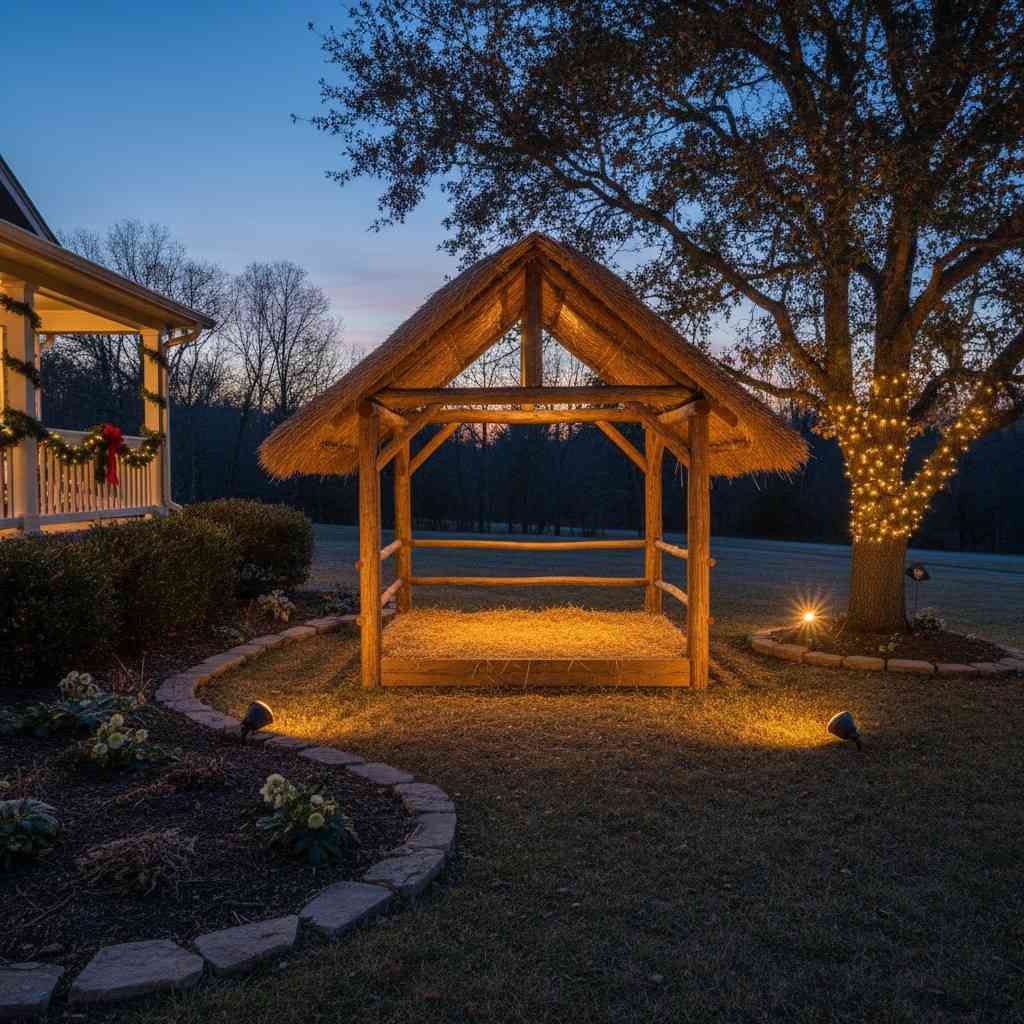
12. Nativity Scene Display
Set up a nativity scene in your front yard as a meaningful focal point. You can choose from simple silhouette versions, detailed figurines, or even life-sized displays depending on your space and budget. Position it where it’s visible from the street but protected from foot traffic, perhaps in a garden bed or on your lawn near a tree.
Light your nativity scene with spotlights or stake lights to make it visible at night. Some sets come with built-in lighting, while others need separate illumination. This decoration adds religious significance to your display and creates a peaceful, contemplative spot in your otherwise festive yard.
13. Lighted Deer Family
Place illuminated wire-frame or mesh deer figures on your lawn for a woodland Christmas theme. These sculptures come in various poses—grazing, standing alert, or even with moving heads. Arrange them as a family group with varying sizes to create a natural scene. Position them near trees or shrubs so they look like they’ve wandered into your yard.
The three-dimensional quality of deer figures adds depth to your decorations that flat displays can’t achieve. They’re especially charming when dusted with snow. Most are lightweight and easy to move, so you can adjust their positions until you find the perfect arrangement.
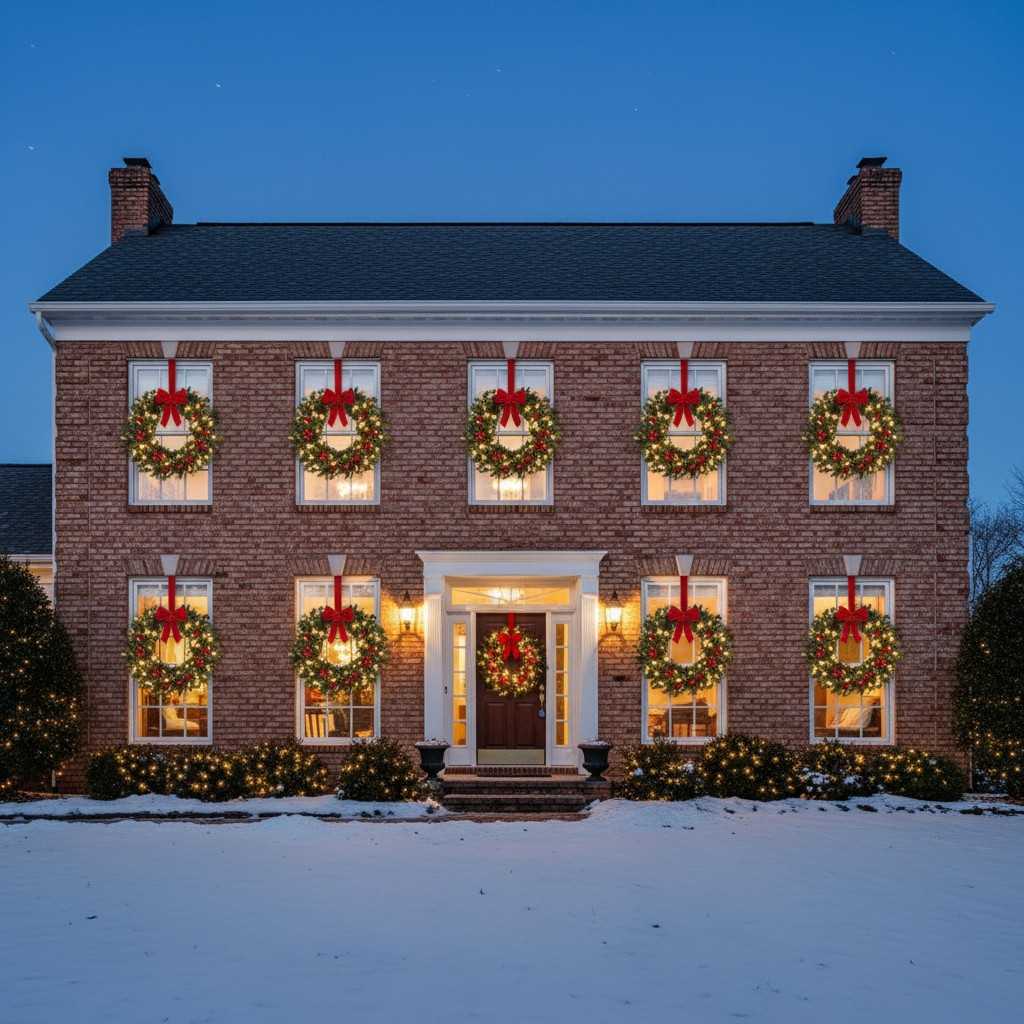
14. Wreath on Every Window
Hang matching wreaths in each front window for a cohesive, polished look. Use suction cup hangers or ribbon to suspend them at the same height in each window. Choose wreaths with built-in lights or add battery-operated string lights for evening glow. This creates a repeated pattern across your home’s facade that’s visually striking.
Coordinate your window wreaths with your front door wreath for maximum impact. You can go traditional with evergreen wreaths, or try something different like grapevine wreaths with red berries. The repetition creates rhythm and makes your entire front yard feel intentionally designed.
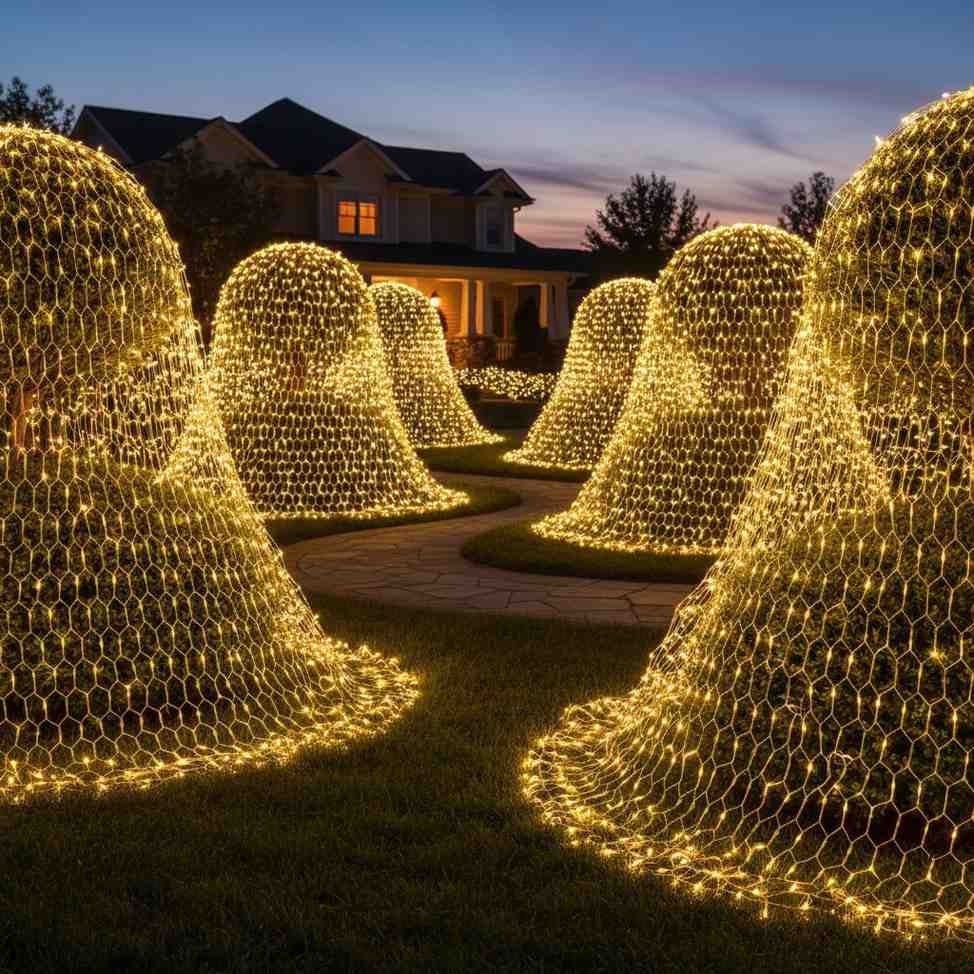
15. Cascading Light Net on Bushes
Drape light nets over your front bushes for quick, even coverage that looks professionally done. These pre-connected lights spread evenly and eliminate the tangled mess of individual strings. They’re particularly effective on rounded bushes where they can be shaped to follow the plant’s natural contours.
Net lights save tons of installation time while creating a uniform glow. Choose net sizes that match your bush dimensions—too small and you’ll need multiple nets, too large and they’ll bunch awkwardly. They also store more neatly than loose strings, making next year’s setup even easier.
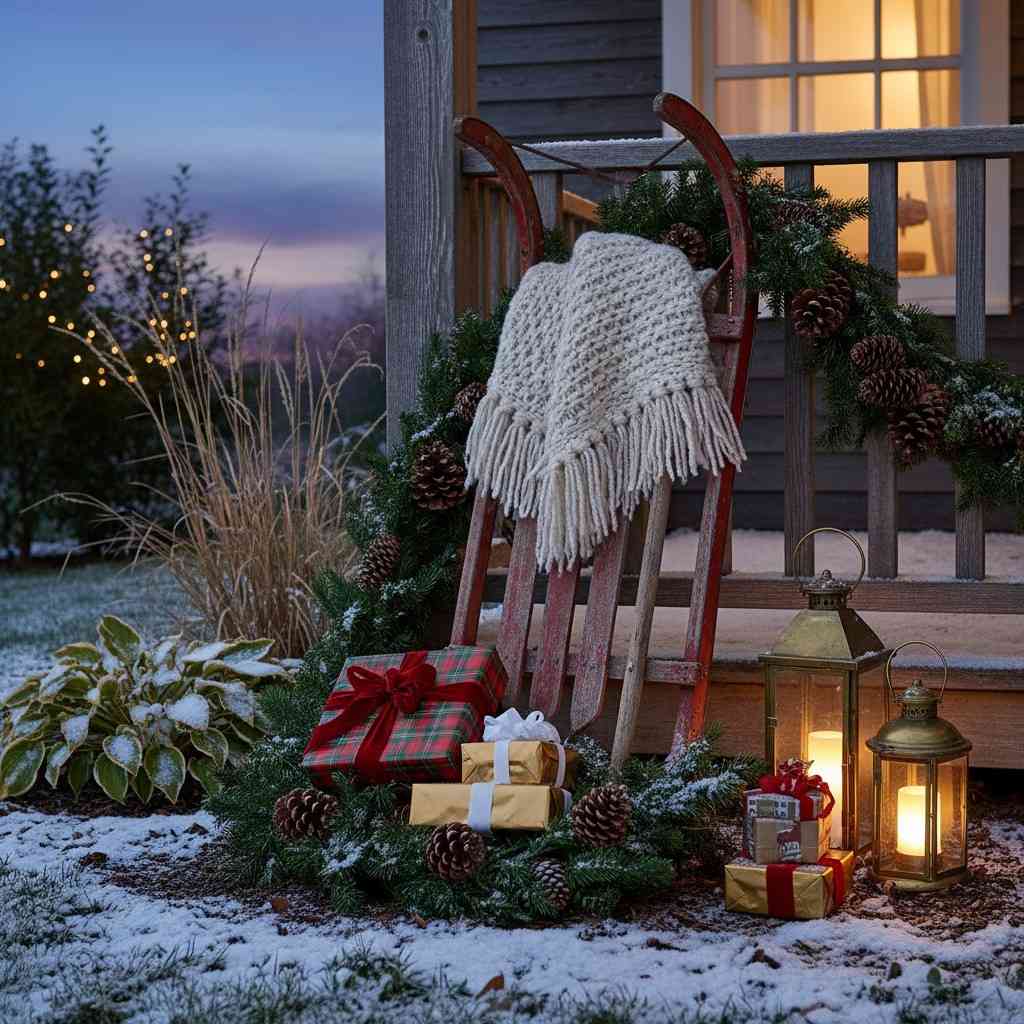
16. Vintage Sled Display
Lean a vintage wooden sled against your porch or prop it in a garden bed filled with evergreen boughs, pinecones, and wrapped presents. This nostalgic touch adds charm and serves as a unique focal point. You can find old sleds at antique stores or use a reproduction version for the same effect.
Decorate your sled with a cozy blanket draped over it, add some lanterns or small wrapped boxes, and tuck in some greenery for a complete vignette. Position it where it’s visible but won’t be knocked over. This decoration tells a story and creates a warm, welcoming feeling.
17. Lighted Snowflakes on House Facade
Mount large illuminated snowflake decorations directly on your home’s exterior walls. These come in various sizes and can be arranged in clusters or spread out across your facade. They add visual interest to blank wall spaces and create a winter wonderland effect. Use outdoor-rated hooks or clips designed for siding to avoid damage.
Vary the snowflake sizes for a more natural, falling-snow appearance. Combine them with icicle lights on your roofline for a coordinated ice and snow theme. The three-dimensional quality of these snowflakes makes them stand out during the day and shine beautifully at night.
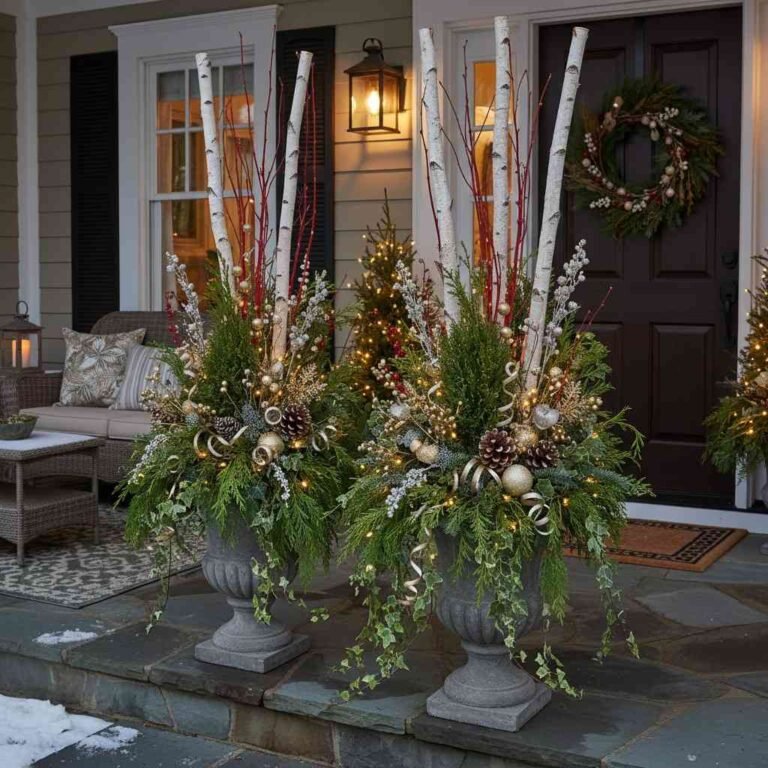
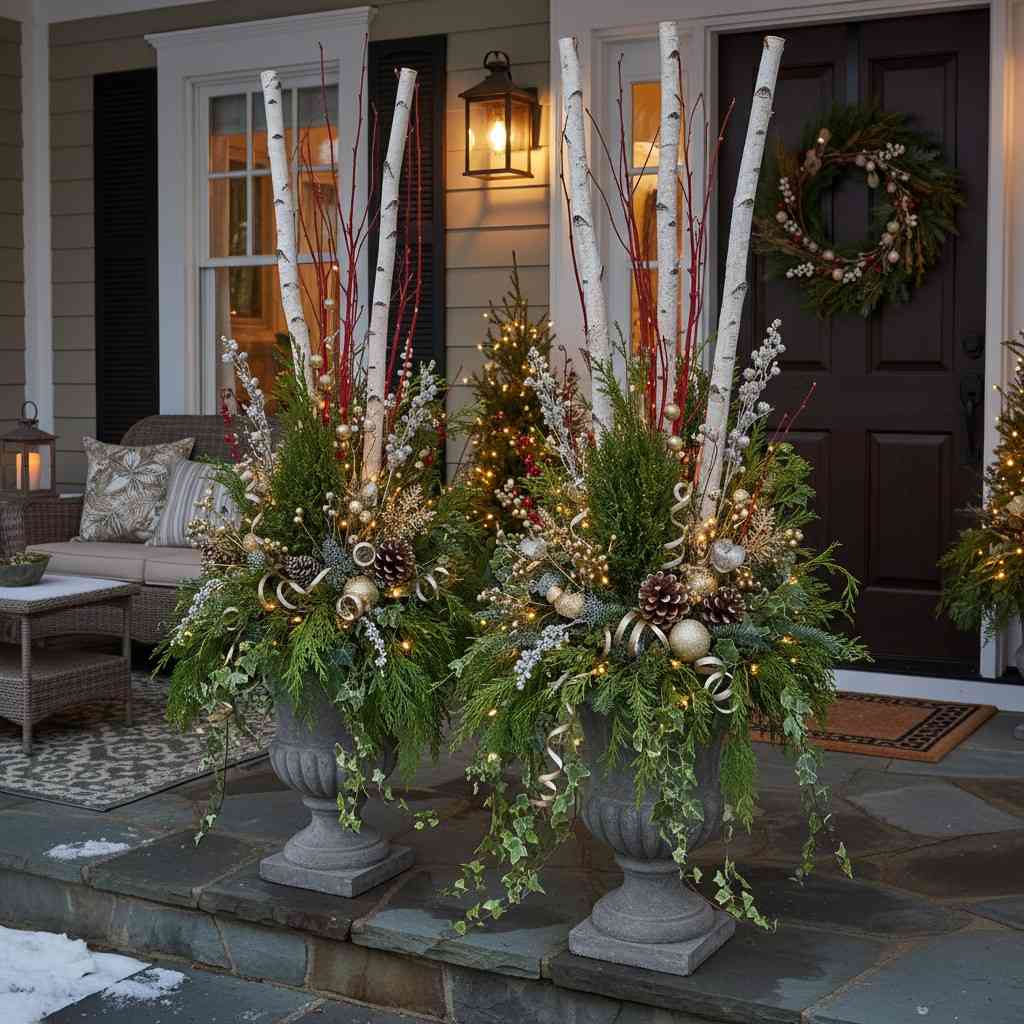
18. Festive Planter Arrangements
Fill your existing front porch planters with winter greenery, branches, pinecones, and holiday picks. Add small evergreen trees, birch branches, red twig dogwood, and ornamental elements. Tuck in some battery-operated string lights for evening sparkle. This transforms containers you already have into festive focal points.
Layer different heights and textures for visual interest—tall branches in back, medium evergreens in the middle, and trailing elements like ivy at the edges. Add decorative elements like large ornaments on stakes or ribbon bows. These arrangements look sophisticated and work with your existing porch furniture and layout.
19. Star or Angel Tree Topper Spotlight
Place a large illuminated star or angel at the peak of your tallest front yard tree. This creates a stunning focal point visible from far away and adds height to your overall display. Secure it properly so it won’t blow off in winter winds. You can use a pole extension or ladder for installation, depending on your tree height.
The tree topper draws the eye upward and makes your decoration feel complete and intentional. Choose a size proportional to your tree—too small and it gets lost, too large and it looks awkward. Coordinate the style with your other decorations for a cohesive theme.
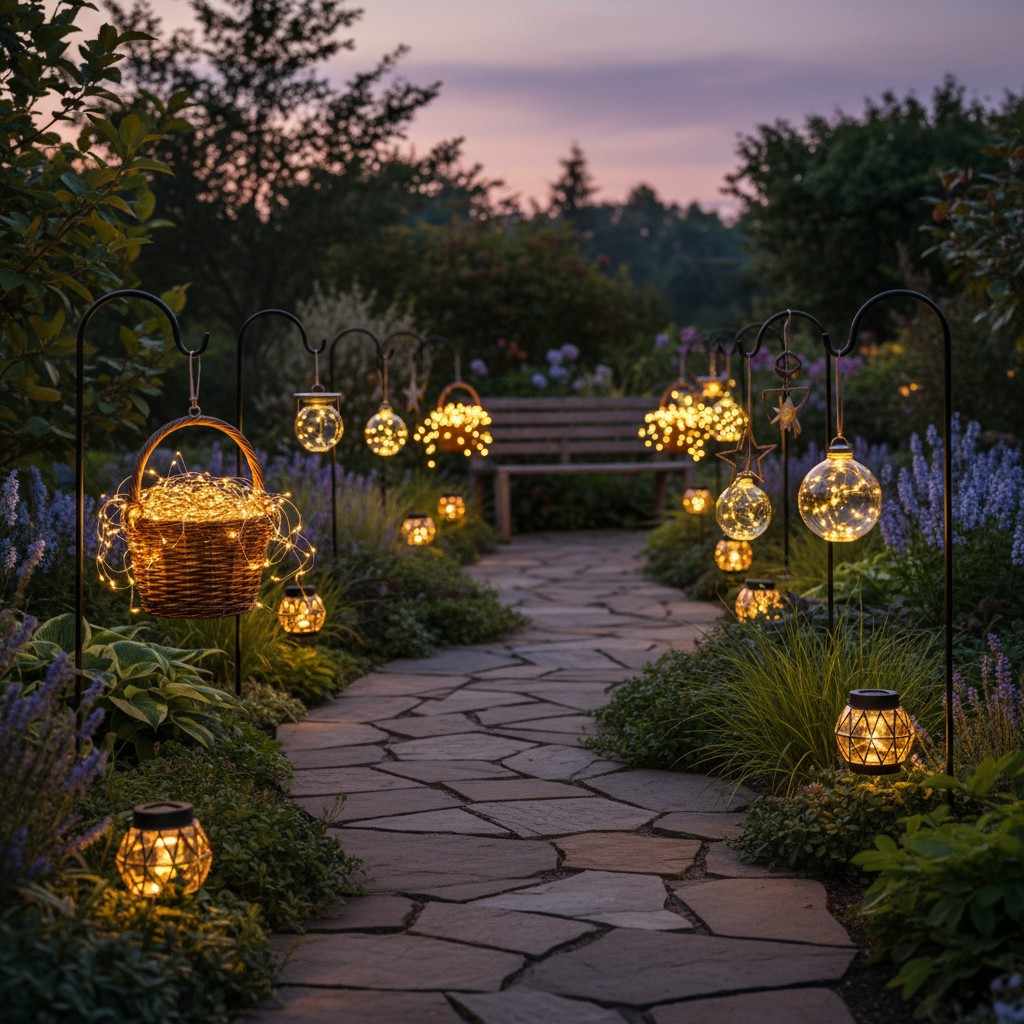
20. Shepherd’s Hook Light Displays
Use shepherd’s hooks with hanging lanterns, baskets filled with lights, or suspended ornaments along your walkway or garden beds. These hooks are easy to install and remove, making them perfect for temporary decorations. Space them evenly for rhythm, or cluster them in groups of three for more impact.
Hang matching elements from each hook for uniformity, or vary them slightly for interest. Add solar lanterns for an eco-friendly option that requires no electrical work. The hooks also work year-round, so you can swap decorations seasonally rather than storing specialized stakes.
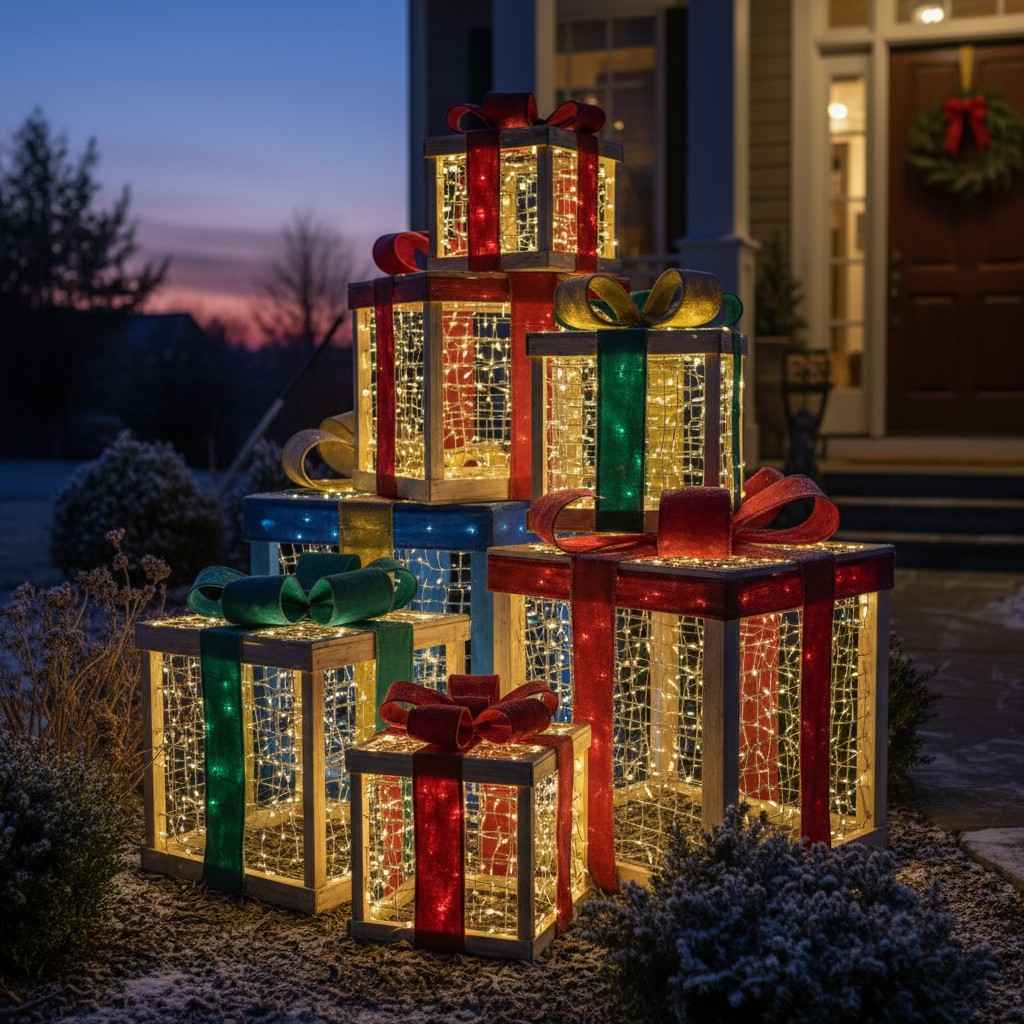
21. Lighted Gift Box Stack
Create stacked gift boxes using wooden frames wrapped with weatherproof ribbon and lights. These faux presents can be any size—from small 12-inch cubes to large 3-foot boxes. Stack them in pyramids or casual clusters near your entrance or in garden beds. They add color, geometry, and whimsy to your display.
Build them sturdily so they won’t collapse in wind or snow. You can make them yourself with wood frames and chicken wire, or purchase pre-made versions. Add oversized bows on top for extra flair. These “presents” look great during the day and glow beautifully at night.
22. Pinecone and Branch Arrangements
Fill large outdoor urns or containers with collected branches, pinecones, and evergreen sprigs for a natural, rustic look. Spray some pinecones with gold or silver paint for extra sparkle, or leave them natural for organic beauty. Add height with birch or curly willow branches. These arrangements cost almost nothing if you gather materials from your own yard.
Position these natural arrangements on porch steps, flanking your front door, or in empty garden beds. They bridge the gap between your year-round gardening and holiday decorations. Add some battery-operated fairy lights woven through the branches for evening glow without overwhelming the natural aesthetic.
23. Porch Column Wraps
Wrap your porch columns with garland and lights from top to bottom, creating glowing pillars that frame your entrance. Start at the top and spiral down, securing as you go with clear fishing line or zip ties. This technique works whether you have traditional round columns or square posts. The wrapped columns create a grand entrance effect.
Add large bows at the top or bottom of each column for extra polish. Use matching garland on your porch railings to tie everything together. The vertical elements draw the eye upward and make your entire porch feel taller and more impressive.
24. Hanging Porch Ornaments
Suspend large outdoor ornaments from your porch ceiling at varying heights. Use different sizes and colors that complement your overall scheme. They add visual interest at eye level and above, filling vertical space that often gets neglected. Secure them well so they don’t swing wildly in the wind.
This decoration works particularly well if you have a covered porch with good ceiling attachment points. Cluster them in groups for more impact, or space them evenly across the ceiling. They catch light beautifully and add movement when they gently sway. Coordinate colors with your other decorations for a pulled-together look.
25. Illuminated Address Numbers
Replace or supplement your house numbers with illuminated versions for a subtle but effective decoration. You can use individual backlit numbers or create a decorative address plaque surrounded by lights and greenery. This practical decoration helps guests find your home while adding festive flair.
Mount your illuminated numbers where they’re clearly visible from the street. Surround them with a small wreath or garland to integrate them into your holiday theme. This decoration stays functional all season while contributing to your overall aesthetic—form and function working together perfectly.
26. Topiary Cone Trees
Create cone-shaped topiary trees using tomato cages or wire frames wrapped with lights and greenery. Stack them in graduated sizes for a miniature forest effect, or use single large ones as focal points. These DIY decorations are budget-friendly and can be customized to your exact specifications.
Place them flanking your front door, lining your walkway, or grouped in garden beds. The cone shape is classically Christmas and works with any decorating style from traditional to modern. Cover the frames completely with lights and greenery so the structure disappears, leaving only glowing trees.
27. Festive Flag or Banner
Hang a large Christmas flag or banner from your porch or mount it on your home’s facade. Choose designs that reflect your style—traditional Santa scenes, elegant snowflakes, or religious themes. These fabric decorations are easy to swap out and store flat, making them convenient for apartment or condo dwellers with limited storage.
Flags add instant color and pattern without requiring electrical work or complicated installation. They move gently in the breeze, adding life to your display. Coordinate your flag with your other decorations or let it stand as a bold statement piece on its own.
28. Ground Spotlight Wash
Install ground-level spotlights to wash your home’s facade with colored light—red and green are traditional, but blue and white create a winter wonderland effect. These lights are adjustable, letting you highlight architectural features or create ambient glowing effects. They transform your entire home into a holiday beacon.
Position spotlights far enough from your house to create wide, even coverage rather than harsh spots. Test different angles before finalizing placement. This lighting technique works beautifully as a foundation layer, with other decorations adding detail and interest on top of the colorful backdrop.
29. Wooden Cutout Displays
Set up painted wooden cutout figures of Santa, reindeer, snowmen, or other holiday characters in your yard. These weatherproof decorations can be handmade or purchased, and they add personality without requiring electricity. Paint them in bright colors so they’re visible during daylight hours, and add spotlights to illuminate them at night.
Cutouts work especially well grouped together to tell a story—Santa’s sleigh landing, snowmen building a snow fort, or reindeer prancing. Stake them securely into the ground and position them where they’re visible but won’t block walkways or garden views. They’re charming, low-maintenance, and weather-resistant.
30. Battery-Operated Lantern Path
Line your walkway with battery-operated lanterns for a warm, old-fashioned glow. Choose lanterns in consistent styles—traditional hurricane lanterns, modern cube designs, or rustic tin styles. Fill them with fairy lights, flameless candles, or holiday greenery. Space them evenly or cluster them in groups at key points along your path.
Battery operation means no extension cords to hide or trip over. Many modern lanterns include timers, so they turn on automatically at dusk. This decoration combines practicality with beauty—your walkway is safely lit while looking festive. Add red ribbons or small wreaths to lantern handles for extra holiday flair.
31. Archway with Lights and Greenery
Create an illuminated archway over your front walkway using a sturdy frame wrapped with lights and garland. This dramatic entrance makes guests feel like they’re entering a winter wonderland. You can build the frame yourself or purchase pre-made garden arbors. Cover it completely with lights, then add greenery and ornaments.
The archway creates a defined threshold that marks the transition into your holiday space. Make sure it’s tall and wide enough for comfortable passage—at least 7 feet high and 4 feet wide. Secure it firmly so it won’t topple in wind. This statement piece becomes the focal point of your entire front yard.
32. Window Box Makeover
Transform your window boxes with winter greenery, berries, and decorative picks. Fill them with small evergreen branches, red twig dogwood, pinecones, and ornamental elements. Add miniature pine trees or cypress, and tuck in some holly with bright berries. These planted boxes add life and color even in the dead of winter.
Window boxes create beautiful frames for your windows from outside while being visible from inside too. Water them occasionally if you use live plants, or go fully artificial for zero maintenance. Add small battery-operated lights woven through the greenery for evening sparkle. This decoration integrates perfectly with your year-round gardening efforts.
33. Rope Light Outlines
Use rope lights to outline your home’s architectural features—roof peaks, windows, doorways, or porch edges. This technique creates clean, professional-looking lines that define your home’s structure. Rope lights are weather-resistant and easier to install than individual bulbs since they’re one continuous strand.
Choose a single color for sophisticated elegance or alternate colors for a more playful look. The consistent glow creates a polished appearance that looks intentionally designed. Secure them with clips designed for your siding or roofing material to avoid damage. This decoration style works particularly well on modern or contemporary homes.
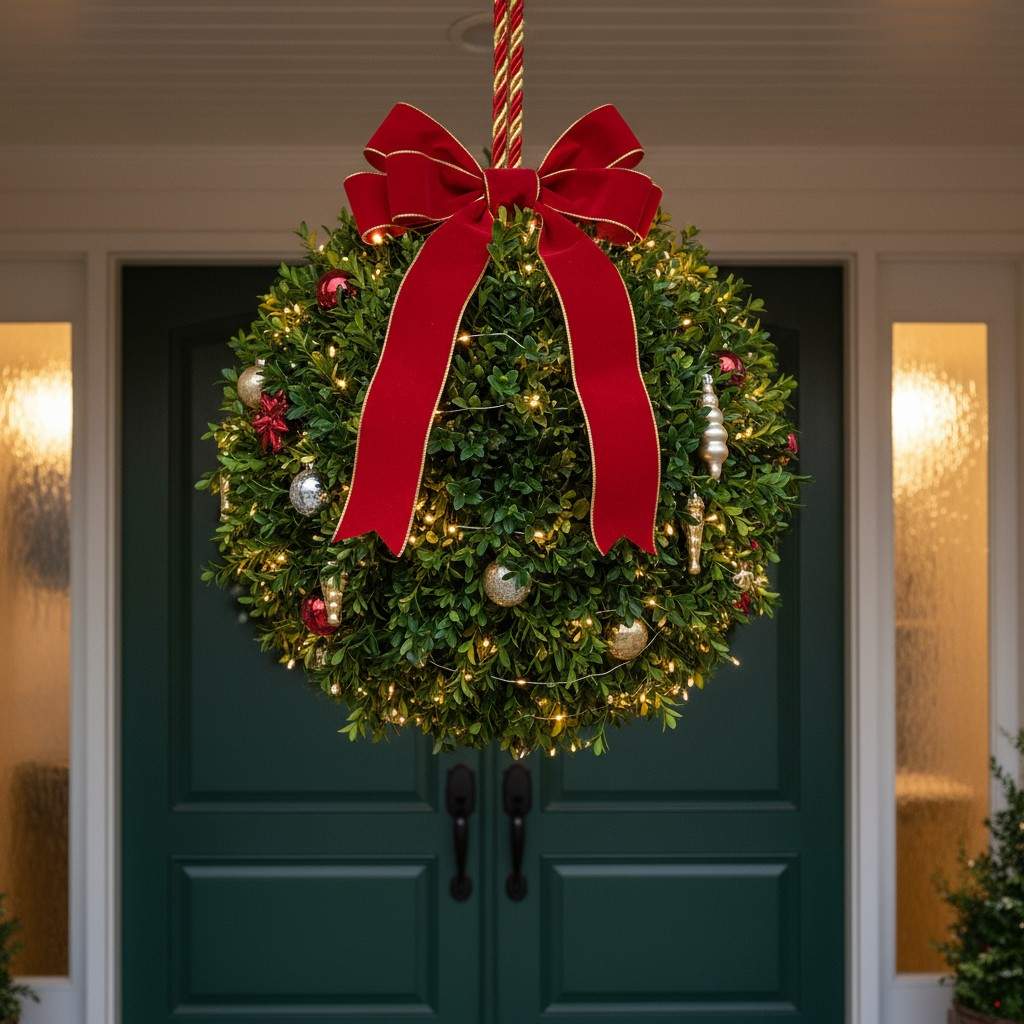
34. Kissing Ball or Pomander
Hang a traditional kissing ball or pomander (sphere covered in greens and ribbons) from your porch ceiling or above your front door. These spherical decorations add dimension and draw the eye upward. Make them yourself using foam balls covered with boxwood or purchase pre-made versions. Add a large bow and hang them with ribbon.
Position your kissing ball where it’s visible but won’t hit anyone’s head. They work beautifully in covered entryways or porch areas. The spherical shape contrasts nicely with other linear decorations, adding variety to your overall design. Include small lights or ornaments for extra sparkle.
35. Solar-Powered Stake Lights
Insert decorative solar stake lights throughout garden beds and along pathways. Choose Christmas-themed designs—snowflakes, stars, candy canes, or presents. These eco-friendly lights charge during the day and automatically illuminate at dusk. They’re perfect for areas without electrical access and require zero operating costs.
Vary heights and designs for visual interest, or use matching styles for uniformity. Solar stakes work beautifully in combination with other decorations, filling empty spaces and adding sparkle to garden areas. They’re incredibly easy to move and adjust, so you can experiment with different arrangements until you find what works best.
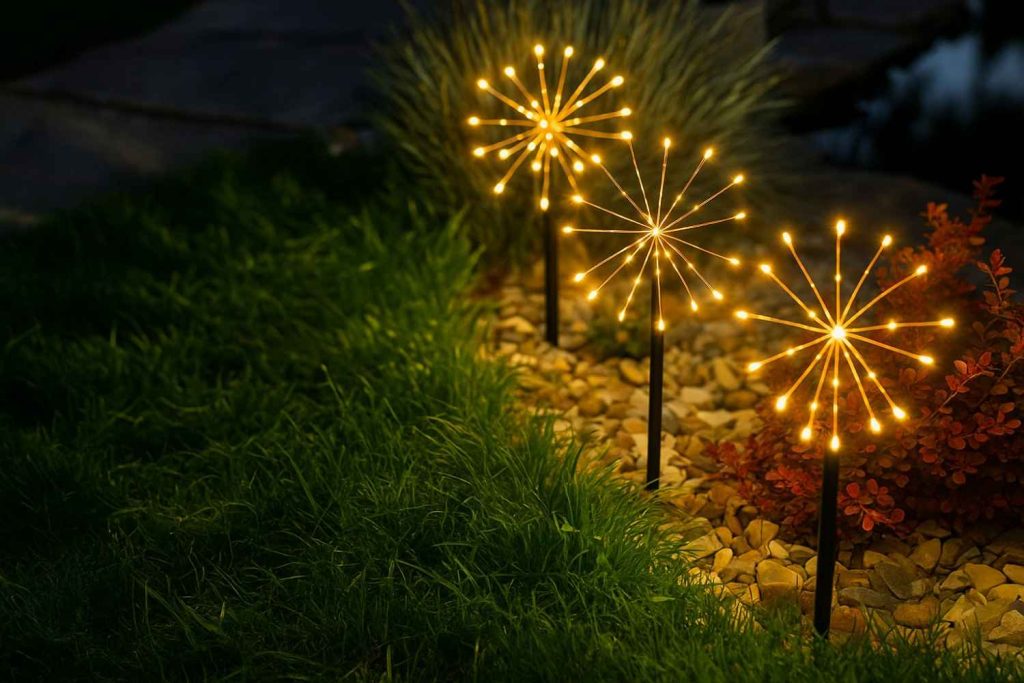
Push star burst or firework-style stakes into your lawn or garden beds for bursts of twinkling light. These decorations create the effect of stars exploding or fireworks frozen in time. They’re particularly striking when used in groups of varying heights. The branching wire arms covered in tiny lights create beautiful geometric patterns.
Place them strategically to fill empty lawn areas or add height to garden beds. They look delicate but are surprisingly sturdy. Many feature twinkling or color-changing options for added visual interest. These modern decorations work well with both traditional and contemporary decorating schemes, adding a magical touch to any style.
37. Themed Color Scheme
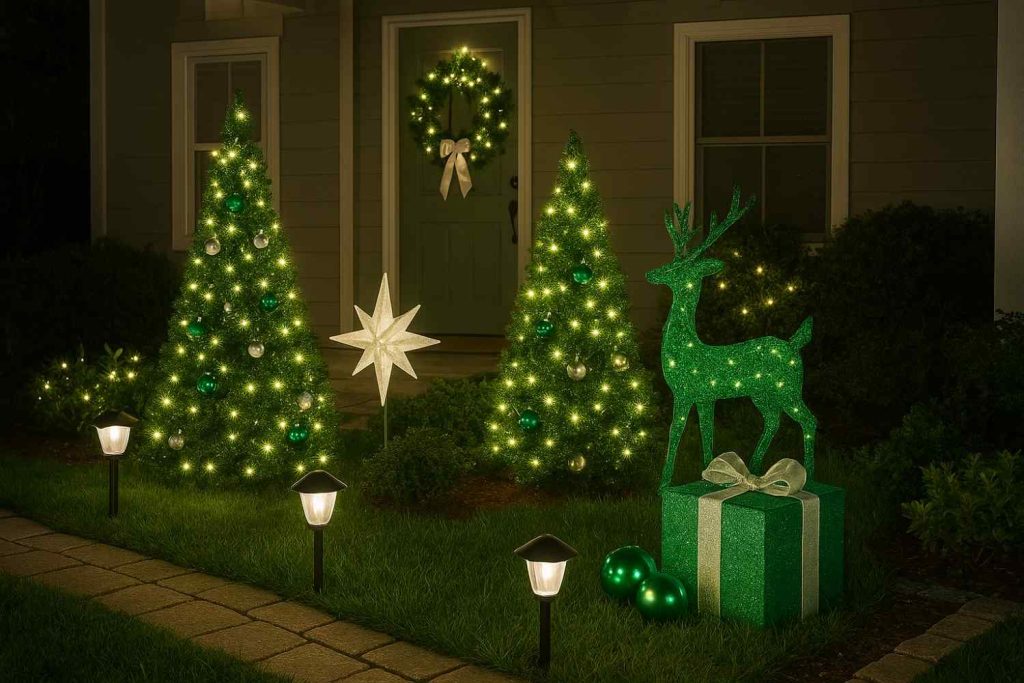
Choose a cohesive color palette and stick to it throughout all your decorations—classic red and green, elegant silver and gold, or modern blue and white. This coordination makes your entire display look professionally designed. Select lights, ribbons, ornaments, and all decorative elements in your chosen colors only.
A unified color scheme creates visual harmony and makes your front yard feel intentional rather than random. It’s easier to achieve this look by planning before you shop, then buying or making decorations that fit your palette. This approach also makes storage and setup easier each year since everything automatically coordinates. The cohesive look elevates your entire display from chaotic to sophisticated.
Conclusion
Your front yard is the perfect canvas for Christmas magic.
Start with key elements like pathway lights and illuminated shrubs, then layer decorations based on your style and budget. Your existing trees, pathways, and garden structures provide the framework—holiday lights add seasonal sparkle. Transform your yard into a winter wonderland!
Khaja Moinuddin, a computer science graduate, finds joy in gardening and homesteading. Join him on this blog as he shares his experiences in homesteading, gardening, and composting
Price: $13.32 - $7.82 (as of Oct 30, 2025 12:42:09 UTC – Details)
Fitvids Resistance Loop Bands Set – 5-Level Exercise Bands for Home Fitness, Physical Therapy & Strength Training (10-50lbs) 【5-Level Adjustable Resistance】 This complete set includes 5 color-coded bands (10/20/30/40/50lbs) that can be used individually or combined for up to 150lbs total resistance. The progressive resistance system accommodates beginners to advanced athletes for full-body training 【Professional Complete Kit】 Includes 5 latex resistance bands, 2 ergonomic foam handles, 1 door anchor, 1 ankle strap, and a portable carrying case. Everything needed for over 100+ exercises targeting arms, legs, glutes, back, and core muscles 【Premium Durability & Safety】 Made from 100% natural latex with double-layered construction and reinforced stitching. Features military-grade metal buckles that won’t slip or break, ensuring safety during intense workouts 【Total Body Training Solution】 Perfect for: physical therapy rehabilitation, muscle toning, strength building, yoga/pilates enhancement, and mobility training. The door anchor enables hundreds of additional exercises for complete home gym replacement 【Portable Gym Anywhere】 Lightweight compact bag, take your workout to the office, hotel room, park, or gym. The non-slip handles and ankle strap provide comfortable secure grip during sweaty sessions
Customers say
Customers find the resistance bands well-made and effective for workouts, particularly in aquafit classes, and appreciate that they come with cards showing different exercises. The bands offer multiple resistance levels, and customers consider them good value for money. They like the carry pouch that comes with the set. Durability receives mixed feedback – while some find them durable, others report them snapping during use.
This sesame ginger dressing features bright lime, fresh ginger, and a touch of honey for a tangy and flavorful twist that’s perfect for salads or marinades.
Price: $15.95 - $13.55 (as of Oct 30, 2025 00:38:42 UTC – Details)
【Anti Slip And Durable Design】These fabric resistance bands are made of thickened and reinforced fabric and anti slip rubber layers. They are flexible and durable, reinforced with rows of stitching, giving you a long-lasting user experience without sliding or rolling off 【Perfect 5 Levels Booty Bands Set】Five different color resistance bands represent different resistance levels. Different resistance levels give you more flexibility and choices to achieve all your exercise goals, whether you are a beginner or an experienced athlete 【Suitable For All Sports】The powerful exercise tool for women/men! You can do many exercises with these fitness belts, such as yoga, Pilates, squats, CrossFit, hot yoga, and more. These straps can exercise your hips, thighs, legs, and abdominal muscles, shaping your perfect hip curve 【Easy To Carry with Case】These booty bands for working out measures 14 “Lx 2.76” W. For your convenience, these fitness belts come with a carrying bag that allows you to exercise anywhere in your home, yard, park, gym, or even office, making them easy to carry and use 【What You Get】Five loop bands , Portable travel carry bag and training guide
Customers say
Customers find these resistance bands well-made and better than rubber ones, noting they stay in place and don’t roll during workouts. They appreciate the different resistance levels for various exercises and consider them good value for money. Customers find them comfortable and durable, though opinions about stretchability are mixed, with some finding them good while others report very little stretch.
Across the country, wildfire fighters work for weeks at a time in poisonous smoke.
Across the country, wildfire fighters work for weeks at a time in poisonous smoke.
The government says they are protected.
The government says they are protected.
We tested the air at one fire to find out why they are still dying.
We tested the air at one fire to find out why they are still dying.
Across the country, wildfire fighters work for weeks at a time in poisonous smoke.
Across the country, wildfire fighters work for weeks at a time in poisonous smoke.
The government says they are protected.
The government says they are protected.
We tested the air at one fire to find out why they are still dying.
We tested the air at one fire to find out why they are still dying.
It’s July and the Green fire is tearing through Northern California. An elite federal firefighting crew called the La Grande Hotshots has been sent to help. The 24-person crew has been working for days on the front lines, where invisible toxins hide in the thick haze.
More than 1,000 firefighters are on the fire. Several crews, including the La Grande Hotshots, are trying to contain the flames by building a trench of bare earth that will stretch from a road to a river bank. They’re doing this at night, in hopes that the cooler air will tamp down the smoke.
The crew knows that they’re risking their health.
The La Grande hotshots on assignment this summer.
La Grande Hotshots
One longtime member died last year after being diagnosed at 40 with brain cancer. A former crew leader is being treated for both leukemia and lymphoma diagnosed in his 40s. Another colleague was recently told that he has the lungs of a lifelong chain-smoker.
Wildfire fighters nationwide are getting sick and dying at young ages, The New York Times hasreported. The federal government acknowledges that the job is linked to lung disease, heart damage and more than a dozen kinds of cancer.
Casey Budlong, a La Grande Hotshot, died of cancer in 2024 after fighting fires for two decades. He left behind an 8-year-old son.
Katy Budlong
But the U.S. Forest Service, which employs thousands of firefighters, has for decades ignored recommendations from its own scientists to monitor the conditions at the fire line and limit shifts when the air becomes unsafe.
To find out how harmful the air gets on an average-size wildfire, Times reporters brought sensors to the Green fire this summer. We tracked levels of some of the most lethal particles in the air, called PM2.5, which are so tiny that they can enter the bloodstream and cause lasting damage.
Readings above 225.5 micrograms per cubic meter are considered hazardous. On the fire line, levels regularly exceeded 500.
The fire began on July 1 after a lightning storm passed over the Shasta-Trinity National Forest.
The fire began on July 1 after a lightning storm passed over the Shasta-Trinity National Forest.
By July 16, much of the area was shrouded in smoke.
By July 16, much of the area was shrouded in smoke.
Around 6 p.m., the La Grande Hotshots started their shift and set off toward the fire line.
Capt. Nick Schramm, a crew leader, assumed the air was reasonably safe. He has done this work for nearly two decades, and like most firefighters, he often has coughing fits after long shifts. But he believes that exposure to hazardous air is unavoidable.
“That’s just the harsh truth,” he said later.
As climate change makes fire seasons worse, several states have tried to shield outdoor workers from wildfire smoke, which can contain poisons like arsenic, benzene and lead. California now requires employers to monitor air quality during fires, and to provide breaks and masks when the air turns unhealthy.
But these rules don’t apply on the wildfires themselves, because state agencies and private companies successfully argued that those constraints would get in the way of fighting fires.
Until recently, federal firefighters weren’t even allowed to wear masks on the job. Masks are now provided, but they are still banned during the most arduous work, closest to the fire. The Forest Service says face coverings could cause heatstroke, though wildland firefighters in other countries regularly use masks without this problem.
As crews descended the ridge toward the fire line, the levels of toxic particles nearly doubled.
As crews descended the ridge toward the fire line, the levels of toxic particles nearly doubled.
Firefighters say that during their shifts they worry more about immediate dangers — falling trees, burns, sharp tools — than about smoke exposure. As the La Grande crew hiked down the steep terrain, Lily Barnes, a squad leader, concentrated on keeping her footing.
Back home in the off-season, she sometimes wonders what the smoke is doing to her body, she said in an interview. “Maybe I’ll realize one day I shouldn’t have been doing this work.”
The handbook issued to Forest Service crews has 10 words of guidance for smoke exposure on the fire line: “If needed, rotate resources in and out of smoky areas.” The agency declined to comment for this story, but in the past has told The Times that while exposure cannot be completely eliminated, rotating crews helps limit risk.
In practice, according to interviews with hundreds of firefighters, workers feel as though they are sent into smoke and then forgotten. Over months of reporting, Times journalists never saw a boss pull a crew back because of exposure.
Even experienced supervisors can’t tell exactly how unhealthy the air is just by looking.
Chuy Elguezabal, the La Grande superintendent, says he pulls his crews out of smoke when it becomes impossible for them to work — when they cannot see or breathe, or they are overcome by headaches and coughing fits.
On the Green fire, he said, the smoke seemed like more of an inconvenience, like the 105-degree daytime heat or the poison oak that had given many of the firefighters weeping sores.
Since the 1990s, Forest Service researchers have suggested giving crews wearable air sensors, but the agency hasn’t done it. Other dangerous workplaces, like coal mines, have long been required to monitor airborne hazards.
On the Green fire, The Times used a device that weighs as much as a deck of cards and costs about $200.
Last year, firefighters wore the same devices during a small federal research project to measure their exposure. For hours, those readings stayed at 1,000 — as high as the monitors go — according to Zach Kiehl, a consultant who worked on the project.
Mr. Kiehl said that ideally, crews would be issued monitors to know when to put on masks or pull back from a smoky area. “You can pay now and prevent future cases, or pay out later when a person is losing a husband or a father,” he said.
The firefighters believe that the decision to work at night has paid off: The smoke occasionally got thick, but didn’t seem bad compared with other fires they have worked. They think the exposure was fleeting.
In fact, the monitors show, the air was never safe.
Methodology
To measure particulate concentrations at the Green fire, The Times followed U.S. Forest Service crews and carried two Atmotube PRO sensors. These portable, inexpensive monitors are the same as those the Forest Service has tested in the field.
We consulted with Dr. Aishah Shittu, an environmental health scientist, and Dr. Jim McQuaid, an atmospheric scientist, both from the University of Leeds. They are co-authors of a study showing that Atmotube Pro sensors demonstrated good performance for measuring fine particulate matter concentrations despite being a fraction of the size of reference-grade models. We also developed our approach in consultation with experts from the Interior Department and the Forest Service.
On the Green fire, the sensors recorded minute-by-minute averages of airborne particles that are 2.5 micrometers in diameter or smaller. The Times then matched these readings with time stamps and locations from a satellite-enabled GPS watch.
Generally, the harm associated with PM2.5 levels is calculated based on a 24-hour average. Here, for near-real-time monitoring on the fire line, we followed the guidance of Drs. Shittu and McQuaid by first averaging the readings from the two sensors and then calculating a 15-minute rolling average.
Using those figures, we categorized the health risks of PM2.5 exposure according to standards set by the U.S. Environmental Protection Agency. We used standards meant for the public because there are no federal occupational standards for wildfire smoke exposure.
After averaging, our data had a correlation coefficient of 0.98 and a mean coefficient of variation between the two sensors of 7.5 percent. The E.P.A. recommends that PM2.5 air measurements have a correlation coefficient of at least 0.7 and a mean coefficient of variation less than 30 percent. Our correlation and variance measures gave us confidence that the sensors were largely in agreement.
The 3-D base map in this article uses Google’s Photorealistic 3D Tiles, which draw from the following sources to create the tiles: Google; Airbus; Landsat / Copernicus; Data SIO, NOAA, U.S. Navy, NGA, GEBCO; IBCAO.
If I had to pick a favorite for the dreamiest scent, it would be jasmine!
I’d like to highlight Arabian jasmine (Jasminum sambac) since it has a potent scent that natural perfumers and gardeners adore.
Photo via Alamy.
Like the other aromatic plants mentioned already, placing jasmine near a sunny window where it will receive at least six hours of sun is optimal for growth and flowering.
Arabian jasmine can reach four to five feet in height and will require trellising for best results.
Pruning helps to keep them in check, and will encourage upright stem growth and more abundant blooms.
Lavender benefits from deadheading after flowering. I like to cut the flowers and place them in vases in other areas of the house where I can enjoy the fresh, calming aroma.
Having a lemony-scented herb like lemon balm (Melissa officinalis) nearby helps bring in the sunshine on gloomy days!
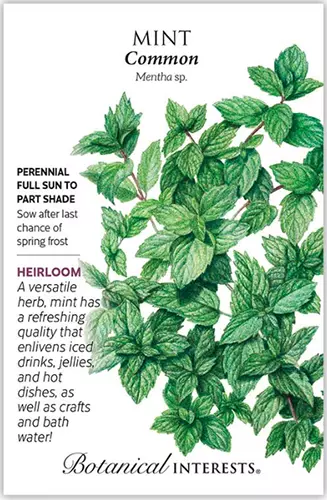
Herbs that are in the mint family like this one are very forgiving and benefit from being picked for use. The more you cut, the bushier the plant will grow.
They do enjoy the sunlight and need to be placed in an indoor area with bright sun exposure for at least four hours a day.
This could be next to a window that receives morning sun, or a space that’s sunny in the afternoon.
This aromatic herb will grow up to 18 inches tall, and you can cultivate it from seed to harvest in about 70 to 90 days.
This resilient herb’s scent is fresh and rejuvenating! Enjoy the fragrance and harvest some leaves for a tasty aromatic tea or to garnish a drink.
It also makes a wonderful aromatic option to grow in an office space. Any time I need a pick-me-up, I run my fingers through the foliage and I am instantly invigorated.
This is one of my favorite geraniums, in terms of its scent!
The silvery-green foliage of this scented geranium (Pelargonium x fragrans)has a strong, spicy aroma that’s released when you brush up against the plant.
Like other types of geraniums, they are easy to grow in containers in a spot that receives at least four hours of bright sunlight per day.
It’s best to water them just before the soil dries out.
Nutmeg geraniums can reach two to three feet tall with an equal spread. Pruning is a simple process, and they will respond with vigorous growth.
The scent of oregano (Origanum vulgare) is nostalgic for me, so I enjoy having it close by.
If you feel the same way, add a plant to your indoor space. Used commonly in cooking, it makes a lovely addition to an indoor kitchen garden on a sunny windowsill.
Oregano grows to about 12 inches in height with an equal spread.
These plants don’t require much water. Wait until the soil has just about dried out for the most fragrant results, with an abundance of aromatic oils produced by the foliage.
And speaking of that foliage, for all of the plants described here, you want to be careful to water the soil rather than sprinkling the foliage.
Perhaps a bit controversial, paperwhites (Narcissus papyraceus) are a delight to some and abhorred by others, emitting a distinctive scent that many find pleasant – though others can’t stand it.
A Narcissus relative of daffodils, if you’re one of those gardeners who loves paperwhites, they can easily be grown indoors.
Add a touch of elegance to any space with these darling, delicate blooms.
Embrace all that fall has to offer when you make this Sweetgreen-inspired harvest bowl featuring fall favorites like apples, sweet potatoes, brussels sprouts, and celery. Tossed together with a tangy balsamic vinaigrette – there’s a lot to love in these bowls!
As a dietitian and plant-based eater, I love restaurants where you can build your own salad (like Sweetgreen). The only problem is that they can really add up if I make it a habit! Luckily, you can make a similar harvest bowl at home for a fraction of the cost but still just as delicious.
If you haven’t been adding celery to your salads or grain bowls yet, this is your sign to finally give it a try! I love the added crunch of fresh celery in these bowls; it pairs well flavor-wise with the apple and adds another texture on top of the other chewy elements. My go-to celery for these bowls (and any recipe) is Dandy® fresh-cut celery. I love it because it’s naturally sweeter, crispier, and less stringy than other brands on the grocery store shelves!
Why You’ll Love These Bowls
Good for You: if you’re on a mission to add more vegetables to your diet, these bowls are the perfect recipe to help you accomplish that. Noshing on one of these harvest bowls provides you with fiber, antioxidants, and plant-based protein.
Meal Prep Friendly: many elements of these bowls can be meal prepped in advance and stored in the fridge until you are actually ready to assemble and eat your bowls.
Easy to Customize: make this recipe as written or get creative and roast up other veggies that you have on hand. You can even experiment with different dressings, grains, or toppings.
Ingredients You’ll Need for Your Harvest Bowls
Here’s a quick rundown of the main ingredients you’ll need for this easy salad recipe. See the recipe card at the bottom of the post for the specific amounts of each ingredient you’ll need.
Fall Veggies: I roasted up sweet potato and brussels sprouts for these bowls since they cook up in the same amount of time in the oven – you can just toss them onto the same tray to bake. If you’re looking for other veggies to try, here are a few other that I like in these bowls: broccoli, butternut squash, delicata squash, cauliflower
Wild rice: for convenience sake, I like to use the microwavable pouches of pre-cooked wild rice but you can use the dried pantry staple too, you’ll just need to account for the cooking time (that’s a great thing to cook in advance if you can!).
Celery: for added crunch, chop up some Dandy® fresh-cut celery, I love the flavor combo of the celery with the apple in these bowls.
Kale: you’ll use some massaged kale to be the base of your bowls. I usually pick up the curly variety but lacinato kale is great too. You can also swap it out for lettuce if you’re not a fan of kale.
Chickpeas: I always keep my pantry stocked with a few cans of beans since they’re such an easy way to add protein (and fiber!) to any meal. You don’t have to use chickpeas either, you can easily swap with a different bean or lentils or tofu.
Balsamic Vinaigrette: to bring it all together, you’ll top your bowls with a simple balsamic vinaigrette made from olive oil, balsamic vinegar, dijon mustard, and maple syrup.
Variations
Use a Different Grain: I like using wild rice, which is what they typically use in the Sweetgreen bowls. However, you can easily substitute with another grain of your choice like quinoa, brown rice, farro, or barley.
Swap out the Dressing: I love the sweet-tangy flavor of balsamic vinaigrette, but if that’s not your thing, you can swap it out for another dressing option. Try this lemon dijon dressing or this tahini sauce.
Try Other Toppings: you can easily substitute the feta and almonds for other cheese and nuts if you’d like. Crumbled goat cheese and parmesan are delicious options. If you don’t have almonds, you could also try walnuts, pumpkin seeds, or pistachios.
How to Make Vegan Harvest Bowls
Roast the Veggies: Place Brussels sprouts and sweet potatoes in a bowl. Drizzle with the olive oil, sprinkle with rosemary, thyme, salt and pepper to taste and toss. Spread on a baking sheet and bake for 25-35 minutes or until browned.
Make the Wild Rice: While the veggies are roasting in the oven, make the wild rice according to package directions. I usually use 1 package for 4 bowls.
Make the Dressing: Make the dressing by adding all the ingredients to a jar and shaking to combine.
Assemble: In shallow bowls divide the kale, wild rice blend, sweet potatoes and Brussels sprouts, chickpeas, apples, celery, almonds and feta. Drizzle with dressing and serve.
Meal Prep and Storage
Meal Prep: You can meal prep different elements of these bowls and store them in the fridge separately, or it is hearty enough to assemble completely and store in the fridge in meal prep containers. If you want to get a head start on making these bowls, you can roast the sweet potatoes and brussels sprouts in advance, cook the wild rice, and make the dressing. Store in the fridge for 2-3 days before combining with the rest of the salad ingredients.
Storage: once assembled, you can store this salad in the fridge in an airtight container for up to 4 days. They make a great packable lunch option!
Embrace all that fall has to offer when you make this Sweetgreen-inspired harvest bowl featuring fall favorites like apples, sweet potatoes, brussels sprouts, and celery. Tossed together with a tangy balsamic vinaigrette – there’s a lot to love in these bowls!
Place Brussels sprouts and sweet potatoes in a bowl. Drizzle with the olive oil, sprinkle with rosemary, thyme, salt and pepper to taste and toss. Spread on a baking sheet and bake for 25-35 minutes or until browned.
While the veggies are roasting in the oven, make the wild rice according to package directions. I usually use 1 package for 4 bowls.
Make the dressing by adding all of the ingredients to a jar, screwing on the lid, then shaking to combine.
In shallow bowls, divide the roasted sweet potatoes and Brussels sprouts, wild rice, kale, apples, celery, almonds, feta, and chickpeas. Drizzle with the balsamic vinaigrette to serve.
Price: $33.99 - $29.99 (as of Oct 29, 2025 12:23:35 UTC – Details)
From the brand
More Types of Resistance Bands
Meet Your Different Needs
270lbs Heavy Bands with Handle
Resistance Bands Set Of 6
【Diverse Resistance Levels】: Explore our Pull Up Resistance Bands with 6 different color-coded bands, offering a distinct exercise bands resistance level: Purple (15-25 lbs), Cyan (20-35 lbs), Yellow (30-50 lbs), Orange (40-80 lbs), Red (50-125 lbs), and Green (60-170 lbs). Customize your workout by using a single band or combining multiple for increased challenge. Designed for individuals weighing 90 lbs to 300+ lbs 【Comprehensive Full-Body Training】: Our collection of 6 resistance bands for working out caters to a complete body workout. Whether you’re aiming for increased flexibility, shoulder rehabilitation, squats, bench presses, pull-ups, or more, there’s a resistance band suitable for your needs. You can strengthen your legs, back, arms, buttocks, or abs, our exercise bands provide versatile options for achieving your fitness goals 【High Elastic Material】: Made from natural rubber, these pull up assistance bands are skin-friendly, non-slip and soft to touch . Experience remarkable elasticity, capable of stretching up to 3 times their original length. Rigorously tested for durability, they offer exceptional resistance without compromising quality 【For Convenient Workouts】: Elevate your exercise experience with the door anchor, allowing you to connect our resistance bands to a sturdy door for a wide range of versatile workouts, enabling effective training wherever you find a suitable door frame, and ensuring worry-free usage as it leaves no marks or damage upon removal. 【Portable and User-Friendly】: Designed for convenience, our workout bands are compact and lightweight. Complete with a professional exercise door anchor, a training poster and a storage bag, you can easily set up your workout space anywhere in just 60 seconds
Customers say
Customers find these resistance bands to be a fantastic addition to their workout routine, providing a range of resistance and being convenient for travel. They work well for various exercises and offer good value for money. The durability receives mixed feedback – while some say they’re durable, others report them breaking shortly after use. The stretchability is also mixed, with some finding them elastic while others say they don’t stretch at all.
I don’t have a huge sweet tooth, but sometimes I’m in the mood for a healthy dessert. My kids especially love a delicious sweet treat. These homemade protein bars are full of chocolate flavor and creamy, salty nut butter. They’re easy to customize and perfect for a snack or even dessert!
Homemade Protein Bars
Protein is finally getting it’s time in the spotlight. I’m finding more and more high protein recipes in my Instagram feed and I love it! Unfortunately though, not all of them use clean ingredients, or they opt for protein powders with fillers that I’m not a fan of. I’ve used cottage cheese in certain high protein recipes before, but something tells me cottage cheese chocolate protein bars might not be a hit with the kids.
Instead, these use Equip Prime Protein powder. I keep several different protein powders in stock for days I need an easy protein boost. What I like about Equip is that it’s made from grass-fed beef protein. No dairy, no whey, and no plant protein (like soy or peas). While I’m certainly not against dairy or legumes, they can cause digestive issues for some people, including bloating. I’ve noticed the beef protein powder digests easier and doesn’t have a noticeable beefy taste.
Customize Your Ingredients
For the homemade protein bars in the batch pictured here, I used chocolate protein powder. Vanilla will also work, but salted caramel, mint chocolate, or iced coffee protein powder flavors would also be delicious. Equip has all of these different flavors as options.
You can also use whatever nut butter you’d like in these. I used peanut butter, but try hazelnut butter or walnut butter for a flavor twist. There are so many good options!
The recipe calls for oat flour, but you can easily make your own from rolled oats if you don’t have the flour on hand. Simply pulse some rolled oats into a fine powder in a coffee grounder or high speed blender, like a Vitamix.
And if you’re avoiding grains or oats, then try a little coconut flour instead. Start with 1 Tablespoon coconut flour and slowly increase until you get the texture you want. Coconut flour is very absorbent so be careful here.
My kids love these homemade protein bars so much that I make a triple batch whenever I make them!
Homemade Chocolate Chip Protein Bars
These delicious and chocolately protein bars can be made with any nut butter. High in healthy fats and protein for nourishing energy!
In a medium bowl, mix nut butter and honey until smooth.
Add Equip protein, oat flour, flaxseed meal, and sea salt. Stir well. It’ll look dry at first.
Add milk 1 tablespoon at a time, mixing until a thick, slightly sticky dough forms.
Fold in chocolate chips.
Press mixture into a parchment-lined 8×8 pan and smooth the top.
Chill for 30 minutes, then slice into 8 bars.
Nutrition Facts
Homemade Chocolate Chip Protein Bars
Amount Per Serving (1 bar)
Calories 295 Calories from Fat 171
% Daily Value*
Fat 19g29%
Saturated Fat 4g25%
Polyunsaturated Fat 5g
Monounsaturated Fat 9g
Cholesterol 0.04mg0%
Sodium 276mg12%
Potassium 244mg7%
Carbohydrates 22g7%
Fiber 3g13%
Sugar 13g14%
Protein 14g28%
Vitamin A 0.4IU0%
Vitamin C 0.1mg0%
Calcium 42mg4%
Iron 1mg6%
* Percent Daily Values are based on a 2000 calorie diet.
Store in the fridge for up to a week or freeze for longer.
For a firmer bar, reduce milk slightly. For softer bars, add a bit more.
Sprinkle it with sea salt before chilling for that salty-sweet combo.
More Protein Recipes
Looking for more ways to easily sneak more protein into your diet? Give one of these recipes a try!
What are some of your favorite ways to eat more protein? Leave a comment and let us know!