
Happy Monday GPODers!
It’s officially fall in the Northern Hemisphere and our gardens are already reflecting the change of seasons. Late bloomers are unfurling and foliage colors are beginning to shift, but pollinators are still busy. To celebrate these vital creatures that are hard at work in our gardens for the entire growing season, Stephanie Stewart in Averill Park, New York has shared some fantastic pollinator photos. Stephanie has shared the beautiful flowers she grows and the pollinators that enjoy them a couple of times in the past (Check out those posts here: Stephanie’s Coneflowers and Stephanie’s Favorite Pollinators), and today she’s sharing the busy pollinators she was able to photograph this summer.
It’s been an unusually dry summer in Averill Park, NY. My gardens are suffering from lack of water as we’ve conserved our well water. It’s wonderful to see the pollinators visiting both perennials and annuals in the garden.
Stephanie Stewart
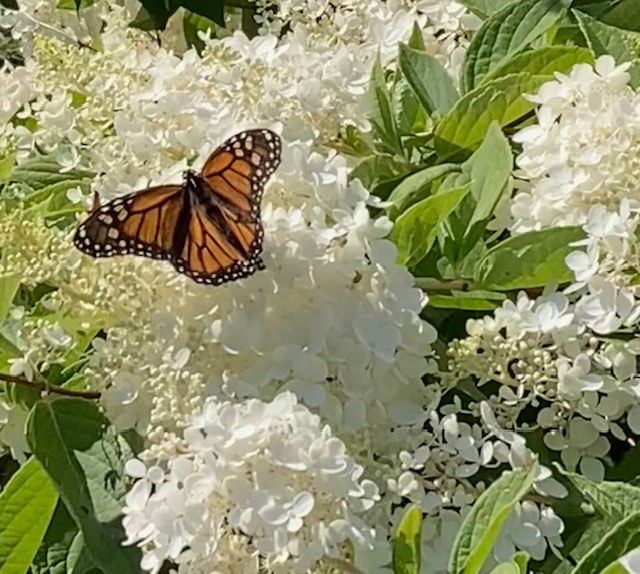
Monarchs (Danaus plexippus) and swallowtails flutter from flower to flower, always a pleasure to observe!
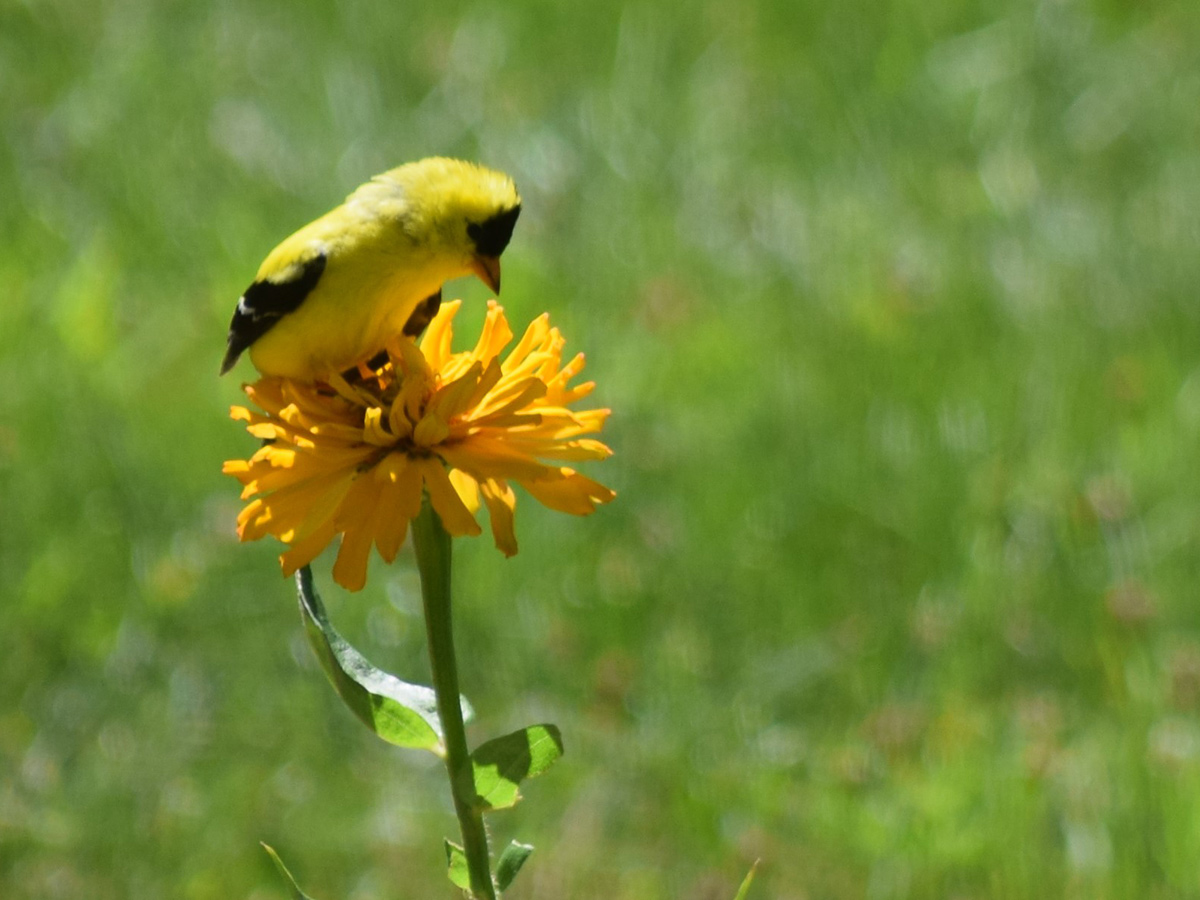 The goldfinches (Spinus tristis) are very interested in the zinnias, stripping the petals and leaving seed heads for another feast.
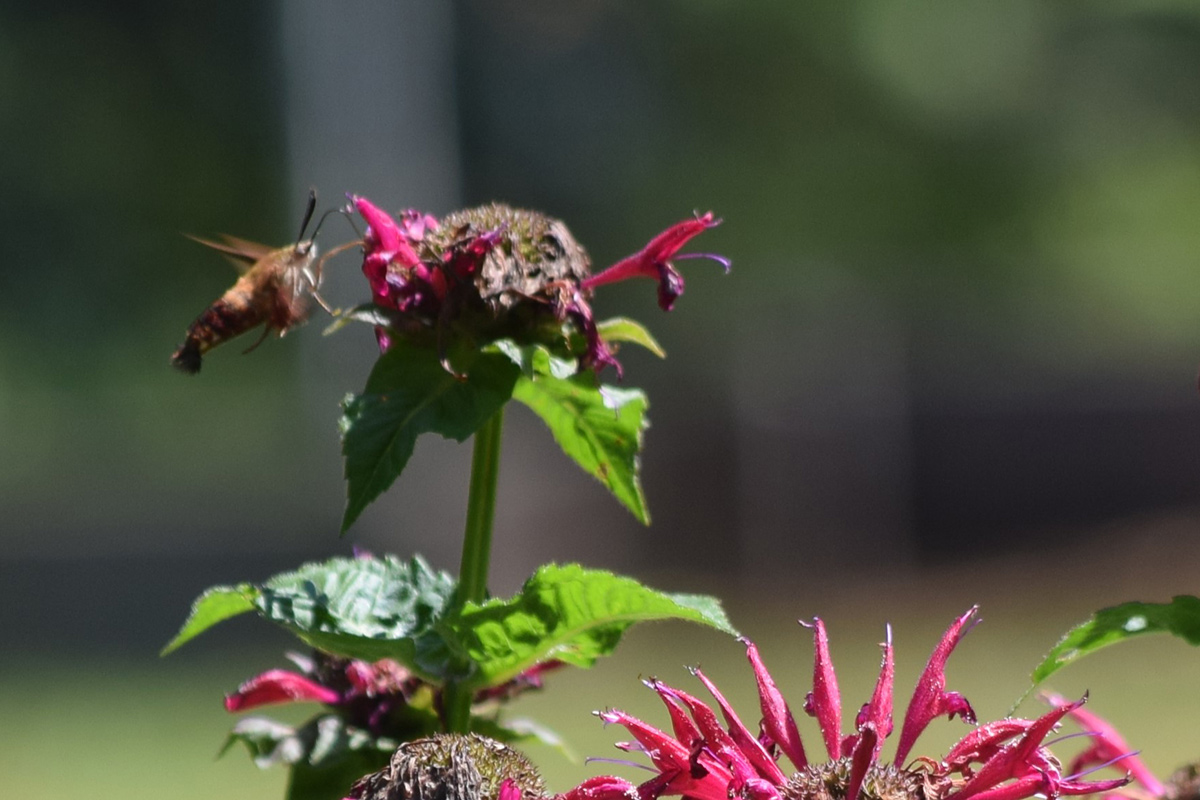 The hummingbirds and hummingbird moths (Hemaris thysbe) are very active as well.
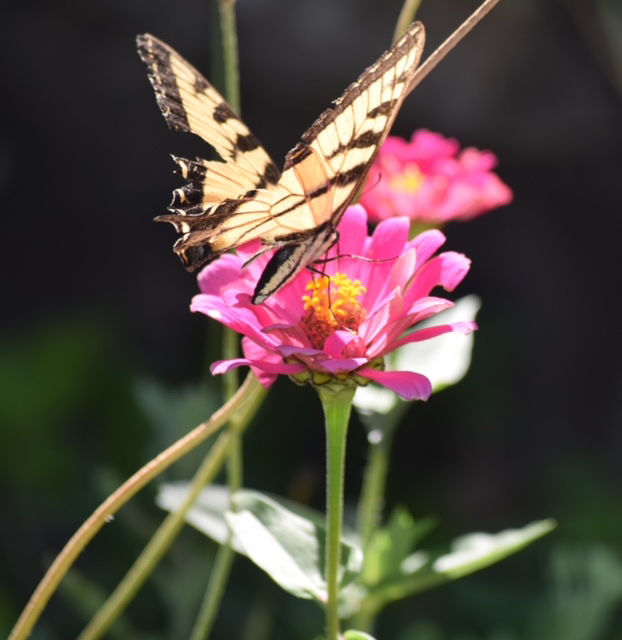 An eastern tiger swallowtail (Papilio glaucus) enjoyed Stephanie’s bright pink zinnias—lucky to snag this snack before a goldfinch has its way with it!
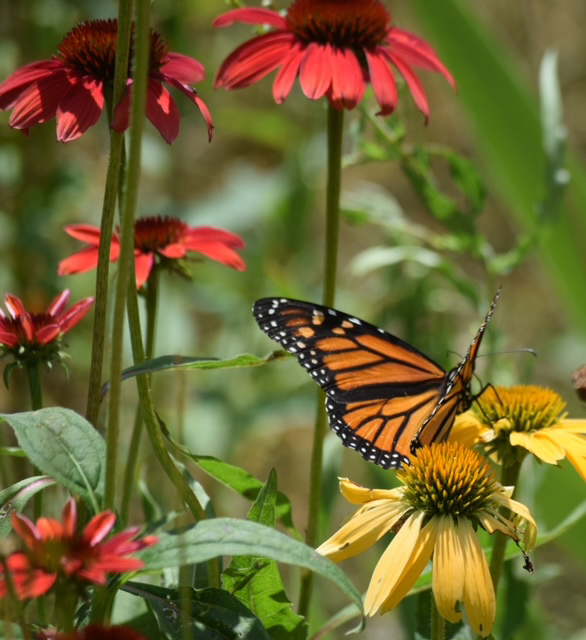 Stephanie has an incredible collection of coneflowers (Echinacea spp. and cvs., Zones 4–9) in a dazzling assortment of colors. And as this visiting monarch indicates, these vibrant blooms are just as enticing for butterflies and other pollinators as they are to gardeners.
Thank you so much for sharing this assortment of incredible pollinators that have visited your garden, Stephanie! You captured some magical moments of real garden harmony this summer.
What pollinators did you spot in your garden this year? Let us know in the comments, or considering sharing any pollinator activity you were able to photograph with Garden Photo of the Day! Follow the directions below to submit photos via email, or send me a DM on Instagram: @agirlherdogandtheroad.
Have photos to share? We’d love to see your garden, a particular collection of plants you love, or a wonderful garden you had the chance to visit!
To submit, send 5–10 photos to [email protected] along with some information about the plants in the pictures and where you took the photos. We’d love to hear where you are located, how long you’ve been gardening, successes you are proud of, failures you learned from, hopes for the future, favorite plants, or funny stories from your garden.
Have a mobile phone? Tag your photos on Facebook, Instagram, or Twitter with #FineGardening!
Do you receive the GPOD by email yet? Sign up here
Fine Gardening Recommended Products

Lee Valley Mini Garden Shear Set
Fine Gardening receives a commission for items purchased through links on this site, including Amazon Associates and other affiliate advertising programs.
These shears have a distinctive finger rest that not only aids grip but allows greater freedom of movement than a conventional handle design. They have a durable powder-coat finish to resist rust and wear, and a simple clasp that locks the spring-action stainless-steel blades closed. The set includes one pair of round-nose shears measuring 5 1/2″ overall with 1″ blades for cutting stems up to 3/8″ in diameter, and one pair of 6 1/2″ needle-nose shears with 2″ fine-tip blades for precise work.

Gilmour 5/8″ x 25′ Round Weeper Soaker Hose
Fine Gardening receives a commission for items purchased through links on this site, including Amazon Associates and other affiliate advertising programs.
Lightweight garden hose is made of 100% recycled vinyl for clog resistant, consistent soaking in the garden or around foundations. Can be installed above or below ground to efficiently deliver water directly to plant roots. Can be linked with other hoses to create your own DIY garden drip irrigation system, and is flexible for easy storage and space saving.
D&X Garden Sprinkler
Fine Gardening receives a commission for items purchased through links on this site, including Amazon Associates and other affiliate advertising programs.
– The Sprinkler is made of durable ABS Plastic, Base connector: Approx. 1/2″ ; Side connector: Approx. 3/4″
– 12 flexible nozzles that you can set in any direction, simply bend hoses to customize new watering patterns
– 360 degree coverage of 3000 sq. ft area
– 3.5 x 4 x 6 inches

Martin Kulldorff (right) speaks with Robert Malone during a meeting of the CDC’s Advisory Committee on Immunization Practices on September 18, 2025 in Chamblee, Ga.
Elijah Nouvelage/Getty Images
hide caption
toggle caption
Elijah Nouvelage/Getty Images
In a surprise move on Friday morning, a panel of vaccine advisors to the federal government backed off from a proposed change to the vaccine schedule that would have scrapped the current recommendation that all children receive the hepatitis B shot at birth.
It also reversed a vote it took yesterday on coverage for a shot known as the MMRV — measles, mumps, rubella and chickenpox (or varicella). Yesterday, the panel said the Vaccines for Children program could cover the combined shot if parents want it — Friday they voted that it shouldn’t. The MMRV shot is no longer recommended to be given, and it will not be paid for by government insurance.
The Advisory Committee on Immunization Practices, or ACIP, had spent much of Thursday debating the rationale for giving newborns the hepatitis B vaccine at birth — but then the committee pushed off the vote until Friday. Instead, it proceeded with a separate vote that removed the MMRV shot for children under age 4 from the vaccine schedule.
“We are rookies,” chair Martin Kulldorff said in opening the second day of the meeting. “With one exception, this was either our first ACIP meeting or our second.”
The ACIP panel crafts recommendations on vaccine policy for the Centers for Disease Control and Prevention.
Earlier this year, Health Secretary Robert F. Kennedy Jr. fired the existing panel, installed during the Biden administration, and replaced them with his own handpicked roster, including five members he added this week. Some of those he chose have a history of being critical of vaccines.
Kennedy’s moves to reshape vaccine policy in the U.S. hinge in part on ACIP’s recommendations. Kennedy has a long-running campaign to question the safety of many vaccines. Since being confirmed he’s limited access to the COVID vaccines, ditched millions of dollars in funding for mRNA vaccine research, and fired many career scientists at CDC, including its Senate-confirmed director, Susan Monarez.

Though the ACIP panel backed off changing its recommendation for the birth dose of the hepatitis B vaccine, its actions have led the public to question a shot that has been in use since 1991. It has been a success, Sen. Bill Cassidy, R-La., noted this week.
“We have decreased from 20,000 kids a year getting hepatitis B to 20 kids a year. That’s exponential decline,” Cassidy, who is a liver doctor, told reporters on Wednesday.
On Thursday, ACIP chair Kulldorff said the panel is setting up two new working groups: one on vaccines recommended during pregnancy and another on the timing of when shots are given on the vaccine schedule. That action indicates that Kennedy’s ACIP will continue to question well-established vaccine practices.
The two-day ACIP meeting, which is held at CDC headquarters in Atlanta and is expected to continue until late afternoon Friday, has been marked by confusion. As he opened it Friday morning, Kulldorff explained that the members’ lack of experience led them to need to redo a vote from the previous day because the wording had been confusing.
The outcome of that re-do was to change the insurance coverage of the MMRV vaccine for low-income children. On Thursday, the panel ended with a split vote: MMRV shots were not recommended, but they would be paid for by the government. Friday’s re-do vote made it all align — not recommended, not allowed to be paid for.
Then came hepatitis B. Although some on the committee seemed enthusiastic about pushing the first dose recommendation for hepatitis B from birth to 1 month of age, after some discussion, there was a revolt against tackling the issue at all.
“I move to postpone the question indefinitely,” Dr. Robert Malone, an ACIP member and close associate of Kennedy, said. “I believe that there’s enough ambiguity here and enough remaining discussion about safety, effectiveness and timing that I believe that a vote today is premature.”

That seemed to take Kulldorff by surprise. The committee voted 11 to 1 to table action on the birth dose of hepatitis B vaccine, with Kulldorff as the lone dissent.
Medical experts participating in the meeting as liaisons representing major medical groups seemed relieved by the decision to table the question.

ACIP Chair Dr. Martin Kulldorff, pictured at his first ACIP meeting in June 2025.
Ben Hendren/Bloomberg via Getty Images
hide caption
toggle caption
Ben Hendren/Bloomberg via Getty Images
Many had voiced their opposition to overhauling the recommendations, pointing to data showing the current policy had helped dramatically reduce cases of hepatitis B. The proposed changes also ran counter to hours of data presented by the CDC’s own scientists supporting the safety and efficacy of offering the shot right after a baby is born.
“It is very easy to get distracted by one study that says this or one study that does say that,” noted Dr. Amy Middleman, representing the Society for Adolescent Health and Medicine. “There’s always some risk — there’s a risk to walking across the street. The committee’s scientific challenge is to determine whether the benefits outweigh the risks.” She added that she hoped the panel would use scientific tools like grading evidence to evaluate these questions going forward.
The panel’s votes still require final approval from the acting CDC Director Jim O’Neill. He was installed by Kennedy after the senate-confirmed director, Susan Monarez, was ousted in part for refusing to commit to adopting ACIP’s recommendations before she’d seen evidence, she testified to the Senate earlier this week.
Later on Friday, the panel will vote on recommendations on who should be eligible for the latest COVID-19 vaccines.

Children’s Health Defense, the anti-vaccine group, founded by Kennedy before he became health secretary, has long targeted the hepatitis B vaccine recommendation, claiming the risk of illness is small for most babies and the vaccine can be harmful.
Tensions between the committee and the medical establishment have surfaced repeatedly throughout the two-day gathering.
On Thursday, Dr. Jason Goldman, president of the American College of Physicians, urged ACIP not to change the recommendations on the MMRV shot and criticized the broader process, saying they’ve sidelined subject matter experts and clinicians. He also noted that representatives from medical groups have been removed from ACIP workgroups, though they are still able to comment during the public meetings.
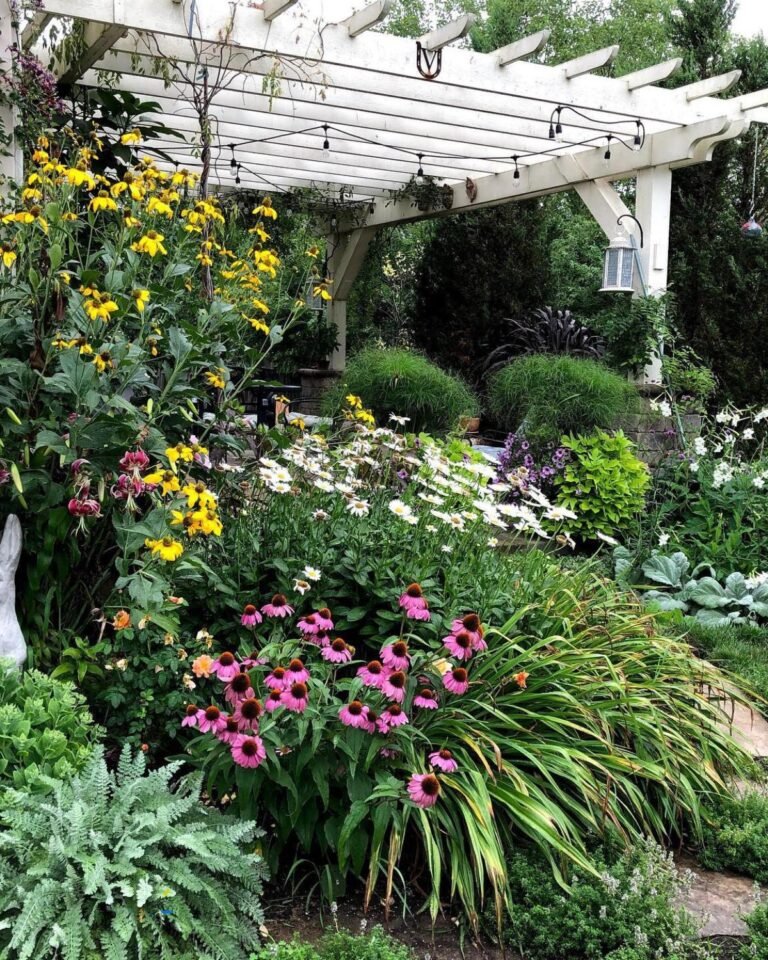
When backyard is filled with composting bins, veggies and other cold hardy plants, don’t you think a gardener’s front yard must welcome guests with a climbing perennial on an arch paired with red bougainvillea and pansies brightening the entry.
As the summer heat is gone, you’ve an opportunity to start fall gardening by adding few creative touches to your landscape.
After all gardening isn’t just to feed yourself, it has ability to nurture your soul with vibrant thoughtful designs.
If you’re eager to try your green thumb in autumn, then these front yard fall flower bed ideas can uplift your spirit as a gardener.
Researchers states that enhanced curb appeal of a home can increase its resale value by 7%.
So, it isn’t just about aesthetics, decorating your front yard with flowering beds can benefit you economically.
You don’t have to go big all the time.
Small tweaks here and there can illuminate your lawn, making the evening dinner delightful.
Go simple at first, like adding bird feeders, planting flowers that attract birds and cleaning lawn.
Plants like camellia, aster, cyclamen, pansies and hellebores can survive mild winter, so, you can include them in your front yard flower beds.
When it comes to landscaping, even small changes can completely transform your front yard.
A curvy path lined with flowers, a pop of color near the porch, or a cluster of native plants can instantly elevate the aesthetics.
These little touches don’t just add curb appeal—they create a warm and welcoming atmosphere for both guests and homeowners.
Instead of straight walkways, add a curvy path that naturally guides the eye through your front yard. This shape softens the overall look and feels more inviting than rigid lines. A winding path creates a sense of discovery as guests walk toward your home.
Lining the edges with low-growing flowers like alyssum, lobelia, or dwarf marigolds enhances the effect. These blooms highlight the curves and give the impression that the path is wrapped in a ribbon of color. Adding mulch or gravel keeps the area neat and well-defined.
For a finishing touch, consider solar-powered lights along the bends. In the evening, the illuminated path not only improves safety but also makes your flower beds glow beautifully.

Heleniums, also called sneezeweed, are a fall-blooming perennial that brings fiery reds, oranges, and yellows to the landscape. Their daisy-like flowers bloom late in the season, making them perfect for adding vibrancy when many other plants are fading.
These hardy flowers thrive in full sun and pair wonderfully with ornamental grasses. Plant them in clusters near entryways or along fences for maximum visual impact. Their bright hues naturally draw attention and set a cheerful tone for the season.
Another bonus is their appeal to pollinators. Bees and butterflies love heleniums, so planting them supports local wildlife while enhancing the front yard’s charm.
Also Read: 12 Low Budget Backyard Designs with Gravel

The front porch is often the centerpiece of a home’s curb appeal. By adding flower beds or potted plants around it, you can instantly create a warm and welcoming entry. Consider symmetrical arrangements with matching planters on either side of the steps for a balanced look.
Seasonal flowers like chrysanthemums in fall or geraniums in summer work beautifully in porch displays. You can also combine flowers with ornamental grasses or shrubs to add height and depth. This layering gives your porch area a polished yet cozy feel.
Don’t forget hanging baskets near the porch columns or railings. They add vertical charm and soften the architectural lines, blending the house and garden seamlessly.
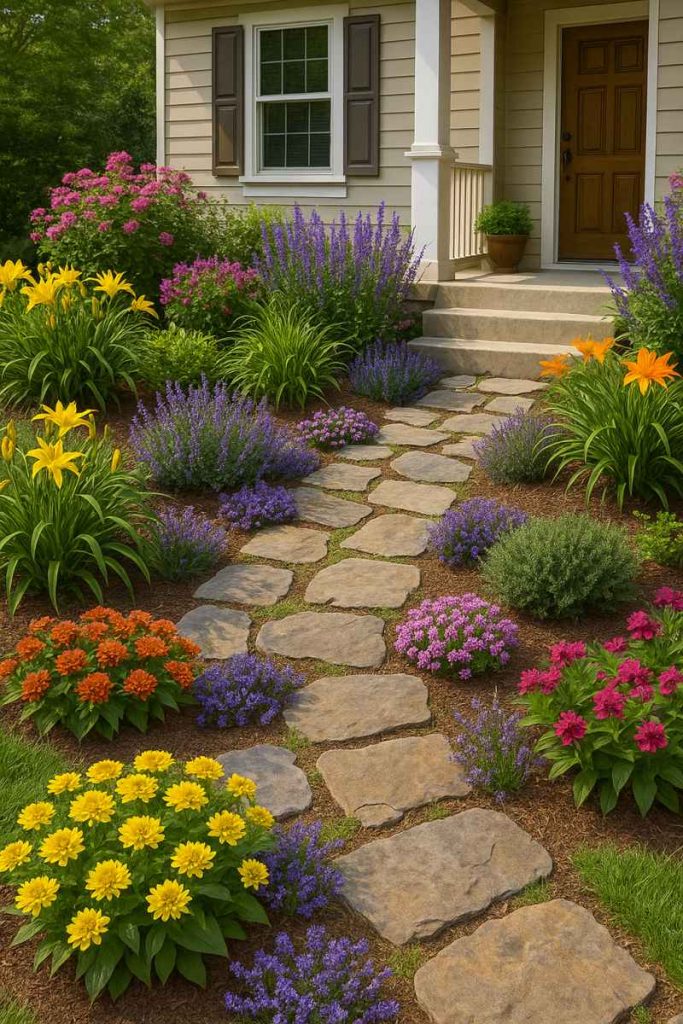
Flagstone paths bring a rustic, natural look to the front yard. Their irregular shapes give character and charm, making them perfect for cottage-style gardens. Surrounding the stones with small flower beds enhances the walkway’s beauty.
Plant creeping thyme, lavender, or dianthus between the cracks for a fragrant, colorful touch. These plants thrive in the narrow spaces and spread gently without overwhelming the stones. Every step guests take is accompanied by pleasant aromas and bursts of color.
To elevate the look, border the flagstone path with larger perennials like daylilies or salvia. This creates a layered effect that makes the walkway stand out as a focal point.
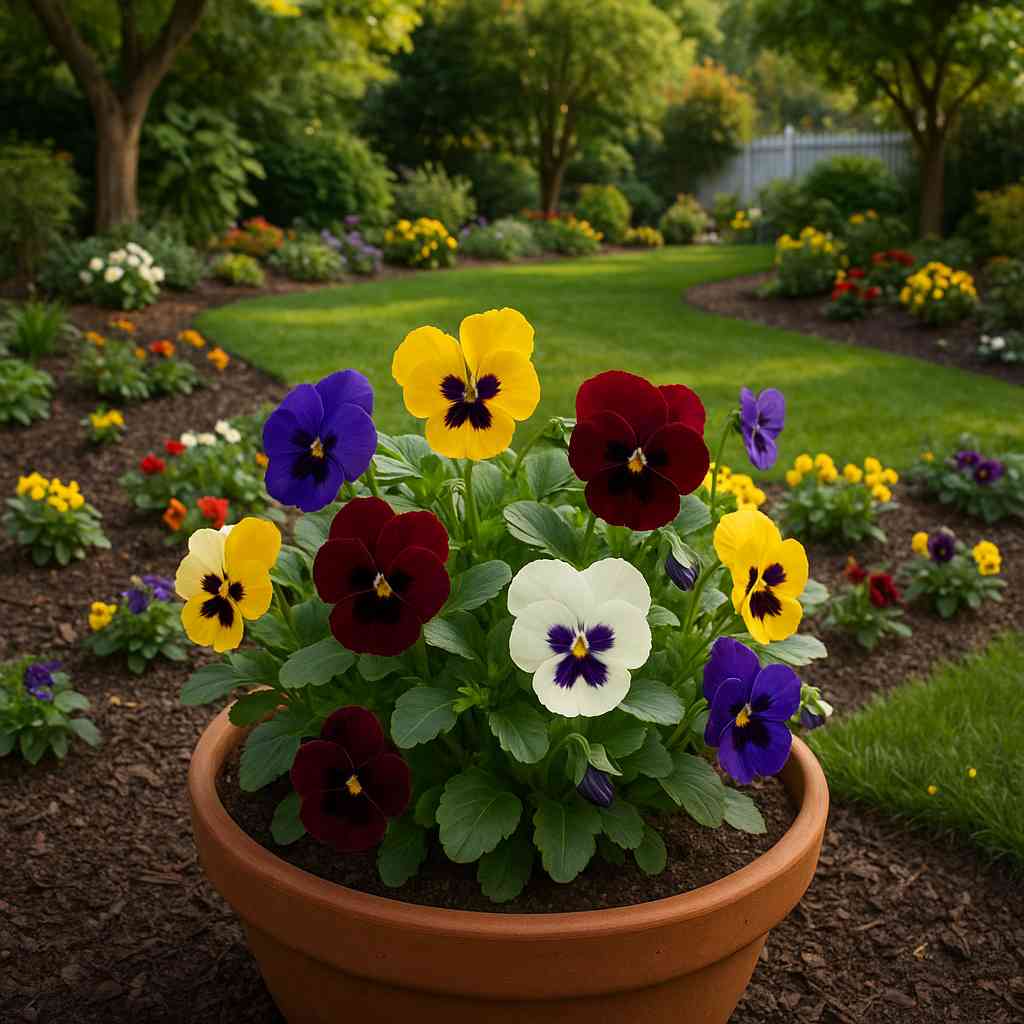
Color is the simplest way to make your flower beds eye-catching. A mix of bold and subtle tones can transform even a small yard into a vibrant showpiece. Choose a variety of seasonal flowers so your beds remain colorful year-round.
For example, pansies and violas thrive in cooler weather, while zinnias and salvias provide bright shades in summer. Combining warm hues like reds and yellows with cool tones like blues and purples creates balance and prevents clashing.
If you prefer a softer look, try a monochromatic scheme with varying shades of one color. This still creates depth while maintaining a more elegant, cohesive appearance.
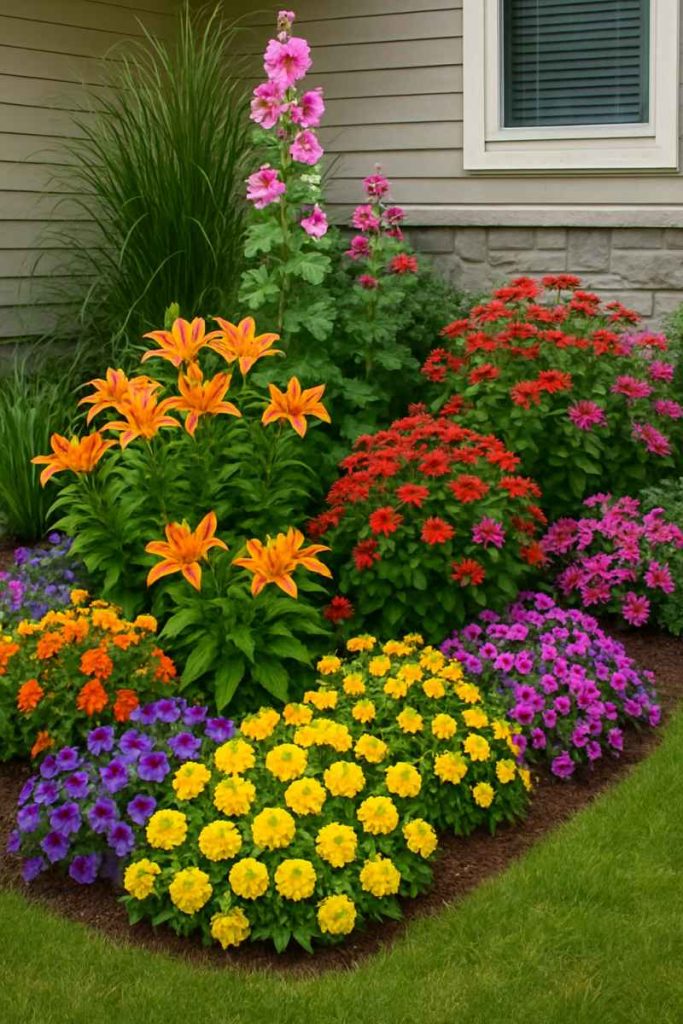
Mixing plant heights and textures gives flower beds a layered, professional look. Place taller plants such as hollyhocks or ornamental grasses at the back, medium-height blooms in the middle, and groundcovers at the front. This tiered arrangement ensures every plant is visible.
Using different sizes also adds depth, making small yards appear larger. Taller plants create a natural backdrop, while cascading flowers like trailing petunias soften the edges. The contrast in heights makes the beds look dynamic rather than flat.
To keep the design organized, stick to odd-number groupings—three tall plants grouped together look more natural than two. This small design trick keeps the yard visually appealing.
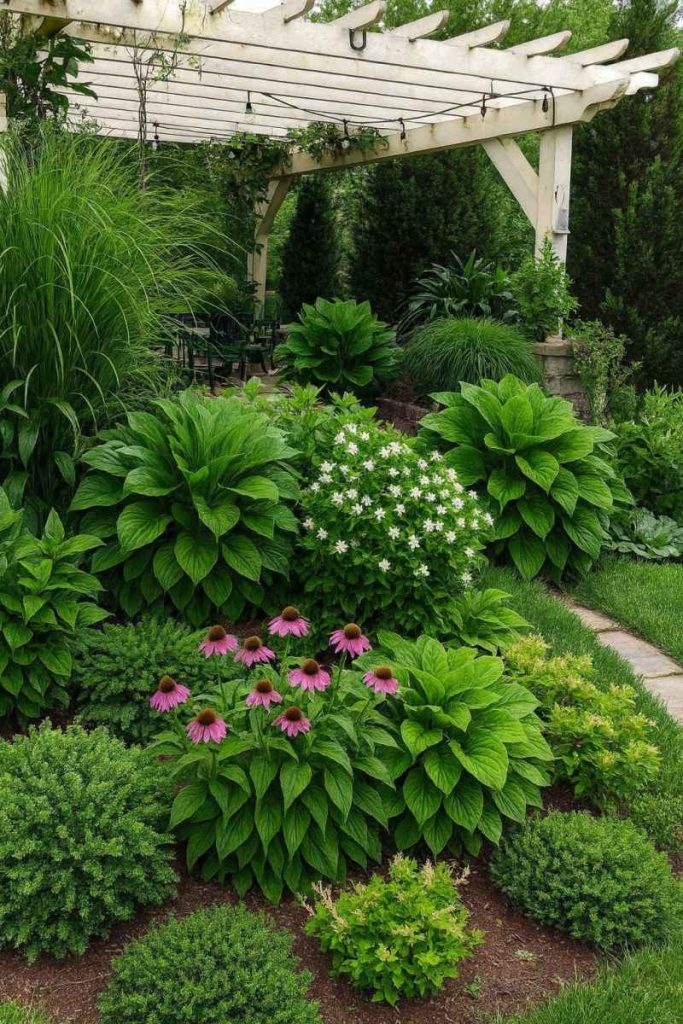
Not all front yards need to be neat and orderly. A wildflower-inspired design gives your home a natural, meadow-like charm. Mixing daisies, coneflowers, black-eyed Susans, and native grasses creates a free-flowing style.
The wild look is also low-maintenance. Once established, wildflowers reseed themselves, requiring minimal replanting. They also attract pollinators like bees and butterflies, which adds life and movement to the garden.
To avoid the space looking messy, add subtle structure with edging stones or a small pathway. This balances the wild beauty with a touch of order.

Native plants are adapted to your local climate, which makes them both eco-friendly and easy to maintain. They require less water, fertilizer, and care compared to non-native species. Plus, they provide essential habitats for local birds and insects.
Incorporating native perennials like coreopsis, bee balm, or asters ensures your flower beds bloom naturally with the seasons. Their resilience means they’ll return year after year without much intervention.
Planting natives also connects your yard to the surrounding environment, making it feel more harmonious with the local landscape.
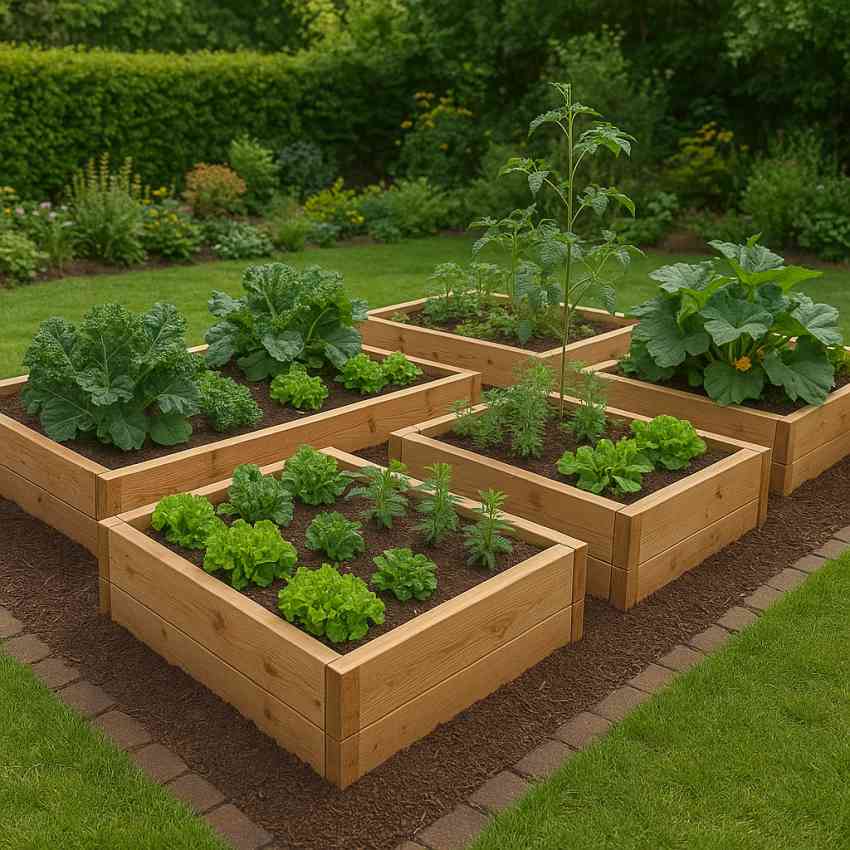
Raised beds add definition and structure to flower beds, while also improving drainage and soil quality. They are especially useful if your native soil is too sandy or clay-heavy for delicate flowers.
Wood, stone, or brick-edged raised beds can be styled to match your home’s architecture. They also make gardening easier since you don’t have to bend as much to tend to the plants.
Fill raised beds with seasonal flowers for maximum impact. In fall, pansies and ornamental kale are excellent options, while spring tulips and daffodils brighten the beds after winter.
Hanging baskets bring flowers to eye level and add vertical interest. They are perfect for porches, pergolas, or even along fences. Trailing plants like ivy geraniums or petunias create a cascading effect that feels lush and full.
The great thing about hanging baskets is their versatility. You can change them seasonally—fill them with pansies in fall, petunias in summer, and evergreen sprigs in winter. This keeps the front yard looking fresh year-round.
They also work well in smaller spaces where ground planting isn’t possible. A few strategically placed baskets can brighten dull corners instantly.
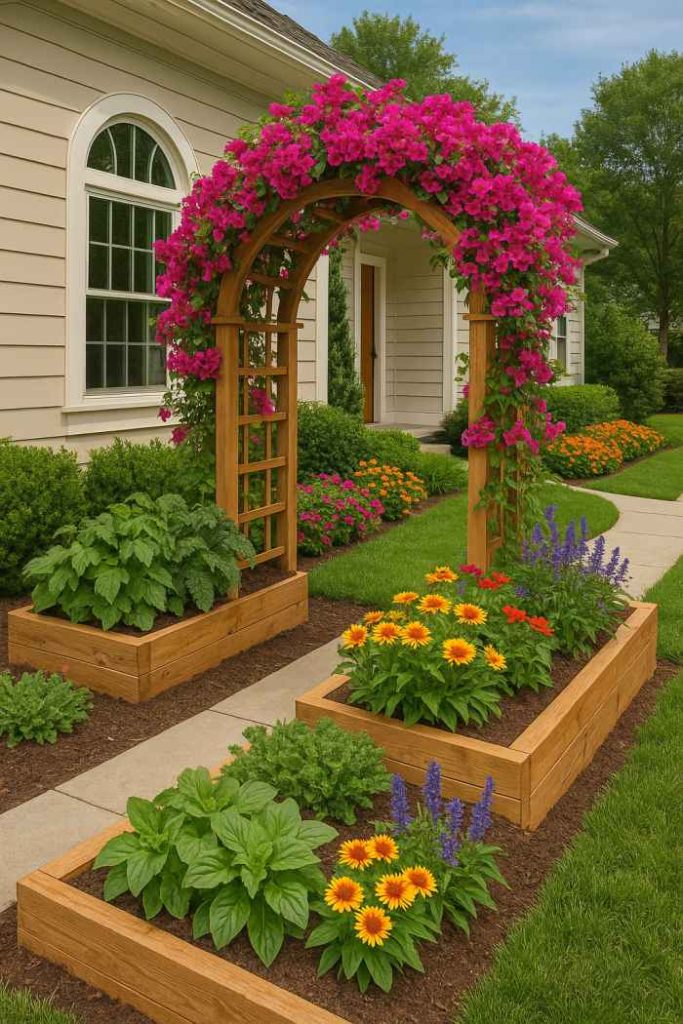
Trellises add vertical drama to front yards by showcasing climbing plants. Whether you use a simple wooden design or a decorative metal frame, trellises instantly make your garden feel taller and more structured.
Bougainvillea, clematis, and morning glories thrive when trained on trellises. Their upward growth saves space while filling the vertical plane with greenery and blooms. Placing trellises at entrances or alongside pathways creates a natural archway effect.
To soften the look, add smaller flower beds at the trellis base. This way, you get both vertical and horizontal beauty in one design.
While colorful blooms are beautiful, green plants bring texture, freshness, and a soothing feel to the landscape. Ferns, hostas, and ornamental grasses are excellent choices for lush foliage.
A bed filled with greenery provides a calm backdrop against which seasonal flowers pop even more. It also ensures your yard looks alive year-round, even when flowers are out of season.
You can mix shades of green—deep emeralds, bright lime, and variegated patterns—for extra depth and contrast without relying on flowers alone.

Crotons are known for their bold, fiery foliage that ranges from red and orange to yellow and green. Unlike seasonal flowers, their color comes from leaves, which last year-round in warm climates.
Planting crotons near entrances, walkways, or in pots makes them instant focal points. Their dramatic tones are especially effective in fall, blending beautifully with seasonal flowers.
Crotons also pair well with green plants. Their vivid hues stand out against calmer backgrounds, ensuring your front yard always has a striking element.
Transforming your front yard doesn’t require a complete overhaul—sometimes, it’s the small, thoughtful touches that make the biggest difference.
From curvy paths lined with cheerful flowers to raised beds, hanging baskets, and bold foliage like crotons, each idea adds character and charm in its own way.
Whether you prefer a structured look or a natural, free-flowing style, these front yard flower bed ideas will help you create a space that welcomes guests and brings daily joy.

Khaja Moinuddin, a computer science graduate, finds joy in gardening and homesteading. Join him on this blog as he shares his experiences in homesteading, gardening, and composting


The teen years can feel like a whirlwind. Bodies are changing daily, hormones are in constant flux, and no snack in the pantry is safe. For teen athletes, that whirlwind becomes even more intense. Practices, games, tournaments, and strength training sessions pile on top of schoolwork and social life.
So how can we as parents best support our kids during this stage? And of course, without putting too much pressure on them or feeling burnt out ourselves. As a mom of several teens (and counting!) I’ve learned that they don’t always want to listen to mom. They’re learning independence, an important skill, but they still need some guidance and direction from parents.
I’ve found what teens need most during this stage is balance. Their growing bodies and developing brains require more than just calories. They need targeted nutrition, consistent recovery habits, and the tools to take ownership of their health. Drawing from both research and real-life experience raising athletic kids and as a high school track coach, here are some practical strategies.
Even if your kids aren’t in competitive sports, much of this still applies to teens in general.
It’s tempting to think that teens can follow the same sports nutrition and training advice as adults, just in smaller doses. But adolescence is a unique window of development. Bones are still lengthening, muscles are forming rapidly, and the brain is fine-tuning everything from decision-making to stress response. Hormones like testosterone, estrogen, and growth hormone surge during this period. This influences energy needs, sleep cycles, and even mood (as I’m sure you’ve noticed!).
On top of that, the typical teenage schedule often works against what their bodies actually need. Their circadian rhythms naturally shift later, yet school start times keep them waking up early. Add in evening practices or weekend competitions, and it’s easy for teens to fall into a pattern of chronic sleep deprivation.
Meanwhile, their nutrient requirements are higher than ever. Not just calories, but also specific proteins, minerals, and healthy fats that fuel growth and repair. It’s easy for even well-meaning families to end up with nutritional gaps.
If I could only say one thing about teen athlete’s nutrition it would be how important protein is. For active teenagers, I like to aim for about one gram of protein per pound of body weight each day. This can make a tremendous difference in muscle development, recovery, and even mood stability.
That might sound like a lot, but when you consider the demands of growth and training, it makes sense. Eggs, chicken, beef, fish, and dairy are all excellent sources, and protein powders or shakes can fill in the gaps when schedules get tight.
Breakfast sets the tone for the entire day. Teens who start with a protein-rich meal are less likely to crash mid-morning or reach for ultra-processed foods later on. Something as simple as scrambled eggs, a smoothie with Greek yogurt, or overnight oats with a boost of protein powder. From there, including balanced meals with real food proteins, colorful veggies, healthy fats, and complex carbs helps them with energy and recovery.
And don’t forget about the micronutrients and minerals! Electrolytes like sodium, potassium, and magnesium keep muscles functioning properly. They also prevent cramping, especially in hot weather or during long practices. Vitamin D supports both bone health and hormone balance, yet many teens don’t get enough.
Omega-3 fats, choline, and collagen-rich foods like slow-cooked meats or bone broth can help with brain health, skin, and joint support. These aren’t just “extras.” They’re the building blocks teenagers need, especially athletes.
Here are some healthy options to fuel teen athletes
We often think of training as the main event, but the real magic happens during recovery. This is when muscles repair, hormones regulate, and the nervous system recalibrates. For teenagers, recovery is doubly important because their bodies are still developing.
Sleep is the most powerful recovery tool available. Most teens need nine to ten hours of quality sleep, but few get close to that. Encouraging a consistent bedtime, reducing screen use at night, and creating a dark, cool sleeping environment can make a big difference. Here are some resources for healthier sleep and recovery:
Other recovery strategies, like mobility work, stretching, or even light breathwork, support joint health and stress management. Some teens may enjoy experimenting with things like cold plunges or sauna sessions. However, don’t overlook the basics, like regular rest days, training variation, and simple downtime. Even encouraging more barefoot time can strengthen the feet and ankles, reducing injury risk.
Supplements are never a replacement for whole food, but they can fill in important gaps for busy or highly active teens. Creatine is one that comes up often in the athletic world. You might think of body builders, but the research shows it’s a great option for muscle and brain health for many people. Magnesium (as mentioned earlier) is also really helpful since the majority of us, including teens, are deficient.
Vitamin D is worth monitoring, especially for kids who spend much of their day indoors. Pairing it with vitamin K2 helps our bodies properly use calcium and supports bone health. Of course, any time they can get outside in the sun the better! Other minerals like zinc and selenium also play a role in hormone regulation and immune function, especially during puberty.
Here are my favorite supplement resources that I use and recommend:
One of the most important lessons I’ve learned in raising athletes is that lasting change happens when teens take ownership of their health. Many people are shocked when I tell them I let my kids eat whatever they want! Ultimately we’re not raising kids, we’re raising adults who will make their own life decisions.
Instead of dictating what they have to eat or supplement with, I’ve found it works best to lead by example. As the old saying goes, more is caught than taught. I also share the “why” behind things. When they can see how protein affects soreness, or how sleep influences their reaction times, they’re more motivated to make those choices themselves.
Creating an environment that makes good decisions easy is another step. As their mom my job is to provide nutrient-dense snacks and meals, it’s up to them to eat them (or not). We also keep certain supplements readily available, like electrolytes on the counter, and digestive enzymes on the dinner table.
Teens also benefit from tracking their own progress. Whether that’s noticing how they feel after a week of better sleep, or seeing how protein affects their strength in the gym. Small experiments like these and showing them how to be mindful help them see the connection between their habits and performance. Something like an Oura Ring to track health metrics can be really useful and help put them in the driver’s seat.
Mental health and social support are also important. Training stress is one thing, but emotional stress from friendships, academics, or family dynamics can take just as much of a toll on recovery. Making space for teens to feel heard and supported goes a long way in their overall well-being.
So what does this actually look like in real life? A typical day might start with a protein-rich breakfast. Maybe eggs with avocado and fruit, or a brain power protein smoothie. During the school day, having water with electrolytes and snacks like nuts, beef jerky, or a protein bar keeps energy steady.
After practice, a balanced dinner with protein, vegetables, and some healthy carbs helps replenish nutrient stores. Also, getting outside as much as possible for circadian alignment, vitamin D synthesis, and other health benefits.
In the evenings, the focus shifts to recovery. A little stretching or mobility work, some downtime with the family, and a screen-free wind-down routine. These make it easier to get the 8-10 hours of sleep they need. Physical and mental rest is also important to prevent burnout and injuries. Supplements can then support the base of whole, nutrient-dense foods.
Supporting a teen athlete isn’t about micromanaging their schedule or filling their plate with perfect meals. It’s about creating a foundation where their body has what it needs to grow, adapt, and thrive.
Our job as parents and mentors is to provide the tools, the environment, and the encouragement. Their job is to learn, experiment, and take ownership of their own health journey. The idea is to set them up with the tools and habits they need for success into adulthood. We can’t make their choices for them, but we can help them thrive both on and off the playing field!
Do you have any teen athletes in your home? What are some ways you’ve found to support them? Share below!
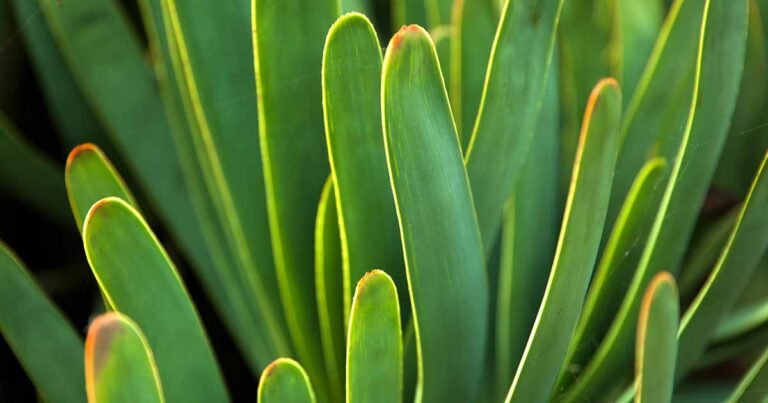
With sculptural, corky branches ending in fan-shaped rosettes of succulent leaves, fan aloe (Kumara plicatilis syn. Aloe plicatilis) is a unique plant that would look equally at home in a garden of botanical oddities as in a Dr. Seuss book.
This fascinating species can be grown indoors or outdoors under the right conditions.
For fans of bonsai, wizened bristlecone pines, and other sculptural trees, fan aloe offers the same striking appeal.

We link to vendors to help you find relevant products. If you buy from one of our links, we may earn a commission.
Whether cultivated in containers or in the ground, this unusual plant can grow considerably over the years with proper care.
Whether you’re considering growing one of these succulent trees or simply want to learn about this magnificent plant, this article will inform and satisfy your curiosity.
Here’s what we’ll cover:
Strap-shaped, light green to grayish green succulent leaves grow in fan-like arrangements at the ends of woody, branching stems.
These low-maintenance shrubs or small trees reach a few feet tall in home gardens, or up to 16 feet under optimal conditions.

In addition to its intriguing foliage, K. plicatilis produces eye-catching tubular, bright red to orange flowers on 18-inch stems from winter to spring.
Hardy in USDA Zones 9b to 11b, this long-lived species works well in rock gardens, xeriscapes, and can serve as part of a fire-resistant landscape strategy.
Common name(s): Book-leaf aloe, fan aloe, French Hoek aloe, waaier-aalwyn
Plant type: Evergreen succulent
Hardiness (USDA Zone): 9b-11b (outdoors)
Native to: South Africa
Bloom time / season: Winter to spring
Exposure: Full sun to part shade, bright indirect light indoors
Soil type: Loose, well-draining
Soil pH: 5.5-6.5, slightly acidic to neutral
Time to maturity: 20-50 years
Mature size: Up to 16 feet tall and wide in optimal conditions
Best uses: Container gardening, fire resistant landscaping, rock gardens, xeriscaping
Order: Asparagales
Family: Asphodelaceae
Genus: Kumara
Species: Plicatilis
Also known as book-leaf aloe or French Hoek aloe, this shrubby species is native to the fynbos ecoregion of South Africa.
It originated in a Mediterranean-like climate and is well-adapted to cold, damp winters and hot, dry summers.
Reclassified from Aloe plicatilis to Kumara plicatilis in 2013, it has been cultivated in California since the 1920s.
Within the Aloeae tribe, K. plicatilis is related to aloes, haworthias, gasterias, and Haworthiopsis species.
Experienced succulent growers have a solid foundation for growing fan aloe, but this guide covers the specific care requirements.
Let’s take a look at their cultural requirements:
There are a few different factors that must be combined to create fan aloe magic – these include the right approach to light, soil, water, and of course, climate.
In our guide to growing succulents, we give an overview of how to cultivate these plants in your home and landscape.
Having originated in a Mediterranean-type climate, K. plicatilis is a great option for gardeners in parts of California and southern Europe in Zones 9b to 11b, or equivalent.

If you’re gardening in a cooler location, further north than Zone 9b, you’ll need to provide winter protection or cultivate it as a houseplant.
Learn how to care for succulents in winter here.
This species enjoys hot weather and when grown as a houseplant, it will benefit from being placed outdoors during summer.
Fan aloe can be cultivated in full sun to part shade. Consider locating it where it will receive sun in the morning and shaded conditions in the afternoon, especially in very hot regions.

For those growing K. plicatilis as a houseplant, place it close to a south-facing window or you can use a grow light.
Since this species grows in rocky, well-drained soils in its native regions, you’ll need to try and mimic those conditions for best results.
While many succulents grow in alkaline conditions, fan aloe prefers growing mediums with a pH of 5.5 to 6.5 – slightly acidic.
You may have to amend a commercial mix or make your own potting soil for succulents.
This plant is pretty forgiving about moisture, but for best results, let the soil dry out completely between waterings.
When you’re watering small, potted specimens, grab a houseplant watering can if you have one.
The narrow spout makes it easier to aim at the soil, not the leaves, so the roots get what they need without soaking the foliage.
Fertilizing isn’t necessary, but if you want to speed up growth, you can feed your fan aloe once a month during the growing season with a fertilizer formulated for cacti and succulents.
A fertilizer like Dr. Earth’s Succulence Plant Food is a good choice, be sure to apply according to the manufacturer’s recommendations.

You can find 16-ounce pump dispensers of Dr. Earth’s Succulence Plant Food available from Arbico Organics.
Learn more about fertilizing here.
One of the rarer succulents in cultivation, fan aloes may be hard to find at local big box stores or family run plant nurseries. You may need to look for stores that specialize in succulents.

Alternatively, you can also source seeds from succulent seed sellers and propagate your own.
There are two main methods for propagating fan aloe: growing from seed or rooting cuttings.
Growing new specimens from seed requires some patience, as germination can take many months.
Here’s how:
After germination, gradually remove the humidity dome and transition the seedlings to more direct sunlight and less frequent waterings.
Learn more about propagating aloes from seed here.
Gardeners can take cuttings from specimens with branches for propagation.
Select a branch with several rosettes, and remove it from the parent plant with a pair of sharp, sterilized garden pruners.

Place the cutting in a well-ventilated, dry location out of direct sunlight for three weeks to allow the wound to heal or callus over.
Choose an appropriately sized nursery pot for the cutting, and fill it with moist coarse sand.
Insert the cutting into the sand.
Water the medium when it dries out, and allow the cutting to establish roots for several months before transplanting.
If you’re unsure whether it’s time to repot a container-grown specimen or transplant a seed- or cutting-grown plant, the general rule is to wait until it has clearly outgrown its container.
Signs include roots poking through the drainage holes or pushing up through the surface of the soil.

When you’re ready to transplant, start by choosing a container one size larger than the current one. For in-ground plants, dig a hole twice as wide and just as deep as the original pot.
If needed, amend the soil to improve drainage.
Carefully remove the plant from its pot and gently loosen the soil around the outer edges of the root ball.
Set it into the new container or planting hole, making sure the top of the root ball remains level with the surface of the soil.
Fill in around the roots with fresh soil or growing medium, but don’t bury the crown.
After transplanting, wait a week before watering the newly transplanted succulent.
Fan aloes are generally trouble-free when grown in the right conditions, with few issues from pests or disease.
Many nursery-grown plants can carry common pests like aphids, mealybugs, and scale insects, so inspect any new purchase before placing it near any other prized plants.
Quarantining new houseplants for at least two months is a smart habit, it gives you time to catch any hitchhikers before they spread to your other plants.
Rot is the most common disease problem succulent growers experience with K. plicatilis, and this is usually caused by overwatering or poor drainage.
If the stems are drooping and mushy, or turning brown or black, it’s safe to assume that the plant is rotting.
On the other hand, plants that are still perky looking that have some yellow or browning leaves may be perfectly healthy.
Find more details about how to deal with rotting succulents here.
Now that you’ve learned about the backstory and growing needs of this succulent plant, do you consider yourself a member of the (unofficial) fan aloe fan club?

Remember to provide the plant with excellent soil drainage and keep it protected from cold temperatures, and you may be one of the lucky ones who gets to see this South African plant grow to the size of a shrub or small tree!
If you have any remaining questions about growing this succulent, feel free to drop them in the comments section below. Have any tips of your own you’d like to share with our readers? Let us know!
And if you’re looking for other aloes to grow in your yard, save these articles to read next:

ACIP member Retsef Levi speaks during a meeting of the CDC’s Advisory Committee on Immunization Practices on September 18, 2025 in Atlanta, Ga. The federal vaccine advisory group, recently appointed by Health Secretary Robert F. Kennedy Jr., made recommendations on the COVID vaccine.
Elijah Nouvelage/Getty Images
hide caption
toggle caption
Elijah Nouvelage/Getty Images
A panel of vaccine advisers to the federal government debated several changes to COVID-19 vaccine access in a chaotic meeting Friday, marked by confusion over processes, technical difficulties and passionate disagreement among members and other experts in attendance.
Ultimately, the Advisory Committee on Immunization Practices, or ACIP, backed away from its most controversial proposal that called for states to require those who want a COVID-19 vaccine to get a prescription. But the end result is that the COVID-19 vaccine could be less available than it has been the last few years.
The group, which crafts recommendations on vaccine policy for the Centers for Disease Control and Prevention, voted to recommend vaccination for adults 65 and older and younger people, subject to a process called “shared decision making.” Their recommendations would not prohibit anyone over six months from getting the shot, but call for patients to speak with a clinician about the risks and benefits.

“In the prior seasons of COVID, we’ve had routine vaccine access — you or I could go to our pharmacy or doctor’s office and just get our vaccine, it was encouraged as a routine recommendation,” says Jen Kates, director of global health and HIV policy at KFF.
Friday’s vote essentially says “this is no longer routinely recommended — it’s ‘shared clinical decision-making,'” says Kates. The details about what that entails and how access will play out are not immediately clear, Kates says, but what is clear is that it’s a “more narrow recommendation” than it has been in past years.
And ACIP’s recommendation states that for people 64 and younger the conversation should emphasize that benefits are greatest for people with the most risk of serious disease and lowest for people without increased risk.
The advisers also voted that the CDC should add information about the possible risks and uncertainties related to COVID vaccine effectiveness to information sheets about the shots. Many of the risks were speculative or already known to be unfounded.
The gathering underscored the turbulent and highly politicized nature of vaccine policy under Health Secretary Robert F. Kennedy Jr.’s leadership, which is now at odds with positions held by major medical organizations.
The recommendation that a prescription be required for anyone to get a COVID vaccine – which could have been a new hurdle in many places, if states adopted the recommendation – ended in a tie. ACIP chairman Martin Kulldorff voted no, breaking the tie. The motion failed.
But the debate over the proposal got heated. Some on the committee warned it would ultimately lead to fewer people getting shots. Dr. Amy Middleman of the Society for Adolescent Health and Medicine, was among many who spoke up, urging committee members to reject this idea.
“If we start asking for prescriptions for vaccines — which are a primary prevention public health strategy — we are going to overwhelm physicians’ offices.”
Committee members also expressed their concern, saying it would create access problems especially for people who are underinsured or don’t have primary care providers. “I am also concerned as it is my understanding that approximately 30% of Americans don’t have access readily to primary health care providers,” said committee member Dr. Joseph Hibbeln.
Earlier this year, Kennedy fired the existing ACIP panel, installed during the Biden administration, and replaced them with his own handpicked roster, including five members he added this week.
Some of those he chose have a history of being critical of vaccines, as does Kennedy himself — he once called COVID-19 vaccines a “crime against humanity.” Kennedy’s ACIP was widely expected to curb access to the COVID booster.
Over the course of the meeting, many clinicians in attendance raised concerns about how ACIP had sidelined expert input, elevated questionable or preliminary data, and broken from the established process for developing these recommendations, which influence insurance coverage.
“It’s troubling to see the erosion of the committee’s integrity,” said Dr. Sandra Fryhofer, who spoke on behalf of the American Medical Association on Friday, “We’re concerned about how vaccine recommendations are being developed by this new panel, data is being selectively used to justify specific conclusions.”
In a break from past precedent, the voting topics for the COVID vaccine were not shared publicly until the end of the meeting, when ACIP member Retsef Levi, an MIT professor of operations management, presented them. Several outside medical groups in attendance had requested that they be shared for the sake of transparency.
Levi led much of the discussion leading up the votes on COVID-19. In his comments, he emphasized safety concerns about the vaccines.
“I don’t think that the public currently believes the narrative of safe and effective,” he told the panel.
The meeting was marked by disorganization and confusion, even among the voting members. During the vote on individual decision making, Dr. Cody Meissner, asked what it would mean in practice. “A Vaccine Information Sheet is already required by law for every vaccine — so what will change here is the content of the Vaccine Information Sheet. Is that correct?”
Levi said yes, that would be the change. “We suggest that the content will be changed. The CDC will have to apply their judgment about how to do that exactly, given this suggestion that we are making here.”
In recent weeks, states and insurance companies have undertaken a flurry of actions to blunt the potential impact of ACIP’s decisions in their two-day meeting. For instance, California, Oregon and Washington launched a West Coast Health Alliance and states from Maine to Maryland formed the Northeast Public Health Collaborative to issue their own vaccine recommendations.
America’s Health Insurance Plans, the industry group for private insurance companies, issued a statement that COVID-19 vaccines would be covered with no cost-sharing through the end of 2026. There’s less clarity about how coverage will work for public health insurance programs like Medicaid, Medicare, the Children’s Health Insurance Program, and the Vaccines for Children program given this new recommendation.
Regardless of their insurance coverage, patients trying to get vaccinated in different places are reporting that they’re being turned away from pharmacies, including caregivers of those with high risk conditions.
Kates says the patchwork of policies and access depending on where you live is reminiscent of the early days of the COVID-19 vaccine rollout.
“In the early days everybody wanted it and there was very little skepticism about it,” she says. “Today the demand is much lower, but for those who want it, they’re going to have to do a little extra work — I think that’s the bottom line here.”
While the CDC generally adopts the recommendations of the panel, the votes are not final until acting CDC director Jim O’Neill signs off on them. He was installed by Kennedy after director Susan Monarez, who’d been confirmed by the Senate, was ousted in part for refusing to commit to adopting ACIP’s recommendations before she’d seen evidence, she testified to the Senate earlier this week.
NPR’s Sydney Lupkin contributed to this report.
Happy Friday, GPODers!
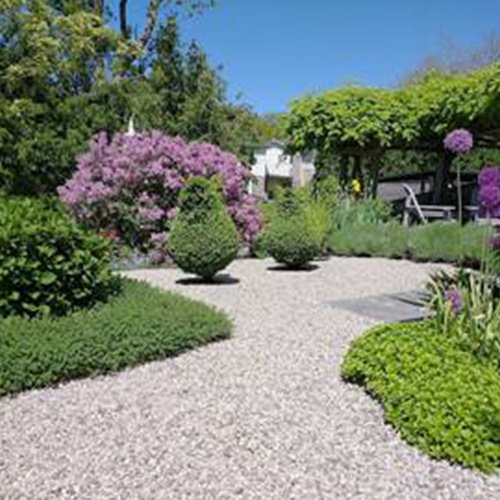
If you received the Fall 2025 issue of Fine Gardening magazine in your mailbox, you would have seen Lynn Fournier’s incredible garden in St. Catharines, Ontario, Canada, gracing the pages. We were first introduced to Lynn’s lush designs last fall (check out that feature here: Lynn’s Garden in Ontario), and it didn’t take us long to fall in love with the stunning landscape she created with the help of her husband, Ray. Today she is back with a look at this year’s growing season and some fantastic additions made to the garden.
This has been quite a long, hot, and humid summer in my neck of the woods, and I’ve had to restrict my gardening chores to mornings. This year’s spring and early summer didn’t disappoint, but as we now head into late summer I feel a bit of sadness as plants begin to look a little tired. Also, rabbits have been feasting on some of my favorites, and it’s been a challenging exercise trying various methods to discourage them . . . mostly they’re winning!
New this year are the ‘Sutton’s Apricot’ foxgloves (Digitalis purpurea ‘Sutton’s Apricot’, Zones 4–8), and three little boxwoods (Buxus spp. and cvs., Zones 4–9) planted in pots and being trained into birds.
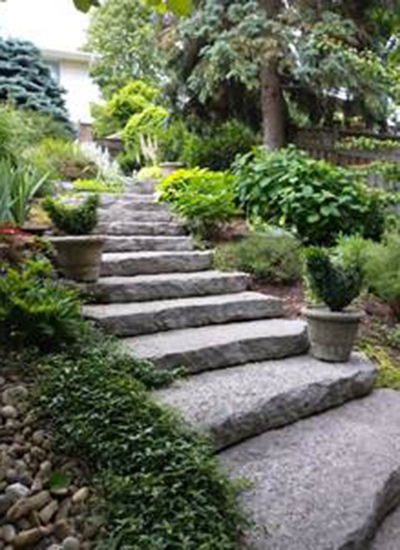
These beautiful stone steps are an access point through a sloped section of Lynn’s garden, and the perfect spot for her new potted topiary birds.
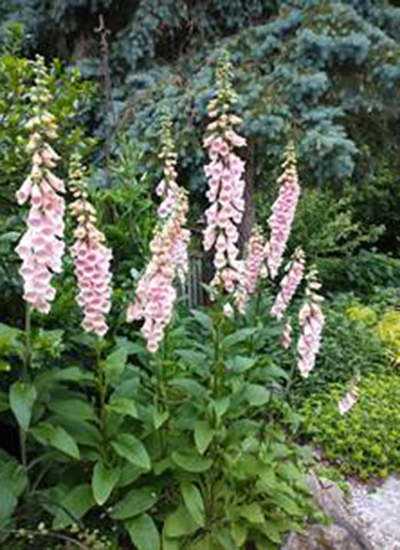 The other addition to Lynn’s garden this year, ‘Sutton’s Apricot’ foxgloves, is showing off those peachy pink blooms that give the cultivar its name. It’s a wonderful shade to mix and mingle with the other pink and purple blooms that are prominent in the garden.
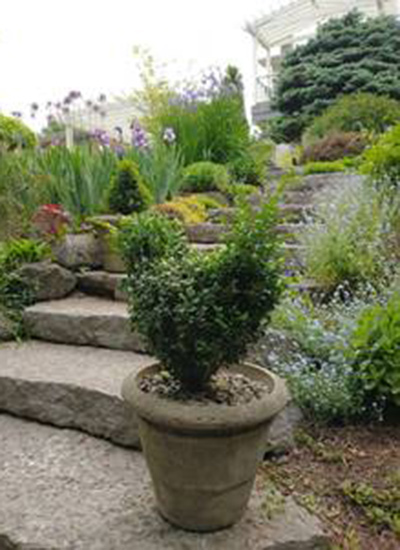 A closer look at the small topiaries that Lynn is training: I wonder if she is planning on keeping these container-sized, or if she will let them grow to eventually plant with her large creations?
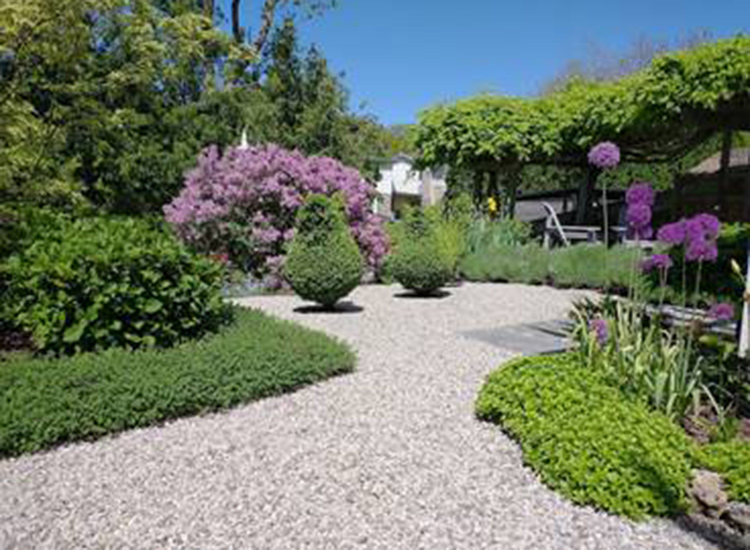 And speaking of those larger plants, it’s great to see them still looking pristine this summer. Boxwood blight and the box tree moth are constant threats to these creatively cultivated plants, but Lynn is diligent in their care.
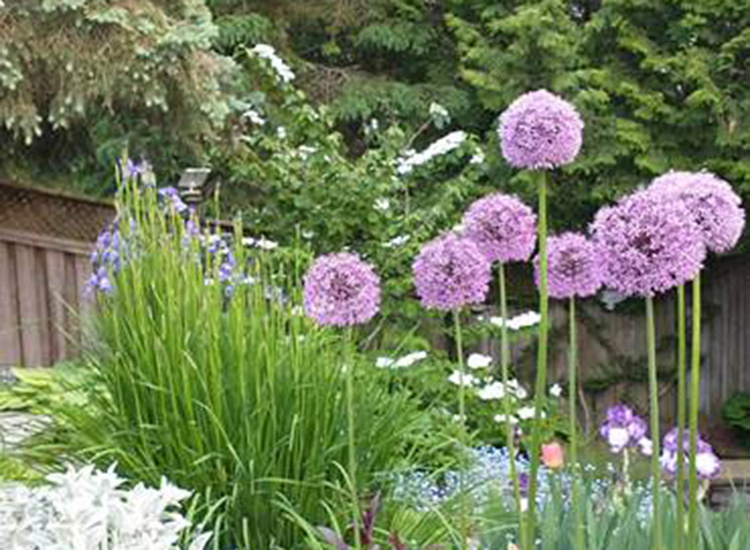 Aside from creating whimsical and wonderful shapes with her topiary, Lynn is also intentional with the shapes and forms of flowers in the garden. With this diversity she is able to create really exciting scenes, even when many of the colors are similar.
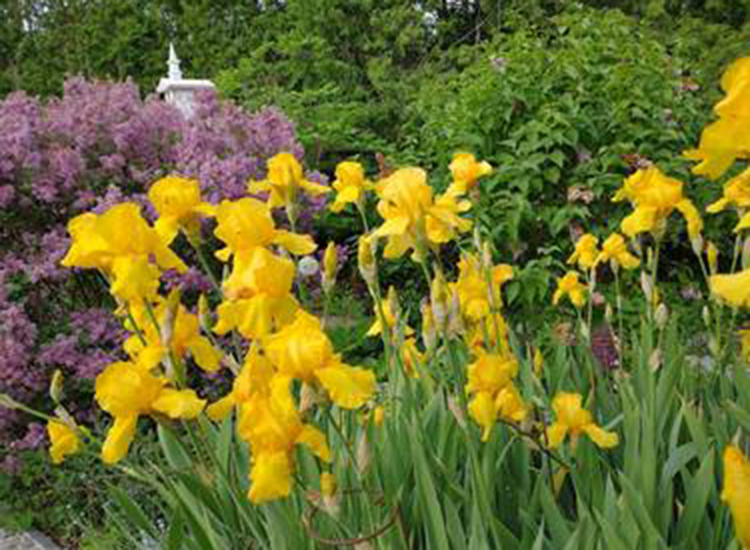 While pink and purple are the predominant colors in the landscape, blooms in other hues are utilized to provide contrast and act as accents. Compared to the cooler tones of many of the plants in Lynn’s garden, these bright yellow bearded irises absolutely glow.
Thank you so much for sharing your gorgeous garden and incredible topiary creations with us again, Lynn! Your ability to mix a little whimsy with a sophisticated plant palette results in a wonderfully unique and inspiring design.
We love to hear about new garden additions and exciting plant projects here at Garden Photo of the Day. As summer comes to a close and we start reflecting on this year’s growing season, consider sharing your garden updates and upgrades with the blog. Follow the directions below to submit photos via email, or send me a DM on Instagram: @agirlherdogandtheroad.
Have photos to share? We’d love to see your garden, a particular collection of plants you love, or a wonderful garden you had the chance to visit!
To submit, send 5–10 photos to [email protected] along with some information about the plants in the pictures and where you took the photos. We’d love to hear where you are located, how long you’ve been gardening, successes you are proud of, failures you learned from, hopes for the future, favorite plants, or funny stories from your garden.
Have a mobile phone? Tag your photos on Facebook, Instagram, or Twitter with #FineGardening!
Do you receive the GPOD by email yet? Sign up here
Fine Gardening Recommended Products

Attracting Beneficial Bugs to Your Garden, Revised and Updated Second Edition: A Natural Approach to Pest Control
Fine Gardening receives a commission for items purchased through links on this site, including Amazon Associates and other affiliate advertising programs.
This revised and updated edition of Jessica Walliser’s award-winning Attracting Beneficial Bugs to Your Garden offers a valuable and science-backed plan for bringing balance back to the garden. With this indispensable gardening reference—now updated with new research, insights, and voices—learn how to create a healthy, balanced, and diverse garden capable of supporting a hard-working crew of beneficial pest-eating insects and eliminate the need for synthetic chemical pesticides.
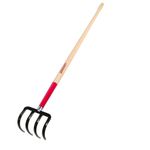
Razor-Back Potato/Refuse Hook
Fine Gardening receives a commission for items purchased through links on this site, including Amazon Associates and other affiliate advertising programs.
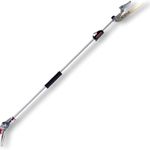
ARS Telescoping Long Reach Pruner
Fine Gardening receives a commission for items purchased through links on this site, including Amazon Associates and other affiliate advertising programs.
Telescopes from 4 to 7′. Cut and Hold (160) Blades. Drop forged blades for unsurpassed long lasting sharpness. Lightweight, 2.3 lbs., for continued use. Perfectly balanced for easy pruning.

Welcome to Well Rooted Wellness, your transformative journey towards holistic wellness and personal growth. We are an online learning platform that believes in the power of interconnectedness between the mind, body, and environment. Our mission is to empower individuals like you to lead fulfilling lives by nurturing these essential connections.
Contact us: contact@yoursite.com
© Copyright - wrwofficial.com - 2025