

Senate Majority Leader John Thune, R-S.D., (center) joined from left by Sen. John Barrasso, R-Wyo., the GOP whip, Mike Crapo, R-Idaho, and Budget Committee Chairman Lindsey Graham, R-S.C., speaks after Senate passage of the “One Big Beautiful Bill.” Millions are estimated to lose health care if the bill becomes law.
J. Scott Applewhite/AP
hide caption
toggle caption
J. Scott Applewhite/AP
President Trump’s “One Big Beautiful Bill” cuts federal spending on Medicaid and Affordable Care Act marketplaces by about $1 trillion over a decade, according to the nonpartisan Congressional Budget Office, threatening the physical and financial health of tens of millions of Americans.
The bill, which the Senate passed Tuesday, would reverse many of the health coverage gains of the Biden and Obama administrations, whose policies made it easier for millions of people to access health care and reduced the U.S. uninsured rate to record lows.
The Senate plan to slash Medicaid and ACA marketplace funding could lead to nearly 12 million more people without insurance by 2034, the CBO estimates. That in turn would harm the finances of hospitals, nursing homes and community health centers — which would have to absorb more of the cost of treating uninsured people — and may force them to reduce services and employees, as well as close facilities.

The legislation is nearing Trump’s desk, though first the Senate and House must approve the same version. The House passed its own version in May and is expected to consider the Senate’s version Wednesday, according to House Majority Whip Tom Emmer.
Here are five ways the GOP’s plans may affect health care access.
The deepest cuts to health care spending come from a proposed Medicaid work requirement, which would cut off coverage for millions of enrollees who do not meet new employment or reporting standards.
In 40 states and Washington, D.C., all of which have expanded Medicaid under the Affordable Care Act, some Medicaid enrollees would have to regularly file paperwork proving that they are working, volunteering, or attending school at least 80 hours a month or that they qualify for an exemption, such as caring for a young child.
The bill’s requirement would not apply to people in the 10 largely GOP-led states that have not expanded Medicaid.
Health researchers say the policy would have little impact on employment. Most working-age Medicaid enrollees who don’t receive disability benefits already work or are looking for work or are unable to do so because they have a disability, attend school, or care for a family member, according to KFF.
State experiments with work requirements have been plagued with administrative issues, such as eligible enrollees’ losing coverage over paperwork problems, and budget overruns. Georgia’s work requirement, which officially launched in July 2023, has cost more than $90 million, with only $26 million of that spent on health benefits, according to the Georgia Budget & Policy Institute, a nonpartisan research organization.
“The hidden costs are astronomical,” said Chima Ndumele, a professor at the Yale School of Public Health.
Belt-tightening that would target states could translate into fewer health services, medical professionals and even hospitals, especially in rural communities.

The GOP’s plan would curtail a practice, known as provider taxes, that nearly every state has used for decades to increase Medicaid payments to hospitals, nursing homes and other providers and to private managed-care companies.
States often use the federal money generated through the taxes to pay the institutions more than Medicaid would otherwise pay. (Medicaid generally pays the lowest fees for care, compared with Medicare and private insurance.)
Hospitals and nursing homes say they use these extra Medicaid dollars to expand or add new services and improve care for all patients.
Rural hospitals typically operate on thin profit margins and rely on Medicaid tax payments to sustain them. Researchers from the Cecil G. Sheps Center for Health Services Research who examined the House bill concluded it would push more than 300 rural hospitals — many of them in Kentucky, Louisiana, California and Oklahoma — toward service reductions or closure.
Republican senators tacked a $50 billion fund onto their version of the bill to cushion the blow to rural hospitals.

For those with ACA marketplace coverage, the GOP plan would make it harder to enroll and to retain their plans.
Marketplace policyholders would be required to update their income, immigration status and other information each year, rather than be allowed to automatically reenroll — something more than 10 million people did this year. They would also have less time to enroll; the bill shortens the annual open enrollment period by about a month.
People applying for coverage outside that period — for instance, because they lose a job or other insurance or need to add a newborn or spouse to an existing policy — would have to wait for all their documents to be processed before receiving government subsidies to help pay their monthly premiums. Today, they get up to 90 days of premium help during the application process, which can take weeks.
Republican lawmakers and some conservative policy think tanks, including Paragon Health Institute, say the changes are needed to reduce fraudulent enrollments, while opponents say they’re the latest attempt to undo Obamacare.
The legislation also does not call for an extension of more generous subsidies put in place during the COVID-19 pandemic. If Congress doesn’t act, those enhanced subsidies will expire at year’s end, resulting in premiums rising by an average of 75% next year, according to KFF.
Many Medicaid enrollees can expect to pay more out-of-pocket for appointments.
The bill would require states that have expanded Medicaid to charge enrollees up to $35 for some services if their incomes are between the federal poverty level (this year, $15,650 for an individual) and 138% of that amount ($21,597).
Medicaid enrollees often don’t pay anything when seeking medical services because studies have shown charging even small copayments prompts low-income people to forgo needed care. In recent years, some states have added charges under $10 for some services.
The policy would not apply to people seeking primary care, mental health care or substance abuse treatment. The Senate bill would allow states to enact even higher cost sharing for enrollees who seek emergency room care for nonemergencies. But if Medicaid patients fail to pay, hospitals and other providers could be left to foot the bill.
The GOP plan could cause at least hundreds of thousands of immigrants who are lawfully present — including asylum-seekers, victims of trafficking and refugees — to lose their ACA marketplace coverage by cutting off the subsidies that make premiums affordable. (Note: The restriction would not apply to green-card holders.)
Because the immigrants who would lose subsidies under this plan tend to be younger than the overall U.S. population, their exit would leave an older, sicker and costlier population of marketplace enrollees, further pushing up marketplace premiums, according to marketplace directors in California, Maryland and Massachusetts, and health analysts.
Taking health care access away from immigrants living in the country legally “will do irreparable harm to individuals we have promised to protect and impose unnecessary costs on local systems already under strain,” John Slocum, executive director of Refugee Council USA, an advocacy group, said in a statement.
Both the House and Senate versions of the bill reflect the Trump administration’s restrictive approach to immigration. But because it ran afoul of Senate rules, the legislation won’t include a proposal that would have reduced federal Medicaid payments to states like California that use their own money to cover immigrants without legal status.
KFF Health News chief Washington correspondent Julie Rovner contributed reporting.
KFF Health News is a national newsroom that produces in-depth journalism about health issues and is one of the core operating programs at KFF.
Hi GPODers!
As promised, we’re back in in Apalachin, New York, to see more photos from Jane Watkins’s spring garden. Be sure to check out Part 1 if you missed it yesterday, or read Jane’s description below if you need a refresher on her space. Otherwise, keep on scrolling to see more photos of her spring plants.
After a chilly April and a rainy May, spring weather is finally here in central New York! I garden on 5-plus acres in very rocky clay soil, high on a hilltop in Zone 5b. Winter winds and voracious deer are a challenge, so I try to limit myself to deer-resistant shrubs and perennials that can withstand Zone 4b just in case we get a really cold winter. Some plants I love too much to give up, such as hostas, clematis, and hibiscus, so I drape them with deer netting held down with metal earth anchors. My beautiful pink tree peony is easily 20 years old and had 40 blooms this year. My Sarah Bernhardt peonies are 35 years old.
I’ve been gardening since we bought our first house in the late 70s. I am a Master Gardener through Cornell Cooperative Extension, and spending time in my gardens is my source of relaxation.
This slice of lovely shade is what Jane has dubbed her Meditation Garden, with an attractive palette of bright green foliage and pink blooms creating a serene and relaxing space.
 Yesterday we saw Jane’s sensational 35-year-old Sarah Bernhardt peony covered in ruffled blooms and lots of buds. Today we get a look at her equally enchanting pink tree peony (Paeonia × suffruticosa, Zones 3–8) that she says is at least 20 years old.
 This red peony is potentially a newer addition but just as wonderful.
 A lovely cluster of Siberian iris (Iris sibirica, Zones 3–9) is a wonderful pop of indigo against bright green foliage.
 More of Jane’s colorful collection of hostas—these have been draped with deer netting to protect them from the next passing herd.
 Jane has a great eye for plants that have multiple areas of interest. Yesterday we admired her Black Lace elderberry (Sambucus nigra ‘Eva’, Zones 4–7), and this Magic Carpet spirea (Spiraea japonica ‘Walbuma’, Zones 4–9) is another stand-alone star. It’s absolutely covered in clusters of bright pink blooms, but it’s the chartreuse foliage that makes the plant extra wow-worthy.
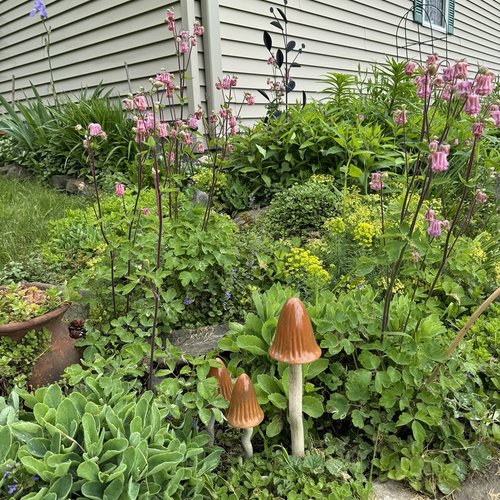
 A mix of sedum and other low-growers come together in Jane’s succulent garden. Pink columbine blooms—potentially ‘Dorothy Rose’ (Aquilegia vulgaris ‘Dorothy Rose’, Zones 3–9)—on tall stems add some height, and a trio of mushrooms add a whimsical touch.
 While Jane’s garden features a range of wonderful pink, purple, blue, and yellow blooms, white flowers can create just as eye-catching of an impact. White bleeding heart (Dicentra spectabilis ‘Alba’, Zones 2–9) has those heart-shaped blooms we all love; they glow against its green foliage and would make a wonderful addition to any moon garden.
 Lastly, a Wine and Roses weigela (Weigela florida ‘Alexandra’, Zones 4–8) is another excellent plant selection from Jane. The dark foliage contrasts wonderfully with the tubular, bright pink blooms, and its deer resistance means that Jane can enjoy all this beauty without worry of complete destruction.
Thank you so much for two great days of photos from your garden, Jane! You have so many fantastic plants putting on beautiful shows this time of year that I’m glad you didn’t hold back on your submission.
What spring plants put on the best performance in your garden this year? Or are there already summer stars that are stealing the show? Consider sending photos of your favorite plants to be featured on Garden Photo of the Day! Follow the directions below to submit photos via email, or send me a DM on Instagram: @agirlherdogandtheroad.
Have photos to share? We’d love to see your garden, a particular collection of plants you love, or a wonderful garden you had the chance to visit!
To submit, send 5–10 photos to [email protected] along with some information about the plants in the pictures and where you took the photos. We’d love to hear where you are located, how long you’ve been gardening, successes you are proud of, failures you learned from, hopes for the future, favorite plants, or funny stories from your garden.
Have a mobile phone? Tag your photos on Facebook, Instagram or Twitter with #FineGardening!
Do you receive the GPOD by email yet? Sign up here
Fine Gardening Recommended Products

Razor-Back Potato/Refuse Hook
Fine Gardening receives a commission for items purchased through links on this site, including Amazon Associates and other affiliate advertising programs.

SHOWA Atlas 370B Nitrile Palm Coating Gloves, Black, Medium (Pack of 12 Pairs)
Fine Gardening receives a commission for items purchased through links on this site, including Amazon Associates and other affiliate advertising programs.
Lightweight and close-fitting for excellent dexterity. Machine washable. Breathable back of hand to reduce perspiration. Designed for easy movement and continuous wear. Ideal for aerospace, assembly, automotive, construction, final fix, gardening, manufacturing, operating machinery, packaging, precision handling, tiling, warehousing.

Monarch Butterfly Rescue Wildflower Seeds 4 oz.
Fine Gardening receives a commission for items purchased through links on this site, including Amazon Associates and other affiliate advertising programs.
HIGH QUALITY SEEDS and EXPERT GUIDANCE: Experience the quality seed difference. We are committed to providing the highest quality, open-pollinated, non-GMO/non-GE seeds to our customers, guaranteed. A trusted source of high quality seeds since 1985. ATTRACT MORE MONARCHS: We know seeds and we know pollinators! Our expertly crafted botanical garden seed mixes contain a wide variety of both perennials and annuals that are specifically designed to attract pollinators. Attract more Monarchs and Butterflies in general. Gardener tested, pollinator approved! All Of Our Wildflower Varieties Are 100% Pure Seed, They come with complete planting instructions. Compare and see the quality value. This Wildflower Seed Mix will make the perfect gift for those gardeners in your life.

Let’s talk mayo. That classic, creamy condiment loved by some and loathed by others. Homemade mayonnaise is definitely a favorite around here (I have several recipes for it!). And while it’s an undeniable fridge staple in many households, store-bought mayo is almost entirely vegetable oil, one of the few foods I try to completely avoid.
This latest recipe is an easy, oil-free, high-protein version that’s faster to make! I found the idea originally on my friend Bethany’s page (go follow lilsipper if you don’t already…she’s amazing).
It has zero mystery, zero refined oils, and zero chance of separating halfway through your sandwich assembly (because who wants a runny mayo situation?). This homemade mayo is packed with protein and tastes delicious. Plus, if you eat the whole thing? You just got over 20 grams of protein!
Most store-bought mayo relies heavily on neutral-flavored oils like vegetable oils, sunflower oil, or canola oil. While that might sound like a healthy choice, they’re often highly processed and stripped of their natural nutrients. Not to mention, they’re full of omega-6 fatty acids that throw off your body’s delicate balance and contribute to inflammation.
There are now healthier options at the grocery store that use avocado oil or extra virgin olive oil. However, these can be cost-prohibitive, especially for those of us with a houseful of hungry teenagers! It’s simple and affordable to make your own mayo with clean ingredients.
This easy homemade mayonnaise is oil-free so you don’t have to worry about inflammatory oils. Some people don’t like the stronger taste of olive oil, so going oil free solves that problem too. Instead, it uses hard-boiled eggs for a rich, creamy texture and protein boost that regular mayo just can’t offer. Throw in a little vinegar, mustard, and water and you’ve got yourself simple, delicious mayo.
While my family loves a more traditional homemade mayo, it can be tricky to get right if it’s your first time making mayo. Regular mayo relies on separating egg yolks from room temperature raw eggs and doing an emulsion with oil, either in a food processor or stick blender/ immersion blender. And if your emulsion breaks, you’re left with broken mayonnaise and a mess.
This recipe uses the whole egg, and there’s no need to emulsify. So, without further ado, here’s the recipe for the easiest homemade mayo ever.
A simple homemade mayo recipe that uses only 3 ingredients. High in protein and fast to make if using already boiled eggs!
Start by boiling your eggs. You can do this the classic way and boil for about 10-12 minutes. Or use the Instant Pot and cook for 5 minutes on high, followed by a quick release. Once they’re done, peel the eggs and set them aside.
Place all of the ingredients in the blender, but start with ? cup of water and add more as needed to get the desired consistency.
Blend everything for about 10-15 seconds until smooth and creamy. The mayo will start to thicken as it blends.
Taste and adjust the seasonings as desired. If you want to add ranch or other herbs add them now. I’ve even added Parmesan, anchovies and Worcestershire for a great Caesar dressing.
Nutrition Facts
Easiest 3-Ingredient Homemade Mayo Recipe
Amount Per Serving (2 TBSP)
Calories 47
Calories from Fat 27
% Daily Value*
Fat 3g5%
Saturated Fat 1g6%
Polyunsaturated Fat 0.4g
Monounsaturated Fat 1g
Cholesterol 112mg37%
Sodium 160mg7%
Potassium 39mg1%
Carbohydrates 0.4g0%
Fiber 0.02g0%
Sugar 0.3g0%
Protein 4g8%
Vitamin A 156IU3%
Vitamin C 0.002mg0%
Calcium 16mg2%
Iron 0.4mg2%
* Percent Daily Values are based on a 2000 calorie diet.
Store in an airtight container like a Mason jar for up to 4 days in the fridge. You can also cut the recipe in half if you won’t use it that quickly.
You can also get creative with this mayo. Want to spice things up? Add in some ranch seasoning, French onion seasoning, or any of your favorite flavor blends to make a custom dip or sauce.
You can also switch up the ingredients. I like spicy brown mustard, but yellow mustard or even Dijon mustard works too. Or try some apple cider vinegar, white wine vinegar, or fresh lemon juice instead of white vinegar. Add a spicy kick with a little added sriracha.
Easily change things or add things, or keep it simple with just the 3 ingredients.
We don’t eat a ton of sandwiches around here, but there are still plenty of ways to use homemade mayo. Thin with a little water or milk and use it as a salad dressing. Add some minced garlic while blending to make an aioli sauce. And of course, there’s always the classic egg salad, chicken salad, or potato salad.
Here are some more of my mayo recipes to try:
Have you ever made your own homemade mayo before? Will you try this version? Leave a comment and let us know!
An ideal garden is mix of different plants, flowers, veggies, herbs and small shrubs. It not only makes the garden beautiful; it attracts pollinators and bees that keeps the garden healthy.
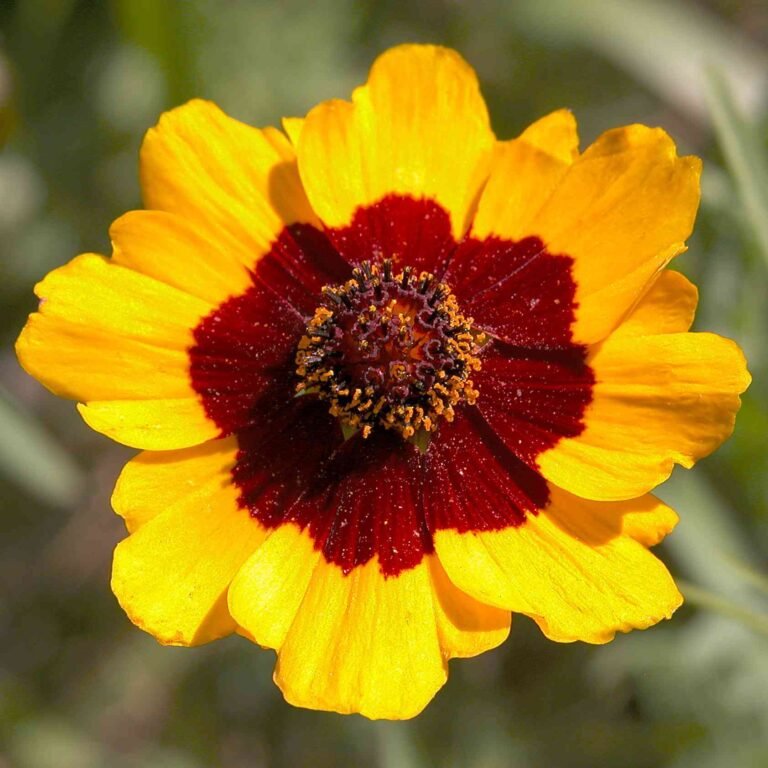
Coreopsis is one such low-maintenance flowering plant, known for its daisy-like blooms and long blooming period.
Native to North America, coreopsis is drought-tolerant and performs beautifully in sunny locations.
You can grow this plant to add a splash of color to your vegetable garden borders or to bring in helpful pollinators. Its bright yellow, pink, red, or bi-colored blooms are a magnet for bees and butterflies, and the plant itself is tough, thriving with very little care.
Coreopsis thrives in full sun and well-drained soil.

While it tolerates poor or sandy soils, it performs best in moderately fertile, slightly acidic to neutral pH soil (around 6.0–7.0).
Overly rich or moist soil can lead to floppy stems or root rot. Most varieties are perennial in USDA zones 4–9, though some are grown as annuals.
Ensure plenty of airflow around the plant, as crowded conditions can lead to mildew or other fungal issues.
1. Sunlight
Coreopsis loves the sun. It needs at least 6–8 hours of direct sunlight per day to produce its best blooms. While it can tolerate light shade, especially in very hot climates, too much shade will result in fewer flowers and leggy growth.
2. Soil Type
Coreopsis grows best in well-drained soil. It tolerates poor, rocky, or sandy soil better than rich or heavy clay. In fact, overly fertile soil can cause the plant to grow too tall and floppy with fewer flowers. Aim for neutral to slightly acidic soil (pH 6.0–7.0) for ideal results.
3. Watering Needs
Young plants need regular watering to establish strong roots. Once established, coreopsis becomes drought-tolerant and prefers slightly dry conditions. Overwatering or poorly draining soil can lead to root rot or fungal diseases, so allow the soil to dry slightly between waterings.
4. Spacing and Air Circulation
Good air circulation is important to prevent mildew and other fungal problems. Space plants according to variety:
5. Climate and Hardiness
Most coreopsis varieties are hardy perennials in USDA zones 4–9, though some are grown as annuals in colder regions. They can handle both heat and light frosts, making them a great choice for many climates.

Coreopsis can be grown in several easy ways: by sowing seeds directly in the garden after the last frost, starting seeds indoors for an early start, or transplanting nursery-grown plants into your landscape.
Perennial varieties can also be propagated by dividing mature clumps every few years, while some types can be multiplied through stem cuttings.
Additionally, gardeners can collect and save seeds from existing plants to replant each season.
Check this: How to Propagate Black-Eyed Susan?
Growing Coreopsis from seed is one of the most rewarding ways to add bright, cheerful color to your garden.
It’s budget-friendly and perfect for gardeners who enjoy watching the full growth cycle, from sprout to bloom. Whether you sow directly outdoors or start seeds indoors, the process is simple and reliable.
Direct sowing is the most common method for growing Coreopsis from seed, especially for annual species like Coreopsis tinctoria. This method works best when soil temperatures have warmed and the threat of frost has passed.
If you want to get a head start on the growing season or have a short summer, starting Coreopsis seeds indoors is a great option. This method is especially helpful for perennial species.

In addition to growing from seed, Coreopsis can also be propagated through division, stem cuttings, and seed saving. These methods allow gardeners to multiply existing plants, preserve specific traits (such as flower color or size), and rejuvenate older plants.
Division is the most reliable propagation method for perennial Coreopsis species like Coreopsis grandiflora and Coreopsis verticillata. It helps to refresh overgrown or declining plants while producing new ones for other areas of the garden.
Also Read: How to Propagate Bee Balm?
Some hybrid or sterile Coreopsis varieties do not produce viable seeds. In these cases, stem cuttings can be an effective way to propagate the plant.
When planting Coreopsis, spacing depends on the variety and whether you’re growing from seed or transplanting mature plants.
In general, most types benefit from being spaced 12 to 18 inches apart. This allows each plant enough room to spread, develop a healthy root system, and grow into a full, bushy shape.
Proper spacing also helps improve air circulation, which is important for preventing fungal diseases like powdery mildew.
Overcrowding can lead to weak stems, poor blooming, and increased competition for water and nutrients. If you’re growing a compact or dwarf variety, 10 to 12 inches of spacing is usually enough.
If starting from seed, thin seedlings once they’re a few inches tall, leaving 10 to 15 inches between each plant.
This early thinning step ensures strong, healthy growth and reduces crowding as the plants mature. Giving Coreopsis the right amount of space encourages more blooms and long-term garden performance.
Also Read: How to Plant Daylily Bulbs?
One of the standout features of coreopsis is its extended blooming period, which can last from late spring to fall:
In warm climates or with early seed starting, some varieties may start blooming as early as April. The plant naturally slows down toward the end of the season, but a mid-season trim can rejuvenate it.
Coreopsis height varies by species, but most varieties grow between 1 to 3 feet tall. Dwarf types may stay under 12 inches, while taller cultivars can reach up to 4 feet.
Plant height is influenced by sunlight, soil, and care. Full sun and well-drained soil help plants reach their maximum height and bloom potential.
Once established, coreopsis requires minimal care. Here’s how to keep it thriving:
Watering
Water deeply when newly planted. Once mature, coreopsis is drought-tolerant and only needs watering during prolonged dry spells.
Feeding
Coreopsis generally does not require fertilizing. Overfeeding may reduce blooming and encourage leggy growth. Compost at planting time is often sufficient.
Pruning and Deadheading
Regular deadheading extends blooming. In midseason, cut plants back by a third to promote fresh growth and another round of flowers.
Winter Care
In fall, let the last flowers go to seed for winter interest and to feed birds. Cut back dead stems in early spring. Mulch lightly in cold zones to protect roots.
Pests/Diseases
Coreopsis is mostly pest-free but may occasionally attract aphids or suffer from mildew if overcrowded or overwatered. Good spacing and well-drained soil prevent most problems.
Coreopsis is a resilient, sun-loving plant that brings bright color and pollinator activity to your garden with very little effort.
From sowing seeds in spring to watching bees buzz around its cheerful blooms all summer, it’s a gardener’s joy.
With proper spacing, full sun, and minimal care, coreopsis can be a blooming success whether you’re planting a border, filling a meadow, or adding charm to a container.

Khaja Moinuddin, a computer science graduate, finds joy in gardening and homesteading. Join him on this blog as he shares his experiences in homesteading, gardening, and composting

California Assemblymember Rebecca Bauer-Kahan introduced a bill in the current legislative session to mandate menopause education for doctors in the state.
Rich Pedroncelli/AP
hide caption
toggle caption
Rich Pedroncelli/AP
Former middle school teacher Lorraine Carter Salazar isn’t easily embarrassed. But when she began having hot flashes at school about a decade ago, she worried about how she came off to coworkers, students and parents.
“It doesn’t convey competence,” said Carter Salazar, 62. She recounted how parents could tell she was uncomfortable in meetings. One time, a student even fanned her and remarked that she was used to seeing her grandma feeling the same way.
When she took her concerns to her doctor, he didn’t take them seriously.
“So you sweat,” Carter Salazar recalled him saying. “And he’s right. Nobody dies from sweating.”

People experiencing perimenopause and menopause symptoms — which can range from hot flashes and night sweats to mood changes, decreased libido and cognitive issues — often complain of unresponsive doctors and inconsistent care. Symptoms can impact quality of life in the moment, and long-term health.
Many doctors are ill-equipped to handle these conversations.

Lorraine Carter Salazar (right) works on a knitting project at a craft group she attends weekly at a Sacramento library branch.
Megan Myscofski/CapRadio
hide caption
toggle caption
Megan Myscofski/CapRadio
A needs assessment published in the medical journal Menopause in 2023 showed just under a third of the residency programs in obstetrics and gynecology it surveyed offered training on menopause, even though half of the population experiences it.
That’s led lawmakers in California and nationally to try to intervene.
In California, legislators introduced two bills this legislative session on menopause education for doctors. Assembly Bill 360, which would have required a state agency to look into education gaps and how to fill them, was tabled last month. But Assembly Bill 432, which would require menopause coursework for doctors to renew their licenses — if at least 25% of their patients are women under 65 — is still moving through the legislature.
“It reflects my own experience having to go to three doctors before a doctor could adequately have a conversation with me about menopause,” said Democratic Assemblymember Rebecca Bauer-Kahan, who introduced the measure.
She says when she was going through menopause, her brain fog became so intense that she worried she might have early-onset Alzheimer’s Disease.
And California’s efforts are part of a national trend.
“Thirteen states, including California, have introduced a total of 21 bills [related to menopause] this legislative session, which is pretty stunning actually for an issue that really wasn’t on any legislator’s radar, certainly three years ago,” said Jennifer Weiss-Wolf, who runs the Birnbaum Women’s Leadership Center at New York University and tracks menopause bills.
Several of those bills also touch on doctor education. In New Jersey, for example, one bill would allow providers to use continuing education credits towards their license renewal. Arizona and Massachusetts introduced bills this year to provide more information on menopause to providers and patients.
In recent years, Illinois and Louisiana have started to mandate insurance coverage for some menopause treatments.
Training is available for doctors who want it – and treatments are available for people who need them.
“There’s no reason that somebody should suffer with those symptoms,” said Dr. Monica Christmas from the University of Chicago. She runs the menopause program at the Center for Women’s Integrated Health.
Christmas, who has practiced gynecology for over 20 years, fell into the speciality because her colleagues kept sending her their menopausal patients.
“I didn’t know the answers, but I listened,” she said.
After hearing their concerns, she researched their symptoms before coming back with treatment ideas. They, in turn, told their friends at work, over coffee, and while waiting for the train about the doctor who took them seriously.
“And so very quickly, I got super busy,” she said.
Christmas said the training a school offers on menopause usually depends on how well-resourced it is. Since few schools have a robust program, many physicians also seek out information and training elsewhere.
Christmas also works for The Menopause Society — a national organization that provides training for doctors on how to treat women at this stage of life.
Christmas said it’s imperative that doctors know how to work with lots of different people — because symptoms vary, and so do people’s tolerance levels and trust in the medical system.
“Black women like myself were very reluctant to take anything for the symptoms that they were experiencing,” she said. She never understood why, and heard myriad reasons when she asked. Some patients explained that menopause is simply a natural process meant to be endured. “Yet, I could see in front of me them having hot flashes in the conversation.”
Kim Robinson, with the advocacy organization Black Women for Wellness, said Black women have to navigate discrimination on top of seeking helpful information from health care providers.
She added that doctors should be better versed in how Black women experience this time of life differently from other women.
For instance, Black women often experience fibroids, or benign growths in the uterus, at higher rates than white women, according to a recent study in the American Journal of Obstetrics and Gynecology.
As they reach menopause, Robinson said many doctors suggest Black women get hysterectomy, which is the removal of the uterus, without fully explaining the risks or alternatives. According to the Mayo Clinic, several alternatives exist, such as hormone regulation, but nearly 60% of women who receive a hysterectomy are offered other treatment first.
“It’s not just this one invasive thing, remove your parts and the problem is solved,” she said of the procedure.
Robinson knows from experience. When her doctor suggested she get a hysterectomy, she knew to push back and ask questions, eventually finding a less-invasive alternative.
But, she said, the burden shouldn’t be on patients to advocate for themselves. Doctors, she said, should get more training and education on symptoms and treatments.
In California, the measure that would require doctors to study menopause builds off a bill that Democratic Governor Gavin Newsom vetoed last year. In his veto message, Newsom said the bill was “too far-reaching” because it would have required health insurance plans to cover expensive and non-FDA-approved treatments.
However, Newsom encouraged lawmakers to “continue to work towards a more tailored solution that can improve access to perimenopause and menopause care, inform patients of their options, and encourage providers to stay informed of the latest clinical care recommendations,” he wrote.
But Bauer-Kahan, the assemblymember, kept the provisions that Newsom cited as a problem. However, she added education requirements, when last year’s bill strictly focused on insurance.
“We’ve doubled down,” she said. “I think one of the things I learned last year through the hearings we held on menopause and this work is how little is understood about menopause.”
Newsom’s office declined to comment on the measure.
Opposition within the medical field is also an obstacle.
Dr. Tanya Spirtos, former president of the California Medical Association, which represents doctors, said the bill is well-intentioned but misguided. Doctors generally know they must stay up to date and informed about the latest treatments, she said.
“We do the reading and the education, as I say, to stay one step ahead of our patients,” she said.
Spirtos, a gynecologist, also said there are lots of areas — like diabetes or nutrition — where doctors need to stay current, but requiring training in each one would create too much of a burden. She said doctors should decide for themselves what kind of training is most relevant to their practice.
“Every area that touches on bones or brain or heart or vagina or hot flashes has literature available that’s really easy for our physicians to get a hold of and educate themselves,” she said.
NYU’s Weiss-Wolf’s says she hopes to see access to good menopause care take off. Her focus on women’s health also includes advocating for making tampons and pads more accessible.
“Certainly when I started working on periods, people weren’t talking about it in any sort of public and systematic way,” she said. “And I would say that 10 years later, that feels different to me.”
She thinks something similar is happening now for menopause.
This story is part of a series produced for the USC Annenberg Center for Health Journalism‘s 2025 California Health Equity Fellowship.
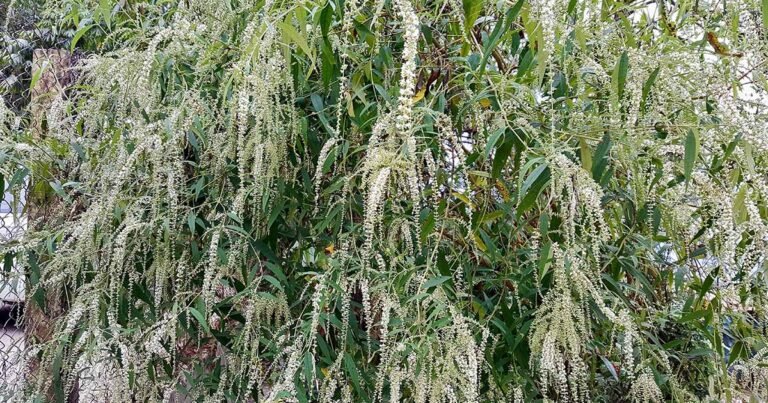
Sweet almond bush (Aloysia virgata), also known as sweet almond verbena or incense bush, is a fast-growing, woody shrub or small tree in the Verbenaceae family.
Native to northern Argentina, this perennial thrives in USDA Hardiness Zones 8 to 11, where it may remain evergreen or die back in the winter, depending on the local climate.

This cousin of edible lemon verbena (A. citrodora) features pointed terminal clusters of white blossoms that bloom profusely from midsummer to fall and infuse gardens with a sweet almond or vanilla-like fragrance, especially during the late afternoon and evening hours.
The flowers attract a variety of pollinators, including bees, butterflies, and hummingbirds.
Let’s take a closer look at how to grow and care for this striking, sweet-scented plant. Here’s what I’ll cover:
Also commonly known as sweet almond verbena or incense bush, A. virgata is a low-maintenance shrub with an upright growth habit.
The green leaves have a soft luster and are arranged alternately along slender branches that arch slightly for a graceful, airy display as a multi-stemmed shrub or small tree.
Common name(s): Sweet almond bush, sweet almond verbena, incense bush
Plant type: Woody flowering shrub
Hardiness (USDA Zone): 8-11
Native to: Northern Argentina
Bloom time / season: Midsummer to fall
Exposure: Full sun
Soil type: Fertile loam, moderately moist to dry, well-draining
Soil pH: 5.6-7.8, slightly acidic to neutral
Time to maturity: 3-5 years
Mature size: 5 to 15 feet tall, 3 to 8 feet wide
Best uses: Border, container, rock garden, specimen
Order: Lamiales
Family: Verbenaceae
Genus: Aloysia
Species: Virgata
Showcase this ornamental specimen in borders, containers, and rock gardens, to add long-lasting fragrance and attract pollinators.
Mature dimensions are five to 15 feet tall and three to eight feet wide. Sweet almond bush grows as an evergreen in frost-free climates.
Where it is cooler, and the ground freezes, these perennial plants die to the ground at season’s end and return in the spring.
Alternatively, you can grow sweet almond bush in pots that can be moved indoors as needed and returned outside after last frost.
When you replicate its natural habitat, A. virgata rewards you with an abundance of flowers and an outdoor living space infused with perfume.

Sweet almond bush grows rapidly and reaches mature dimensions in three to five years when its cultural requirements are met.
Let’s discuss how to accommodate its needs.
In its native range of northern Argentina, sweet almond bush grows in tropical to subtropical conditions.
Summers are hot and humid, with temperatures between 86 and 104°F, and seasonal rainfall.
Winters are mild, with average temperatures between 50 and 68°F and only occasional light frosts.
In cultivation, this species performs best in similar conditions.
Sweet almond bush prefers a location with full sun to support optimal growth and flowering.

Aim for at least six hours of direct sunlight per day. Adequate light also helps to dry the soil surface between waterings, reducing the risk of root rot.
The ideal soil is organically-rich loam with a pH of 5.6 to 7.8. It should be loose, airy, and well-draining.
If you’re cultivating in containers, select a potting mix that is loose, moisture retentive, and drains well.
Provide consistent moisture during the first two to three years after planting. Water when the top two to three inches of soil are dry, especially during hot weather.
Once established, A. virgata has above-average drought tolerance. Avoid overwatering as this can lead to root rot. Mature plants generally need irrigation only during a protracted dry spell.
While this shrub is not a heavy feeder, it benefits from a yearly application of an all-purpose, slow-release, granular fertilizer with a balanced N-P-K ratio, such as 10-10-10, to support overall health and blooming.
Sweet almond bush isn’t commonly found at big-box garden centers, but you may be able to source it through specialty nurseries in Zones 8 to 11 or from individual growers via plant exchanges.
With regular pruning, sweet almond bush can be shaped into a multi-stemmed shrub or trained as a small tree. In containers, trimming helps control size and maintain a tidy form.
The best time to prune is in midsummer, after the first flush of flowers fades.

Because this plant blooms on new growth, cutting branches post-bloom often encourages a second round of flowering.
Deadheading spent flower stems throughout the growing season also supports prolific reblooming.
Remove any damaged, dead, or pest- or disease-affected branches as needed.
In cooler regions, where the shrub dies with the first frost, cut it back to the ground and dispose of the debris to avoid harboring garden pests and pathogens over the winter.
Apply a loose, airy two- to three-inch layer of straw mulch over the root zone for winter insulation.
For potted specimens in areas that freeze, you can take them indoors before the first frost to enjoy as a houseplant, returning it outdoors the following spring.
Choose a location in bright, indirect light, and water when the top few inches of soil dry out.
For container-grown plants in freezing climates, bring them indoors before the first frost. They can be kept as houseplants in a bright location, watered when the top few inches of soil are dry.
Alternatively, allow frost to trigger leaf drop and store the pot in a dark room at around 60°F where it will remain dormant until you put it outside in the spring.
Water infrequently, just before the pot completely dries out.
The best ways to propagate sweet almond bush is by taking cutting or by air-layering.
If you don’t have a shrub to work with, you can purchase a nursery start from a reputable grower.
To propagate sweet almond bush by cuttings:
When new foliage sprouts, the cutting is ready to transplant out into the garden or into a permanent container.
Air layering is a propagation method that encourages roots to form on a wounded section of a branch while still attached to the parent plant.
You should now have a leafy stem with a root mass at the bottom ready to transplant.
To transplant sweet almond bush into the landscape, work the soil to a depth of eight to 12 inches until it is loose and crumbly.
Set the crown, where the roots and stem(s) meet, slightly above the soil surface, backfill with soil, and water in well.
After transplant, maintain even moisture, watering when the top few inches of soil feel dry and rain is not in the forecast.
Pamper your sweet almond bush for the first couple of years. After that, it is drought tolerant and shouldn’t need supplemental water unless there is a drought.
A. virgata is not prone to pests or pathogens in the landscape.

However, the plants may be visited by aphids in overly humid conditions, and spider mites, and/or whiteflies in hot, dry environments.
Damage from these sapsucking insects includes leaf yellowing, wilting, and stunted growth.
Address infestations with a strong spray of water from the hose and applications of neem oil as needed.
Sweet almond bush may be vulnerable to root rot in wet soil. Signs of rotting include the softening of foliage and roots, wilting, and a foul odor.
If caught early, healthy portions may be salvageable. Grow in well-draining pots or ground soil and avoid overwatering.
When a shrub repeat-blooms throughout the growing season, it is a valuable asset in the midsummer-to-fall landscape, well worth the minimal maintenance required.
With its substantial size, gracefully arching branches, lovely blossom spikes, and heady fragrance, the long-blooming sweet almond bush is destined to play a starring role in Zone 8 to 11 landscapes.
Do you grow sweet almond bush in your outdoor living space? Please tell us your tips for success in the comments section below!
If you enjoyed reading about this sweetly-scented species and want to learn more about growing woody shrubs, we recommend the following articles next:
Happy Monday, GPODers!
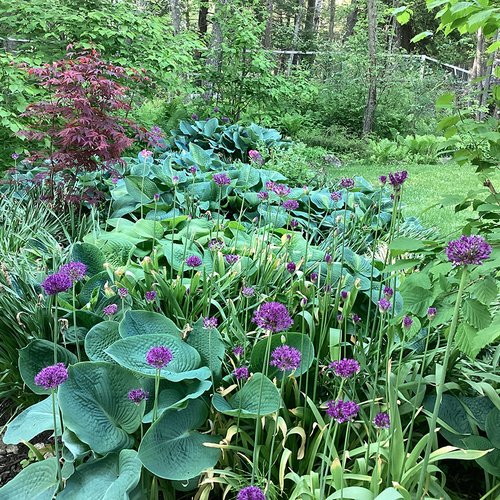
Today we’re getting a springtime update from Deb Skup in Sturgeon Bay, Wisconsin. Deb has shared her garden a couple of times in the past (Deb & Paul’s Garden in the Wisconsin Woods and Wild but Wonderful), but it has been several years since the last update and her plantings have evolved quite a bit. As Deb highlights in this submission, alliums have self-seeded throughout her gardens and helped to create a luscious green and purple color palette throughout her beds and borders.
Hi,
I haven’t submitted any new pictures for quite a while so thought I would send some today of my self-seeded alliums. They seem to look good wherever they pop up (except for their ugly leaves!). I have been retired now since 2022 so have had time to get the gardens a bit more under control, most days spending at least four hours working on them.
In this picture: catmint, mountain cornflower (Centaurea montana, Zones 3–8), astilbe, Dutch iris (Iris × hollandica, Zones 6–9), Japanese forest grass (Hakonechloa macra, Zones 5–9), purple heuchera, hosta, and some self-seeded blue columbine. My vegetable beds are in the background with a row cover over the peppers.
 The burgundy maple tree was a seed in some mulch 30 years ago!
 I braid all my thousands of daffodils and tuck them under each year so they don’t smother everything around them.
 This is Jazz, our 9-month-old puppy who loves to trample and chew on things while I weed.
 Here is my baby ‘Bloodgood’ Japanese maple (Acer palmatum ‘Bloodgood’, Zones 5–8) among hostas, allium, and other things that are buried in unbraided dafs. In the background is the native forest.
 One final photos shows the alliums adding more color to yet another bed, this time a wonderful contrast to a mass of bright yellow Japanese forest grass (Hakonechloa macra, Zones 5–9).
Thank you so much for this fantastic update on your garden, Deb! The additional hours you are now able to spend in your garden have made an impact, and it’s so fun to see how your space has transformed over the years.
Do you let any plants self-seed freely in your garden? Maybe it’s a plant that just looks great in every setting, like Deb’s alliums, or maybe you’re a native plant connoisseur that lets beneficial beauties spread anywhere they’d like. Let us know in the comments what plants have free rein in your garden, or consider sharing photos with the blog! Follow the directions below to submit photos via email, or send me a DM on Instagram: @agirlherdogandtheroad.
Have photos to share? We’d love to see your garden, a particular collection of plants you love, or a wonderful garden you had the chance to visit!
To submit, send 5–10 photos to [email protected] along with some information about the plants in the pictures and where you took the photos. We’d love to hear where you are located, how long you’ve been gardening, successes you are proud of, failures you learned from, hopes for the future, favorite plants, or funny stories from your garden.
Have a mobile phone? Tag your photos on Facebook, Instagram or Twitter with #FineGardening!
Do you receive the GPOD by email yet? Sign up here
Fine Gardening Recommended Products
Razor-Back Potato/Refuse Hook
Fine Gardening receives a commission for items purchased through links on this site, including Amazon Associates and other affiliate advertising programs.

X3 Stainless Steel Midi-Mod Fountain
Fine Gardening receives a commission for items purchased through links on this site, including Amazon Associates and other affiliate advertising programs.
3 feet high, it’s a more compact version of the larger X3 Fountain
-9.5″ w by 9.5″ d
-Powdercoat over stainless steal
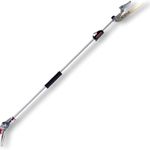
ARS Telescoping Long Reach Pruner
Fine Gardening receives a commission for items purchased through links on this site, including Amazon Associates and other affiliate advertising programs.
Telescopes from 4 to 7′. Cut and Hold (160) Blades. Drop forged blades for unsurpassed long lasting sharpness. Lightweight, 2.3 lbs., for continued use. Perfectly balanced for easy pruning.

Welcome to Well Rooted Wellness, your transformative journey towards holistic wellness and personal growth. We are an online learning platform that believes in the power of interconnectedness between the mind, body, and environment. Our mission is to empower individuals like you to lead fulfilling lives by nurturing these essential connections.
Contact us: contact@yoursite.com
© Copyright - wrwofficial.com - 2025