We have returned to Simcoe, Ontario, Canada today to enjoy more incredible plants and pairings in the garden of Linda and Terry Walsh. We enjoyed a sensational assortment of photos from their large and lively garden yesterday (Check out Part 1, if you missed it), and we’re back today to see more of the fabulous plant selections that make their “demonstration garden” a special place to visit.
As mentioned earlier we have lived here for about 40 years and have been gardening extensively for the last 20 years. We have become a ‘Demonstration Garden” as people often want to know what plants look like full size and also wish to get landscaping ideas. We are open by appointment from June to September; it is a great way to meet fellow gardeners. Several years ago we put in electric gates which we designed with the Tree of Life in the centre. We are situated about 1000 feet from the road so the gates are not only security but do let people know when we are not available. We have over 175 rhododendrons, 50 + flowering dogwoods, hydrangeas, azaleas, viburnums, redbuds, Japanese maples, tulip trees, sassafras, paw paw and many other native trees. Children of all ages enjoy our koi pond, peacocks and border collies. We also grow organic brandy wine raspberries in our spare time, along with dahlias and numerous perennials.
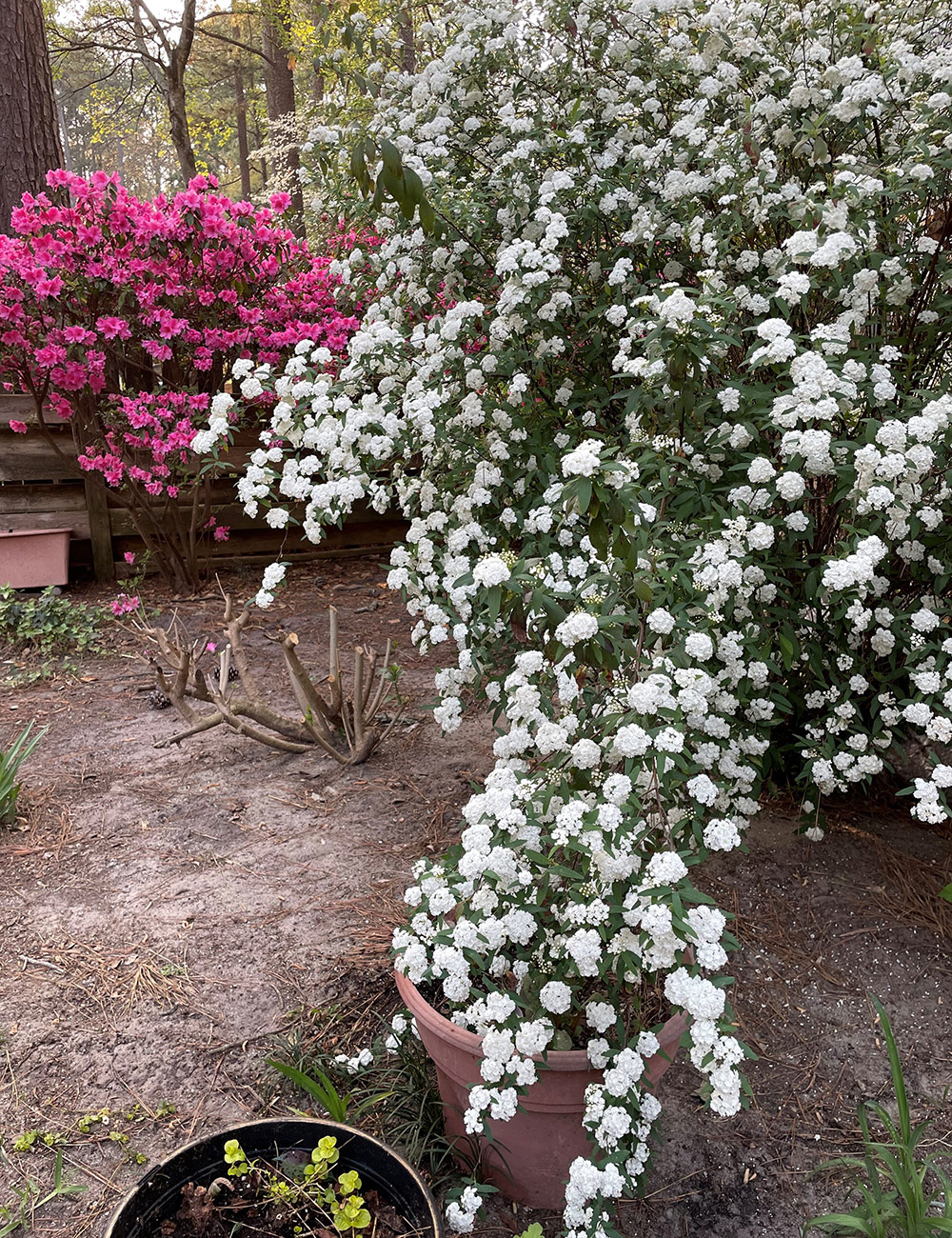
White Catawba rhododendron(Rhododendron ‘Catawbiense Album’, Zones 4–8)with a cutleaf Japanese maple(Acer palmatum var. dissectum, Zones 5–9)
Flowering dogwood(Cornus florida, Zones 5–9) in full bloom at entrance
More fabulous flowering trees putting on colorful displays.
One of many Japanese maples, not sure of the variety as it may be a cross of the many maples here.
Brandywine raspberries(Rubus idaeus ‘Brandywine’, Zones 4–8)that we planted years ago for our son who wanted a part time job.
Giant fleece flower(Persicaria polymorpha, Zones 4–9)
Border of lilies and marigolds
Thank you so much for this fantastic update on your garden, Linda! I can only image the lucky visitors walk away with endless planting ideas and inspiration.
How do you share your garden with others? Do you open your space to the masses on local garden tours, or do you keep your oasis a private retreat for only close friends and family? Let us know in the comments below, or consider sharing your space with our community by sending in photos to the blog. Follow the NEW directions below to submit your photos to Garden Photo of the Day!
We want to see YOUR garden!
Have photos to share? We’d love to see your garden, a particular collection of plants you love, or a wonderful garden you had the chance to visit!
You can also send 5–10 photos to [email protected] along with some information about the plants in the pictures and where you took the photos. We’d love to hear where you are located, how long you’ve been gardening, successes you are proud of, failures you learned from, hopes for the future, favorite plants, or funny stories from your garden.
Do you receive the GPOD by email yet? Sign up here
Fine Gardening Recommended Products

ARS Telescoping Long Reach Pruner
Fine Gardening receives a commission for items purchased through links on this site, including Amazon Associates and other affiliate advertising programs.
Telescopes from 4 to 7′. Cut and Hold (160) Blades. Drop forged blades for unsurpassed long lasting sharpness. Lightweight, 2.3 lbs., for continued use. Perfectly balanced for easy pruning.
Pruning Simplified: A Step-by-Step Guide to 50 Popular Trees and Shrubs
Fine Gardening receives a commission for items purchased through links on this site, including Amazon Associates and other affiliate advertising programs.
Pruning Simplified shows you exactly how to do it. This must-have guide offers expert advice on the best tools for the job, specific details on when to prune, and clear instructions on how to prune. Profiles of the 50 most popular trees and shrubs—including azaleas, camellias, clematis, hydrangeas, and more—include illustrated, easy-to-follow instructions that will ensure you make the right cut the first time.
DeWalt Variable-Speed Cordless Reciprocating Saw with 6-Piece Saw Blade Set
Fine Gardening receives a commission for items purchased through links on this site, including Amazon Associates and other affiliate advertising programs.
You can fit a variety of blades to this saw to cut fallen branches or prune larger limbs from trees in a pinch. It’s fast, tough, easy to use, and extremely versatile.
– 18.31 x 6.13 x 4 inches
– 1-1/8-inch stroke length
– Variable speed trigger with 0-3000 spm
– DW4856 Metal/Woodcutting Reciprocating Saw Blade Set, 6-Piece
Price: $12.90 - $11.90 (as of Feb 17, 2026 08:15:52 UTC – Details)
Sale is for a SINGLE BAND. We offer six different size bands that have tensions ranging from 5 lbs. to 150 lbs. Bands are perfect for any users from beginner to professional athlete. Whether it is mobility training or powerlifting – Serious Steel bands have been the #1 trusted bands on Amazon for over 10 years. Often Imitated, Never Duplicated. YOU ARE CURRENTLY VIEWING OUR #0 (ORANGE) Micro BAND. This band measures 1/4” wide, 4.5 mm thick and 41” in length. It offers resistance from 2-15 lbs. This band provides our lowest level of resistance and is great for light stretching, high-performance speed training and sports specific training. It is also great when combined with our other size bands for that little extra tension. PULL-UPS: Serious Steel Bands are a perfect tool to help you with your pull ups, dips or muscle-ups. Take a quick look at the Pull-Up Guide image to your left to get an idea of the best band for you. Choose a band based on your bodyweight and the current number of unassisted repetitions you can complete. MULTIPLE BANDS: Do you think you need a #4 band, but concerned it may be too much tension? You can purchase multiple smaller bands to equal the tension of heavier bands. Try the #2 & #3 instead of the #5 or try the #3 & #1 instead of the #4 band. Combining multiple sizes gives you more levels of tension because you can use them individually or you can use them at the same time. ALL ABOUT THE LAYERS: Serious Steel bands have stood the test of time. Our bands are 15-continuous layers made from a single piece of natural latex. The individual layers make Serious Steel bands up to 5X stronger than molded bands and 2X stronger than other “layered” bands. Does not include colored storage rubber bands.
Price: $34.95 (as of Feb 16, 2026 20:15:10 UTC – Details)
Premium Weightlifting Belt with Anatomical Contoured Design Our newest weight lifting belt features a 6” contoured design to specifically increase lumbar support and abdominal pressure while increasing freedom of movement. The reinforced back support and wider ends increase performance and comfort like no other belts on the market. The anatomical fit results in better performance and greater range of motion to fit all your lifting needs. Add to this our auto-lock security and durable construction and you get the best bang for your buck fitness belt you will ever purchase. Who Can Benefit From a Weight Lifting Belt? Lifting belts increase intra-abdominal pressure. Increasing pressure to your core through our workout belt will make you feel safer and increase core stability giving you much more power lifting heavy weights. If a lifter is squatting heavy or pulling big, a belt will increase performance on those lifts. Main Features: -6” Anatomical Contoured Design -4″ Wide Velcro Strap -Auto-Lock Roller Buckle -Double Stitching Construction -Lightweight and Ultra Durable Fit Guide Measure with your clothing around the area the belt will be worn (NOT pants waist size). Pull tape tight for best measurement. -Small:25-30″ -Medium: 30-35″ -Large: 35-40″ -X-Large: 40-45″ -XX-Large: 45-50″ 5 Star Experience Built tough for your workouts, our premium 6” lifting belt is durable, offers extreme support, effective and fully portable, will last many years of usage and give you the results you want. We’re so confident that you’ll absolutely love our lifting belts that if somehow you aren’t 100% satisfied, just contact us and we’ll take them back for a full refund! Click on the Yellow “Add to Cart” button above Now to MAXIMIZE your workouts and experience the RESULTS you deserve. 100% Nylon PREMIUM BACK SUPPORT: Protect your back with our premium 6” nylon weightlifting belt. Our weight belt offers a reinforced back area with a full 4” wide Velcro strap for a perfect, secure fit. Our back belt offers great support and top stability to the lower back and abdominal. It is a must have for heavy squats, deadlifts, rows, and more! PERFECT ANATOMICAL FIT – Our contoured and tapered design offers a 6” wide front and rear area providing optimal support for the back and stomach section. The narrower areas on the sides increase comfort and freedom of movement during any type of workout resulting in maximum protection and comfort! AUTO-LOCK FASTENING TECHNOLOGY: Our weight lifting belt features the best fastening roller buckle system you will find on the market. It works just like a ratchet fastener. It is the most simple and effective way to secure a weightlifting belt, super reliable to use and will never fail under heavy pressure. Our Auto-Lock design will allow you to secure your waist, boost your confidence and improve performance! New PR’s are just around the corner! COMFORTABLE & ULTRA LIGHT – Our top-quality neoprene build and top layer mesh fabric makes the belt very comfortable to wear and ultra-breathable. Our fitness belt is designed to support your back while providing you the mobility to perform multiple exercises. SIZING CHART: Please use sizing chart in listing images to order the correct size. You need to measure your true waist size with a flexible tape and NOT order by pants size. Select a size smaller if you’re in between sizes.
If you’ve ever stood in your kitchen at 5:30 p.m. with zero energy and zero ideas, Cooking Burnout Club is for you.
I created these meal plans because dinner shouldn’t feel like a daily crisis. The goal isn’t perfection or complicated recipes. The goal is peace of mind. Fewer decisions. Minimal chopping. Simple ingredients. Meals that are quick, easy, and actually delicious, or they don’t make the cut.
Meal Plan 5 is built exactly that way. Every recipe is designed to keep effort low while still delivering flavor that feels worth it.
This post contains affiliate links. As an amazon associate I earn from qualifying purchases. Click here to read my policy and more about affiliate links.
Here’s what we are making this week
Easy Lasagna Soup with Ground Chicken
This lasagna soup is a one-pot dinner made with ground chicken, pasta, marinara, and cottage cheese for a creamy texture. It comes together in about 20 minutes using simple ingredients and minimal prep.
This Mediterranean shrimp recipe is a one-pot, baked dinner made with shrimp, olives, sun-dried tomatoes, white beans, and tomatoes. Everything cooks together in the oven for an easy, low-effort meal.
Follow the recipe as written, except instead of chopping celery and carrots, heat up frozen carrots and peas! Don’t forget to add some ranch dressing on top!
Instant pot Mexican rice and beans is quick, easy and the perfect weeknight dinner recipe. This healthy meal is vegan, gluten free, dairy free and is great in tacos, burritos, burrito bowls, salads or over nachos.
Planting tulip bulbs is an easy and rewarding process, but timing, technique, and care are crucial for success.
By understanding the right steps and providing the ideal growing conditions, you can ensure a spectacular display of tulips in your garden.
These iconic blooms have been cherished for centuries, symbolizing renewal and beauty. Whether you’re a seasoned gardener or just starting, planting tulip bulbs can be a rewarding experience.
This guide will take you through everything you need to know to grow breath-taking tulips, from selecting the perfect site to post-bloom care.
Planting tulip bulbs properly ensures a vibrant spring display. Start by choosing firm, high-quality bulbs and selecting a sunny, well-draining location.
Prepare the soil by loosening it to a depth of 12 inches and enriching it with compost or fertilizer.
Dig holes 6–8 inches deep, spacing bulbs 4–6 inches apart. Place each bulb with the pointed side up, cover with soil, and water lightly to settle them in.
Add mulch to retain moisture and insulate against cold temperatures. Protect bulbs from pests with netting or deterrents. With these simple steps, your tulips will burst into stunning blooms when spring arrives.
Growing Conditions of Tulips
Tulips are resilient and versatile, but they flourish best in specific conditions that mimic their native habitat. Here are the detailed growing requirements to help you achieve a stunning tulip display:
Sunlight: Tulips thrive in full sunlight, requiring at least 6–8 hours of direct light daily. While they can tolerate partial shade, the blooms may be smaller and less vibrant.
Soil Requirements: Well-drained soil is essential to prevent bulb rot. Tulips prefer sandy or loamy soil enriched with organic matter, with a slightly acidic to neutral pH range of 6.0–7.0.
Watering Needs: Tulips need moderate moisture but cannot tolerate soggy conditions. Ensure the soil stays moist but not waterlogged, particularly during their growing and blooming periods.
Temperature: Tulips require a chilling period to bloom, with bulbs needing 12–16 weeks of cold dormancy at temperatures between 35°F and 50°F. This makes them ideal for regions with cold winters and mild springs.
Humidity: These bulbs prefer low to moderate humidity. High humidity can encourage fungal diseases, so ensure proper air circulation if planting in humid climates.
Wind Protection: Tulips have tall stems that can be susceptible to wind damage. Plant them in sheltered locations or among sturdier plants to protect them from strong gusts.
Understanding and recreating these conditions in your garden will ensure your tulips bloom beautifully each spring.
Timing is critical when planting tulip bulbs to ensure they receive the necessary chilling period and grow into stunning spring blooms.
Planting them too early or too late can affect their growth, flowering, and overall health. Here’s an in-depth guide to help you choose the best time to plant tulips:
Ideal Planting Season
The best time to plant tulip bulbs is in the fall, typically when soil temperatures have dropped to 40°F–50°F. This cooling period is essential for tulip bulbs to establish roots before winter dormancy.
For most gardeners in the United States, this means planting tulips between late September and mid-November, depending on your local climate and USDA hardiness zone.
By Hardiness Zone
Zones 3–5: In these colder regions, tulip bulbs should be planted from late September to early October. This timing allows the bulbs to establish roots before the first frost arrives.
Zones 6–7: Gardeners in these zones should plant tulip bulbs in October or early November. This gives the bulbs ample time to root while avoiding premature sprouting.
Zones 8–10: In warmer zones, tulips may require pre-chilling to mimic the cold conditions they need. Chill the bulbs in a refrigerator for 12–16 weeks before planting them in late November or early December.
Soil Temperature Monitoring
Tulips require cold soil temperatures to establish roots but should not be exposed to freezing soil at the time of planting.
Use a soil thermometer to ensure the temperature is consistently between 40°F and 50°F at a depth of 6 inches.
Planting too early in warm soil can lead to disease or premature growth, while planting too late risks insufficient root development.
Avoiding Early Planting
Planting tulips too early, when soil temperatures are still warm, can lead to bulb rot or premature sprouting.
This can result in weakened plants that may not bloom correctly. Always wait until the weather cools, and night time temperatures drop consistently to the 40s or lower.
Late Planting Tips
If you miss the ideal planting window, tulips can still be planted as long as the ground isn’t frozen.
Late-planted tulips may bloom slightly later in the season, but they can still produce beautiful flowers. Dig a hole deep enough to protect the bulbs from frost, and add a layer of mulch for insulation.
Consider Regional Weather Patterns
Weather conditions can vary widely even within the same hardiness zone. Monitor your local forecast and adjust your planting schedule accordingly.
For example, an unseasonably warm fall may delay the optimal planting time, while an early frost could require earlier planting.
Forcing Tulips Indoors
If outdoor planting isn’t feasible, tulips can be grown indoors through a process called forcing.
This involves chilling the bulbs in a refrigerator for 12–16 weeks, then planting them in pots for indoor blooming. This technique allows you to enjoy tulip blooms even in regions with unsuitable outdoor conditions.
By planting tulip bulbs at the right time in the fall, you set the stage for a spectacular spring display. Proper timing ensures the bulbs establish strong roots and undergo the natural processes needed to produce vibrant, healthy blooms.
Tulips thrive in well-draining, nutrient-rich soil that mimics their natural habitat. The right potting mix ensures healthy roots, prevents bulb rot, and promotes vibrant blooms. Here’s a guide to creating the perfect potting soil mix for tulips:
Key Characteristics of Ideal Soil for Tulips
Drainage: Tulip bulbs are prone to rot in waterlogged soil, so a well-draining mix is essential.
Nutrient Content: Tulips need a moderate amount of nutrients to support growth and flowering.
Texture: A light, crumbly soil texture allows roots to spread easily and absorb moisture efficiently.
pH Level: Tulips prefer a slightly acidic to neutral pH of 6.0–7.0 for optimal growth.
Recommended Potting Soil Mix Recipe
Base Soil (40%): Use high-quality garden soil or commercial potting soil as the base.
Sand (20%): Add coarse sand to improve drainage and aeration, ensuring the bulbs don’t sit in wet soil.
Compost or Organic Matter (30%): Incorporate well-rotted compost, aged manure, or leaf mold to enrich the soil with nutrients.
Perlite or Vermiculite (10%): Mix in perlite or vermiculite to enhance drainage and maintain soil aeration.
Amending the Soil
If your soil is heavy clay, add extra sand or grit to improve drainage.
For sandy soils, increase the organic matter content to retain moisture and nutrients.
Conduct a pH test and adjust as needed. Use lime to raise pH or sulfur to lower it.
Prepping the Potting Mix for Tulips
Before planting, moisten the potting mix slightly so it’s damp but not soggy. This helps settle the soil around the bulbs and encourages root growth.
Soil for Container-Grown Tulips
For tulips in pots, use the same mix but ensure the container has drainage holes. Layer the bottom with pebbles or broken pottery pieces to enhance drainage further.
By using the right potting soil mix, you can provide tulip bulbs with the ideal conditions for strong growth, preventing issues like rot or nutrient deficiencies. This mix ensures your tulips will bloom beautifully in spring, whether planted in the ground or containers.
How to Plant Tulips?
Planting tulip bulbs properly ensures they grow into vibrant, healthy flowers that brighten your garden in spring. Here’s a detailed step-by-step guide to planting tulips for stunning results.
Step 1: Choose Quality Bulbs
Select firm, large tulip bulbs free of soft spots, mold, or damage.
Bigger bulbs produce larger blooms, so invest in premium-quality ones for the best results.
Step 2: Pick the Perfect Location
Tulips thrive in full sun, so choose a spot that receives at least 6–8 hours of sunlight daily.
Ensure the soil drains well, as tulips dislike soggy conditions that can lead to bulb rot.
If planting in containers, ensure the pots have drainage holes to prevent waterlogging.
Step 3: Prepare the Soil
Loosen the soil to a depth of about 12 inches using a spade or garden fork.
Amend heavy clay soils with sand or compost to improve drainage.
Mix in a slow-release, balanced fertilizer or bone meal to provide nutrients for strong root development.
Step 4: Dig Planting Holes
Dig holes or trenches 6–8 inches deep for standard tulip varieties.
Space the bulbs about 4–6 inches apart to give them enough room to grow without crowding.
For a natural look, plant bulbs in clusters or irregular patterns rather than straight rows.
Step 5: Place the Bulbs Correctly
Place each bulb in the hole with the pointed end facing up. The flat, wider end is where roots will emerge.
Ensure the bulbs are sitting upright, as sideways or upside-down planting can hinder growth.
Step 6: Cover the Bulbs
Gently backfill the holes with soil, ensuring the bulbs are fully covered.
Pat the soil lightly to remove air pockets, but avoid compacting it too much.
Step 7: Water the Bulbs
Water the area immediately after planting to settle the soil and encourage root establishment.
Tulips don’t require excessive watering; only water if the fall season is unusually dry.
Step 8: Add Mulch
Apply a 2–3 inch layer of organic mulch, such as straw, bark chips, or shredded leaves, to insulate the soil.
Mulch helps maintain soil temperature, retain moisture, and protect the bulbs from extreme cold.
Step 9: Protect from Pests
To deter squirrels and other bulb-loving pests, cover the planting area with chicken wire or netting.
Consider sprinkling deterrents, such as crushed garlic or cayenne pepper, around the site.
Step 10: Mark the Planting Spot
Use plant markers or stakes to identify where your tulips are planted, especially in mixed beds.
This helps avoid accidentally digging up bulbs during future gardening activities.
If planting many bulbs, use a bulb planter or auger drill attachment to save time.
Group bulbs by color or height to create visually appealing arrangements.
By following these steps, you can ensure your tulip bulbs are set up for success, resulting in a spectacular display of blooms come springtime. Whether planting in garden beds or containers, the right preparation and care make all the difference!
Where to Plant Tulips?
The location plays a vital role in tulip success. Consider these options:
Garden Beds: Plant tulips in well-drained garden beds with full sun exposure. Use them as border plants or focal points.
Containers: Tulips thrive in pots, making them perfect for patios and balconies. Ensure the pot has drainage holes and is at least 10 inches deep.
Under Trees: Tulips can grow under deciduous trees, as the flowers will bloom before the trees fully leaf out in spring.
What To Do With Your Bulbs Once They Finish Blooming?
Once tulips finish blooming, they need care to ensure strong blooms the following year:
Deadhead Spent Blooms Cut off the flower heads as soon as they fade to prevent the plant from wasting energy on seed production.
Leave the Foliage Allow the leaves to yellow and wither naturally. This process helps the bulb store energy for next year’s bloom.
Digging Up Bulbs (Optional) In warmer climates or areas with wet summers, dig up the bulbs once the foliage dies back. Store them in a cool, dry place until fall.
Growing Tips for Tulips
Rotate Locations: To prevent pests and diseases, avoid planting tulips in the same spot year after year.
Companion Planting: Pair tulips with daffodils or alliums to deter pests like rodents and deer.
Watering Tips: Water deeply during dry periods in fall and spring but avoid waterlogged conditions.
Fertilize Annually: Apply a low-nitrogen fertilizer, such as 5-10-10, in early spring as shoots emerge.
Planting tulip bulbs is an exciting and straightforward way to welcome spring into your garden.
By choosing the right location, preparing the soil, and following proper planting techniques, you’ll be rewarded with a breath-taking floral display.
With some post-bloom care and growing tips, you can enjoy these timeless blooms year after year. Start planting today, and let the magic of tulips transform your garden.
Khaja Moinuddin, a computer science graduate, finds joy in gardening and homesteading. Join him on this blog as he shares his experiences in homesteading, gardening, and composting
Price: $119.90 (as of Feb 16, 2026 08:12:22 UTC – Details)
Thank you for viewing Serious Steel Resistance Bands. Please use our information and images above to select the best band for your fitness and exercise needs. Still not sure which band is best for you? Email us at Serious Steel Fitness and we will do our best to help you select the right size. Using bands for PULL-UPS? These bands are going to give you that extra amount of assistance to get you started completing pull-ups or will help you get that extra repetition you have been looking for. Using bands for RESISTANCE TRAINING? Serious Steel bands are easy to take anywhere for a workout anytime. With six different resistance levels, you are sure to find the ideal band for your exercise needs. Bands help stimulate and optimize your muscles with eccentric and concentric tension that is always changing. The kinetic energy generated using bands helps stimulate and strengthen the stabilizing muscles that are necessary for healthy joint function. Give the bands a try. If you are not happy with the product, don’t’ worry. We offer a 60-DAY RETURN POLICY. All orders come with a FREE Pull-up and Starter Band e-Guide* Sale is for our Complete Band Set (6 bands) – This set includes: #0 (2 lb. – 15 lb.), #1 (5 lb. – 35 lb.), #2 (10 lb. – 50 lb), #3 (25 lb. – 80 lb.), #4 (50 lb. – 120 lb.), & #5 (60 lb. – 150 lb.) bands. Bands #0, #1, #2, #3 is best for general conditioning, rehabilitation, stretching, jumping, speed training, aerobics, and for lifters as assistance for the upper body to increase the resistance for bicep and triceps. Either band is great for beginners and light weightlifters. Large bands (#4, #5) are usually used for obtaining maximum resistance with squats, deadlifts, leg presses and shrugs. All bands can be used to safely increase the intensity of a workout without adding additional weights to a bar. For the stronger lifter, they will add considerable resistance to bicep and tricep exercises. Bands #3 & #4 can be used by stronger benchers, and with exercises involving the lower body, calves, quads, hamstring and glutes. Six sizes of bands for any use for any exercise. #0 Band 2.5 mm. 2-15 lbs, #1 Band 1/2″ x 4.5mm (5-35 lbs.), #2 Band 13/16″ x 4.5 mm (10-50 lbs.), #3 Band 1.125″ x 4.5 mm (25-80 lbs.), #4 Band 1.75″ x 4.5 mm (50-120 lbs.), #5 Band 2.5″ x 4.5 mm (60-150 lbs.) Bands are 100% Natural Latex and are over 99.9% free of soluble proteins (latex allergens). If you have a sensitivity to latex, purchase and use this product with caution. Does not include colored storage rubber bands.
Bacterial brown spot, caused by Pseudomonas syringae pv. syringae, thrives in warm, wet weather between 80 and 85°F.
The bacteria survive in crop residue, weeds, and contaminated seed, spreading via splashing rain and wind.
Infected beans develop small, circular brown lesions surrounded by yellow tissue. The centers often fall out, creating a shot-hole appearance.
Pods develop water-soaked spots that turn brown and sunken, sometimes causing the pod to twist or bend.
Use certified disease-free seed and rotate beans with non-legumes for two to three years. Bury crop debris after harvest and control nearby weeds.
For infected crops, you can salvage your yields by using copper-based bactericides 40 days after the plants emerge, then additional applications every seven to 10 days.
5. Bean Rust
Bean rust, caused by the fungus Uromyces appendiculatus, produces raised, reddish-brown pustules surrounded by yellow halos on leaves and pods.
The pustules contain powdery spores that give infected bean foliage a rusty appearance. Severe infections cause leaves to die and drop, significantly reducing yields.
The fungus overwinters in plant debris and spreads by wind. It thrives in moderate temperatures between 68 and 77°F with high humidity or moisture.
Rotate beans with non-leguminous crops and remove debris immediately after harvest.
Remove volunteers and avoid overhead watering that keeps leaves wet for extended periods. Grow resistant varieties when available.
For severe infections, apply fungicides before the disease spreads throughout the garden.
6. Black Root Rot
Caused by the fungus Thielaviopsis basicola (syn. Berkeleyomyces spp.), black root rot affects a wide variety of flora. The pathogen produces spores that persist in soil for several years.
Spores germinate in wet conditions at temperatures between 55 and 70°F, particularly when the soil pH is neutral to alkaline.
Roots develop elongated red lesions that turn black as spores form.
Entire roots can turn black, and infected bean plants become chlorotic, stunted, and wilted. Leaves may drop and may collapse.
Black root rot is tough to control, so prevention is much more effective than management.
Fungicides can be used at the first sign of disease, and insect vectors such as fungus gnats and shore flies should be controlled.
If any crops become diseased, they should be removed and destroyed.
7. Bean Mosaic Virus
Bean common mosaic virus (BCMV) and bean common mosaic necrosis virus (BCMNV) spread through infected seed and aphid vectors. BCMV is more common than BCMNV.
BCMV causes stunted growth, reduced yields, and distorted leaves with mosaic patterns of light green, dark green, and yellow patches.
Plants with the dominant I resistance gene are protected from BCMV but become hypersensitive to BCMNV.
When these resistant varieties encounter BCMNV, they develop small reddish-brown spots on shoots, followed by tissue death that spreads through leaves and stems, eventually killing the entire plant.
Plants without the I gene infected with BCMV simply develop standard mosaic symptoms.
Use certified, disease-free seed and grow resistant varieties. Control aphids to reduce virus spread. Remove and destroy infected plants immediately.
8. Damping Off
Caused by pathogens such as Pythium, Rhizoctonia, and Thielaviopsis, damping off is a disease that severely weakens seedlings.
They develop water-soaked lesions, rot, and collapse. The soil-borne pathogens are primarily an active threat in cool, wet weather.
Price: $55.04 (as of Feb 15, 2026 20:10:54 UTC – Details)
The role of pharmacy technicians is rapidly expanding, and demand for well-trained technicians has never been higher!
Technicians are assuming more responsibilities and are taking on greater leadership roles. Quality training material is increasingly important for new technicians entering the field, and current technicians looking to advance.
Look no further than the new 5th edition of the best-selling Manual for Pharmacy Technicians to master the practical skills and gain the foundational knowledge all technicians need to be successful.
Complete your technician training with these resources:
Workbook for the Manual for Pharmacy TechniciansPharmacy Technician Certification Review and Practice Exam Publisher : American Society of Health-System Pharmacists Publication date : May 14, 2019 Edition : 5th Language : English Print length : 720 pages ISBN-10 : 1585285013 ISBN-13 : 978-1585285013 Item Weight : 3.75 pounds Dimensions : 11 x 8.5 x 1 inches Best Sellers Rank: #354,421 in Books (See Top 100 in Books) #26 in Pharmacy (Books) #55 in Pharmacies #1,244 in Basic Medical Sciences Customer Reviews: 4.7 4.7 out of 5 stars (110) var dpAcrHasRegisteredArcLinkClickAction; P.when(‘A’, ‘ready’).execute(function(A) { if (dpAcrHasRegisteredArcLinkClickAction !== true) { dpAcrHasRegisteredArcLinkClickAction = true; A.declarative( ‘acrLink-click-metrics’, ‘click’, { “allowLinkDefault”: true }, function (event) { if (window.ue) { ue.count(“acrLinkClickCount”, (ue.count(“acrLinkClickCount”) || 0) + 1); } } ); } }); P.when(‘A’, ‘cf’).execute(function(A) { A.declarative(‘acrStarsLink-click-metrics’, ‘click’, { “allowLinkDefault” : true }, function(event){ if(window.ue) { ue.count(“acrStarsLinkWithPopoverClickCount”, (ue.count(“acrStarsLinkWithPopoverClickCount”) || 0) + 1); } }); });
Price: $28.95 - $23.24 (as of Feb 15, 2026 08:08:11 UTC – Details)
From “pharma bros” to everday household budgets, just how did the pharmaceutical industry betray its own history—and how can it return to its tradition of care? It’s an unfortunate and life-threatening fact: one in five Americans has skipped vital prescriptions simply because of the cost. These choices are being made even though we have reached a point in the conveyance of medical options where cancers can be cured and sight restored for those blinded by rare genetic disorders. How, in this time of such advancements, did we reach a point, where people cannot afford the very things that could save their lives? As the COVID-19 global pandemic has pointed out, we need the leadership of scientists, researchers, public health officials and lawmakers alike to guide us through not only in times of a global health crisis, but also during far more mundane times. For the first time in decades, people from all walks of life face the same need for medicine. It is time to discuss the tough questions about drug pricing in an open, honest and, hopefully, transparent manner. But first we must understand how we, as a society, got here. Medicines are arguably the most highly regulated—and cost-inflated—products in the United States. The discovery, development, manufacturing and distribution of medicines is carried out by an ever more complex and crowded set of industries, each playing a part in a larger “pharmaceutical enterprise” seeking to maximize profits. But this was not always the case. The Price of Health is the reveals the story of how the pharmaceutical enterprise took shape and led to the present crisis. The reputation of the pharmaceutical industry is suffering from self-inflicted wounds and its continued viability, indeed survival, is increasingly questioned. Yet the drug makers do not shoulder all the blame or responsibility for the current price crisis. Deeply researched, The Price of Health gives us hope as to how we can still right the ship, even amidst the roiling storm of a global pandemic. How have medicines have been made and distributed to consumers throughout the years? What sea of changes that have contributed to rising costs? Some individuals, actions, and systems will be familiar, others may surprise. Yet the combined implications of these actions for will be surprising and at times shocking to both industry professionals and average Americans alike. Like so much else in human history, the history of the pharmaceutical enterprise is populated mostly by well-intended and even noble individuals and organizations. Each contributed to the formation or maintenance of structures meant to improve the quality and quantity of life through the development and distribution of medicines. And yet systems originally created to do good have often been subverted in ways contrary to the motivations of their creators. Only by understanding this disconnect can we better tackle the underlying problems of the industry head on, preventing foreseeable, and thus avoidable, medical calamities to come. Publisher : Pegasus Books Publication date : April 6, 2021 Language : English Print length : 336 pages ISBN-10 : 1643136801 ISBN-13 : 978-1643136806 Item Weight : 1.2 pounds Dimensions : 6 x 1.4 x 9 inches Best Sellers Rank: #757,668 in Books (See Top 100 in Books) #72 in Pharmaceutical & Biotechnology Industry (Books) #282 in Pharmacies #403 in Public Health Administration Customer Reviews: 4.7 4.7 out of 5 stars (9) var dpAcrHasRegisteredArcLinkClickAction; P.when(‘A’, ‘ready’).execute(function(A) { if (dpAcrHasRegisteredArcLinkClickAction !== true) { dpAcrHasRegisteredArcLinkClickAction = true; A.declarative( ‘acrLink-click-metrics’, ‘click’, { “allowLinkDefault”: true }, function (event) { if (window.ue) { ue.count(“acrLinkClickCount”, (ue.count(“acrLinkClickCount”) || 0) + 1); } } ); } }); P.when(‘A’, ‘cf’).execute(function(A) { A.declarative(‘acrStarsLink-click-metrics’, ‘click’, { “allowLinkDefault” : true }, function(event){ if(window.ue) { ue.count(“acrStarsLinkWithPopoverClickCount”, (ue.count(“acrStarsLinkWithPopoverClickCount”) || 0) + 1); } }); });
Here in the West, the ash (Fraxinus spp.) has long been a first-choice tree due to its dependable constitution. Today, ash comprise between 20 and 25% of the urban canopy by square foot in Fort Collins, where I live and garden. The arrival of the emerald ash borer (EAB) is certain to change that. An invasive pest, the beetle’s young feed on the living layers beneath the bark of ash trees, girdling the trees and cutting off the flow of water and nutrients between their roots and canopies. Perhaps the most concerning aspect of the spread of this pest is the mortality rate for trees it infests; nearly 100% of the ash typically used in the West are dead within several years of infestation. In large part that’s because the ash we use widely, including green ash (Fraxinus pennsylvanica, Zones 3–9) and white ash (F. americana, Zones 3–9) have no natural defenses against the pest, which evolved feeding on species of Asian ash that do bear natural resistance.
How EAB is spreading west
EAB has been gradually working its way across the country for the last 20 or so years since it arrived in the Upper Midwest in the early 2000s, likely as a hitchhiker in shipped wood or pallets. The weak-flying adults are a primary means of its spread there, where a patchwork of woods rich in ash trees provides the ideal conditions for this pest to cover a lot of ground. In the West, the nearly treeless Great Plains stopped its spread for years. As far as the beetle is concerned, the West itself is more or less an archipelago of treed towns separated by unnavigable food deserts. The pest is more likely to arrive in ash wood products and firewood bundles moved from one town to another. Sadly, for us, this means that though EAB won’t spread far on its own in the West, its presence in your city is only one firewood bundle away.
This resplendent green ash, spotted growing in Santa Fe, highlights another reason ash became so overplanted in the West: Not only do the trees adapt and grow well in our unforgiving climate, but they also color more reliably than most shade trees through our unpredictable falls. Photo: Bryan Fischer
So far in the West, the EAB has established itself up and down the Colorado Front Range Urban corridor, the Grand Junction, (Colorado) area, and in the Portland, Oregon, area. For a detailed map of its spread by APHIS/the USDA, see here: EAB Infestation Map. The brilliant metallic-green adult beetles typically only fly a half mile or less from their host tree, meaning that if left to its own devices, the pest takes years to make its way across a city after establishment.
EAB was first detected in my region in Boulder, Colorado, in 2013 and took around seven years to cover the 60 miles to Fort Collins, likely in firewood driven between the two cities. It then took five years to cover the final three and a half miles to my street, more likely by natural flight. Finally, last summer, my shady and relatively pleasant three-block walk to the grocery store was turned into an overheated slog through what suddenly felt like a concrete jungle after around half a dozen mature ash were cut down along the route due to EAB infestations. The trees had looked just fine the summer prior, though it’s likely the pest had been in the trees for more than a year.

Symptoms of an EAB invasion
A green ash that is dying due to an infestation of emerald ash borer. Photo: David Cappaert, Bugwood.org
Obvious symptoms on the trees were similar to but more extreme than symptoms caused by other borers:
Branch or twig dieback
Reduced vigor
Leafing out late in spring (some with tiny leaves)
Patchy to widespread dieback in tree canopies
Exit holes in the bark (especially up and down the trunk) where the beetles emerge after maturing
There are two signs to look out for that distinguish the EAB from other ash borers in the region, like the native and not especially harmful lilac/ash borer:
Exit holes will have a distinctive “D” shape (⅛-inch diameter, flat on one side, and otherwise rounded)
Widespread twig death that occurs over the entire canopy simultaneously; it can be gradual or sudden
Lilac/ash borer is already widespread across our region. It routinely causes minor or moderate twig and branch dieback on mature ash and leaves round O-shaped exit holes. It rarely causes the severe, widespread canopy damage seen with EAB and is more harmful to stressed trees. EAB successfully invades and kills virtually all American ash, even healthy, mature specimens.
Extreme weather events, like cold snaps or drought, can also cause canopy death in ash, but typically in such cases the damage is self-limiting rather than worsening with time. There also isn’t the profusion of growth from the interior of the tree crown that is associated with borers. If you see trees in your area that show damage consistent with EAB’s feeding, check in with your local county extension office. If it is in your yard, consult with a professional arborist for a diagnosis.
EAB Management
Treatment
No matter the method you choose, remediation of a severe EAB infestation is not cheap. To potentially save your trees, and wallet, have healthy ash trees surveyed now to catch any infestations at an early stage. Photo: Paula Gross
So far, the only effective treatment for EAB is systemic insecticides. In the cases of mature specimen ash, sentimental trees, or those that provide significant benefit for your home (like a shade tree on the west side of your house), their use is often warranted. That being said, treatments aren’t cheap if done professionally, do carry some harm to nontarget insects, and must be carried out on a rolling, three-year basis to remain effective. While some smaller ash can be treated by the homeowner, I personally wouldn’t do so. The insecticide is typically applied as a soil drench, carrying greater risks to both the applicator and environment. Also, it is less effective than professional trunk injections so must be done more frequently.

Removal
In the case of young trees, those with less value to your property, or those that could be done without, removal is typically a more sustainable option—both environmentally and fiscally. Removing trees killed by this pest is often more expensive than removing healthy ones, due to dead and dying wood becoming brittle and the need to properly chip or dispose of infested wood—therefore, early removal can save money.
Replacement
Several oak species, like this bur oak (Quercus macrocarpa, Zones 3–8), make excellent ash substitutes for the West, with some attaining even greater size. Photo: Bryan Fischer
If treating sounds unappealing but removal would be detrimental to your property, consider shadow planting a replacement tree. The concept is to use your mature tree as a shelter for an establishing sapling; once the mature tree starts to fail and is removed, the sapling will be fully established and grow in more quickly than one planted in full sun after the ash is removed. To do this, find a suitable replacement tree and plant the sapling far enough from your ash tree’s trunk so that removal will remain safe and as easy as possible when the time comes. A 15-foot distance between the two is a good minimum.
If removal and replacement or shadow planting is on the table, below is a quick list of shade trees adapted to our region that can make good ash replacements; all are durable and adaptable, each with its own strengths and weaknesses:
For a large tree with extra interest, Northern catalpa (Catalpa speciosa, Zones 4–8) makes for an impressive display. Photo: Michelle Provaznik
Northern catalpa (Catalpa speciosa, Zones 4–8) is an easygoing and unique-looking shade tree with massive leaves, handsome clusters of throated white flowers in early summer, and unusual, foot-long, bean-pod-like seedpods.
Netleaf hackberry (Celtis reticulata, Zones 4–9) is a superb wildlife tree, very adaptable, and quite drought tolerant. It is a “no frills” option that is among the toughest and best for wildlife on this list.
Ginkgo (Ginkgo biloba, Zones 3–8) has a unique leaf and form, good fall color, and a shape that is usually narrower than other options on this list.
Honey locust (Gleditsia triacanthos, Zones 3–8) is adaptable and drought tolerant, and has good fall color. There are some problems with canker in locales where these trees are stressed by extreme heat or drought on the Colorado Front Range in recent years.
Kentucky coffeetree (Gymnocladus dioicus, Zones 3–8) is adaptable and drought tolerant, but some forms drop large seedpods. Look for seedless (male) types, like Espresso™.
Plains cottonwood (Populus deltoides, Zones 3–9) is an adaptable and drought-tolerant wildlife tree, though only suitable for large lots and away from buildings due to brittle, rot-prone wood. However, resulting holes and snarls make great homes for birds and critters.
Gambel oak (Quercus gambelii, Zones 4–8) is adaptable, drought tolerant, and has a huge variety of growth habits ranging from running shrubs to single-trunk trees. Look for those known to retain tree form, like Gila Monster™.
Gambel oak often grows as a thicket-forming shrub or a small, multi-trunk tree (left). However, the single-trunk cultivar Gila Monster™ is a great ash replacement option (right). Photos: (left) Bryan Fischer, (right) David Salman
Bur oak (Q. macrocarpa, Zones 3–8) is a particularly large tree that is adaptable and drought tolerant once established.
Chinkapin oak (Q. muehlenbergii, Zones 5–7) is adaptable and drought tolerant, with some forms featuring deep, rusty red fall color.
Shumard’s oak (Q. shumardii, Zones 5–9) is adaptable and handsome but not quite as drought tolerant as other oaks mentioned.
Japanese pagoda/scholar tree (Styphnolobium japonicum, Zones 4–8) is an unusual summer-flowering tree (hanging clusters of cream blooms) with elegant, compound leaves that give an airy feel but can be messy due to dropped pods in summer.
Bald cypress (Taxodium distichum, Zones 4–9) is a deciduous conifer that is more drought tolerant and adaptable than its origins in swamps may suggest but still loves soils of moderate or greater moisture. It has proven itself attractive and dependable in irrigated landscapes around Fort Collins and some other parts of the Colorado Front Range. Consider it worth trying but not entirely proven in other areas in the West.
David elm (Ulmus davidiana, Zones 5–8) is a particularly tough elm resistant to both Dutch elm disease and elm scale (the cause of the sticky coating and black, sooty mold on everything below some elms). This tree is quite adaptable and reliable with irrigation and attains a great size.
Final thoughts
While emerald ash borer is already proving catastrophic for some places in the West, it may not reach others for years. So, having an ash in your yard now doesn’t necessarily require action if the pest hasn’t arrived in your area. If you’re in a situation like mine, with active infestations in your area and an ash-heavy tree canopy, action is warranted sooner than later. Currently, I counsel friends and family in my area to remove or shadow plant under most ash in advance of infestation, saving and professionally treating those of unique value (shade for home, sentimental, or otherwise), and replacing those removed with a lesser-used but reliable shade tree. At least an opportunity to grow a new-to-you tree is a small silver lining. With time, it’s likely that the West will replant its urban canopies to avoid more damage by these beetles. It is also possible the ash will return to our canopies, thanks to genetic work by plant breeders and scientists alike, similar to the increasingly likely return of the American chestnut (Castanea dentata, Zones 4–8) through comparable means after the chestnut blight epidemic.
Learn more about managing tree pests and diseases:
Discuss this article or ask gardening questions with a regional gardening expert on the Gardening Answers forum.
And for more Mountain West regional reports, click here.
Bryan Fischer lives and gardens at the intersection of the Great Plains and the Rockies. He is a horticulturist and the curator of plant collections for a local botanic garden.
Fine Gardening Recommended Products
Corona AG 4930 Long Straight Snip, Tempered Steel
Fine Gardening receives a commission for items purchased through links on this site, including Amazon Associates and other affiliate advertising programs.
Long, straight, pointed blade for a wide range of applications. Fully heat-treated steel blades for strength. Blades, spring, and handle coated to prevent rust. Unobtrusive leather strap lock.
Spear & Jackson 4930FZ Razorsharp Telescopic Tree Pruner
Fine Gardening receives a commission for items purchased through links on this site, including Amazon Associates and other affiliate advertising programs.
Telescopic tree pruner with SK5 carbon steel blade which stays sharper for longer. Variable length telescopic handle extends up to 92 Inch (2340mm). Lopper for cutting branches up to 1.2″ (30mm). 13 inch (330mm) saw is ideal for cutting thicker branches. Supplied with a long cord and pull-action handle. Part of the Razorsharp Advantage collection, the obvious choice for gardeners who demand and expect precise, powerful performance. “Grow Your Own” Great British Growing 2020 Award Winners.