

 Make creamy chicken bacon ranch pasta in one pot! Packed with flavor and requiring minimal cleanup, it’s the perfect comfort dish for a weeknight dinner.
One-Pot Chicken Bacon Ranch Pasta
My Twist on Homemade Spiced Apple Cider

I grew up drinking apple cider and homemade wassail (a spiced cider/tea with citrus) around the holidays. So when I had kids I wanted to come up with my own apple cider recipe to keep the tradition going. That and a gallon of organic apple cider quickly gets expensive for a large family.
Most recipes online called for huge amounts of apples (even too much for us) and required canning and special equipment. I wanted to find a way to make a batch without canning since we drink it that same day.
I immediately thought of making cider in the Crock-Pot. I loved the idea of the smell of baking apples filling the house all day while it cooked. They say smells trigger emotions and memories in the brain, and I believe it Hot apple cider does that for me.
This apple cider recipe version is easy to make too!
What is Apple Cider?
You’ve seen it in the store or maybe bought it at a local farmstand, but what is apple cider? Apple cider is different from apple juice in several ways. Apple cider is made from pressed, fresh apples and is left unfiltered and sometimes unpasteurized. Apple juice however has the apple solids filtered out so it’s clearer and has less fiber.
This version of apple cider is technically neither of those things. While it’s absolutely delicious, I don’t have the large apple press at home necessary for true apple cider. Instead, we’re making a sort of tea that draws all the flavor from the fruit and spices into the water.
5-Minute Apple Cider Recipe (from Scratch)
Homemade fresh applesauce is a fall staple in our home. I usually have a variety of organic apples on hand this time of year for that project. So I just grabbed some of the Fiji, Gala, and Honeycrisp apples on the counter for this apple cider recipe.
I didn’t have to add any sweetener since those varieties are naturally sweet. If you use more sour apples, add a little honey, maple syrup, or coconut sugar to the final product. It only took about 5 minutes to wash, peel, and cut 10 apples. My kids are pretty good with knives in the kitchen thanks to this class so that helps!
After prep it’s really just a matter of waiting and taking in the heavenly smell of baking apples and spices as they cook down. All that’s left is to strain and serve! We like cider best served warm. However, we refrigerate the leftovers (when there are any) in a stainless steel pitcher and it’s wonderful cold as well.
Hot Apple Cider Recipe
A cozy, naturally sweet cider made with fresh apples, warm spices, and citrus. Perfect for fall mornings or holiday gatherings.
Slow Cooker Method
-
Add the sliced apples, sliced oranges, cinnamon sticks, nutmeg, cloves, and water to the slow cooker.
-
Cover and cook on low for 6–8 hours (overnight works great).
-
Strain out the fruit and spices with cheesecloth or a fine mesh strainer.
-
Add some maple syrup or honey to taste if desired.
-
Serve warm or cold with an optional cinnamon stick for garnish.
Instant Pot Method
-
Add apples, orange, spices, and water to Instant Pot, filling just below the max line.
-
Lock lid, set the valve to sealing, and cook on Manual/High Pressure for 15 minutes.
-
Allow natural release for 20 minutes, then carefully release any remaining pressure.
-
Strain and add some maple syrup or honey to taste if desired.
Nutrition Facts
Hot Apple Cider Recipe
Amount Per Serving (1 cup)
Calories 65
Calories from Fat 2
% Daily Value*
Fat 0.2g0%
Saturated Fat 0.1g1%
Polyunsaturated Fat 0.1g
Monounsaturated Fat 0.01g
Sodium 13mg1%
Potassium 139mg4%
Carbohydrates 17g6%
Fiber 3g13%
Sugar 13g14%
Protein 0.4g1%
Vitamin A 81IU2%
Vitamin C 10mg12%
Calcium 22mg2%
Iron 0.2mg1%
* Percent Daily Values are based on a 2000 calorie diet.
- Store in the fridge for up to 1 week, or freeze in portions for later.
- Serve warm or chilled over ice for a refreshing twist.
How to Serve Apple Cider … the Wellness Mama Way
This version of apple cider does have less sugar than the real thing, but it does have natural sugar. I’ll serve this in smaller cups and I’ll often stir in a little collagen or gelatin for an extra protein boost. They’ll never know as long as you serve it hot … let it get cold and they might notice!
If you’re looking for some sugar free apple recipes, then try this immune-boosting Fire Cider or Apple Cider Vinegar recipe.
Put this apple cider recipe in the slow cooker in the morning and have it ready for a cozy night around the fireplace with the family. Or, keep it warm in the slow cooker for guests at a fall party. On the flip side, make this at night before bed and cook on low in the slow cooker so it’s ready for breakfast (on Christmas perhaps!). Bonus: your house will smell amazing all day!
Make This Apple Cider Recipe Even Better … With Butter!
Every heard of butter in your coffee? On special occasions (and when it’s cold enough outside) I’ve also made this into grown-up cider with this Hot Buttered Rum recipe. (It does seem to be true that butter makes everything better!)
Which drinks are a family tradition at your house?

How to Plant and Grow Radishes in Containers

Crisp, juicy, and bursting with a fresh, peppery taste, radishes (Raphanus sativus) are cool season vegetables that are fast and easy to grow.
And thanks to their compact size and easy care habits, these root crops are a breeze to grow in pots, planters, and even window boxes – no garden beds needed!

We link to vendors to help you find relevant products. If you buy from one of our links, we may earn a commission.
Ready to harvest in just four to eight weeks after sowing, radishes are one of the earliest crops to reap and can be sown in late summer for an autumn harvest – the perfect plant to start and wrap up the growing season.
So are you ready for a few pots of these fiery (or mild) root veggies? Then let’s dig into the easy steps of how to grow radishes in containers.
Here’s a look at what’s ahead:
Radishes, Raphanus sativus, are grown for their round, tapered, or cylindrical taproots in pretty shades of gold, mauve, pink, purple, red, and white with white flesh.

Cool season annuals, they do best in spring and fall temperatures.
Fast growing, the roots are typically harvested when they’re an inch or two in diameter, or about 30 days from planting, although some are ready in as little as 22 days.

All parts of the plant are edible, including the flavorful, mild-to-spicy greens, flowers, and seedpods!
And growing them in containers is just as rewarding as in garden plots – so let’s dig into the details now.
Choosing a Container
Any pot or planter can be used as long as it’s at least six inches deep for globe varieties and 10 inches deep for oblong ones.

And they must have drainage holes – radishes love lightly moist soil but wet conditions can cause root rot.
If desired, you can line the bottom with a layer of drainage material such as broken pottery or pebbles to keep the soil draining freely.
Trump’s Tylenol advice: What should parents do? : Shots

The Trump administration has linked use of the painkiller acetaminophen during pregnancy to autism. Here’s what the science, and doctors, have to say about it.
Justin Sullivan/Getty Images
hide caption
toggle caption
Justin Sullivan/Getty Images
Headache? Sore back? Bad cold? In the past, many Americans would reach into their medicine cabinets and pull out acetaminophen, known by the brand-name Tylenol, without any concern at all. It’s long been a staple of home medicine, seen as a safe way to treat pain and fever in pregnancy as well as in childhood, when used as directed. But President Trump has come out swinging against this common over-the-counter drug, blaming it for rising cases of autism in recent years.
“Don’t take Tylenol if you’re pregnant, and don’t give Tylenol to your child,” Trump said in a White House briefing, emphatically repeating this warning more than a dozen times. “Fight like hell not to take it.”

Physician groups, plus the maker of Tylenol, immediately pushed back on the president’s stance, saying it just wasn’t supported by the research — and could have serious repercussions for women and babies.
All of this means that many parents and would-be parents, plus others who sometimes take acetaminophen, are suddenly wondering what they should think about this old mainstay of medicine, and whether they truly need to be concerned.
What have research studies actually found?
Researchers have spent years trying to tease out any links between autism and acetaminophen, but the evidence is uncertain, according to the Food and Drug Administration’s new warning sent to physicians. It noted that while some studies have found an association between use of this drug and development of autism in children, other studies have come to the opposite conclusion.
One reason such research is difficult is that parents may not remember, or may misreport, how much of the drug they actually took during pregnancy. That’s why researchers were particularly interested in one 2019 study in the journal JAMA Psychiatry that made objective measurements of drug levels in umbilical cord blood in nearly a thousand mother-and-child pairs. It found that children with the highest levels of acetaminophen in their cord blood were roughly three times more likely to be diagnosed with autism or ADHD later on, compared with kids that had the lowest levels in their cord blood. However, the lead researcher was careful to note that the study did not show that the drug caused those disorders — just that there was an association.
Another influential study, one of the largest and best controlled, was published in 2024, and it analyzed the records of over two million children in Sweden. It initially found a small link between acetaminophen use in pregnancy and autism. But the researchers knew that genes have a powerful effect on autism risk, and they wanted to control for this. Since siblings share genes and also other commonalities such as the same home environment, they did an analysis that compared siblings who had been exposed to acetaminophen with those who had not. And when they did that, the link between autism and acetaminophen disappeared.
“In other words, the association was not a causal one, and it was most likely due to other factors like genetics, infections, fevers, that sort of thing,” Brian Lee of Drexel University, one of the study’s authors, said in an interview with NPR’s Allison Aubrey.
So far, he says, the evidence largely suggests that acetaminophen does not cause autism.
“I wouldn’t say that the chapter is closed on this by any means, but certainly the mound of evidence from the best studies to date points to no causal effect of acetaminophen on autism.”
One researcher whose work has suggested that the drug may increase the risk of autism is epidemiologist Ann Bauer of the University of Massachusetts. She told NPR’s Jon Hamilton that the “case is still open” on acetaminophen. She thinks that while expectant parents should be told about a potential risk, they should also be told there’s real uncertainty about that risk.
She also thinks it’s too soon for the government to be offering guidance on the use of this drug and how that might be related to autism.
“I think they may be jumping the gun,” she said. “I think those of us in the research community would like to see stronger evidence.”
Why not just avoid Tylenol altogether in pregnancy?
President Trump said repeatedly that there was “no downside” to not taking acetaminophen and that women should just try to tough it out. But experts in maternal-fetal medicine say that untreated fever is known to be dangerous in pregnancy, and pain is a problem too.
The Society for Maternal-Fetal Medicine has pointed out that “untreated fever, particularly in the first trimester, increases the risk of miscarriage, birth defects, and premature birth.”
Untreated pain, meanwhile, can be linked to depression and high blood pressure. Nicole Baldwin, MD, a pediatrician from Cincinnati, Ohio, told NPR’s Allison Aubrey that “I remember when I was pregnant with my daughter, I had an injury. I fell in mid-pregnancy. And if I hadn’t had Tylenol to take, I can’t imagine the suffering I would have had for two months.”
“There are no other medications that these pregnant women can take,” Baldwin said, as other pain and fever reducing drugs have been proven unsafe in pregnancy. Ibuprofen, for example, has been linked to kidney problems in fetuses.
“Acetaminophen is one of the few options available to pregnant patients to treat pain and fever,” the American College of Obstetricians and Gynecologists said in a statement following the president’s press conference. “When considering the use of medication in pregnancy, it’s important to consider all potential risks along with any benefits.”
And that’s basically what the FDA told physicians this week, saying that while “clinicians should consider minimizing the use of acetaminophen during pregnancy for routine low-grade fevers,” this had to be balanced with the fact that acetaminophen is the safest over-the-counter option in pregnancy against fever and pain.
Who should parents trust on these issues?
Worried parents might wonder how they’re supposed to make decisions when the research community might debate autism and acetaminophen for years to come.
“Who has time to sit there and go through the dozens or hundreds of scientific articles on any given topic?” sympathizes Lee. “We trust our experts. And if our experts are telling us one thing, but other experts are saying another thing, it causes confusion.”
“I would say, what parents need to do is to step back and think about who they are hearing the messages from,” Helen Tager-Flusberg, director of Boston University’s Center for Autism Research Excellence, told NPR’s Michel Martin. “Are they going to listen to people who are not physicians, who have no expertise in autism, or are they going to turn to their medical providers, their treatment providers and ask them what their view of the current science is? That’s what they should be doing.”
Baldwin, the pediatrician in Cincinnati, likes to explain that any association that’s been seen between autism and acetaminophen in studies doesn’t necessarily mean there’s a causal relationship. Both shark attacks and eating ice cream increase in summer, she says, but that doesn’t mean that one causes the other.
“These studies that have been out show correlation, but don’t actually show causation,” says Baldwin.” “And I think that’s an important thing for parents to realize — that the science is not known just yet, despite what has been said.”
Cleo’s Summer Garden in Washington
Hi GPODers!
We’re back in Bellevue, Washington today to complete our seasonal tour of Cleo Raulerson’s incredible garden. Over the past year we’ve been enjoying her sensational space during the peak of each season, with new combinations and sources of interest evolving with the change of weather. (Check out her previous submissions here: Late October in Cleo’s Back Garden; moved to Cleo’s Washington Garden in Winter, and Cleo’s Spring Garden in Washington). Her garden has a truly year-round design and delights in every season, but some might say she saved the best for last. We’re finally diving into the vibrant colors and lush growth of her summer garden.
Welcome to my Summer garden! My garden is alive with the colors of more than 750 varieties of flowering plants, designed so that something is in bloom every day of the year. It truly bursts into color and movement in the summer. These photos were taken just prior to my participation in the Northwest Perennial Alliance Open Garden Tour of member gardens—65 people toured my garden on July 27th. This is my 37th year in this garden. I now do naturalistic gardening—it evolved from a planned design and my love of self-seeders. I edit to what pleases me and enjoy how plants weave themselves together. Textures and color combinations have become more important. Enjoy seeing Cleo’s Seattle area garden at its mid-summer peak!
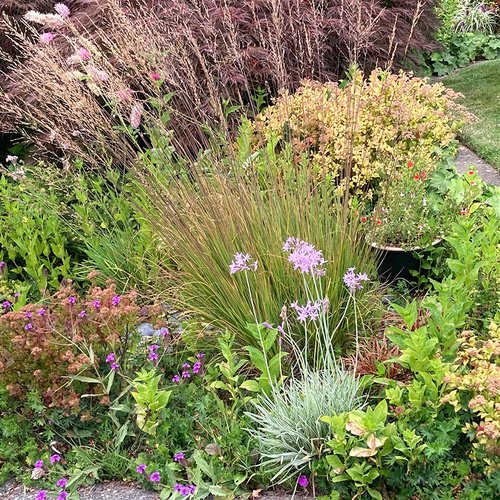
“Welcome Garden” peace pole by Stephanie Burgess with an aster (Symphyotrichum ‘Cape Cod’, Zones 4–9) to the left which will later have small white flowers. Yellow flower shrub in back is shrubby cinquefoil (Dasiphora fruticosa ‘Goldfinger’, Zones 3–7).
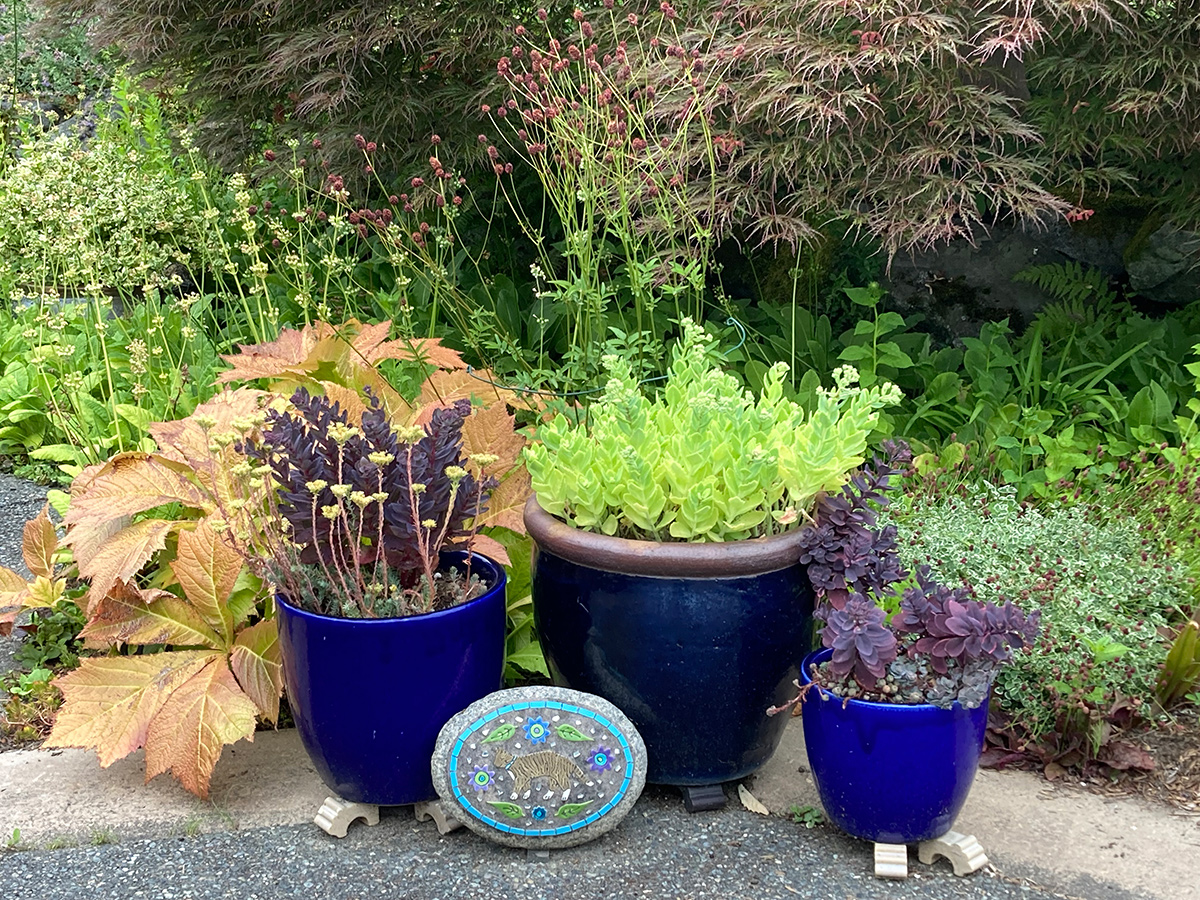 Three blue pots planted with various sedums. Redleaf roger’s flower (Rodgersia podophylla ‘Rotlaub’, Zones 6–9) is behind left pot, and a large Japanese lace-leaf maple (Acer palmatum var. dissectum atropurpureum ‘Ever Red’, Zones 5–9) is in the background. Stone mosaic is by Clare Dohna.
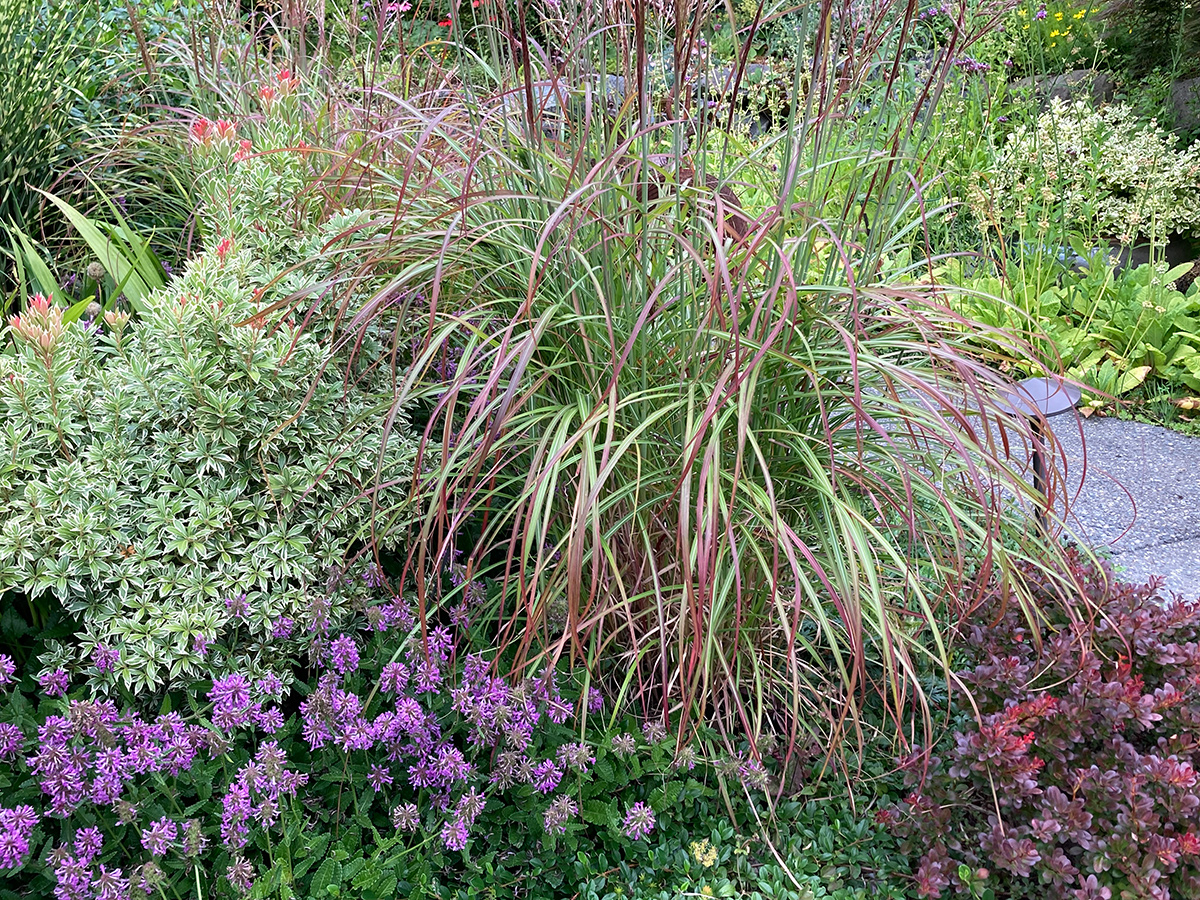 Grasses are accents throughout the garden. This composition is left to right: lily-of-the-valley shrub (Pieris japonica ‘Little Heath’, Zones 5–9), maiden grass (Miscanthus sinensis ‘Little Miss’, Zones 5–9), betony (Stachys officinalis, Zones 4–8), and barberry (Berberis thunbergii ‘Crimson Pygmy’, Zones 4–9).
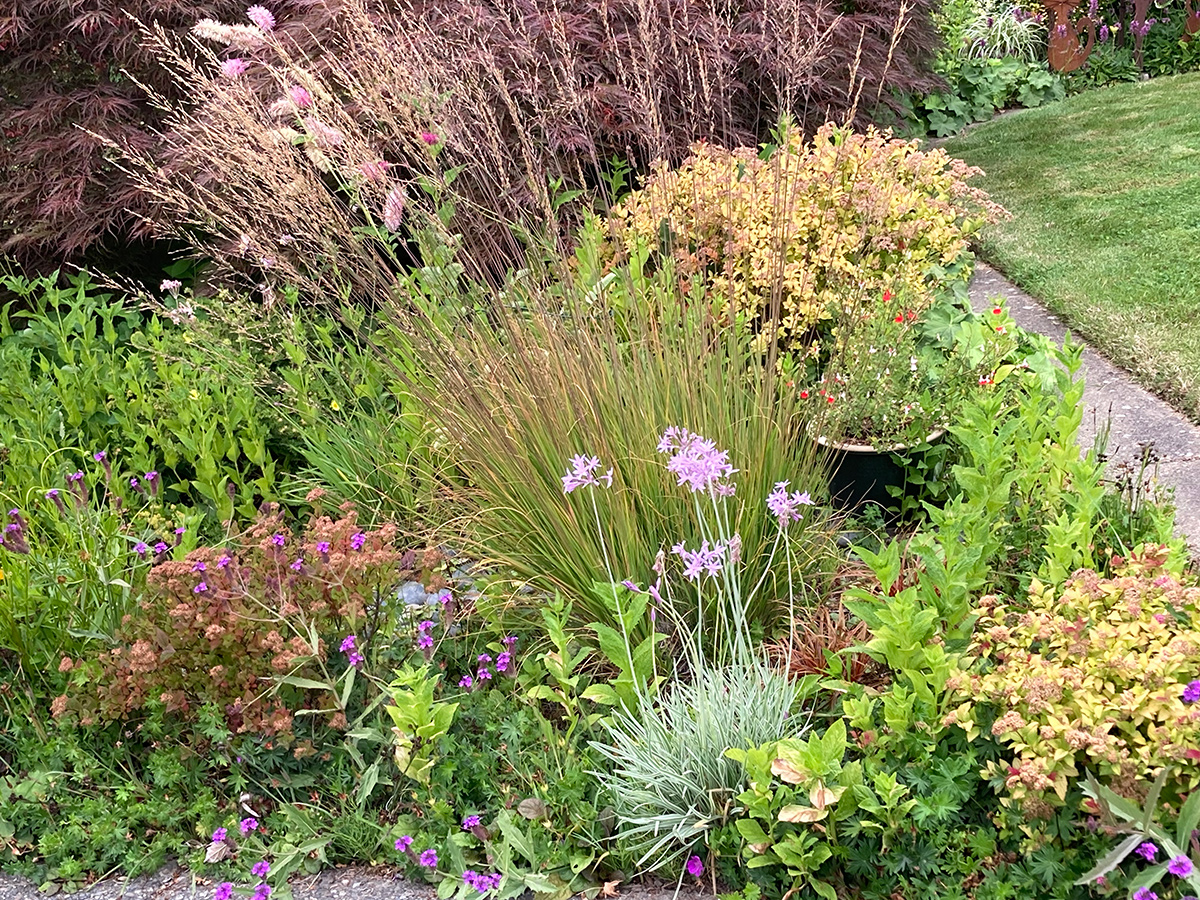 I have a Mexican pebble stone stream running down this bed that is currently hidden by: multiple varieties of past-bloom spirea, purple moor grass (Molinia caerulea ‘Moorflamme’, Zones 4–9), society garlic (Tulbaghia violacea ‘Tri-Color’, Zones 7–11), and other perennials.
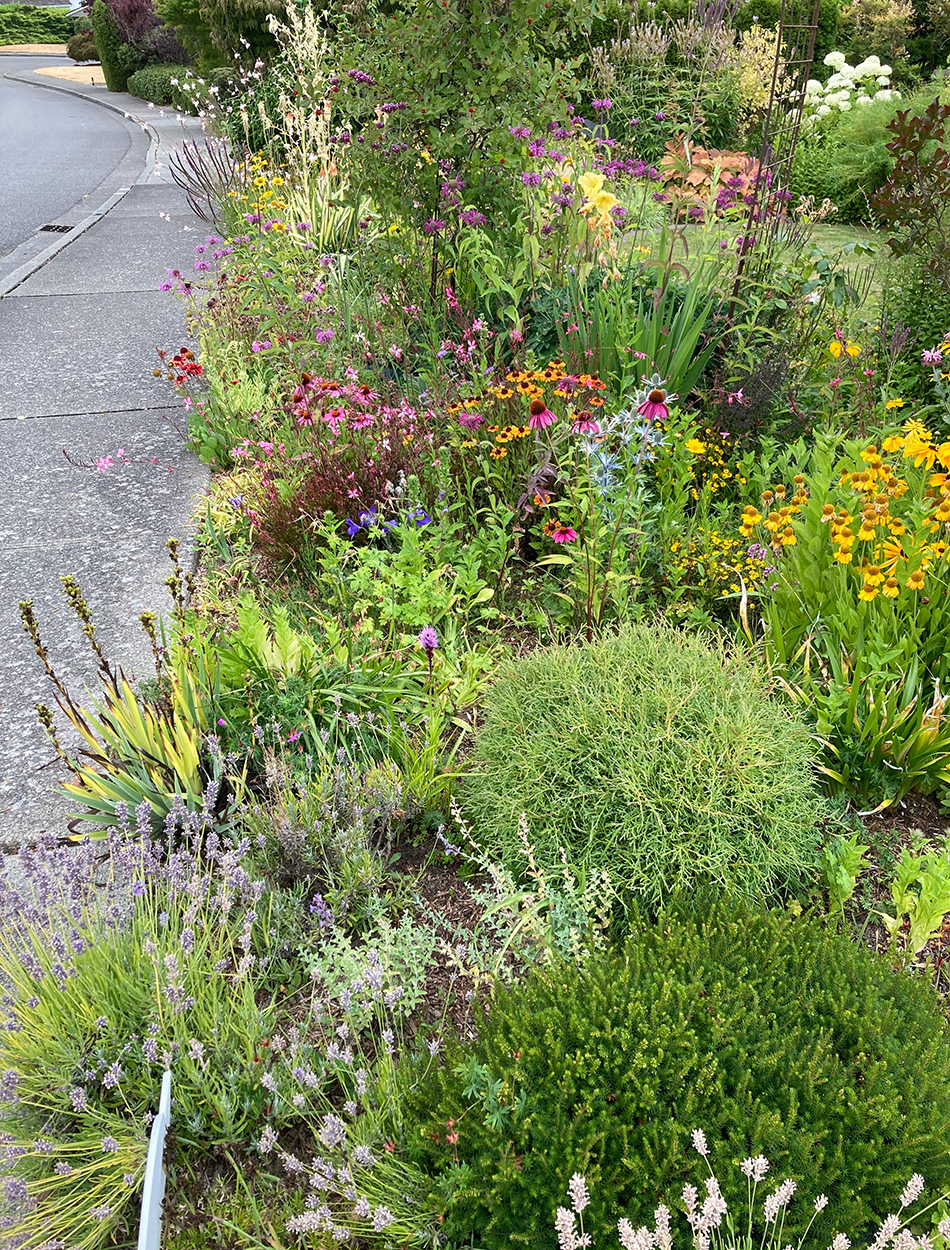 This fast-draining front bed is filled with mid-summer color including: Mr Bowling Ball arborvitae (Thuja occidentalis ‘Bobozam’, Zones 3–8), multiple varieties of gaura, coneflower, helenium, rudbeckia, and many other plants.
 A metal song bird by Haw Creek Forge guards the back bed edging the waterfall. This bed shows off coneflower—’Cheyenne Spirit’ (Echinacea ‘Cheyenne Spirit’, Zones 4–9) started from seed by the grower, red hot poker (Kniphofia ‘Mango Popsicle’, Zones 6–8), Scotch heather (Calluna vulgaris ‘Dark Beauty’, Zones 4–8) not yet in bloom, and chocolate cosmos (Cosmos atrosanguineus ‘Choca Mocha’, Zones 7–11).
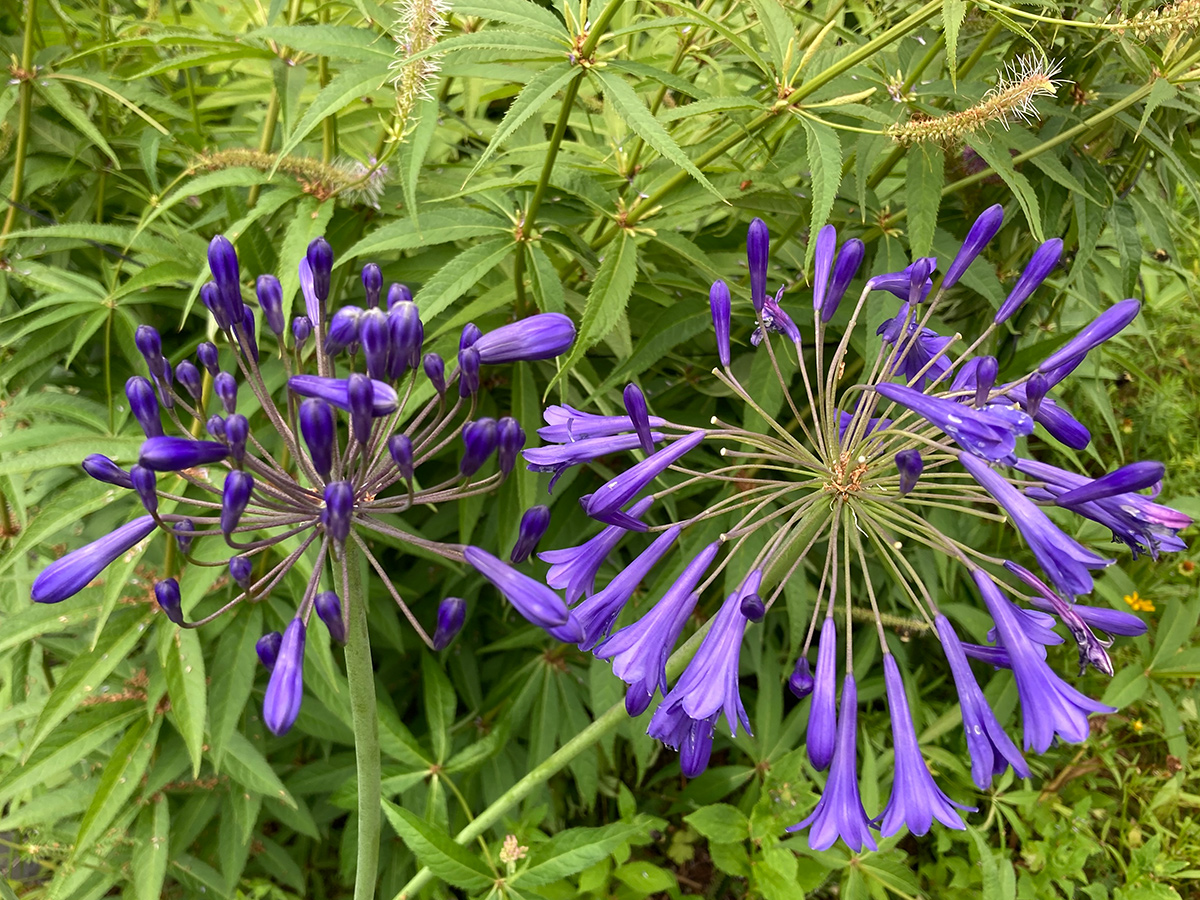
Plant explorer Dan Hinkley hybridized a series of agapanthus which he named after some of his favorite gardening friends. This is ‘Lucy Hardiman’ #26 (Agapanthus ‘Lucy Hardiman’, Zones 7–10), named after one of my favorite Portland garden spirits and designers, who is sadly now deceased.
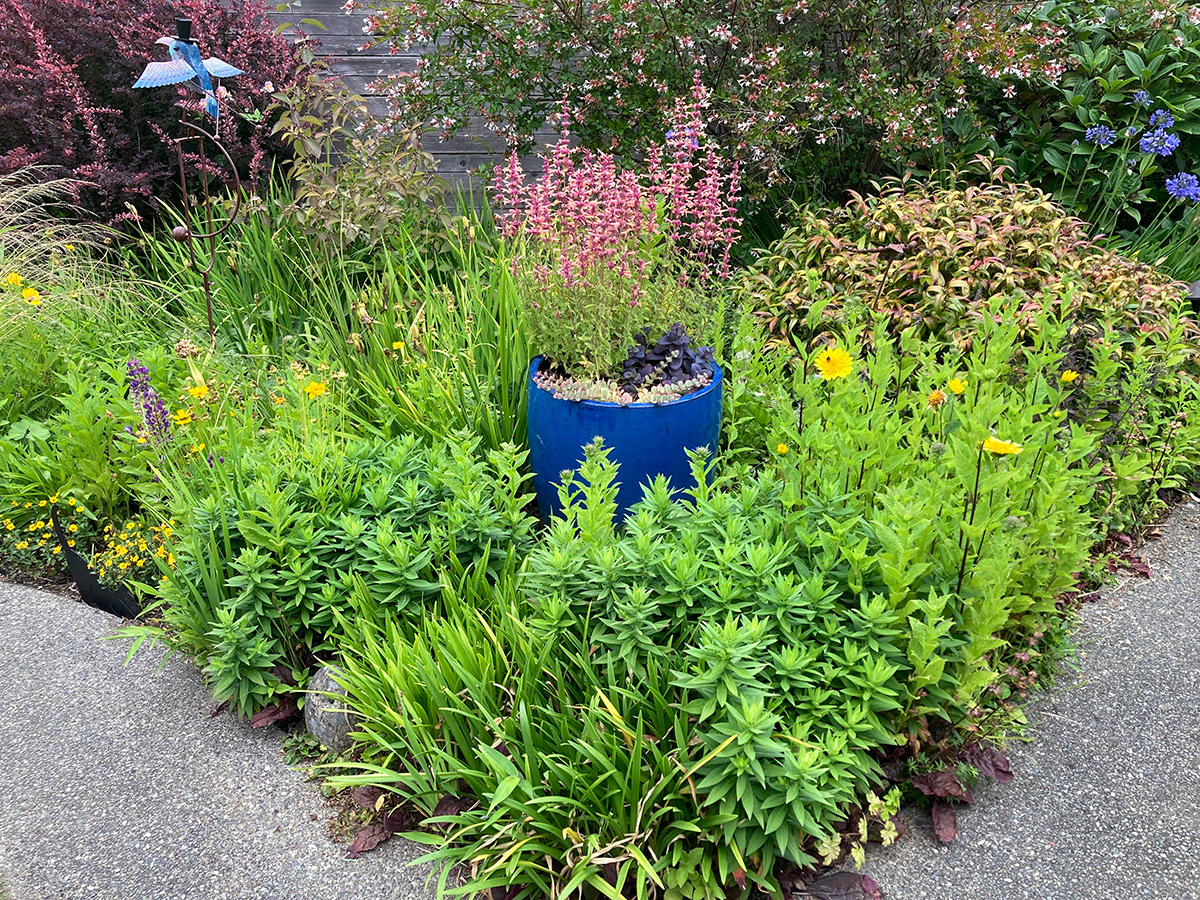 This blue pot—somewhat hidden in summer by asters (Symphyotrichum novae-angliae ‘Purple Dome’, Zones 5–8)—accents the center of my back garden. It is filled with sedums and hyssop (Agapanthus ‘Cotton Candy’, Zones 6–10).
 Black-stemmed bigleaf hydrangea (Hydrangea macrophylla ‘Nigra’, Zones 6–9), flowers faded to a soft violet after starting true-blue. Bobo® panicle hydrangea (Hydrangea paniculata ‘Ilvobo’, Zones 3–9) is in the background.
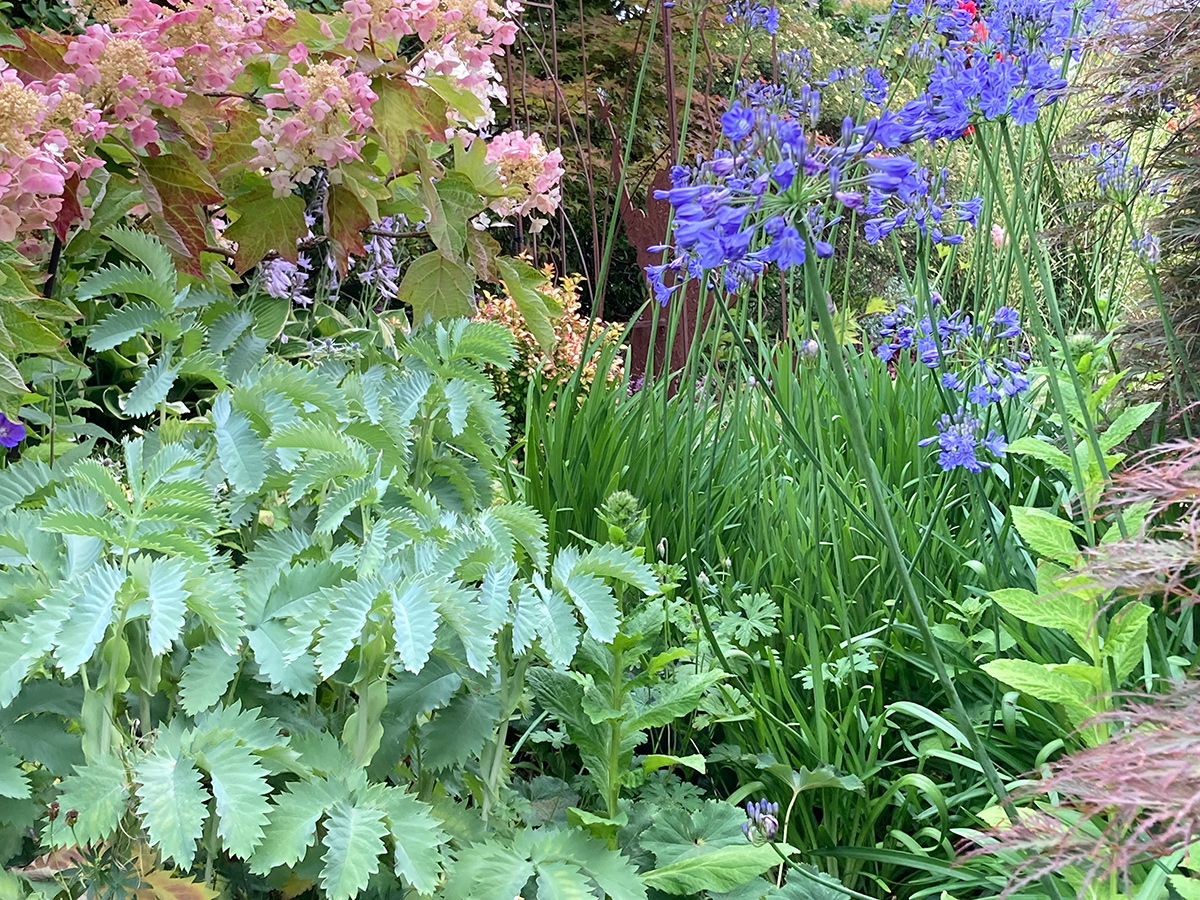 One of the plants I work to keep in my garden is ‘Antonow’s Blue’ honeybush (Melianthus major ‘Antonow’s Blue’, Zones 4–9) which was named after the late, great Seattle gardener Steve Antonow who grew it in his garden. I was privileged to visit his wonderful garden several times and having this plant in my garden reminds me of him and other great local gardens I have visited. Behind it is ‘Snowflake’ oakleaf hydrangea (Hydrangea quercifolia ‘Snowflake’, Zones 5–9), with blue agapanthus (likely straight species: Agapanthus praecox, Zones 8–11) to the right.
Thank you so much for sharing your spectacular garden with us, Cleo! There is endless enjoyment and inspiration to find in the photos you’ve shared over the past year, and while this series is over I sincerely hope that this is not the last update we’ll receive from your garden.
Can you believe that Cleo followed Garden Photo of the Day for years before sharing her incredible garden? While this may surprise some, I know there are a lot more gardeners with amazing talent and wow-worthy spaces that are silent members of the community. There is no pressure to participate, but if you’ve ever thought about sharing your garden with the blog but hesitated, please consider making 2025 the year to finally send those photos in. Follow the directions below to submit photos via email, or send me a DM on Instagram: @agirlherdogandtheroad.
We want to see YOUR garden!
Have photos to share? We’d love to see your garden, a particular collection of plants you love, or a wonderful garden you had the chance to visit!
To submit, send 5–10 photos to [email protected] along with some information about the plants in the pictures and where you took the photos. We’d love to hear where you are located, how long you’ve been gardening, successes you are proud of, failures you learned from, hopes for the future, favorite plants, or funny stories from your garden.
Have a mobile phone? Tag your photos on Facebook, Instagram, or Twitter with #FineGardening!
Do you receive the GPOD by email yet? Sign up here
Fine Gardening Recommended Products

The Crevice Garden: How to make the perfect home for plants from rocky places
Fine Gardening receives a commission for items purchased through links on this site, including Amazon Associates and other affiliate advertising programs.
A crevice garden replicates the environmental conditions of mountain tops, deserts, coastlines, and other exposed or rocky places on earth. These striking garden features provide perfect conditions for the plants native to these far-off places, bringing the cultivation of these precious gems within everybody’s reach.
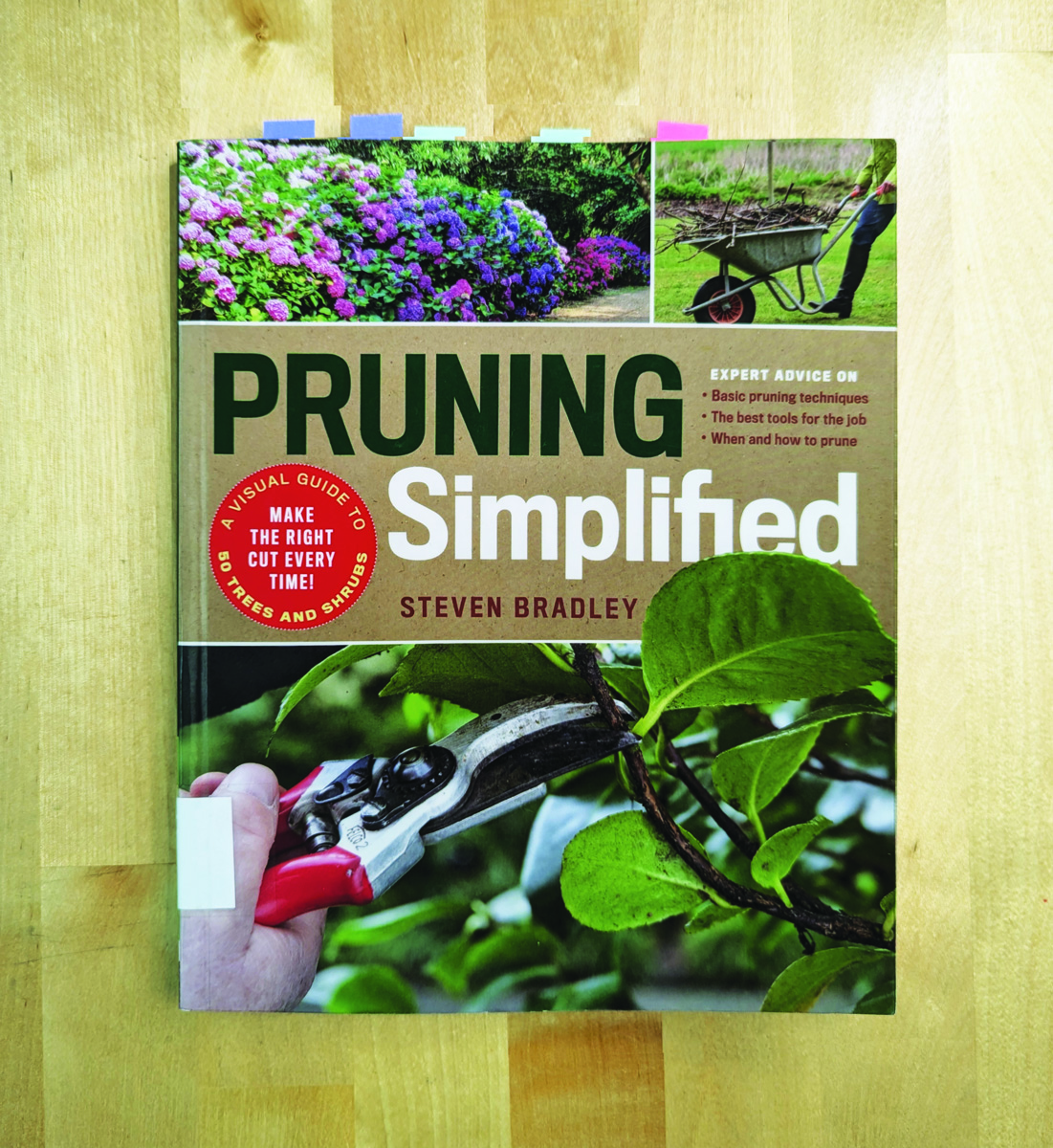
Pruning Simplified: A Step-by-Step Guide to 50 Popular Trees and Shrubs
Fine Gardening receives a commission for items purchased through links on this site, including Amazon Associates and other affiliate advertising programs.
Pruning Simplified shows you exactly how to do it. This must-have guide offers expert advice on the best tools for the job, specific details on when to prune, and clear instructions on how to prune. Profiles of the 50 most popular trees and shrubs—including azaleas, camellias, clematis, hydrangeas, and more—include illustrated, easy-to-follow instructions that will ensure you make the right cut the first time.

ARS Telescoping Long Reach Pruner
Fine Gardening receives a commission for items purchased through links on this site, including Amazon Associates and other affiliate advertising programs.
Telescopes from 4 to 7′. Cut and Hold (160) Blades. Drop forged blades for unsurpassed long lasting sharpness. Lightweight, 2.3 lbs., for continued use. Perfectly balanced for easy pruning.


30 Fall Fireplace Mantel Decor Ideas to Warm Up Your Home

Plants shed their old leaves to conserve the energy and water for winter. Similarly, you need some personal space to get rid of overthinking and digital feeds.
Sitting in front of a fireplace having visual of red, orange and yellow hues in flames is my way of finding inner peace.
Because it’s my way of spending time with myself, I want to have a personal décor that reflects my inner mind.
And I think everyone should have a personal space, be it with family or friends or just sitting alone away from the outside world.
Apart from keeping yourself warm from cold winds, soft crackles of fire can open the gates of your thoughts that are buried under the useless social feed.
Start with the focal point, it can be a minimalist décor or a rustic design. Bring small pieces and fine tuning can bring that needed change for your fall mantel.
Below mentioned are few fall fireplace mantel décor ideas. Try the one which excites you in first glance.
Let’s start with a couple of my favourite décor ideas.
30 Fall Fireplace Mantel Décor Ideas
A well-decorated mantel not only elevates your living room but also mirrors your personal style and seasonal spirit.
Fall mantel décor is more than just pumpkins and leaves—it’s about creating a warm, inviting environment that reflects both tradition and individuality.
1. Wooden Crates and Pumpkins
Stacking small wooden crates on the mantel and filling them with pumpkins, pinecones, and mini hay bales creates a farmhouse-style display. The uneven layers add depth and bring a casual, lived-in look.
This décor suggests someone who values authenticity and warmth. It reflects a love for repurposing and traditions, making the mantel feel like an extension of a cozy country home.
Also Read: 13 Front Yard Fall Flower Bed Ideas to Beautify Your Landscape
2. Plaid Accents and Cozy Textiles

A plaid scarf or fabric runner draped across the mantel, paired with candles and rustic picture frames, instantly softens the look. Mixing in fall-hued pillows or a plaid throw nearby ties the whole living space together.
Those who choose this style often crave comfort and togetherness. It reflects a personality that leans toward nurturing—valuing a home that feels lived-in, approachable, and welcoming for guests.
3. Vintage Lanterns and Weathered Wood

Rustic lanterns paired with reclaimed wood beams or distressed frames set a nostalgic mood. The glow of candles inside the lanterns highlights the natural textures and brings the outdoors inside.
This approach signals a reflective, grounded mindset. It appeals to those who appreciate history, storytelling, and the charm of imperfect beauty—seeing value in age and character rather than polished perfection.
4. Mason Jars with Dried Florals

Filling mason jars with dried sunflowers, lavender, or wheat and placing them across the mantel creates a charming country feel. Tying twine or burlap around the jars enhances the rustic detail.
This décor reflects someone who finds beauty in everyday objects. It shows a resourceful, home-centered mindset that loves turning simple materials into meaningful seasonal art.
5. Antlers and Pinecones

Adding faux antlers and clusters of pinecones brings a rugged, outdoorsy element to the mantel. Pairing them with candles balances the natural and cozy tones.
This look resonates with adventurous souls. It reflects a mindset that appreciates nature’s rawness, suggesting someone who enjoys wilderness escapes and values grounding their home with natural reminders.
6. Chalkboard Backdrop with Seasonal Messages

Placing a chalkboard above the mantel allows for handwritten autumn greetings or seasonal doodles. Surrounded by rustic accents, it feels personal and warm.
This décor reflects creativity and flexibility. It shows a personality that loves to refresh spaces with quick, meaningful updates and values interactive, homemade touches.
Check this: 12 Low Budget Backyard Designs with Gravel
7. Metallic Accents with Minimal Pumpkins
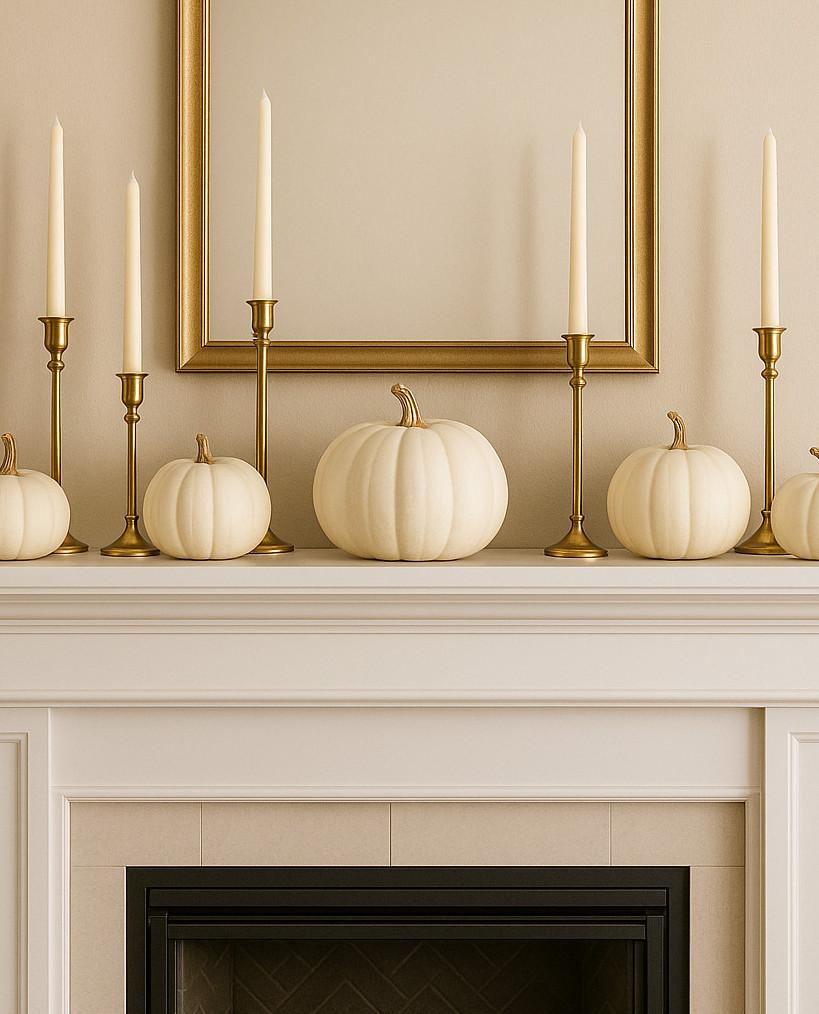
A row of white or neutral pumpkins paired with gold or brass candleholders sets a sophisticated tone. The clean palette and subtle shimmer give the mantel a chic yet seasonal look.
This style reflects a mindset that values refinement and order. It shows an eye for design and a desire to bring seasonal beauty into the home without clutter or excess.
8. Monochrome Palette Mantel
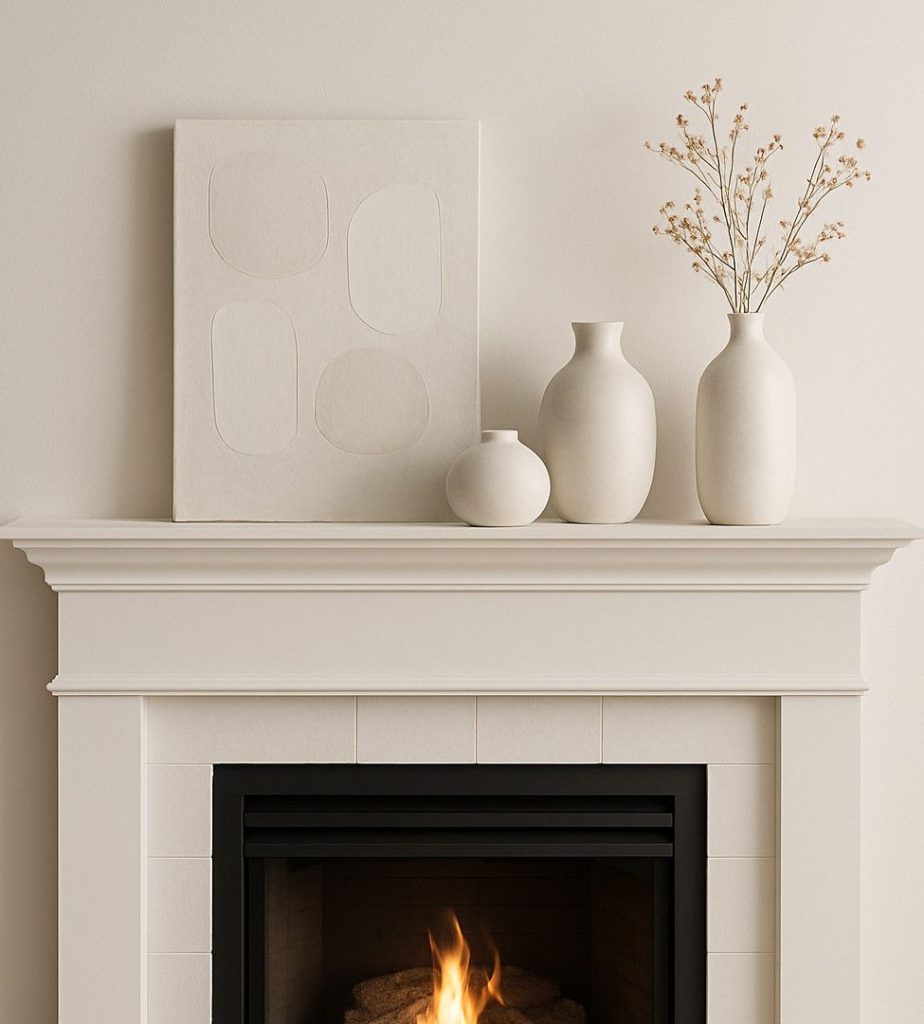
Decorating entirely in shades of cream, beige, or grey creates a soft, modern look. Adding a few glass vases or abstract artwork keeps it stylish and understated.
This décor appeals to those who crave calm and balance. It reflects a personality that leans toward mindfulness and simplicity, preferring harmony over visual busyness.
9. Geometric Candle Holders and Mirrors

Placing geometric metal candle holders alongside a sleek mirror above the mantel makes the space feel bright and contemporary. The mirror reflects candlelight, enhancing the glow.
This look suggests a mindset that appreciates innovation and clean lines. It reflects a person who thrives on structure, precision, and a touch of sophistication in everyday living.
10. Minimal Greenery with Eucalyptus
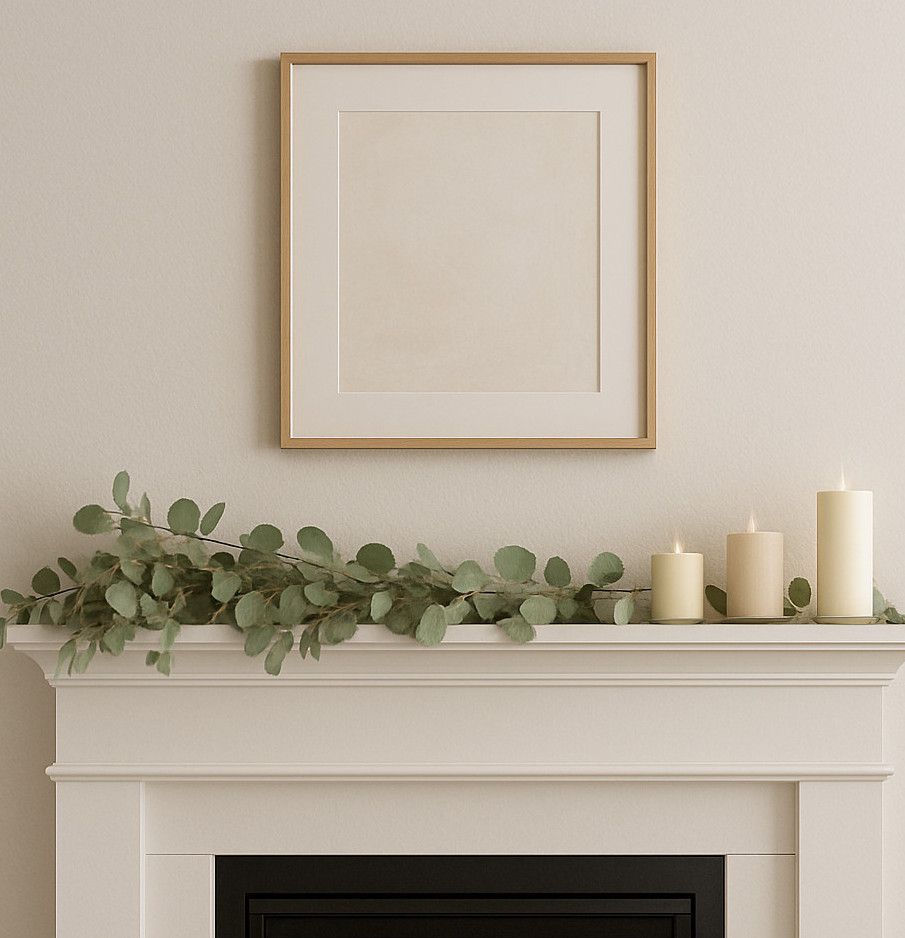
A strand of fresh or faux eucalyptus draped across the mantel brings a touch of greenery without overwhelming the design. Paired with neutral candles, it creates an airy and modern vibe.
This décor reflects someone who values serenity and subtlety. It suggests a personality that enjoys freshness and clarity, preferring nature in its simplest, most elegant form.
11. Corn Husk and Wheat Bundle Display

Tucking dried corn husks, wheat stalks, and gourds across the mantel creates a rich harvest vibe. Adding amber glass bottles or rustic baskets makes the display feel full and abundant.
People drawn to this look often value generosity and community. It reflects a personality that thrives on gatherings, gratitude, and the joy of sharing life’s simple blessings.
12. Overflowing Basket of Gourds
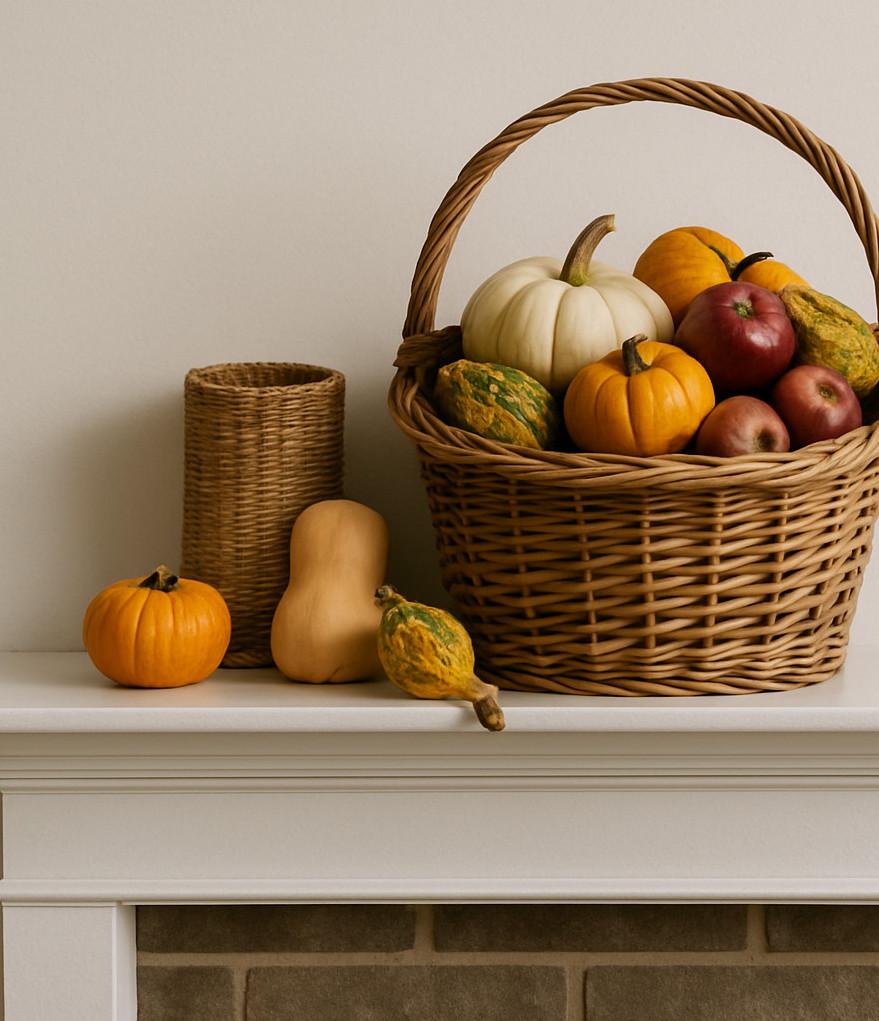
Placing a large woven basket on the mantel filled with gourds, mini pumpkins, and apples gives a farmer’s market feel. Allowing a few pieces to “spill out” creates a sense of plenty.
This décor reflects abundance and openness. It shows a mindset rooted in thankfulness and the desire to celebrate seasonal bounty with warmth and pride.
13. Apple Cider and Copper Accents
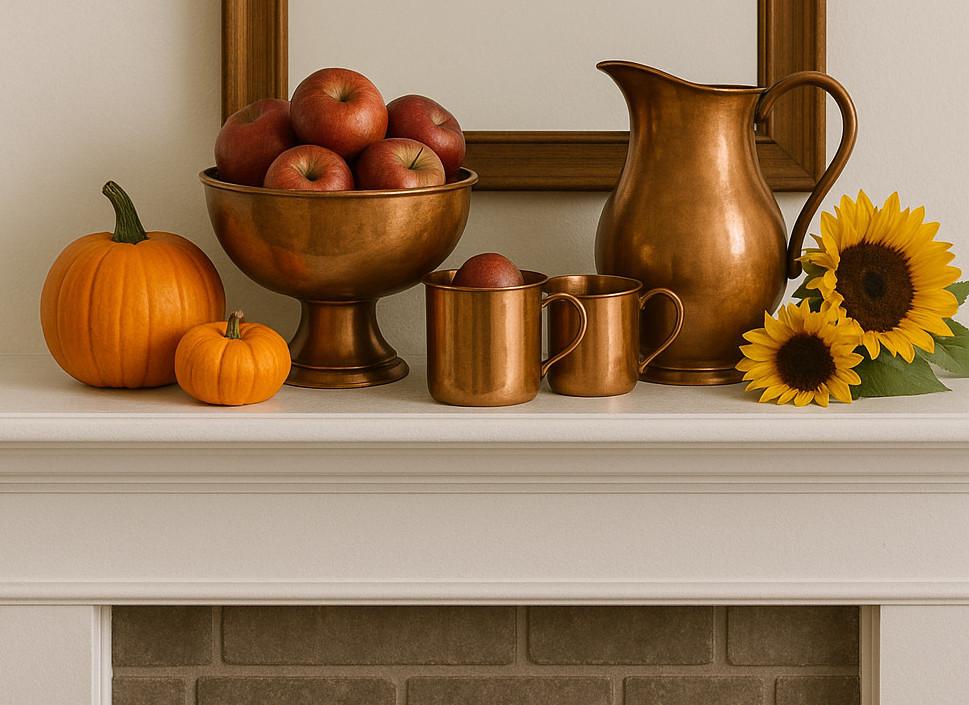
Copper mugs, pitchers, or bowls filled with apples create a cozy harvest look. The combination of shiny copper and crisp red apples adds vibrancy and nostalgia.
Those who love this style are often practical yet sentimental. It reflects someone who treasures traditions, especially those tied to food, comfort, and seasonal rituals.
14. Sunflower and Pumpkin Pairing

Placing sunflower arrangements alongside pumpkins instantly creates a cheerful fall centerpiece. The bright yellows and oranges echo harvest fields and seasonal warmth.
This style reflects optimism and joy. It’s often chosen by people who see fall as a time of light, happiness, and celebrating life’s colorful moments.
15. Dried Corn Garland
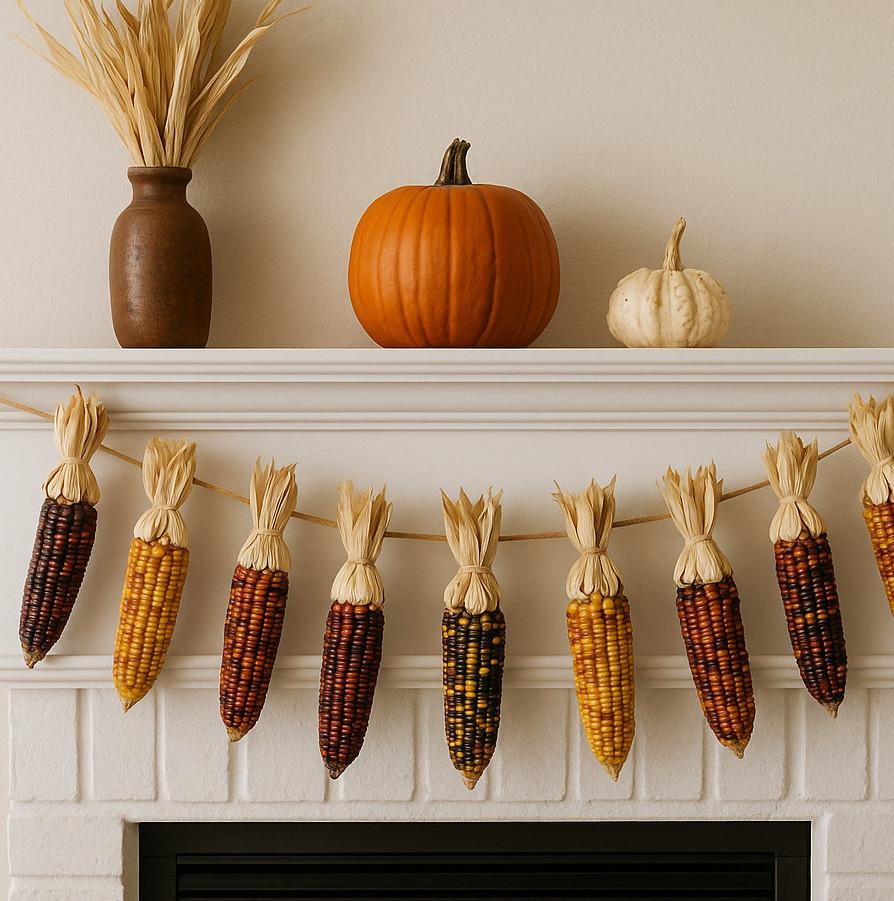
Stringing colorful dried corn cobs into a garland and draping it across the mantel makes a bold seasonal statement. The natural patterns and hues feel festive and grounded.
This décor reflects creativity and earthiness. It suggests someone who values authenticity, enjoys crafting, and takes pride in highlighting natural textures.
Also Read: 6 Low Budget Backyard Privacy Ideas for Your Landscape
16. Pumpkin Pyramid Display
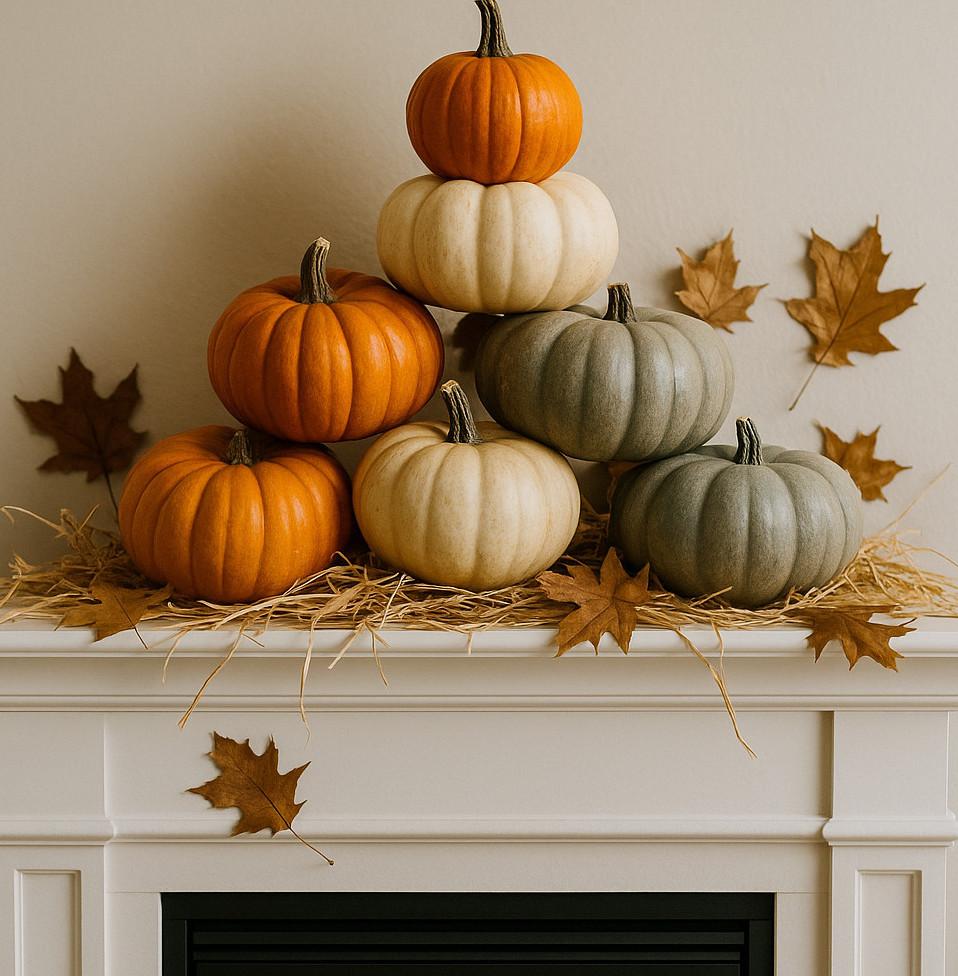
Stacking pumpkins of varying sizes and colors in pyramid form creates a dramatic focal point. Adding small accents like straw or dried leaves enhances the harvest theme.
This look reflects boldness and confidence. It signals a personality that enjoys making a statement while honoring the season’s traditional symbols.
17. Branches in Glass Vases
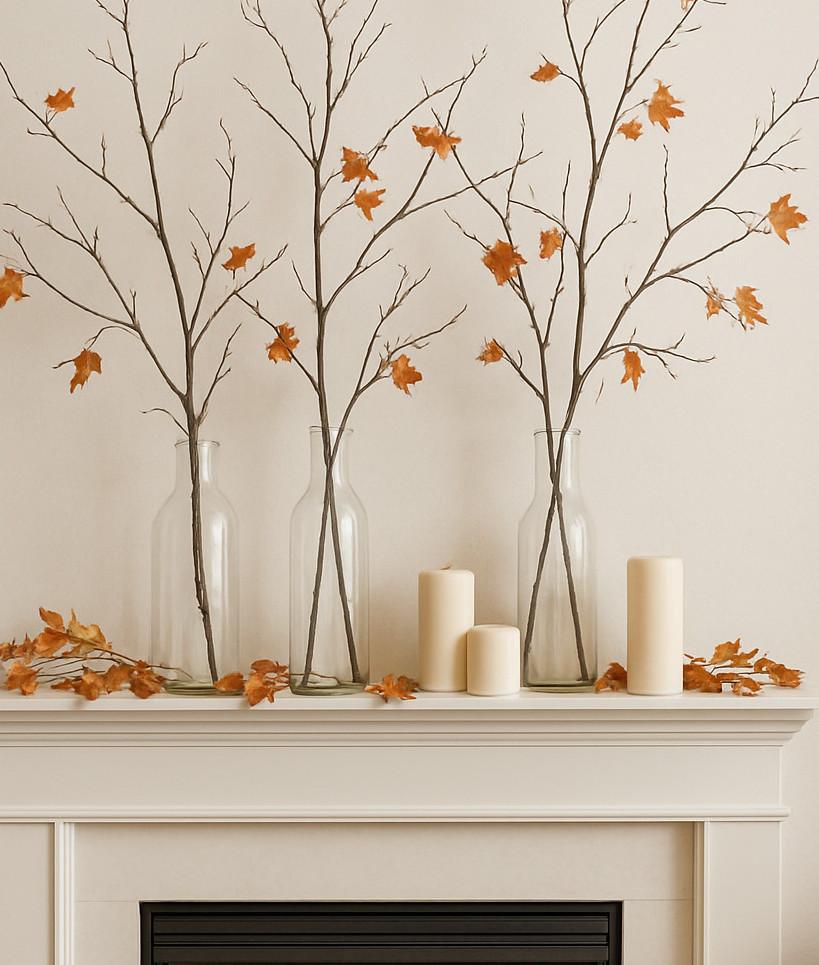
Bare branches placed in tall glass vases anchor the mantel with simplicity. A few autumn leaves or berries attached to the branches highlight seasonal change without overwhelming the space.
This décor reflects a thoughtful, grounded mindset. It suggests someone who appreciates the raw beauty of nature and finds comfort in simplicity and seasonal transitions.
18. Acorn and Pine Garland
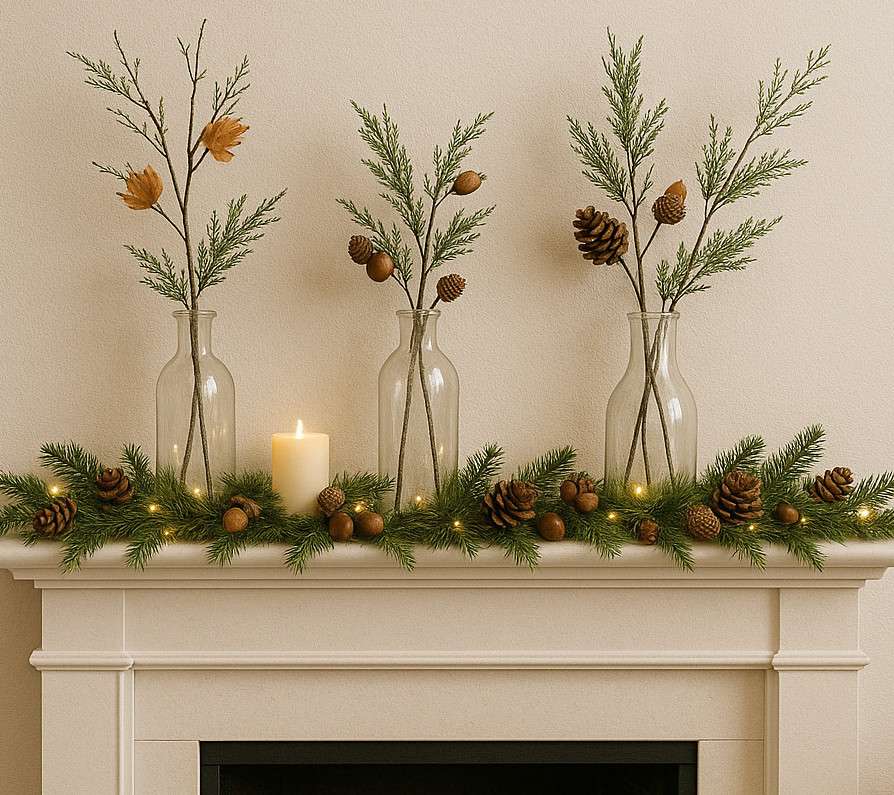
A garland woven with faux acorns, pinecones, and greenery creates an earthy, forest-like vibe. Adding fairy lights makes it feel magical in the evenings.
This style reflects someone who values grounding and balance. It shows a mindset that seeks peace in natural rhythms and finds joy in details others might overlook.
19. Birch Logs and Candles

Placing cut birch logs on the mantel with tall white candles creates a soft woodland feel. The pale bark contrasts beautifully with flickering candlelight.
This décor reflects a mindset that values purity and calm. It appeals to someone who finds comfort in nature’s quiet strength and enjoys a serene, grounded home environment.
20. Pressed Leaf Frames

Framing pressed autumn leaves and leaning them along the mantel brings a delicate, natural touch. Each frame becomes a seasonal art piece.
This choice reflects mindfulness and appreciation for detail. It’s often favored by someone who enjoys slowing down, preserving memories, and celebrating beauty in its simplest form.
21. Dried Flower Bouquets
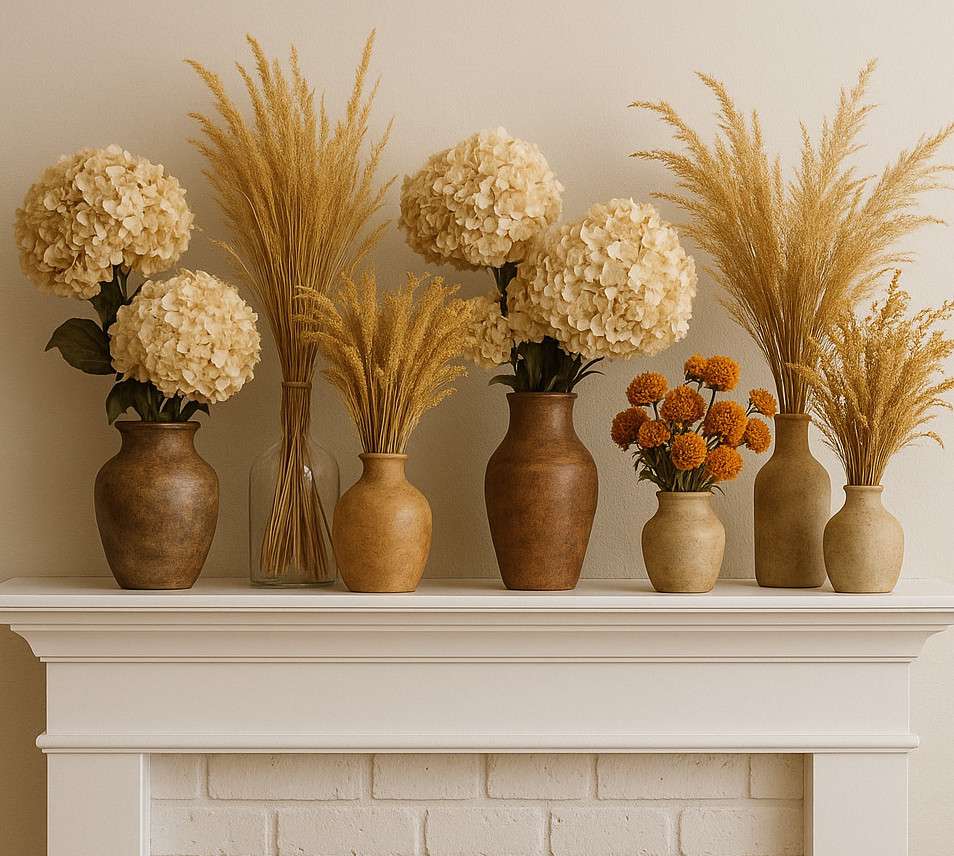
Arranging dried hydrangeas, grasses, or marigolds in rustic vases adds color and life without the upkeep of fresh blooms. The muted tones suit the season perfectly.
This décor reflects a nostalgic, reflective mindset. It suggests someone who cherishes lasting beauty, traditions, and the poetry of seasonal change.
22. Twigs with String Lights
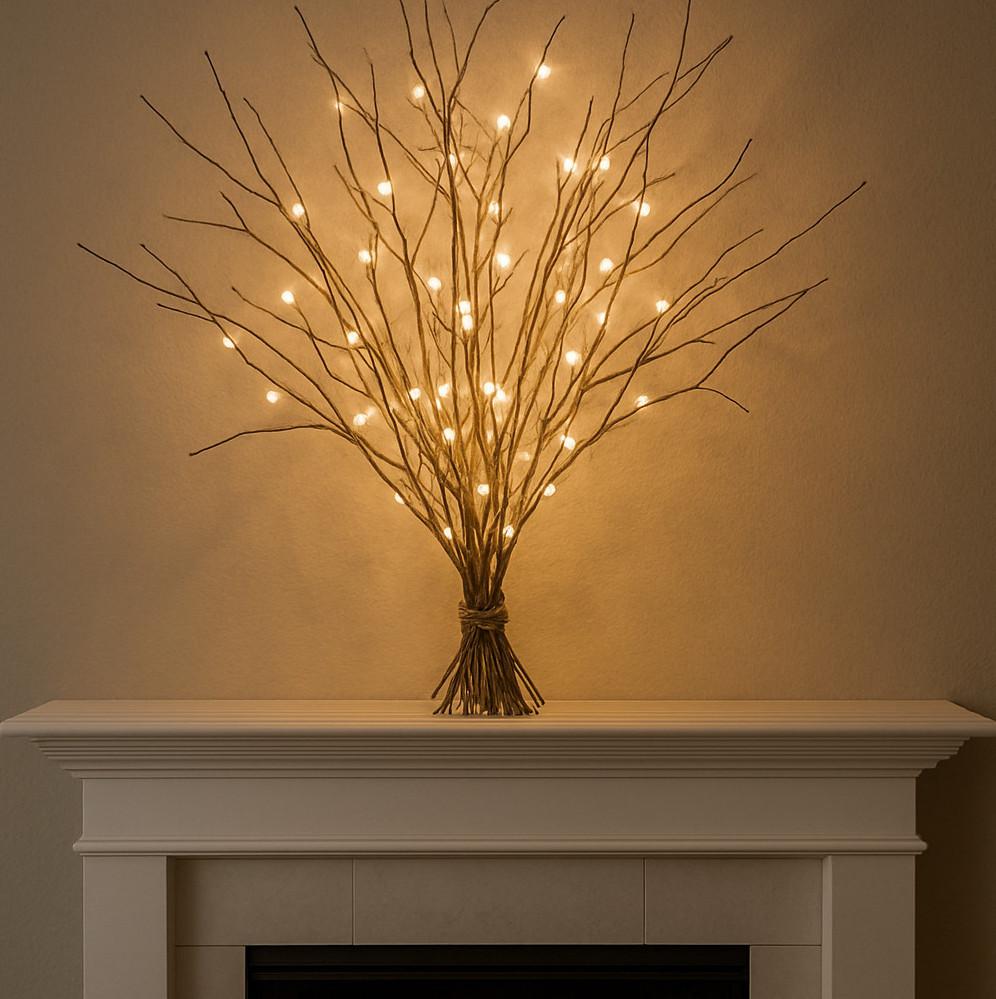
A bundle of twigs wrapped with delicate string lights creates a soft glow and natural silhouette. Placed across the mantel, it feels whimsical yet earthy.
This style reflects creativity and playfulness. It signals someone who likes blending natural simplicity with a hint of magic, bringing warmth into darkening fall nights.
23. Moss and Stone Accents

Placing moss runners with small stones or crystals across the mantel creates a forest-floor effect. Pairing it with wood elements enhances the natural aesthetic.
This décor reflects a grounding, spiritual mindset. It suggests someone who values connection with the earth, balance, and the healing presence of nature in their home.
24. Seasonal Sign with Candles

A wooden or chalkboard sign with a fall phrase like “Give Thanks” or “Hello Autumn” creates a cheerful focal point. Surrounded by candles, it sets a warm and welcoming atmosphere for guests.
This style reflects a mindset that values connection and celebration. It shows a personality that loves marking the season with joy, laughter, and meaningful family traditions.
26. Family Photo Display with Fall Frames

Switching out regular frames for ones in autumnal colors like burnt orange, gold, or deep brown creates a seasonal photo gallery on the mantel.
This décor reflects family-centered values. It suggests someone who treasures memories, cherishes relationships, and enjoys weaving personal history into seasonal traditions.
27. Candle Cluster Glow
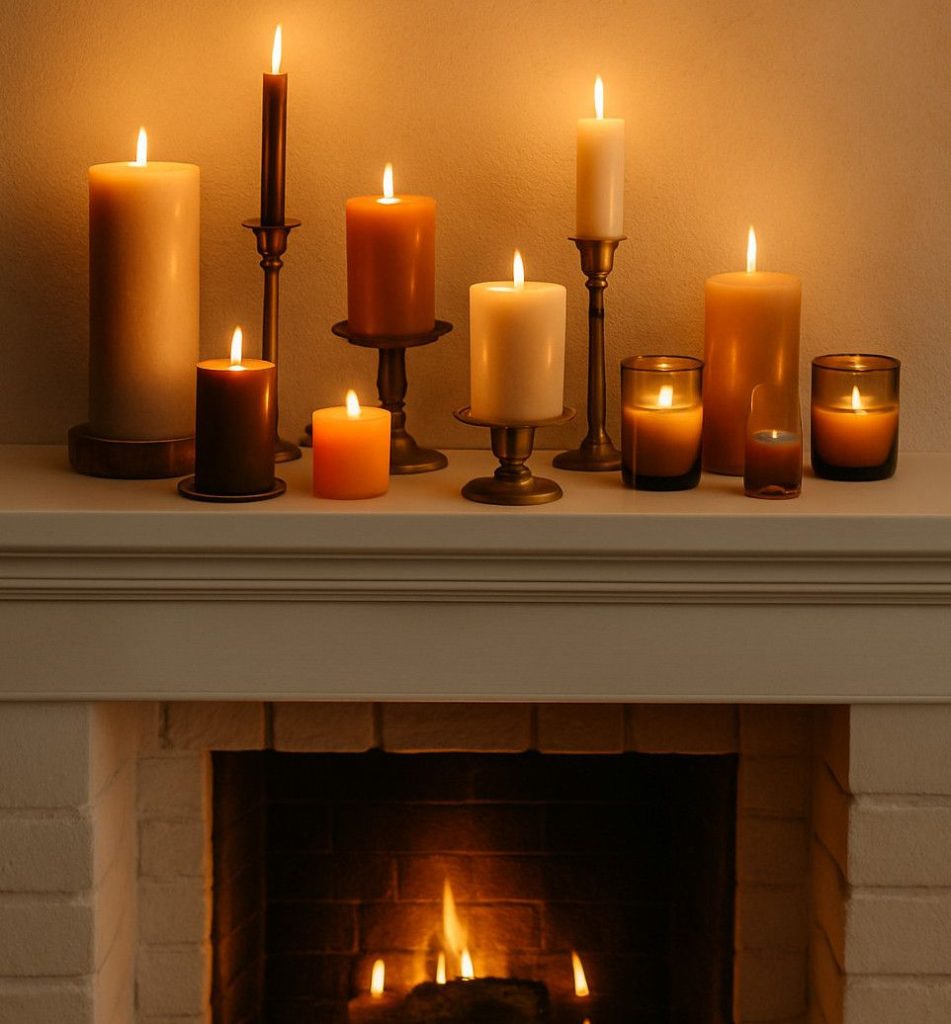
Arranging candles of varying sizes, colors, and holders across the mantel creates a cozy, inviting glow. Adding cinnamon or pumpkin-scented candles enhances the atmosphere.
This look reflects someone who values intimacy and comfort. It suggests a personality drawn to warmth, sensory richness, and the joy of creating mood through light.
28. Fall-Themed Wreath Centerpiece
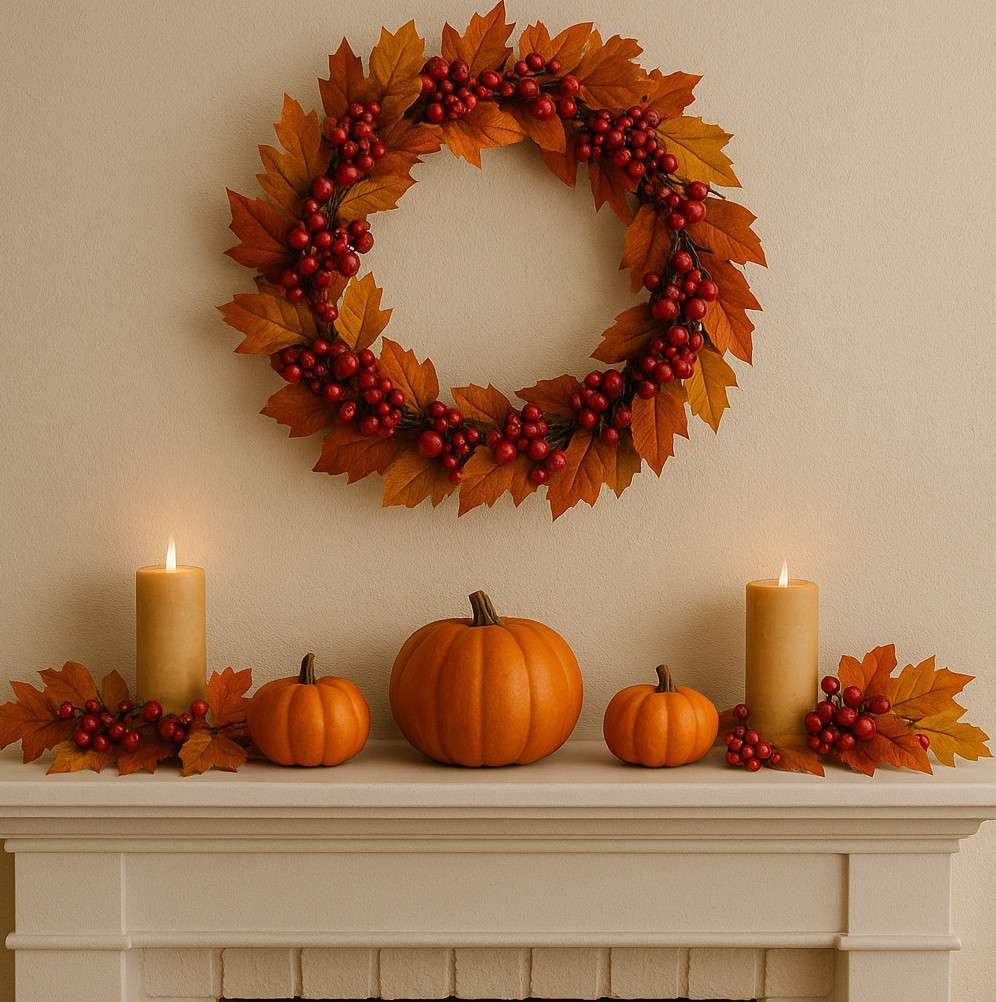
Hanging a wreath of leaves, berries, or mini pumpkins above the mantel gives it a festive centerpiece. Paired with matching accents below, it ties the whole look together.
This décor reflects a love of tradition and balance. It shows a mindset that seeks harmony in design and enjoys celebrating seasonal cycles with symbolic décor.
29. Festive Banner or Garland with Words

A banner spelling out “Thankful,” “Harvest,” or “Autumn” strung across the mantel adds charm and cheer. It’s simple yet effective in setting a celebratory tone.
This style reflects optimism and playfulness. It appeals to someone who enjoys spreading joy and sees seasonal décor as a way to uplift and inspire others.
30. Cozy Blanket and Basket Nearby
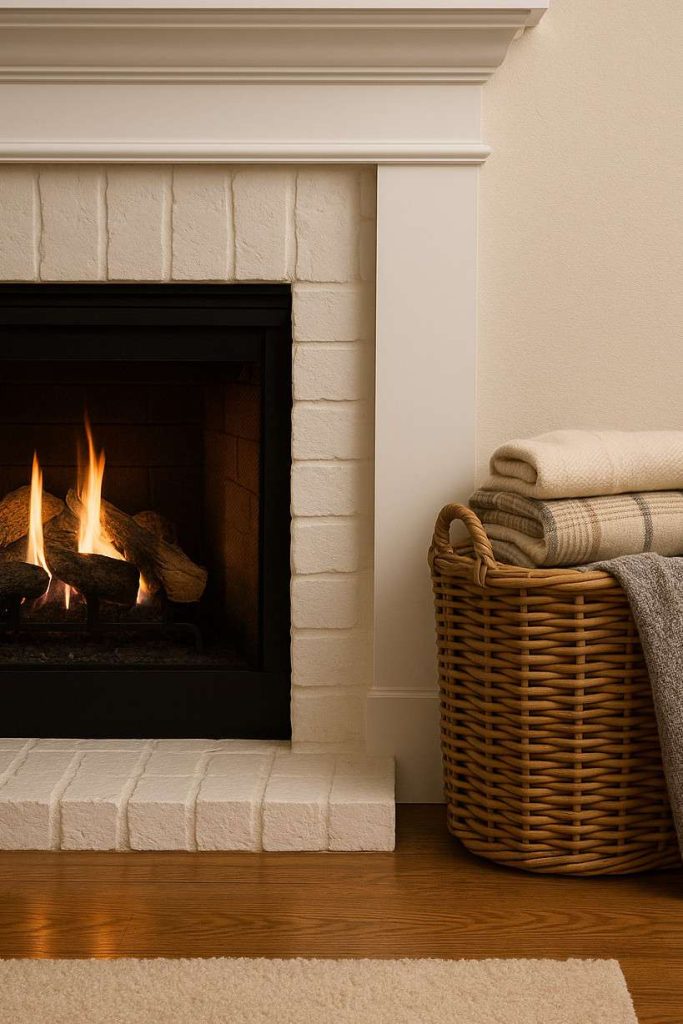
Though not on the mantel itself, placing a basket of folded throws or blankets beside the fireplace completes the scene. It makes the area feel layered, inviting, and lived-in.
This décor reflects nurturing and hospitality. It shows a mindset focused on care, comfort, and making the home a welcoming retreat for family and friends.
Final Thoughts
Whether you lean toward rustic charm, modern elegance, harvest abundance, nature-inspired designs, or festive warmth, your fireplace mantel can become a reflection of your personality and seasonal spirit.
Each idea above isn’t just about style—it’s about the mindset it reveals, the atmosphere it creates, and the memories it helps nurture. This fall, let your mantel tell your story.

Khaja Moinuddin, a computer science graduate, finds joy in gardening and homesteading. Join him on this blog as he shares his experiences in homesteading, gardening, and composting
The Trump administration is expected to link autism to Tylenol use during pregnancy : Shots

U.S. Secretary of Health and Human Services Robert F. Kennedy Jr. speaks during a news conference at the Department of Health and Human Services on April 16, 2025 in Washington, DC.
Alex Wong/Getty Images
hide caption
toggle caption
Alex Wong/Getty Images
The Trump administration is expected to assert later today that use of acetaminophen — the active ingredient in Tylenol — can increase the risk of autism when used during pregnancy, despite the fact that scientific research has not conclusively demonstrated a causal link.
White House officials are also expected to suggest that a form of vitamin B that is typically used in conjunction with cancer treatment could be used to treat autism.

“We’re gonna have one of the biggest announcements, really, medically, I think, in the history of our country,” President Trump said Sunday night, referring to a press conference scheduled for Monday afternoon. “I think we found an answer to autism.”
This would be the administration’s latest move questioning the science of commonly used medications, from vaccines to abortion medications, and stirring up controversy in what many say is an effort to undermine the scientific establishment and advance a political agenda.

Autism has long been a target for Health and Human Services Secretary Robert F. Kennedy Jr. Shortly after taking office, he pledged to swiftly identify the cause “by September,” and has cited the use of everything from synthetic food dyes, childhood vaccines, and painkiller use as potential culprits.
But while autism diagnoses have tripled in the past two decades, the use of acetaminophen has not — remaining largely steady over that time.

In addition, scientists agree that genetics play a central role in a child’s risk of developing autism. The disorder runs in families, and if one identical twin is on the spectrum, most of the time the other will be too.
A few small studies have suggested an association between fetal exposure to acetaminophen and the subsequent risk of diagnosis with autism spectrum disorder (ASD) and attention-deficit hyperactivity disorder (ADHD). But the largest study to date, an NIH-funded collaboration between U.S. and Swedish scientists, found no increased risk.

Even before that study was published in 2024, a U.S. District Court had reached a similar conclusion in a product liability case.
Meanwhile, groups like the Society for Maternal-Fetal Medicine have stood by recommendations to use acetaminophen to treat fever and pain in pregnant women. The group argues that untreated fever, for example, can cause grave harms such as miscarriage, birth defects or premature birth, especially early in a pregnancy.
The administration is also expected to say in its report that leucovorin or folinic acid — a form of vitamin B that is sometimes used to treat deficiencies caused by chemotherapy — could prevent or treat the disorder. The use of leucovorin is based on research suggesting that many people with autism have a metabolic difference that could reduce the amount of folate that reaches the brain. Leucovorin appears to offer a way around that metabolic roadblock.
And although leucovorin affects a system that is important for brain and nervous system development and is sometimes prescribed off-label as a treatment for autism, the evidence that it works is scant.
The Autism Science Foundation said in a statement last week that there are four studies suggesting low folate levels in pregnant women could increase the risk of autism, but it said “this science is still in very early stages, and more studies are necessary before a definitive conclusion can be reached.”
How to Identify and Manage Downy Mildew in Lettuce
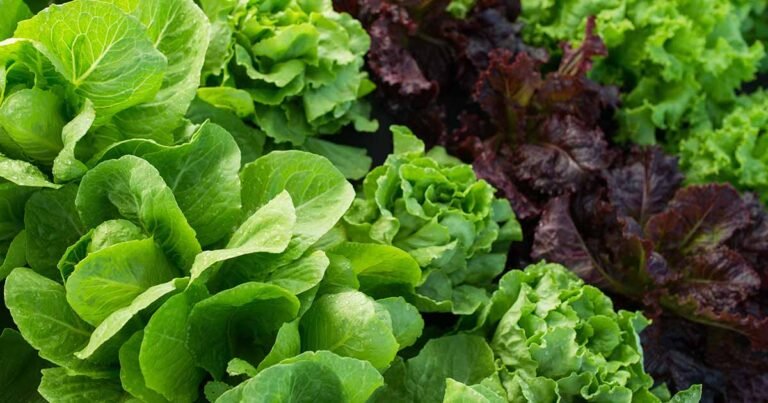
In greenhouses, fans can further lower humidity and prevent prolonged leaf wetness.
Physical
If the disease is caught early and limited to the outer leaves, removing the symptomatic tissue can slow its spread. In some cases, this may be enough to salvage the crop.
However, leaf removal alone is not a cure. Combine it with preventative measures or organic treatments to reduce the chance of reinfection.
Biological
Treatment works best when you use it preventatively or on the first sign. Once the disease advances, your options are limited.
The following products are highly effective as preventatives, but won’t work so well if the disease is already established.
Always follow label directions, as manufacturers provide specific protocols for targeting this disease.
Streptomyces lydicus WYEC 108 is a naturally occurring bacterium that suppresses fungi and oomycetes.
It’s the active ingredient in products like Actinovate AG that can help stop downy mildew in its tracks.

You can find 18-ounce bags of Actinovate AG at Arbico Organics.
Another option is Bacillus subtilis strain QST 713. This beneficial bacterium colonizes plant surfaces and outcompetes pathogens without harming the host.
You can find it in products like Serenade ASO.

Serenade ASO is available at Arbico Organics.
Organic Fungicides
Like biological treatments, organic fungicides work best as preventatives. Once downy mildew is present, it’s much harder to stop or control, but that doesn’t mean you shouldn’t try.

If you see the disease on one plant, treat all of your lettuces, regardless of whether they’re symptomatic or not.
You can also alternate an organic herbicide with a biofungicide so long as you follow the manufacturer’s directions carefully.
Copper is a well-known fungicide that has been used for decades to suppress fungal and oomycete diseases.
It damages cell walls and causes the contents to leak out, killing the pathogen.

Monterey Liquid Copper Fungicide
You can find Monterey’s Liquid Copper available at Arbico Organics.
Sulfur is another tried-and-true option. Applied every two weeks, it can help suppress outbreaks alongside copper sprays.

You can find Bonide Sulfur Fungicide available from Arbico Organics.
Thyme oil contains thymol, which attacks the cell walls of pathogens, killing them. It’s effective at treating downy mildew if used at the first sign of trouble.

You can find Guarda, which harnesses thymol, available at Arbico Organics in two-and-a-half-gallon containers.
Potassium bicarbonate prevents and suppresses disease by disrupting fungal cell walls. It’s effective against downy mildew as well as powdery mildew, leaf spots, and botrytis.

Milstop SP is made using potassium bicarbonate and is available at Arbico Organics.
Citric acid acts both systemically and on plant surfaces. It can be applied repeatedly and provides protection against multiple diseases, including downy mildew.
Plus, you can spray it as often as needed. Look for products like Procidic, which contains citric acid.

Procidic is available at Arbico Organics in 32-ounce ready-to-use bottles, or 16-ounce and gallon concentrates.
In addition to these products, hydrogen dioxide is also an effective treatment option, often used in rotation with other products.
Chemical Control
For home gardeners, there are no chemical fungicides that consistently outperform the organic options listed above.
Stick with those recommended above and be sure to rotate through a few different ones to prevent the oomycetes from developing resistance.
Out, Damn Spot!
Downy mildew is distressingly common and frustratingly resilient. I hope you never have to deal with it, but don’t despair if you do.
Even the most experienced growers encounter it from time to time.

What kind of symptoms are you seeing? Are you having trouble identifying what you’re dealing with? Hit us up in the comments section below and we’ll see how we can help.
And for more information about common lettuce problems, have a read of these guides next: