For the past few years, a small team of health scientists at the Centers for Disease Control and Prevention had been tasked with answering basic statistical questions like: Who is drowning? Where is it happening — in lakes, rivers, swimming pools? And what works to prevent it?
The team was starting to answer some of those questions when it was put on administrative leave in April, according to two former CDC officials familiar with the program. They requested that NPR not use their names because they fear retaliation from the Trump administration for speaking to the media.
Now, those results may not come to light, since the Trump administration terminated the CDC’s drowning prevention experts this month and has proposed eliminating the program in its fiscal year 2026 budget request.
“If this program saved one life, it would be far more than the total cost of the program,” says Jim Mercy, former director of the Division of Violence Prevention at the CDC, who retired in 2023. “The irony is that these and other programs [at the CDC] were cut under the motivation of creating greater efficiency.”
Drowning kills more than 4,000 people each year in the United States. It’s the leading cause of death among children ages 1 to 4 and is one of the top causes of death among children ages 5 to 14. A single drowning costs millions of dollars in terms of medical costs and societal loss, Mercy says.
The CDC’s drowning prevention program was created in response to a spike in drowning deaths during the COVID-19 pandemic. “After the pandemic, quite a few organizations came together to drive some possibilities of federally focused work on drowning prevention,” says Lindsay Mondick, director of aquatic strategy and quality practices for the YMCA nationally, and a longtime water safety advocate. “CDC was a natural fit — not only do they do data science, but they also look at intervention strategies and programs.”
Drowning is largely preventable and costs the U.S. economy over $50 billion a year. The CDC’s efforts had been focused in two areas: determining the risk factors around drowning and what works to prevent drownings, to reduce the likelihood that children die from drowning.
The drowning prevention team worked with partners like the YMCA, the Red Cross and the National Center for Fatality Review and Prevention to help collect and evaluate data, as well as teach children to swim.
Work with YMCA
The YMCA has a water safety approach it has been using for around a decade. “It’s focused on developing skills for swimming and water competency — skills that keep people safe if they were to have accidents or find themselves in an unpredictable situation,” Mondick says.
Over the past few years, the CDC helped it collect data to figure out what was working. “One of the things we were most excited about with this funding is the YMCA was able to build, I think, what is probably the largest drowning data collection hub,” she says.
As part of the process, the CDC provided funding for free swim lessons for thousands of kids at high risk of drowning. This included children from some minority groups and those on the autism spectrum, who are 160 times more likely than their peers to die from drowning, according to a study from Columbia University.
“For a kid with special sensory needs, not only are their senses being challenged because of just water, but it’s noisy and it’s hot and it’s all the things,” says Jennifer Pewitt, who oversees swim programs for the YMCA in the Dallas metro area.
At one facility, swim instructors received specialized training on connecting with kids on the autism spectrum. When parents heard they were running this program, they came from all over Dallas County. “There is a huge community need,” Pewitt says. “There have been some really awesome stories that have come out of it. And there’s been some misses.”
That’s the learning process, Pewitt says. The whole time, they collected data with guidance from the CDC. “The Y doesn’t employ epidemiologists — that is not a thing,” she says.
The goal was to figure out how to best teach kids at high risk of drowning to swim and reduce their risks around water, and to share those lessons widely. “That’s where the magic happens — if what worked with these kids can be replicated,” Pewitt says. “That was the whole point of it.”
Potential impact
The CDC program employed three health scientists and had a $2 million annual budget, most of which was disbursed to partner organizations.
“It’s a very small program, but very important,” Mercy, formerly with the CDC, says, adding that the program had strong bipartisan support when it started receiving congressional funding a few years ago.
Especially in small towns, cutting off the CDC funding would be a big loss, says Pewitt. “It’s really sad that there isn’t going to be those opportunities for those small Y’s to serve the kids in their communities.”
The Department of Health and Human Services did not respond to a request for comment.
Low-temperature in the fall makes working outdoors more pleasant, while the season’s unique colors and textures give your garden a warm, inviting glow.
Whether you’re planting, decorating, or simply preparing for next year, fall gardening can keep your landscape lively and productive.
What to Remember While Planning a Fall Garden?
Before diving into specific ideas, here are a few important tips to keep in mind when planning your fall garden:
Know your frost date: Every region has its own first frost date—plan plantings around it for the best results.
Choose cold-hardy varieties: Some vegetables and flowers thrive even as temperatures dip.
Layer colors and textures: Fall is all about richness—think foliage, ornamental grasses, and late bloomers.
Add warmth and comfort: Outdoor spaces feel more inviting with lighting, cozy seating, and fall décor.
Think ahead: Fall prep (like mulching and composting) sets your garden up for spring success.
27 Fall Garden Ideas
1. Plant Cool-Season Vegetables
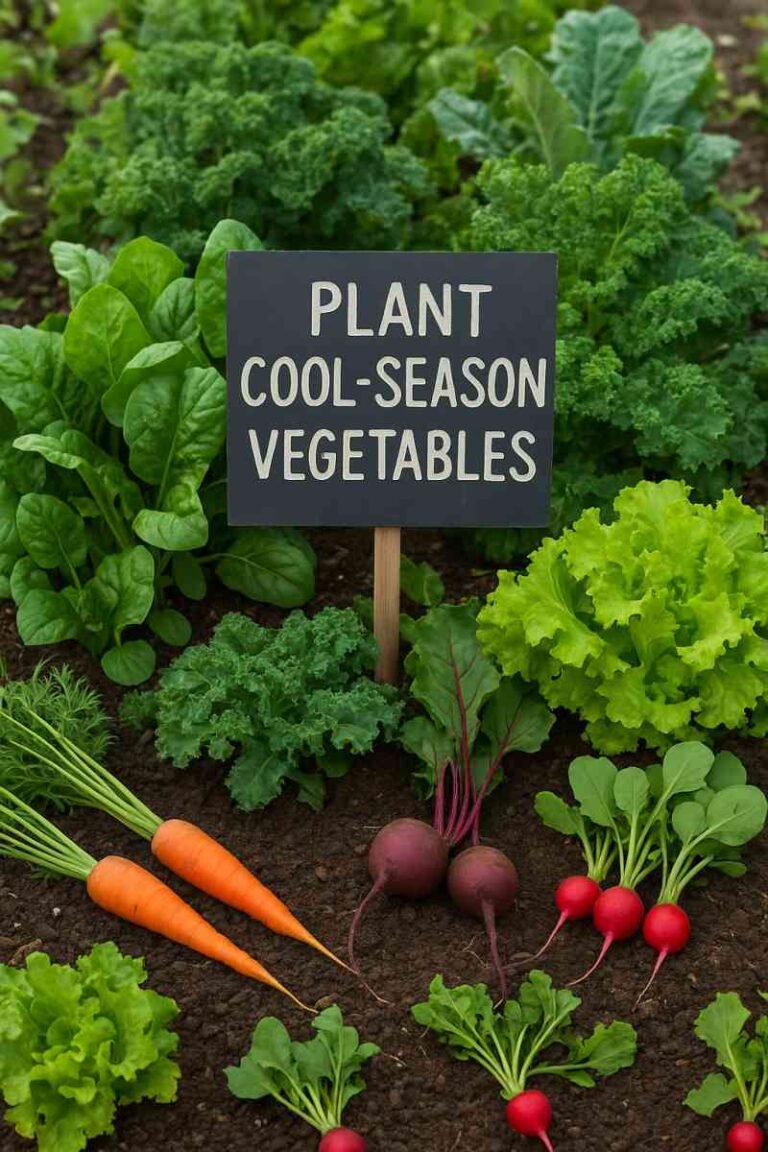
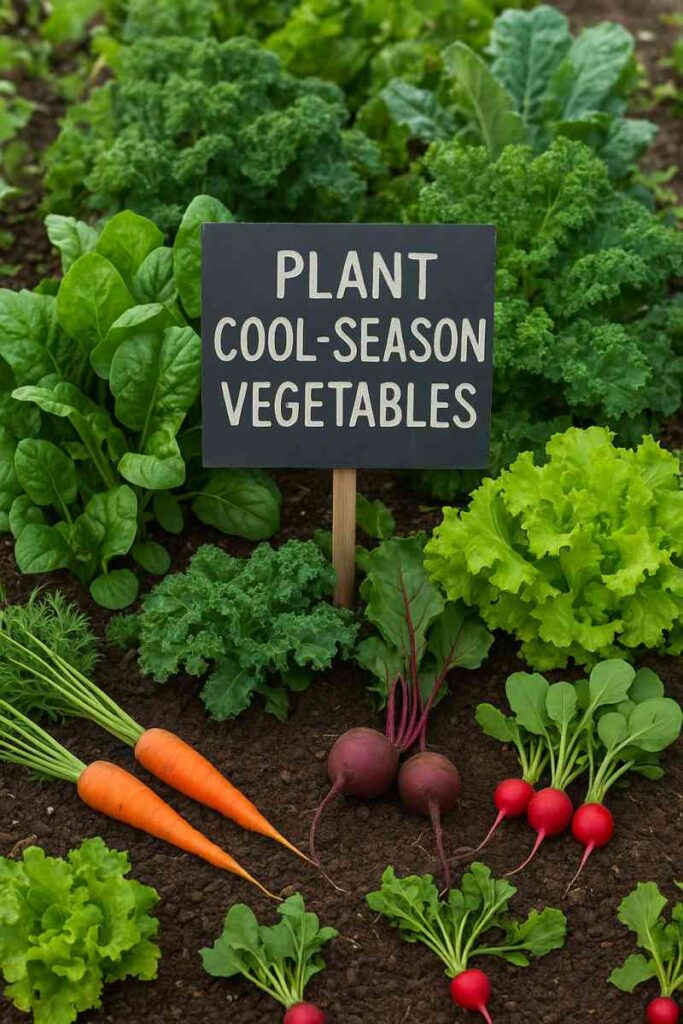
Cool-season vegetables are the backbone of a productive fall garden. Unlike summer crops that struggle in heat, leafy greens like spinach, kale, and lettuce thrive in cooler conditions. Their growth slows slightly, but the flavor improves—greens often become more tender and sweet after a light frost.
Root vegetables like carrots, beets, and turnips thrive in fall, becoming sweeter after frost. Stagger plantings every two weeks for continuous harvests, and pair quick radishes with slower crops for variety.
2. Add Ornamental Kale and Cabbage
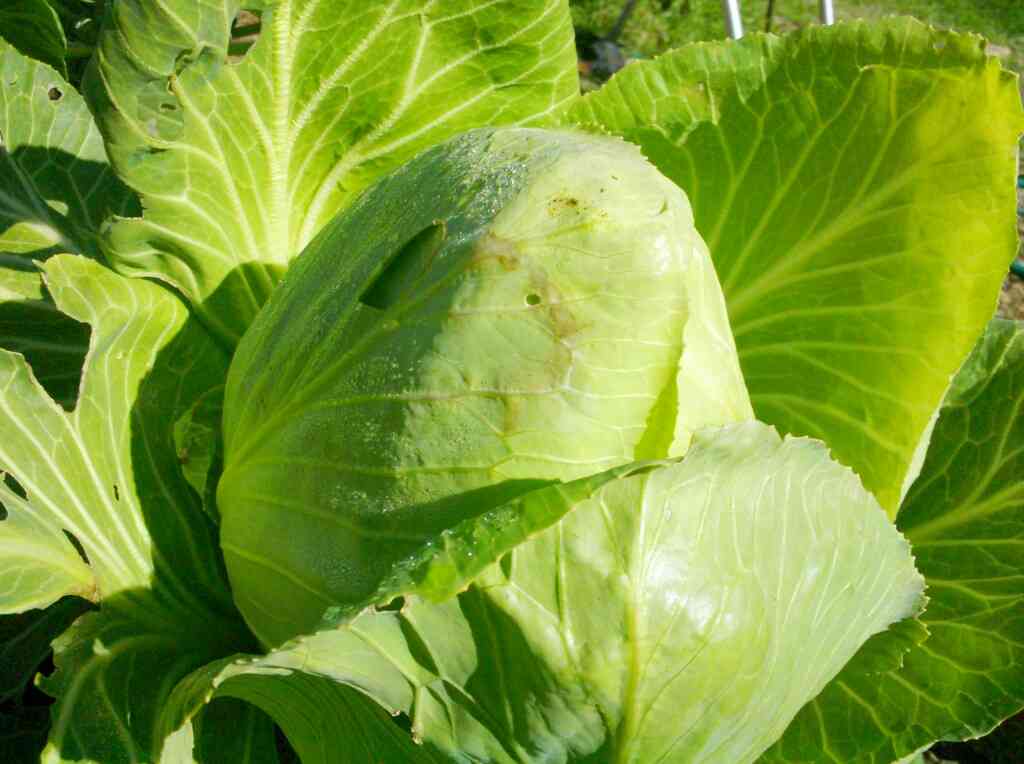
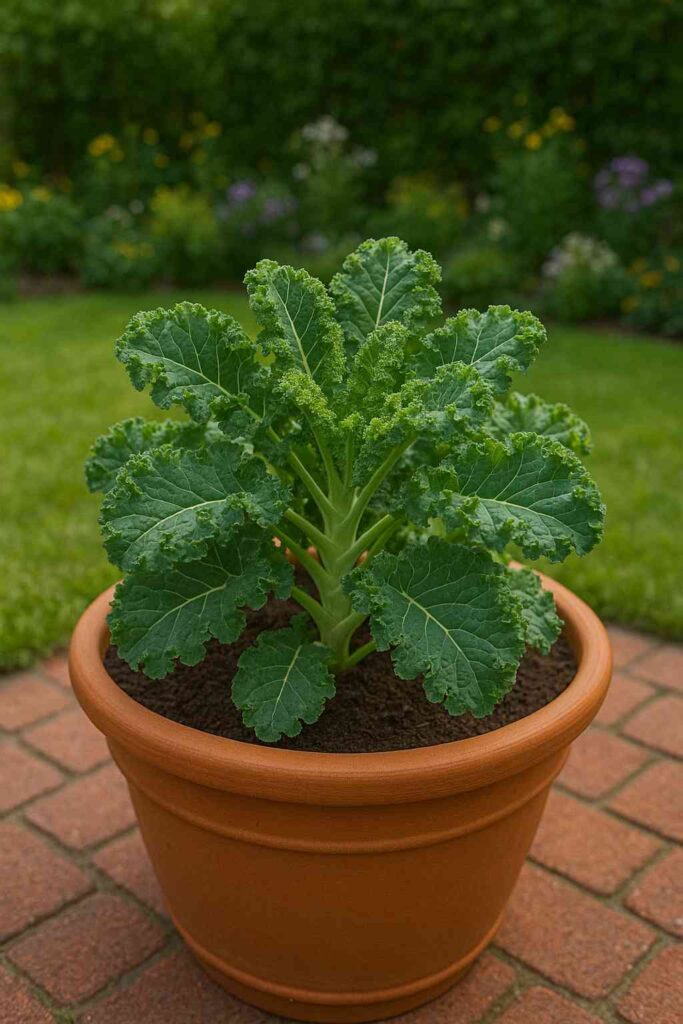
Ornamental kale and cabbage bring bold, lasting color to the fall garden with their rosette-shaped leaves in shades of purple, white, and green. Unlike summer flowers, they thrive as temperatures drop, often looking more vibrant after frost. Their sculptural forms add drama to beds, borders, and containers.
These hardy plants shine when grouped together or paired with mums and pansies for layered displays. Best of all, they remain attractive well into winter, even after light snow, offering long-lasting beauty with very little maintenance.
3. Create a Chrysanthemum Display
No plant says “fall” quite like chrysanthemums. Available in warm hues of gold, bronze, burgundy, and rust, mums bring instant seasonal cheer to gardens. They’re easy to grow in beds, containers, or even window boxes, making them versatile additions for any space.
Mums shine brightest when planted in groups. Lining a walkway with pots creates a warm, welcoming entrance, while massing them in beds delivers bold blocks of color. For a softer, natural look, mix mums with ornamental grasses and asters to mimic a meadow-like display.
To extend their beauty, keep mums well-watered and remove spent blooms regularly. With just a little care, these fall favorites will reward you with vibrant color that lasts for weeks, brightening the garden well into late autumn.
4. Grow Garlic for Next Year
Planting garlic in fall is one of the simplest and most rewarding gardening tasks. All it takes is a few cloves, planted pointy-side up, in well-drained soil about 2 inches deep. Once covered with mulch, they settle in for winter, quietly establishing roots while the garden rests.
Garlic thrives when planted in fall, using the cold dormancy to establish strong roots. By spring, shoots appear, and by early summer, you’ll harvest full, flavorful bulbs. Once cured, they store for months, making fall planting a simple investment with big culinary rewards.
5. Plant Spring-Flowering Bulbs
Fall is the perfect time to plant bulbs like tulips, daffodils, hyacinths, and crocuses. These favorites need a cold period to root and prepare for spring blooms. Planting now guarantees a burst of color just as winter fades, filling your garden with early cheer.
Get creative with placement—scatter bulbs for a naturalized look, line walkways for structure, or layer varieties at different depths for a succession of blooms. Mark your planting spots so they’re not forgotten, and by spring you’ll enjoy a vibrant display that rewards your fall effort.
6. Add Pansies and Violas
Few flowers rival pansies and violas for fall resilience. Their cheerful blooms, often marked with unique “faces,” come in endless colors that brighten beds, borders, and containers even as the weather cools. They tolerate light frosts, bounce back after chilly nights, and in some regions, even overwinter to bloom again in spring.
Pairing them with mums, ornamental kale, and cabbage creates a vibrant, textured display that thrives through the season. With minimal care, pansies and violas deliver lasting color and charm, making them a reliable favorite for any fall garden.
7. Refresh Garden Beds with Mulch
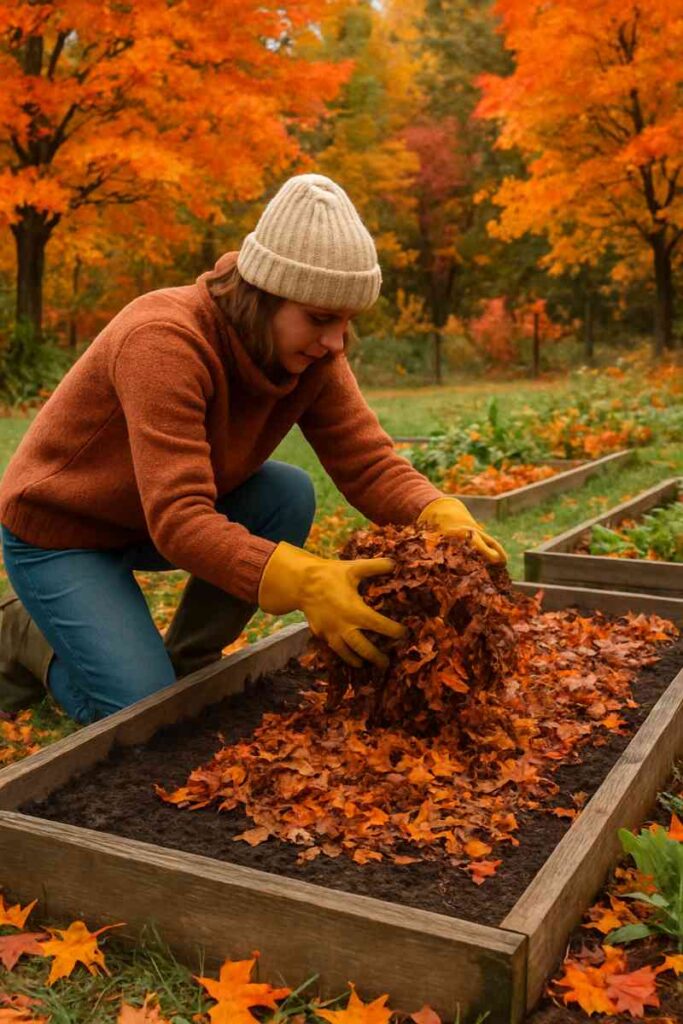
Adding a fresh layer of mulch in fall not only makes beds look neat but also protects plants. It insulates roots against temperature swings, conserves moisture, and suppresses weeds that might sprout in cooler weather. Organic options like shredded leaves, bark, or straw also enrich soil as they break down.
Mulching is especially helpful for perennials through winter. By stabilizing soil temperatures, it reduces freeze-thaw stress that can push plants out of the ground. A well-mulched garden looks tidy now while setting the stage for healthier growth and easier planting in spring.
8. Grow Cover Crops
Cover crops like clover, rye, and vetch protect your soil once the main growing season ends. They help prevent erosion, suppress weeds, and add organic matter back into the ground, keeping your garden’s foundation strong over winter.
In spring, you can till or cut them back into the soil, enriching it naturally with nutrients. This simple step improves soil fertility, structure, and moisture retention, setting up your garden for healthier growth next season.
9. Incorporate Ornamental Grasses
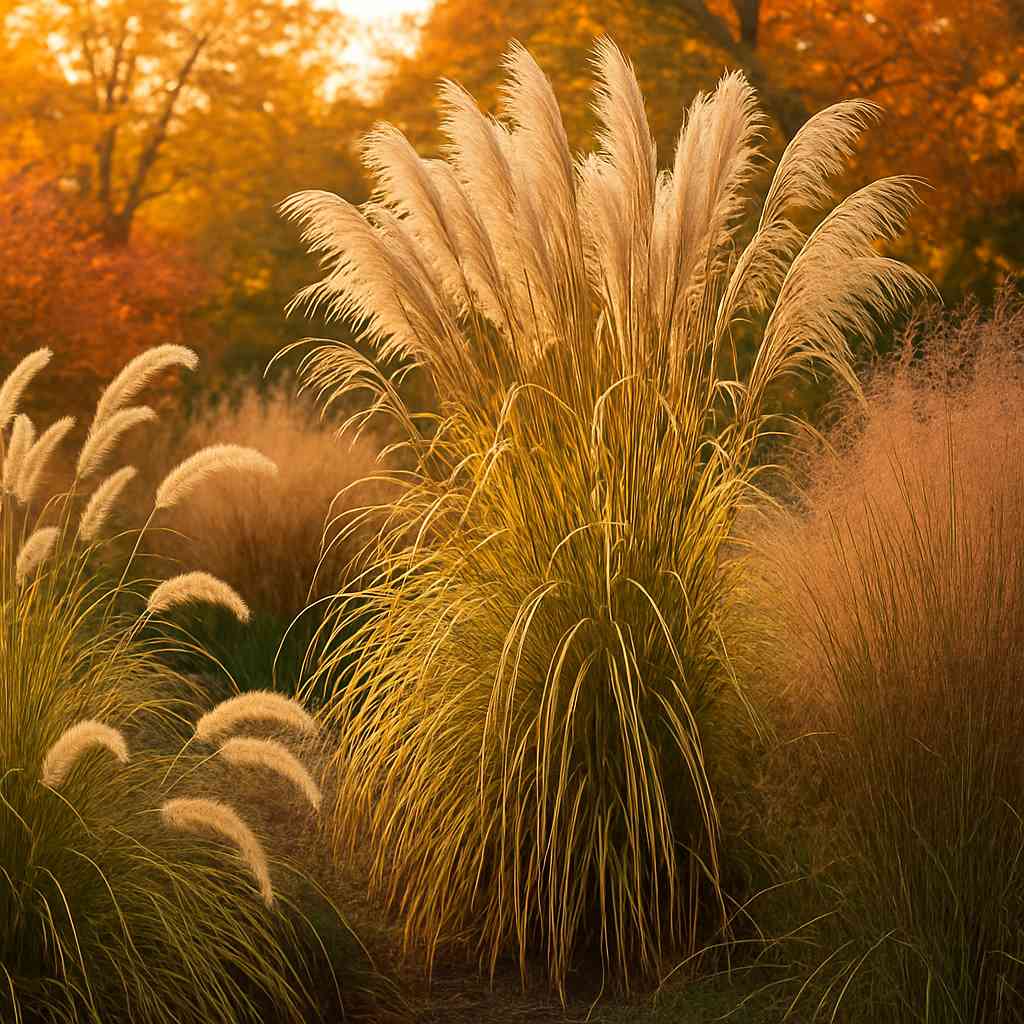
Ornamental grasses such as fountain grass, miscanthus, and switchgrass shine in the fall garden. Their tall plumes catch the golden autumn light and sway beautifully in the breeze, adding movement and texture to beds and borders.
Even after frost, these grasses remain attractive, their dried seed heads offering winter interest. Pairing them with mums or asters creates stunning layered displays that keep your garden lively well into the colder months.
10. Add Pumpkins and Gourds
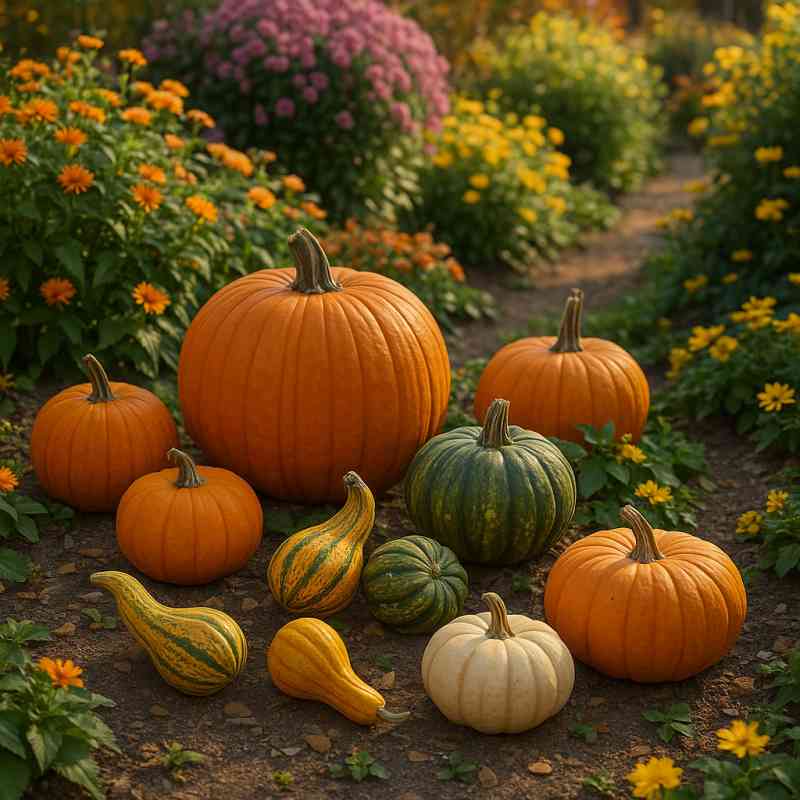
Pumpkins and gourds aren’t just for Halloween—they’re fantastic natural décor pieces for fall gardens. Their shapes, sizes, and colors add rustic charm when scattered along pathways, clustered on porches, or nestled among flower beds.
Mixing traditional orange pumpkins with white or striped varieties creates visual variety. Combined with hay bales, cornstalks, or autumn flowers, they instantly give your garden a festive seasonal feel.
11. Plant Late-Season Perennials
Late-blooming perennials like asters, sedum, and echinacea ensure your garden doesn’t lose steam when summer flowers fade. These hardy plants provide bursts of color just as other blooms are winding down.
They also serve as vital food sources for pollinators stocking up before winter. Once established, they return year after year with little maintenance, making them both beautiful and practical.
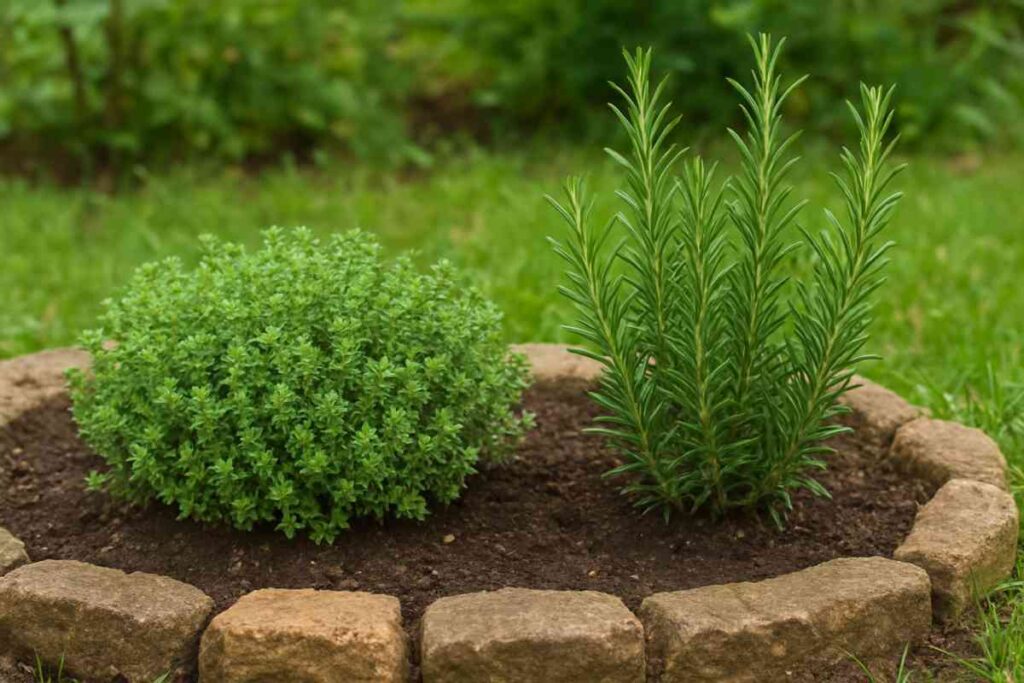
12. Grow Herbs Indoors or Out
Cooler weather is perfect for growing herbs like parsley, thyme, and chives. They thrive in pots outdoors during fall but can also be brought indoors for year-round use.
Having fresh herbs near your kitchen is both convenient and rewarding. Whether you’re seasoning soups or drying them for winter teas, fall herb gardening is an easy way to extend your harvest.
13. Create a Leaf Compost Bin
Autumn leaves are garden gold, and instead of bagging them up, you can turn them into rich compost. A simple bin or wire cage filled with shredded leaves will naturally break down over time.
By spring, you’ll have nutrient-packed leaf mold that improves soil texture and moisture retention. This eco-friendly practice recycles seasonal waste while giving your garden a free fertility boost.
14. Try Raised Bed Planting
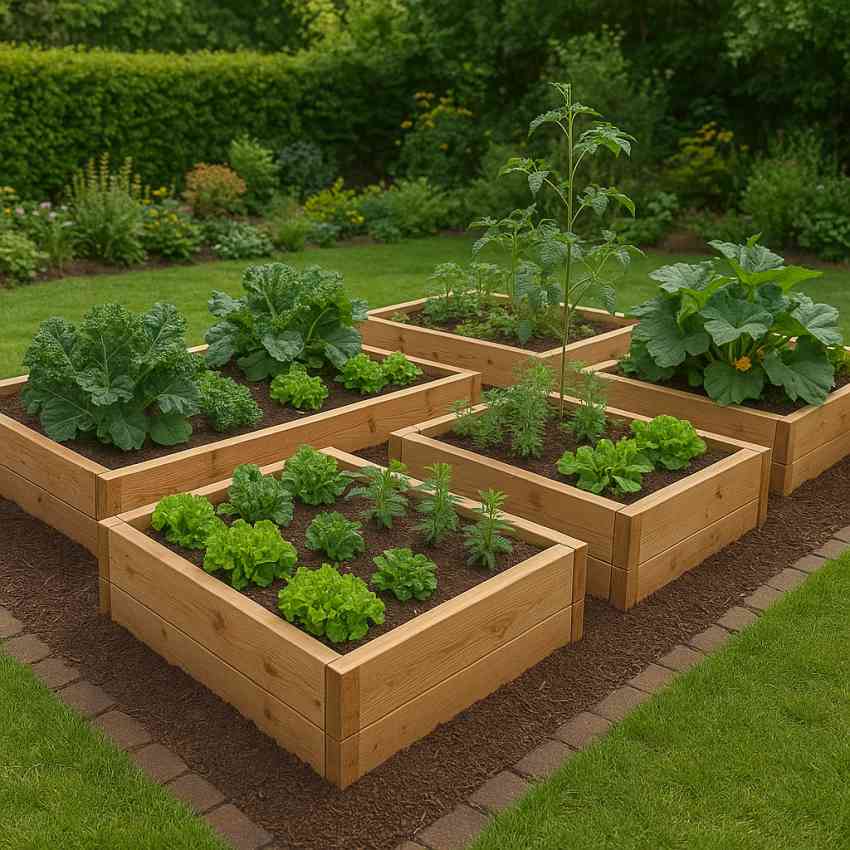
Raised beds are especially useful in fall gardening because they drain well and retain warmth, extending the growing season for greens and root vegetables. They also make planting and harvesting easier by reducing the need to bend.
Fall is a good time to build or refresh raised beds. Once prepared with nutrient-rich soil and compost, they’ll be ready to support not only fall crops but also early spring plantings.
15. Add Autumn Containers
Containers are an easy way to refresh your outdoor space with fall flair. Fill them with mums, ornamental kale, trailing ivy, or small pumpkins for instant seasonal charm on porches, patios, or entryways.
Using rustic pots, wooden crates, or even hollowed-out pumpkins makes displays more eye-catching. Grouping different container sizes together creates depth and visual interest that can carry your garden right through to the holidays.
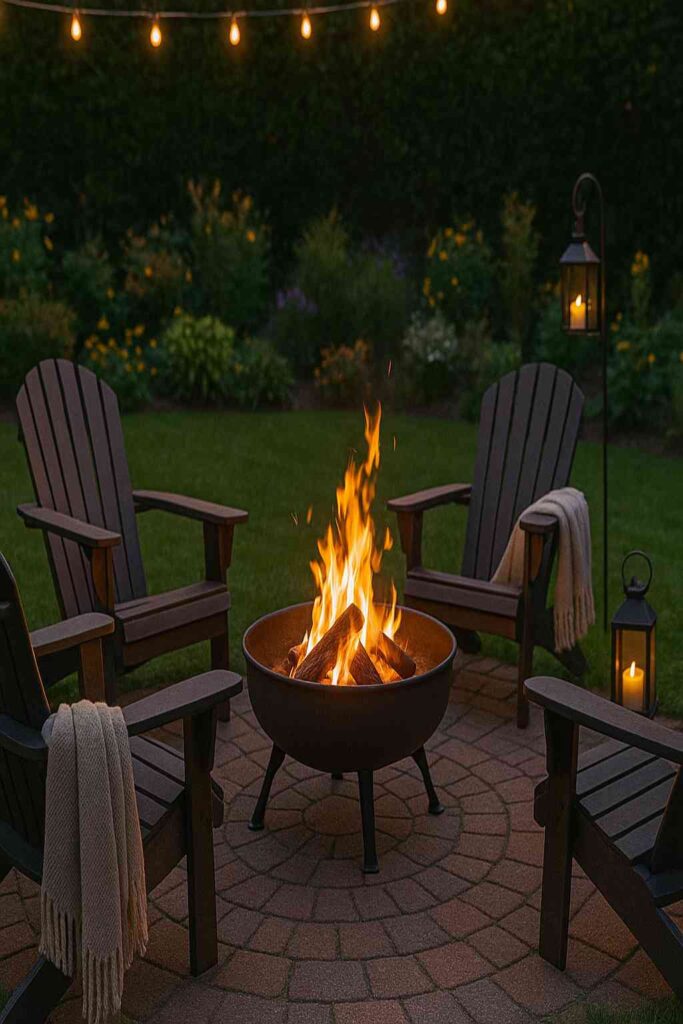
16. Incorporate Fire Pits or Outdoor Heating
A fire pit or outdoor heater turns your garden into a cozy retreat during crisp evenings. It extends the usability of your space, allowing you to enjoy fresh air long after the sun sets.
Surrounding the fire feature with seating, blankets, and lanterns makes it even more inviting. It’s the perfect way to turn your fall garden into a gathering spot for family and friends.
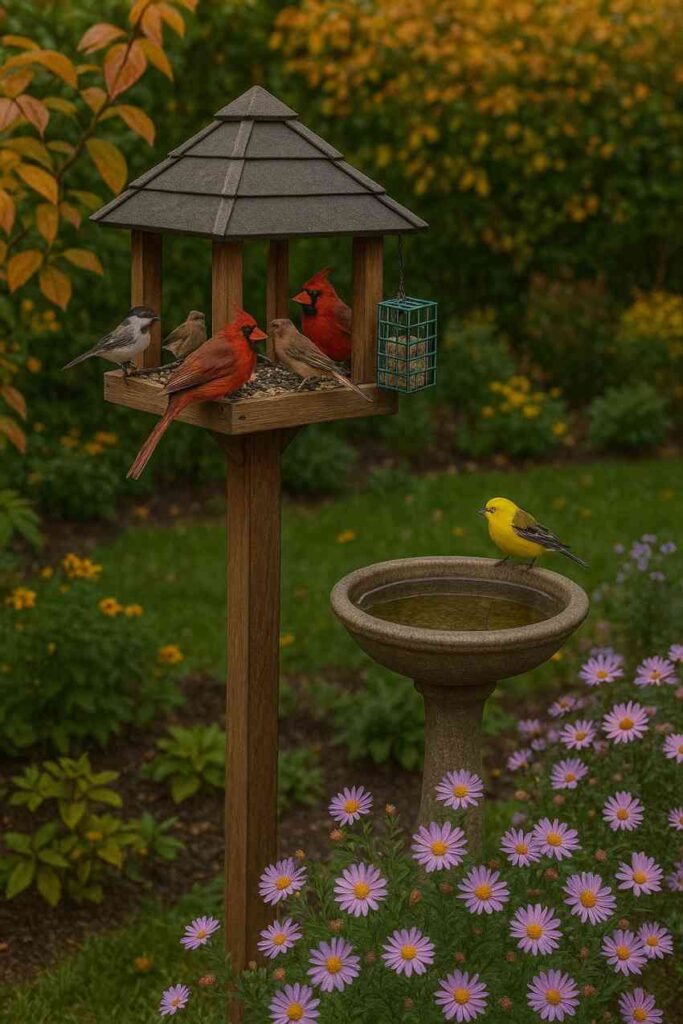
17. Attract Birds with Feeders
Fall is a key season for migratory birds, and setting up feeders helps support them on their journey. Sunflower seeds, millet, and suet blocks attract a wide variety of species to your garden.
In addition to being enjoyable to watch, birds naturally help with pest control by eating insects. A well-stocked feeder and a birdbath will keep your garden lively even as flowers fade.
18. Plant Trees and Shrubs
Fall is one of the best times to plant trees and shrubs because cooler weather reduces stress while soil remains warm enough for roots to establish. This gives plants a head start before spring.
Choosing varieties with colorful fall foliage or berries adds beauty now and structure for years to come. With proper watering and mulching, your fall-planted trees and shrubs will settle in quickly.
19. Decorate with Hay Bales and Cornstalks
Hay bales and cornstalks are classic elements of fall décor that bring rustic charm to your garden. They create height, texture, and a festive backdrop for pumpkins or potted mums.
Stacking hay bales at different levels makes displays more dynamic, while tying cornstalks to porch posts or fences adds vertical interest. Together, they create an unmistakable harvest-season atmosphere.
20. Add Pathway Lighting
As days get shorter, lighting becomes both practical and decorative in the fall garden. Solar lanterns, LED pathway lights, or string lights help guide the way and extend evening enjoyment.
Warm-toned lighting highlights seasonal features like pumpkins or ornamental grasses. It also adds a cozy, welcoming glow that makes your garden inviting on crisp autumn nights.
21. Grow Fall-Blooming Camellias
In mild climates, camellias bloom beautifully in late fall and early winter, producing elegant flowers when little else is flowering. Their glossy evergreen foliage adds year-round appeal.
They thrive in partial shade and provide reliable color just as other plants fade. Adding camellias ensures your garden maintains vibrancy long after the growing season ends.
22. Dry Herbs and Flowers
Fall is the ideal time to harvest and dry herbs like rosemary, mint, or lavender. Drying them preserves their fragrance and flavor for use in teas, cooking, or homemade gifts through winter.
Flowers like hydrangeas or statice can also be dried for arrangements and wreaths. These preserved blooms bring a touch of your fall garden indoors long after the season has passed.
23. Install Cold Frames or Row Covers
Cold frames and row covers extend your harvest by protecting plants from frost. They trap warmth during the day and hold it overnight, creating a microclimate for tender crops.
With these simple tools, you can continue growing greens, carrots, or radishes well into late fall. They’re also reusable season after season, making them a smart gardening investment.
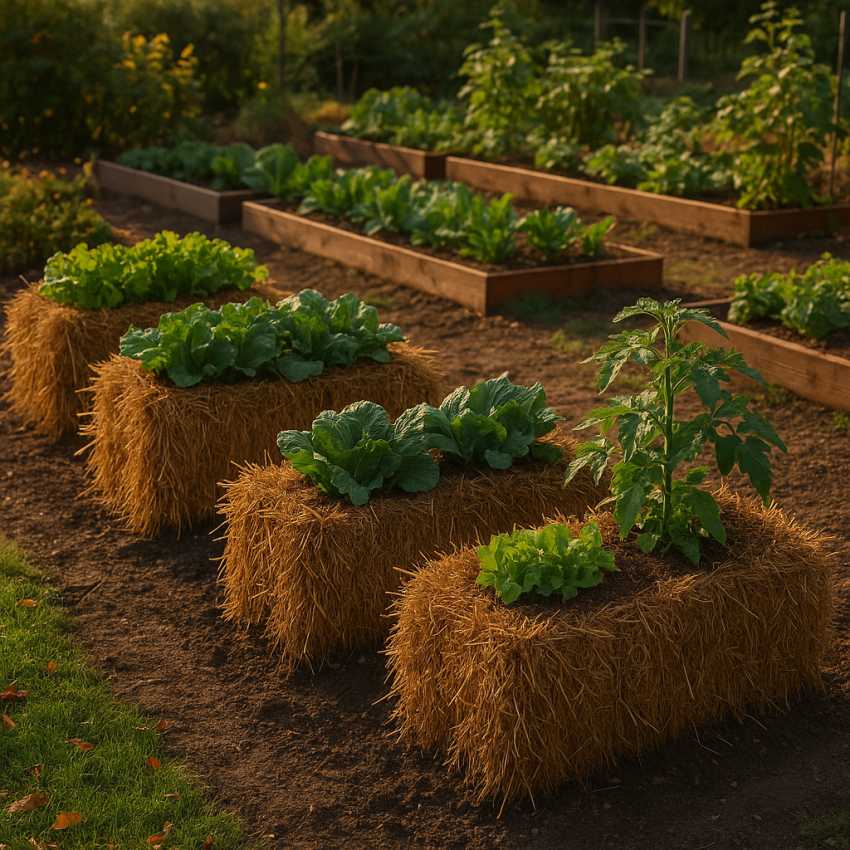
24. Use Straw Bale Gardening
Straw bales act as natural raised beds, offering both structure and nutrition for plants. Once conditioned, they’re perfect for growing leafy greens, herbs, and even root vegetables in fall.
As the bales decompose, they enrich the soil and provide mulch for the garden. It’s a creative, low-cost method that doubles as an easy clean-up at the end of the season.
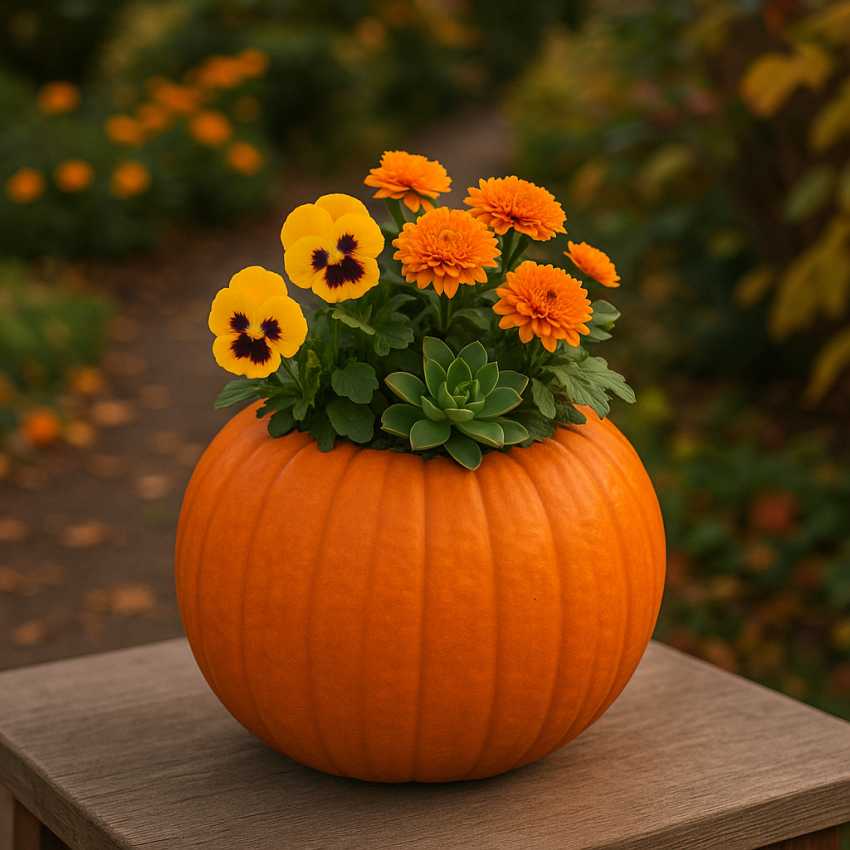
25. Make a Pumpkin Planter
Pumpkins can be transformed into festive planters by hollowing them out and filling them with soil. Add pansies, mums, or succulents for a seasonal centerpiece that looks both fun and elegant.
Once the pumpkin starts to break down, simply compost it. This project adds charm to porches, patios, or garden tables without wasting the pumpkin afterward.
26. Add Cozy Seating Areas
Cool autumn air makes time outdoors even more refreshing, especially with the right seating. Adding benches, Adirondack chairs, or hammocks creates spots to enjoy your fall garden.
Layering cushions, blankets, or outdoor rugs adds comfort and warmth. These touches transform your garden into a relaxing retreat for crisp mornings or golden-hued evenings.
27. Harvest and Preserve the Season’s Bounty
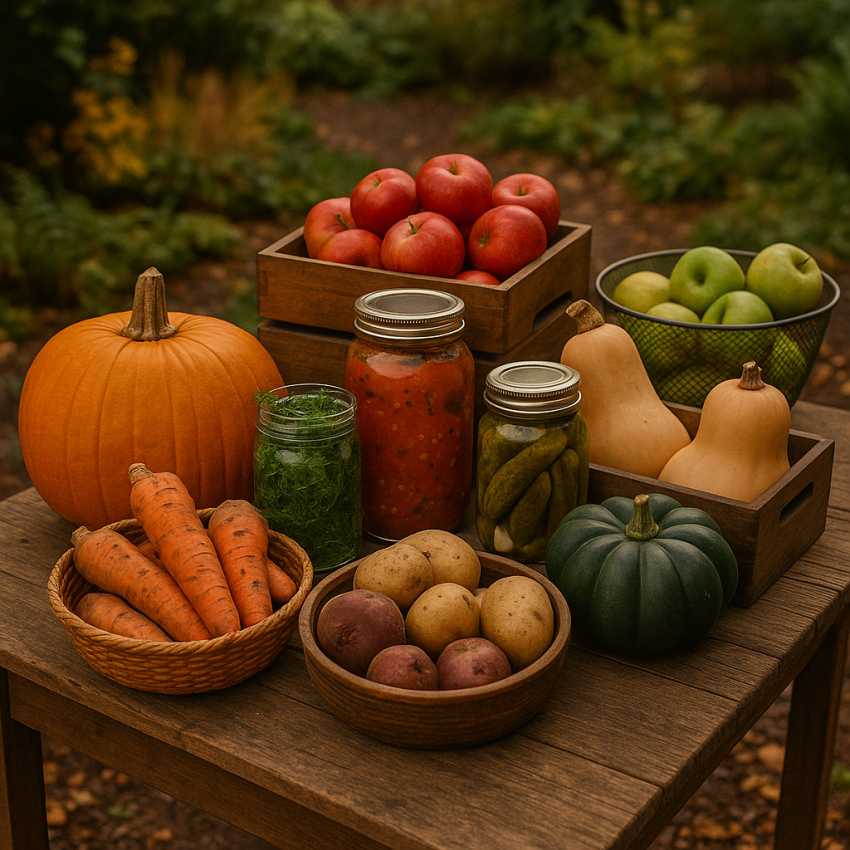
Fall harvests often bring an abundance of apples, squash, and root vegetables. Preserving them through canning, freezing, or drying ensures you’ll enjoy your garden’s rewards all winter long.
Herbs can also be dried, and late-season greens can be blanched and frozen. With a little planning, your fall garden can continue nourishing you long after the season has ended.
Conclusion
Fall gardening goes beyond extending the season—it’s about embracing change and making the most of autumn’s charm.
From cool-season crops and late blooms to pumpkins, cornstalks, and cozy lights, there are countless ways to keep your garden lively.
Blending practical care with creative touches, these 27 ideas ensure a colorful fall and a strong start to spring.
Khaja Moinuddin, a computer science graduate, finds joy in gardening and homesteading. Join him on this blog as he shares his experiences in homesteading, gardening, and composting
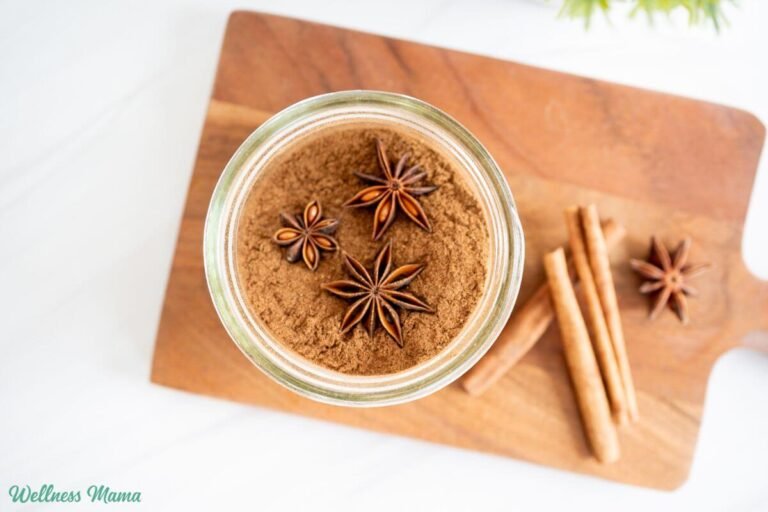
I’ve shared my recipes for homemade herb and spice blends before, and one of my favorites is homemade pumpkin pie spice. It’s simple to make and an easy way to make sure there are fresh spices (and only that) in your blend. You can also adjust the recipe based on your family’s tastes and the way you like to use it.
Pumpkin pie spice is a delicious blend of warming spices that reminds me of the autumn season. Think curled up in the living room with a soft lamp, a good book, and a pumpkin spice latte. Even if PSL isn’t your thing, there are plenty of other delicious ways to use this pumpkin spice.
Origin of an Obsession
Pumpkin pie spice likely originated in Northern America as a variation of the British “mixed spice.” This blend of cinnamon, allspice, and nutmeg was introduced after the European settlers arrival.
By the mid-20th century, spice companies began premixing pumpkin pie spice. This convenient spice blend led to pumpkin pie spice being used in recipes other than just pie.
How to Make Pumpkin Pie Spice + Recipes
I usually make a double or triple batch of this at the beginning of fall. It stores perfectly in a small mason jar in my cabinet for easy use. Not only does mixing it myself save money, but it lasts a long time. Plus, it tastes a lot fresher than spices that have been sitting on the grocery store shelf for who knows how long. Be sure you’re using quality spices when you mix up a batch and that they still have a strong, fragrant smell.
Pumpkin Pie Spice Recipe
Homemade pumpkin pie spice is a delicious addition to sweet and savory recipes. Save money and get more flavor with freshly mixed spices.
Nutrition Facts
Pumpkin Pie Spice Recipe
Amount Per Serving (0.5 tsp)
Calories 3 Calories from Fat 1
% Daily Value*
Fat 0.1g0%
Carbohydrates 0.8g0%
Fiber 0.5g2%
Sugar 0.1g0%
Protein 0.1g0%
* Percent Daily Values are based on a 2000 calorie diet.
This recipe makes ¼ cup + 2 tablespoons. Feel free to double or triple it!
Pumpkin spice blend is an obvious staple for our homemade pumpkin pie. It’s also great in some unusual recipes such as:
Looking for More? Check Out These “Spicy” Fall Recipes!
If you’re looking for fall-inspired recipes but are done with pumpkin, these recipes are perfect!
Spiced-Up Turmeric Latte with Cinnamon and Chicory – If you’re looking for a soothing coffee drink that doesn’t contain coffee, this is it! I love drinking this latte in the morning and at night since there’s no caffeine to mess with sleep.
Fresh Spiced Apple Cider Recipe – I love cooking this recipe in the fall when we have an abundance of fresh apples. The smell is so delicious and permeates the house!
Spice Cake – Fall is a perfect time for spice cake. Try a teaspoon of pumpkin pie spice mixed into the topping of these fruit and nut spice bars.
Applesauce Recipe – A simple recipe consisting of just organic apples and cinnamon. This is a perfect fall treat and can be canned for later use.
How do you use pumpkin pie spice? Do you make your own?
A. alpinus ‘Wargrave Variety’ is a perennial alpine aster cultivar suitable for growers in Zones 4 to 7.
‘Wargrave Variety’
Flowers resembling daisies consist of sparse lavender-pink rays around prominent gold centers and bloom from late spring to early summer.
With a mature height of between eight and 12 inches tall, each bloom is borne on its own stem, unlike branching, clustered varieties.
This type prefers full sun and average soil that drains well. It is very tolerant of cold, drought, part shade, and poor soil.
11. Wood’s Pink
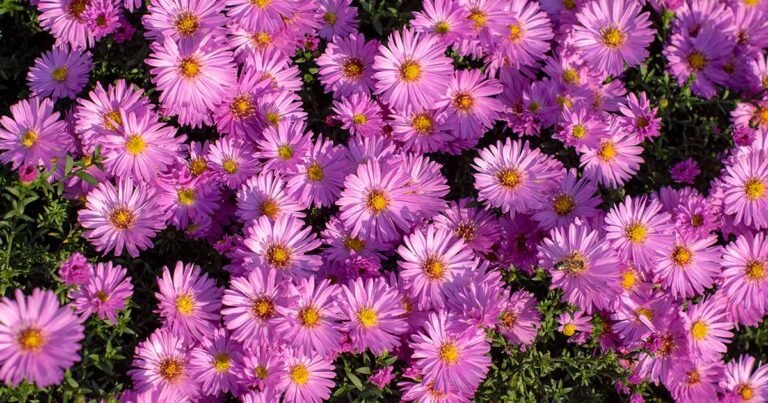
S. novae-angliae ‘Wood’s Pink,’ a New York native perennial cultivar, is a dwarf type that tops out at 12 to 18 inches tall. It thrives in Zones 4 to 8.
Bloom time is from late summer to early fall, with clusters of semi-double fuchsia rays surrounding vivid gold disks.
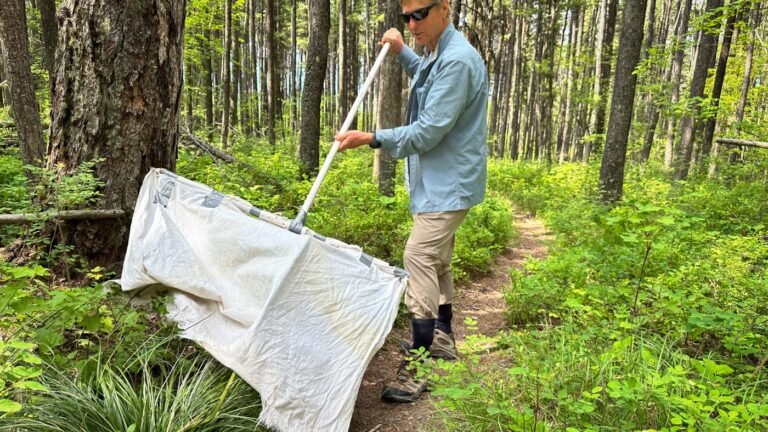
Carroll College professor of biology Grant Hokit drags a white cloth through brush outside of Condon, Mont., looking for ticks. Hokit surveys for ticks statewide for the Montana health department.
Aaron Bolton
hide caption
toggle caption
Aaron Bolton
CONDON, Mont. —Biologist Grant Hokit has come to this small meadow in the mountains outside Condon to look for ticks. A hiking path crosses the expanse of long grasses and berry bushes.
As Hokit walks the path, he carries a handmade tool made out of plastic pipes taped together that hold a large rectangle of white flannel cloth.
He jokes that this device is “sophisticated,” but the scientific survey is quite serious: He’s sweeping the cloth over the shrubs and grass, hoping that “questing” ticks will latch on.
Along the summer trail, ticks dangle from blades of grass, sticking their legs out and waiting for a passing mammal.
“We got one,” Hokit says. “So that came off of this sedge grass right here… simply pick them off with our fingers. We’ve got a vial that we pop them in.”
Any captured ticks will go back to Hokit’s lab in Helena for identification. Most of them will likely be identified as Rocky Mountain wood ticks.
But Hokit also wants to find out if new species are making their way into the state.
As human-driven climate change makes winters shorter, ticks are spending less time hibernating and have more active months when they can hitch rides on animals and people. Sometimes the ticks carry themselves — and diseases — to new parts of the country.
Hokit found deer ticks for the first time earlier this year in northeastern Montana. Deer ticks are infamous for transmitting Lyme disease and can infect people with other pathogens.
Hokit finds and identifies ticks alongside a trail outside Condon, Mont. These surveys help public health officials understand where ticks are in Montana and detect new species that have migrated on large mammals like deer. Hokit found deer ticks, which are known to carry Lyme disease, earlier this year in northeast Montana.
Aaron Bolton
hide caption
toggle caption
Aaron Bolton
Knowing a new species like the deer tick has arrived in Montana or other states is important for doctors.
Dr. Neil Ku is an infectious disease specialist at Billings Clinic in eastern Montana. He says most patients don’t come in right after they get bitten by a tick. They usually show up later, when they start feeling sick from a tick-borne illness.
“Fever, some chills, they may just feel bad, similar to many infections we may encounter throughout the year,” he says.
It’s rare that patients connect a tick bite to those symptoms and even more rare that they capture and keep the tick that bit them. Sorting out whether someone might have a tick-borne illness can be complicated.
Knowing what ticks are in the region will help doctors know that they might start encountering patients infected with new diseases after a tick bite, Ku says
That’s partially why the state is on the hunt for new tick species.
“The more we know about what’s in Montana, the better we can inform our physicians, the better care you can receive,” said Devon Cozart, a zoonotic illness and vector-borne disease epidemiologist with the Montana Department of Public Health and Human Services.
Cozart collects and tests the ticks from field surveys in Montana to see whether they are carrying any pathogens.
Whether a tick can get a human sick depends on the species, but the kind of mammal on which it feeds also plays a role.
“Usually it’s a rodent that might be carrying, for example, Rocky Mountain spotted fever. So, the tick will feed on that rodent, then will get the pathogen as well,” she said.
Because the prevalence of a particular disease can vary in mammal populations, ticks in one part of the state could be more or less likely to get you sick. That’s also important information for medical providers, says Cozart.
This kind of surveillance and testing isn’t happening in every state or county. A 2023 survey of nearly 500 health departments around the country found that roughly a quarter do some kind of tick surveillance.
Field surveys can be expensive. For numerous local and state health departments, tick surveillance relies on a less expensive, more passive approach. Concerned patients, veterinarians and doctors must collect and send in ticks for identification.
“It does provide a little information about what ticks are actually interacting with people and animals, but it doesn’t get into the weeds of how common ticks are in that area and how often do those ticks carry pathogens,” said Gridley-Smith.
She says more health departments want to start tick surveillance, but getting funding is hard and might get harder as federal public health grants from agencies like the Centers for Disease Control and Prevention dry up.
Montana receives about $60,000 from a federal grant annually, but the bulk of that funding goes toward mosquito surveillance, which is more intensive and costly. What’s left funds trips into the field to look for ticks.
Hokit says he doesn’t have enough funding for his small team to survey everywhere he would like to in a state as large as Montana. That means he’s unable to monitor emerging populations of deer ticks as closely as he would like.
He found those new deer ticks in two Montana counties, but he doesn’t have enough data to determine whether they have begun reproducing there, establishing a local population.
In the meantime, Hokit uses data on climate and vegetation to make predictions about where deer ticks might thrive in the state. He has his eye on particular areas of western Montana, like the Flathead Valley.
He says that will help his team narrow down where to look next so they can let the public know when deer ticks — and the disease they can carry — arrive.
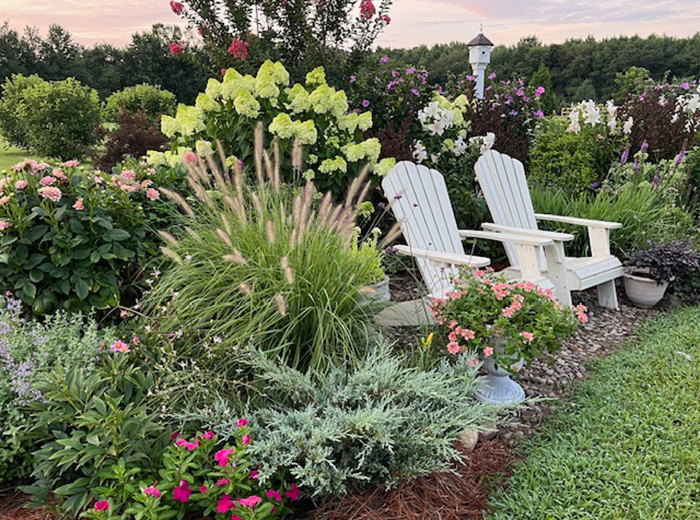
We’re heading to the Mid-Atlantic coast today to visit a new garden—brand new to Garden Photo of the Day and a relatively new creation on freshly developed property. These beautiful beds were cultivated by Teresa Eutsler in Worcester County, Maryland after moving from an extensive garden they tended for over 30 years. Looking to reduce the time she spent working in her new garden, Teresa aimed to create a low-maintenance landscape, but her passion for plants had other plans. She now has a stunning garden that is easy to care for, but she has too much fun experimenting in to stay out of for long.
Hi there. My name is Teresa Eutsler and I garden on the eastern shore in Worcester County, Maryland, zone 7b. My garden is about 15 miles from the Atlantic coast. I’ve been gardening over 40 years. My husband and I moved and built this home on a wide open piece of farmland in 2017 so this is a fairly young garden. There was nothing here at all and since I’m 65 and had left a garden I had worked on for over 30 years that was quite extensive I was determined to keep it simple! Easier said than done!
Even though I’m getting older and am trying to make things a little easier one thing I’ve learned is that a garden is never really done because when you love your garden you are always trying new combinations or making room for a new plant or changing something you don’t like! That’s what a gardener does! Thank you for letting me share a small part of my garden with you!
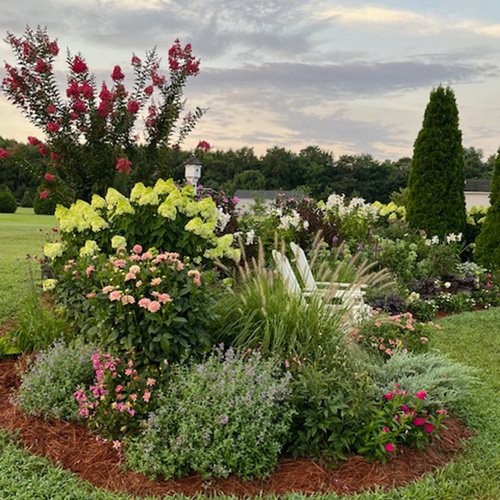
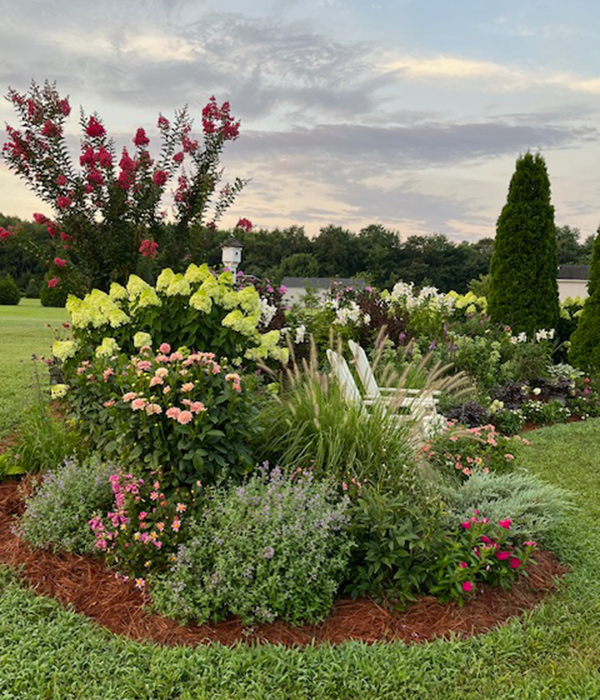
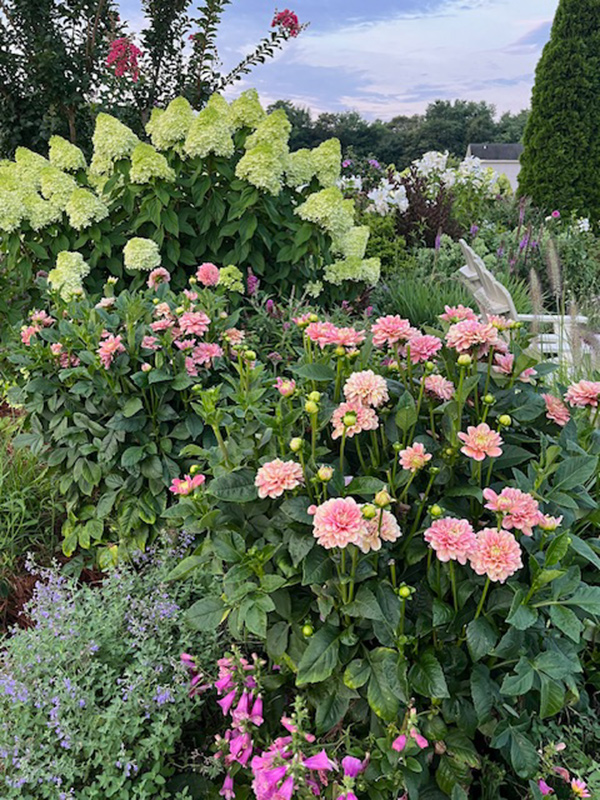
The skies have been generous so the little limelight’s are enjoying the moisture and I’ve been very happy with Milena Fleur dahlia(Dahlia ‘Milena Fleur’, Zones 9–11 or as an annual). It has returned for me despite a very cold winter and is a beautiful color with the Hameln grass (Pennisetum alopecuroides ‘Hameln’, Zones 5–9) as it’s neighbor and the Tuscarora crepe myrtle (Lagerstroemia indica ‘Tuscarora’, Zones 6–9) behind along with the Casa Blanca lilies (Lilium ‘Casa Blanca’, Zones 5–8) in the background.
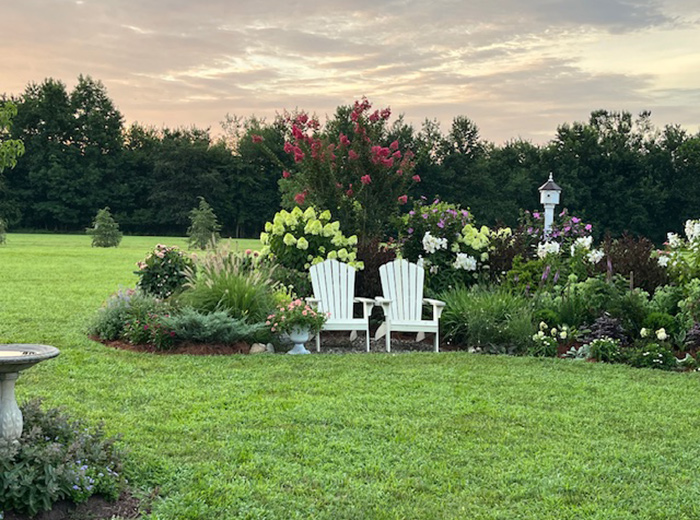
A wider view shows the open farmland that the garden sits on. Just as small gardens are a challenge to plan, it can be equally difficult to build gardens that don’t look out of place in a large, open space. But building beds with a slight curve, like Teresa has here, is an effective way of making them feel more like more natural elements in the landscape.
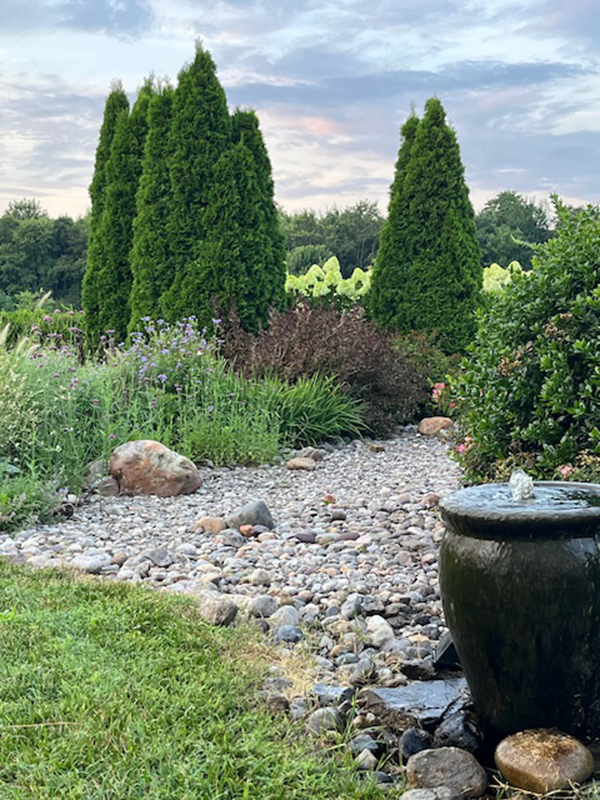
The dry river rock bed carries the water from our roof away from the house and when it rains really hard makes a beautiful little river running through it. The bed next to it is dry and pretty exposed so the Hameln grass, alliums, Autumn Joy sedum (Hylotelephium ‘Herbstfreude’, Zones 3–9), gaura, tall ageratum and self seeded verbena (Verbena bonariensis, Zones 7–10) don’t mind and are easy maintenance.
In the background are Emerald Green arborvitae (Thuja occidentalis ‘Smaragd’, Zones 4–8) , Little Lime hydrangea (Hydrangea paniculata ‘Jane’, Zones 3–9) and burgundy leafed dwarf weigela.
Lastly, a closer look at those successful Milena Fleur dahlia along with one of the Little Lime panicle hydrangeas absolutely covered in perfect blooms. It’s clear that Teresa has a special touch with plants if this is what she is able to create on “easy” mode.
Thank you so much for sharing your gorgeous designs with us, Teresa! I can only imagine how beautiful your previous gardens were if you’ve been able to create these stunning scenes in such a short amount of time.
Follow the directions below to submit photos via email, or send me a DM on Instagram: @agirlherdogandtheroad.
We want to see YOUR garden!
Have photos to share? We’d love to see your garden, a particular collection of plants you love, or a wonderful garden you had the chance to visit!
To submit, send 5–10 photos to [email protected] along with some information about the plants in the pictures and where you took the photos. We’d love to hear where you are located, how long you’ve been gardening, successes you are proud of, failures you learned from, hopes for the future, favorite plants, or funny stories from your garden.
Do you receive the GPOD by email yet? Sign up here
Fine Gardening Recommended Products
XLUX Soil Moisture Meter
Fine Gardening receives a commission for items purchased through links on this site, including Amazon Associates and other affiliate advertising programs.
– Large and clear dial, including ten scales, plug and read
– Simply insert the moisture meter into soil and you’ll get the test result instantly
– Single probe, less hurts to the roots, doesn’t dig up too much soil after test
The Regenerative Landscaper: Design and Build Landscapes That Repair the Environment
Fine Gardening receives a commission for items purchased through links on this site, including Amazon Associates and other affiliate advertising programs.
2024 Nautilus Award Gold Medal Winner! This awe-inspiring guide weaves together permaculture design, food resiliency, climate adaptation, community organizing, and indigenous wisdom that you can implement in your own backyard.
ARS Telescoping Long Reach Pruner
Fine Gardening receives a commission for items purchased through links on this site, including Amazon Associates and other affiliate advertising programs.
Telescopes from 4 to 7′. Cut and Hold (160) Blades. Drop forged blades for unsurpassed long lasting sharpness. Lightweight, 2.3 lbs., for continued use. Perfectly balanced for easy pruning.
Chrysanthemums are one of the prominent flowering plants that bloom from summer through fall.
It’s easy to grow mums in your backyard, provided that you give them enough sunlight and well-drained and nutrient-rich soil.
Also known as a mum, Chrysanthemums are a great addition to your backyard if you’re looking to have colorful blooms even in autumn.
Planted in March, mums produce blossoms, particularly in the fall when many other plants start winding down.
Often referred to as “mums,” Chrysanthemums are versatile and relatively easy to care for flowering plants that are renowned for their vibrant colored blossoms.
Adequate sunlight, rich soil, well-drained and well-aerated growing medium are common requirements of Chrysanthemums.
Apart from just planting these fall flowering plants in your backyard, you must take proper care to keep them alive for the next blooming season.
If you’re looking to grow Mums in your garden, then you can propagate it through the division method or grow from cuttings. Seed propagation is also possible, but it takes time.
Once your plant is well established, ensure to give proper care, like enough sunlight and water, and enrich the soil with a balanced fertilizer.
Growing Requirements of Mums
Prominent for enticing and long-lasting flowers, Mums are easy to care for and have only a few preferences, like full sunlight and moist soil, along with nutrient-rich soil to grow and produce blooms.
Though they are adaptable, it is essential to understand their basic growing requirements to have a healthy plant.
1. Sunlight (Choose a location that gets 6 hours of sunlight)
Mums can tolerate partial shade, but if you’re looking to have the best blossoms in your garden, then give them at least 6 hours of full sunlight.
In hotter climates, Mums can tolerate a bit of shade, but too much shade can cause the plants to become leggy and produce fewer flowers.
2. Soil (Well-drained and well-aerated soil)
Chrysanthemums prefer well-draining soil with a slightly acidic to neutral pH (6.5-7.0).
If your soil is heavy or clay-like, mix in some organic matter like compost to improve drainage.
Standing water or overly wet conditions can cause root rot, so good drainage is crucial.
3. Watering (Water 1 inch per week)
Plants need light, water, and nutrients to grow and produce blooms.
Nutrients in the soil are transported to plants through water.
Overwatering and underwatering are the most common cause of stunted plant growth.
Water the plant only when the top 1-2 inches of the soil is dry. Avoid excess watering as it can lead to root rot and plant death.
Water deeply at the base of the plant, ensuring the roots are hydrated.
Be careful not to get the leaves wet, as this can lead to fungal diseases. During dry spells, check the soil regularly and water as needed.
4. Fertilizing (Use balanced fertilizer)
Chrysanthemums benefit from regular feeding throughout the growing season.
Use a balanced fertilizer with equal parts nitrogen, phosphorus, and potassium (10-10-10) to promote healthy growth and abundant blooms.
Begin feeding your mums in early spring and continue until they start blooming in the fall. Once buds have formed, switch to a fertilizer higher in phosphorus to encourage flower production.
5. Pruning and Pinching
To keep your mums compact and complete, pinch them back in early summer.
Pinching encourages the plant to produce more branches, resulting in a bushier shape and more blooms in the fall.
Stop pinching around mid-July to allow buds to form for the fall bloom.
How to Grow Chrysanthemums?
Growing chrysanthemums rewards you with vibrant colored blossoms.
You can plant them in the garden or grow them in a container.
With dozens of different varieties, mums are easy to grow flowering plants that can bloom in fall.
1. Choosing the Right Location
Start by selecting a sunny location in your garden or yard. Mums need at least 6 hours of sunlight per day to produce the best blooms.
Avoid planting them in areas that are prone to flooding or where water tends to pool, as this can lead to root rot.
2. Preparing the Soil
Before planting, prepare the soil by loosening it to a depth of about 12 to 15 inches.
Mix in organic matter, such as compost or well-rotted manure, to improve drainage and provide nutrients.
Chrysanthemums prefer slightly acidic to neutral soil with a pH between 6.5 and 7.0.
3. Planting Chrysanthemums (Division, Cuttings or Seed)
It all depends on you.
You can grow chrysanthemums by division process or just by planting the cutting in the soil or starting from scratch through seeds.
Just plant the mums in a slightly larger hole than the root ball.
Place the plant in the hole, ensuring that the top of the root ball is level with the soil surface.
Backfill the hole with soil, firming it gently around the plant to eliminate air pockets.
Space your plants 18 to 24 inches apart to allow for proper airflow and growth.
4. Watering and Mulching
Water your mums deeply after planting to help them settle into their new environment.
Going forward, keep the soil consistently moist but not soggy.
Apply a layer of mulch around the plants to help retain moisture and suppress weeds.
5. Fertilizing
Feed your chrysanthemums regularly during the growing season.
Use a balanced fertilizer, such as a 10-10-10 formula, to provide essential nutrients for healthy growth.
As the plants begin to bud, switch to a fertilizer with higher phosphorus content to encourage more extensive and more vibrant blooms.
6. Pinching for Bushier Growth
To ensure your chrysanthemums grow bushy and full, pinch back the growing tips in early summer.
Pinching encourages the plant to branch out, resulting in more blooms.
Continue pinching every few weeks until mid-July to avoid cutting off flower buds for fall.
What Are Various Types of Chrysanthemums That You Can Grow?
Chrysanthemums come in a wide variety of forms, each with its unique flower shape and growth habit.
Below are some of the most popular types you can grow in your garden.
1. Single Chrysanthemums
Single mums resemble daisies, with a central disc surrounded by one or two layers of petals.
These are typically smaller and more delicate than other types, but they’re incredibly charming and look great in both garden beds and containers.
Single chrysanthemums require the same growing conditions as other mums, with plenty of sunlight and well-draining soil.
2. Pompom Chrysanthemums
Pompom mums have small, round, ball-like blooms that are densely packed with petals.
These are compact plants that make excellent borders or accent plants.
Pompom mums prefer full sun and regular feeding, just like other chrysanthemums, and their unique flower shape adds texture to garden beds.
3. Cushion Chrysanthemums
Cushion mums are known for their low, mound-like growth habit, making them perfect for ground covers or front-of-the-border plantings.
They produce masses of small flowers, often completely covering the plant. These hardy perennials are great for filling in garden spaces and require little maintenance once established.
4. Anemone Chrysanthemums
Anemone mums have a raised, cushion-like center surrounded by flatter petals, creating a striking contrast.
These blooms are often larger than single or pompom varieties and add a unique focal point to your garden. Like most chrysanthemums, they thrive in well-drained soil and full sunlight.
5. Spider Chrysanthemums
Spider mums are characterized by their long, tubular petals that spread out in all directions, resembling the legs of a spider.
These dramatic flowers are often used in floral arrangements but also look stunning in the garden.
Spider mums are slightly more delicate than other types, so be sure to plant them in a spot that provides shelter from strong winds.
6. Spoon Chrysanthemums
Spoon mums are named for their spoon-shaped petals, which give the flowers a distinctive and playful appearance.
These mums are unusual and can add an element of whimsy to your garden. Like other chrysanthemums, spoon mums require full sun and regular watering to thrive.
How to Care for Chrysanthemums?
Once your chrysanthemums are established, they require ongoing care to keep them looking their best.
Here’s how to care for your mums throughout the growing season:
1. Watering
Mums prefer consistent moisture, but be careful not to overwater. Water the plants deeply at the base to encourage root growth and avoid getting the foliage wet, as this can lead to fungal issues.
During dry spells, check the soil regularly and water when the top inch feels dry.
2. Fertilizing
Continue feeding your mums throughout the growing season with a balanced fertilizer.
Once buds have formed, switch to a fertilizer with higher phosphorus to promote abundant blooms.
Fertilize once a month during the growing season and reduce feeding as the flowers start to fade.
3. Deadheading
To encourage continuous blooming, remove spent flowers (a process called deadheading).
This redirects the plant’s energy into producing new buds rather than wasting it on spent blooms. Snip off the faded flowers at the base of the stem.
4. Supporting
Some taller varieties of chrysanthemums may require staking or support, especially if they’re planted in windy areas.
Use bamboo stakes or garden twine to keep the plants upright and prevent the stems from breaking under the weight of the blooms.
5. Overwintering
In colder climates, garden mums may need some extra protection to survive the winter.
After the first frost, cut the plants back to about 6 inches above the ground and apply a thick layer of mulch around the base to insulate the roots.
In warmer climates, chrysanthemums may continue to grow and bloom year-round.
Are Chrysanthemums or Mums Perennial or Annual Plants?
Chrysanthemums can be either perennials or annuals, depending on the type and growing conditions.
The hardy garden mums that most people are familiar with are perennials, meaning they will return year after year if planted in the right environment.
These are the mums you often see planted in garden beds in the fall. With proper care, they’ll bloom each year, brightening up your landscape during the cooler months.
On the other hand, florist mums are typically treated as annuals. These are the mums you might buy in a decorative pot from the garden center, and while they can be planted in the garden, they often don’t survive winter conditions, especially in colder climates.
If you live in a milder climate, or if you’re willing to provide some extra protection, even these mums can potentially return the following year.
Conclusion
Having a garden in your backyard is a boon. Adding flowering plants like chrysanthemums is an excellent addition to it.
Apart from offering stunning blooms in a wide array of shapes, sizes, and colors, flowering plants benefit your vegetable garden by attracting pollinators.
With the right growing conditions, which include full sunlight, well-drained soil, and regular watering and fertilizing, your mums will thrive and reward you with an abundance of beautiful blooms.
By selecting a suitable variety and providing proper care, including pinching for bushier growth and overwintering in colder climates, you can enjoy chrysanthemums year after year.
From the delicate Single mums to the dramatic Spider variety, there’s a chrysanthemum to suit every garden style and climate.
With a little effort, you can grow and care for these iconic fall flowers, ensuring they remain a vibrant centre piece in your garden throughout the season.
Khaja Moinuddin, a computer science graduate, finds joy in gardening and homesteading. Join him on this blog as he shares his experiences in homesteading, gardening, and composting
The company Natera offers a blood test to pregnant women that checks for fetal abnormalities. Natera offers what it calls a “prompt-pay cash price” for these tests.
Halfpoint Images/MomentRF/Getty Images
hide caption
toggle caption
Halfpoint Images/MomentRF/Getty Images
When Mara Varona was pregnant she decided to take a common prenatal blood test to screen for genetic conditions. It was part of a proactive approach she and her husband took to pregnancy.
“We’re just information people,” says Varona, who works in finance and lives in Miami, Florida. “We’d rather have as much information as we can.”
Pay $349 now or …
Shortly after her blood draw, the testing company Natera emailed and texted her an offer to pay its cash price — $349 and skip insurance altogether. The offers said she was out of network and estimated Varona’s cost would be the balance of her deductible plus $100 to $200, according to a statement from Natera.
But Varona doesn’t recall seeing the offers at the time they were sent. She found them in her records as NPR was reporting this story. The email and text required her to click through to see the details. She let the bill go to her insurance assuming it would pick up most of the tab.
The blood test results came back with good news — no signs of genetic concerns.
But a few months later, other news arrived: a bill for $750, the amount of her unmet insurance deductible. According to the explanation of benefits, Natera had charged her insurance company $4,480. The insurer paid just 45 cents.
“I tend to be the type to just pay it and move on,” she says. “But something in me told me this just seemed unreasonably high. It was probably the highest medical bill I’d received throughout the pregnancy.”
Varona tried calling both Natera and her insurer to understand the charge, but didn’t get clarity. She put the bill aside until shortly after she gave birth. That’s when she received a notice that if she didn’t pay the bill it would go to collections.
“I wanted to take care of it,” she says.
Then she came across a Reddit thread. Other women were sharing a tip: Call Natera and ask to pay the cash rate instead of going through insurance.
A counterintuitive trend
While Varona’s experience might sound unusual it’s not. In fact, it reflects a reality of the U.S. health care system: Paying the out-of-pocket cash price can sometimes be cheaper than using health insurance.
This dynamic became more visible in 2021, when a new federal rule required hospitals to publish their prices online. Since then, researchers have found that for a wide range of services—like lab tests, X-rays, and even joint replacements—many hospitals charge cash-paying patients less than they charge insured ones.
A study published in JAMA Network Open in 2021 found that for half of the hospitals surveyed, cash prices were lower than the median price negotiated by insurance companies.
Ge Bai, a professor of health policy and management at Johns Hopkins University and co-author of the study, said she became interested in the topic after her own experience. She discovered that using her insurance for a blood test for her son would have cost three times more than paying in cash.
“We always believe insurance companies exist to use their bargaining power to get better prices,” Bai says. “But this ruined my faith in that idea.”
Bai says there are a few reasons for this price mismatch. One is administrative — providers are more willing to offer a discount when they don’t have to deal with insurance paperwork and delayed payments. Another is market behavior: Consumers paying cash are more likely to shop around for the best price.
That means lower medical spending can actually reduce an insurer’s revenue.
And that’s why, Bai says, insurance companies cannot be relied upon to get us the lowest prices.
“Proactive approach”
NPR contacted Varona’s insurer, Independence Blue Cross, which confirmed she is a member and has access to Florida Blue’s network where she lives. Both insurers declined to answer questions about her case and explain why they only reimbursed 45 cents for her test.
NPR also asked Natera about its pricing policies.
“We recognize that health insurance can be difficult to navigate, and we provide patients with clear, upfront information about coverage and cost,” Brian Symmons, Natera’s senior vice president of patient experience wrote in a statement. “We provide cost estimates before billing insurance whenever possible. If Natera is out-of network with a patient’s insurer, or if our estimate shows their cost would likely exceed the cash price, we notify them and offer the option to pay the lower rate instead. Natera was one of the first in the industry to adopt this proactive approach.”
Natera did not answer NPR’s questions about how often it provides cost estimates for patients, but said the company needs valid contact info for patients to send the estimates.
A phone call that saved $400
Varona tested out the theory she read on Reddit about calling Natera and asking for what’s described on the company’s website as a “prompt-pay cash price.” To her surprise, it worked.
“I thought it was b******t that they can just suddenly come up with another amount,” she said. “But I was also happy I just saved $400.”
In the statement, Symmons writes that “Before billing, we contacted her by email and text, explained our out-of-network status, estimated her cost would likely fall between $100–$200 after her deductible was met.” That sum turned out to be $750, which was her unmet deductible. “In conversations with our team, Ms. Varona expressed confusion about her insurance benefits, and we therefore made a courtesy adjustment.”
Varona said her experience paying the cheaper cash rate has completely changed how she approaches medical bills.
“I question the bills now,” she said. “I don’t just pay them right away.”
A high insurance price and lawsuits
Part of the problem for consumers is the list price for insurers. In Varona’s situation, that was Natera’s $4,480 price. With a price that high, anyone in a high deductible plan using their insurance could easily owe their full deductible on one out-of-network blood test — hundreds of dollars, as in Varona’s case, or even thousands. Natera did not answer NPR’s question asking why it sets this list price at more than 10 times what it was willing to accept as a cash payment in Varona’s case. Symmons said in a statement that Natera offers the rate to patients with high deductibles or the uninsured but it’s not the primary way the company gets paid for these tests.
The company is facing some legal challenges for its billing practices.
One patient who paid more than $1,000 for these tests with insurance is part of a proposed class action lawsuit against Natera. The suit was filed in December 2023 in California. An earlier proposed class action suit alleging that the company was deceptive about its pricing was dismissed in 2023. That’s because the female plaintiff never ended up paying the full medical bill she alleged was hundreds of dollars more than the bill of up to $249 she had anticipated. In dismissing that lawsuit, the judge noted that the public-facing statements Natera provided to patients said “some patients will in fact pay more than $250 for a genetic test.”
Natera’s spokesperson Symmons wrote in a statement, “We strongly deny the allegations in the pending lawsuit. Our billing policies reflect our focus on transparency, patient choice, and affordability.”