78.5 F
Klamath Falls
Friday, July 31, 2026
Home Blog Page 99

Learn How to Grow Nerve Plants (Fittonia)

0

Fittonia spp.

There’s something almost hypnotic about Fittonia leaves. The veining sprawls across each leaf in intricate patterns of white, pink, or red against deep or bright green.

It’s easy to see where the common name “nerve plant” comes from – those veins really do look like a delicate nervous system mapped across the foliage.

A close up horizontal image of the green and white foliage of a nerve plant (Fittonia) growing as a ground cover.A close up horizontal image of the green and white foliage of a nerve plant (Fittonia) growing as a ground cover.

We link to vendors to help you find relevant products. If you buy from one of our links, we may earn a commission.

These compact houseplants rarely grow more than six to eight inches tall, which makes them ideal for small spaces, terrariums, or anywhere you need a pop of color without taking up much room.

Native to the tropical rainforests of South America, you’ll also see these sold as mosaic or painted net leaf plants.

Nerve plants are not the easiest houseplants to cultivate and they have a reputation for being a bit fussy. That’s okay, I’m a bit fussy too.

In this guide, I’ll discuss everything you need to know to keep yours thriving. Here’s what I’ll cover:

Fittonia species are creeping evergreen perennials native to the tropical rainforests of Peru, Colombia, Ecuador, Bolivia, and northern Brazil.

On the forest floor, they form dense mats of foliage beneath the canopy thriving in dappled light and constant humidity.

A close up horizontal image of the foliage of a pink-veined nerve plant.A close up horizontal image of the foliage of a pink-veined nerve plant.

With a prostrate, spreading growth habit, stems trail along the ground or cascade over the edges of containers, rooting at nodes wherever they touch soil.

This makes nerve plants excellent choices for hanging baskets, terrariums, or as tabletop plants.

In USDA Hardiness Zones 10 to 12, they can be grown outdoors as ground cover in shady, protected areas.

The ovate leaves measure two to four inches long with a soft texture and slightly quilted appearance.

The characteristic bold veining creates striking patterns across each leaf – depending on the variety, those veins appear in white, silver, pink, or red against a deep green background.

Though small white flowers may appear on short spikes during summer, they’re fairly insignificant compared to the showy foliage. Indoor specimens rarely flower.

Nerve plants are non-toxic to humans and pets, so I’m quite happy growing these with a curious Labrador retriever in residence. Not like those dumbcanes that I had to rehome.

Quick Look

Common name(s): Nerve plant, fittonia, mosaic plant, painted net leaf

Plant type: Evergreen perennial

Hardiness (USDA Zone): 11-12 (outdoors)

Native to: Tropical rainforests of South America

Bloom time: Summer (rare indoors)

Exposure: Bright, indirect light

Soil type: Moisture retentive, organically-rich, well-draining

Soil pH: 5.5-6.5, slightly acidic

Growth Rate: Moderate

Mature size: 3-8 inches tall by 6-18 inches spread

Best uses: Houseplant, hanging baskets, terrariums, ground cover

Taxonomy

Order: Lamiales

Family: Acanthaceae

Genus: Fittonia

Species: Albivenis, gigantea

The genus was named after Elizabeth and Sarah Fitton, Irish sisters whose book “Conversations on Botany,” published in 1817, helped popularize botanical study among women.

There are two species in the Fittonia genus, F. albivenis and F. gigantea.

A close up vertical image of a red-veined nerve plant in a small ceramic pot indoors.A close up vertical image of a red-veined nerve plant in a small ceramic pot indoors.

F. albivenis is the primary species grown as a houseplant. The specific epithet “albivenis” translates to “white veins,” though modern cultivars come in a rainbow of colors.

Leaf edges are often gently crinkled or wavy, adding to the textural interest.

Nerve plants have earned a reputation as drama queens – they’re notorious for their theatrical wilting when they need water.

The good news is that they bounce back quickly when provided with the necessary moisture, usually within an hour or two.

This predictable behavior actually makes them easier to care for than many houseplants, since they tell you exactly when they need attention.

How to Grow

These tropical natives want conditions that mimic their rainforest home: warmth, humidity, and consistent moisture.

Light

Fittonia species thrive in bright, indirect light. Think of the dappled sunlight filtering through a rainforest canopy.

A vertical image of different colored nerve plants in pots set outdoors in the sunshine.A vertical image of different colored nerve plants in pots set outdoors in the sunshine.

An east-facing window works well or a spot a few feet back from a south- or west-facing window where they won’t be exposed to harsh rays.

Too much direct sun will scorch the leaves causing them to turn brown and crispy.

Too little light and the plant becomes leggy with stems stretching toward the light source.

If you’re working with low-light conditions, nerve plants can tolerate it better than many tropicals, but the vein coloration may fade.

You may need to use a grow light if natural light is limited.

Temperature and Humidity

This tropical species needs warm temperatures – but not too hot! Keep the temperature between 60 and 80°F for best results.

Nerve plants can tolerate brief dips to around 55°F but if it drops below that, you’ll likely see leaf drop.

A close up horizontal image of a Fittonia in a white decorative ceramic pot set on a wooden surface indoors.A close up horizontal image of a Fittonia in a white decorative ceramic pot set on a wooden surface indoors.

Avoid placing them near cold drafts, heating vents, or air conditioning units where temperature fluctuations can cause stress.

The most important aspect of growing nerve plants is that they need at least 50 percent relative humidity and they’re happier closer to 60 or 70 percent.

Dry air causes leaf edges to turn brown and growth slows to a crawl.

There are several ways to boost humidity. A bathroom with decent light is ideal – the steam from showers provides a natural humidity boost.

You can group houseplants together so they create their own microclimate or set the pot on a tray filled with pebbles and water, making sure the pot sits on the pebbles above the water line.

You can also grow Fittonia in a terrarium which provides a humid environment.

Soil

Choose a potting medium that’s moisture-retentive but well-draining.

A peat-based or coco coir mix with added perlite or vermiculite is ideal. The goal is soil that stays evenly moist without becoming waterlogged.

I like Tank’s House Plant Potting Mix which contains a mixture of coco coir, compost, biochar, pumice to help with drainage, and Tank’s organic fertilizer.

A close up of a bag of Tank's Houseplant Mix isolated on a white background.A close up of a bag of Tank's Houseplant Mix isolated on a white background.

Tank’s House Plant Potting Mix

You can find this excellent product available from Arbico Organics in eight- and 16-quart bags.

Make sure whatever container you use has drainage holes. This is non-negotiable as oversaturated soil can lead to root rot.

Because these are shallow-rooted, they do well in wide, shallow pots rather than deep containers.

Water

These houseplants are notorious for their dramatic fainting act when they are thirsty – leaves wilt spectacularly, flopping over like they’ve given up on life.

The good news? Give them a drink and they’ll typically perk up within an hour or two.

A horizontal image of a nerve plant in a decorative container on a plant stand.A horizontal image of a nerve plant in a decorative container on a plant stand.

However, repeated wilting episodes will eventually damage the plant, causing leaf drop and stunted growth.

Keep the soil consistently moist but not soggy. Water when the top quarter-inch of soil feels dry to the touch.

During the growing season in spring and summer, this might mean watering every few days. In fall and winter when growth slows, you’ll need to water less frequently.

The soil should feel like a well-wrung-out sponge at all times. You can use a moisture meter to guide you.

Use room-temperature water to avoid shocking the roots. See our guide to watering houseplants here.

Fertilizer

Nerve plants aren’t heavy feeders. During spring and summer, you can apply a balanced liquid houseplant fertilizer diluted to half strength every two to four weeks.

In fall and winter, reduce to once a month or skip fertilizing entirely since growth naturally slows.

If you potted in a medium that already has compost or fertilizer, you can skip feeding altogether and just refresh the soil once a year.

Overfertilization can cause salt buildup in the soil, leading to brown leaf tips and edges. You can learn more about fertilizing houseplants here.

Species and Cultivars

As mentioned, the Fittonia genus includes two species but F. albivenis is by far the most common in cultivation.

F. albivenis is divided into two main cultivar groups: Argyroneura, which features white or silver veins, and Verschaffeltii, which displays red or pink veining.

Historically, these were treated as separate species – F. argyroneura and F. verschaffeltii – but taxonomists now recognize them as cultivar groups within a single species.

Modern breeding has produced dozens of named cultivars in various sizes and colors. Here are some standouts:

Most are sold simply labeled by vein color – white, pink, or red – without specific cultivar names.

A close up of a pink-veined nerve plant in a pot isolated on a white background.A close up of a pink-veined nerve plant in a pot isolated on a white background.

Pink Nerve Plant

You can find a pink variety in two-and-a-half-inch pots available from Hirt’s Gardens via Walmart.

A close up square image of the foliage of a red-veined fittonia.A close up square image of the foliage of a red-veined fittonia.

Red-Veined Nerve Plant

If red is more your style, Hirt’s Gardens has specimens in three-inch pots available via Walmart.

A close up of a potted white-veined nerve plant isolated on a white background.A close up of a potted white-veined nerve plant isolated on a white background.

White Nerve Plant

Prefer white? Pick up plants in four-inch pots from Florida House Plants via Walmart.

A few named cultivars occasionally show up at specialty nurseries. Here are a few standout options:

Pink Angel

‘Pink Angel’ is a miniature Verschaffeltii Group cultivar that typically reaches just three to four inches tall with a dense, bushy growth habit.

A close up horizontal image of a 'Pink Angel' fittonia growing in a pot pictured on a soft focus background.A close up horizontal image of a 'Pink Angel' fittonia growing in a pot pictured on a soft focus background.

The leaves are small with intense bright pink veining that covers much of the surface. Works well in terrariums and small containers.

Ruby Red

A Verschaffeltii Group selection, ‘Ruby Red’ features dark green leaves with rich crimson veining.

A close up horizontal image of a 'Ruby Red' Fittonia growing in a small white pot set on a tiled surface.A close up horizontal image of a 'Ruby Red' Fittonia growing in a small white pot set on a tiled surface.

The red coloration is deep and saturated, creating bold contrast against the olive-green background.

White Anne

‘White Anne’ is an Argyroneura Group cultivar with dense white veining that dominates the leaf surface, leaving only thin strips of dark green between the veins.

A close up horizontal image of Fittonia 'White Anne' growing in a pot indoors pictured on a green background.A close up horizontal image of Fittonia 'White Anne' growing in a pot indoors pictured on a green background.

The overall effect is almost silvery white rather than green.

Maintenance

Pinch back stem tips regularly to encourage bushy growth. Left to their own devices, especially in low light conditions, nerve plants can become leggy.

Pinching just above a leaf node redirects energy into lateral growth, creating a fuller, more dense plant.

A close up horizontal image of a gardener holding a potted nerve plant.A close up horizontal image of a gardener holding a potted nerve plant.

You can also remove any yellowed, brown, or damaged leaves as they appear. Just snip them off at the base.

If flower spikes appear, which is not common when grown indoors, most growers pinch them off as flowering takes energy away from foliage production.

You’ll likely need to repot every year or two. If you see roots growing out of the drainage holes, it’s time to pot up.

The best time to do this is in spring, when the plant is actively growing.

Choose a new pot just one to two inches larger in diameter than the current container. Going too large can lead to overly wet soil since there won’t be enough root mass to take up the moisture.

Gently remove the plant, loosen the roots slightly if they’re tightly bound, and place it in the new pot at the same depth it was in the previous container.

Fill in around the roots with fresh potting mix and water well.

If your home is very dusty, wipe leaves gently with a damp cloth occasionally, or give the whole plant a gentle rinse in lukewarm water if it’s small enough to move easily to a sink or shower.

Propagation

One of the joys of growing Fittonia is how easily it propagates. You can create new plants via stem cuttings or division, both of which have high success rates.

Stem Cuttings

In spring or early summer, select a healthy stem with at least two to three leaf nodes.

A close up horizontal image of green and white nerve plants in hanging pots pictured in light sunshine on a dark background.A close up horizontal image of green and white nerve plants in hanging pots pictured in light sunshine on a dark background.

Use clean, sharp scissors or pruning shears to take a cutting two to four inches long, making your cut just below a node.

Remove the lower leaves from the bottom inch of the stem, leaving two to three leaves at the top.

At this point you have two options: you can root in water or soil.

Set the cutting in a small jar or glass with enough water to cover the nodes but ensure the leaves are not submerged.

Change the water every few days to keep it fresh.

Roots should appear within two to three weeks. When roots reach about an inch long – usually after four to six weeks – pot up the cutting in soil.

If you prefer to propagate in soil, fill a small pot with moist, well-draining potting mix and insert the cutting an inch deep.

Cover the pot with a clear plastic bag or place it in a propagation tray with a humidity dome to maintain moisture. Set it in bright, indirect light.

Keep the soil consistently moist but not waterlogged. You’ll know the cutting has rooted when you see new growth emerging, typically within three to four weeks.

By Division

If you have a mature Fittonia that has outgrown its container you can divide it to produce new plants.

A close up horizontal image of a potted fittonia on a windowsill.A close up horizontal image of a potted fittonia on a windowsill.

Gently remove the nerve plant from its pot and shake off excess soil so you can see the roots clearly.

Using your hands or a clean knife, separate the root ball into two or three sections, making sure each division has both roots and stems with foliage attached.

Pot each section in its own container with fresh potting mix and water well. Maintain even moisture, but don’t allow the soil to become waterlogged.

New growth should appear within a few weeks.

Pests and Disease

Fittonia species don’t tend to suffer from pests or diseases unless they are stressed by low humidity, overwatering, or lack of light.

Pests

The most common pests that show up are sapsuckers: mealybugs, scale, and spider mites. Fungus gnats can appear in oversaturated conditions.

Fungus Gnats

Fungus gnats are small flies and while the adults don’t do much damage, the larvae feed on organic matter and roots.

Yellow sticky traps catch the adults. You can also drench the soil with diluted neem oil to kill larvae.

Read our guide to managing fungus gnats here.

Mealybugs

Mealybugs appear as white, cottony clusters on stems and leaf axils. They suck sap, causing yellowing and stunted growth.

For light infestations, dab individual insects with a cotton bud dipped in rubbing alcohol.

In the case of a heavy infestation, spray the plant thoroughly with insecticidal soap or neem oil, making sure to coat both sides of leaves and all stems.

Learn more about mealybugs here.

Scale

Scale insects look like small brown or tan bumps on stems and leaves. They’re immobile but damaging – sucking sap and weakening the plant over time.

Remove them manually with a cotton bud dipped in rubbing alcohol, then treat the plant with neem oil or horticultural oil to catch any you missed.

Check out our guide to managing scale to learn more.

Spider Mites

Spider mites are tiny arachnids that create fine webbing between leaves. Leaves may develop stippling and eventually turn brown.

They thrive in dry conditions, which is one reason maintaining humidity is so important.

You’re unlikely to see the pests themselves as they are so small but if you notice webbing, spray the plant with water to knock them off. You can also use neem oil or insecticidal soap.

Disease

Most disease issues stem from too much moisture – either in the soil or on the foliage.

Leaf Spot

Leaf spot can develop when water sits on the foliage for extended periods.

Various fungi and bacteria cause similar symptoms: brown, tan, or black spots on leaves, sometimes with yellow halos.

Water at the soil level rather than from above. Improve air circulation. Remove affected leaves promptly. If the problem persists, treat with neem oil or a copper-based fungicide.

Powdery Mildew

Powdery mildew occasionally shows up as white, powdery patches on the foliage usually in conditions with high humidity but poor air circulation.

Increase air movement, reduce humidity slightly if possible, and treat with neem oil.

Learn more about managing powdery mildew here.

Root Rot

Root rot, caused by various fungi and water molds including Pythium species, is the most serious concern.

It appears as yellowing lower leaves, wilting despite moist soil, and eventually mushy, blackened roots.

If root rot develops, remove the plant from its pot, trim away affected roots with clean scissors, repot in fresh soil, and adjust your watering schedule.

Our guide to managing root rot has more information.

Don’t Lose Your Nerve

Despite their fussy reputation, Fittonia species aren’t actually that difficult to grow when you understand what they need.

A close up horizontal image of a small nerve plant in a decorative pot growing as a houseplant with other species either side.A close up horizontal image of a small nerve plant in a decorative pot growing as a houseplant with other species either side.

Get the humidity right, keep the soil consistently moist but not waterlogged, and provide bright indirect light. You’ll be rewarded with vibrant, patterned foliage that brings tropical flair to small spaces.

Do you grow nerve plants? Share your experiences in the comments section below – and feel free to share a picture!

And to learn more about growing houseplants, add these guides to your reading list next:

Lifeline 5′ Resistance Cable for Low Impact Strength Training and Greater Muscle Activation

0


Price: $12.25
(as of Dec 27, 2025 04:43:18 UTC – Details)


Made using Lifeline’s Progressive Layering Technology™ to perform better and last longer than common extruded fitness cables, Resistance Cables provide continuous tension throughout an exercise’s entire range of motion to build strength and endurance. Featuring plugged ends to safely, securely and easily fit into Exchange Handles, each cable is color coded for quick identification during interchange and are five feet long to accommodate a wide variety of exercises for everyone from beginners to advance users.
Can be used with any Lifeline cable pocket to vary resistance levels
Provide constant tension for greater muscle activation
Low impact strength training great for injury rehabilitation
Layered cable construction for optimum durability and function
Color-coded for quick and easy identification and interchange

The Daily Health Habits I Can’t Live Without

0

For a long time, I believed feeling my best required complex routines and constant optimization. Instead of spreadsheets to track all my supplements, I’ve learned that health is built through simple, daily habits. While I don’t follow them perfectly and I vary as needed, there are some things that I consider to be my non-negotiables.

When people ask about my daily habits, they often expect advanced biohacks or expensive tools. The reality is much simpler. Most of what I do is free or low-cost and rooted in nature. Light, minerals, movement, sleep, and time outdoors aren’t trends, but foundational needs. This post breaks down the habits I practice most consistently and explains why they matter.

The idea isn’t for you to copy everything I do exactly, but see what resonates with you. Use it as a springboard to create your own healthy routines.

Why I Rely On Minerals (and So Do You)

Hydration is one of the few things I consider close to a true non-negotiable, but it’s not just about drinking more water. You might have heard that we’re 80% water, but actually we’re 80% salt water. Our bodies are intricate electrical systems that need minerals for cellular communication, nerve signaling, muscle contraction, and energy. Water alone won’t do the job.

Our ancestors drank from streams and rivers that washed over rocks and minerals, but our modern water sources are less ideal. I’ve noticed a huge difference in my hydration since adding minerals and salt first thing in the morning.

After hours of sleep, the body naturally wakes up mildly dehydrated from water lost through breathing and perspiration. I rotate different sources, including mineral water, electrolytes, or water with plenty of quality salt. I even travel with my own salt and minerals!

Most of us are mineral deficient from depleted soil and filtered water. Add sweating, sauna use, or exercise, and those needs increase significantly. I also prefer to front-load hydration earlier in the day so I’m not trying to catch up at night. This supports better sleep and steadier energy throughout the day.

The Minerals I Take Daily

I mention several different mineral sources on the podcast and blog and that’s because I like to rotate my minerals. Right now my go-to minerals are :

Supplements I’m Loving Right Now

I don’t take supplements every single day, and I don’t even take the same ones every day. I’ll reach for what I feel like my body needs in the moment. There are a few however that I do take most days. While my genetic testing showed these are especially helpful for me, they’re also great for most people. I rotate others as needed, but these are the steady ones.

 Phosphatidylcholine (for methylation, nervous system health, and focus)
• Glycine (for sleep, blood sugar support, collagen production)
• Inositol (for mood, metabolic support, and restorative sleep)

Getting Morning Sunlight to Set Circadian Rhythm

Morning light exposure is one of the most impactful daily habits I’ve adopted. As soon as I roll out of bed and grab my jar of salt water, I step outside for some morning sunlight. If you can’t get out at sunrise, aim to get outside within an hour of it. I’m not staring at the sun, just being outdoors and letting natural light do its work.

Light exposure regulates circadian rhythm, cortisol patterns, and hormone signaling. Morning light also supports melatonin production later in the day, which directly impacts sleep quality. Even on cloudy days, outdoor light is far stronger and more beneficial than indoor lighting.

I often habit stack this with hydration and grounding, standing barefoot outside while drinking mineral water. When possible, I also try to see sunrise and sunset. These times offer natural red light that supports mitochondrial health, skin health, and eye health.

Light is one of the simplest and most overlooked health tools available, and it’s completely free.

Make Sleep a True Priority

Quality sleep is foundational. I’ve never interviewed a single health expert who said sleep doesn’t matter. Without enough quality sleep, every other aspect of our health suffers. But a good night’s sleep starts long before bedtime.

Morning light exposure, hydration, and daytime movement all support better sleep at night. Our sleep environment also plays a big role. I prioritize darkness with full blackout shades and eliminate artificial light exposure in the bedroom. I literally can’t see my hand in front of my face once the shades go down!

Temperature is another key factor. Sleeping in a cooler environment supports deeper and longer sleep. Instead of cooling the entire house, I use my ChiliPad to cool my bed and mimic natural sleeping conditions. I notice a big difference when I travel and don’t have it with me!

My Favorites For Sleep

While many of my health habits are free, my sleep area and nighttime routine is one area I’ve invested a little more in. And things like a sound machine, bedroom air filter, and blackout shades are things I can set up once and just keep using. It’s an easy way to automate my health habits.

It’s completely optional, but I’ve also been liking Tranq Dart from Wizard Sciences at night for winter sleep. Sometimes I’ll alternate this with my other favorite evening beverage, Cacao Calm.

Better Breathing With Mouth Taping

This is another nighttime habit, but deserves it’s own mention. Mouth taping is one of my more unconventional habits, and it’s not for everyone. It helps support nasal breathing during sleep, which promotes slower, deeper breaths and better oxygenation.

Chronic mouth breathing can contribute to dry mouth, cavities, brain fog, sleep issues, and so much more. Gently taping the lips closed encourages nasal breathing and I notice I wake up more refreshed. You can get more details on mouth taping (and if you should try it) here.

Grounding For a Happier Nervous System

Grounding (aka earthing) means spending time barefoot on grass or dirt. It’s another daily staple in my healthy habit routines. Whether it’s grass, dirt, or sand, direct contact with the earth has a calming effect on the nervous system and helps align our body’s natural electrical signals. These can easily become disrupted from too much time indoors and using devices (like cell phones).

Research suggests grounding may help regulate cortisol rhythms, reduce inflammation, and improve heart rate variability over time. Subjectively, it feels grounding and stabilizing, especially when paired with sunlight and fresh air. I’ll often ground in the mornings and evenings when I’m getting light exposure and it’s another free habit.

Using Hot and (Sometimes) Cold Therapy

Sauna is one of my favorite and most powerful wellness tools I use. Heat exposure creates a short-term stress that teaches the body to become more resilient. Regular sauna use is linked with cardiovascular benefits, better detox, and a longer life span.

I aim for sessions around 20 minutes and use my sauna several times per week whenever possible. Cold exposure can also be beneficial, either on its own or paired with sauna in contrast therapy. While this one isn’t free, it can be a great addition to your health routine. If I could only keep one wellness modality in my home, sauna would be it.

Starting the Day With Protein

After hydration and light exposure, I prioritize morning protein. Getting at least 40 grams of protein early in the day helps stabilize blood sugar, support muscle health, and promote steady energy.

From a hormonal perspective, protein-first mornings send safety signals to the body. This helps reduce junk food cravings later in the day and help avoid energy crashes. I’ve noticed I focus better and feel fuller when I get morning protein in.

It’s not about eating the same foods on repeat, but prioritizing nourishment so our body is getting those safety signals.

Timing Is Everything

When possible, I try to stop eating around sunset. This isn’t a strict rule, and I recognize it doesn’t work for everyone or every location. For me, eating earlier supports better digestion and deeper sleep.

By aligning meals with daylight hours this works with our circadian biology. It gives the body a break from digestion and instead allows more energy for repair and recovery during sleep. Even shifting dinner a bit earlier so that you’re done eating 3-4 hours before bed can make a difference.

This is one habit that’s flexible and depends on the seasonal rhythms.

Why I Hang (Almost) Every Day

Hanging from a bar or sturdy surface is one of the simplest movement habits I practice. Even short intervals throughout the day can decompress the spine, stretch the shoulders, and support grip strength.

Researchers are increasingly recognizing how grip strength plays a big role in our longevity and overall health. Hanging supports joint health, posture, and functional movement without requiring a formal workout. I aim for a total of about three minutes per day, broken up as needed. This habit fits easily into daily life and offers benefits far beyond the time invested.

Getting Red Light From Nature First

Red light therapy devices can be helpful, but nature offers a free version every day at sunrise and sunset. This gentle light supports mitochondrial health, skin health, and circadian rhythm regulation.

I have red light panels that I use often, but I still prioritize natural red light whenever possible. This keeps the focus on foundational habits rather than tools or technology. Simply being outside at sunrise and sunset is an easy way to get the free benefits of red light. And again, I’ll habit stack this with grounding and minerals!

I prioritize the simple things, but I’ve also noticed benefits from other wellness tools. I love my acupressure mat for muscle tension relief, and things like PEMF and BioCharger tech. While I don’t consider them essential basics, they’re a nice addition to a solid health routine.

These tools are layered on top of foundational daily habits and the basics matter far more than any advanced tech. You can still be really healthy without access to specialized equipment.

Final Thoughts on Building Your Own Daily Habits

Over time, I’ve found consistency matters more than intensity. Most of the habits I rely on are simple and accessible. They don’t require perfection or rigid schedules but instead support the body’s natural rhythms day after day.

Health builds quietly, much like compound interest. The small choices you make most days shape how you feel over time. You don’t need to adopt every habit at once. Start with baby steps and build from there. Often, the simplest daily habits create the biggest and most lasting change.

Which health habits do you rely on to feel your best? Any you would add to this list? Leave a comment and let us know!

Fresh Snow in Carol’s Pennsylvania Garden

0

Happy Friday GPODers!

Yesterday we were transported back to warm weather and peak season color thanks to Ezequiel Martín Barakat in Buenos Aires, Argentina (Be sure to check that out, if you missed it: Spring in Ezequiel’s Argentina Garden), but today we’re celebrating the beauty that a subdued winter garden can provide. Carol Verhake in Berwyn, Pennsylvania has shared her garden with us many times in the past (Check out her garden in other seasons: Revisiting Carol’s Fall Garden, Carefully Chosen Colors Bring a Garden Together, New Spaces in Carol’s Garden, and more), but some of our favorite submissions are of her winter landscape (Carol’s Garden in Winter, Snow in Carol’s Garden, Beauty in the Winter Garden, and January in Carol’s Garden). Today she is back to share some gorgeous shots of her beautiful winter garden that was made even more enchanting by a fresh blanket of snow.
It’s been a while since I last shared photos. Life got busy, and on June 19, straight-line winds caused significant tree damage in my garden. I chose to leave one massive fallen tree where it landed, naming that area Mother Nature’s Fury—not the first time she’s left her mark there.

Last night, several inches of snow fell, blanketing the garden in white. This is when it feels most special: quiet, calm, and insistent that you slow down and notice the details. I couldn’t love it more.

Carol Verhake
Berwyn, PA
Zone 7

In the quieter landscapes of winter, garden elements that sometimes fade into the background during more lively seasons now take center stage. Paperbark maple (Acer griseum, Zone 4–8) is a gorgeous tree all year-round, but it becomes a glowing focal point in the late season.

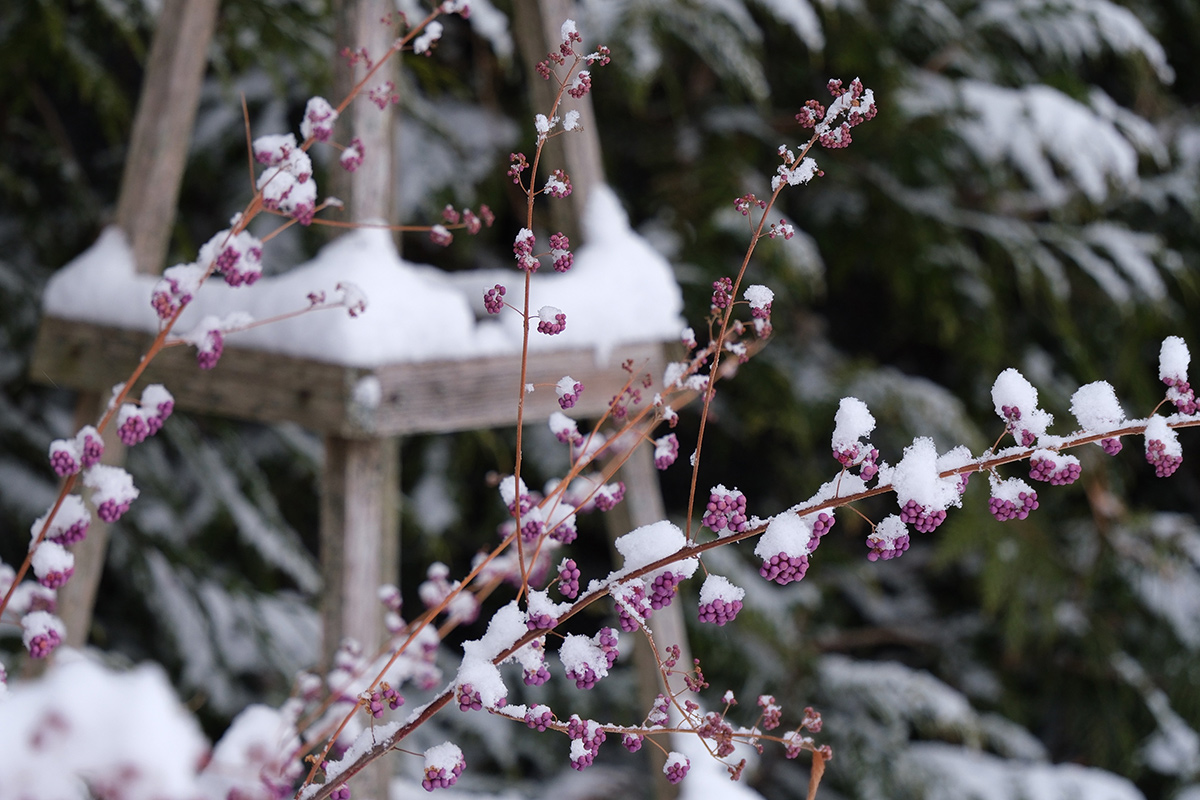
plant with light purple berries covered in snowCarol has made many superb plant selections for an exciting winter garden. ‘Early Amethyst’ beautyberry (Callicarpa dichotoma ‘Early Amethyst’, Zone 5–8) is just wrapping up it’s yearly performance with these gorgeous clusters of pretty purple fruit, which were preceded by lush, verdant foliage and small, pink to lavender flowers.

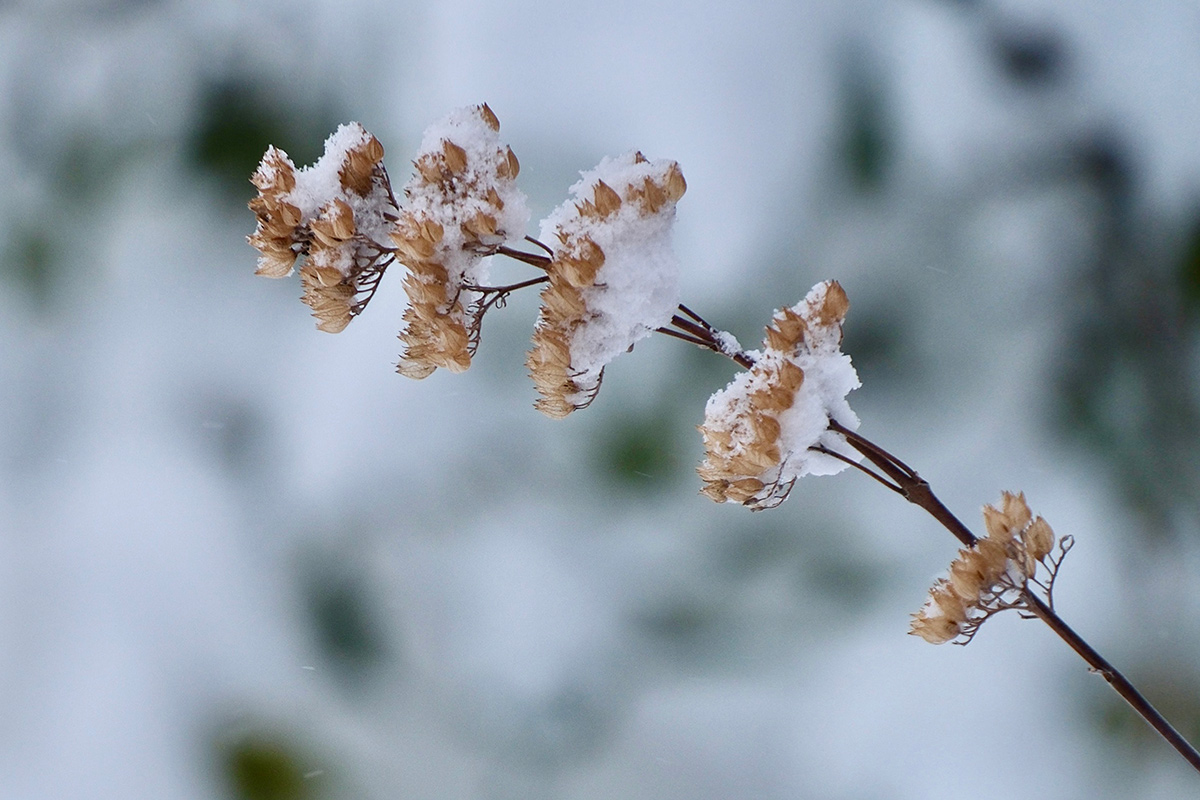
seed head covered in snowOther plants in Carol’s garden, like this bluebeard (Caryopteris x clandonensis, Zone 6–9), provide interest through plant structures that have already faded. These seed heads don’t add exciting color, but are the clusters provide interesting shapes and perfect perches for clumps of snow to cling on to.

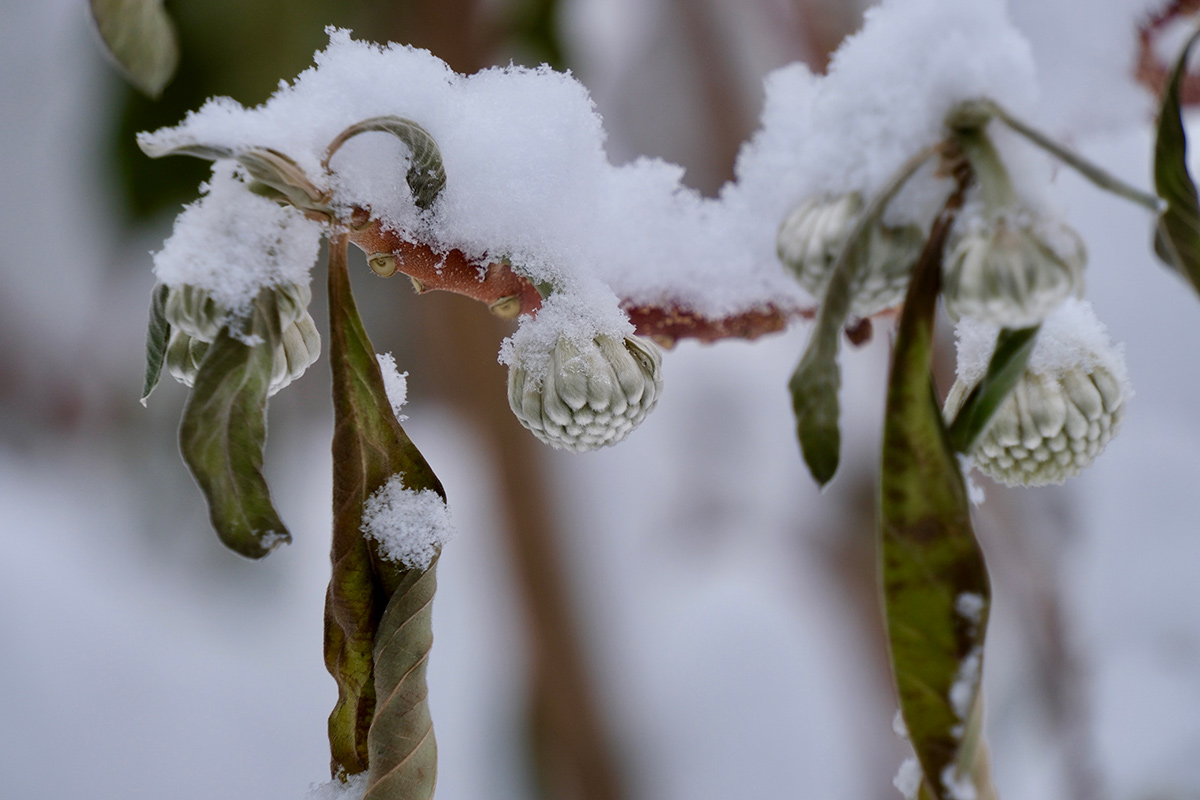
plant with flower buds covered in snowOther plants, like paperbush (Edgeworthia chrysantha, Zone 7–10), are excellent choices for the new growth they get at the end of the season. These buds won’t open until very late winter to early spring, but their silvery-green color are still an interesting addition to a winter landscape.

old flower bloom covered in snowAnother plant Carol enjoys for interesting seed heads and dried blooms are hydrangeas. This lacecap hydrangea will give an even more convincing lace illusion as the snow begins to melt.

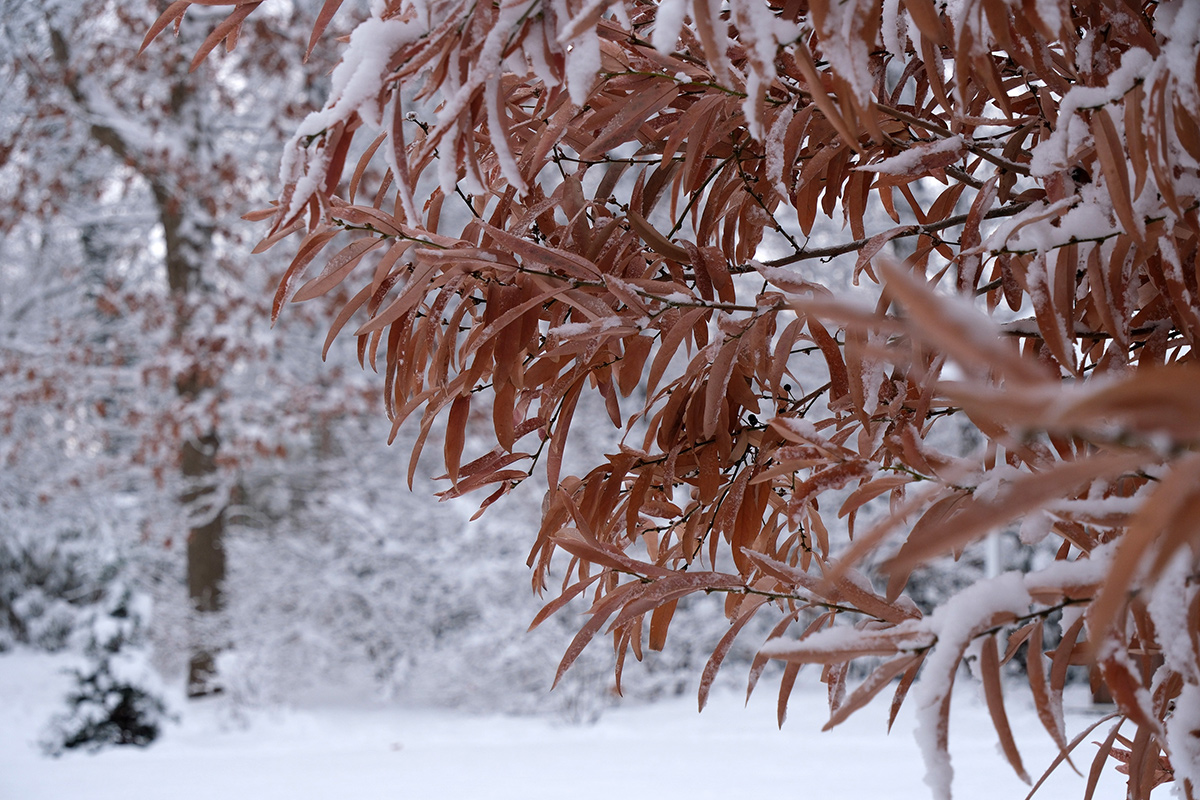
shrub with orange foliage in snowy gardenThe first snowfalls of the season can be the most interesting, and not only because we haven’t yet tired of clearing cars, driveways and sidewalks. Some deciduous trees and shrubs often still have faded foliage that give the snow more surfaces to coat. Carol’s oriental spicebush (Lindera angustifolia, Zone 6–8) was still covered in light orange leaves when this snow hit.

spiky foliage peeking out from snow coverCarol has demonstrated how deciduous plants can still provide interest through fading foliage and seed heads, but evergreens are synonymous with winter for a reason. Conifers are always classic, but there is a whole world of trees, shrubs, and even some perennials to explore. Carol’s leatherleaf mahonia (Mahonia bealei, Zone 7–9) is s standout selection and adds and extra pop of color with leaves tipped in a vibrant orange-red.

moon gate covered in snowCarol’s garden is instantly recognizable from her stunning stone moon gate. Serving as a kind of picture frame in the landscape, many moments of magic have been captured through and around this garden portal. In this season the gate is showcasing the fallen tree that Carol mentioned in her intro.

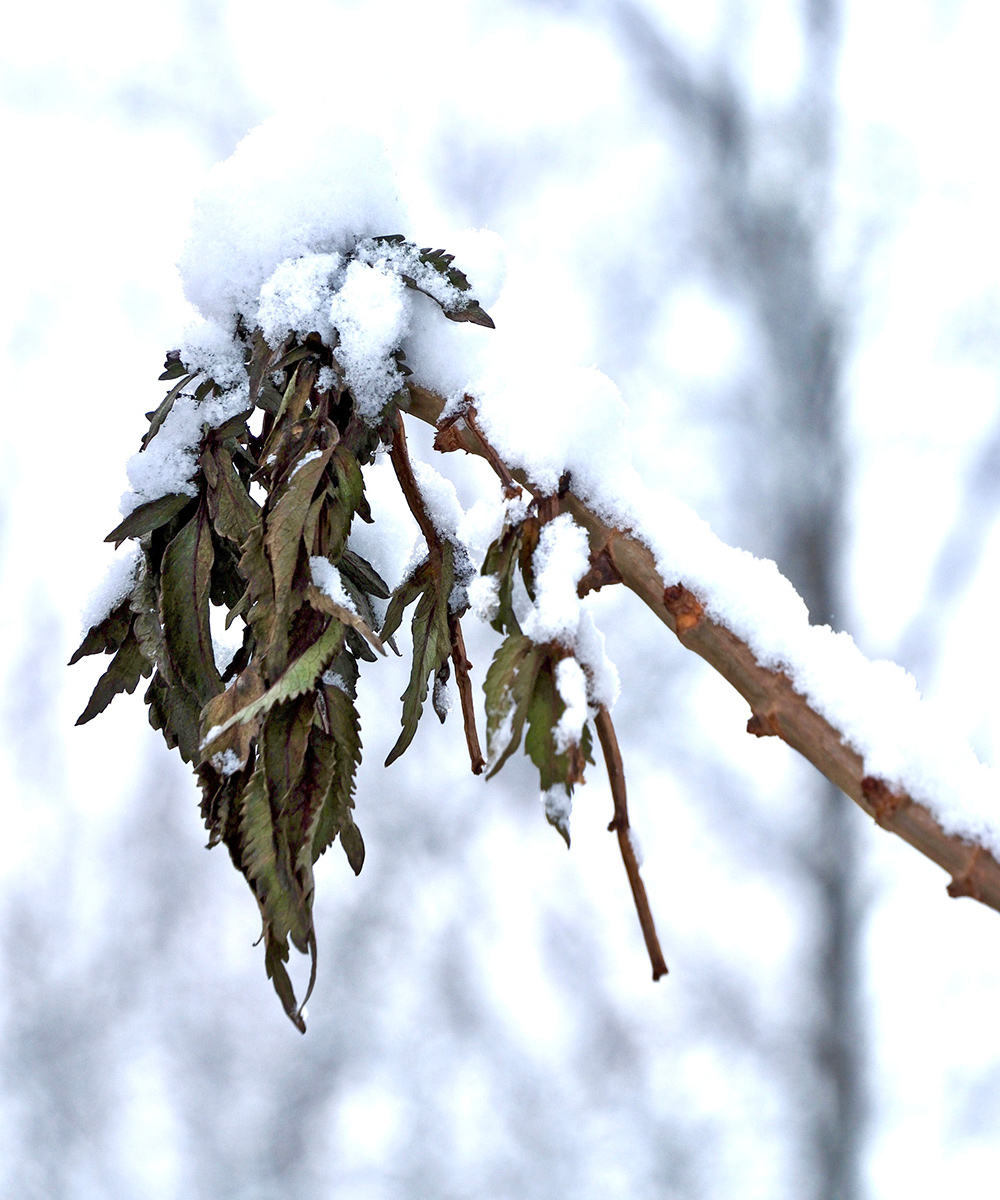
drooping leaves on branch covered in snowWinter is also an time to take appreciation of some of the darker themes of life, like decay and death. The last leaves of a ‘Black Tower’ elderberry (Sambucus nigra ‘EIFFEL 1’, Zone 4–8) are sure to fall after this snowstorm, but they held on long enough to provide one last moment of interest and intrigue.

branch with red berries in snowBerries are always a wonderful addition to winter gardens for their bright color as well as the sustenance they provide birds during this unforgiving time of year. The vibrant red berries of ‘Winter Red’ winterberry (Ilex verticillata ‘Winter Red’, Zone 3–9) are extra radiant against a snowy white backdrop.

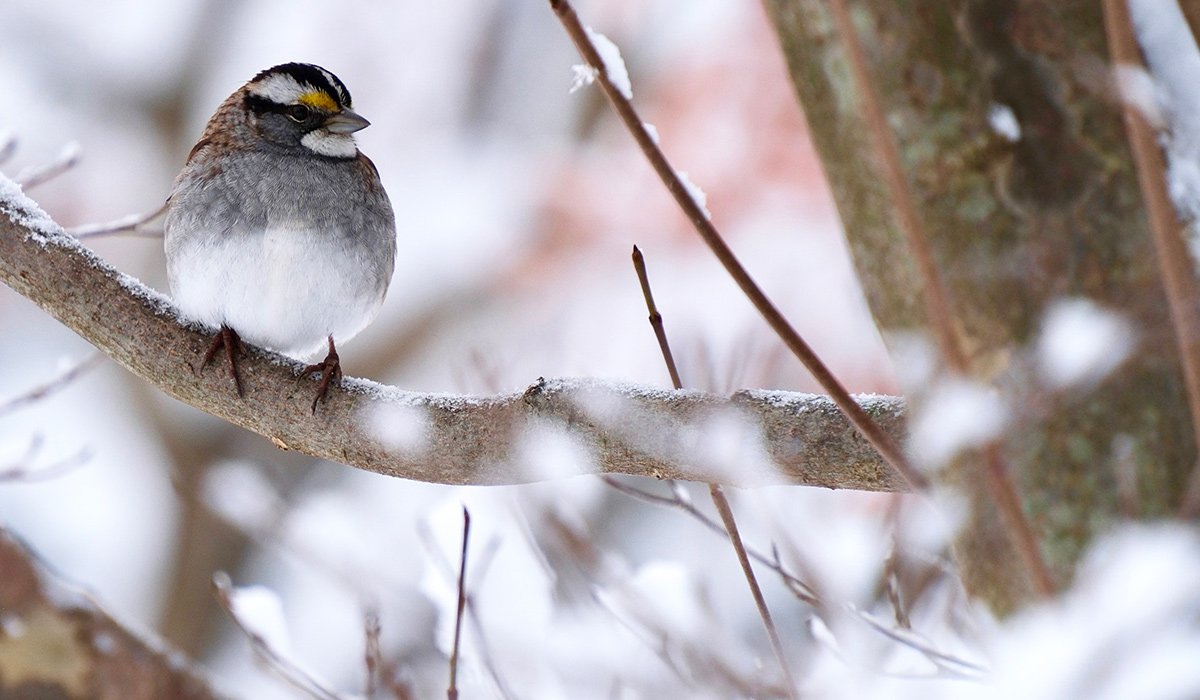
sparrow in a snowy gardenWith berries, seed heads, and plenty of places for shelter, it’s no surprise that birds make visits to Carol’s garden in winter. This white-throated sparrow (Zonotrichia albicollis) looks well-fed for the cold months ahead.

Thank you so much for another incredible collection of photos, Carol! Your winter submissions are incredible sources of inspiration and fantastic reminders that beauty is abundant in every season.

From fresh snow scenes to those rare winter blooms, please consider sharing photos of your winter garden with the blog. Follow the NEW directions below to submit your photos to Garden Photo of the Day!


We want to see YOUR garden!

Have photos to share? We’d love to see your garden, a particular collection of plants you love, or a wonderful garden you had the chance to visit!

To submit, fill out the Garden Photo of the Day Submission Form.

You can also send 5–10 photos to [email protected] along with some information about the plants in the pictures and where you took the photos. We’d love to hear where you are located, how long you’ve been gardening, successes you are proud of, failures you learned from, hopes for the future, favorite plants, or funny stories from your garden.

Do you receive the GPOD by email yet? Sign up here

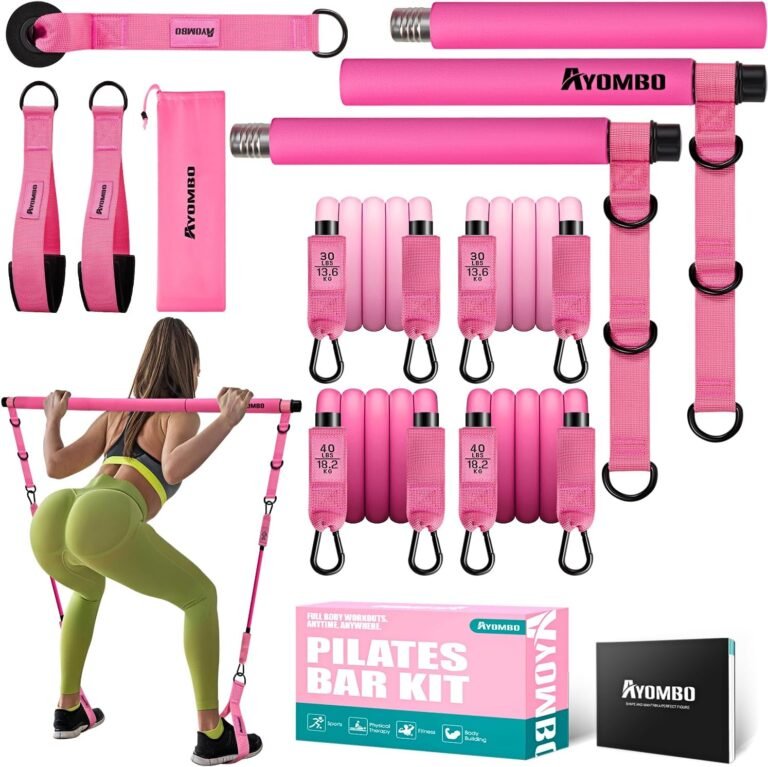
Pilates Bar Kit with Resistance Bands, Pilates Workout Equipment for Legs, Hip, Waist, Arm, Squats Exercise Equipment for Home Workouts, Adjustable 3-Section Pilates Bar Kit for Women & Men

0


Price: $39.97 - $26.97
(as of Dec 26, 2025 16:42:06 UTC – Details)

From the brand

AYOMBO Pilates Bar Equipment

Making it easy to tailor workouts to specific goals.

Ayombo brand places great emphasis on the development and design of fitness equipment, dedicated to helping everyone build a healthy and strong body, shaping the perfect S-curve. Ayombo Home Gym Equipment,whether you are a beginner or a professional athlete, is suitable for men and women of all ages, and can be used for Sports anywhere, anytime, to exercise the body and enhance physical fitness.

Enjoyable Pilates Exercise

Healthy and Happy Every Day

Professional Service

Answer your questions online at any time

Best Gift Choice

Bring happiness to the people you love most

Pilates Exercise is Everywhere: Do you want to have a perfect hip? Do you want to have an enviable and impressive figure? This professional pilates bar kit with resistance bands allows you to achieve twice the result with half the effort, it can offer more targeted and challenging squat training approaches. you can just toss it in the storage bag and take it everywhere. It is not just a glute workout equipment, but also a silent companion for pursuing a healthy lifestyle
Multifunctional Pilates Equipment:With the resistance bands and Pilates bar, it offers a full body workout that can be customized to suit individual fitness levels and preferences. And this glute workout equipment can work together with home gym fitness equipment such as exercise bands, pilates ball, pilates reformer, pilates mat, pilates ring, hip training machine and physical therapy equipment to achieve excellent squat workout results
Adjustable Resistance Bands Workout Equipment:Our multifunctional pilates bar comes with adjustable resistance bands, allowing you to customize the length according to your height. You’ll receive a pair of 30lb and a pair of 40lb bands, giving you the flexibility to use them individually or combine them for up to 70lb of resistance. Whether focusing on exercise her Hip, Arms, back, abdomen, glute, etc, or improving flexibility and squat training, this glute workout equipment delivers help.
Softer and Safer:Our pilates bar sticks are wrapped in comfortable and non slip foam pads, providing a softer grip and preventing slipping caused by sweat. The screw in assembly method ensures safety by avoiding finger pinching accidents. Stay focused on your workout without any worries
Perfect Replacement for Traditional Exercise Equipment:Whether you’re someone who exercises regularly or someone who just wants to add a bit of exercise to your daily routine this pilates bar kit a great workout option. it’s very light and portable, Can perfectly replace bulky dumbbell sets, They have the same function as resistance bands, yoga sets, etc., and can perfectly replace large exercise equipment such as rowing machines, pulley systems, squat rack and squat machine for women
No Bands Twine and Heavyweight:Our pilates bar kit features 360° rotating metal lugs on both sides, ensuring smooth movement and eliminating the hassle of tangled resistance bands. The solid iron connectors are welded with the pilates stretch bar, guaranteeing durability and long-lasting performance
Home gym for Whole Family:Our pilates bar is designed to be easily assembled and disassembled, making it convenient for trainers of all ages. It can be used in 2 or 3 sections, offering a wide range of exercise possibilities. This versatile glute workout equipment is perfect for the whole family to enjoy
Portable and Space Saving:Our pilates stretch fusion bar is detachable and compact, making it incredibly portable and space-saving. It can be easily stored and carried wherever you go. With this pilates bar kit with resistance bands, you have the convenience of a mobile gym that can be used anytime, anywhere. Embrace the fitness journey and achieve the body you desire

Fitness Trackers,Smart Band 24/7 Health Monitoring,Blood Oxygen Heart Rate Sleep Monitor,Calorie Pedometer Steps Counter Activity watchs/Notifications for iOS/Android

0


Price: $34.99 - $5.99
(as of Dec 26, 2025 04:41:13 UTC – Details)

From the brand

USMECBL SMART WATCHUSMECBL SMART WATCH

About us

Elevate your daily routine with Our Smart Band, your ultimate companion for fitness, health, and connectivity. Designed for modern life, it empowers you to track your wellness, stay motivated, and never miss a beat.

officeoffice

SportsSports

YogaYoga

【10-14 Day Long Battery Life – Wear It Day and Night】Forget daily charging anxiety. A single, full charge powers up to 7 days of continuous use. Monitor your sleep seamlessly every night and enjoy worry-free weekends or travel without carrying a charger. Running watch Regular use up to 10-14 days, standby for 30 days.
【24/7 Accurate Health Monitoring】Keep a close eye on your well-being with all-day automatic heart rate tracking, detailed sleep stage analysis (deep, light, awake), blood oxygen (SpO2) saturation monitoring. Gain valuable insights into your body’s patterns and make informed decisions about your health.When the fitness tracker app is disabled, it means that the fitness tracker and the phone have lost their connection, and the app cannot update the latest data.
【25 Sports Modes & Smart Activity Tracking】Track virtually any activity with 25 built-in modes (Cycling, tennis, football, baseball, cricket, rugby, dancing, sit-ups, gymnastics, rowing, jumping jacks, hockey, etc). It automatically records your steps, distance, and calories burned. The built-in stopwatch helps you time your workouts precisely, helping you crush your fitness goals.
【 Universal Compatibility & Stable Connection】Works seamlessly with both iOS and Android smartphones. Receive call, text, and app notifications (SNS) reliably on your wrist. The Bluetooth connection is stable, so you stay connected without constantly re-pairing.
【 Smarter Daily Life Management】More than a tracker, it’s your personal assistant. Control your phone’s music, check the weather forecast, find your phone with a tap, and use the “Shake-to-Take” feature to remotely control your phone’s camera. Customize alerts to avoid notification overload.
【Comfortable, Lightweight & IP68 Waterproof】Crafted for all-day comfort. The lightweight, skin-friendly band feels like a natural part of you, even while sleeping. With an IP68 rating, it’s resistant to rain, sweat.

Millions of soon-to-be uninsured Americans are looking for a ‘plan B’ : Shots

0

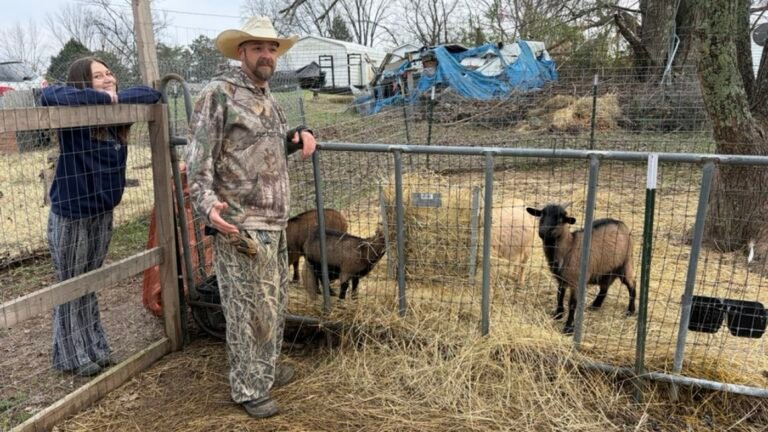
Robert and Emily Sory are starting an animal sanctuary at their home in Thompson Station, Tenn. In 2026, they plan to be uninsured. They’re looking for ways to pay for their care without coverage.

Blake Farmer
/WPLN News


hide caption

toggle caption

Blake Farmer
/WPLN News

It’s feeding time for the animals on this property outside Nashville. An albino raccoon named Cricket reaches through the wires of its cage to grab an animal cracker — an appetizer treat right before the evening meal.

“Cricket is blind,” said Robert Sory, who is trying to open a nonprofit animal sanctuary along with his wife Emily. “A lot of our animals come to us with issues.”

The menagerie in Thompson’s Station also includes Russian foxes, African porcupines, emus, bobcats and some well-fed goats.

The Sorys are passionate about their pets and seem to put the needs of the animals above their own.

Both Robert and Emily will start 2026 without health insurance.

Robert had been covered through a marketplace plan subsidized through the Affordable Care Act Marketplace. His share of the monthly premiums? Zero dollars.

Robert Sory feeds a blind racoon a treat before the evening meal.

Robert Sory feeds a blind racoon a treat before the evening meal.

Blake Farmer/WPLN


hide caption

toggle caption

Blake Farmer/WPLN

When he looked up the rates for 2026, he saw a barebones “Bronze” plan would cost him at least $70 a month. He’s decided to forgo coverage altogether.

“When you don’t have any income coming in, it doesn’t matter how cheap it is,” he said. “It’s not affordable.”

Dumping coverage

Marketplace plans from the Affordable Care Act no longer feel very affordable to many people, because Congress did not extend a package of enhanced subsidies that are expiring this month. An estimated 4.8 million are expected to go without coverage.

But even without a health plan, people will still need medical care. Many of them, like the Sorys, have been thinking through their “plan B” to maintain their health.

The Sorys both lost jobs in November, within days of each other. Robert worked as a farmhand. Emily worked at a staffing firm, and lost her insurance along with her position.

“It’s a horrible, horrible market right now. Really tough,” she said.

The first time she had to pay out of pocket for her three monthly prescriptions, it cost $184.

“To equate that to kind of how we think about it, you’re talking about 350 pounds of food for these animals,” Robert said. He pointed to his bobcats, who only eat meat.

Mapping out workarounds for the newly uninsured 

To keep kibble in the food bowls, the Sorys are prepping for an uninsured future. They both see the same psychiatrist, and met with him. He said he was willing to work with them by charging $125 per visit. They’ll have to go every three months to keep their prescriptions current.

And if other medical problems emerge? They’re hoping for the best.

“I’m not somebody who gets sick super often, thank god,” Robert said. “And if I do, generally I go to an emergency room where they’re going to bill me later and I can get on a [re-payment] plan.”

Emily Sory feeding grey foxes at their home in Thompson's Station, Tenn.

Emily Sory feeding grey foxes at their home in Thompson’s Station, Tenn.

Blake Farmer/WPLN


hide caption

toggle caption

Blake Farmer/WPLN

Emily has some costly health conditions and has already taken on some substantial medical debt.

“It’s just sitting there, and I’ve racked up money,” she said. “But I’ve had to go to the doctor.”

Donated drugs and sliding scales

Hospitals and clinics are bracing for the influx of newly uninsured patients. They’re also concerned that people won’t know about alternative ways to get some medical care.

“We don’t have marketing dollars, so you’re not going to see big billboards or radio ads,” said Katina Beard, CEO of Matthew Walker Comprehensive Health Center in Nashville, Tenn. It’s one of the country’s 1,400 Federally Qualified Health Centers (FQHCs).

FQHCs are partially funded by the federal government. Although they don’t usually offer free care, their fees tend to be lower or on a sliding scale.

“It’s likely they will receive a bill,” Beard said. “But the bill will be based on their ability to pay.”

Many FQHCs also have their own on-site pharmacies, and some offer prescription medications for free through a partnership with the Dispensary of Hope, a Nashville-based nonprofit.

Many hospital pharmacies also partner with the nonprofit, which has distributed medication donated by pharmaceutical companies to 277 sites in 38 states.

Robert Sory preparing to feed meat to a bobcat.

Robert Sory preparing to feed meat to a bobcat.

Blake Farmer/WPLN


hide caption

toggle caption

Blake Farmer/WPLN

The participating pharmacies must make the medicine available free of charge to people without insurance who have annual incomes under 300% of the federal poverty limit.

The organization primarily sources medications for chronic conditions such as high blood pressure, diabetes, and mental health. Demand is expected to outstrip supply in the new year, according to CEO Scott Cornwell.

“We’re projecting and engaging with our manufacturers and asking them, ‘Are you willing to help support for this future status that we are anticipating?'” he said. “By and large,” he said, pharmaceutical companies have said they’re willing to step up.

“Their strategy, their position, what their outlook looks like is always an at-play issue. So it’s a continuous conversation that we’re having,” Cornwell said.

Ten states still have Medicaid ‘gap’ 

Hospitals will also have to find a way to care for more patients who can’t pay. Industry groups like the Federation of American Hospitals have been vocal about the threat to hospitals’ financial health, and have urged Congress to extend the enhanced subsidies, which come in the form of tax credits.

The impact might be most acute in states like Tennessee that have not expanded Medicaid to cover people who are working — but don’t get job-based insurance, and can’t afford it on their own.

Ten states have chosen not to expand Medicaid to uninsured, low-income adults — an optional provision of the ACA that is mostly paid for by federal funds.

This Medicaid “gap” is expected to cause uninsured rates to jump by as much as 65% in Mississippi, and by 50% in South Carolina, according to the Urban Institute.

As Emily Sory pets one of her Russian foxes, she admits she is keenly aware that she will soon become part of this unfortunate — and growing — population. After all, her last job involved healthcare staffing. Her mother is a nurse.

“I understand the system. And I get it’s people like me that don’t pay their bill are why it suffers. And I feel bad,” she said. “But at the same time, I don’t have the money to pay it.”

This story comes from NPR’s health reporting partnership with Nashville Public Radio and KFF Health News.

How Cold Is Too Cold for Ducks?

0

Raising ducks through winter can feel intimidating at first—especially if you’re staring at frozen water bowls, icy mornings, and temperatures that make you want to stay indoors. Naturally, the big question most duck keepers ask is: how cold is too cold for ducks?

The good news is that ducks are far tougher than they look. Thanks to their unique physical adaptations, they’re built to handle cold weather far better than many other backyard birds. However, even hardy ducks have limits.

When temperatures dip too low for too long—especially without proper shelter, water, and nutrition—ducks can experience stress, frostbite, and health issues.

Understanding duck cold tolerance helps you know when to relax and when to step in. This guide walks you through temperature limits, breed differences, winter shelter needs, feeding adjustments, water management, and warning signs to watch for—so your flock stays safe, comfortable, and thriving all winter long.

Understanding Duck Cold Tolerance and Temperature Limits

Ducks are surprisingly resilient in cold weather, often outperforming chickens when temperatures drop. Fully feathered, healthy adult ducks can tolerate freezing conditions that would stress many other poultry species.

Scientific observations and real-life experience from backyard duck keepers show that adult ducks can handle temperatures as low as -15°F for short periods—and sometimes even colder—when they have proper shelter and care.

Some flocks have safely endured temperatures between -20°F and -30°F (-29°C to -34°C) with extreme wind chills, as long as wind, moisture, and frozen water were managed properly.

One reason ducks handle cold so well is their high internal body temperature, which averages around 107°F (42°C). This higher baseline helps them retain warmth even when surrounded by freezing air or icy ground.

That said, cold tolerance isn’t unlimited. Prolonged exposure to harsh conditions without shelter, dry bedding, and unfrozen water can overwhelm even the toughest ducks. Knowing where the line is helps you provide support before problems arise.

Critical Temperature Thresholds

For most backyard duck keepers, 20°F (-6°C) is an important benchmark.

Above this temperature, healthy adult ducks generally manage well on their own. Below it, they begin to rely more heavily on human support to stay comfortable and healthy. This doesn’t mean ducks immediately suffer at 19°F—but it does mean you should start paying closer attention.

Once temperatures consistently fall below 20°F, ducks need:

  • Draft-free shelter
  • Dry, insulated bedding
  • Reliable access to unfrozen water
  • Extra calories to maintain body heat

Ducklings are an entirely different story. Baby ducks lack the feather development needed to regulate body temperature and cannot survive cold weather without heat.

Ducklings require brooder temperatures starting around 90–95°F (32–35°C) during their first week, decreasing gradually as they grow feathers. Until fully feathered, they must be kept indoors with supplemental heat.

How Cold Is Too Cold for Ducks: Breed Variations and Individual Factors

While ducks as a group are cold-hardy, not all breeds are equal. Some handle winter effortlessly, while others need extra help when temperatures dip.

Cold-Hardy Duck Breeds

Most domestic ducks tolerate cold well, especially breeds descended from mallards. These ducks evolved to survive seasonal changes and freezing conditions.

Cold-hardy breeds include:

  • Rouen ducks, with their thick, heavy plumage
  • Khaki Campbells, known for both productivity and resilience
  • Blue Swedish ducks, which handle cold and damp weather well
  • Pekin ducks, which adapt well to winter when sheltered properly

On the other hand, Muscovy ducks are less cold-tolerant than most domestic breeds.

Originating from warmer climates, Muscovies can become uncomfortable in freezing temperatures and are more prone to frostbite on exposed skin. They require extra dry, windproof shelter and close monitoring in cold regions.

Individual Health and Condition

Breed matters—but individual health matters just as much.

A well-fed, healthy duck with a full feather coat and good body weight will handle cold far better than a thin or stressed bird. Ducks rely on fat reserves for insulation and energy during winter. If a duck enters winter underweight or malnourished, cold weather becomes much harder to tolerate.

Feather condition is another major factor. Ducks depend on clean, waterproof feathers to trap warmth. Dirty, damaged, or poorly maintained feathers allow moisture in, which leads to rapid heat loss—even in moderately cold temperatures.

Ducks that can’t preen properly or don’t have access to water for cleaning may struggle much sooner than healthy flockmates.

Physical Adaptations That Help Ducks Survive Cold

Ducks are equipped with some impressive biological tools that make winter survival possible.

Waterproof Feather System

A duck’s feather system works like a high-performance winter coat.

The outer feathers are coated in oil from the uropygial (preen) gland near the tail. Ducks spread this oil through preening, making their feathers waterproof. This outer layer prevents snow and icy water from soaking through.

Beneath that lies a thick layer of soft down feathers, which trap warm air close to the body. This insulating layer is incredibly efficient and allows ducks to retain heat even in freezing conditions.

For this system to work, ducks must:

  • Stay clean and dry
  • Have access to water for preening
  • Avoid prolonged exposure to damp conditions

Wet or matted feathers lose insulation fast, making moisture control critical in winter.

Counter-Current Heat Exchange System

One of the most fascinating adaptations ducks have is their counter-current heat exchange system.

Warm blood flowing from the duck’s core transfers heat to cooler blood returning from the feet. This minimizes heat loss and keeps the core warm while allowing feet to remain cool without freezing.

Duck feet also contain mostly tendons and bone, not muscle, which reduces heat demand. That’s why ducks can stand on ice or swim in icy water without immediate harm.

Still, duck feet are the most vulnerable part of their body. Standing on frozen, wet surfaces without dry bedding increases the risk of frostbite.

Winter Shelter Requirements for Ducks

Ducks don’t need heated coops—but they do need protection from wind and moisture.

Essential Shelter Features

A good winter duck shelter should be:

  • Draft-free, especially at ground level
  • Well-ventilated to release moisture
  • Dry and sturdy, with a solid roof
  • Large enough for ducks to move comfortably

Ventilation is especially important. Ducks produce a lot of moisture through breathing and droppings. Without airflow, condensation builds up, increasing frostbite risk even when temperatures aren’t extreme.

Bedding and Floor Management

Bedding is one of your most powerful winter tools.

Straw is the best bedding choice for ducks in cold weather. Its hollow stems trap warm air, creating natural insulation. Wood shavings can work but are best layered underneath straw.

Using the deep litter method—adding fresh layers over time instead of removing everything—helps generate warmth as bedding decomposes. This composting action creates gentle heat and keeps floors warmer.

Keep bedding:

  • Several inches deep
  • Dry and fluffy
  • Changed or topped up regularly

Wet bedding equals cold feet—and cold feet lead to frostbite.

Water Requirements in Freezing Temperatures

Water is one of the hardest winter challenges—and one of the most important.

Why Ducks Need Deep Water

Ducks don’t just drink water. They need water deep enough to:

  • Rinse their eyes
  • Clean their nostrils
  • Aid digestion

Without this, ducks are prone to eye infections and respiratory issues.

Preventing Water from Freezing

Options include:

  • Heated water bowls or bases (effective to around 10–12°F)
  • Black rubber tubs in tires to absorb solar heat
  • Swapping frozen waterers multiple times daily in extreme cold

In very cold climates, rotating waterers is often the most reliable solution—even though it requires more effort.

Nutritional Needs for Cold Weather

Cold weather dramatically increases calorie needs.

High-Energy Foods

Ducks burn more energy staying warm, so winter diets should include:

  • Cracked corn
  • Scratch grains
  • Whole grains
  • Peanuts (in moderation)

Feeding these in the evening helps ducks generate heat overnight through digestion.

Protein and Supplements

Protein supports feather health, which supports warmth.

Continue feeding a quality duck feed and supplement with:

  • Mealworms
  • Greens like kale or cabbage
  • Vitamin supplements if sunlight is limited

Healthy feathers equal better insulation.

Behavioral Adaptations and Management

Ducks naturally adjust their behavior in winter.

Natural Cold Weather Behaviors

Expect ducks to:

  • Be less active
  • Spend more time resting
  • Huddle together for warmth
  • Venture out mainly during warmer daylight hours

These behaviors are normal and healthy.

Monitoring for Cold Stress

Watch for warning signs like:

  • Swollen or discolored feet
  • Lethargy beyond normal winter rest
  • Reluctance to move even during warmer hours

Address problems early to prevent serious injury.

Conclusion

So, how cold is too cold for ducks? For most healthy adult ducks, temperatures below 20°F signal the need for extra care—but not panic.

With proper shelter, dry bedding, unfrozen water, and increased nutrition, ducks can safely handle far colder conditions than many people expect.

By understanding duck biology, recognizing breed differences, and providing thoughtful winter support, you’ll help your flock not just survive—but thrive—through the coldest months of the year

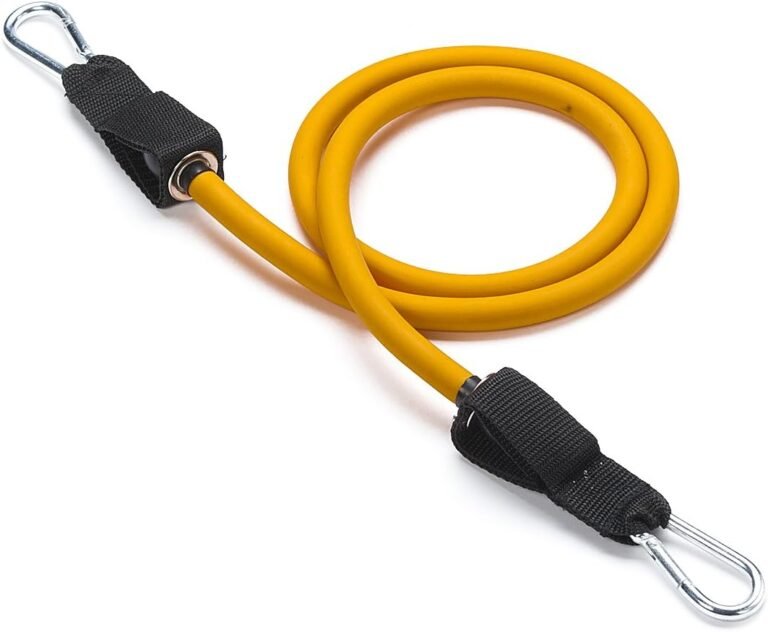
Black Mountain Products Single Stackable Resistance Band

0


Price: $12.49
(as of Dec 25, 2025 16:40:40 UTC – Details)


Black Mountain Products single resistance bands are made out of the highest quality rubber to ensure maximum life and are 99 percent latex free! These bands are ideal for physical therapy, exercise, weight loss, Pilates, muscle toning, muscle strengthening, stretching, rehabilitation and general health and fitness. B.M.P. resistance bands are great for home use, gym use, offices and are ideal for travel. B.M.P. single resistance bands are a great alternative to conventional weights and exercise equipment. All Black Mountain Products Resistance bands come with a manufactures warranty.
Polyester Blend
Made in the USA or Imported
Black Mountain Products single resistance band
Stackable resistance bands with carabineer clips (handles not included)
Yellow 2-4lbs, blue 4-6lbs, green 10-12lbs, black 15-20lbs, Red 25-30lbs, orange 30-35lbs, purple 45-50lbs, atomic 70-75lbs
Great for gym, home, travel and office Use
Comes with manufacturer Warranty

Systemic failures turn state mental hospitals into prisons : Shots

0

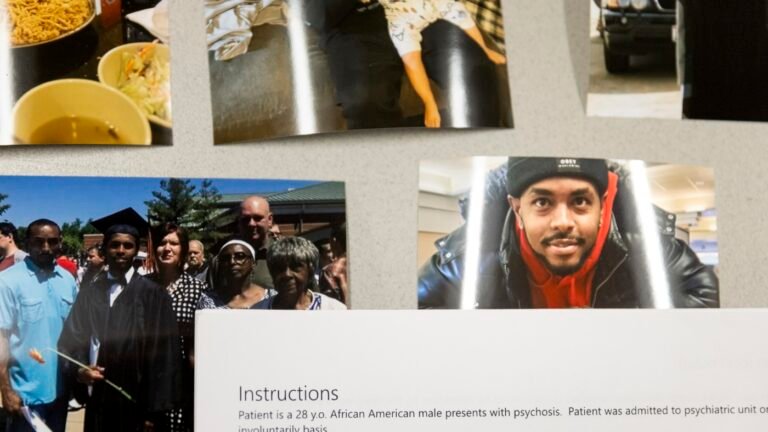
Family photos and hospital records of Quincy Jackson III, gathered by his mother, Tyeesha Ferguson. The mental health system makes it “easier to criminalize somebody than to get them help,” she says. “He’s not a throwaway child.”

Meg Vogel for The Marshall Project and KFF Health News


hide caption

toggle caption

Meg Vogel for The Marshall Project and KFF Health News

SPRINGFIELD, Ohio — Tyeesha Ferguson fears her 28-year-old son will kill or be killed.

“That’s what I’m trying to avoid,” said Ferguson, who still calls Quincy Jackson III her baby. She remembers a boy who dressed himself in three-piece suits, donated his allowance, and graduated high school at 16 with an academic scholarship and plans to join the military or start a business.

Instead, Ferguson watched as her once bright-eyed, handsome son sank into disheveled psychosis, bouncing between family members’ homes, homeless shelters, jails, clinics, emergency rooms and Ohio’s regional psychiatric hospitals.

Over the past year, The Marshall Project — Cleveland and KFF Health News interviewed Jackson, other patients and families, current and former state hospital employees, advocates, lawyers, judges, jail administrators, and national behavioral health experts. All echoed Ferguson, who said the mental health system makes it “easier to criminalize somebody than to get them help.”

A portrait of Tyeesha Ferguson. She has a resolute look on her face and she is wearing a yellow t-shirt that says "Ferguson Family Reunion."

Tyeesha Ferguson has been trying to get mental health care for her son, Quincy Jackson III, for most of his adult life. He has cycled in and out of hospitals and jails for about a decade.

Meg Vogel for The Marshall Project and KFF Health News


hide caption

toggle caption

Meg Vogel for The Marshall Project and KFF Health News

State psychiatric hospitals nationwide have largely lost the ability to treat patients before their mental health deteriorates and they are charged with crimes. Driving the problem is a meteoric rise in the share of patients with criminal cases who stay significantly longer, generally by court order.

Patients wait or are turned away

Across the nation, psychiatric hospitals are short-staffed and consistently turn away patients or leave them waiting with few or no treatment options. Those who do receive beds are often sent there by court order after serious criminal offenses.

In Ohio, the share of state hospital patients with criminal charges jumped from about half in 2002 to around 90% today.

The surge has coincided with a steep decline in total state psychiatric hospital patients served, down 50% in Ohio in the past decade, from 6,809 to 3,421, according to the U.S. Substance Abuse and Mental Health Services Administration. During that time, total patients served nationwide dropped about 17%, from 139,434 to 116,320, with state approaches varying widely, from adding community services and building more beds to closing hospitals.

Ohio Department of Behavioral Health officials declined multiple interview requests for this article.

The decline in capacity at state facilities unfurled as a spate of local hospitals across the country shuttered their psychiatric units, which disproportionately serve patients with Medicaid or who are uninsured. And the financial stability of local hospital mental health services is likely to deteriorate further after Congress passed President Donald Trump’s One Big Beautiful Bill Act, which slashes nearly $1 trillion from the federal Medicaid budget over the next decade.

The constricted flow of new patients through state hospitals is “absolutely” a crisis and “a huge deal in Ohio and everywhere,” said retired Ohio Supreme Court Justice Evelyn Lundberg Stratton. As co-chair of the state attorney general’s Task Force on Criminal Justice and Mental Illness, Lundberg Stratton has spent decades searching for solutions.

“It hurts everybody who has someone who needs to get a hospital bed that’s not in the criminal justice system,” she said.

“I’m sick; I take medication”

Quincy Jackson III’s white socks stuck out of the end of a hospital bed as police officers stood watch.

At 5-foot-7-inches, Jackson has a stocky build and robotic stare. Staff at Blanchard Valley Hospital in Findlay, Ohio, had called for help, alleging Jackson had assaulted a security guard.

“I’m sick; I take medication,” Jackson said to the officers, according to law enforcement body camera footage. His hands were cuffed behind his back as he lay on the bed, a loose hospital gown covering him.

Ferguson called it one of his “episodes” and said her son experienced severe psychosis frequently. In one incident, she said, Jackson “went for a knife” at her home.

From December 2023 through July 2025, Jackson was arrested or cited in police reports on at least 17 occasions. He was jailed at least five times and treated more than 10 times at hospitals, including three state-run psychiatric facilities.

A recent psychiatric evaluation noted that Jackson has been in and out of community and state facilities since 2015.

Jackson is among a glut of people nationwide with severe mental illness who overwhelm community hospitals, courtrooms, and jails, eventually leading to backlogs at state hospitals.

High-profile incidents

That dearth of care is often cited by families, law enforcement authorities, and mental health advocates after people struggling with severe mental illness harm others. In the past six months, at least four incidents made national headlines.

In August, a homeless North Carolina man reportedly diagnosed with schizophrenia fatally stabbed a woman on a train. Also in August, police said a Texas gunman with a history of mental health issues killed three people, including a child, at a Target store. In July, a homeless Michigan man who family members said had needed treatment for decades attacked 11 people at a Walmart store with a knife. In June, police shot and killed a Florida man reportedly diagnosed with schizophrenia after authorities said he attacked law enforcement.

Mark Mihok, a longtime municipal judge near Cleveland, told a spring gathering of judges and lawyers he had never seen so many people with serious mental illnesses living on the streets and “now punted into the criminal justice system.”

37-day wait for a bed

At Blanchard Valley Hospital, sheriff’s deputies had taken Jackson from jail for a mental health check. But Jackson’s actions raised concerns.

In the body camera video, a nurse said Jackson was “going to be here all weekend. And we’re going to be calling you guys every 10 minutes.”

The officer responded: “Yeah, well, if he keeps acting like that, he’s going to go right back” to the county jail.

Within minutes, Jackson was taken back to jail, yelling at the officers: “Kill me, motherf—–. Yeah, shoot them, shoot them. Pop!”

Statewide, Ohio has about 1,100 beds in its six regional psychiatric hospitals. In May, the median wait time to get a state bed was 37 days.

That’s “a long time to be waiting in jail for a bed without meaningful access to mental health treatment,” said Shanti Silver, a senior research adviser at the national nonprofit Treatment Advocacy Center.

Long waits, often leaving people who need care lingering in jails, have drawn lawsuits in several states, including Kansas, Pennsylvania, and Washington, where a large 2014 class action case forced systemic changes such as expanding crisis intervention training and residential treatment beds.

Ohio officials noticed bed shortages as early as 2018. State leaders assembled task forces and expanded treatment in jails. They launched community programs, crisis units, and a statewide emergency hotline.

Yet backlogs at the Ohio hospitals mounted.
Ohio Department of Behavioral Health Director LeeAnne Cornyn, who left the agency in October, wrote in a May emailed statement that the agency “works diligently to ensure a therapeutic environment for our patients, while also protecting patient, staff, and public safety.”

“It’s heartbreaking”

Eric Wandersleben, director of media relations and outreach for the department, declined to respond to detailed questions submitted before publication and, instead, noted that responses could be publicly found in a governor’s working group report released in late 2024.

Elizabeth Tady, a hospital liaison who also spoke to judges and lawyers at the May gathering, said 45 patients were waiting for beds at Northcoast Behavioral Healthcare, the state psychiatric hospital serving the Cleveland region.

“It’s heartbreaking for me and for all of us to know that there are things that need to be done to help the criminal justice system, to help our communities, but we’re stuck,” she said.

Ohio officials added 30 state psychiatric beds by replacing a hospital in Columbus and are planning a new 200-bed hospital in southwestern Ohio.

Still, Ohio Director of Forensic Services Lisa Gordish told the gathering in Cleveland that adding capacity alone won’t work.

“If you build beds — and what we’ve seen in other states is that’s what they’ve done — those beds get filled up, and we continue to have a waitlist,” she said.

Heartland Behavioral Healthcare in Massillon, Ohio, is a medium sized building made of beige and brown bricks. It sits on a wide green lawn.

Heartland Behavioral Healthcare in Massillon, Ohio, is one of the state’s psychiatric hospitals.

Meg Vogel for The Marshall Project and KFF Health News


hide caption

toggle caption

Meg Vogel for The Marshall Project and KFF Health News

This year, Jackson waited 100 days in the overcrowded and deadly Montgomery County jail for a bed at a state hospital, according to jail records.

Ferguson said she was afraid to leave him there but could not bail him out, in part, she said, because her son cannot survive on his own.

“There’s no place for my son to experience symptoms in the state of Ohio safely,” Ferguson said.

Sick system

Patrick Heltzel got the extended treatment Ferguson has long sought for her son, but he stabbed a 71-year-old man to death before getting it.

The 32-year-old is one of more than 1,000 patients receiving treatment in Ohio’s psychiatric hospitals.

“People need long-term care,” Heltzel said in October, calling from inside Heartland Behavioral Healthcare, near Canton, where he has lived for more than a decade after being found not guilty by reason of insanity of aggravated murder. Inpatient care, he said, helps patients figure out what medication regimen will work and deliver the therapy needed “to develop insight.”

As he spoke, the sound of an open room and patients chatting filled the background.

“You have to know, ‘OK, I have this chronic condition, and this is what I have to do to treat it,'” Heltzel said.

Patrick Heltzel is shown in the backseat of a car, cuddling a black dog.

Patrick Heltzel with his dog, Violet, during a family visit in October 2023. (Jan Dyer)

Jan Dyer


hide caption

toggle caption

Jan Dyer

As the ranks of criminally charged patients in Ohio’s hospitals have increased over the past decade, the shift has had an impact on patient care: The hospitals have endangered patients, have become more restrictive, and are understaffed, according to interviews with Heltzel, other patients, and former staff members, as well as documents obtained through public records requests.

Escapes and a lockdown

Katie Jenkins, executive director of the National Alliance on Mental Illness Greater Cleveland, said the shift from mostly civil patients, who haven’t been charged with a crime, to criminally charged patients has changed the hospitals.

“It’s hard in our state hospitals right now,” she said. Unfortunately, she said, patients who have been in jail bring that culture to the hospitals.

In the first 10 months of 2024, at least nine patients escaped from Ohio’s regional psychiatric hospitals — compared with three total in the previous four years, according to state highway patrol reports.

In one instance, two female patients at Summit Behavioral Healthcare near Cincinnati escaped after one lunged at a staff member. In another, a man broke a window and climbed out. Most of the escapes, though, were not violent.

Days after a patient at Northcoast jogged away during a trip to the dentist in a Cleveland suburb, state officials stopped allowing patients to leave any of the six regional hospitals.

A memo to leaders at the hospitals said officials had seen “similarities across multiple facilities,” raising significant concern about “ensuring patient and public safety.”

For Heltzel, the inability to go on outings or to his mother’s house on the weekends was a setback for his treatment. In 2024, when the lockdown began, he had more freedom than most patients at the psychiatric hospitals, regularly leaving to go to the local gym and attend off-site group therapy.

His mother signed him out each Friday to go home for the weekend, where he drove a car and played with his 2-year-old German shepherd, Violet. On Sundays, Heltzel was part of the “dream team” at church, volunteering to operate the audio and slides.

Federal records reveal that, at Ohio’s larger state-run psychiatric hospitals, including Summit and Northcoast, patients and staff have faced imminent danger.

In 2019 and 2020, federal investigators responded to patient deaths, including two suicides in six months at Northcoast. One hospital employee told federal inspectors, “The facility has been understaffed for a while and it’s getting worse,” according to the federal report. “It is very dangerous out here.”

Disability Rights Ohio, which has a federal mandate to monitor the facilities, filed a lawsuit in October against the department. The advocacy group, alleging abuse and neglect, asked for records of staff’s response to a Northcoast patient who suffocated from a plastic bag over their head. At the end of October, the court docket showed the parties had settled the case.

Retired sheriff’s deputy Louella Reynolds worked as a police officer at Northcoast for about five years before leaving in 2022. She said the increase in criminally charged patients meant the hospitals “absolutely” became less safe. Her hip still hurts from a patient who threw her against a cement wall.

Reynolds said officers should be able to carry weapons, which they don’t, and that more staff are needed to handle the patients. Mandatory overtime was common, she said, and often staff would report to work and not “know when we would get off.”

A disaster that wasn’t averted

Back at Heartland, Heltzel requested conditional release. The judge denied the release request.
Heltzel said it was devastating. He grew up Catholic and said, “I was kind of looking for absolution.”

Now, Heltzel said he is practicing acceptance. “Acceptance is all the more important to practice when you don’t agree with something,” Heltzel said, adding, “I’m a ward of the state.”

He still hopes to be released: “I just do what I can to move forward.”

Heltzel, like Jackson, had been hospitalized before and released. In early 2013, Heltzel said, he asked his dad to kill him.

“And he refused and I did smack him,” he said.

Heltzel was sent to Heartland for a short stay — about 10 days, according to his mother, Jan Dyer. She recalled “begging” the hospital staff to keep him.

Heltzel said he remembers not being ready to leave: “I was still sick, and I was still delusional.”

Back at home, he said, he had a “sense of existential dread, like that all this horrible stuff was going to happen.” He stopped taking his medication.

Within weeks, Heltzel killed 71-year-old Milton A. Grumbling III at his home, placing him in a chokehold and stabbing him repeatedly, according to court records. He beat him with a remote control and then left, taking a Bible from the home, as well as a ring. Delusional with schizophrenia, Heltzel believed that Grumbling had sexually abused him in another life, according to the records.

A family member of the man he killed told the judge in 2023 that Heltzel should “stay in prison,” according to court records.

In denying his conditional release, judges cited Heltzel’s failure to take medication before killing Grumbling.

Jenkins, who said she worked at a state hospital for nine years before becoming the lead advocate for NAMI Greater Cleveland, said psychiatric medications can take as long as six weeks to become fully effective.

“So clients aren’t even getting stabilized when they’re being hospitalized,” Jenkins said.

‘He’s not a throwaway child’

In a July interview, Jackson said inconsistent care or unmedicated time in jail “worsens my symptoms.” Jackson was on the phone during a stay at a state psychiatric hospital.

Tyeesha Ferguson sits at a table and wears reading glasses as she looks through various paperwork relating to her son, Quincy Jackson III.

Tyeesha Ferguson looks through police reports, court files, and hospital records for her son, Quincy Jackson III.

Meg Vogel for The Marshall Project/KFF Health News)


hide caption

toggle caption

Meg Vogel for The Marshall Project/KFF Health News)

Without medicine, “my head hurts, to be honest,” Jackson said, before asking to get off the phone because he was hungry. It was lunchtime. “Can you get the information from my mom?” Jackson said. “She has the records.”

After Jackson hung up the phone, Ferguson explained that “he says the food is excellent, so he does not want to miss it.” And, she added, the hospital staff had not yet seen the explosive side of her son.

In early September, after 45 days at Summit — his longest stay yet at a state psychiatric hospital — Jackson returned to the Montgomery County jail facing misdemeanor charges because of an altercation in April with staff at a Dayton behavioral health hospital. In court, Ferguson said, her son struggled to explain to the judge why he was there. On a video call from the jail days later, she saw him playing with his hair and ears.

“That tells me he’s not OK,” Ferguson said.

Before Jackson’s diagnosis more than a decade ago, Ferguson said, her son wasn’t a troublemaker. He had goals and dreams. And he’s still “loved and liked by a lot of people.”

“He’s not a throwaway child,” she said.

KFF Health News is a national newsroom that produces in-depth journalism about health issues.

The Marshall Project – Cleveland is a nonprofit news team covering Ohio’s criminal justice systems.