91.1 F
Klamath Falls
Friday, July 31, 2026
Home Blog Page 102

How to Keep a Greenhouse Warm in Winter?

0

Maintaining optimal heat is the primary expense of having a greenhouse. During colder seasons, this becomes essential to extend the growing season and protect plants from frost.

Most vegetables, ornamentals, and seedlings prefer daytime temperatures of 65–75°F and nighttime temperatures of 55–65°F, although cold-hardy greens and overwintering plants can tolerate lower ranges.

Keeping a greenhouse warm doesn’t always mean running heaters nonstop.

A smart combination of insulation, passive solar design, thermal mass, and selective heating can dramatically reduce energy use while keeping plants healthy through even the coldest months.

Understanding Greenhouse Heat Loss

Before adding heat, it’s important to understand where heat escapes, because stopping heat loss is often cheaper and more effective than producing more heat.

  • Conduction occurs when heat moves directly through glazing materials, frames, and foundations into cold outside air. Single-layer plastic or glass loses heat fastest.
  • Infiltration happens when cold air sneaks in through cracks, gaps, doors, vents, and poorly sealed joints, forcing warm air out.
  • Convection causes warm air to rise and escape through roof vents while drawing cold air in near the base.
  • Radiation allows stored heat to radiate outward through greenhouse coverings at night, especially during clear, cold evenings.

Reducing these losses is the foundation of winter greenhouse success.

How to Keep a Greenhouse Warm in Winter?

Keeping a greenhouse warm in winter works best when you combine heat capture, heat storage, and heat conservation.

During the day, allow maximum sunlight to enter by opening shade cloths and keeping glazing clean.

At night, trap that heat with insulation materials such as bubble wrap, thermal blankets, or insulated curtains. Thermal mass—like water barrels, soil, brick, or stone—absorbs daytime heat and slowly releases it overnight, reducing sharp temperature drops.

Healthy soil also plays a role. Soils rich in organic matter and clay retain heat better, while deeper soil beds help stabilize root temperatures.

Also Read: 36 Vegetables You Can Plant in January for Spring Harvest

Insulation Strategies for Winter Warmth

Insulation is the most cost-effective way to maintain winter warmth without increasing heating bills.

  • Bubble wrap insulation is one of the most popular solutions. Horticultural-grade bubble wrap allows light penetration while trapping air for insulation. Double-bubble, foil-backed options last up to five years and reflect radiant heat back into the greenhouse.
  • Rigid insulation boards such as closed-cell polystyrene, polyurethane, or polyisocyanurate provide higher R-values (R-5 to R-8). These work best on north-facing walls or knee walls where light is less critical.
  • Thermal curtains or blankets create an insulating air layer at night and can raise nighttime temperatures by up to 15°F.
  • Sealing gaps and cracks with weatherstripping and caulk prevents cold drafts and stops warm air from leaking out.

Passive Solar Heating Techniques

Passive solar heating is one of the most powerful—and free—methods of winter greenhouse warming.

South-facing greenhouses capture the most winter sun, especially when glazing is clear and unobstructed.

Keep the area just inside the walls free of clutter so sunlight can reach floors, soil, and thermal mass materials. Reflective surfaces such as white-painted walls or aluminum panels help distribute sunlight deeper into the space.

When designed correctly, passive solar input often exceeds the greenhouse’s total energy demand, significantly reducing or even eliminating the need for active heating.

Thermal Mass for Heat Storage

Thermal mass acts like a natural battery, storing heat during the day and releasing it slowly at night.

  • Water barrels are the most efficient option. Place black-painted barrels along the north wall or in corners for maximum absorption.
  • Even small water jugs help in tight spaces.
  • Brick, stone, and concrete paths add both visual appeal and thermal stability.
  • Extra bags of soil stored inside the greenhouse also contribute meaningful heat retention.

The more thermal mass you include, the more stable nighttime temperatures become.

Check this: How to Grow Potatoes in Winter?

Composting for Natural Heat Generation

Active compost piles generate surprising amounts of heat—often raising surrounding temperatures by 10–20°F.

Building a compost heap inside the greenhouse provides:

  • Continuous natural heat
  • Increased humidity
  • Added carbon dioxide that boosts plant growth

To maintain heat output, turn the compost regularly to introduce oxygen. Keep compost piles away from plastic walls to prevent heat damage. Straw or hay bale composting works especially well for low-tech, electricity-free heating.

Heating System Options

Electric Heating Solutions

Electric heaters are convenient and easy to install, making them ideal for small or hobby greenhouses.

  • Convection heaters work well for spot heating.
  • Radiant strip heaters provide gentle overhead warmth.
  • Forced-air wall heaters deliver fast, floor-level heat.

Electric heating is best used as supplemental or intermittent heat, as operating costs can rise quickly in colder climates.

Gas and Alternative Fuel Systems

Natural gas and propane heaters are common in larger greenhouses.

  • Natural gas unit heaters provide consistent, whole-space heating at relatively low operating costs.
  • Propane radiant tube heaters emit directional heat from overhead tubes.
  • Avoid open-flame heaters, which release ethylene gas that can damage flowers and buds.

These systems require proper ventilation and safety monitoring.

Hydronic Heating Systems

Hydronic heating circulates hot water through pipes laid under benches or along walls.

  • Provides even, gentle warmth
  • Excellent for root-zone heating
  • Higher upfront cost but very energy efficient long-term

Bench heating allows you to keep air temperatures slightly cooler while maintaining optimal soil warmth for seedlings and propagation.

Geothermal and Renewable Energy Options

Geothermal systems tap into stable underground temperatures and deliver reliable, efficient heat year-round. While installation costs are higher, they offer exceptional long-term savings.

Solar water heating systems circulate sun-warmed water through pipes or barrels, offering a renewable and low-maintenance heat source when paired with thermal mass.

Also Read: How to Overwinter a Boston Fern?

Budget-Friendly DIY Heating Methods

Terracotta Pot Heaters

Terracotta pot heaters use candles and clay pots to generate localized warmth.

  • Place candles on a heat-safe base
  • Stack nested terracotta pots above them
  • Trapped heat radiates slowly into surrounding air

These setups can raise nearby temperatures by 4–5°F, making them useful for frost-prone nights.

Livestock Heat

Chickens, rabbits, or other small animals produce body heat, humidity, and CO₂ that benefit plants. Even a few animals can raise greenhouse temperatures by several degrees, though proper ventilation and hygiene are essential.

Hotbeds and Underground Systems

Hotbeds use decomposing manure, straw, and compost buried beneath soil beds to generate bottom heat for months. These systems are excellent for early-season seed starting.

Walipini-style underground greenhouses take advantage of Earth’s natural insulation by being built into slopes, dramatically reducing winter heat loss.

Temperature Control Best Practices

Stable temperatures come from layered strategies, not a single solution.

  • Use thermostats to prevent overheating and cold stress
  • Monitor both daytime and nighttime temperatures
  • Choose twin-wall or double-layer polycarbonate glazing for better insulation
  • Combine insulation, thermal mass, passive solar gain, and backup heating

Redundancy ensures your plants stay protected even during extreme cold snaps.

1. How to Keep a Greenhouse Warm Without Electricity?

You can keep a greenhouse warm without electricity by relying on passive solar heat, insulation, and thermal mass. South-facing placement, sealed gaps, bubble wrap insulation, and thermal curtains help trap daytime heat.

Adding water barrels, stone paths, compost piles, and rich soil allows stored heat to release slowly at night. These methods work together to stabilize temperatures naturally, even during cold winter nights.

2. The Cheapest or Even Free Way to Heat a Greenhouse in Winter?

The cheapest way to heat a greenhouse is by maximizing free sunlight and preventing heat loss. Passive solar heating, paired with insulation and sealing air leaks, costs little to nothing once set up.

Free heat sources like compost piles, hotbeds, black water containers, and underground soil warmth provide steady, ongoing heat without fuel or electricity, making them ideal for budget gardeners.

3. Is There Any Small Greenhouse Heating System?

Yes, small greenhouses can be heated using compact electric heaters, radiant heat strips, or small propane heaters designed for enclosed spaces. These systems are easy to install and work well as backup heat.

For low-energy options, seedling heat mats, bench heating, and terracotta pot heaters offer targeted warmth where plants need it most, reducing overall heating costs.

4. What Is a Deep Winter Greenhouse?

A deep winter greenhouse is a highly insulated structure designed to grow plants through winter with little or no supplemental heating. It relies on passive solar gain, thick insulation, and large amounts of thermal mass.

These greenhouses are often built partially underground with south-facing glazing, allowing them to maintain above-freezing temperatures even in extreme cold while using minimal energy.

Conclusion

Keeping a greenhouse warm in winter doesn’t require expensive equipment or constant energy use.

By reducing heat loss, capturing solar energy, storing warmth, and using supplemental heating only when necessary, you can maintain a productive greenhouse all year long—while keeping costs under control and plants thriving through winter.

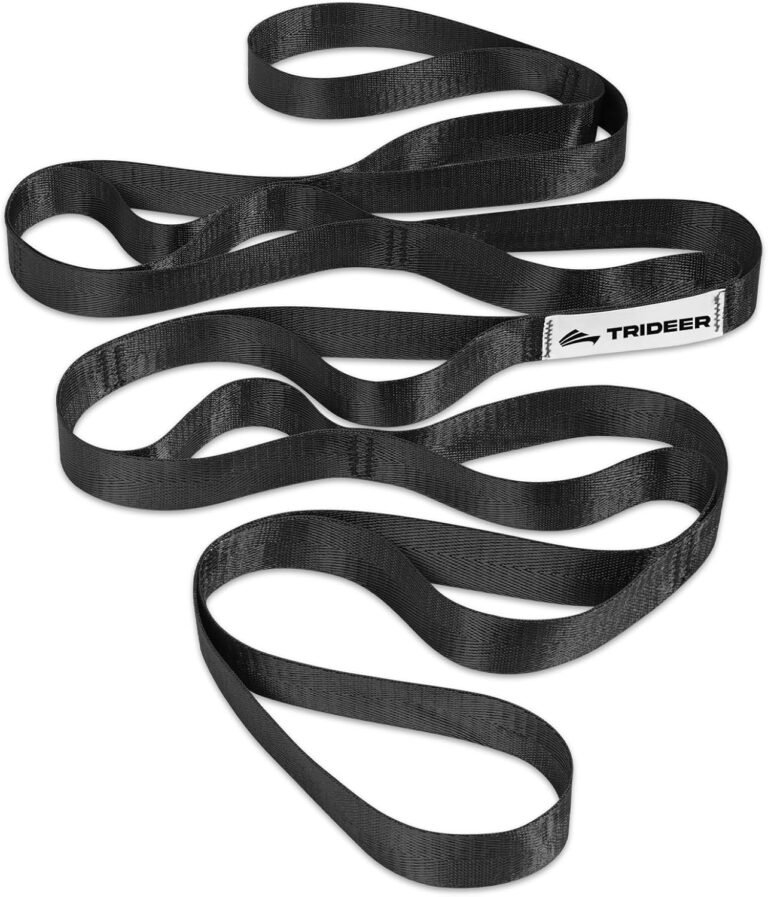
Trideer Stretching Strap Yoga Strap Physical Therapy for Home Workout, Exercise, Pilates and Gymnastics, 10 Loops Non-Elastic Stretch Bands with Aesthetic Packaging for Women & Men

0


Price: $5.99
(as of Dec 21, 2025 04:23:48 UTC – Details)

From the brand

stretching strapstretching strap

stretching strapstretching strap

stretching strapstretching strap

Release & Recover. Faster.

Release & Recover. Faster.

Stretching StrapStretching Strap

stretching strapstretching strap

stretching strapstretching strap

stretching strapstretching strap

Long Lasting Premium Quality: Made of sturdy polypropylene, this tough yoga strap stands out in a crowd by providing amazing stability for your safe practice; and the reinforced stitching makes it last for years to come

Versatile: This stretching strap is a perfect choice for a wide variety of types of exercise: pre workout warmup, post workout stretching, yoga, Pilates, and physical therapy
Multi-benefit Stretch Strap: Boosts flexibility, knee ROM, muscle recovery, injury prevention. Recommended by PTs. Eases joint pain, addresses shoulder & leg issues. Perfect yoga gear
Handy & Comfy Stretch Strap: 10-loop, non-stretch rope, 75″x1″. Ideal for beginners. Enhances stretching accessibility & progression, making exercises easy & achievable
Great after-Sales Service: If you encounter any problems or product malfunctions during use, you can always contact our customer service team, and we will be happy to answer and solve your questions

What My Health Risk Assessment Showed Me (and How It Can Help You Too)

0

I used to think that serious disease was either genetic, unavoidable, or something that appeared suddenly later in life. You went to the doctor when something felt wrong, ran tests, and reacted from there. I never thought that there was a better way to do health risk assessment. 

Over the last decade, that view has changed dramatically. I’ve since learned that most of the diseases that impact us the most are not sudden at all. They develop quietly over years or even decades, often without obvious symptoms. What’s different now is that we finally have tools that allow us to see those risks early and respond long before our body reaches a crisis point.

Lately I’ve been taking a deep dive into data backed, noninvasive ways to identify disease risk early and how to actually reduce that risk. It’s something I’ve personally explored, invested in, and used. I truly think it represents a major shift in how we think about our health.

The Four Horsemen 

You might think chronic disease is really diverse and complicated, but there are a lot of similarities. Just four health categories account for about 85% of deaths over age 50. Often referred to as the four horsemen they include heart disease, cancer, metabolic diseases (like type two diabetes), and Alzheimer’s dementia

Even more concerning is that the rates of all four are increasing. Not just in older adults but in younger populations and even children. So what do all of them have in common?

They’re not sudden and they don’t appear overnight. Instead, they develop slowly as the result of a build up of lifestyle choices, environmental exposures, and biological changes. Symptoms can start to slowly develop and creep up on us years or decades before a diagnosis. 

Despite this, most of our medical system is built around reaction rather than prevention. We typically wait until a disease is so far along that we can get a diagnosis before taking action. By then our body has often been stressed and sending us subtle (or not so subtle) signals for a very long time. I was struggling with hypothyroid symptoms for many years and felt off, yet couldn’t get a diagnosis until I’d hit a crisis point. 

Understanding this shared pattern is important because it reframes disease not as an inevitable outcome, but as a process. And when we can see the process early through a health risk assessement, we have a chance to change its direction.

Why Waiting For Symptoms Doesn’t Work

One of the biggest challenges of chronic disease is that the early stages are often subtle. There may be quiet changes happening beneath the surface, but nothing that clearly signals a problem.


For heart disease, the first symptom for many people is a heart attack. And about half of heart attacks happen in people who had no prior warning signs. Cancer is frequently detected only once it’s progressed to a later stage, even though we know outcomes are dramatically better when it’s found early. Alzheimer’s disease can begin twenty to thirty years before noticeable memory loss, yet we rarely screen for risk during that window.

Standard screening approaches don’t do much to address this gap either. Heart disease risk is often calculated using a narrow ten year model. Cancer risk for the average person is not routinely assessed at all. And Alzheimer’s risk typically isn’t evaluated unless someone is already showing symptoms. 

Many people have experienced the frustration of knowing something feels off, seeking answers, and being told everything looks normal. Years later, a diagnosis appears that confirms what the body had been signaling all along. This isn’t a failure of intuition. It’s a limitation of a system that wasn’t designed to catch early risk.

The Most Empowering Truth About Disease Risk

When I realized we can often change our chronic disease risk, it completely changed how I think about health. Depending on the condition, we can influence about 60 and 90 percent of our disease risk. For cancer specifically, less than 10 percent of risk is purely genetic. The rest is shaped by lifestyle, environment, and daily habits over time.

That means risk isn’t fixed, it’s flexible. Early detection makes an enormous difference. When cancer is caught early, survival rates can approach 90 percent. When it’s found late, survival rates drop dramatically. Similar patterns exist for heart disease and cognitive decline.

Lifestyle isn’t just a vague concept here, it’s measurable. Small choices made consistently compound over time, either increasing or decreasing risk. This is where early, personalized data becomes so powerful. It helps identify which levers matter most for each individual instead of relying on broad, one size fits all advice.

How Data and AI Are Changing Early Detection

Until recently, assessing early disease risk at an individual level wasn’t realistic. Each condition is influenced by dozens or even hundreds of variables that interact and change over time. No human could track or interpret that complexity accurately.

With advances in data analysis and AI, that’s changed. Large datasets from thousands of studies can now be analyzed together to identify meaningful patterns and calculate personalized risk.

This is why I became involved with a company called Catch. They use data from over ten thousand studies to analyze hundreds of individual variables and generate personalized lifetime cancer risk profiles. These profiles show which factors increase risk, which reduce it, and which changes are likely to have the greatest impact. Even though this just covers cancer right now, it offers insight into positive changes we can make for overall better health too. 

They also help prioritize screening in a more personalized way, focusing on what actually matters for an individual instead of just age based guidelines. This approach doesn’t replace medical care, but it adds a layer of insight that simply didn’t exist before.

Lifestyle Factors That Quietly Shape Risk

One of the most fascinating parts of reviewing this kind of data is seeing how specific lifestyle factors influence risk in ways that aren’t always intuitive.

For example, adding even a modest amount of extra vegetables to our daily diet is linked with a lower risk of multiple cancers. Eating oily fish once per week is linked to lower stomach cancer risk. Adding just one more serving of fruit a day, especially berries, is linked with a lower risk of lung cancer risk.

Some associations are more surprising. Drinking coffee regularly (not full of sugar and vegetable oils!) is linked to a lower risk of several cancers. A history of asthma or allergies appears to reduce the risk of certain brain cancers, possibly due to differences in immune system activity.

On the other hand, certain risk factors often go unnoticed. Head injuries and concussions can significantly increase lifetime brain cancer risk. Radon exposure in homes is a major contributor to lung cancer that many people never test for. Poor sleep, circadian disruption, and indoor air pollution are all linked to higher disease risk.

When these factors are viewed together, it becomes clear that risk is rarely random. It’s the cumulative result of small inputs adding up over time.

What My Own Risk Assessment Revealed

Using a personalized health risk assessment model taught me several things I didn’t expect. Despite having a family history of cancer, my overall risk was lower than the population average. That reinforced how much lifestyle and environment matter.

I also learned that having children at a younger age, having multiple children, and breastfeeding all reduced my risk for certain cancers, including breast and uterine cancer. My blood type slightly increased risk for a few cancers, something I had never considered. My height increased risk marginally (something I can’t change), while my activity level offset that increase.

Some recommendations were simple and practical. Increasing vegetable intake, especially fermented vegetables, adding more colorful plant foods, and increasing weekly intake of oily fish were all identified as meaningful levers for me.

What stood out most was how achievable these changes felt. I didn’t need to overhaul my life. A few targeted adjustments could meaningfully reduce lifetime risk, which made the process feel empowering rather than overwhelming. And these were already things I was doing, I just decided to bump it up a little. 

Why Nuance and Personal Discernment Matter

While I found Catch to be very insightful, there was one area where I disagreed with my health risk assessement. When it comes to sun exposure, sunscreen, and skin cancer, I have a different opinion than some. Many health experts suggest sunscreen helps prevent or reduce skin cancer risk, but there’s more to it.

The data does not show a clear link between moderate, non-burning sun exposure and increased skin cancer risk. It does show a strong link between sunburn and cancer risk. Healthy vitamin D levels are linked with the reduced risk of several cancers, and for me personally, sunlight is essential for maintaining those levels. Sunlight is also crucial for so many other healthy biological functions in our body!

This isn’t a recommendation for or against sunscreen. It’s an example of why data should guide curiosity, not replace discernment. Tools like this provide information, but it’s still important to ask questions, understand context, and listen to your own body. So even though Catch said my risk of skin cancer is higher than average due to my health sun exposure, I respectfully disagree. 

Taking a Peak at Heart Disease and Alzheimer’s

What excites me most about this approach to health risk assessment is that it doesn’t stop with cancer. The same principles apply to heart disease and Alzheimer’s dementia.

Heart disease risk isn’t fully captured by cholesterol numbers alone. Inflammation, calcification, metabolic markers, mineral balance, and even light exposure play significant roles. Half of people who experience heart attacks have normal LDL levels, which highlights how incomplete our current models are.

Alzheimer’s disease begins decades before symptoms appear, and lifestyle is one of the strongest drivers of risk. AI driven models can identify early patterns long before traditional screening methods would detect a problem.

This is where proactive health truly becomes protective health, giving us time and space to make changes that matter.

Final Thoughts on Health Risk Assessment 

We don’t have a shortage of health information, but a lack of clarity and personalization. Generic advice and fear based messaging leave many people overwhelmed or disconnected from their own bodies. Personalized data helps bridge that gap by showing which factors actually matter for each individual and where small changes can have the greatest impact.

The good news is that our health future isn’t random. It’s shaped daily by choices, environments, and habits that compound over time and that are largely within our control. Early detection gives us the opportunity to change outcomes before disease takes hold.

That’s not to say that if we eat healthy and try to avoid toxins that nothing bad will ever happen to us. However, there is a lot we can do to mitigate that risk, and personalized and actionable health recommendations have never been more available. 

When we change and tweak our habits, we change our future health story. 

What steps and daily habits do you take to lessen your chronic disease risk? Have you ever used a health risk assessment tool before? Leave a comment and let us know!

Garden Myths and Folklore: Separating Truth from Fiction

0

Set out beer traps to end your garden slug problem

Does it work? This one can be answered with a resounding “kinda.”

The yeast in beer will certainly help to attract slugs to a well-placed trap, but the validity of this garden myth has all of its weight resting on whether or not the slugs can get back out of the trap again.

A close up of slugs at a beer trap showing one climbing into the trap and the other climbing out.

If you set out a shallow bowl with some beer in it, the slugs can climb up and slurp.

But if it’s too shallow, they’ll just turn around and go back to whatever other goodies you have available in your garden when they’re done.

The effectiveness of this legendary method rests on how quickly and effectively you can nab the slugs from these traps and dispose of them in another way.

Occasionally they may drown, but more often they manage to climb up the side of the container and go on their merry way.

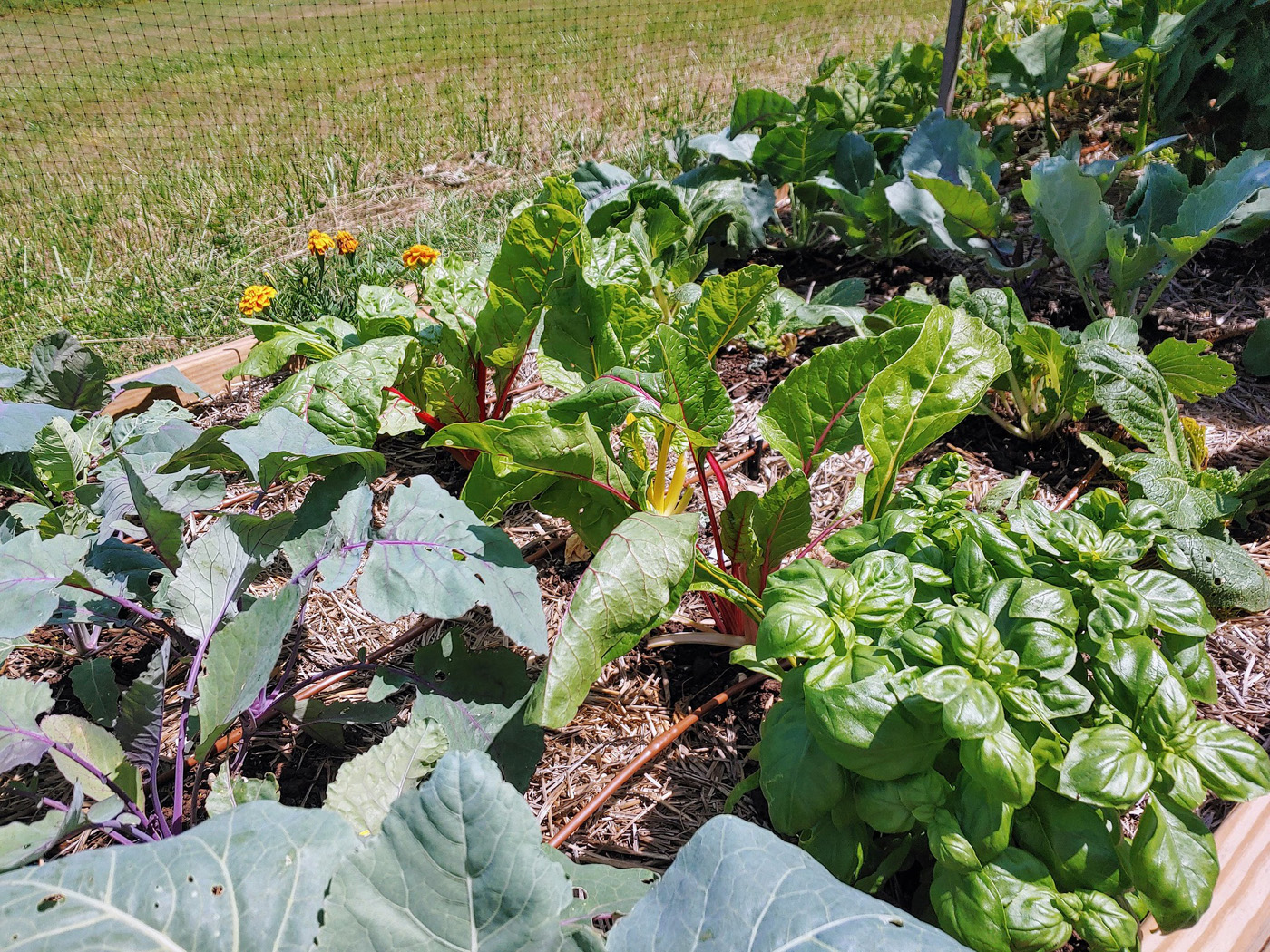
Plant marigolds to keep the bad bugs away

This is a garden myth with a lot of truth to it, but likewise a lot of misunderstanding.

Marigolds do indeed deter some of the bugs we don’t like in the garden, such as cabbage worms, and they can attract beneficial flies that feed on aphids and other nasties.

A close up of marigolds growing in the garden, fading to soft focus in the background.A close up of marigolds growing in the garden, fading to soft focus in the background.

But we need enormous amounts of marigolds for this to have a real effect.

A single six-pack of marigold starts from the nursery won’t do much for your garden. But if you carpeted the beds with a hundred plants, you’d definitely notice a positive impact.

Keep in mind, however, that those extra marigolds will also compete for the same resources our vegetable crops and other edibles need.

So, marigolds can certainly benefit your garden space as companion plants, but only when they’re grown in sufficient numbers, and there are some considerable drawbacks to this strategy as well.

If you choose to plant some marigolds in your garden, I’d recommend you do it with only their lovely appearance and scent as your reward.

Learn more about using marigolds for pest control here.

Flora Folklore That’s Garden Fact!

Yes, here we go! Definite garden truth that offers a clear, concise, factual bit of wisdom.

Use eggshells and banana peels in your garden for healthier plants

Eggshells and banana peels contain significant amounts of calcium and potassium, respectively, and these common kitchen waste products can be a boon to your garden.

I’d sprinkle crushed eggshells on the surface of the soil or work it just underneath.

A close up of a hand from the left of the frame putting eggshells at the base of a plant in a terra cotta pot.A close up of a hand from the left of the frame putting eggshells at the base of a plant in a terra cotta pot.

And I recommend burying banana peels in the earth instead of tossing them loose on the surface of your garden beds – that’s a recipe for attracting rodents and other pests.

These two helpful food scraps are basic elements of compost, and they may be put to the best use in a bin where they can contribute to creating nutrient-rich compost.

However, in a pinch, adding them straight to the garden in their raw form works too.

Soak your plant cuttings in a “tea” made from soaked willow cuttings to promote rooting

I have a friend who asked if he really could get willow whips to set root in a bucket of water. I told him he’d have a hard time getting them not to take root.

Willows are fast growers, and this is due in large part to the growth hormone indolebutyric acid, which they contain. This hormone will indeed help your cuttings to root.

A close up of hardwood stem cuttings with fresh new growth.A close up of hardwood stem cuttings with fresh new growth.

Cut about twenty branches from a willow tree, nothing larger than a pencil in diameter. Don’t worry, your willow can handle losing these!

Strip the leaves from the branches you’ve cut, and then cut the branches into one- to two-inch lengths.

Boil half a gallon of water, remove it from the heat, and then place the pieces in the water to soak.

In the past I’ve steeped mine for 24 hours because I’m an impatient guy, but they can sit in the water for 48 hours.

Sieve the mixture and discard the twigs however you prefer to go about this (throw them on the compost, etc.).

Fitness Tracker with Step/Distance/Calories Counter, Activity Tracker with Heart Rate Monitor, Slim Style Watch IP68 Waterproof, Sleep Monitor Tracker, Pedometer Watch for Women Men

0


Price: $19.99
(as of Dec 20, 2025 16:23:00 UTC – Details)

Product description

ENGERWALL Fitness TrackerENGERWALL Fitness Tracker

replacement wristbands in other colorsreplacement wristbands in other colors

Waterproof IP68Waterproof IP68 The Main Function

Waterproof IP68Heart Rate MonitorSleep MonitorCalorie CounterStep Counter16 Sports ModesRemote CameraCall & Message AlertConnected GPS

Pre-use information

1. After receiving the tracker, please fully charge it. After making sure it is fully charged, press and hold the button on the smart tracker to turn it on. Generally it can be fully charged within 2 hours. The usage time is 5-7 days.

2. Time Setting: After successfully connecting the tracker to the Runmefit app via Bluetooth, the tracker will automatically sync with your phone’s time.

3. If the tracker and app are unable to maintain a connection: Please refer to the FAQ in the Runmefit app.

ENGERWALL store sells fitness tracker replacement wristbands in other colors to make your smart bracelet look more like fashion accessories. (You can search for B0CMQBPHDD on Amazon.) If you have any questions about the product, please let us know through the way on the card. (Usually reply within 12 hours)

All-day Activity and Health TrackerAll-day Activity and Health Tracker

16 Sport Modes

With the Fitness Tracker, you can record your exercise data during exercise. For example: steps, calories, distance, heart rate, exercise time, etc. Let you exercise more scientifically.Note: There are 16 sport modes in the application RUNMIFIIT. The fitness tracker can store 4 exercise modes. You can save 4 commonly used sport to Fitness Tracker

Heart Rate MonitorHeart Rate Monitor

Heart Rate Monitor

Track your 24-hour heart rate. One button to monitor current heart rate. Keep your data recorded on the app.For example: maximum, average, minimum heart rate value, heart rate value curve graph.New function: Smart Bracelet can detect body temperature, blood oxygen, blood pressure

Sleep Monitor & Silent Vibration Alarm ClockSleep Monitor & Silent Vibration Alarm Clock

Sleep Monitor & Silent Vibration Alarm Clock

This Activity Tracker can track your deep sleep/ light sleep/ awakening and analyze your sleep quality all day.You can also add up to 8 alarm clocks to wake you up by gentle vibration, no need to worry about disturbing people around you.

Call & Message AlertCall & Message Alert

Call & Message Alert

The Fitness Tracker support message notification (SMS or SNS from Facebook, Linkedin, WhatsApp, Wechat, Twitter, Snapchat, Instagram, Messenger, QQ, Skype, Line and so on.)Please connect the fitness tracker with your phone in the app(RUNMEFIT), then turn on the message notification

Drink Water &Sedentary ReminderDrink Water &Sedentary Reminder

Drink Water & Sedentary Reminder

Turn on the “Sedentary Reminder” or “Water Reminder” function in the APP. Sedentary will vibrate to remind you to move and remind you to drink water. Remember to stay active and help reduce stress, and set the time you need to relax.

StopwatchStopwatch

Stopwatch

You can set the stopwatch directly on the fitness watch. Assist you to exercise more scientifically.

Customizable Watch FaceCustomizable Watch Face

Customizable Watch Face

A variety of watch faces are available for you to choose from the Runmefit app. You can also choose your picture as the watch face, such as your selfie or photo of your kid, family, pet ,etc.

Remote Camera ControlRemote Camera Control

Remote Camera Control

Just enjoy the time together. This tracker can remote control your phone’s camera to capture the cherished moments.

Super Long Battery LifeSuper Long Battery Life

Super Long Battery Life

Charging for 2 hours, you can enjoy up to 5-7 days of long battery life or 30 days of standby time.It has a built-in USB charging port, so no additional cables are needed. Both computers and mobile phone chargers can charge this Fitness Tracker, which is more convenient.Note: Charging can only proceed if the tracker makes proper contact with the metal side of the power source.

FAQ Troubleshooting:

Q1: My fitness tracker won’t charge?

A1: Please check the metal parts of the USB port on my phone charger and the metal parts of the USB port on the tracker. (The tracker will only charge if they are metal to metal.) Once charging begins, the tracker will vibrate and a charging symbol will appear on the screen.

Q2: Time display error/How to set the time?

A2: After pairing with the app, the fitness tracker automatically syncs the time and date with your phone. If the time is incorrect after the battery is low, recharge and reconnect to sync to the correct time.

Q3: Regarding step count accuracy.

A3: My fitness tracker has a built-in 3D sensor. Most fitness trackers on the market count steps based on hand movements while walking. Therefore, after walking for a while, the data may take some time to sync. You can check if your step count has increased after walking 100 steps to determine if the tracker is functioning properly. Distance data is calculated using an algorithm based on step count, height, and weight. There may be some error, but this is within the normal range.

Q4: My notification function isn’t working.

A4: If notifications don’t work, follow the app’s prompts during the initial connection to grant the necessary permissions to your phone app. Ensure the app is running in the background even when the screen is off. If the issue persists, please let us know and we will help you.

Q5: Will my exercise data be permanently saved on the watch?

A5: The watch only stores up to 7 days of data. You need to sync your data with the app to permanently save it. (After connecting to the app, pull down the “Home” tab to complete the sync.)

Add to Cart

Add to Cart

Add to Cart

Add to Cart

Customer Reviews

4.2 out of 5 stars 173

4.1 out of 5 stars 40

4.6 out of 5 stars 12

4.4 out of 5 stars 17

Price

$9.99$9.99 $9.99$9.99 $9.99$9.99 $9.99$9.99

Replacement band colors
Black+Blue Pink+Gray Purple+Army Green Red+Orange

【All-day Activity Tracker】: ENGERWALL IP68 Waterproof fitness tracker can record and track your daily steps, calories burned, exercise distance and time. It can also monitor your Body Temp, Heart Rate, Blood Oxygen and Blood Pressure. IP68 waterproof ensures that you don’t need to take it off for daily hand washing and swimming, but don’t soak it in water for a long time or wear it for hot baths, saunas.
【Slim and simple band design】The design concept of this tracker’s band is slim and unique, offering a comfortable and lightweight wearing experience. Suitable for men, women and the elderly.
【Heart Rate Monitor and Sleep Tracker】: Smart tracker can detect heart rate, blood pressure, blood oxygen, and body temperature in daily life. Monitor your sleep and analyze your sleep quality through Fall Sleep, Deep Sleep, Light Sleep, REM Sleep. You can view daily, weekly, and monthly data in the APP “Runmefit” to help you better understand your health status and lead a healthy lifestyle.
【Call and message notifications】: You can receive text messages and SNS notifications (including Facebook, Twitter, WhatsApp and Instagram) directly on your wrist. When your phone’s Bluetooth is turned on, if you receive a message, the watch will vibrate to remind you and you can view the specific message. This function is very practical whether in work or life.
【Working Time】: Smart Fitness Watch is the best partner at work, you can set it on the mobile APP ‘Runmefit’: up to 5 sets of alarms, you don’t have to worry about being late for appointments or forgetting important things. You can set drinking Water Reminders and Sedentary Reminders to establish a healthy way of working.
【16 Sports Modes】: This fitness tracker with 16 sports modes to track the corresponding exercise. It will record your workout time, heart rate, and distance. With connected GPS, it can record your workout route, and so on. (Achieved through APP positioning)
【USB Charging】: Remove the wristband and plug it into the USB-A port to charge the fitness tracker. You can plug it into the USB-A port of a computer or a regular charger to charge it. This fitness watch can last up to 5-7 days on a full charge.

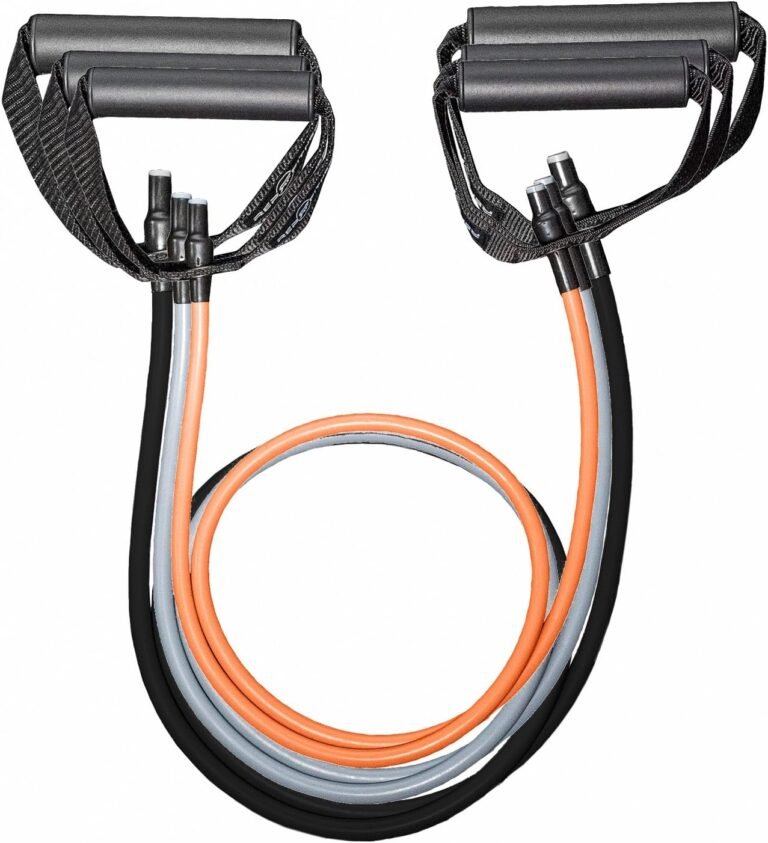
REP Fitness Tube Resistance Bands with Handles – Exercise Bands for Home Fitness Training and Strength Training

0


Price: $26.99
(as of Dec 20, 2025 04:22:33 UTC – Details)


EFFICIENT AND PORTABLE: Rep Fitness Tube Resistance Bands are an efficient addition to anyone’s gym bag and workout routine. Whether you are using them at home or at the gym, they are sure to help you improve resistance strength, mobility, flexibility and more.
CHOOSE YOUR RESISTANCE LEVEL: Available in light, medium or heavy. Save money by purchasing the set and have different resistance levels for all of your needs.
IMPROVE STRENGTH AND FLEXIBILITY: Handles were constructed to provide a comfortable grip so that you can focus all of your energy on your workout or stretching.
STRETCHING AND REHAB: Our bands are designed to perform optimally for strength training and rehabilitation exercises

More Trump deals to lower drug prices : Shots

0

President Trump unveiled deals with nine pharmaceutical companies on drug prices in a White House event Friday.

BRENDAN SMIALOWSKI/AFP via Getty Images


hide caption

toggle caption

BRENDAN SMIALOWSKI/AFP via Getty Images

President Trump said the administration has reached agreements with nine more drugmakers to bring their U.S. drug prices more in line with what other wealthy countries pay.

Fourteen companies in total have now reached what the administration calls most-favored-nation pricing deals. The companies that took part in Friday’s announcement were: Amgen, Boehringer Ingelheim, Bristol Myers Squibb, Genentech, Gilead Sciences, GSK, Merck, Novartis and Sanofi.

They agreed to charge the U.S. government no more for new drugs than the prices paid by other well-off countries. The agreements will allow state Medicaid programs to access lower prices from the nine companies. In a statement, the White House said the change will result “in billions of dollars in savings.”

The drugmakers also agreed to invest at least $150 billion in manufacturing operations in the U.S. The president is seeking to increase domestic production of pharmaceuticals.

In addition, the companies agreed to make some of their most popular drugs available at lower prices to consumers who pay out of pocket through a government website called TrumpRx.com. The TrumpRx website is expected to launch in early 2026, and would take consumers to pharmaceutical companies’ direct-to-consumer websites to fulfill orders.

For example, Merck will reduce the price of Januvia, a medication for Type 2 diabetes, from $330 to $100 for patients purchasing directly through TrumpRx, the White House said. Amgen will reduce the price of Repatha, a cholesterol-lowering drug, from $573 to $239 when purchased through TrumpRx.

In exchange for these concessions, the companies will be exempt from possible administration tariffs for three years.

The extent of savings for consumers under the agreements is unclear. Medicaid and its beneficiaries already pay some of the lowest prices for drugs. And people with health insurance could spend less on copays for their medicines than paying cash for them through the drugmakers.

Separately, Trump said during the press event that he would like to get health insurers to lower their prices, too.

“I’m going to call a meeting of the insurance companies,” he said. “I’m going to see if they [will] get their price down, to put it very bluntly.”

Episode 188: The Best Seeds We’ve Ever Started

0

Meet Our Favorite Seeds to Start

The wonder of sowing seeds and watching tiny new plants emerging from the soil never gets old. In this episode, Danielle, Carol, and their guest compare notes on some of their favorite plants that can be grown easily (or not so easily) from seed. Whether you are an experienced seed propagator or a nervous newbie, you’ll be sure to find something in this episode that catches your interest and makes you look forward to spring. 

While we’re on the topic of plant propagation, check out this video about growing plants from cuttings, mentioned in this episode: Growing Cuttings for Gifts 

The lavender variety that Carol successfully grew from seed a couple of years ago is ‘Ellagance Purple’. 

Episode Expert: Christine Alexander is the executive digital editor for Fine Gardening. 

More Let’s Argue About Plants Podcast Episodes
Watch Our Podcast on YouTube!
Subscribe to Fine Gardening Magazine


Danielle’s Favorite Seeds to Start

  • ‘Amish Gold’ paste tomato  
  • ‘Mad Hatter’ pepper  
  • Chocolate cosmos (Cosmos atrosanguineus, Zones 7–9) 
  • ‘Hawaiian Currant’ tomato  
‘Amish Gold’ paste tomato
‘Mad Hatter’ pepper on the plant photo
‘Mad Hatter’ pepper on the plant  Photo courtesy of All America Selections
Chocolate cosmos
Chocolate cosmos after a rain
‘Hawaiian Currant’ tomato

CarolFavorite Seeds to Start

  • ‘Pampas Plume’ celosia (Celosia argentea ‘Pampas Plume’, annual) 
  • Blackberry lily (Iris domestica, Zones 5–10) 
  • ‘Apricotta’ cosmos (Cosmos bipinnatus ‘Apricotta’, annual) 
  • ‘Dandy Collarette’ dahlia (Dahlia ‘Dandy Collarette’, Zones 8–11) 
‘Pampas Plume’ celosia
Blackberry lily flowers
‘Apricotta’ cosmos
‘Apricotta’ cosmos blooms in the garden
‘Dandy Collarette’ dahlia
‘Dandy Collarette’ dahlia with bee
Floating dahlia display, including ‘Dandy Collarette’
Carol’s floating dahlia display, including ‘Dandy Collarette’

Expert Christines Favorite Seeds to Start

  • ‘Black Beauty’ eggplant 
  • ‘Bright Lights’ Swiss chard 
  • ‘Pepperbox’ breadseed poppy (Papaver somniferum ‘Pepperbox’, annual) 
  • ‘Provence’ lavender (Lavandula × intermedia ‘Provence’, Zones 5–9) 
‘Black Beauty’ eggplant flickr
‘Black Beauty’ eggplant
 ‘Provence’ lavender
‘Provence’ lavender
‘Bright Lights’ Swiss chard
‘Pepperbox’ breadseed poppy 
‘Pepperbox’ breadseed poppy

All photos from the contributors unless noted otherwise. 

Fiesta Fajita Bowl with Chimichurri

0

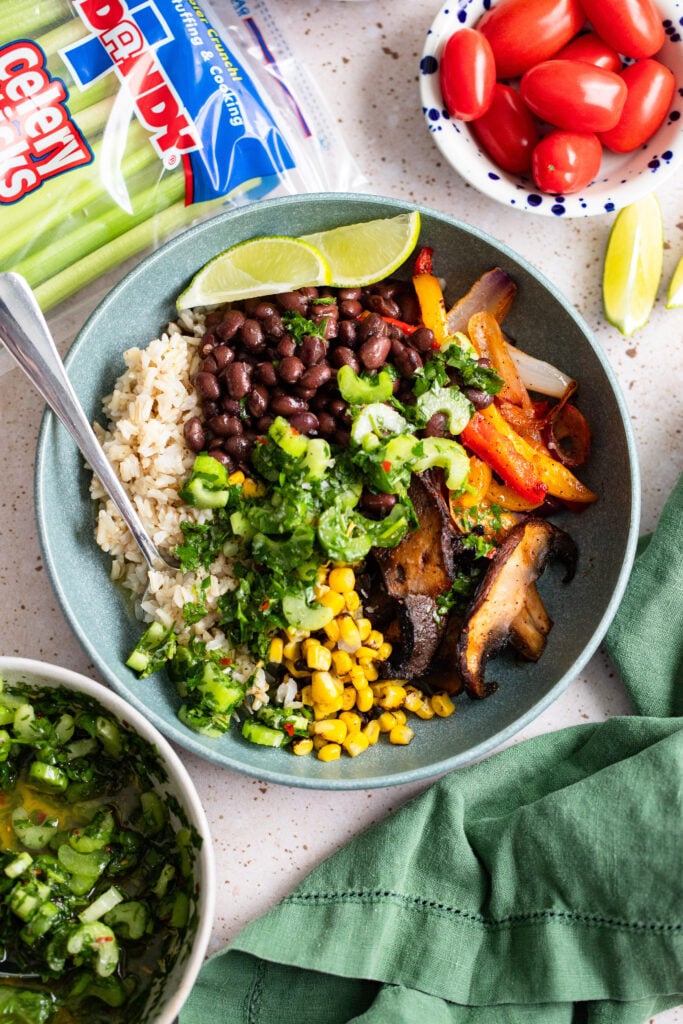
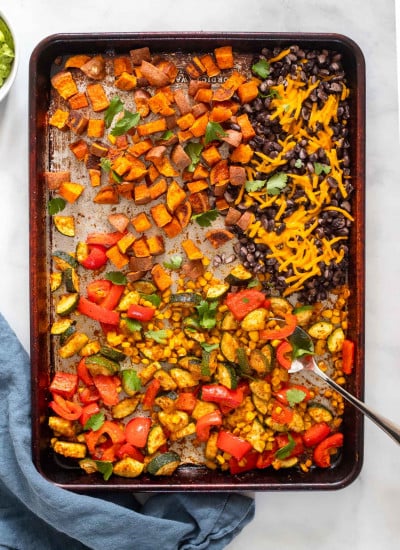
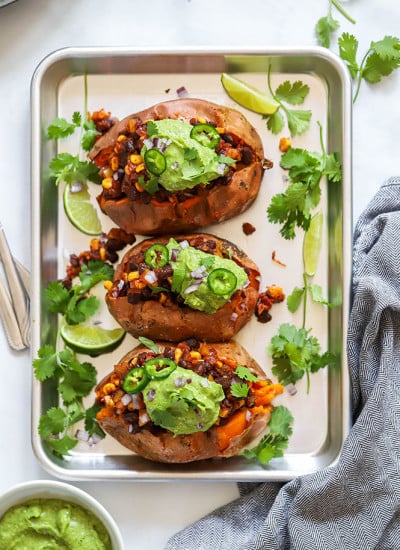
Level up your weekly taco night by making this fiesta fajita bowl with chimichurri instead. Adding celery to your chimichurri or these bowls adds a delightful crunch that will have you going back for seconds.

This post is sponsored by Dandy® Fresh Produce

fiesta bowls ingredients plated in a blue bowl topped with chimichurri

To help cut down on the mental load of figuring out what to make for dinner every night (yes, even food bloggers/dietitians struggle with it!), we create meals based on a theme. Even though it’s unoriginal, Tuesdays are usually tacos or another southwestern inspired dish. These lentil tacos or this enchilada skillet have been our go-tos for a while, but these fiesta fajita bowls with chimichurri are the newest addition to our Tuesday routine.

One of the secret ingredients to this fajita bowl recipe is fresh celery. So I’ve partnered with Dandy® Fresh Produce and used their crispy celery to add crunch and flavor to the chimichurri sauce that brings these bowls together.

What’s more, celery is a great addition to bowls like this one since it’s also high in fiber, full of vitamins and minerals, and just overall such a great kitchen staple. Plus, Dandy® fresh-cut celery is naturally sweeter, crispier, and less stringy than other brands on the grocery store shelves!

Ingredients You’ll Need

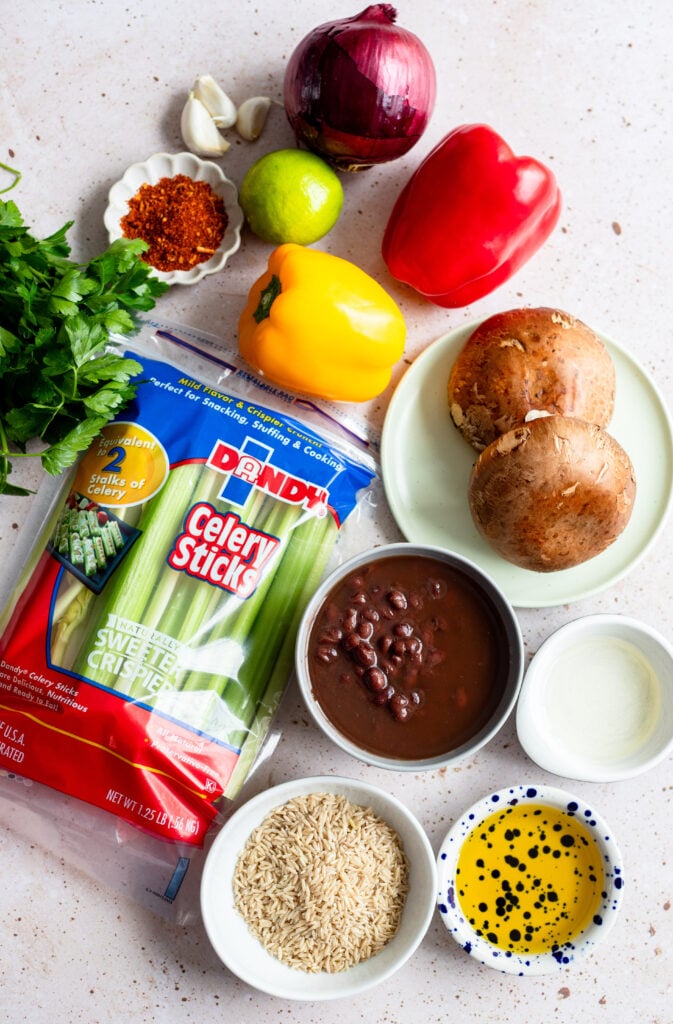
Here’s a quick rundown of the key ingredients you’ll need for these vegan fajita bowls. Be sure to check out the recipe card for the exact measurements.

ingredients for fiesta fajita bowls on a gray backdrop
  • Red Onion, Bell Pepper: use a couple different colors for the peppers and the finished bowls turn out so pretty! Not to mention, these colorful veggies are packed with vitamins A, C, and antioxidants.
  • Portobello Mushrooms: I like adding some sliced portobellos to this bowl because they add umami and “meatiness” but without the meat. I usually toss them in the seasoning separate from the red onion and bell pepper because I like plating it separately for serving, but you could mix everything together.
  • Taco seasoning: use your favorite taco seasoning blend for a no-fuss way to add tons of flavor the roasted veggies for these bowls.
  • Spicy Black Beans: to save an extra step, I buy pre-seasoned canned black beans. (I like the spicy ones.) however, you could also add a bit of cumin, garlic powder, and smoked paprika to your beans when you reheat them if you only have plain ones.
  • Brown Rice: to cut down on prep time, I buy some pre-cooked brown rice either in the pouch or the freezer. This is also a great recipe for using up leftover brown rice.
  • Parsley: fresh parsley is one of the quintessential ingredients for chimichurri since it adds lots of color and a bit of flavor. It’s also a great source of antioxidants too!
  • Celery: to add crunch to these bowls, I mixed some celery into the chimichurri sauce. It may sound like a wild combination but they flavors do go so well together!

Variations

  • Try a Different Protein: we used black beans as the protein for this recipe, but you could replace that with another protein. Give lentils, soy curls, crumbled tofu, plant-based chicken, or plant-based steak a try!
  • Swap the Grain: I love using brown rice as the base for these bowls, but my husband uses cauliflower rice instead as a lower carb option. You could also use white rice or quinoa or even wrap it all up in a burrito-size tortilla.

How to Make Fiesta Fajita Bowls

I love that these creamy parmesan beans come together in one pot with plenty of sauce for dipping some bread into. See the recipe card for the full directions. 

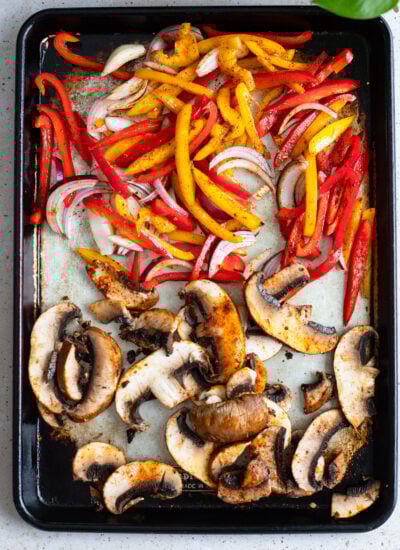
Roast the Veggies: Preheat the oven to 400 degrees Fahrenheit. Add the red onion, bell pepper, and portobello mushrooms to a large mixing bowl with the olive oil and taco seasoning. Toss gently to coat then spread into a single layer on a rimmed baking sheet. Bake for 20-25 minutes or until softened. 

Make the Chimichurri: While the veggies are cooking, whisk together the olive oil, white wine vinegar, garlic, salt, oregano, red pepper flakes, and parsley together in a bowl. Stir in the celery to coat in the chimichurri. 

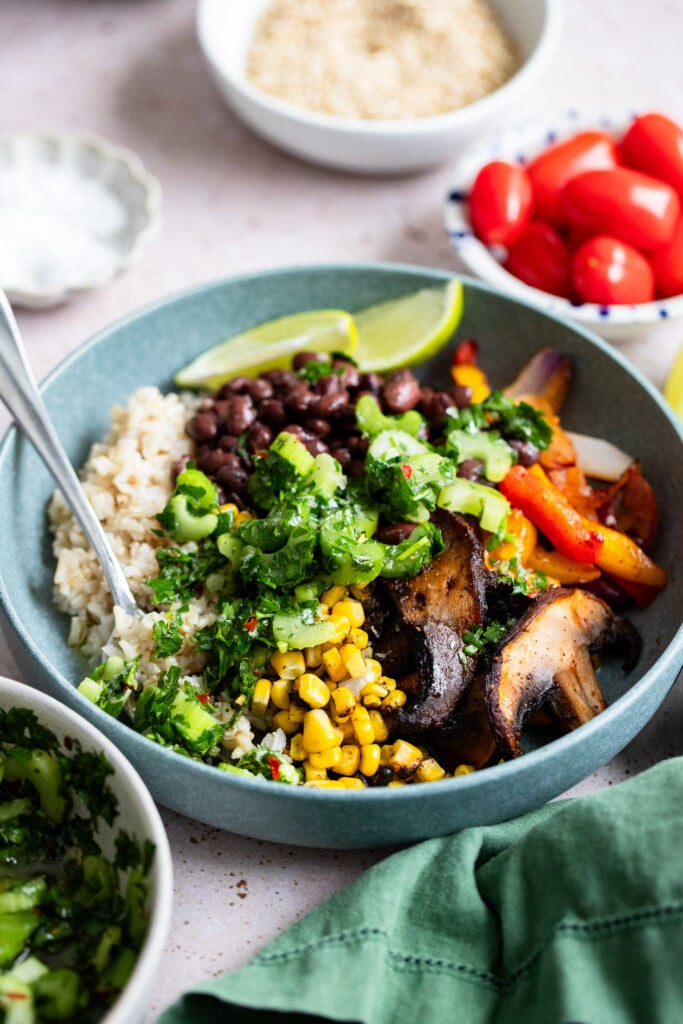
Assemble: To assemble the bowls, add the rice then top with the roasted veggies, corn, black beans, and chimichurri.

mushroom fajita bowls with chimichurri

Meal Prep and Storage

Meal Prep: to make assembly quick and easy you can meal prep the rice, black beans, and chimichurri in advance. Just store in the fridge in airtight containers until you’re ready to assemble your bowls.

Fridge: store any leftover fiesta bowl ingredients in an airtight container in the first for up to 3 days.

Freezer: I would say to skip the freezer on this one since the cooked peppers could get soggy after thawing/reheating.

fajita bowl with celery chimicurri
Print

Fiesta Fajita Bowl with Chimichurri

#wprm-recipe-user-rating-0 .wprm-rating-star.wprm-rating-star-full svg * { fill: #343434; }#wprm-recipe-user-rating-0 .wprm-rating-star.wprm-rating-star-33 svg * { fill: url(#wprm-recipe-user-rating-0-33); }#wprm-recipe-user-rating-0 .wprm-rating-star.wprm-rating-star-50 svg * { fill: url(#wprm-recipe-user-rating-0-50); }#wprm-recipe-user-rating-0 .wprm-rating-star.wprm-rating-star-66 svg * { fill: url(#wprm-recipe-user-rating-0-66); }linearGradient#wprm-recipe-user-rating-0-33 stop { stop-color: #343434; }linearGradient#wprm-recipe-user-rating-0-50 stop { stop-color: #343434; }linearGradient#wprm-recipe-user-rating-0-66 stop { stop-color: #343434; }
Level up your weekly taco night by making this fiesta fajita bowl with chimichurri instead. Adding celery to your chimichurri or these bowls adds a delightful crunch that will have you going back for seconds.
Course Entree, Main Dish
Cuisine Mexican-Inspired
Diet Vegan, Vegetarian
Prep Time 10 minutes
Cook Time 30 minutes
Total Time 40 minutes
Servings 4

Ingredients

For the Bowl

  • 1/2 red onion
  • 2 bell peppers
  • 2 portobello mushrooms
  • 2 tablespoons olive oil
  • 1 1/2 tablespoons taco seasoning
  • 1 cup corn
  • 2 1/2 cups black beans
  • 2 cups cooked brown rice

For the Chimichurri

  • 1/3 cup olive oil
  • 2 tablespoons white wine vinegar
  • 1 clove garlic
  • 1/2 teaspoon salt
  • 1/4 teaspoon dried oregano
  • 1/4 teaspoon red pepper flakes
  • 1/2 cup parsley
  • 1 cup celery

Instructions

For the Bowl

  • Preheat the oven to 400 degrees Fahrenheit. Add the red onion, bell pepper, and portobello mushrooms to a large mixing bowl with the olive oil and taco seasoning. Toss gently to coat then spread into a single layer on a rimmed baking sheet. Bake for 20-25 minutes or until softened.

For the Chimichurri

  • While the veggies are cooking, whisk together the olive oil, white wine vinegar, garlic, salt, oregano, red pepper flakes, and parsley together in a bowl. Stir in the celery to coat in the chimichurri.

Assemble

  • To assemble the bowls, add the rice then top with the roasted veggies, corn, black beans, and chimichurri.

Notes

Meal Prep: to make assembly quick and easy you can meal prep the rice, black beans, and chimichurri in advance. Just store in the fridge in airtight containers until you’re ready to assemble your bowls.
Fridge: store any leftover fiesta bowl ingredients in an airtight container in the first for up to 3 days.

The post Fiesta Fajita Bowl with Chimichurri appeared first on Dietitian Debbie Dishes.

Shappy 10 Pcs Resistance Bands with Handles Exercise Stretch Bands for Exercise Woman Man Training Physical Therapy Workouts Fitness

0

Price: $42.99 - $39.99
(as of Dec 19, 2025 16:19:34 UTC – Details)

Product description

11

22

33

44

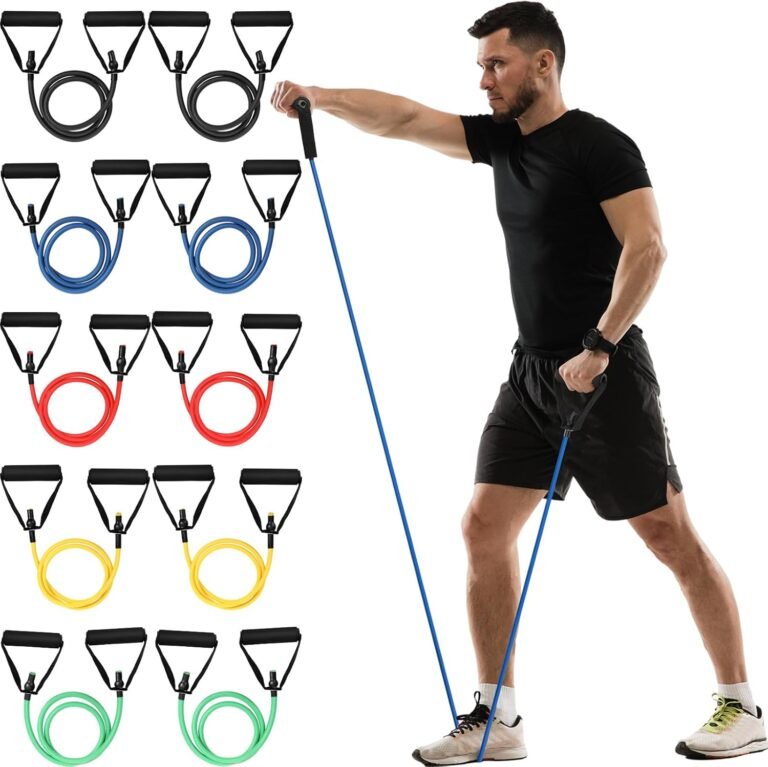
Abundant Quantity: these exercise bands with handles come in a set of 10; With 5 vibrant colors in yellow, red, green, blue, black, our resistance bands are not just attractive but practical as well; Each color represents a different resistance level, making it easier for you to select the suitable one for your workouts and track your progress
5 Resistance Levels: these resistance bands come in different resistance levels, such as 20lb (yellow), 30lb (red), 40lb (green), 50lb (blue) and 60lb (black); No matter your current fitness level, these bands can be applied for a variety of exercises and target different muscle groups, well trained to each of your muscles, so you can get a full body workout
Reliable and Long Lasting: constructed from quality latex tubes, the bands for working out are stable, long lasting, difficult to break or rust, and easy to use, offering good resilience and longevity; These bands are designed to maintain their elasticity and effectiveness even after frequent use; The resistance band has two foam handles that are soft, pleasant, and easy to hold; This makes for a good user experience
Lightweight and Portable: the workout bands resistance for women are compact, lightweight, and easy to transport, allowing you to take your workout routine wherever you are, for example, at home, in the office, while traveling, or at the gym
Suitable for Various Exercise Scenarios: whether you are new to fitness or a seasoned athlete, these elastic bands for exercise enhance your workouts and help assist with a variety of exercises like strength training, yoga, Pilates, Fitness, exercise, stretching, and physical therapy; They offer a versatile workout solution targeted for every muscle group