35.2 F
Klamath Falls
Sunday, March 15, 2026
Home Blog Page 115

What Actually Worked For Me

0

Cortisol, often referred to as the “stress hormone,” is one of the most powerful hormones in the body. While cortisol’s primary function is to help manage stress, it also plays a crucial role in a wide range of bodily processes, from metabolism to immune function, and even brain activity. When cortisol levels are out of balance, they can cause a variety of health problems, including chronic stress, fatigue, weight gain, and poor sleep.

It’s gotten a lot of attention lately and has been trending on social media, with many people claiming that just “fixing” their cortisol drastically improved their health and helped them lose weight. This points to just how important cortisol is, but before we jump into believing that a stack of herbs is a miracle cure, it’s important to understand some background context. 

The Low Down on Balancing Cortisol

Specifically, “cortisol cocktails” including ingredients like orange juice, coconut water, and salt are trending as miracle cures. Personally, I’ve found some other (no-cost) factors to be more effective. Even though I did create my own version of the cortisol cocktail drink!

In this article, I’ll break down my understanding of cortisol and what’s worked for me. As always, this is my opinion, shared only for inspiration and general information and is never for comparison or advice!

So, how can we manage and optimize our cortisol levels to feel our best? The answer lies in understanding how cortisol works and supporting its natural rhythm with simple lifestyle habits. These habits include things like light exposure, supplements, and sleep practices. 

In this post, we’ll take a deep dive into the science of cortisol, explain how light impacts cortisol levels, explore the top supplements for supporting healthy cortisol patterns, and show you how sleep can be a game-changer for hormone balance. Plus, I’ll share what I do to keep my cortisol levels in check.

What Does Cortisol Do?

Cortisol is a steroid hormone produced by the adrenal glands, which are found on top of your kidneys. It’s primarily known for its role in the “fight or flight” response, helping the body respond to stress by increasing blood sugar, enhancing brain function, and suppressing non-essential functions like digestion and reproduction. While cortisol is essential for survival in stressful situations, chronic cortisol imbalance (too high or too low) can lead to serious health problems.

Our cortisol levels follow a natural circadian rhythm, peaking in the morning shortly after waking and gradually declining throughout the day. This daily pattern is essential for maintaining energy levels, sleep quality, and emotional balance. When cortisol levels are chronically elevated or suppressed, this rhythm is disrupted, leading to feelings of fatigue, difficulty focusing, and mood swings. 

In the past, there was a point when my cortisol patterns were exactly opposite of the ideal natural pattern. My deep dive into helping my body find balance taught me a lot about cortisol, light, sleep, and other factors that can help. 

The Impact of Light on Cortisol

One of the most powerful and often overlooked influences on cortisol patterns is light exposure. In fact, I’d dare say this was the most important factor for me in finding balance, and the good news is that it’s free. Light has a direct effect on cortisol production, helping regulate the body’s internal clock or circadian rhythm. Exposure to natural light, especially in the morning, plays a crucial role in maintaining healthy cortisol patterns.

1. Morning Light to Balance Cortisol

Getting natural sunlight in the morning is critical for resetting your circadian rhythm and ensuring cortisol levels peak at the right time. When you wake up and are exposed to sunlight, it triggers the release of cortisol to help you feel alert and energized. This cortisol surge is designed to support your wakefulness and focus throughout the day.

Research shows that morning light exposure, preferably within the first 30 minutes of waking, has a significant impact on the timing and intensity of your cortisol release. Studies suggest that people who receive adequate morning light exposure tend to have better sleep quality, improved mood, and a more stable cortisol rhythm.

A study published in The Journal of Clinical Endocrinology & Metabolism found that morning light exposure increases cortisol production. This in turn improves alertness and reduces sleep inertia (the grogginess many people experience after waking). The timing of light exposure matters though. Blue light exposure at night can interfere with your ability to fall asleep and disrupt cortisol patterns.

2. Natural Light Throughout the Day

Not just the morning light, but consistent exposure to natural light throughout the day helps to maintain healthy cortisol rhythms. When you’re indoors all day, especially under artificial lighting, your body doesn’t receive the necessary signals to effectively regulate its circadian rhythm. This can result in disrupted cortisol patterns, leading to fatigue and increased stress.

Spending time outdoors during daylight hours helps synchronize your body’s internal clock. This can improve sleep, reduce stress, and enhance overall well-being. If you’re working from home or spend most of your day indoors, try to step outside every few hours for a short walk or simply sit by a window with natural light.

I love Dr. Courtney Hunt’s recommendation of: sunrise, sunlight, sunset, repeat. 

3. The Effect of Artificial Light

Artificial lighting (especially blue light from screens) can throw off your cortisol patterns. Exposure to blue light late at night suppresses melatonin (the sleep hormone). It also delays the natural decline of cortisol in the evening, making it harder for you to unwind and get restful sleep. To minimize the negative effects of artificial light, consider using blue light filters on your devices in the evening. You can also limit screen time at least an hour before bed.

In my house, we try to avoid screens after the sun goes down and I have red and amber bulbs in lamps that we use after dark. I don’t go as far as just using candles, though some people have tried this as well. If I’m going to be in a car, airport or store after dark, I’ll often wear blue light blocking glasses

Top Supplements to Support Healthy Cortisol Levels

While light exposure and sleep play foundational roles in managing cortisol, certain supplements also help. They support healthy cortisol levels and alleviate the negative effects of chronic stress. Here are some of the most effective, evidence-backed supplements to consider.

1. Ashwagandha

Ashwagandha, an adaptogenic herb, helps the body adapt to stress and regulate cortisol levels. Several studies show ashwagandha supplementation can reduce cortisol levels and improve the body’s stress response. Cherry rose moon milk is a great way to get some ashwagandha before bed!

In one study published in The Indian Journal of Psychological Medicine, participants who took ashwagandha showed a significant reduction in cortisol levels and reported less stress and anxiety. Ashwagandha has also been shown to support improved sleep and better physical performance.

2. Rhodiola Rosea

Rhodiola rosea is another adaptogen that can help the body manage stress and balance cortisol rhythms. Studies suggest rhodiola can reduce fatigue, improve mood, and decrease cortisol levels during times of stress.

A review published in Phytomedicine found that rhodiola supplementation helped reduce cortisol secretion and improved mental performance in individuals exposed to stress. This herb is particularly helpful for people who experience energy crashes during the day, as it helps maintain balanced cortisol levels throughout the day.

3. Phosphatidylserine

Phosphatidylserine is a phospholipid found in the brain that plays a critical role in cognitive function and cell signaling. Research has shown that phosphatidylserine supplementation can help reduce cortisol levels in response to exercise and stress.

A study published in The Journal of the International Society of Sports Nutrition showed that participants who took phosphatidylserine experienced lower cortisol levels after intense physical activity. This supplement is beneficial for managing cortisol spikes after exercise or stressful events.

Taking choline supplements in the morning was also helpful for my energy and focus. I rotate between this choline supplement, this one, and this one. I did this while also taking these cortisol supplements. 

4. Magnesium

Magnesium is a vital mineral that plays a crucial role in over 600 biochemical reactions in the body. It’s also known for its ability to help regulate the stress response. Studies have shown that magnesium supplementation can help reduce cortisol levels, especially in people experiencing chronic stress.

A study in The Journal of Research in Medical Sciences found that magnesium supplementation helped lower cortisol levels in individuals under stress, improving both mood and relaxation. Magnesium-rich foods like leafy greens, nuts, and seeds can also support healthy cortisol rhythms. I also like to supplement with Magnesium Breakthrough which has 7 different types of magnesium 

5. Omega-3s

Omega-3 fatty acids are essential fats that play a crucial role in supporting overall health, and they’ve been shown to help regulate cortisol levels. Research indicates that omega-3s, found in fatty fish like sardines, can reduce inflammation and lower cortisol levels in response to stress. They also help improve brain function and mood, further supporting your body’s ability to manage stress effectively. 

There are Omega-3 supplements and I occasionally take these but some people worry about oxidation in these supplements. Whenever possible I try to get Omega’s from food sources like seafood. 

Adding sardines to your diet a few times a week is an excellent way to boost your omega-3 intake. Sardines are not only rich in omega-3s, but they’re also an affordable and sustainable option for enhancing your overall nutrition, helping to maintain balanced cortisol levels and improve your stress resilience.

6. Magnolia Bark

Magnolia bark is an ancient herb that has gained attention for its potential to support cortisol balance and promote relaxation. The active compounds in magnolia bark, particularly honokiol and magnolol, have been shown to help reduce cortisol levels by interacting with the body’s stress response systems. Studies suggest magnolia bark can help manage anxiety and promote a sense of calm, which is essential for keeping cortisol levels in check during stressful situations. 

Additionally, magnolia bark may help improve sleep quality by supporting the natural decline of cortisol in the evening. Incorporating magnolia bark as a supplement or in a calming tea can be a beneficial addition to your routine for managing stress and promoting balanced cortisol levels.

A supplement blend like this one has magnolia bark along with other supporting herbs for balanced cortisol. 

How to Use Sleep to Improve Cortisol Levels

Sleep is one of the most effective ways to balance cortisol levels and support overall hormone health. The relationship between sleep and cortisol is complex, but it’s essential for keeping your body’s stress response in check.

1. Prioritize Sleep Quality

Chronic sleep deprivation can elevate cortisol levels and disrupt your body’s natural rhythm. To optimize cortisol levels, focus on improving your sleep quality. Aim for 7-9 hours of sleep per night, and ensure that your sleep environment is conducive to rest. This means a dark, quiet, and cool room.

Avoid caffeine and heavy meals close to bedtime, and incorporate relaxing activities like reading or meditation to wind down. Here’s how to create an ideal sleep environment.

2. Maintain a Consistent Sleep Schedule

Going to bed and waking up at the same time every day helps regulate your cortisol patterns. Irregular sleep schedules can confuse your body’s internal clock, leading to fluctuations in cortisol levels. Try to get up at the same time each morning, regardless of whether it’s a workday or weekend, and avoid sleeping in excessively.

3. Use Sleep to Lower Cortisol at Night

The body naturally releases cortisol in the morning to help you wake up, but cortisol should be at its lowest point at night to prepare your body for restful sleep. A consistent sleep routine, combined with reducing stress during the day, will help promote this natural decline. 

Avoid stimulating activities in the evening, like intense exercise or stressful work tasks. These can raise cortisol levels and disrupt sleep. Here’s a peek into my nighttime routine.

What I Do to Support Healthy Cortisol Patterns

For me, balancing cortisol is about creating a routine that respects my body’s natural rhythms. In my opinion, supplements alone won’t work without these other lifestyle factors as well. Here’s what I do:

  • Morning sunlight: I aim to get outside within 30 minutes of waking up to soak up some natural sunlight. This helps reset my circadian rhythm and supports a natural cortisol surge to get my day started. I also try to eat breakfast and all meals outside when I can. 
  • Light exposure throughout the day: I make a point of staying active during the day, taking short breaks to step outside or sit near a window with natural light. This keeps my cortisol levels balanced throughout the day. I feel best when I get enough bright light 
  • Supplements: I take ashwagandha and magnesium in the evenings to support relaxation and help lower cortisol levels before bed.
  • Sleep routine: I stick to a consistent bedtime, avoiding screens for at least an hour before bed, and make sure my bedroom is cool, dark, and quiet.

Action Steps

  • Get outside for 20-30 minutes in the morning to get natural light.
  • Consider adding supplements like ashwagandha or magnesium.
  • Establish a consistent sleep schedule and create a relaxing bedtime routine.

By supporting your body’s natural rhythms with light, supplements, and sleep, you can help maintain balanced cortisol levels. This can lead to improved energy, mood, and overall health. 

What do you do to support your cortisol levels? Leave a comment and let us know!
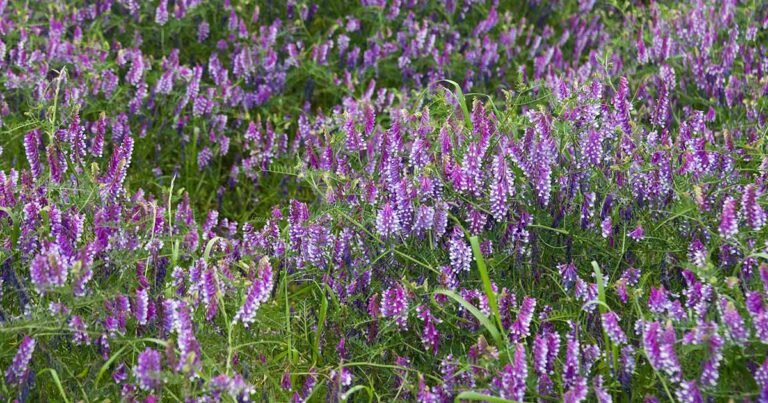
How to Grow Hairy Vetch as a Cover Crop

0

How to Sow

You can sow seeds from midsummer through early fall. When all your summer or fall crops have been harvested, prepare the bed by removing any plant debris or tilling it into the soil.

A horizontal image of soil in a garden raked and prepared for cover cropping.

Clear out any stones or large debris and rake the surface of the soil in preparation for sowing.

If you’re planting hairy vetch in an area where legumes haven’t been grown recently, it’s a good idea to inoculate the seeds with the appropriate strain of Rhizobium leguminosarum bacteria before sowing.

After inoculation, if using, sow seeds about half an inch to an inch deep. If you’re sowing in rows or small sections, space them roughly three inches apart.

A horizontal image of a hand from the right of the frame broadcasting seeds on the surface of the soil pictured in evening sunshine on a soft focus background.A horizontal image of a hand from the right of the frame broadcasting seeds on the surface of the soil pictured in evening sunshine on a soft focus background.

For larger beds, you can broadcast the seeds evenly over the surface, then rake or press them in lightly to ensure good soil contact.

Water well to ensure even moisture in the top layer of soil. Keep the soil lightly moist. Seeds should sprout in about seven to 10 days.

How to Grow

Hairy vetch grows best in full to partial sun, in well-draining soil with a pH between 5.0 to 7.5, so it’s suitable for use as a cover crop in most backyard vegetable beds.

A close up horizontal image of Vicia villosa growing as a cover crop pictured in bright sunshine.A close up horizontal image of Vicia villosa growing as a cover crop pictured in bright sunshine.

After germination, there’s no need to thin the seedlings, just allow them to grow freely to form a dense ground cover.

Maintain consistent soil moisture until a hard frost arrives or temperatures reliably remain below 40°F. During this time, trim back any stems that begin to encroach on other parts of the garden.

When cold weather sets in, you can stop watering. Little maintenance is required through winter, so your job is pretty much done until the final frost of spring.

Where to Buy

Hairy vetch seeds are available at all good plant nurseries and online.

A close up of a packet of hairy vetch seeds with text to the left of the frame and a hand drawn illustration to the right.A close up of a packet of hairy vetch seeds with text to the left of the frame and a hand drawn illustration to the right.

Hairy Vetch Seeds

If you’d like a recommendation, you can find packets of seeds available at Botanical Interests.

Termination in Spring

As spring arrives and the last frost date approaches, it’s time to deal with your cover crop before planting new crops.

About three weeks before sowing seeds or transplanting seedlings, cut the hairy vetch at the soil line using a hoe or garden shears.

A close up horizontal image of hairy vetch in a flowerbed in full bloom by a metal fence.A close up horizontal image of hairy vetch in a flowerbed in full bloom by a metal fence.

At this point, you have several options for handling the plant residue.

You can leave the clippings in place as a green surface mulch, work them into the soil, or compost them separately.

Whichever method you choose, be sure to incorporate the lower stems and roots into the soil to boost organic matter and nutrient availability.

The ideal time to terminate a cover crop is when it starts flowering but before it sets seed.

Trump administration ends 988 suicide prevention service for LGBTQ+ youth : Shots

0

When the 988 Suicide and Crisis Lifeline launched in 2022 it included a pilot to offer specialized support to LGBTQ+ kids. The Trump administration is ending that.

Patrick T. Fallon/AFP via Getty Images


hide caption

toggle caption

Patrick T. Fallon/AFP via Getty Images

The Trump administration is ending specialized suicide prevention services for LGBTQ+ youth on the 988 Suicide and Crisis Lifeline.

While anyone in a mental health crisis can call or text 988 and be connected to a trained counselor, the line has specially trained counselors, often with similar life experiences, for high risk groups like veterans and LGBTQ+ youth.

The federal government’s Substance Abuse and Mental Health Services Administration, or SAMHSA, announced Tuesday it was ending these specialized services for LGBTQ+ youth on July 17.

If you or someone you know is in crisis, please call, text or chat with the Suicide and Crisis Lifeline at 988, or contact the Crisis Text Line by texting TALK to 741741.

“This is devastating, to say the least,” Jaymes Black, CEO of The Trevor Project, said in a statement. The Trevor Project is one of several nonprofits administering the services. “The administration’s decision to remove a bipartisan, evidence-based service that has effectively supported a high-risk group of young people through their darkest moments is incomprehensible.”

SAMHSA said in its statement that while it “will no longer silo LGB+ youth services,” “everyone who contacts the 988 Lifeline will continue to receive access to skilled, caring, culturally competent crisis counselors who can help with suicidal, substance misuse, or mental health crises, or any other kind of emotional distress.”

SAMHSA launched the LGBTQ+ youth service as a pilot program when it launched the 988 helpline in 2022. It has received nearly 1.3 million contacts from LGBTQ+ people (calls, texts and online chats) since the launch.

The higher risk of suicide for LGBTQ+ youth has been well documented by surveys, psychologist Benjamin Miller, an adjunct professor at Stanford School of Medicine told NPR.

“Just last year alone, approximately 40% of LGBTQ youth considered suicide,” he says, citing data from the most recent survey by The Trevor Project, a suicide prevention organization for LGBTQ+ youth. “One in 10 had an attempt. And for those looking for help, only about half could get the help they need.”

A line like 988 makes it easier for such youth to get mental health support, he adds.

He notes that SAMHSA’s announcement omitted the “T” for transgender and “Q” for queer which are typically included in the acronym LGBTQ+.

Cutting off support for this group of youth, he says, sends a message “and that message is more like you’re on your own.”

He says, there were clues that something like this might happen — the service wasn’t in the president’s budget for next year, for instance. But he says it’s destabilizing “because it’s a system that has been set out over the last couple of years that people are beginning to finally utilize and rely on.”

“As someone who has worked in this space for over two decades, I just don’t understand the strategy,” he adds.

HHS did not respond by deadline to NPR’s request for an on-the-record comment on this story.

Miller says the data are clear that there is a need for support for the specialized service.

This January and February, he says, the LGBTQ+ service fielded about 100,000 contacts, “which means that there are a lot of people who identify as LGBTQ+ who are seeking help through this line.”

“What they get with that specialized services line is they get somebody who cares, somebody who’s been there with them, who has shared experiences, who can understand where they’re coming from, and who has been specially trained to address the situations that they are dealing with,” says Hannah Wesolowski, the chief advocacy officer at the non-profit National Alliance for Mental Illness.

“And we know that crisis services geared towards LGBTQ+ youth and young adults work,” says Wesolowski. “These services save lives.”

Taking that service away from 988 could be devastating for individuals, say Wesolowski and other mental health advocates.

Black wants gay and trans youth to know that they can still reach out to The Trevor Project’s own helpline.

“I want every LGBTQ+ young person to know that you are worthy, you are loved, and you belong,” he said in a statement. “The Trevor Project’s crisis counselors are here for you 24/7, just as we always have been, to help you navigate anything you might be feeling right now.”

However, the organization doesn’t have the capacity to handle the same volume of calls and chats as 988, says Black.

Wesolowski notes that a recent poll by NAMI showed that 61% of respondents supported specialized mental health services through 988 for high risk groups like LGBTQ+ youth.

In a statement, Senator Tammy Baldwin, D-Wis., said that the funding for 988’s LGBTQ+ service had been passed through Congress with bipartisan support.

She said she’ll fight to continue to fund suicide prevention for LGBTQ+ children. “Suicide prevention has been and should continue to be a nonpartisan issue, and I call on my Republican colleagues who have long supported this program to fight for these kids, too.”

Episode 182: Favorite Plants with Red Flowers  

0

Red flowers—love ‘em or hate ‘em—add an undeniable fiery look to gardens. The hue stands out brilliantly against the predominant greens of most landscapes, which makes red flowers an instant focal point. For many gardeners, red blooms are the heartbeats of their beds and borders, radiating passion, energy, and a timeless charm. Perhaps it’s no surprise that the familiar line “Roses are red . . .” from the popular nursery rhyme comes so readily to mind; those four words have etched red flowers into the cultural imagination as symbols of love and beauty.

Whether it’s the velvety petals of a crimson peony or the fiery spikes of a hummingbird favorite, these blooms offer not just color but drama. If you think you’re not a fan of red-flowered plants, give this episode a listen because we offer up some options for every imaginable shade of this controversial color, from magenta pinkish-red to dark and moody burgundy.   

Expert: Erin Schanen is creator of the Impatient Gardener blog and YouTube channel and a Fine Gardening author.  


Danielle’s Red-Flowered Plant Picks 

  • ‘Sword Dance’ peony (Paeonia lactiflora ‘Sword Dance’, Zones 4–9) 
  • ‘Major Wheeler’ trumpet honeysuckle (Lonicera sempervirens ‘Major Wheeler’, Zones 4–8) 
  • ‘Claude Shride’ martagon lily (Lilium ‘Claude Shride’, Zones 3–9)
  • Red trillium (Trillium erectum, Zones 3–7) 
‘Sword Dance’ peony
Major Wheeler lonicera
‘Major Wheeler’ lonicera
Claude Shride martagon lily
‘Claude Shride’ martagon lily
Red trillium
Red trillium

Carol’s Red-Flowered Plant Picks:  

  • ‘Red Rouge’ pinks (Dianthus ‘Red Rouge’, Zones 4–9)
  • ‘Showy Lantern’ redvein enkianthus (Enkianthus campanulatus ‘Showy Lantern’, Zones 4–7) 
  • ‘Strawberry Fields’ gomphrena (Gomphrena ‘Strawberry Fields’, annual) 
  • Red buckeye (Aesculus pavia, Zones 4–8) 
  • Bonus plant: ‘America’ peony (Paeonia ‘America’, Zones 4–9) 
‘Red Rouge’ pinks
‘Red Rouge’ pinks
Showy Lantern redvein enkianthus
‘Showy Lantern’ redvein enkianthus
Strawberry Fields Gomphrena
‘Strawberry Fields’ gomphrena
Aesculus pavia
Red buckeye
Paeonia America
‘America’ peony

Expert Guest Erin Schanen’s Red-Flowered Plant Picks:

  • ‘Golden Delicious’ pineapple sage (Salvia elegans ‘Golden Delicious’, Zones 7b–10) 
  • Breadseed poppy (Papaver somniferum and cvs., annual) 
    • ‘Red Giant’ (not pictured)
    • Frilly hybrid cross  
  • ‘Ladybird’ poppy (Papaver commutatum ‘Ladybird’, annual) 
  • ‘Lucifer’ crocosmia (Crocosmia ‘Lucifer’, Zones 5–9) 
'Golden Delicious' pineapple sage
‘Golden Delicious’ pineapple sage
Breadseed poppy courtesy of Erin Schanen
'Ladybird' poppy courtesy of Erin Schanen
‘Ladybird’ poppy courtesy of Erin Schanen
'Lucifer' crocosmia
‘Lucifer’ crocosmia courtesy of Erin Schanen


All photos from the contributor unless noted otherwise. 

What Happens if Vaccines Aren’t Recommended?

0

In recent extraordinary moves, Health Secretary Robert F. Kennedy Jr. has fired and replaced a team that makes vaccine recommendations for the country. Apoorva Mandavilli, a science and global health reporter at The New York Times, explains how this change could impact vaccine accessibility.

How to Treat Bumblefoot in Chickens Naturally?

0

Raising chickens can be such a fun and rewarding experience—fresh eggs, quirky personalities, and the joy of watching them scratch around the yard.

But along with all that comes the responsibility of keeping them healthy and safe. One thing that every chicken keeper should be aware of is bumblefoot.

If you’ve spotted one of your hens limping or noticed a strange bump on her foot, you might be dealing with bumblefoot—a common bacterial infection in chickens.

Don’t panic; it’s treatable, and this guide will walk you through natural methods to help your feathered friend heal without relying on antibiotics.  

Before you dive in further, it is essential that you know more about this infection.

What Is Bumblefoot?

Bumblefoot is a common foot infection in chickens that shows up as a swollen, sometimes painful lump on the bottom of the foot. It usually looks like a round, raised bump, and sometimes you’ll even see a dark scab in the center. It’s basically a chicken’s version of a foot abscess.

This condition happens when bacteria—usually from dirty bedding, rough perches, or sharp objects—get into a small cut or scratch on the foot. Chickens that are overweight or kept on hard surfaces are more likely to develop it since there’s more pressure on their feet.

While it might seem minor at first, bumblefoot can get worse if left untreated. The infection can spread deeper into the tissues and even cause problems with walking. So, it’s one of those things that’s best caught and treated early.

Also Read: How to Prevent Bird Flu in Backyard Chickens?

Signs and Symptoms of Bumblefoot

Spotting bumblefoot early is key to successful treatment. Here’s what to look for:

  • Limping One Foot: Your chicken might hobble, avoid putting weight on one foot, or sit more than usual.
  • Swelling or Redness: The footpad may look puffy, red, or warm to the touch.
  • Black Scab or Sore: A dark, crusty scab on the footpad is a classic sign. It might be small or cover a larger area.
  • Heat in the Foot: An infected foot often feels warmer than the other.
  • Lethargy or Reduced Activity: In severe cases, the chicken may seem less active or stop laying eggs.

Regularly checking your chickens’ feet during routine handling can help you catch bumblefoot before it worsens. If you notice any of these signs, it’s time to act.

How to Treat Bumblefoot in Chickens Naturally – A Step-by-Step Guide

Treating bumblefoot naturally involves a step-by-step approach to ensure the chicken’s comfort and promote healing. Here’s how to do it, based on various effective methods:

Step 1: Gather Your Supplies

Before starting, collect everything you’ll need to keep the process smooth. Here’s a checklist:

  • Clean towels or cloths
  • Warm water
  • Epsom salts
  • Antiseptic herbs (e.g., calendula, chamomile, or oregano)
  • Raw honey or Manuka honey
  • Colloidal silver (optional, for its antibacterial properties)
  • Coconut oil or aloe vera gel
  • Clean bandages or vet wrap
  • Sterilized tweezers
  • Gloves (optional, for hygiene)
  • A quiet, comfortable space for treatment

Having these ready helps you focus on the chicken without interruptions.

Step 2: Isolate and Calm the Chicken

Chickens can get stressed during treatment, so gently catch the affected hen and place her in a quiet, dimly lit area, like a crate or a corner of the coop.

Wrapping her in a towel, often called a “chicken burrito,” can keep her calm and make handling easier. Speak softly and move slowly to avoid startling her.

Isolation is crucial to prevent other chickens from pecking at the wound, which could worsen the infection. Keep her in a clean, dry space during recovery to minimize re-infection risks.

Step 3: Soak the Foot

Soaking softens the scab and surrounding tissue, making it easier to clean and treat. Here’s the process:

Prepare an Epsom Salt Soak: Dissolve 1–2 tablespoons of Epsom salts in a gallon of warm (not hot) water. For added benefits, include dried calendula or chamomile flowers, known for their anti-inflammatory and antiseptic properties.

Soak the Foot: Place the chicken’s affected foot in the soak for 10–15 minutes. If she’s fussy, gently hold her foot in the water or use a cloth to apply the solution. This helps draw out infection and reduce swelling.

Pat Dry: Gently dry the foot with a clean towel, avoiding rubbing to prevent irritation.

Soaking twice daily for a few days can significantly improve the foot’s condition, preparing it for further treatment.

Step 4: Clean the Wound

Once the scab is softened, clean the area to remove debris and reduce infection risk:

Remove Debris: Use a clean cloth or sterile tweezers to gently remove dirt, loose skin, or debris around the scab. Be careful not to force anything, as this can cause pain or bleeding.

Apply a Natural Antiseptic: Dab the area with natural antiseptics like colloidal silver, diluted apple cider vinegar (1:10 with water), or a strong chamomile tea infusion. It helps kill bacteria without harsh chemicals.

Assess the Scab: If the scab is loose, gently try to lift it with tweezers to check for pus or debris. If it’s firmly attached, let the soaking process loosen it over time.

This step should be done gently to avoid stressing the chicken or worsening the wound.

Check this: How to Deworm Chickens Naturally?

Step 5: Remove the Bumble (If Necessary)

Sometimes, the hardened “bumble” (pus-filled core) needs removal for healing to progress. This requires care:

Sterilize Tools: Use sterilized tweezers or, if confident, a scalpel to gently lift the scab. If unsure, consult a vet or experienced poultry keeper.

Gently Extract the Core: If the scab lifts easily, you may see a cheesy, pus-like core. Gently squeeze or tease it out, being careful not to damage healthy tissue. Stop if the chicken shows pain or if bleeding occurs.

Flush the Wound: After removal, rinse with saline (1 teaspoon salt per cup of water) or an herbal tea rinse to flush out remaining debris.

This step isn’t always needed for mild cases, as soaking and topical treatments can suffice. Seek advice if the bumble is deep or you’re unsure.

Step 6: Apply Natural Healing Agents

Natural remedies can promote healing and fight infection. Consider these options:

Raw Honey or Manuka Honey: Honey is a powerful antibacterial and promotes tissue repair. Apply a thin layer to the cleaned wound.

Coconut Oil: Rich in antimicrobial properties, it soothes and protects. Mix with a drop of diluted oregano essential oil for extra antibacterial power.

Aloe Vera Gel: Fresh gel is soothing and supports skin healing; apply directly from the plant if possible.

Herbal Poultices: Make a poultice with crushed plantain leaves, comfrey, or yarrow, known for healing properties. Apply to the wound, cover with a bandage, and leave for a few hours.

Apply these daily after cleaning, monitoring for signs like reduced swelling or no new scab formation.

Check this: What Causes Salmonella in Chickens and How to Prevent It?

Step 7: Bandage the Foot

Bandaging protects the wound from dirt and further injury:

Apply a Protective Layer: After applying a healing agent, cover with sterile gauze or a clean cloth.

Wrap with Vet Wrap: Use vet wrap or cohesive bandage to secure, ensuring it’s snug but not too tight to avoid circulation issues.

Check Daily: Change the bandage daily, reapplying the healing agent after cleaning.

This is crucial if the chicken returns to a dirty or rough environment.

Step 8: Support Healing with Nutrition

A strong immune system speeds recovery. Enhance her diet with:

Probiotics: Offer yogurt or fermented feed to support gut health and immunity.

Vitamin-Rich Foods: Include greens like kale, spinach, or dandelion leaves for vitamins A and C.

Garlic and Oregano: Add small amounts to feed for natural antibiotic properties.

Clean Water: Ensure constant access, possibly with a splash of apple cider vinegar (1 tablespoon per gallon) for immune support.

This holistic approach helps the chicken fight infection internally.

Step 9: Monitor and Repeat

Check the foot daily for improvement or worsening. Mild cases may heal in a week, while moderate ones can take 2–3 weeks. Continue treatments until the wound closes and swelling is gone. If no improvement after a week, or if you notice fever, lethargy, or spreading infection, consult a veterinarian.

Must Read: Marek’s Disease in Chickens: How to Treat?

Aftercare and Prevention Strategies

After treatment, proper aftercare is vital. Keep the chicken separate during healing, providing layer pellets, high-protein snacks like mealworms, vitamins, and electrolytes in water.

Use thick pine shavings for bedding, avoid roosting until healed, or pad roosts with towels. Change bandages every few days, monitoring for infection signs like warmth, redness, or foul-smelling drainage; consult a vet if present.

Healing typically takes a couple of weeks, and chickens often recover quickly with this method.

Prevention is key to avoiding future issues. Maintain clean, dry bedding in coops and runs, using sand or pine shavings changed regularly.

Ensure roosts are smooth and rounded (about 2 inches in diameter) to prevent foot irritation, and sand down rough edges.

Remove sharp objects like rocks or wire from the run, providing soft substrates like grass or dirt for scratching. Regularly check feet, especially for heavier breeds, and manage weight to reduce foot pressure. Boost immunity with a balanced diet including probiotics, herbs, greens, and fermented feed.

When to Seek Professional Help?

While natural treatments are effective for mild to moderate bumblefoot, severe cases may need more. Seek a vet if:

  • The infection spreads up the leg or to other parts.
  • The chicken develops a fever or stops eating/drinking.
  • The abscess is too deep or painful to treat at home.
  • There’s no improvement after 7–10 days.

A vet may prescribe antibiotics or perform minor surgery, ensuring the chicken’s safety.

Conclusion

Dealing with bumblefoot might seem a little intimidating at first, especially if you’re new to keeping chickens—but once you know what to look for and how to treat it, it becomes just another part of good flock care.

Catching it early makes a big difference, and your chicken will thank you for stepping in before things get worse.

Regularly checking their feet, keeping the coop clean, and providing soft perches can go a long way in preventing bumblefoot in the first place. At the end of the day, healthy feet mean happy chickens—and happy chickens mean a thriving backyard flock!

How To Transform Your Yard Into a Permaculture Paradise

0

Years ago, I started questioning why we pour so much time, energy, and chemicals into maintaining the “perfect” lawn. A lawn that doesn’t support biodiversity and often leaves our soil depleted and our schedules packed with weekend mowing. What if instead our yards could feed us, support pollinators, heal the soil, and still be beautiful?

If you haven’t already heard of it, let me introduce you to the world of permaculture! This design approach transforms lawns into living, self-sustaining ecosystems. Whether you have acres, a suburban backyard, or just a small patio, permaculture is a way to reimagine your space. It helps bring life, food, and health back to the land, starting right outside your door.

What Is Permaculture?

Permaculture is short for “permanent agriculture,” a concept first developed in the 1970s. But it’s more than just gardening. It’s a philosophy rooted in working with nature, not against it. And even though it seems like a newer concept, really it’s a return back to what yards used to be. Heavily maintained grass lawns started to become popular in 17th century England and spread from there. 

Rather than fighting weeds, pests, or the seasons, permaculture mimics the patterns and rhythms of natural ecosystems. The result? Landscapes that regenerate themselves, require less work over time, and support both people and the planet.

Think of it as regenerative gardening with multiple functions (kind of like habit stacking). Your yard can feed your family, attract pollinators, hold water in the soil, and improve air quality, all at once.

Where Can You Practice Permaculture?

One of the best things about permaculture is that you can apply the principles anywhere. While most people may think of a homestead out in the country, permaculture can just as easily thrive in small backyards, front yards, or even apartment patios.

The key is thoughtful design. A few potted plants on a balcony is just as much a permaculture feature as a sprawling food forest in the countryside. It’s not the size of the space, but how you use it.

Why Consider a Permaculture Yard?

If you’ve ever dreamed of a low-maintenance garden that supports your health, your family, and the earth, permaculture is a natural next step. Here’s why it’s worth considering:

Less Maintenance Over Time

Permaculture systems are designed to be self-sustaining. It focuses on partnering with nature’s innate rhythms, instead of fighting them. The more mature the system becomes, the less hands-on work it requires. Perennials come back year after year. Mulch suppresses weeds, holds in moisture, and breaks down over time adding to the soil health. Companion plants lessen the amount of pests. Eventually, the system (mostly) takes care of itself, leaving you more time to enjoy it.

A Naturally Healthier Environment

Most traditional yards rely on synthetic fertilizers, pesticides, and herbicides to stay pristine. But those chemicals damage soil health, pollute waterways, and negatively impact the health of our kids and pets. Just one example, children who live on or near areas treated with pesticides are significantly more likely to develop cancer.

Permaculture yards, on the other hand, avoid synthetic inputs. They build soil naturally through composting, mulch, and plant diversity. Plus, there’s no need for constant mowing, watering, or leaf blowing. This translates to less pollution and quieter Saturday mornings.

A Pollinator Haven

Even if you do nothing to your lawn but mow it once a week, it’s not having much of a positive net effect. Flip the script and instead have your yard be a part of the solution!

Bees, butterflies, hummingbirds, and beneficial insects are in decline, but your yard can help. By planting a variety of flowering species (especially natives), you can create a thriving habitat for these essential creatures. You can even build bat houses or plant patches of wildflowers to encourage biodiversity.

Fresh, Organic Food for the Whole Family

Even a small permaculture plot can yield a surprising amount of food. Herbs like thyme and basil, vegetables like kale and tomatoes, fruits like strawberries and blueberries, it all adds up. And because you’re growing bioregional food without harmful chemicals, it’s healthier (and tastier!) than even the organic produce at the local grocery store.

Grow a little extra and you’ll have enough to share with neighbors, friends, or a community food pantry. Not allowed to have a front yard garden patch? Grow one in the back. Get creative and do what you can, it doesn’t have to be all or nothing.

Regenerates Soil Health

One of the most overlooked benefits is the way permaculture rebuilds soil. Conventional yards often leave soil depleted, compacted, and lifeless. But with practices like no-till planting, composting, and the use of ground covers like clover, permaculture revitalizes the soil. Not only does it feed soil microbes that are essential for all life, but it improves water retention/drainage, and supports the eco-system. 

How to Get Started With a Permaculture Yard

Creating a permaculture yard doesn’t require a total overhaul. In fact, starting small is often the best way to start. Begin with one corner, one garden bed, or even a few pots on your porch. Then, let the journey grow from there.

You can even get your yard certified as an official wildlife habitat. The National Wildlife Federation is a great resource for information on creating an eco-conscious space. 

Start Small, Think Big

It’s tempting to rip out your whole lawn and dive in all at once, but that can quickly become overwhelming. Instead, choose one small area to start. A sunny patch near your back door is ideal for an herb garden. Or plant a few pollinator-friendly flowers near your mailbox. Install a bat house or begin a compost pile. Each small step brings you closer to a larger vision.

Observe and Plan for Your Local Conditions

Permaculture always begins with observation. Take time to notice where the sun hits during the day, how water flows when it rains, and where plants already thrive. Use this information to plan around your USDA hardiness zone, your microclimate, and the unique features of your property.

Before planting anything, it’s helpful to do a soil test. Most garden centers or cooperative extensions offer affordable testing kits. You’ll learn your soil’s pH and nutrient levels, which helps guide the plants you use and what you need to add to the soil. 

Choosing the Right Plants: Perennials and Natives

Whenever possible, prioritize perennial plants, since these return year after year. Fruit trees, berry bushes, perennial herbs, and flowering plants reduce the need for replanting. They also help stabilize your soil and ecosystem and over time are less work. 

Also focus on native species. These are naturally adapted to your region’s soil, pests, and climate. They often require less care and provide essential habitat for local wildlife. On the other hand, steer clear of invasive plants, like this infamous (but very popular) tree.  

Think in Layers

Permaculture mimics a natural forest, which means designing your yard in vertical layers. Picture it like a stacked ecosystem:

  • Canopy layer with fruit or nut trees
  • Understory shrubs like currants, blueberries, or blackberries
  • Herbaceous layer of culinary and medicinal herbs
  • Ground cover like creeping thyme or clover
  • Root zone with carrots, garlic, or radishes
  • Climbing vines, like grapes, beans, or flowering vines that reach into vertical space

Each layer plays a role, like catching rain, shielding the soil, providing food, or attracting pollinators. When you’re planning your layers look into how much space each plant needs. If you have a small yard, there’s no point in planting 10 fruit trees that will quickly outgrow the space! In some spaces, especially neighborhoods with stricter yard requirements, you’ll want to opt for middle and lower layers. 

Companion Planting and Plant Guilds

In permaculture, certain plants are grouped together because they benefit one another. These clusters form mini-ecosystems that work together, reducing the need for fertilizers or pest control. For example, a fruit tree “guild” might include: 

  • A fruit tree
  • A nitrogen-fixing plant (like clover or comfrey)
  • Aromatic herbs to deter pests (like chives or mint)
  • Pollinator flowers (like borage or calendula)
  • Ground cover to protect the soil (again, clover)

Build and Conserve Healthy Soil

Permaculture is grounded in soil health. Instead of tilling or disturbing the soil, focus on building it naturally. Use compost from kitchen waste, apply mulch to retain soil moisture, and plant ground cover to add nutrients back to the soil. Healthy soil is the foundation for a healthy yard and a healthy body, too.

Harvest Rain and Conserve Water

Instead of relying on sprinklers or hoses, permaculture uses smart water management. Rain barrels collect runoff from your roof. Swales (shallow ditches) slow and spread water across your property. Mulching and ground covers help lock moisture in, meaning you’ll water less often and conserve more.

Keep a Garden Journal

I’m a big fan of journaling. It’s a great way to see what’s working, what’s not, and reflect on what you’d like to change. As your permaculture yard grows, so will your understanding of it. Keep a simple garden journal where you track things like what you planted, how it performed, and what insects you saw. These notes become invaluable as you plan future plantings or troubleshoot gardening challenges.

It also helps to draw up a layout of where you planted what. Or maybe I’m the only one who has so many plants that I don’t remember where they all are in the yard!

What About HOAs or Small Spaces?

Some people may hesitate to start a permaculture yard because of neighborhood rules or limited space. The good news? It’s possible to design a permaculture space that meets most requirements and still supports the environment.

If your HOA has restrictions, carefully look through them to see what you can do. You may not be allowed to grow dandelions or tall grasses, but pollinator-friendly flowers in a neat bed with mulch and edging are okay. Opt for tidy, intentional design over wilder chaos when necessary. 

Also, keep communication lines open and be friendly. Educate your neighbors. Sometimes, simply sharing a bowl of strawberries from your garden is enough to turn skeptics into supporters. And if you’re passionate, consider joining your HOA board to influence policy from the inside.

As for limited space? A few containers of herbs, a vertical trellis for tomatoes, or a hanging basket of strawberries still counts. You don’t need lots of acreage to grow something meaningful. Whatever you can manage to plant in your yard’s soil will further benefit the soil health and overall eco-system. But even if you’re in an apartment with no yard, you can still contribute something with an apartment garden!

Help!

If designing your own permaculture yard feels overwhelming, you’re not alone. There are now professionals who specialize in permaculture design. They offer consultations, full-scale designs, and will even install it for you. Hiring one is similar to bringing in an interior designer, but for your outdoor space, with a holistic focus on the eco-system.

There are also plenty of online courses and books that walk you through the process step-by-step. Or find a local class or workshop that focuses on permaculture or regenerative practices. 

Final Thoughts on Creating a Permaculture Haven

Creating a permaculture yard is more than a gardening project, it’s a mindset shift. It asks us to slow down, observe, and partner with nature rather than try to control it. It reminds us that every patch of soil, no matter how small, is innately designed to heal, nourish, and sustain life.

You don’t have to do it all at once. Start with an herb spiral. Add a butterfly garden. Maybe hang a bat house. Then step back, observe, and let nature show you the next move. Over time, you’ll build a space that supports not just your family, but the broader ecosystem around you. You might even inspire your neighbors to start their own permaculture yard.

What kinds of plants do you grow in your yard? What are some ways you’d like to transform it? Leave a comment and let us know!

Learn How to Grow Cucumbers in Pots and Containers

0

Growing Medium

C. sativus are heavy feeders, and for the crispest, firmest, and most flavorful fruits, they require a light, well-draining soil mixture that’s rich in organic materials with a slightly acidic to neutral pH of 6.0 to 6.8.

A close up horizontal image of two gloved hands picking up potting soil.
Photo by Lorna Kring.

I find that potting soil alone is too lightweight in texture and nutrients for container grown veggies and prefer to mix my own blend.

Here’s how to make it:

  1. Into a large bin or wheelbarrow, place two parts of loamy garden or potting soil.
  2. Mix in two parts of organic matter such as compost, well-rotted manure, or worm castings.
  3. If desired, add in one-half or one part of moisture retentive materials such as coconut coir, peat moss, or vermiculite. This can be helpful in smaller pots where the soil tends to dry out more quickly than large planters.
  4. If using larger pots or planters, add in one part of gritty materials such as landscape sand, stone chips, pea gravel, or perlite to prevent compaction and ensure the soil is well-draining.

Also, avoid using garden soil alone for potted vegetables – it’s too heavy and compacts easily, causing problems for the roots.

Cultivars to Select

There are many vigorous bush varieties that are ideal for container cultivation – here are a few popular choices to get you started.

Bush Champion

A non-climbing, compact cucumber, ‘Bush Champion’ is early fruiting and produces an abundance of large cukes with a crisp texture and full flavor.

The fruits measure eight to 12 inches long on plants that grow up to eight inches tall with a 24-inch spread.

A close up of 'Bush Champion' cucumber growing in a terra cotta pot.A close up of 'Bush Champion' cucumber growing in a terra cotta pot.

‘Bush Champion’

‘Bush Champion’ has good disease resistance and is a smart choice for patio pots and other containers.

You can find ‘Bush Champion’ seeds available at Burpee.

Pick A Bushel

A semi-bush variety, ‘Pick A Bushel’ is a small cucumber cultivar but reliably high yielding with up to 20 flavorful and firm-textured fruits per plant.

The small, light green fruits grow three to six inches long on 12-inch plants that spread up to 24 inches.

A close up square image of 'Pick A Bushel' cucumbers freshly harvested and set on a wicker mat.A close up square image of 'Pick A Bushel' cucumbers freshly harvested and set on a wicker mat.

‘Pick A Bushel’

An easy choice with good disease resistance, ‘Pick A Bushel’ is ideal for hanging baskets, kitchen potagers, or patio planters.

You can find seeds in a variety of packet sizes available at Eden Brothers.

Saladmore

Perfect for container gardens, ‘Saladmore’ is a reliable bush variety that provides an ample harvest of crisp, sweetly flavored fruits.

The dark green cukes grow seven to eight inches long on cucumber plants that reach up to 24 inches with a similar spread.

A close up square image of 'Saladmore' cucumbers freshly harvested. To the bottom right of the frame is a white circular logo with text.A close up square image of 'Saladmore' cucumbers freshly harvested. To the bottom right of the frame is a white circular logo with text.

‘Saladmore’

A handsome, disease resistant choice for patio pots and mixed veggie planters.

You can find seeds available in a variety of packet sizes at True Leaf Market.

How to Grow

Heat-loving cucumbers shouldn’t be planted out until overnight temperatures remain above 50°F and soil temperatures are a minimum of 60°F.

A close up horizontal image of a cucumber seedling growing in the garden.A close up horizontal image of a cucumber seedling growing in the garden.

To ensure the deeper soil in pots doesn’t become soggy, I like to add a one- to two-inch layer of porous drainage material, like broken pottery or pebbles, to the bottom of the container.

Prepare your pots with your favorite soil mixture then allow it to warm in the sun for a couple of days.

Screen addiction and suicidal behaviors are linked for teens, a study shows : Shots

0

The study asked about signs of addiction to mobile phones, social media and video games. Those signs can include being preoccupied thinking about them and being unable to cut down on using them.

Catherine McQueen/Moment RF/Getty Images


hide caption

toggle caption

Catherine McQueen/Moment RF/Getty Images

If you or someone you know is in crisis, contact the 988 Suicide & Crisis Lifeline via call, text or chat.

A new study finds that addiction to social media, mobile phones and video games is linked to a higher risk of suicidal thoughts and behaviors.

The study, published in JAMA on Wednesday, looked at data on more than 4,000 kids from an ongoing longitudinal study following them for years, starting at ages 9 to 10. It found that by age 14, about a third of the kids had become increasingly addicted to social media, about a quarter had become increasingly addicted to their mobile phone and more than 40% showed signs of addiction to video games.

“And these youth are significantly more likely to report suicidal behaviors and thoughts,” says study author Yunyu Xiao, a professor at Weill Cornell Medicine in New York.

“It’s an important study and raising awareness about screen addiction,” says Dr. Jason Nagata, a pediatrician specializing in adolescent screen use at the University of California, San Francisco. “It shows that elements of addiction related to screen use are more strongly predictive of poorer mental health and even suicide risk compared to just screen time. So, I think that it provides more nuance.”

A large study known as ABCD

Xiao and her colleagues used data from a large-scale ongoing longitudinal study called the Adolescent Brain Cognitive Development (ABCD) Study. It’s been following thousands of kids over the years, and assessing them periodically for both their average daily screen time as well as for symptoms of addiction, which also allowed them to see how these addictive behaviors changed over time.

They assessed addiction with a standardized questionnaire asking them to respond to statements like, “‘I spend a lot of time thinking about social media apps or planning to use the social media apps,'” explains Xiao. “‘I try to use the social media app less, but I can’t.’ And also ‘I feel stressed and or upset if I am not allowed to use my social media apps’ or ‘I use it so much already it has a bad effect on my schoolwork.'”

Her team was able to group the teens based on how these answers changed over time.

With social media, they found that almost 60% had low levels of addiction to social media and that stayed stable over the years. But about a tenth had increasing addiction that peaked around year three and four of the study, and a third showed increasing addiction.

With mobile phone use, about half showed high addiction and a quarter had increasing addiction. With video games, they found only two groups — with about 60% showing low addiction that stayed stable over time, and 41% were highly addicted to it through the period.

Questions about suicidal behavior

The study also evaluated suicidal thoughts and behaviors. It uses a questionnaire that asked about passive and active thoughts of suicide, as well as any suicide attempts. At year four of the study, nearly 18% reported having had suicidal thoughts, and 5% admitted to suicidal behaviors, which includes making suicide plans and attempts.

The groups with high and increasing addiction to mobile phone and social media were associated with a higher risk of suicidal thoughts and behaviors. The highly addictive group for video games also had a higher risk of suicidal thoughts and behaviors compared to the group with low addictive use. However, total screen time was not linked to a higher suicide risk.

“What surprised us is that these are substantial groups, and they are associated with 2 to 3 times [risk] of suicidal behaviors,” says Xiao.

Screen time is not inherently good or bad

Researchers, educators, and parents often point to the amount of time teens spend on their screens to gauge problematic use, say Xiao and Nagata.

“We all get reports from our phones about our weekly screen time,” says Nagata. “Screen time is an easily understandable metric because it’s minutes or hours a day that we’re spending on screens.”

But, he adds, screen time isn’t inherently good or bad, so he welcomes the nuance this study adds to the conversation since it flags signs of addiction.

“Some kids might spend their time on screen reading the news, and some might be trolling some pretty dangerous sites,” says psychologist Mitch Prinstein, a professor at University of North Carolina at Chapel Hill. “So it’s really hard to know what to make of screen time as a risk factor.”

That’s why screen time alone is “not a helpful measure,” says psychologist Mary Alvord. It’s more important to understand how a teen is using their screen time.

“They may be talking to a friend, but are they talking to a friend I-R-L, or are they talking to an avatar created by AI?” says Alvord. “And are they using screens to avoid things in real life?”

Avoidance of real life is a red flag

One of the statements in the addictive use questionnaire is: “I play video games so I can forget about my problems.”

“Avoidance is a key symptom of both anxiety and depression,” says Alvord, and it is revelatory about a teen’s mental health status and relationship with video games or screens in general.

“We’re starting to really try and understand what are the specific features or the specific behaviors that might be more concerning,” explains Prinstein, who has co-chaired the American Psychological Association’s advisory panel on social media use in adolescents. “And the extent to which kids say, ‘I can’t stop even when I’m trying to. I’m having withdrawal, dependence, tolerance symptoms,’ that’s important.”

Nagata has also used data from the ABCD study to understand how teens are using social media over time and how that’s affecting their risk of mental health symptoms.

“One thing that was really striking to me is that, unfortunately, these symptoms of screen addictions are actually pretty common,” says Nagata. He also found that some of the symptoms get more common over time.

He and his colleagues found that 47.5% of 11-12 year olds said that “I lose track of how much I am using my phone,” 22.5% said “I spend a lot of time thinking about social media apps or planning my use of social media apps” and 18.4% said “I use social media apps so I can forget about my problems.”

By age 12-13, 25% said they use social media to forget about their problems, and 25% admitted to spending a considerable amount of time thinking about social media apps.

Using the same data from the ABCD study, he and his colleagues also found that time on social media increased for preteens over the course of the study. “At the beginning of the study, the average time was only 7 minutes a day, but four years later, the average time was over 70 minutes a day.”

And the more time these kids spent on social media, the more their depressive symptoms increased.

“Parents, teachers, clinicians should be, on the lookout for warning signs for screen addictions, particularly as they may relate to higher depression risk or suicide risk in teenagers,” Nagata says.

Heidi’s Pots, Plants, and Yard Art in Washington

0

Hi GPODers!

One of the many reasons I love the Garden Photo of the Day community is because of the many diverse gardening stories we get to hear. From lifelong plant lovers who have fond memories of playing in their grandmother’s gardens to enthusiasts who caught the gardening bug later in the life, it’s inspiring how we can all come together to enjoy each other’s unique journeys and landscapes.

Today, we’re hearing from Heidi Behrens-Benedict, an interior designer in Bellevue, Wash., who had a very unconventional path to her garden in the Pacific Northwest. She shares the story of how an interior design job at Washington Park Arboretum in Seattle gave her a new introduction to the world of gardening and shifted her perspective that stemmed from an initial unfortunate experience with plants in her youth.

Dear Friends at Fine Gardening ~

Many years ago, I was prime on the new Arboretum Visitors Center in Seattle. I remember my first meeting with a group of guild members who had raised money for the project. As I sat around the conference table, I was introduced to the hosta expert, the rhody expert, the native species guru, gardeners who were passionate about gardening in the Puget Sound.

One of the group asked me what kind of gardening I liked. While I believe I am a good designer, I knew from nothing about gardening. When I was growing up, my father was in the military. We lived in hot, dry bases. When my father would come home about 4:30 p.m., he’d walk in the door and say, “Why are you just sitting there? Go outside and weed.” Since it was 115 degrees in the shade, gardening always felt like punishment.

I remember once tilting my head back as I was standing on the black, hot tarmac one recess and praying, “Please, God, when I grow up, I want to live someplace it rains every day.” When I graduated from college, I moved to Seattle. The first summer, it did rain every day. The windows sheeted with water day after day. Mid-August, I was standing at the window and saying, “Please, God, I should have been more specific. Perhaps not every single day.”

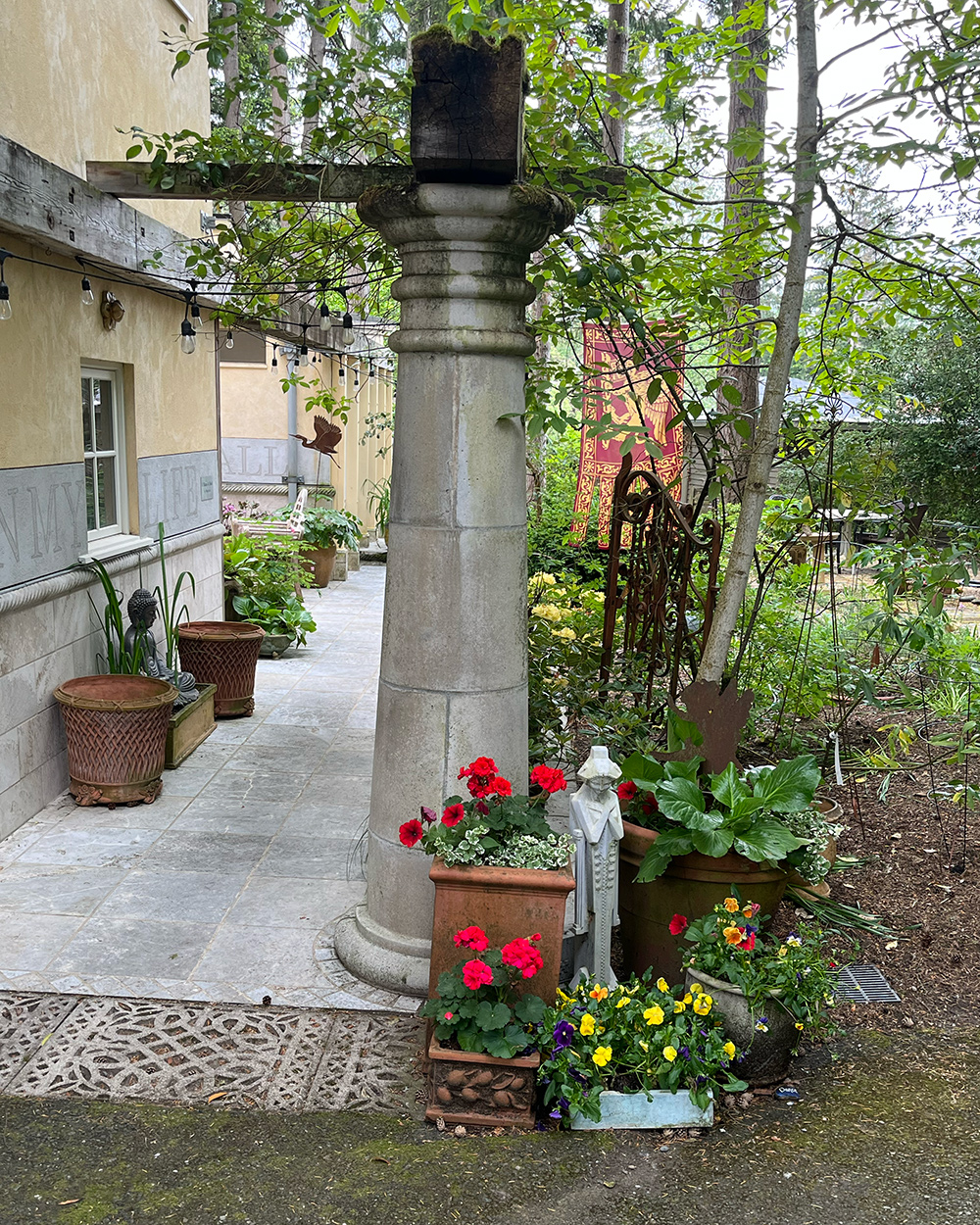
Which brings me to my arboretum project, when I stumbled with an answer for what kind of gardening I liked and said, “Container gardening.” What I really liked about container gardening was not so much the plants but the vintage pots. Large glazed pots. Large terracotta pots. Large Chinese pots. Square pots. For years, I collected beautiful pots and beautiful yard art.

About 20 years ago, I started putting plants in the pots. What I really like are perennial plants with interesting leaf structure, and lately, after becoming a novice beekeeper, I’ve focused on flowers that my bees will love.

So here are a few pictures of my pots, plants, and yard art.

With every good wish ~
Heidi

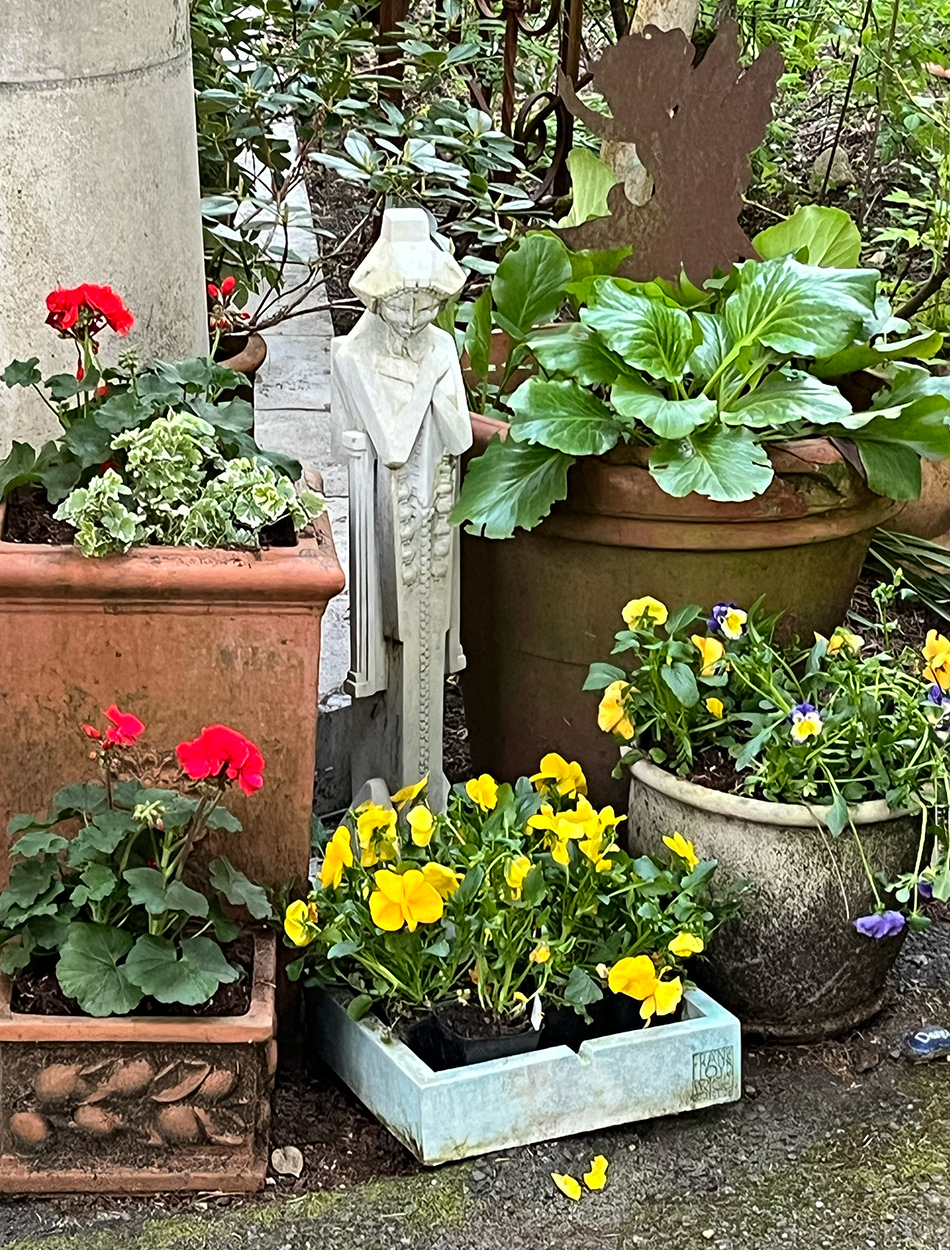
Heidi’s background in interior design, particularly her focus on architectural salvage, is evident in her outdoor space. Aside from the color she has potted into her incredible collection of containers, interest abounds in all the artful touches and decor.

close up of colorful annuals in containersA closer look at the colorful annual flowers Heidi potted this year

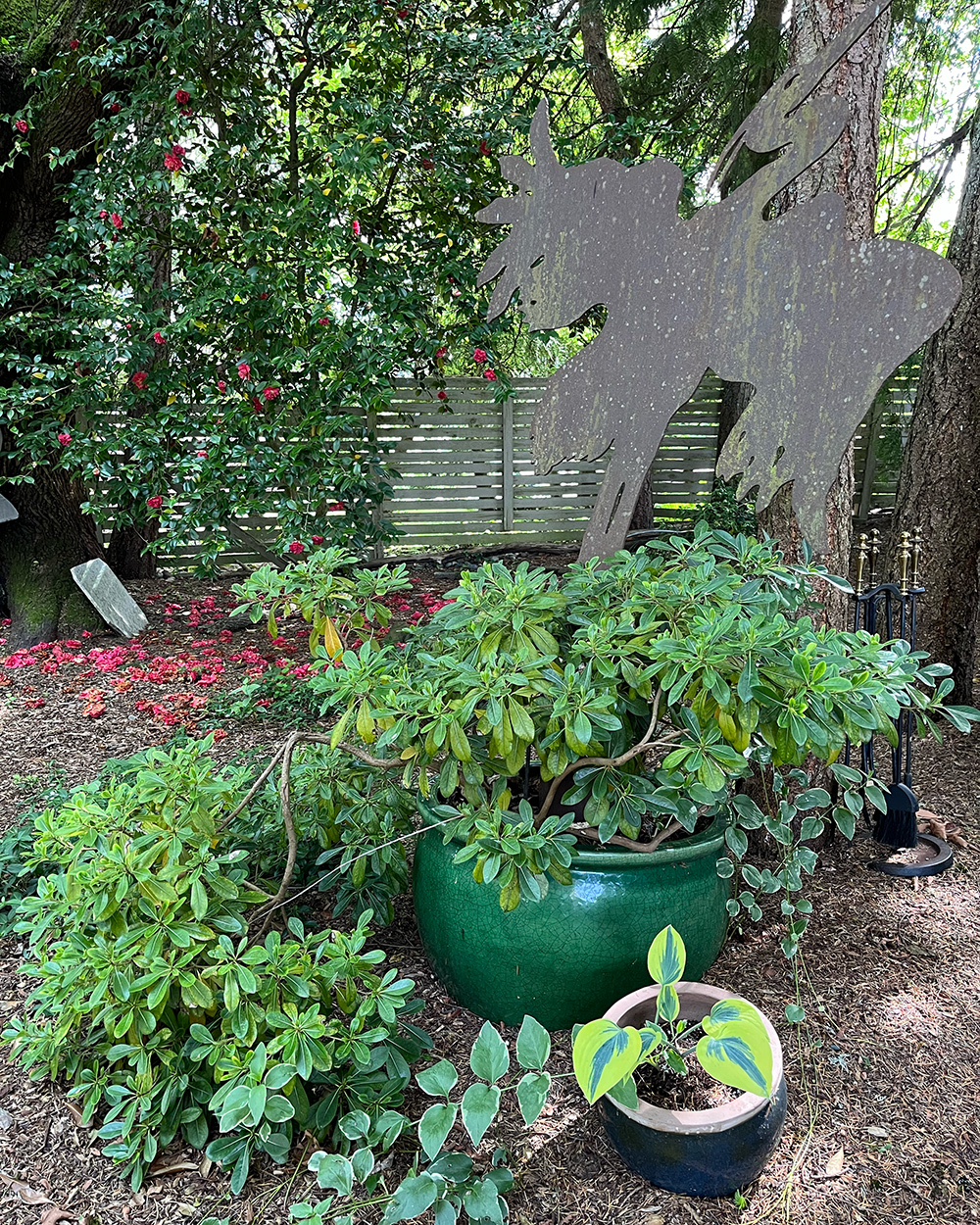
green foliage plants in containersAnnuals tend to get the bulk of the container space in gardens every year, but, as Heidi mentioned in her intro, the beautiful foliage of perennials and shrubs can be just as successful in a pot as they are in the ground. I love how this Japanese mock orange (Pittosporum tobira, Zones 8–10) is spilling out of its gorgeous green pot.

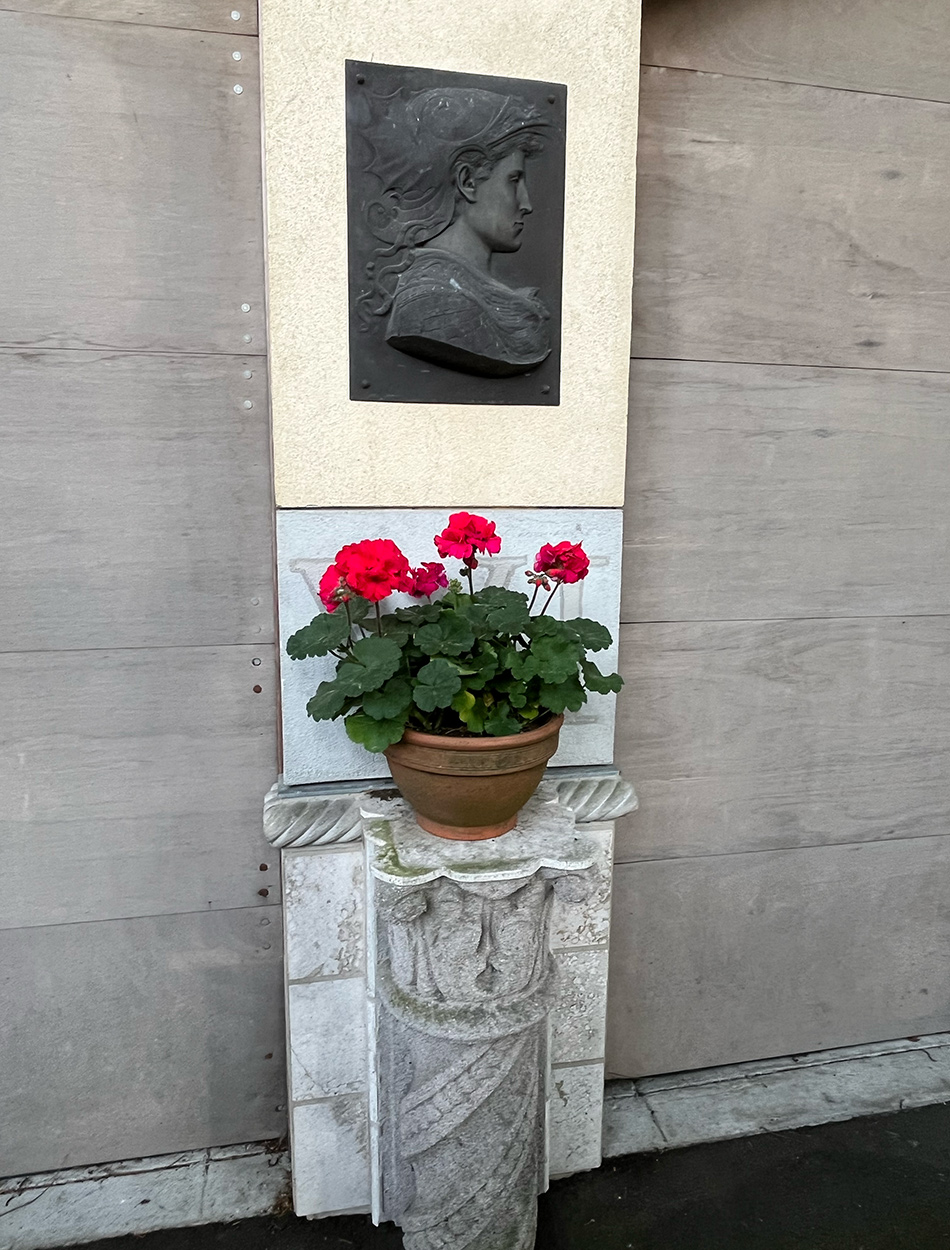
red geranium on ornamental pillarWhen a backyard is full of this much fascinating art, even a simple planting can create a big impact. This ornate pillar and relief sculpture already have a lot going on, so a simple red geranium is all that’s needed for a colorful pop of extra interest.

garden seating area with container plantingsThe outdoor seating area of a real collector: not only a space to enjoy Heidi’s lush gardens, but a spot to admire her thoughtfully curated art and furniture pieces.

Thank you so much for sharing your artful potted displays and creative garden adornments, Heidi! Your story is certainly a unique one, and your garden truly reflects that unique background as well as your designer’s eye.

What was your introduction to gardening? What journey brought you to your current garden? If you haven’t shared your garden on the blog yet, or it has been a while and you have a lot to update us on, consider sharing photos of your space this year! Follow the directions below to submit photos via email, or send me a DM on Instagram: @agirlherdogandtheroad.


We want to see YOUR garden!

Have photos to share? We’d love to see your garden, a particular collection of plants you love, or a wonderful garden you had the chance to visit!

To submit, send 5–10 photos to [email protected] along with some information about the plants in the pictures and where you took the photos. We’d love to hear where you are located, how long you’ve been gardening, successes you are proud of, failures you learned from, hopes for the future, favorite plants, or funny stories from your garden.

Have a mobile phone? Tag your photos on Facebook, Instagram or Twitter with #FineGardening!

Do you receive the GPOD by email yet? Sign up here