Health and Human Services Secretary Robert F. Kennedy Jr. (R) and Food and Drug Administration (FDA) Commissioner Martin Makary at the White House in May, when Kennedy released a Make America Healthy Again Commission report that blamed the rise in chronic illnesses on ultraprocessed foods, chemical exposures, lifestyle factors and excessive use of prescription drugs.
Kevin Dietsch/Getty Images North America
hide caption
toggle caption
Kevin Dietsch/Getty Images North America
Health Secretary Robert F. Kennedy Jr. has upended medical research and public health in the U.S. in many ways. One of the ideas that could be influencing his overhaul of federal health agencies dates back to ancient Greece.
The miasma theory is one of the first ideas that civilization hatched to try to explain why people get sick.
“It goes back to Hippocrates,” says Dr. Howard Markel, an emeritus professor of medical history from the University of Michigan, Ann Arbor. “He wrote in a book called Epidemics, that epidemics came from some type of pollution – some pollution of the atmosphere, of the air that we breathe. And hence we got terrible infectious diseases.”
This idea that, in essence, bad air caused illness was later championed by many others, including Florence Nightingale. It also led to some things that did help fight diseases, like cleaning up sewage.
But then came the germ theory — one of humanity’s big eureka moments. Scientists like Louis Pasteur and Robert Koch discovered it wasn’t some mysterious stench in the air from rotting garbage that spread diseases. Instead, it was living microscopic entities.
“They discovered what we know as germs – microbes,” says Melanie Kiechle, a historian at Virginia Tech. “Bacteria and viruses and other microscopic materials were actually what caused illness and also explained the spread of illness from one person to another. So miasma theory is debunked, essentially.”
The discovery of germs led to breakthroughs like antibiotics and vaccines.
But in a book Kennedy published about four years ago, The Real Anthony Fauci: Bill Gates, Big Pharma, and the Global War on Democracy and Public Health, the now- health secretary harkens back to the miasma theory.
“Miasma theory emphasizes preventing disease by fortifying the immune system through nutrition and reducing exposures to environmental toxins and stresses,” Kennedy writes.
But experts say one problem is how Kennedy defines miasma theory.
“I will categorically say that miasma theory, as historians of medicine and science understand it, is not what he is saying it is, period,” says Nancy Tomes, a historian of germ theory at Stony Brook University, who wrote The Gospel of Germs: Men, Women and the Microbe in American Life.
But Kennedy’s take may help explain some of his policies, especially about vaccines.
“The miasma theory is the notion that there are environmental poisons, not necessarily rotting organic matter,” says Dr. Paul Offit, a vaccine expert at the University of Pennsylvania. “For him, those environmental poisons are electromagnetic radiation, pesticides, vaccines. Vaccines are, for him, a modern-day miasma.”
And that’s dangerous, many experts say.
“Can stress, air pollution, other things, make infections worse? Yes. But the cause of infections is a microorganism,” says Dr. Tina Tan, who heads the Infectious Disease Society of America. “It’s the microorganisms that are making people sick.”
And vaccines have clearly been shown to safely and effectively protect people against dangerous microorganisms, Tan and others say.
“He’s trying to give this false veneer of intellectualism by saying, ‘Oh, the miasma theory,'” says Dr. Amesh Adalja, a senior scholar at the Johns Hopkins Bloomberg School of Public Health Center for Health Security. “This all just obfuscation to support his idea that vaccines are not valuable.”
But some other observers argue that Kennedy’s ideas about the miasma and germ theories aren’t necessarily mutually exclusive.
“The real debate here is whether we can solve public health problems by developing treatments like vaccines, antibiotics, or other drugs? Or whether we will solve these problems by strengthening people’s immune systems through healthier habits?” says Gregg Girvan, a resident fellow at the Foundation for Research on Equal Opportunity, a Washington think tank. “And my response is, ‘Why can we not acknowledge that there is truth in both positions?'”
Kennedy’s office did not respond to NPR’s request for more information about his views about the miasma and germ theories.
On Wednesday we saw Linda’s lovely woodland garden on Lookout Mountain (Linda’s Garden on a Mountain), yesterday we saw pretty pink blooms from Lila’s garden in Mill Creek (Lila’s Azaleas), and today we’re wrapping up this mini spring tour of Washington with Cleo Raulerson in Bellevue. Cleo has already shared her gorgeous garden in fall and winter (Late October in Cleo’s Back Garden and Cleo’s Washington Garden in Winter), and today we finally get to see her space as the weather warms up and plants wake from their winter slumber. Cleo always includes so much fabulous information on her plants, so I will waste no time and get straight to the good stuff.
Spring is my favorite time of the year, especially in the garden. We are fortunate in Western Washington to have a long spring to watch the new leaves and spring flowers emerge and grow. Here are 2025 photos of some of my favorite spring plants and garden scenes.
Leaves of our laceleaf Japanese maple (Acer palmatum var. dissectum atropurpureum ‘Ever Red’, Zones 5–8), planted 36 years ago, just beginning to emerge in early April with two Magic Carpet spirea(Spiraea japonica ‘Walbuma’, Zones 4–9)in the foreground
Ten days later, the laceleaf Japanese maple on the left is mostly leafed in. Shrubs left to right: Snowflake oakleaf hydrangea(Hydrangea quercifolia ‘Brido’, Zones 5–9), violet-blue flowers of ‘Crater Lake’ rhododendron(Rhododendron ‘Crater Lake’, Zones 6–8), and Shindeshojo Japanese maple(Acer palmatum ‘Shindeshojo’, Zones 5–9)in its initial red leaf color (then green leaves in summer and coral-red leaves in autumn). The Bellevue skyline is in the background.
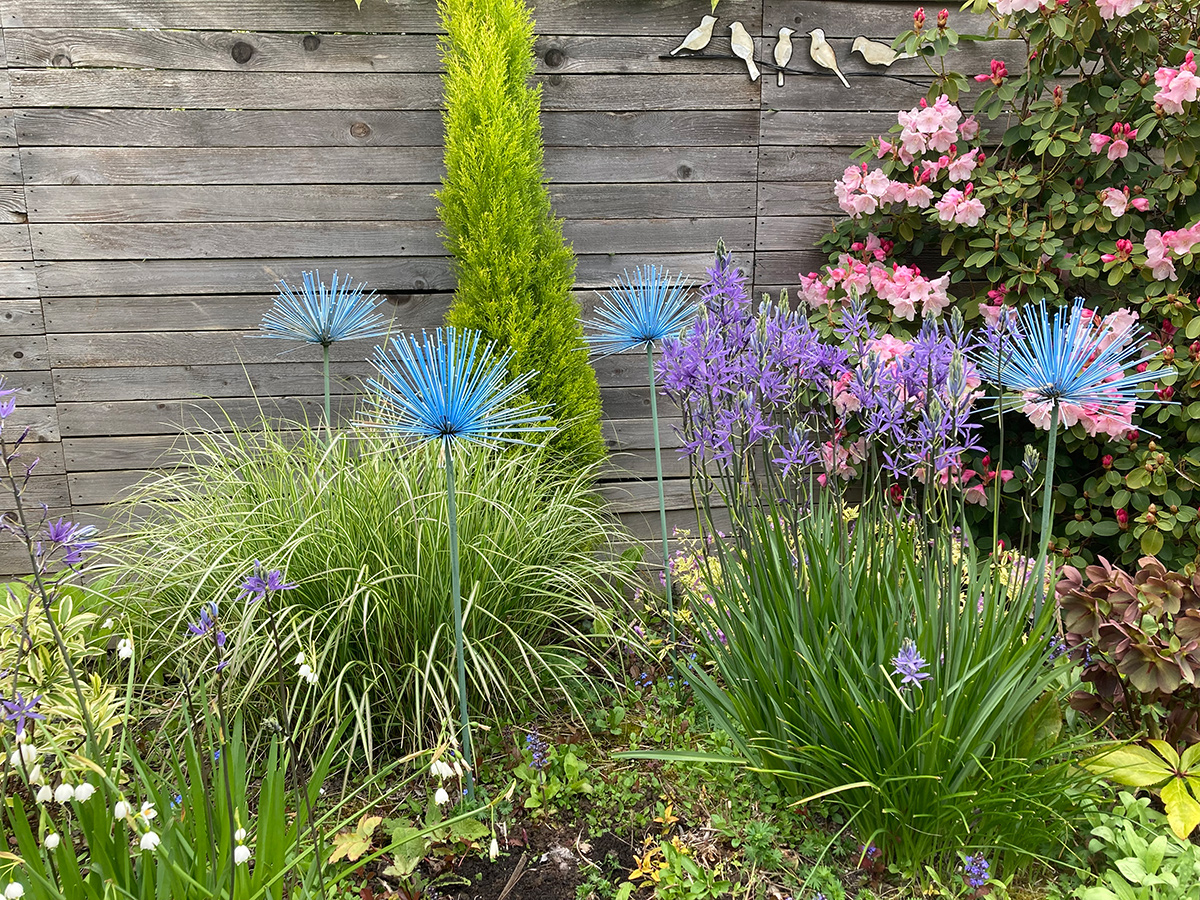
The metal blue allium sculptures are a favorite topic on garden tours. In April, white summer snowflake (Leucojum aestivum ‘Gravetye Giant’, Zones 4–8)is blooming on the left, next to blue camas(Camassia leichtlinii ‘Blue Danube’, Zones 3–8). Pink ‘Bow Bells’ rhododendron(Rhododendron ‘Bow Bells’, Zones 6–9)is just starting to bloom on the right.
One of my favorite spring scenes, with ‘Redleaf’ Roger’s flower (Rodgersia podophylla ‘Rotlaub’, Zones 5–9)just emerging; an ancient Exbury azalea adding a bright pop of apricot color, which is echoed in the glass goldfish; and other plantings. The small white flowers in the back are dwarf fothergilla(Fothergilla gardenii ‘Blue Mist’, Zones 5–8).
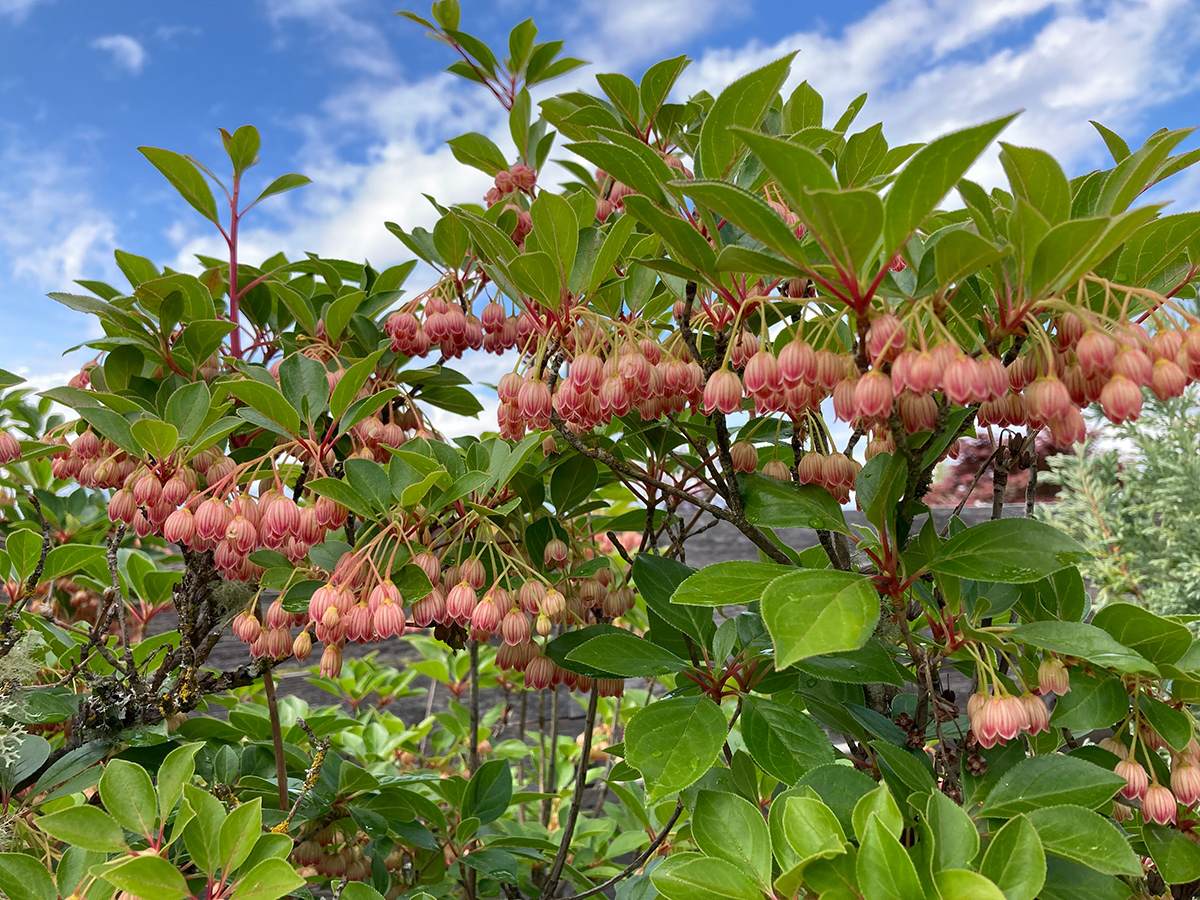
Close-up of redvein enkianthus (Enkianthus campanulatus, Zones 5–8)in full bloom. This is a great year-round shrub.
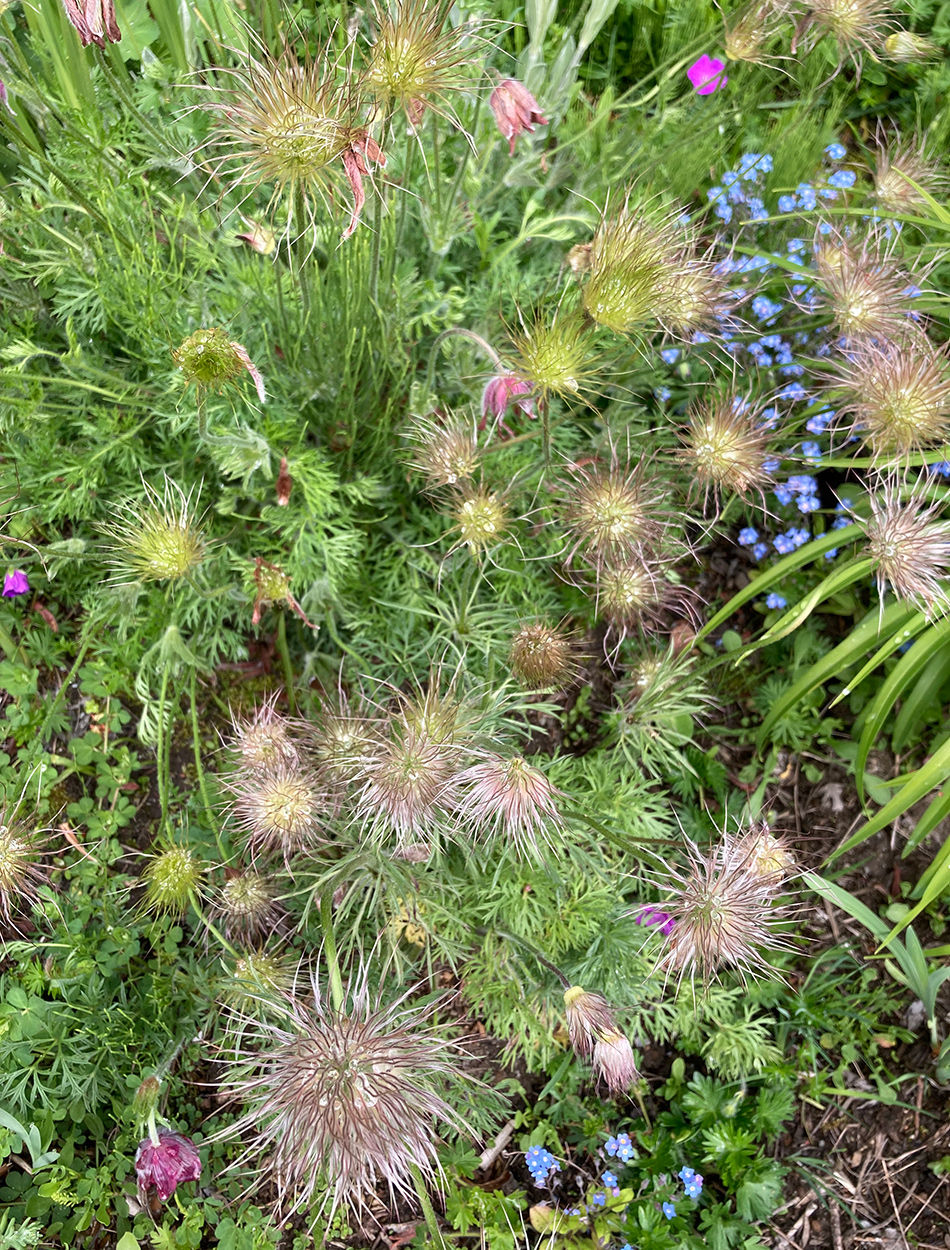
One of our favorite subalpine wildflowers on Mt. Rainier is the mophead(Pulsatilla occidentalis syn. Anemone occidentalis, Zones 3–8). Its European cousin, pasque flower(Pulsatilla vulgaris, Zones 4–8), happily grows at sea level, so we can have a reminder of our great Mt. Rainier hikes in our urban garden. Pulsatilla vulgaris blooms in shades of purple/mauve in March, then the white-gray mopheads last well into summer.
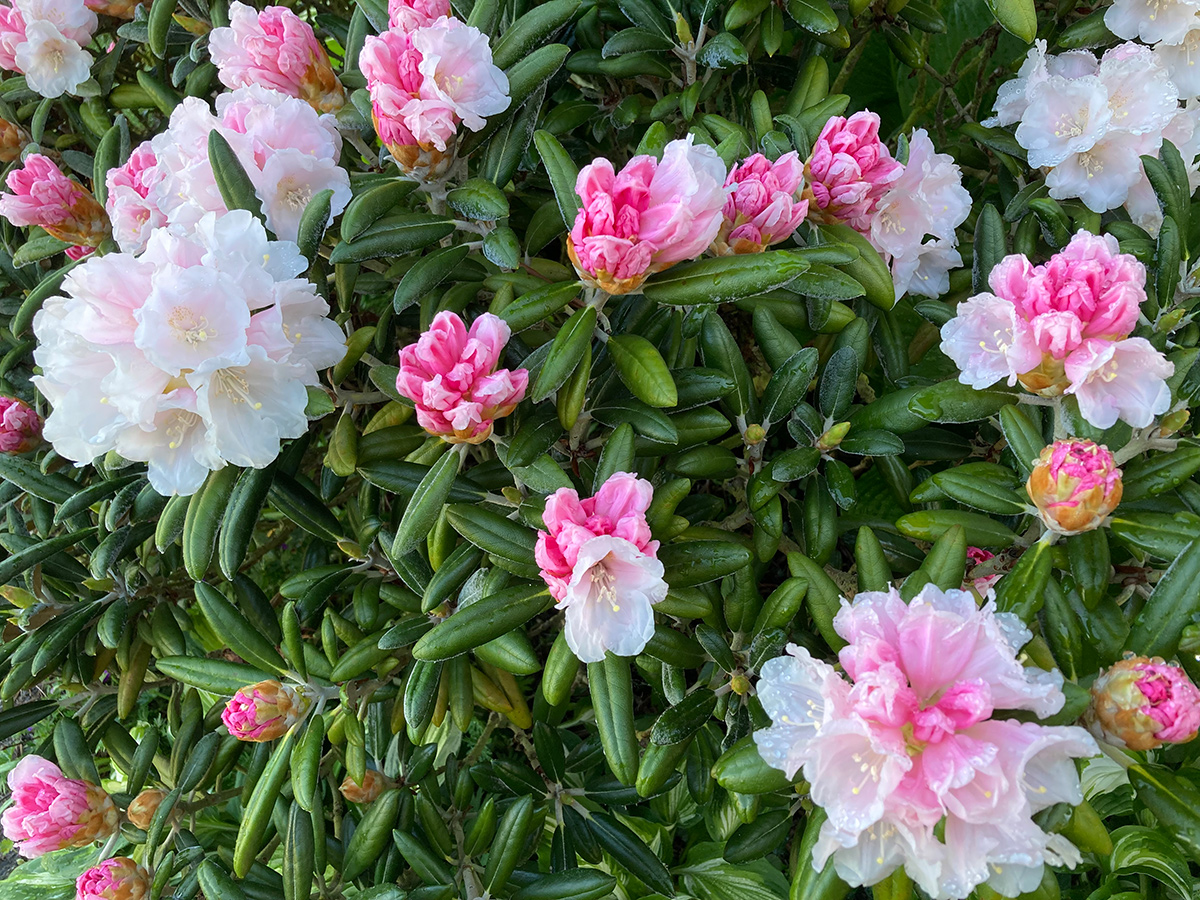
Close-up of yak rhodie blooms(Rhododendron yakushimanum ‘Koichiro Wada’, Zones 5–9). This pale pink flower fits well into the garden; then we can enjoy the new silvery leaves with a covering of fine, felty hairs later in the spring.
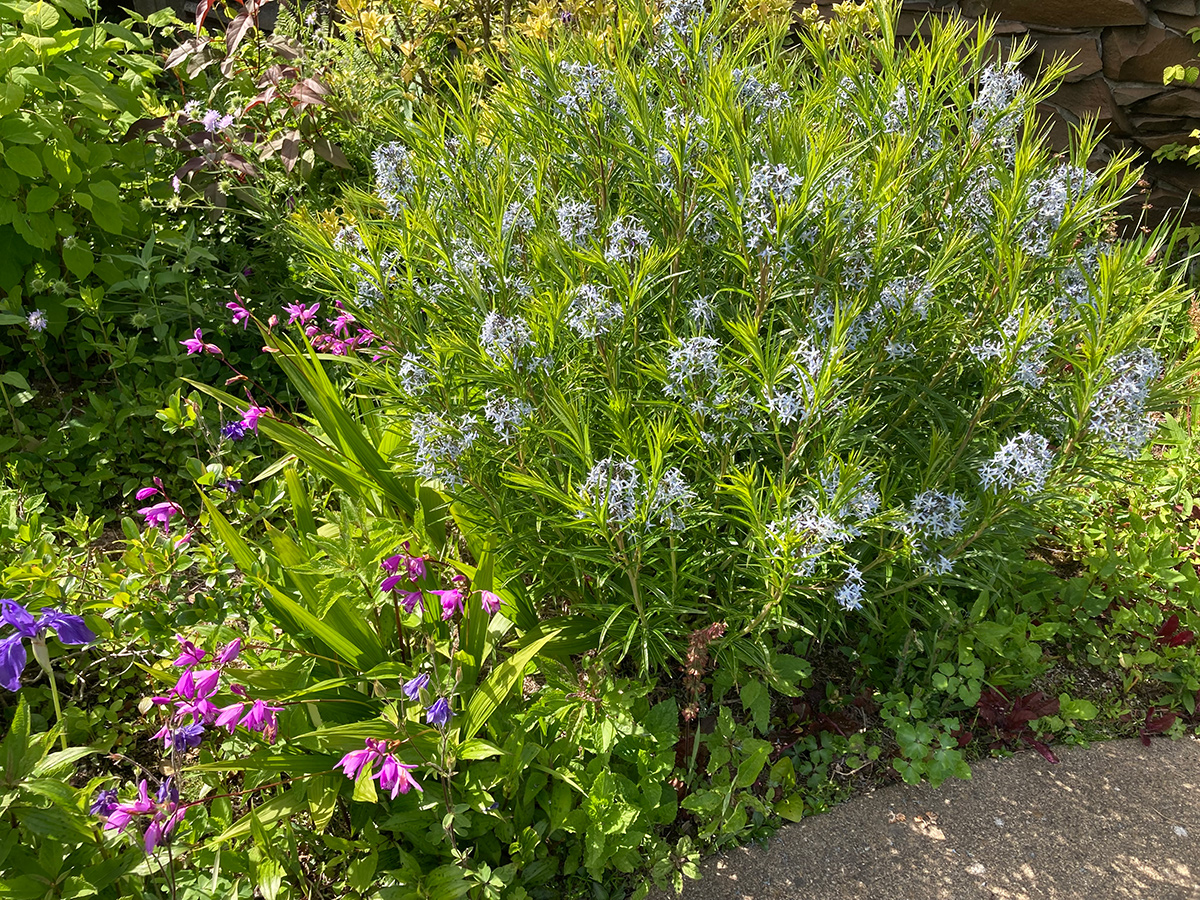
I love blue flowers. Hubricht’s bluestar (Amsonia hubrichtii, Zones 5–8)is wonderful. Here are the blue spring flowers; then the slender green leaves sway in the breeze all summer and turn bright yellow in the autumn. Magenta flowers on the left are the hyacinth orchid(Bletilla striata, Zones 5–9), which I got from my aunt’s Maryland garden.
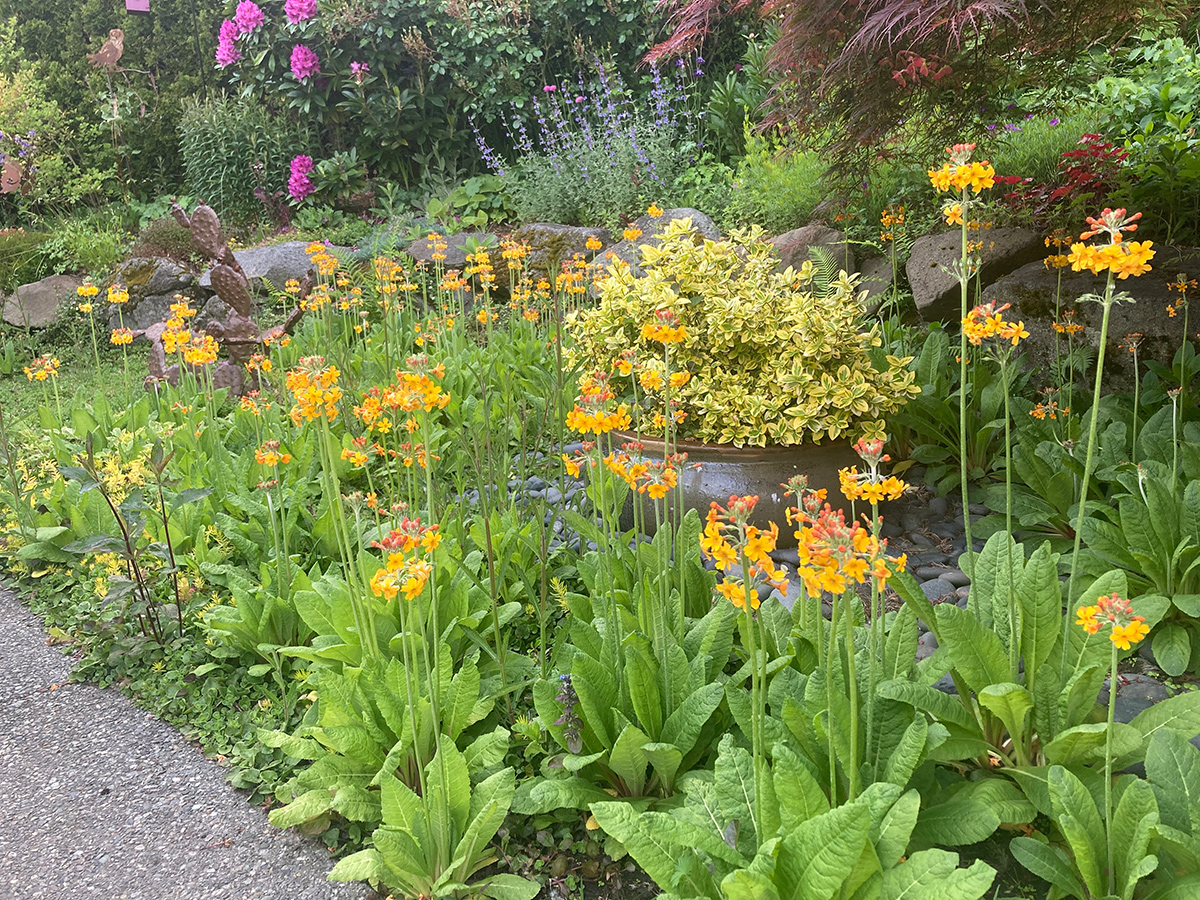
Part of our garden is damp clay. Sixteen years ago, I bought seven plants of this candelabra primrose(Primula × bulleesiana, Zones 4–7). The seed heads are left on most of the summer. I now have a wandering stream of these primroses, which is a garden favorite.
Thank you so much for this fantastic spring tour of your garden, Cleo! Your space is filled with so many interesting and eye-catching plants in every season; we greatly appreciate the time you take to identify each one.
I cannot believe that next week is already the end of spring! This season absolutely flew by, but I’m thrilled with how many fabulous spring gardens we’ve been treated to over the past few months. If you would like your spring garden featured on the blog before summer photos flood our inbox, consider sharing your photos this weekend! Follow the directions below to submit photos via email, or send me a DM on Instagram: @agirlherdogandtheroad.
We want to see YOUR garden!
Have photos to share? We’d love to see your garden, a particular collection of plants you love, or a wonderful garden you had the chance to visit!
To submit, send 5–10 photos to [email protected] along with some information about the plants in the pictures and where you took the photos. We’d love to hear where you are located, how long you’ve been gardening, successes you are proud of, failures you learned from, hopes for the future, favorite plants, or funny stories from your garden.
Do you receive the GPOD by email yet? Sign up here
Fine Gardening Recommended Products
Attracting Beneficial Bugs to Your Garden, Revised and Updated Second Edition: A Natural Approach to Pest Control
Fine Gardening receives a commission for items purchased through links on this site, including Amazon Associates and other affiliate advertising programs.
This revised and updated edition of Jessica Walliser’s award-winning Attracting Beneficial Bugs to Your Garden offers a valuable and science-backed plan for bringing balance back to the garden. With this indispensable gardening reference—now updated with new research, insights, and voices—learn how to create a healthy, balanced, and diverse garden capable of supporting a hard-working crew of beneficial pest-eating insects and eliminate the need for synthetic chemical pesticides.
ARS Telescoping Long Reach Pruner
Fine Gardening receives a commission for items purchased through links on this site, including Amazon Associates and other affiliate advertising programs.
Telescopes from 4 to 7′. Cut and Hold (160) Blades. Drop forged blades for unsurpassed long lasting sharpness. Lightweight, 2.3 lbs., for continued use. Perfectly balanced for easy pruning.
The Regenerative Landscaper: Design and Build Landscapes That Repair the Environment
Fine Gardening receives a commission for items purchased through links on this site, including Amazon Associates and other affiliate advertising programs.
2024 Nautilus Award Gold Medal Winner! This awe-inspiring guide weaves together permaculture design, food resiliency, climate adaptation, community organizing, and indigenous wisdom that you can implement in your own backyard.
I recently shared how I reversed my Hashimoto’s and naturally healed my thyroid, and many of you were curious how. In this post, I’m sharing a full thyroid update and walking you through my Hashimoto’s healing journey. But before we start, please keep in mind that everyone is different and what works for me may […]
Imagine turning your pond into a self-cleaning, crystal-clear oasis—just by letting the right plants do the work.
Crystal-clear pond water doesn’t just magically appear—it needs a balanfced ecosystem where nutrients, oxygen, and waste are all in harmony. A bog filter is one of the coolest, most natural ways to make that happen, using aquatic plants to clean the water like champs.
Unlike clunky mechanical or chemical filters, bog filters vibe with nature instead of fighting it. They lean on wetland vibes to clear out gunk with a living, breathing system.
The plants are the real MVPs here—hardworking, easy to care for, and nice to look at. But you’ve gotta pick the right ones to nail the results.
What Is a Bog Filter and How Does It Work?
A bog filter is a natural, eco-friendly filtration system for ponds that uses aquatic plants and a gravel bed to purify water, mimicking the processes of a wetland.
As mentioned above, it’s a low-maintenance, sustainable alternative to mechanical or chemical filters, working in harmony with nature to keep pond water crystal-clear.
How It Works?
Bog filters leverage nature’s own processes—plants and microbes naturally cleanse water in wetlands, and this system replicates that.
It reduces the need for frequent maintenance, cuts down on chemical use, and creates a thriving habitat for both plants and pond life. Choosing the right plants and ensuring proper water flow are key to making it effective.
Structure: A bog filter is typically a shallow, gravel-filled basin or section of the pond (often 10-30% of the pond’s surface area) that’s separated from the main pond but connected via a pump or water flow system.
Water Flow: Pond water is pumped or gravity-fed into the bog filter, where it slowly percolates through layers of gravel and plant roots.
Plant Power: Aquatic plants, like watercress, pickerelweed, or cattails, are rooted in the gravel. Their roots absorb excess nutrients (like nitrates and phosphates) and trap organic waste, preventing algae growth and water cloudiness.
Microbial Magic: Beneficial bacteria colonize the gravel and plant roots, breaking down pollutants, ammonia, and fish waste into less harmful compounds.
Clean Water Return: The filtered water flows back into the pond, refreshed and balanced, maintaining a healthy ecosystem.
Key Components of a Bog Filter:
Gravel bed: Acts as a medium for beneficial bacteria and root stabilization.
Aquatic plants: Extract nutrients (nitrates, phosphates, ammonia) from the water.
Slow water movement: Ensures maximum contact between water, plants, and microbes.
Mechanical pre-filter (optional): Prevents large debris from clogging the bog.
How It Benefits Your Pond?
A bog filter brings a bunch of awesome benefits to your pond, making it healthier, clearer, and easier to maintain. Here’s how:
Crystal-Clear Water: The plants and beneficial bacteria in the bog filter suck up excess nutrients like nitrates and phosphates, starving out algae and keeping your water sparkling clean.
Low Maintenance: Unlike mechanical filters that need constant cleaning or chemical treatments, bog filters are pretty much set-it-and-forget-it once established, saving you time and hassle.
Eco-Friendly: It’s a natural system that works with nature, not against it, so you’re not dumping chemicals into your pond or relying on energy-hungry equipment.
Boosts Ecosystem Health: The plants and microbes create a balanced environment, breaking down fish waste and pollutants, which keeps your fish and other pond critters happy and healthy.
Adds Beauty: Those hardworking aquatic plants like watercress or pickerelweed look gorgeous, turning your filter into a lush, natural feature that enhances your pond’s vibe.
Cost-Effective: Once set up, bog filters are cheap to maintain—no pricey filter replacements or chemicals needed, just nature doing its thing.
10 Best Plants for a Bog Filter
These aquatic plants are the MVPs of bog filters, naturally cleaning pond water by absorbing excess nutrients and trapping waste, all while adding beauty to your setup. Pick the right ones, and your pond will stay clear and healthy with minimal effort.
1. Pickerelweed
With its upright spikes of violet-blue flowers, Pickerelweed is as functional as it is beautiful. Native to North America, this marginal aquatic plant thrives in shallow water up to 6 inches deep and blooms from summer into early fall.
Why It Works: Its roots penetrate deep into the gravel, absorbing excess nitrogen and phosphates that would otherwise feed algae. It also provides shelter for frogs and beneficial insects.
Growing Conditions:
Sun: Full sun to partial shade
Water depth: 1–6 inches
Height: 2–3 feet
Zones: 3–10
2. Water Iris (Iris pseudacorus, Iris versicolor)
Water irises add striking vertical foliage and spring blooms in shades of yellow, blue, or purple. While Iris pseudacorus (Yellow Flag) is widely used, it’s invasive in many areas—choose Iris versicolor (Blue Flag) instead for a native, safe option.
Why It Works: Irises are nitrate hogs, removing large amounts of nutrients quickly. Their dense, fibrous roots also help prevent erosion and trap debris.
Growing Conditions:
Sun: Full sun
Water depth: Moist soil to 4 inches
Height: 2–4 feet
Zones: 4–9
3. Creeping Jenny
This fast-spreading groundcover has cheerful golden foliage and small yellow blooms. It cascades beautifully over rocks and gravel, creating a lush carpet in the bog filter.
Why It Works: It smothers weeds, covers bare gravel, and absorbs nutrients quickly. It also helps reduce algae growth by shading water and minimizing exposed surfaces.
Growing Conditions:
Sun: Full sun to part shade
Water depth: Moist soil to 1 inch
Height: 2–4 inches
Zones: 3–9
4. Marsh Marigold
One of the first pond plants to flower in spring, Marsh Marigold brightens bog filters with its shiny, buttercup-like flowers and glossy foliage. It prefers cool, wet environments and disappears in heat but returns each spring.
Why It Works: Its early-season growth kickstarts the bog’s filtration when other plants are still dormant.
Growing Conditions:
Sun: Full sun to partial shade
Water depth: Moist soil to 2 inches
Height: 8–18 inches
Zones: 3–7
5. Horsetail Rush
A prehistoric-looking plant with bamboo-like stems, Horsetail Rush is a dramatic vertical accent in bog gardens. It’s durable and spreads by underground rhizomes.
Why It Works: Its roots are efficient at trapping fine sediments and absorbing nutrients. It’s also deer-resistant and thrives in poor soil.
Growing Conditions:
Sun: Full sun to part shade
Water depth: Moist to 4 inches
Height: 2–4 feet
Zones: 4–9
Note: Can be aggressive—contain with edging or containers in the bog.
6. Arrowhead (Sagittaria latifolia)
This North American native features arrow-shaped leaves and tall white flower spikes. It grows in shallow water and is often found along streambanks.
Why It Works: Its broad leaves and strong roots make it a champion at filtering water. It also offers excellent habitat for pollinators and amphibians.
Growing Conditions:
Sun: Full sun
Water depth: 1–6 inches
Height: 2–3 feet
Zones: 3–10
7. Blue Flag Iris
A native iris ideal for bog filters, this species produces showy blue-purple flowers in late spring and is beloved by bees and butterflies.
Why It Works: Like other irises, Blue Flag removes heavy metals and excess nutrients while anchoring gravel with tough root systems.
Growing Conditions:
Sun: Full sun to partial shade
Water depth: Moist to 4 inches
Height: 2–3 feet
Zones: 5–9
8. Cardinal Flower
This native wildflower is famous for its fiery red blooms that attract hummingbirds. It thrives in wet soil but can handle shallow water as well.
Why It Works: Fast-growing and nutrient-hungry, it helps prevent nutrient overload while adding visual drama.
Growing Conditions:
Sun: Full sun to partial shade
Water depth: Moist soil to 1 inch
Height: 2–4 feet
Zones: 3–9
9. Sweet Flag (Acorus calamus)
Often confused with ornamental grasses, Sweet Flag has sword-like leaves and a pleasant aroma when crushed. It’s easy to grow in shallow water.
Why It Works: It oxygenates water, absorbs pollutants, and spreads gently. A fantastic filler plant in any bog.
Growing Conditions:
Sun: Full sun to partial shade
Water depth: Moist soil to 2 inches
Height: 1–3 feet
Zones: 4–11
10. Taro (Colocasia esculenta)
For a bold, tropical look, few plants match the size and impact of Taro. Its massive leaves shade the bog, helping control algae.
Why It Works: Heavy feeder that absorbs vast amounts of nutrients. Excellent at shading shallow areas to reduce evaporation.
Growing Conditions:
Sun: Full sun to partial shade
Water depth: Moist to 4 inches
Height: 3–6 feet
Zones: 8–11 (annual in cooler zones)
Planting & Maintenance Tips for Your Bog Filter
1. Use Washed Gravel
Avoid soil—it clogs water flow. Use pea gravel or expanded clay for better drainage and root penetration.
2. Plant Sparingly (at First)
Start with small transplants spaced 12–18 inches apart. Most plants will spread quickly.
3. Prune Regularly
Dead foliage can rot and release nutrients back into the water. Trim back in fall or early spring.
4. Prevent Overgrowth
Fast-spreaders like Horsetail or Creeping Jenny should be contained with edging or root barriers.
5. Balance Plant Types
Include a mix of bloomers, spreaders, and vertical plants for aesthetics and filtration coverage.
How deep should a bog filter be?
Most bogs are 6–12 inches deep. Deeper areas may reduce plant root oxygenation.
How long until the bog filter starts working?
A pump is essential for moving water through the gravel bed. Still water won’t be filtered effectively.
Conclusion
If you’re serious about water clarity and pond health, a bog filter is a game-changer—and the right plants are the key to its success. By choosing water-loving, nutrient-hungry species like Pickerelweed, Iris, and Arrowhead, you create a living, breathing water filter that not only purifies your pond but also adds unmatched beauty and biodiversity.
So go ahead—let plants do the heavy lifting, and watch your pond come alive.
Khaja Moinuddin, a computer science graduate, finds joy in gardening and homesteading. Join him on this blog as he shares his experiences in homesteading, gardening, and composting
A group of medical experts that advise the CDC largely determine which vaccines people should receive, what gets covered by insurance and which shots are made available free of charge to millions of low-income children.
Joe Raedle/Getty Images
hide caption
toggle caption
Joe Raedle/Getty Images
Until this week, it’s likely many people hadn’t heard much about the Centers for Disease Control and Prevention’s vaccine advisory panel.
But the Advisory Committee on Immunization Practices, or ACIP, plays a key role in determining which vaccines children and adults receive, what gets covered by insurance and which shots are made available free of charge to millions of low-income children. So the panel’s decisions ultimately affect the health of all Americans.
Several of Kennedy’s new selections for the panel rose to prominence during the COVID-19 pandemic, when they criticized government policies on school closures and lockdowns, and the mRNA vaccines. One, Vicky Pebsworth, has served on the board of the National Vaccine Information Center — an advocacy group that warns against vaccine risks.
Some immunization and infectious disease specialists worry that the newly constituted committee is skeptical of vaccines and could vote to downgrade the importance of some shots, and ultimately make it more difficult for families to get them.
“I am very concerned,” says Dr. Walter Orenstein, who served as director of the U.S. immunization program at the CDC from 1988 to 2004 and is now professor emeritus of infectious diseases at Emory University School of Medicine. “I have spent a career of more than 50 years in vaccinology, and I have never seen the names of most of those people.”
Dr. Sean O’Leary, chair of the Committee on Infectious Diseases for the American Academy of Pediatrics, calls the changes to ACIP a “disaster.”
“Imagine if you took all the air traffic controllers in the U.S. and just fired them and you replaced them with people that not only didn’t really know how to be air traffic controllers, but several of them didn’t even believe in flying,” he says.
In a statement, HHS defended Kennedy’s choices for the committee, saying they are “highly credentialed doctors, scientists, and public health experts committed to evidence-based medicine, gold standard science, and common sense.”
The statement said that the group “will demand definitive safety and efficacy data for any new vaccine recommendations,” and that they will review the current vaccine schedule.
Recommendations that affect insurance coverage
The members of ACIP meet at least three times a year to sift through the scientific data on vaccines and determine which ones are recommended for different age groups. If the CDC approves ACIP’s recommendations, that can lead to a vaccine becoming part of the official immunization schedule for children and adults.
It also means insurance has to pay for it. Under the Affordable Care Act, health insurers are required to cover all ACIP-recommended vaccines.
ACIP’s recommendations also determine which vaccines get covered by the Vaccines for Children program, a federally funded initiative that provides free access to low-income and underinsured children. Around half of all children in the U.S. are eligible for free vaccines from the program, says Orenstein.
That means any changes to the vaccines recommended by ACIP “would be a major potential barrier to access for vaccines for a substantial proportion of the children in this country if they took it from a vaccine off of the schedule,” Orenstein says.
He helped launch the Vaccines for Children program in the aftermath of a huge measles resurgence from 1989 to 1991 that resulted in tens of thousands of cases and over 120 deaths. Many of the kids who got sick had not been vaccinated because their families couldn’t afford it.
ACIP’s recommendations often help guide which immunizations are required for school entry.
Guidance that influences how doctors practice
The wording of the committee’s recommendations matters too. A routine recommendation calls for all people within a given age or risk group to get a specific vaccine, unless there is a medical reason not to. But ACIP can also choose to recommend a vaccine under what’s called shared clinical decision-making – which means a doctor and a patient decide together if it makes sense.
“Generally, we don’t really like shared clinical decision-making because it makes it less of a priority for clinicians to talk to their patients about a vaccine,” says Dr. Michelle Fiscus, a pediatrician and chief medical officer for the Association of Immunization Managers.
It also makes it harder to have a clear, direct conversation with families, says O’Leary, of the American Academy of Pediatrics, who is also a professor of pediatrics at the University of Colorado School of Medicine.
“What I’ve heard anecdotally from pediatricians is, what [families will] say is, well, you guys are the experts. If you can’t figure out what the right thing to do is, you know, how do you expect us to do that in a ten-minute office visit?” O’Leary says.
That designation can also make it less likely that a medical provider will keep a vaccine in stock, he says. O’Leary notes that most pediatricians and many other health care providers in the U.S. participate in the Vaccines for Children program and are required to keep routinely recommended vaccines in stock. But that’s not the case when a vaccine is recommended under shared clinical-decision making.
“Already it’s very challenging for a lot of mostly family medicine physicians in rural areas to stock vaccines because it financially is very challenging for them,” O’Leary says.
He says recommending a vaccine under shared clinical decision-making could potentially make it less available, especially in rural areas.
The CDC’s recently changed the recommendations on COVID vaccines for children to shared clinical decision-making, and O’Leary says that has already sown confusion among parents and pediatricians alike. He worries that, if the new ACIP moves more vaccines to that designation, it will “sow distrust in the process.”
“It makes it look like these vaccines aren’t important and these vaccines are very important. They save lives every day,” he says.
With its glossy green foliage, cheerful yellow blossoms, and striking fruit display, the Mickey Mouse plant (Ochna serrulata) is suited to cultivation in Zones 9 to 11.
Native to South Africa, this semi-evergreen shrub is also known as bird’s eye bush, carnival ochna, and small-leaved plane.
We link to vendors to help you find relevant products. If you buy from one of our links, we may earn a commission.
Why the whimsical name?
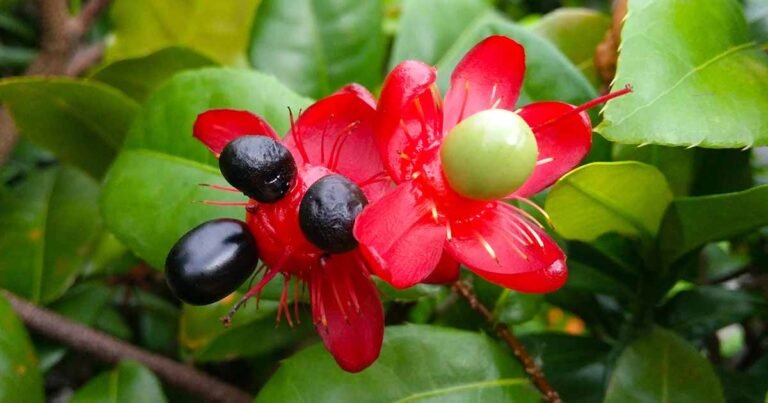
As the yellow flowers fade, they’re followed by red petal-like sepals and glossy black berries, resembling the classic cartoon character’s yellow shoes, black ears, and red pants.
Read on to learn how to grow and care for Mickey Mouse shrubs in your landscape.
O. serrulata puts on a decorative display from late spring to fall.
The shrubs have a loose, irregular growth habit. Elliptical green leaves alternate along branching stems dotted with respiratory pores called lenticels, giving the bark a spotted appearance.
Five-petaled, fragrant yellow flowers appear briefly in spring.
As the petals fall, the green sepals enlarge and turn bright red, encasing the young green drupes that mature into shiny black berries by late summer.
The shrubs are semi-evergreen and may drop some leaves at season’s end in the cooler parts of their hardiness range.
Mickey Mouse plant is a slow-growing species with the potential to become invasive and has done so in parts of Australia and New Zealand as well as Hawai’i.
The Hawai‘i-Pacific Weed Risk Assessment rates it as “High Risk,” indicating significant potential for ecological disruption.
Note also that it is toxic to people and pets if ingested.
Other, less commonly cultivated Ochna species include O. natalitia, aka Mickey Mouse bush, and Natal or showy plane.
This species differs from O. serrulata, having larger leaves that emerge red in the spring and slightly larger yellow flowers.
Expect mature heights of four to eight feet with a spread of three to four feet.
Mickey Mouse plants work well as ornamental specimens, naturalize readily, and make attractive informal hedges when multiple are planted together, spaced three to four feet apart.
How to Grow
Mickey Mouse plant is relatively easy to cultivate when its basic requirements are met. It thrives in warm, humid environments that mimic its native subtropical South African habitat.
Climate
This shrub flourishes in temperatures ranging between 59 and 97°F during the growing season.
It can tolerate temperatures as low as 28°F in winter but may experience leaf drop or dieback.
In areas prone to frost, consider providing protection or cultivating Mickey Mouse plant in containers that can be moved indoors during colder months.
Light
Choose a location with full sun to partial shade. In the warmest regions, an understory placement with the dappled sunlight penetrating the foliage of taller shrubs and trees can help to avoid leaf scorch.
While Mickey Mouse plant can tolerate some shade, insufficient light may lead to reduced flowering and fruiting.
Soil
The soil should be moisture-retentive, well-draining average loam. A slightly acidic to neutral pH between 5.5 and 6.5 is ideal.
Water
Maintain consistent moisture, especially during the growing season. Water Mickey Mouse plants when the top inch of soil feels dry, ensuring the soil remains moist but not waterlogged.
Once established, O. serrulata exhibits moderate drought tolerance but benefits from regular watering during prolonged dry periods.
Fertilizing
Mickey Mouse isn’t a heavy feeder, so avoid overfertilizing, which can damage roots and stems.
If your soil is poor, work in a few handfuls of compost at planting time to improve nutrition and drainage.
Each spring, you can top-dress with compost or apply a slow-release granular fertilizer with a 5-10-5 (NPK) ratio to support blooming and fruit development.
Keep the product away from the base of the shrub to avoid stem burn.
Where to Buy
Mickey Mouse plant is not commonly available through mainstream nurseries or large online retailers.
You will most likely find it in specialty nurseries in the appropriate growing zones or from plant enthusiasts.
You can find Mickey Mouse plants available from 9EzTropical via Amazon in six-inch pots.
Maintenance
Prune after fruiting to shape the specimen into a compact, multi-branching shrub or single-trunked small tree.
Avoid removing more than one-third of the total volume at any one time to avoid shock.
You can also perform light trimming during the growing season to remove dead, damaged, or diseased branches as needed.
Pluck and dispose of seedlings that pop up in unwanted places in the spring.
Propagation
You can propagate these shrubs from seeds or via stem cuttings. The easiest way to get started is to transplant a nursery start.
From Seed
Purchase seeds or collect the fruits from an existing Mickey Mouse plant when they turn black and crinkly.
You can remove the seeds from the fruits or simply scarify them by rubbing them with sandpaper or a nail file to remove some of the tough outer coating.
Soak the seeds overnight in tepid water.
Fill three-inch seed starter pots three-quarters full with moisture-retentive, well-draining potting soil.
Sow one or two seeds in each pot about a third of an inch deep.
Cover them lightly with soil.
Water the soil so it’s evenly moist but not waterlogged.
Set them in a location with bright, indirect sunlight.
Maintain even moisture by watering before the potting mix dries out.
When the seedlings have several sets of true leaves, thin them to one per pot.
The seedlings are ready for transplant when they are about four to six inches tall.
From Cuttings
To propagate from stem cuttings, wait for a flush of new foliar growth.
Cut a six-inch length of fresh stem and tip growth just below a leaf node.
Remove the leaves from the bottom three inches of stem.
Prepare a six-inch pot three-quarters full of moisture-retentive, well-draining potting medium.
Use a pencil or chopstick to make a three-inch-deep hole in the center of the soil.
Dip the cut end of the stem into rooting hormone powder.
Place the stem in the three-inch hole so the leafless part is below the soil.
Tamp the soil to hold it firmly in place and water in well.
Place the container in bright, indirect sunlight. Maintain even moisture without oversaturation.
When the cutting produces new foliage it’s ready to transplant.
Transplanting
When you have an established seedling, cutting, or nursery start, you can transplant it to the landscape in spring. In warm, frost-free regions, late winter to early spring is ideal.
Begin by watering shrub the day before to help ease transplant shock. Note its depth in the original container.
Choose a site with loamy, well-draining soil, and amend it with compost if necessary to improve texture and drainage.
Work the soil to a depth of eight to 12 inches until it is crumbly and free from debris.
Make a hole twice as wide and the same depth as the current container.
Unpot and place the root ball in the prepared hole at the same depth as in the original container, slightly above ground level.
Backfill, tamp well, and water in well.
Maintain even moisture during the establishment period, watering when the top few inches of soil dry out.
Alternatively, grow in a well-draining container three-quarters full of a moisture-retentive, well-draining potting medium.
Choose a pot that’s two to four inches wider and deeper than the root ball. Water when the top few inches of soil feel dry, and hold off on fertilizing at planting time.
Pests and Disease
While Mickey Mouse plant is not especially prone to problems with pests or disease, you may encounter them in less than ideal growing conditions.
Scale, mealybugs, and thrips are sapsucking insects that favor hot, dry conditions.
These insects feed on plant juices and can cause yellowing leaves, stunted growth, and overall decline. They may also spread disease.
Keep the soil consistently moist but not soggy to help discourage infestations, and treat outbreaks with organic neem oil.
The lenticels on the branches are open pores that can sometimes become entry points for fungal pathogens, particularly in overly wet or humid conditions.
To reduce the risk of infection, ensure the shrub receives adequate sunlight and avoid overwatering.
M-I-C-K-E-Y-M-O-U-S-E
If you are – ahem – of a certain age, like me, you are bound to have seen one of the incarnations of the Mickey Mouse Club TV show and know that the theme song spelled out the beloved rodent’s name.
The bright red sepals and black fruits of easy-care, semi-evergreen O. serrulata make a vibrant, whimsical welcome in outdoor living spaces in the classic “Hey, there, hi there, ho there” Mickey Mouse style many gardeners fondly remember.
Do you grow Mickey Mouse plant in your landscape? Please share your tips in the comments section below.
It’s really common to have a baby shower for new parents. And while baby shower gifts and a new baby are always exciting, let’s not forget about the mom to be either! A postpartum gift basket is a great way to show a new mama (or seasoned mama) some love.
If you don’t have the time/money to do a large new mom gift basket, even just an item or two can show you care. Postpartum recovery can be tough, both physically and emotionally. And if the new mama is breastfeeding or had a C-section, those come with their own challenges. A postpartum care package is a great way for moms to get a little self-care and pampering.
Gifts like a journal to process postpartum emotions, a comfy robe, or nursing-friendly pajamas are all great ideas. Throw a water bottle or even a gift card in there too! I have lots of ideas in this postpartum essentials post.
DIY Postpartum Gift Basket Ideas
Some of the most affordable and thoughtful gifts are homemade ones. And if you’ve been a reader for very long, you know I love a good natural DIY recipe! The following DIY postpartum gift basket ideas are simple to make and make a great gift for any new mom and her little one.
Some of the recipes serve double duty and are great for other family members, not just moms.
Note: Be sure to double check before adding essential oils to any of the recipes, like lotion. For example, oils like peppermint can decrease breastmilk supply. Here’s a thorough list of which essential oils breastfeeding moms should avoid.
Soothing Postpartum Home Remedies
Pregnancy is an impressive accomplishment, but it can come with stretch marks, C-section scars, and other struggles. Here are some DIY postpartum gift ideas to help mom heal faster and soothe the aches that come with postpartum life.
Soothing Postpartum Spray – Helps calm inflammation, relieve pain, and restore damaged tissue in the peri area.
After Birth Sitz Bath – This soothing mix of herbs helps to make mama’s sore bottom less sore. The dry mix can be brewed as a tea and added to a sitz bath or a peri bottle.
After Birth Bath Fizzies – These bath bombs feature nourishing herbs instead of essential oils for soothing relief.
After Birth Tincture – As any seasoned mom knows, after birth contractions can be as painful (or more) than labor itself. Soothe the after birth pains with this homemade tincture.
Rice Heat Packs – These reusable heating pads are a lifesaver when it comes to postpartum discomfort. Customize them with your favorite fabric and add lavender for added relaxation.
Padsicles – These are a great way to relieve pain and inflammation in the peri area. It’s basically herbal tea frozen onto a pad.
Nourishing Foods
Building a baby takes a lot out of a mom, so it’s important to focus on good nutrition. And if they’re breastfeeding, they’re burning an extra 500-700 calories a day! Traditional cultures made sure new moms were getting plenty of nutrient dense, warming, and animal-based foods.
Pregnancy Tea – I drank herbal tea when I was expecting, but many of the same nourishing herbs are also great for postpartum. They increase the nutritional value of breastmilk and help restore mom’s nutrient stores.
Soups and Stews – Slip a jar of some homemade soup into their gift basket (for the freezer) or drop it off on their doorstep after baby arrives. Soups and stews can be a nourishing way to replenish vitamins and minerals.
Sauerkraut – Keep things moving in the bathroom with some homemade sauerkraut! Great for the gut microbiome and offers a big probiotic boost.
Bone Broth – Nourishing bone broth is a staple in our home and also great for postpartum moms.
DIY Bodycare
Making homemade skincare products is a great way to opt for clean, non-toxic ingredients. Plus, they’re fun to make! Many of these recipes use essential oils, so be sure to opt for breastfeeding safe ones or omit them.
Homemade lotion – Soothing shea butter and coconut oil combine to make this luxurious lotion. Infuse the oils with herbs like calendula and chamomile for a gentle version.
Whipped Body Butter – Similar to a lotion but even more moisturizing. This whipped body butter features cocoa butter, shea butter, and coconut oil.
Lotion Bars – Another one for team lotion. These portable lotion bars have all of the benefits of homemade lotion with less mess.
Rosehip Facial Moisturizer – Pregnancy can cause skin changes, including melasma (dark patches) on the face. A face moisturizer can be a great way to help their skin bounce back better.
Hair Growth Oil – Postpartum hair loss can be intense. Help moms take care of their locks and support stronger hair and hair growth with this DIY hair growth oil.
Tallow Lip Balm – Tallow closely mimics our skin’s natural oils, making it a great option for moisturizing. And this tallow lip balm is simple with only 4 ingredients!
Homemade Lip Balm – Want a more traditional Chapstick recipe? This hydrating lip balm is a great option for parched lips.
Nursing Moms Postpartum Gift Basket Ideas
If the new mom is breastfeeding, here are a few recipes to help her out. These are great whether she’s a first-time mom or a seasoned pro.
Nursing Balm Nipple Cream – No one prepared me for how much breastfeeding could actually hurt at first! This nipple cream is safe for baby and helps soothe sore or damaged nipples.
Nursing Mom Tea – This blend of herbs helps provide much needed nutrition and boost breastmilk supply. Plus it tastes pretty good too! Give her a jar full of dried tea mix along with a new thermos to keep it warm!
Lactation Cookies – While nursing tea is certainly nice, who doesn’t like cookies? These lactation cookies are delicious and are a great way to naturally increase breastmilk.
Sweet, Sweet Sleep
Any mom with a newborn knows that sleep can be elusive (and sometimes non-existent). Helping baby stay healthy and supporting their nervous system (like through pediatric chiropractic care) can go a long way towards helping baby sleep at night. While a full night’s sleep isn’t always guaranteed, the following can help mom have a little more rest and relaxation.
Relaxing Pillow Spray – This pillow spray uses calming and stress relieving essential oils like lavender and bergamot. While all of the essential oils used here are considered safe to diffuse around babies, use caution if using directly near co-sleeping babies sleep space.
Sleep Lotion – Help relax and calm with soothing lavender and cedarwood lotion.
Magnesium Body Butter – Most of us are magnesium deficient, and magnesium lotion can be a great way to relax and soothe tired muscles. I like applying this on the legs and bottoms of my feet before bed.
Last week we got a springtime update from Lila Johnson in Mill Creek, Wash. (Spring Greens and Purples in the PNW). Her photos focused on the fresh green foliage and pops of purple flowers in her spring garden, but she did mention that some azaleas and rhododendrons add little pockets of pink to the mix as well. Thankfully, she did not leave us to only imagine the fabulous flowering shrubs, and followed her first batch of photos with a submission featuring these bright spring flowers.
Hi again—since I made mention of azaleas and rhododendrons in my previous emails, I thought I should send some pictures. It is past their prime blooming, but they still add color to our spring green garden. I LOVE rosy pink, as you can probably tell.
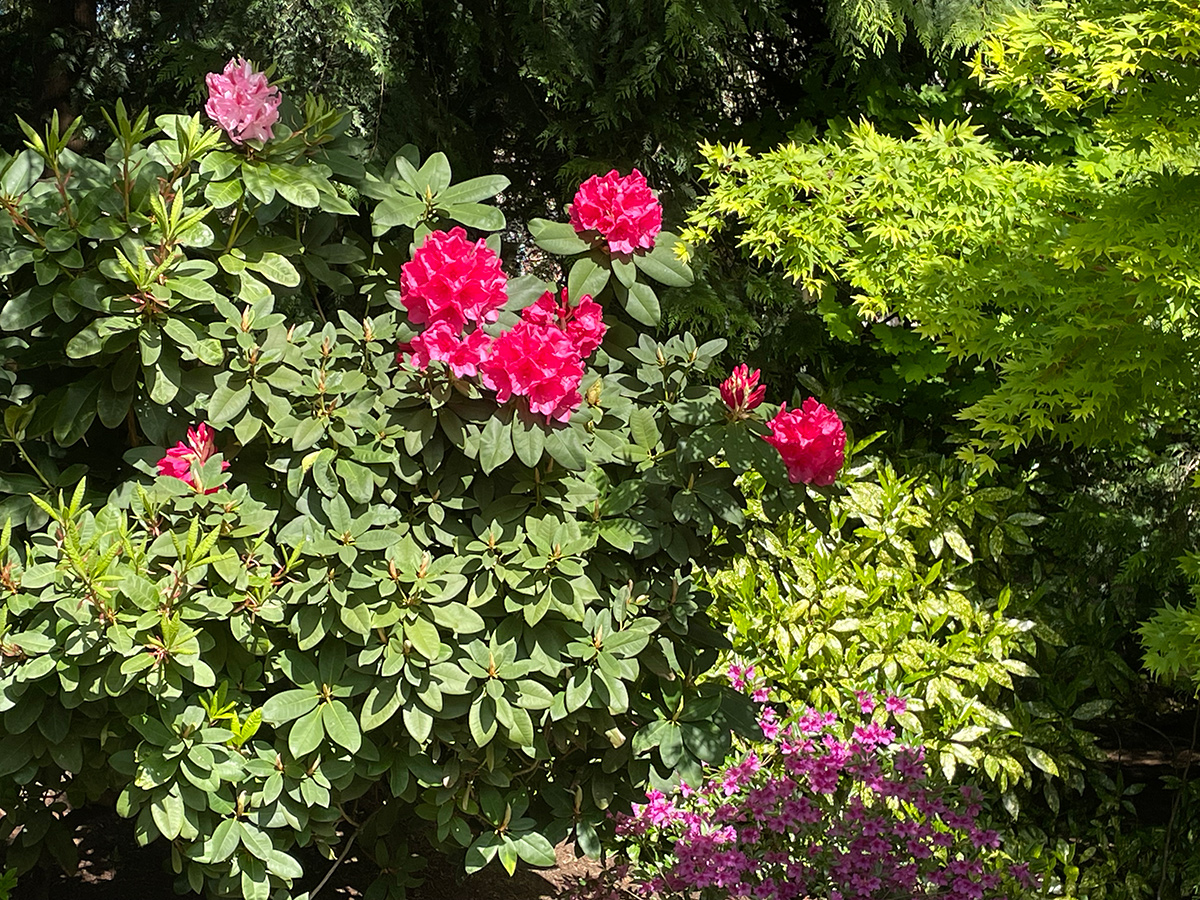
I have no idea what the names are on these plants! Sorry. The large rhodies are on a berm under several cedar trees. They are not hardy bloomers in this morning-sun-only location, but they give us a natural privacy screen from several homes/yards behind us. They’ve been there for more than 25 years. 🙂
This photo [of Lila’s large rhododendron underneath cedar trees] was taken in early May. The others were taken today, May 24.
A “berm” photo to give you an idea of the size of the rhododendrons. I’m sure they would bloom more if they were in a sunnier location, but they provide lovely foliage and natural privacy.
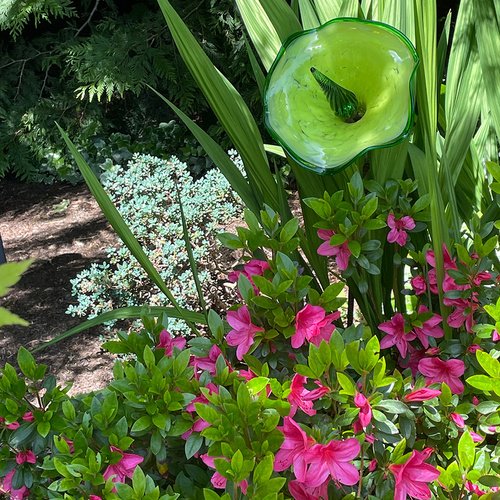
Lila’s azaleas are much smaller but get absolutely covered in these brilliantly bright blooms.
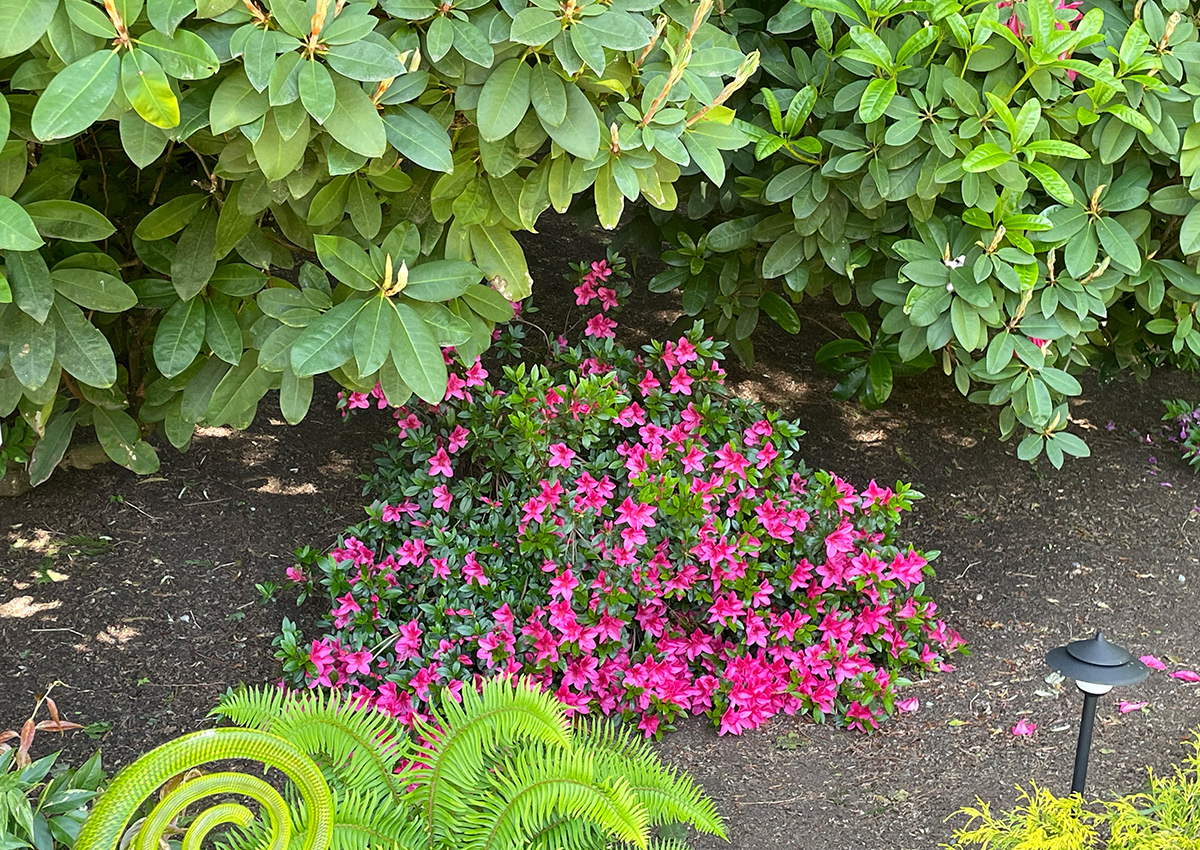
This photo gives a better sense of their size—also tucked into the shade of Lila’s cedar trees and rhododendron but providing a pop of bright pink among her glorious tapestry of green.
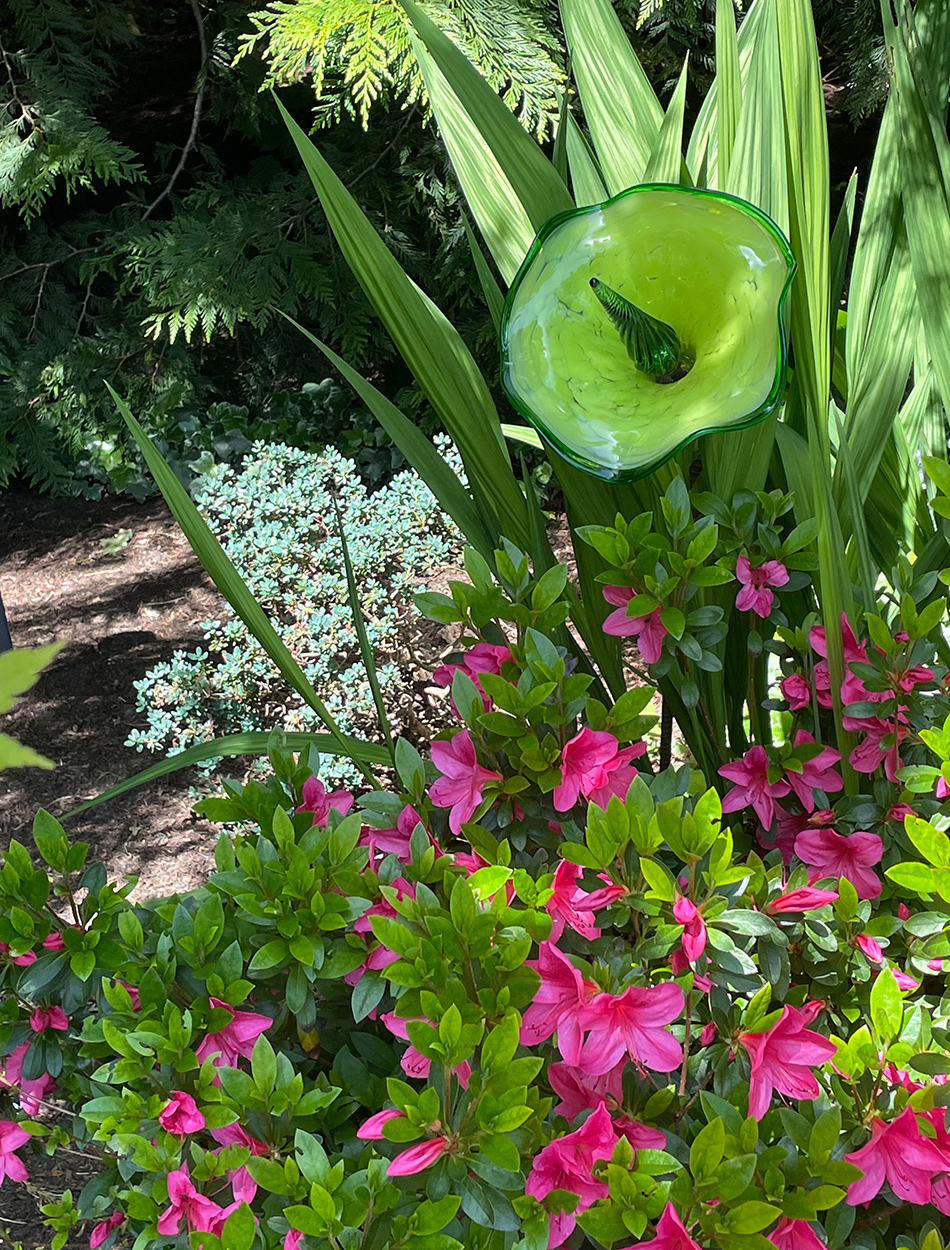
A beautiful green glass flower adds a bit of sparkle and shine to this shady but colorful scene.
A photo from another perspective shows how the bright pink is a fantastic accent to all Lila’s green spring foliage, as well as the purple clematis climbing up her arbor and the shiny blue pot on her patio.
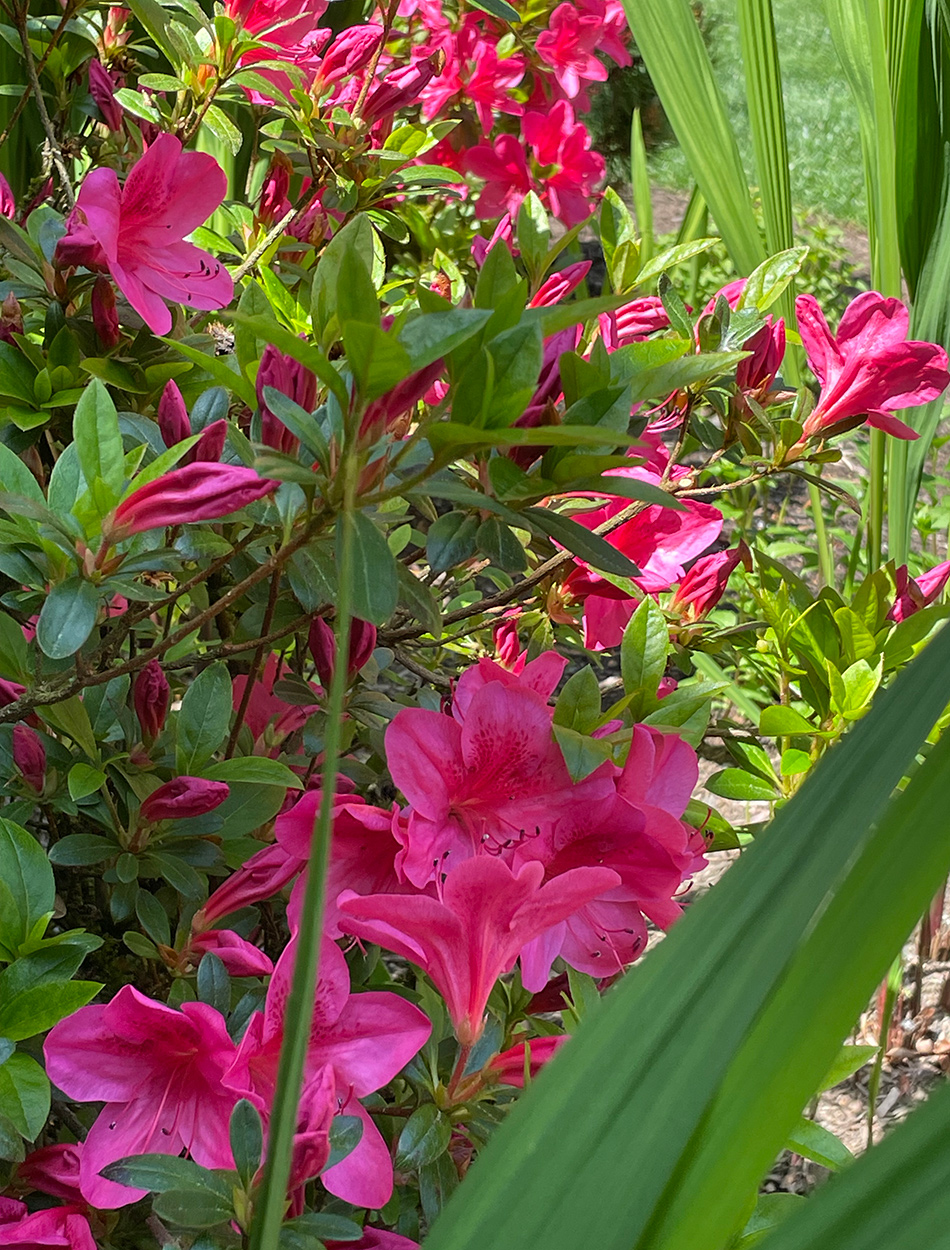
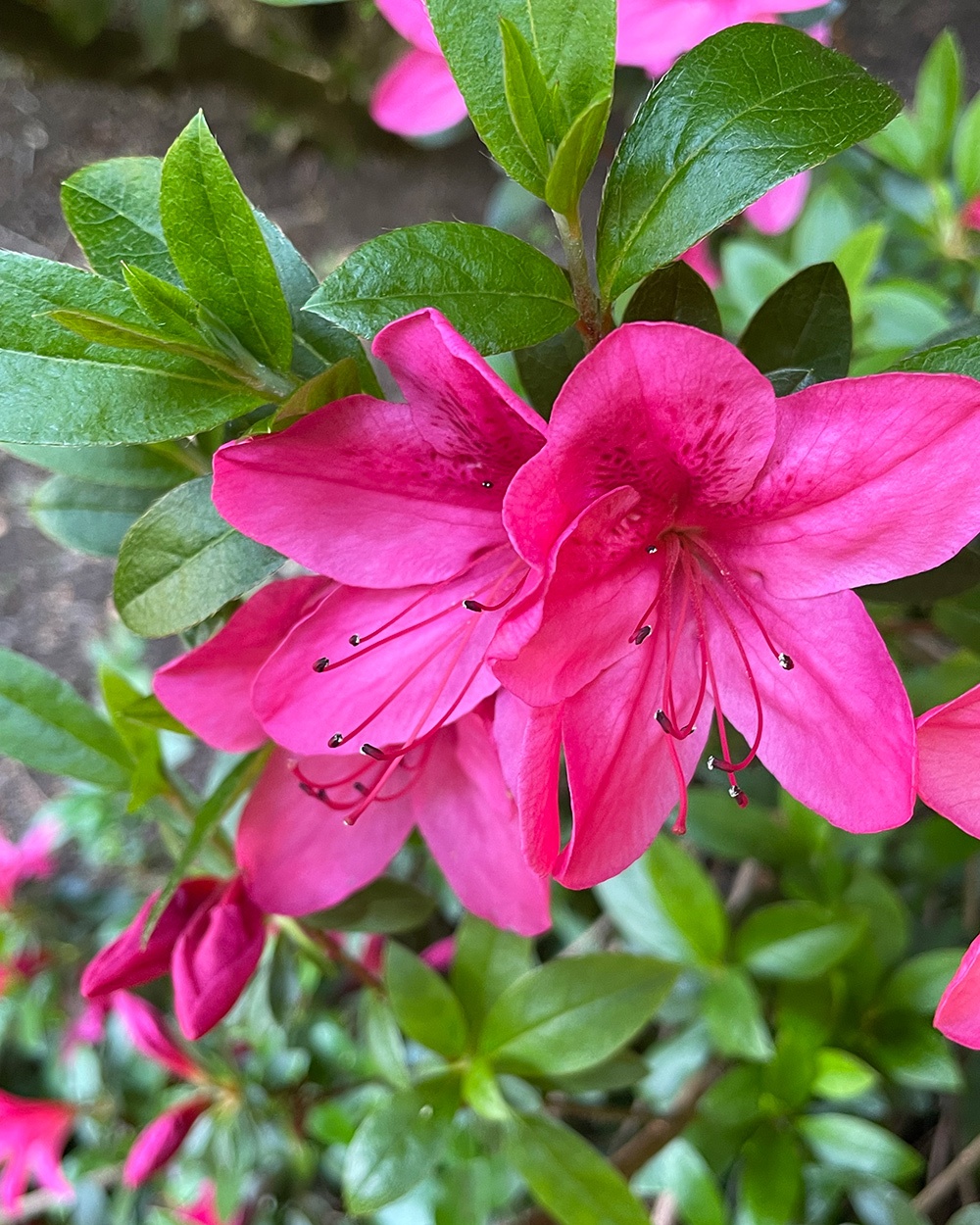
And one final close-up of those beautiful, bright blooms!
Thank you so much for another look at your spring garden, Lila! Your gorgeous sea of green is made sublime with these beautiful pops of bright pink blooms.
What are the boldest blooms in your spring garden? Does a rainbow of bulbs make way for more subtle blooms at the peak of the season, or do irises and other spring stars heat up the garden just before summer displays take over? Consider sharing your spring color palette with Garden Photo of the Day! Follow the directions below to submit photos via email, or send me a DM on Instagram: @agirlherdogandtheroad.
We want to see YOUR garden!
Have photos to share? We’d love to see your garden, a particular collection of plants you love, or a wonderful garden you had the chance to visit!
To submit, send 5–10 photos to [email protected] along with some information about the plants in the pictures and where you took the photos. We’d love to hear where you are located, how long you’ve been gardening, successes you are proud of, failures you learned from, hopes for the future, favorite plants, or funny stories from your garden.
Do you receive the GPOD by email yet? Sign up here
Fine Gardening Recommended Products
Plant Covers Freeze Protection 10 ft x 30 ft Floating Row Cover 0.9oz/yd²
Fine Gardening receives a commission for items purchased through links on this site, including Amazon Associates and other affiliate advertising programs.
Lightweight and Breathable MATERIAL Good for protecting Plant: the plant frost cover material is 0.74 oz/sq non-woven polypropylene fabric, which is lightweight, breathable, and durable. The plant blanket frost protection allows sunlight reach the plants, perfect for protecting plants from the damage of freeze or frost. Wide Application In your Garden Work. The plant row cover not only can work as a barrier against frost, but also can be a great tool for germination and good for rapid seedling growth. By using the fabric plant covers over your plant, you can start the plant earlier in the spring and extending the growing season of your plants. How to Use the Plant Covers: you can cover the plant covers for freeze over your the plants loosely directly and then secure the plant frost blanket with soil, stones or staples. You can also support the floating row covers with a hoop, make enough room for plants to breath and grow. You could also cut the plant covers into different sizes for different purposes.
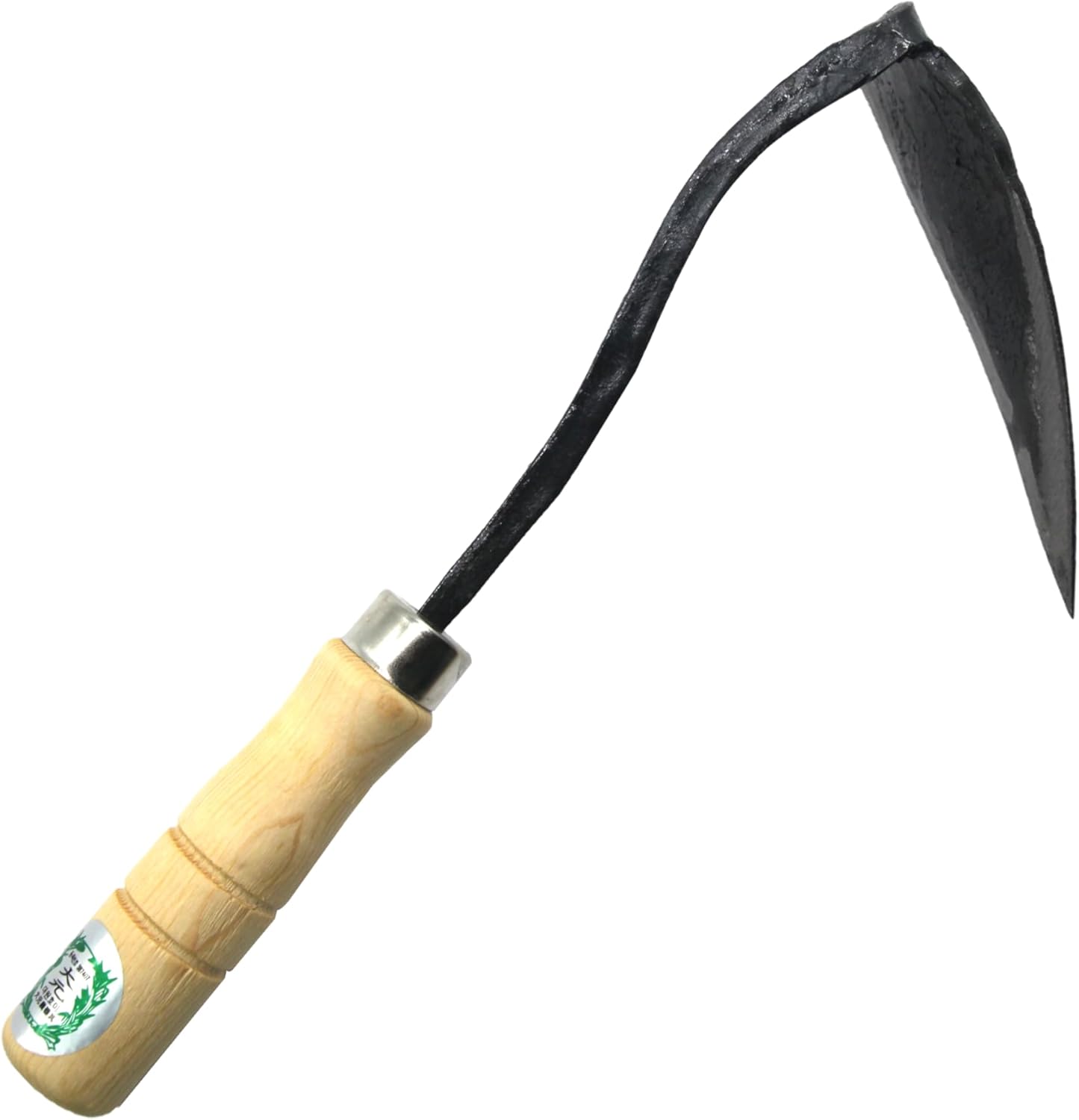
Ho-Mi Digger – Korean Triangle Blade
Fine Gardening receives a commission for items purchased through links on this site, including Amazon Associates and other affiliate advertising programs.
Versatile Tool: The Easy Digger Korean Triangle Blade Ho Mi Ho-mi is a versatile gardening tool designed for leveling and digging in home and garden settings. Efficient Design: Its unique triangular blade shape allows for easy soil penetration and efficient leveling of garden beds or landscaping areas. Durable Construction: Crafted with sturdy materials, this tool ensures long-lasting performance and reliability.
Ergonomic Handle: The comfortable handle provides a secure grip, reducing hand fatigue during extended use. Compact Size: Its compact design makes it easy to maneuver in tight spaces and store when not in use.
Gardener’s Log Book from NYBG
Fine Gardening receives a commission for items purchased through links on this site, including Amazon Associates and other affiliate advertising programs.
This weatherproof five-year log book includes the following features:
· Sturdy waterproof cover to protect pages from rain and muddy soil
· Lined pages and gridded paper for plotting beds
· Five years of 12-month bloom and harvest grids for recording what you planted and when
· Authoritative appendices on composting, pruning, pest and disease control, and container gardening
· Useful reminders by season on fertilizing, mulching, and transplanting
· Space for listing your favorite sources and suppliers.