

Hundreds of people join a protest in downtown Hamilton, Mont., in April supporting the work of federal employees as President Donald Trump oversees efforts to restructure the nation’s government. Federal scientific research and forestry work are part of this small town’s economic bedrock.
Katheryn Houghton/KFF Health News
hide caption
toggle caption
Katheryn Houghton/KFF Health News
HAMILTON, Mont. — Scientists are often careful to take off their work badges when they leave the campus of one of the nation’s top biomedical research facilities, here in southwestern Montana’s Bitterroot Valley.
It’s a reflection of the long-standing tension caused by Rocky Mountain Laboratories’ improbable location in this conservative, blue-collar town of 5,000 that was built on logging.
Rocky Mountain Labs has become an economic driver for the town, generating hundreds of millions of dollars for the local economy through spillover to other industries and retail.
Many residents are proud of the internationally recognized research unfolding at the National Institutes of Health facility. But a few locals resent what they consider the elitest scientists at the facility, which has employed about 500 people in recent years. Or they fear the contagious pathogens studied there could escape the labs’ well-protected walls.

That split widened with the COVID-19 pandemic and the divisions that emerged from mask mandates and vaccine development. In 2023, Matt Rosendale, a Republican who was then a U.S. representative from Montana, falsely tied the lab to the origins of COVID in an attempt to cut its funding.
Now, Hamilton is a prime example of how the Trump administration’s mass federal layoffs and cancellation of research grants are being felt in communities far from Washington, D.C.

Some residents of Hamilton, Mont., in April protest efforts to restructure the nation’s government. Federal scientific research and forestry work are part of this small town’s economic bedrock.
Katheryn Houghton/KFF Health News
hide caption
toggle caption
Katheryn Houghton/KFF Health News
On an April afternoon, hundreds of people filled the sidewalks at an intersection of Hamilton’s usually quiet downtown, waving signs that read “Hands Off Federal Workers” and “STOP STRANGLING SCIENCE.”
Some driving by honked in support, rolled their windows down, and cheered. Others flipped off the rallygoers and cast insults at them. A passing bicyclist taunted protestors with chants of “DOGE” — short for the Department of Government Efficiency, the federal initiative led by billionaire Elon Musk to cut costs that has driven mass layoffs and slashed programs.
Kim Hasenkrug, a former Rocky Mountain Labs researcher of 31 years, who retired in 2022, joined the crowd. He slammed President Donald Trump’s promise to let Health and Human Services Secretary Robert F. Kennedy Jr. “go wild” on health issues.
“We’re beginning to see what ‘going wild’ looks like,” Hasenkrug said. “These cuts will not streamline research. They will throttle it.”
As of early May, 41 Rocky Mountain Labs workers had been let go or told their contracts would end this summer, and nine more had retired early, according to researchers employed by the facility.
KFF Health News spoke with 10 current or former Rocky Mountain Labs workers who requested anonymity to speak about information that has not been publicly released. The federal government has also slashed billions of dollars for research, including at least $29 million in grants to Montana recipients, ranging from university scientists to the state health department. That’s according to HHS data confirmed by KFF Health News.

The National Institutes of Health’s Rocky Mountain Laboratories in Hamilton, Mont.
Katheryn Houghton/KFF Health News
hide caption
toggle caption
Katheryn Houghton/KFF Health News
Scientists who remain in Hamilton said research has slowed. They’ve struggled to buy basic gear amid federal directives that changed how orders are placed. Now, more cuts are planned for workers who buy and deliver critical, niche supplies, such as antibodies, according to researchers at the labs.
The Department of Health and Human Services didn’t respond to repeated requests for more information on the government’s cuts to research, including questions about the changes in Hamilton. Emily Hilliard, a deputy press secretary, said the department is committed to the “continuity of essential research.”
Some within the lab feel like they’ve become public enemies or outcasts, unable to defend themselves without risking their jobs. Postdoctoral scientists just starting their careers are seeing options dwindle. Some workers whose employment contracts expire within days or weeks have been in the dark about whether they’ll be renewed. At least one Rocky Mountain Labs scientist moved to another country to research infectious disease, citing “current turmoil,” according to an email sent from the scientist to co-workers that was reviewed by KFF Health News.
“The remaining staff has been discredited, disrespected, and discouraged from remaining in public service,” Hasenkrug said.
The National Institutes of Health is the largest public funder of biomedical research in the world. It has 27 institutes and centers focused on understanding illness and disabilities and improving health. The agency’s research has contributed to the development of vaccines against major diseases — from smallpox to COVID — and has been behind the majority of medicines approved for the U.S. market. That research also generated more than $94.5 billion in new economic activity nationwide, according to United for Medical Research, a coalition of research groups and advocates.
The Trump administration aims to eliminate at least 1,200 jobs at the NIH and shrink its budget by 40%. The administration’s budget proposal to cut NIH funding calls the agency’s spending “wasteful,” deems its research “risky,” and accuses it of promoting “dangerous ideologies.”
It’s a dramatic political turnabout for the NIH, which for decades enjoyed bipartisan support in Washington. From 2015 to 2023, its annual budget grew by more than $17 billion.
As of 2023, Rocky Mountain Labs was one of only 51 facilities in the world with the highest level of biosafety precautions, according to the Global BioLabs mapping project. In April, HHS indefinitely stalled work at another of those labs, the Integrated Research Facility in Frederick, Maryland, Wired reported.
Kennedy has said the nation should pause funding infectious disease research, and the White House has said it plans to intensify scrutiny of gain-of-function research, which involves altering a pathogen to study its spread.
Hamilton, in Ravalli County, is home to scientists, ranchers, and outdoor recreationists. Here, 1 in 8 people live below the federal poverty line. Nearly 70% of the county’s residents voted for Trump in 2024, and Trump signs still dot U.S. Highway 93 leading to town. In the thick of the COVID pandemic, the sheriff and county commissioners refused to enforce a statewide mandate to mask in public spaces while Rocky Mountain Labs researchers worked to understand the virus.
The lab’s work dates to 1900, and even early on it was controversial. Rocky Mountain spotted fever was killing people in the valley. Researchers found the cause — ticks — and worked to eradicate the disease-carrying bugs by requiring ranchers to treat their cattle.
That created resentment among locals who “already harbored a healthy distrust of government-imposed programs,” according to an NIH history. The tension came to a head in 1913 when a “dipping vat” used to chemically treat cattle was blown up with dynamite and another damaged with sledgehammers.
Now, some residents and local leaders are worried about the economic consequences of an exodus of federal workers and their salaries. Most of the county is government-managed public land, and the first wave of federal cuts hit U.S. Forest Service workers who do everything from clear trails to fight wildfires.
Rocky Mountain Labs creates more work for industries including construction and brings more people into the city’s shops, a 2023 University of Montana study found. The rural community is also a base for international vaccine developer GSK due to the lab’s presence. Kathleen Quinn, a vice president of communications for the company, said GSK’s business with government agencies “continues as usual” for now amid federal changes and that it’s “too early to say what any longer-term impact could be.”

Hamilton city leaders moved a weeknight March meeting on federal cuts to a school auditorium to fit a crowd of people concerned that Trump’s reshuffling would change the nature of their town. Kim Hasenkrug, a former Rocky Mountain Labs researcher of 31 years, who retired in 2022, was among those who asked city councilors to try to buffer Hamilton from federal cuts.
Katheryn Houghton/KFF Health News
hide caption
toggle caption
Katheryn Houghton/KFF Health News
In March, hundreds of people turned out for a town hall in Hamilton to discuss the impacts of the federal government cuts and asked city councilors to do something.
“Our community is impacted more than most,” said City Councilor Darwin Ernst, during the overflowing meeting.
Ernst, a former researcher at the lab who now works as a real estate broker and appraiser, said in an interview he’s starting to see more homes go up for sale, which he attributed to the atmosphere of uncertainty and former federal workers’ having to find jobs elsewhere.
“Someone recently left with her entire family. Because of the layoffs, they can’t afford to live here,” he said. “Some people retire here but that’s not everyone.”
Jane Shigley said she’s been a Hamilton resident for more than 30 years and initially thought the government would find “some inefficiencies, no big deal.” But now she’s worried about her hometown’s future.
“Something’s going on that we can’t control,” Shigley said. “And the people that it’s happening to aren’t allowed to talk to us about it.”
The City Council sent a letter to federal officials in April asking for formal consultation prior to any significant changes, given Hamilton’s “interdependence” with Rocky Mountain Labs and the federally controlled lands surrounding Hamilton. As of May, city leaders hadn’t received a response.
People in town are split on how badly the federal cuts will affect Hamilton.
Julie Foster, executive director of the Ravalli County Economic Development Authority, said the community survived the decline of logging, and she thinks Rocky Mountain Labs will survive, too.
“It will be here. There may be bumps in the road, but this is a resilient place,” Foster said.
Even amid the cuts at Rocky Mountain Labs, researchers’ work continues. This spring, scientists there helped make the first identification in Montana of a species of tick known to carry Lyme disease.
KFF Health News correspondent Rae Ellen Bichell contributed to this report.
KFF Health News is a national newsroom that produces in-depth journalism about health issues and is one of the core operating programs at KFF.

Happy Monday GPODers!
About a month ago, we were treated to photos from Adriana Porter Felt’s garden in Berkeley, California for the first time (Check out that post here: Adriana’s Pride of Madeira in Spring). At that point in the season, she was singing the praises of her incredible pride of Madeira blooms (Echium candicans, Zones 9–11). Now, she is sharing another plant that provides spectacular spires of flowers in the season, this one planted in mass to create a dramatic burst of blooms along one of her garden paths. And if you’d like to see even more of Adriana’s beautiful garden, check her out on Instagram: @adriana_digs_holes.
Hi GPOD,
I planted a drift of ‘Rosada’ heuchera (Heuchera ‘Rosada’, Zones 8–10) two winters ago. The scale of the drift—two plants wide by nine long—makes for a dramatic and long-lasting spring display. They bloom from late March through late May. The blooms start lighter and get darker pink as they age.
I first learned about planting in drifts from Fine Gardening (Give Your Garden Mass Appeal), and it was a great tip. The singletons that I’ve planted elsewhere don’t look nearly as impressive. However, it was surprisingly difficult to get 18 of the same plant. Most local shops only have 4-8 of the same plant at a time. I hunted around until I found a nursery that does both wholesale and customer sales of 4″ pots. I’m glad I was able to find them.
‘Rosada’ heuchera is a hybrid of two native California plants, and it seems to be happy in my garden in the Berkeley hills. The drift is placed near the north side of the house so it gets full shade in winter, part sun in spring and fall, and full sun at the peak of summer. It needs supplemental irrigation for the hottest part of summer but it pulls through. It’s hard to find plants for garden beds on the north sides of homes.
Adriana (@adriana_digs_holes on IG)
I also attached a “before” photo from when I first purchased the home. I improved the soil health with compost and mulch, and then planted my garden.
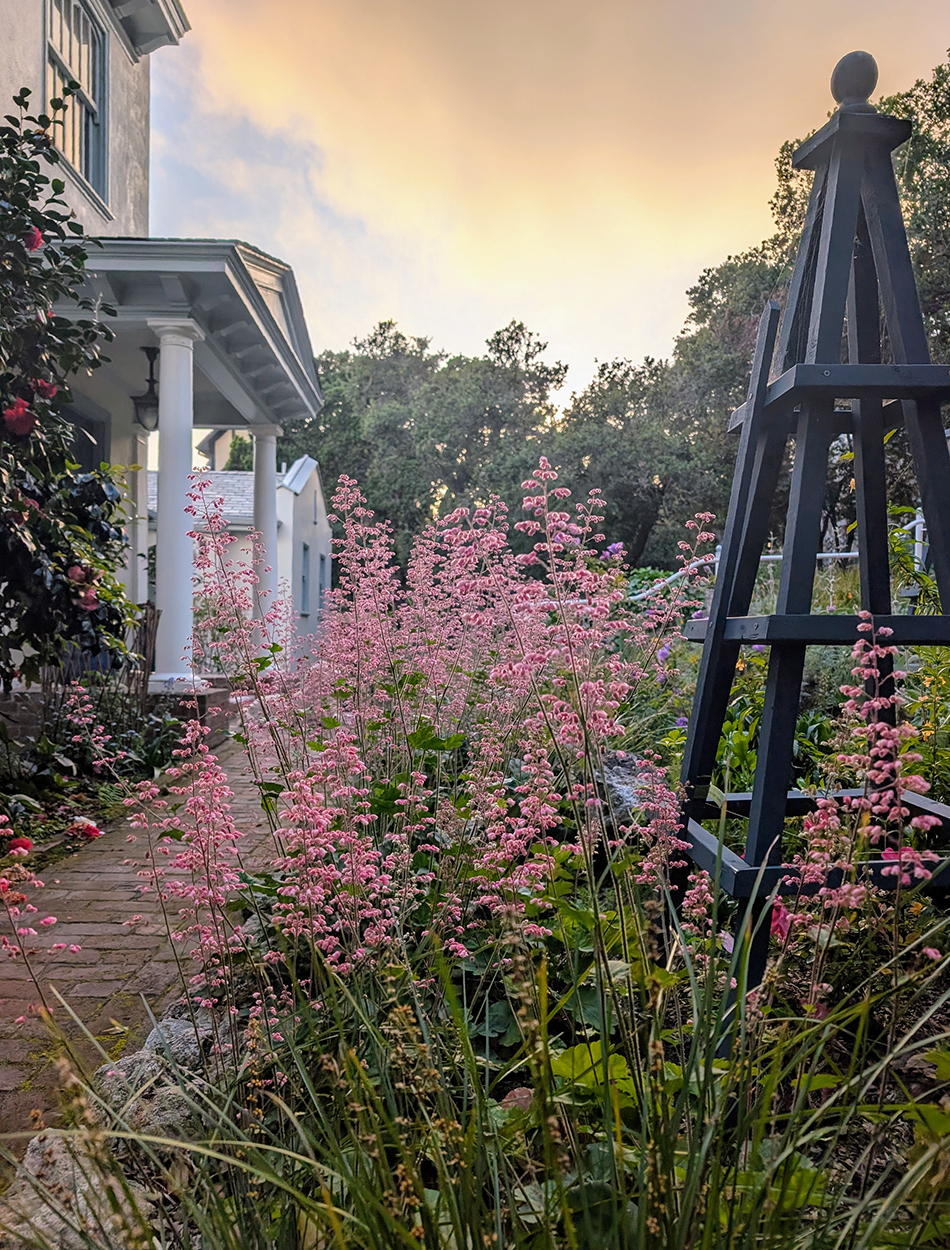 While both pride of Madeira and heuchera produce spires of beautiful blooms, the forms and textures couldn’t be more different. Heuchera spires have that “see-through” affect, being so thin and sparse that the flowers of a single plant can blend into surrounding plantings. Creating these larger drifts, however, allows the small flowers to create a bigger impact.
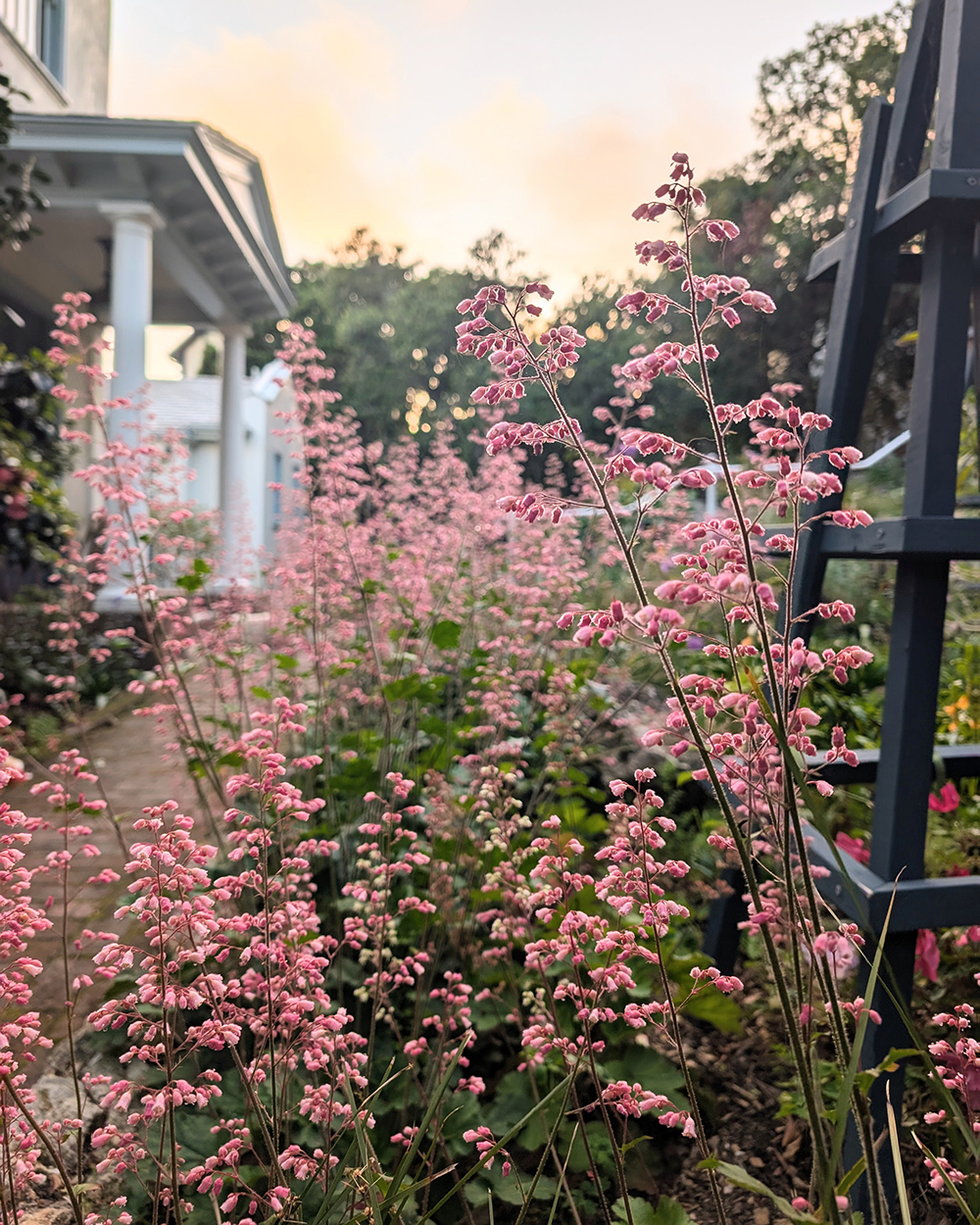 A closer look reveals the various shades of pink in each small flower.
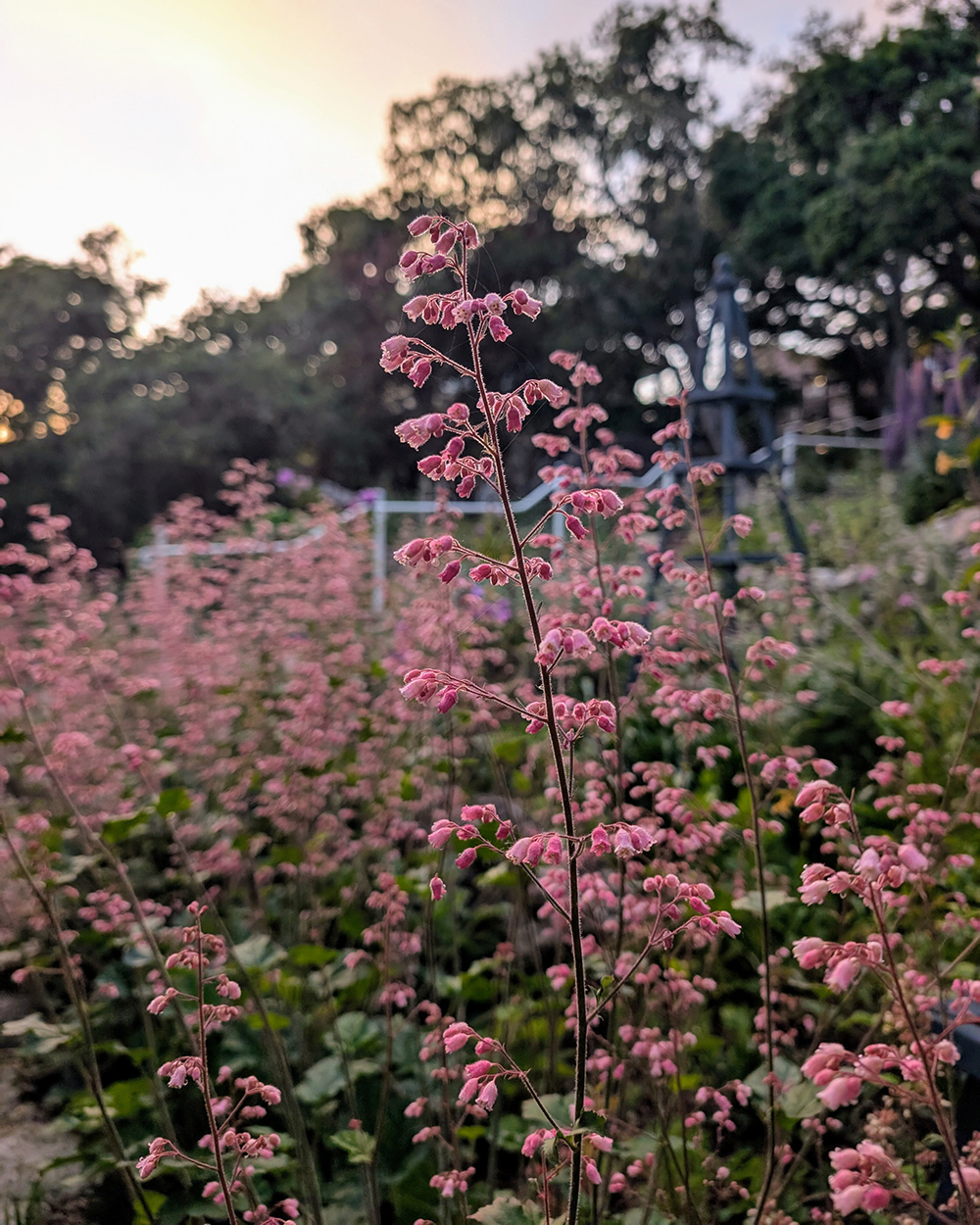 And this close-up shot really showcases that “see-through” quality.
 And one final view of that fluffy cloud of pink that Adriana’s heucheras create along her brick path. Her black and white cat makes for an adorable model in this garden scene.
Thank you so much for sharing another garden highlight with us, Adriana! It’s obvious that you have a great eye for stunning plants, and your photos demonstrate a real love and appreciation for these beautiful specimens.
What are some of your favorite plants to bloom in spring? If I know the GPOD community, I’m sure you have a camera roll full of photos of that plant at its peak. Before spring slips away from us, consider sharing your favorite spring plants with Garden Photo of the Day! Follow the directions below to submit photos via email, or send me a DM on Instagram: @agirlherdogandtheroad.
Have photos to share? We’d love to see your garden, a particular collection of plants you love, or a wonderful garden you had the chance to visit!
To submit, send 5–10 photos to [email protected] along with some information about the plants in the pictures and where you took the photos. We’d love to hear where you are located, how long you’ve been gardening, successes you are proud of, failures you learned from, hopes for the future, favorite plants, or funny stories from your garden.
Have a mobile phone? Tag your photos on Facebook, Instagram or Twitter with #FineGardening!
Do you receive the GPOD by email yet? Sign up here
Fine Gardening Recommended Products
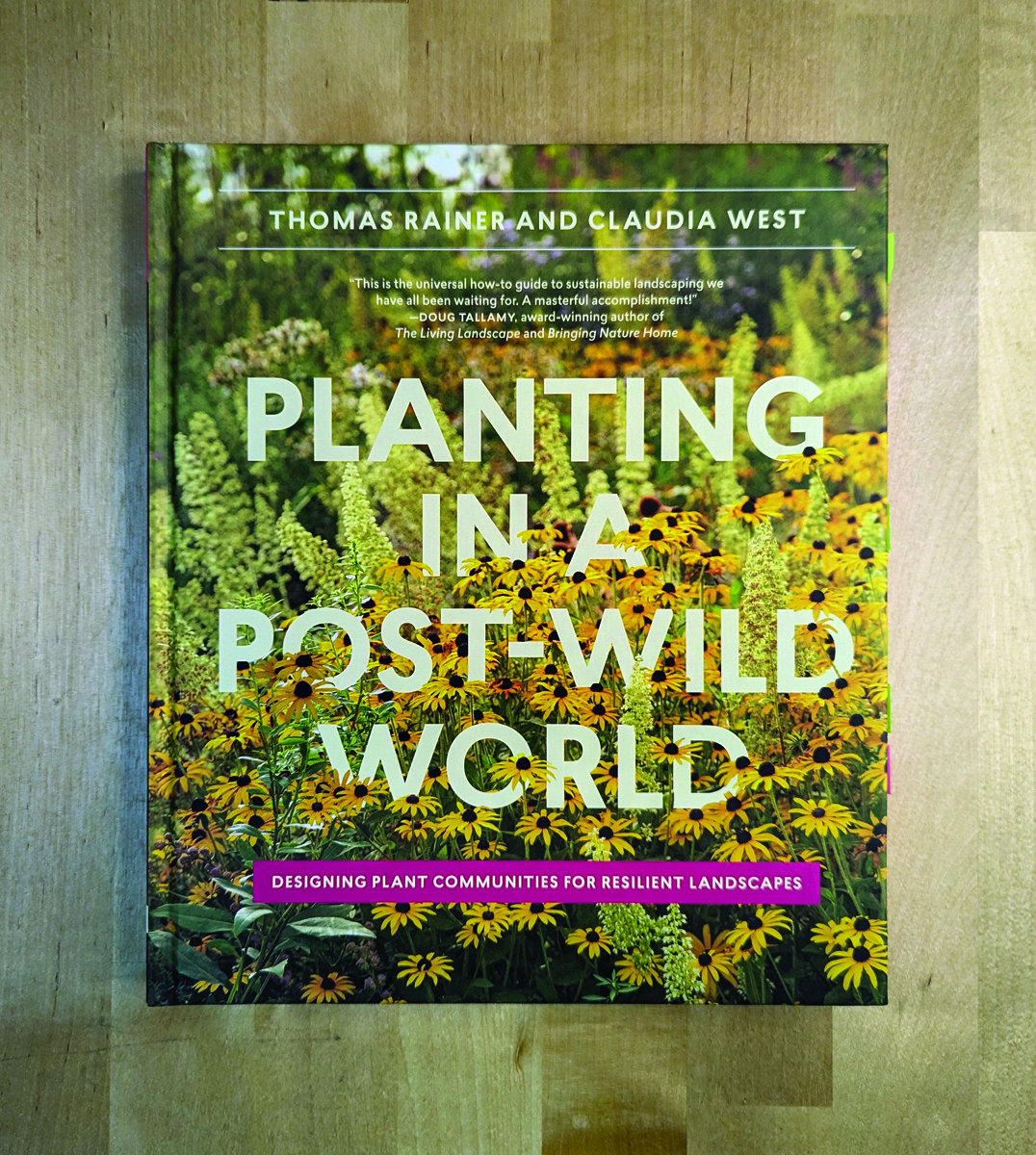
Planting in a Post-Wild World: Designing Plant Communities for Resilient Landscapes
Fine Gardening receives a commission for items purchased through links on this site, including Amazon Associates and other affiliate advertising programs.
Featuring gorgeous photography and advice for landscapers, Planting in a Post-Wild World by Thomas Rainer and Claudia West is dedicated to the idea of a new nature—a hybrid of both the wild and the cultivated—that can nourish in our cities and suburbs.
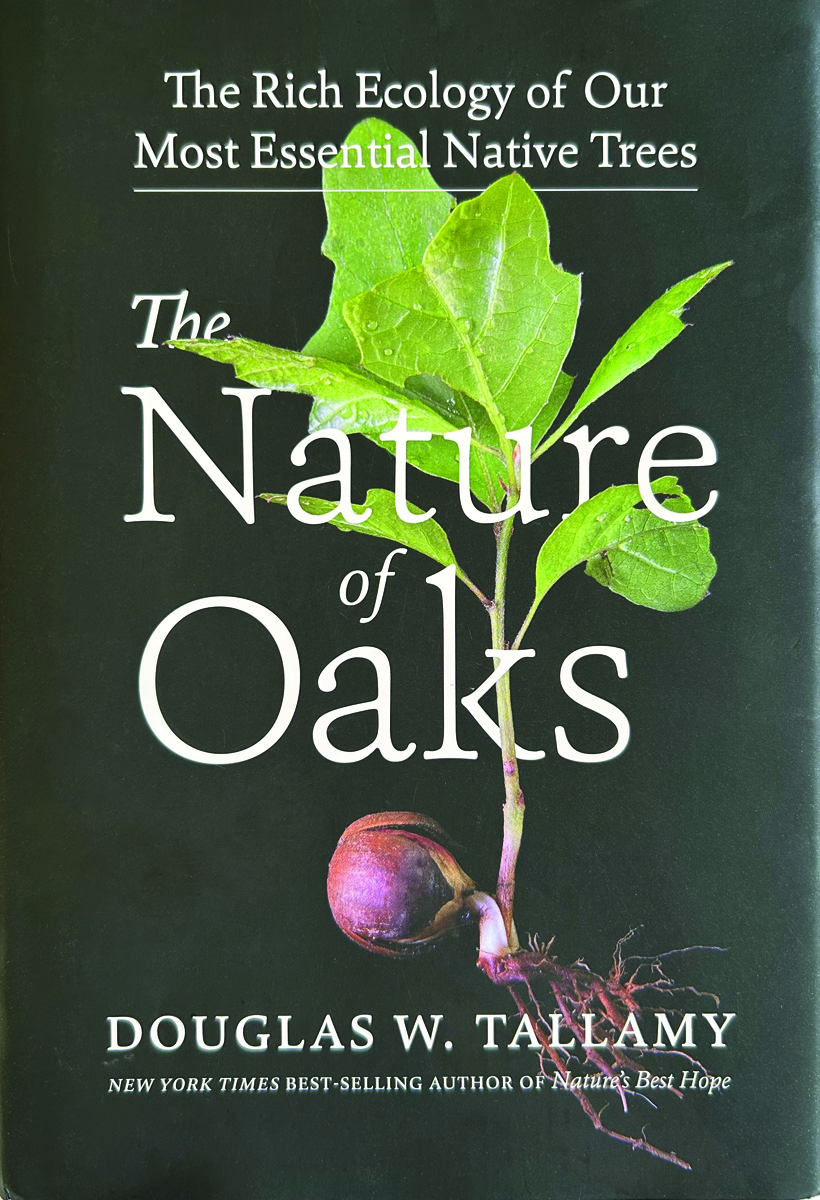
The Nature of Oaks: The Rich Ecology of Our Most Essential Native Trees
Fine Gardening receives a commission for items purchased through links on this site, including Amazon Associates and other affiliate advertising programs.
The Nature of Oaks reveals what is going on in oak trees month by month, highlighting the seasonal cycles of life, death, and renewal. From woodpeckers who collect and store hundreds of acorns for sustenance to the beauty of jewel caterpillars, Doug Tallamy illuminates and celebrates the wonders that occur right in our own backyards. He also shares practical advice about how to plant and care for an oak, along with information about the best oak species for your area.

Gardener’s Log Book from NYBG
Fine Gardening receives a commission for items purchased through links on this site, including Amazon Associates and other affiliate advertising programs.
This weatherproof five-year log book includes the following features:
· Sturdy waterproof cover to protect pages from rain and muddy soil
· Lined pages and gridded paper for plotting beds
· Five years of 12-month bloom and harvest grids for recording what you planted and when
· Authoritative appendices on composting, pruning, pest and disease control, and container gardening
· Useful reminders by season on fertilizing, mulching, and transplanting
· Space for listing your favorite sources and suppliers.

by Caitlin H,
Apr 30, 2024

Fresh air. Warm sunshine. Green leaves. Birds twirping happily. The sound of dirt crunching beneath your feet. There’s something uniquely restorative about spending time in nature — a fact backed by science.
A host of research published in the National Library of Medicine shows being in nature:
Activities in nature are also a boon for your physical health, typically requiring movement and exercise, which can improve your cardiovascular and muscular health.
With that in mind, we rounded up eight outdoor activities to boost the time you spend in nature — things like hiking and biking for those who are mobile to gardening and boating for those who need to go the lower-impact route.
Hiking is a definite go-to for getting out in nature — and for good reason! Not only is it an excellent full-body workout, but it’s also one of the best ways to explore new settings and take nature in on every level. It’s also an activity perfect for groups and families, offering options for people of all fitness levels. With more than 400 national parks across the U.S., you can enjoy a unique experience with nature year-round.
Find any nearby trail on a warm spring or summer day, and there’s a good chance you’ll find bicyclists of all levels out enjoying it. Cycling is the perfect activity for covering lots of ground with the wind in your hair and the sun on your face to make it all the more pleasant. You can go as fast or slow as you want and see all the incredible things nature has to offer along the way.
Rock climbing outdoors is not for the faint of heart, but if you’re game to give it a try, you’re unlikely to be disappointed. Rock climbing offers a tremendous workout and a truly exhilarating way to enjoy nature, with challenging courses and one-of-a-kind views waiting for you at every turn. It also can help with cognitive health by fostering problem-solving skills, and it typically has a tight-knit community for increased social interaction.
If you’re a fan of water sports, get out on the nearest river with a water activity like kayaking, canoeing, or white water rafting. Each of these will engage your core and offer a strenuous workout, making them ideal for exercise and taking in nature alike. Rivers also provide a unique view of the world around you, carving through canyons or flowing alongside rows and rows of trees for truly breathtaking sights you won’t find anywhere else.
Planting seeds for flowers or fruits and vegetables and helping them sprout leaves and grow into something new is itself profoundly rewarding. Add in the time spent outside in the sunshine and the functional movement that goes with it, and you’ve got a recipe for some serious mental health boosts. Plus, tending to your plants can provide a significant stress reliever after a busy day, and growing and eating your own fruits and vegetables can even improve your diet.
Walking is one of those simple things that you can do anywhere and at any pace, making it a perfect go-to for everyone to get outside to take in some fresh air. You can go on scenic, nature-friendly walks at the local park, around your neighborhood, along green belts, or even at national and state parks. Go at your own pace and breathe all of nature’s beauty in along the way.
If you live near a beach, a day outside soaking in the sun and listening to the waves lap against the shore is a definite recipe for a mental wellness boost. Pack a picnic lunch and grab your towel and flip-flops for a relaxing day on the sand. If you’re feeling up for it, consider rolling in a fun activity like shell-hunting or kite-flying.
Fishing is one of the best activities for stress relief. It gives you a peaceful way to explore nature in all sorts of different ways and places while simultaneously requiring physical activity that improves health. Plus, people who fish also tend to find their patience and concentration improve and that it lowers stress levels.
————————————————————————————

Author: Caitlin H
Diet-to-Go Community Manager
Caitlin is the Diet-to-Go community manager and an avid runner. She is passionate about engaging with others online and maintaining a healthy, active lifestyle. She believes moderation is key, and people will have the most weight loss success if they engage in common-sense healthy eating and fitness.
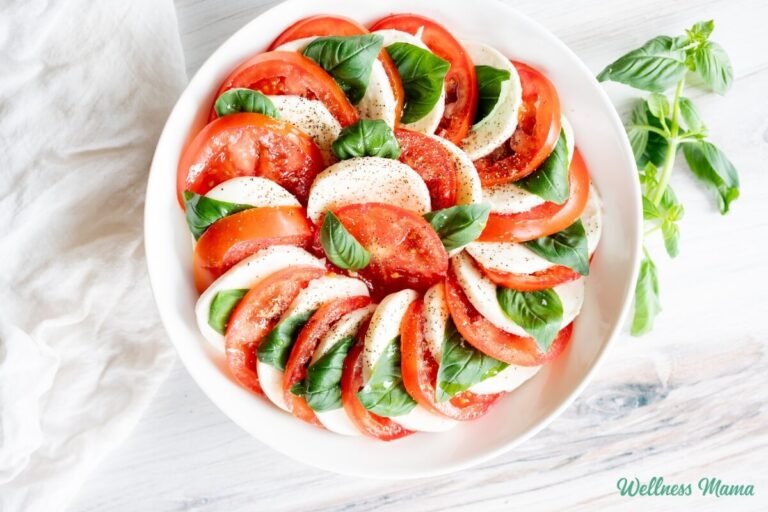
Introducing one of my favorite simple salad recipes. This tomato, basil, and mozzarella Caprese salad is an easy summer favorite our whole family loves. We make it often in the summertime when our tomatoes are in season. This classic Italian dish is light, flavorful, and delicious!
This appetizer (or side dish) really couldn’t be any easier. All it requires is some slicing, arranging, and herb sprinkling. Known in Italy as insalata caprese, no one’s quite sure where it originated, though it’s thought to have started on the Island of Capri. Others have noted it’s patriotic resemblance to the Italian flag. However it came about though, this herbed tomato salad is oh so good!
It’s quick to put together but still looks impressive, making it perfect for a weeknight dinner or your next BBQ.
I often find that the simplest recipes are sometimes the most delicious. Especially when they take advantage of seasonal produce. Few things taste better than a truly fresh peach, tomato, or salad right after they’re picked.
Since the ingredients are simple, there isn’t much to hide behind when it comes to caprese. Watery, rubbery tomatoes won’t taste very good here. I like using homegrown tomatoes or heirloom tomatoes from the farmer’s market for the best caprese salad. Some freshly ground black pepper and flaky sea salt or kosher salt really help bring out the flavors of the tomato. Any good quality salt will work though.
I like the salad plain, but you can also add a balsamic reduction (aka balsamic vinegar glaze) or vinaigrette drizzle. Make it a meal and add some grilled chicken on the side!
For a fun variation try individual caprese salad skewers. Thread grape tomatoes or cherry tomatoes onto skewers with basil leaves and mozzarella balls in between.
A delicious and simple Caprese salad with tomatoes, mozzarella, basil, olive oil, and spices.
Slice tomatoes in ¼ or ½ inch thick slices, discarding top and bottom slice.
Alternate slices of tomato and fresh mozzarella slices on a serving platter.
Sprinkle with salt, pepper, and garlic salt.
Sprinkle with shredded fresh basil.
Add a drizzle of olive oil and balsamic glaze if using and serve.
Nutrition Facts
Italian Caprese Salad Recipe
Amount Per Serving (1 serving)
Calories 313
Calories from Fat 234
% Daily Value*
Fat 26g40%
Saturated Fat 9g56%
Polyunsaturated Fat 2g
Monounsaturated Fat 14g
Cholesterol 45mg15%
Sodium 943mg41%
Potassium 343mg10%
Carbohydrates 6g2%
Fiber 2g8%
Sugar 4g4%
Protein 14g28%
Vitamin A 1488IU30%
Vitamin C 17mg21%
Calcium 303mg30%
Iron 1mg6%
* Percent Daily Values are based on a 2000 calorie diet.
Ever had Caprese salad with fresh tomatoes? What’s your favorite summer salad recipe? Share below!
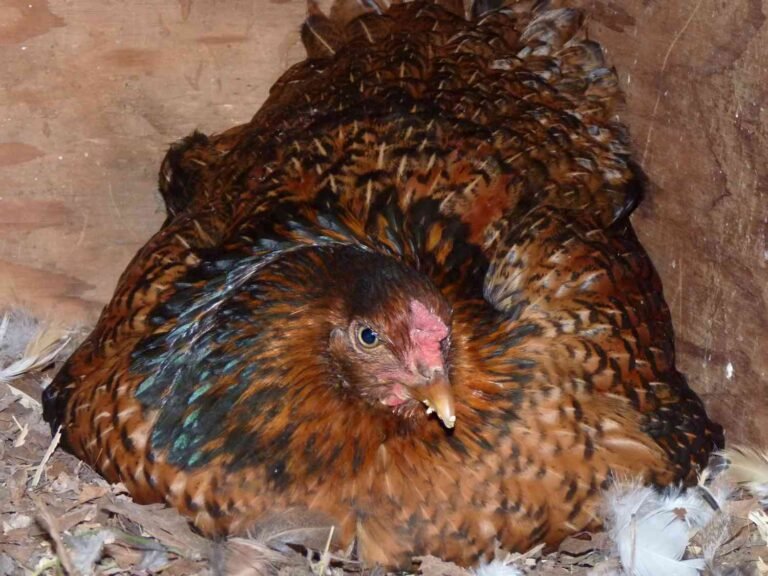
If one of your chickens isn’t acting normal, like refusing to eat and opting to stay in the coop all day, then probably it want to hatch some eggs.
This behavior of hen going broody is just fine for those who’re planning for baby chicks. But, who are raising chickens only for egg consumption, a broody hen can be pain.
Some of them can be aggressive and stubborn refusing to go out and pecking or yelling at you.
Fortunately, there are different ways to break a broody hen.
To successfully break broodiness, you might have to try more than 2-3 ways.
To break a broody hen, start by removing her from the nest regularly and blocking off the nesting area. This disrupts her routine and discourages her from settling back in.
If she’s still broody, try cooling her body with a frozen water bottle or a quick cold-water dip during warm weather. Removing nesting material and limiting her access to the coop during the day can also help.
For more stubborn hens, use a wire cage with no bedding (broody jail) for a few days. If you’re okay with chicks, giving her fertile eggs to hatch can satisfy her natural instinct.

A broody chicken is a hen that insists on sitting in the nest to hatch eggs, even if they aren’t fertilized. Hormonal changes drive this behavior, and she may refuse to leave the nest, eat very little, and pluck feathers from her chest to warm the eggs.
Certain breeds like Silkies, Cochins, and Orpingtons are more prone to going broody. This phase can last for weeks, during which the hen stops laying and may sit on anything egg-shaped, believing she’s hatching chicks.
For egg-focused chicken keepers, a broody hen can be disruptive. She stops laying and may block the nesting box, making it necessary to break her broodiness.
Also Read: How to Keep Chickens Cool in Hot Weather?
A broody hen will spend nearly all her time sitting in the nesting box, often refusing to come out even to eat or drink. Unlike other hens who lay and leave, a broody one stays put, sometimes trying to cover multiple eggs at once.
One of the clearest signs is puffed-up feathers and sudden aggression. A normally calm hen may hiss, growl, or peck if you get too close, acting as if she’s guarding developing chicks—even if there are no eggs at all.
You might also notice a bare patch on her chest. Broody hens often pluck out their own feathers to create better skin-to-egg contact, which helps with warmth during incubation.
Her voice may change too. Instead of her usual clucks and chatter, she may start making low, repetitive broody clucks, especially when disturbed or while sitting in the nest.
Broody hens eat and drink very little. They usually leave the nest once or twice a day, and when they do, they often produce one large, foul-smelling poop—a result of holding it in for hours.
Lastly, a broody hen will stop laying eggs. Her body shuts down egg production as it focuses entirely on hatching mode. If your best layer suddenly stops and shows these signs, she’s likely gone broody.
Breaking a broody hen is important if you’re not planning to hatch chicks. When a hen goes broody, she stops laying eggs, which can lower overall egg production in your flock.
She also occupies the nesting box for long periods, making it harder for other hens to lay comfortably. This can lead to stress and disruptions among the flock.
Additionally, broodiness can take a toll on the hen’s health. She may eat and drink less, lose weight, and become more vulnerable to parasites and disease due to prolonged sitting and poor hygiene. Breaking the cycle helps her return to her normal, healthy routine.

When a hen goes broody and you’re not looking to hatch chicks, it can turn into a frustrating cycle. Her egg-laying stops, her attitude changes, and she becomes glued to the nest box, disrupting your flock’s routine.
Thankfully, there are several effective strategies to help snap her out of broody mode. Here are seven practical methods you can try—some gentle, others a bit more assertive.
Start by simply taking her out of the nesting box every time you catch her sitting. Do this gently but consistently throughout the day. Place her outside with the other hens to encourage normal behavior like scratching, dust bathing, and foraging.
This method works best in early stages of broodiness. The key is persistence—removing her multiple times a day sends a message that nest-sitting isn’t an option. Keep an eye on her to make sure she doesn’t sneak back.
If she continues returning immediately, pair this with other methods. Some hens are stubborn and will need a more disruptive change to reset their hormones.
Also Read: How to Deworm Chickens Naturally?
If removing her doesn’t work, try shutting down her access to the nesting area entirely. Block the nesting boxes during the day by placing a board or turning over a laundry basket. This removes her “broody zone” and forces her to engage in normal flock behavior.
Do this only when other hens aren’t laying or have alternative places to go. Some keepers temporarily remove all nesting boxes if broodiness becomes widespread.
If you can’t block access, try removing the hen and placing her in a different area entirely for a few days.
The warmth under a broody hen keeps her in the nesting mood. To disrupt this, place a frozen water bottle wrapped in a towel under her belly when she’s nesting. This cools her body temperature and makes sitting less comfortable.
Some keepers also use brief “cool baths”—placing the hen in shallow, cold (not icy) water for a few minutes. This method should be used cautiously and only in warm weather to prevent stress or chills.
Both approaches help lower the elevated body temperature that fuels broodiness, but they usually work best when combined with nest access removal.
Another way to make the nest uninviting is to strip it of all bedding. Remove straw, shavings, or anything soft, and leave only the bare surface. Without cozy nesting material, the box becomes much less appealing.
Check often, though—determined hens might sit on bare wood if they’re really set on hatching. Combine this with removal or cooling methods for better results.
This is especially helpful for hens who aren’t overly aggressive and haven’t fully committed to broodiness yet.
Temporarily denying her access to the coop during the day can be very effective. Keep her in a chicken-safe outdoor run or fenced area with food and water. This prevents her from returning to the nesting box over and over.
After a few days of “coop ban,” many hens will give up. Just be sure she has shade, shelter, and company so the separation doesn’t cause stress or loneliness.
This method is more direct. Place the broody hen in a wire-bottomed crate or cage raised off the ground. The lack of nesting material and better airflow underneath helps cool her underside and break the broody cycle.
Leave her in the crate for 2–4 days with food and water but no bedding. Most hens snap out of it after a few days of “jail time.” Return her to the flock and monitor her—if she goes straight back to the nest, repeat the process.
If you don’t mind raising chicks, lean into her broodiness and give her fertilized eggs to hatch. Broody hens are great natural incubators and mothers, and it’s a productive use of her instinct.
Letting her go through the process may satisfy her hormones and stop future episodes of broodiness—at least for a while. Just make sure she’s healthy and committed before giving her eggs to hatch.
Check this: Why Have My Chickens Stopped Laying Eggs in Summer?

Breaking a broody hen requires patience and a combination of strategies to gently discourage her from nesting.
By consistently disrupting her behavior, cooling her body, and making the nest less inviting, you can help her return to normal egg-laying.
Whether using simple removal, restricting nest access, or more hands-on methods like broody jail, the key is to stay consistent until she loses the urge to brood. With time and care, your hen will be back to her regular, healthy routine.

Khaja Moinuddin, a computer science graduate, finds joy in gardening and homesteading. Join him on this blog as he shares his experiences in homesteading, gardening, and composting

U.S. Secretary of Health and Human Services Robert F. Kennedy Jr. testifies before the Senate Committee on Health, Education, Labor, and Pensions on Capitol Hill on May 14, 2025 in Washington, DC.
Samuel Corum/Getty Images
hide caption
toggle caption
Samuel Corum/Getty Images
The Trump administration released a sweeping report Thursday, offering its analysis of what’s driving chronic disease among the nation’s children.
The report titled, “The MAHA Report: Make Our Children Healthy Again” catalogues in detail a “chronic disease crisis,” including high rates of obesity, asthma, autoimmune conditions and behavioral health disorders among kids.
The 72-page document is a product of the MAHA commission, which was established by President Trump through an executive order on Feb. 13. The commission, chaired by Health Secretary Robert F. Kennedy, Jr., enlisted various Cabinet members, including the secretaries of agriculture and education and the head of the Environmental Protection Agency, and met in private over the last few months.
“There is something wrong and we will not stop until we defeat the chronic disease epidemic,” Trump said at a White House event on Thursday, flanked by Secretary Kennedy and other members of the commission.
Much of what’s detailed reflects the views Kennedy has articulated during his many public appearances.
The report identifies four major drivers behind the rise in childhood chronic illness: poor diet, environmental chemicals, chronic stress and lack of physical activity, and overmedicalization. In keeping with the messaging that has animated the MAHA platform, the report pins much of the blame on conflicts of interest and corporate influence in the food, chemical and pharmaceutical industries.
The report lays the groundwork for the MAHA commission to develop a strategy for addressing childhood disease, which is supposed to happen by mid August according to the February executive order.
The proposition that nutrition, lifestyle and exposure to pollution and other harmful chemicals are conspiring to harm children’s health is not controversial among longtime researchers in public health.
“Many of us have been calling for some attention to these issues for decades now,” says Dr. James Perrin, a professor of pediatrics at Harvard Medical School. “This is a real American problem, and it’s not one that we’re seeing quite so dramatically in other countries.”
But the report doesn’t resolve some of the central tensions that have characterized Kennedy’s MAHA platform from the outset.
“They make a great diagnosis and they have a very weak treatment plan,” says Dr. Philip Landrigan, a professor of pediatrics and public health at Boston College.
Among the concerns: The report doesn’t contain a thorough discussion of the socioeconomic factors like poverty, which is a key predictor of chronic disease.
“They acknowledge that ultra-processed foods are cheaper, but aren’t acknowledging that growing poverty and the wealth gap is leading more people, and children, to relying on cheaper foods,” says Carmen Marsit, a professor of environmental health at Emory University.
The report also questions vaccine safety and suggests that possible links to childhood disease have not been thoroughly studied.
“That is simply not true. There have been abundant studies,” says Landrigan.
More broadly, the emphasis on advancing research and public health initiatives runs counter to many of the recent actions taken by the Trump administration.
For example, the report outlines the risks of exposure to harmful chemicals on children’s health — an area that Dr. Sheela Sathyanarayana, a professor of pediatrics at the University of Washington, says deserves much more attention. And yet the Trump administration is cutting staff at key agencies and dissolving an office in the Environmental Protection Agency that studies the toxic effects of chemicals.
She agrees with the overarching theme that our medical system and our research infrastructure is too focused on treating these diseases and finding cures.
“We really need to move more into a prevention model,” says Sathyanarayana.
“But some of the actions they have taken actually undermine prevention,” she says.
As head of the Department of Health and Human Services, Kennedy has directed the firing of thousands of federal workers, cuts to the Centers for Disease Control and Prevention and elimination of billions of dollars of contracts and grants from the National Institutes of Health, all of which support the kind of research and data that underlie the report.
Dr. William Dietz, a childhood obesity researcher at the George Washington University, says the MAHA commission’s emphasis on the harms of ultra-processed foods is warranted, though the report paints the topic with a broad brush, when, in fact, certain processed foods are more problematic than others.
However, he worries the federal government may not even be able to accurately track its progress on obesity in the future.
“I’m really concerned the scalpel that’s been taken to CDC in general threatens the ongoing ability to monitor health. And those are going to be some of the same data sets that are needed to assess progress in many of these areas,” he says.
The report reserves space at the very end to sketch out a range of proposed solutions: Asking the National Institutes of Health to fund new trials on whole-food diets and on potentially harmful ingredients in the food supply; pushing NIH and the Food and Drug Administration to improve post-marketing surveillance of pediatric drugs; supporting new pediatric drug safety research; and launching a national lifestyle-medicine initiative.
It’s not clear where the funds or staffing would come from for these priorities.
Lauren Wisk, who studies chronic disease in children at UCLA, says the numbers cited on the rates of childhood disease are “reasonable.”
But she worries about Kennedy’s rhetoric that seems to favor the idea of “magic bullets” like eliminating food dyes instead of focusing on large-scale programs that provide access to healthy food for low-income families or tackle air pollution, which is linked to asthma and other conditions.
“This administration has not been as excited to talk about the social policies that need to be in place to address onset of pediatric disease,” she says.
“They have been looking at things that are splashier, easier to point the finger at, but when you actually think about the epidemiology of this — it’s not going to be the most effective strategy if they want to be serious about curbing the issue.”
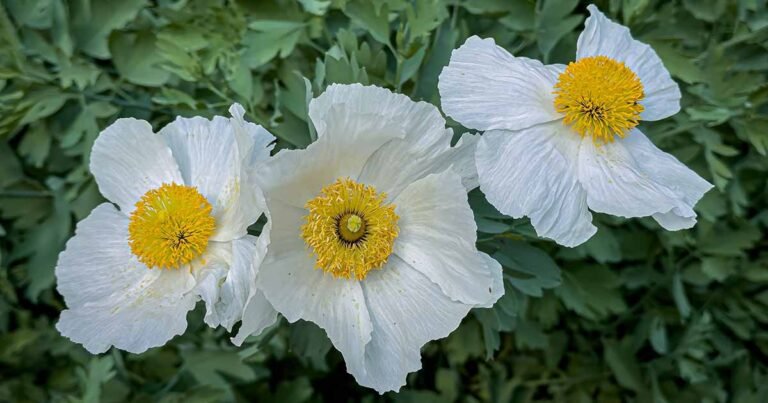
The California tree poppy, Romneya coulteri, is a woody perennial in the Papaveraceae family native to the coastal scrubland of southern California and Mexico’s Baja California.
It is suited to cultivation in Zones 8 to 10. The species grows readily in soil recovering from wildfire damage, and is a water-wise choice for xeriscaping with native flora.

It is also known as Coulter’s Matilija poppy, which honors 19th century Chumash tribal leader Chief Matilija and Irish botanist Thomas Coulter, who explored its native habitat and collected plant samples for Trinity College in Dublin.
Home gardeners delight in the golden-centered, slightly fragrant, crinkly white blossoms measuring up to eight inches across and resembling ruffly fried eggs.
You’ll find all you need to know to grow and care for California tree poppies in this guide.
Here’s what I’ll cover:
California tree poppies sport grayish-green lobed foliage and thick stems, growing to heights of six to eight feet with an equal spread.
In the warmest regions, the leaves are semi-evergreen. Where it is cooler, they turn brown and die at season’s end.
Prolific spring and summer blooming adds substantial vertical visual appeal to climactically suitable landscapes.
The bristly Matilija poppy, R. trichocalyx, is a related species often crossed with R. coulteri to breed ornamental hybrids.
Common name(s): California tree poppy, Coulter’s Matilija poppy, fried egg plant, Matilija poppy
Plant type: Perennial subshrub
Hardiness (USDA Zone): 8-10
Native to: California and Mexico
Bloom time / season: Spring, summer
Exposure: Full sun
Soil type: Sandy loam, organically-rich, well-draining
Soil pH: 5.0-8.0, slightly acidic to slightly alkaline
Time to maturity: 1+ years
Mature size: 6-8 feet tall and wide
Best uses: Massed in drifts
Order: Ranunculales
Family: Papaveraceae
Genus: Romneya
Species: Coulteri
R. trichocalyx differs from our subject species because it has slightly smaller flowers, narrower leaves, and bristles on the calyx below the petals and the upper stems.

California tree poppy is as bold as it is beautiful, the plant is able to withstand strong sea breezes.
When established, the plant increases its landscape footprint with vigor, spreading via rhizomes and by self-sowing.
Choose a location where it can spread into a large drift, or display it on a hillside where the shrub can help control soil erosion.
California tree poppy plants are slow to become established, often failing to bloom – or blooming sparsely – at first.

Once established, they flower profusely, are drought-tolerant, and require little maintenance.
Gardeners are most likely to achieve success when they meet the following cultural requirements:
Provide a location with full sun or the dappled shade of deciduous trees to support robust blooming.
The soil should replicate the species’ native growing environment and consist of organically rich, sandy loam that drains well.
The ideal pH is between 5.0 and 8.0, or slightly acidic to slightly alkaline.
Provide an inch of water per week during the first growing season, in the absence of rain.
Thereafter, plants are drought-tolerant, as mentioned, and should not require supplemental moisture unless the weather is unusually hot and the dry spell prolonged.
California tree poppy is a light feeder that doesn’t require fertilizer. However, some gardeners like to give it a boost in the spring.
If you choose to fertilize, use a slow-release granular product with an NPK ratio of about 5-10-10.
Products lower in nitrogen help to support flowering without promoting an overgrowth of foliage.
Apply it sparingly to the soil around, but not touching the stems. Water immediately after application to dilute and disperse it.
There are several cultivated varieties from which to choose, including:
‘Butterfly’ is a cultivar with exceptionally ruffled snow-white blossoms, fluffy yellow centers, and a generous eight-inch diameter.
The foliage hints of blue, further distinguishing it from the species.
‘White Cloud’ is a hybrid cross between R. coulteri and R. trichocalyx with the signature bristly calyx of R. trifchocalyx and crinkly six-inch blooms.

The density of the growth and the bloom period are somewhat longer than those occurring in nature.
In addition, gardeners will likely find straight species R. coulteri available for purchase in the appropriate growing Zones.
There are few maintenance chores when growing California tree poppies.
With its cultural requirements met, you can expect robust growth.

Because the California tree poppy spreads aggressively via rhizomes you may want to install an underground barrier to restrict root expansion.
Mass-planted specimens are generally self-supporting. However, you may find it beneficial to stake the outer stems to prevent leaning and possible breakage.
Deadheading spent flowers is optional, but it may prolong blooming. It also limits potential self-sowing.
In late fall, cut the stems down to four to six inches tall and dispose of the debris.
End-of-season pruning serves several purposes:
Also, if spring shoots pop up outside your designated growing area, and you don’t want to use them for propagation, dig them up and dispose of them.
The more rootstock you dig up, the slower the spread.
In the wild, smoke and fire naturally stimulate California tree poppy seed germination. In other regions, the species continues to thrive via root expansion.
Seed germination rates are low in the home garden and it can take several years for seedlings to reach maturity and start blooming.

California tree poppies can be easily propagated by digging up and transplanting suckers.
The plant produces many new shoots in spring which pop up on the fine roots that trail from the main rhizomes of mature plants. These can be dug up and transplanted.
Here’s how:
Locate a fresh spring shoot.
Push a hand shovel into the soil three to four inches away from the shoot and three to four inches deep. Bend the shovel slightly toward you to begin to lift the earth.
Work your shovel around the shoot in a circle, cutting and lifting, until you can unearth the soil containing the shoot.
Immediately transplant the entire clump of soil per the instructions below.
To transplant a potted specimen from the nursery, water it the day before.
Note its depth in the current pot.
Work the garden soil to a depth equal to the container and twice as wide. Loosen the soil until it is crumbly and free from debris.
If you wish to curb the spread of the shrub, you can install a root barrier at this stage to prevent the rhizomes from creeping outwards.
Unpot the plant and set the entire root ball in the prepared soil at the original depth, with the crown at or slightly above ground level.
Backfill with soil for a firm hold, and water in well.
Leave at least six feet between plants, and be prepared for aggressive spreading once established.
To prevent damage to the rootstock, avoid moving plants once they are in the ground. Broken roots left in the ground will likely regrow.
You should encounter few pests and pathogens with your California tree poppy. However, there are two that you should be familiar with.
Neoterpes edwardsata caterpillars are moth larvae that generally feed on bright orange California poppies, Eschscholzia californica.
However, when their favorite species is unavailable, they may eat California tree poppies.
The caterpillars are yellow or green with a gray band.
Adult moths have yellow upper wings with an orange to brown fringe and pale yellow lower wings.
You may want to think twice before handpicking and disposing of the foliage-consuming caterpillars because the moths are valuable pollinators that contribute to landscape diversity.
Powdery mildew is a fungal disease that favors shady, humid conditions. Temperatures between 60 and 80°F favor spore germination and dispersal.
Symptoms include leaf distortion and discoloration, followed by fuzzy grayish-white merging patches. The foliage often looks like it’s covered in a white flour coating.
Prevention measures include planting in full sun and not overwatering – if you do need to water, do so at soil level to avoid wetting the foliage.
Treatment with organic neem oil may prove effective if symptoms persist.
Learn more about how to deal with powdery mildew here.
Meeting cultural requirements results in healthy plants equipped to withstand minor infestations or infections.
The California tree poppy offers Zone 8 to 10 gardeners the opportunity to grow a high-impact flowering perennial that commands attention.

Do you have the perfect place for magnificent Matilija to roam through your spring and summer landscape? Why not take out your garden planner and get started?
If you grow California tree poppies in your landscape, we’d love to hear about it in the comments section below!
And for more information about growing other types of poppies and native plants, have a read of these guides next:

by Caitlin H,
May 6, 2024

Eating a healthy, balanced breakfast is one of the best things you can do to improve your chances of reaching your weight loss goals.
Experts say people who eat breakfast start their day off right by giving them fuel to get through the morning without succumbing to temptations like office snacks or fast food at lunch.
And one of the best go-to morning meals — we’re talking easy and delicious — is oatmeal.
Ok, yes, you’ve probably heard of oatmeal — so we won’t go into too much detail answering this question. We will say that oatmeal is a typical breakfast dish comprised of oats, which can come in different varieties, such as steel-cut, crushed, rolled, or instant.
Oats are whole grains packed with powerful nutrients and high-quality protein. They are an excellent source of fiber, too.
The various vitamins and minerals packed into oats also have many health benefits. Studies have linked oat consumption to health benefits that include:
The health benefits make a compelling case for incorporating oatmeal into your morning meal rotation — but how do you keep what could be a pretty bland dish from getting boring?
Read on for 10 creative twists on oatmeal that will keep you invested and, dare we say, looking forward to your oatmeal days.

Take a hot bowl of steel-cut oats with a Honeycrisp apple baked in, add a healthy amount of raisins, cinnamon, and golden raisins, and you’ve got a serious cold-weather comfort food to add to the forever list.
Get the recipe at Treats with a Twist.

It’s hard to argue with the juicy deliciousness of a chocolate-covered strawberry. This topping combination brings those flavors to your steaming bowl of oatmeal with dark chocolate, strawberries, and a splash of cream — all with their own health benefits to add to the oats. Win-win.
Get the recipe at The Recipe Critic.

Oatmeal tends to taste better when it’s thick, rather than runny. Elevate that voluminous mass of warm oats by adding a caramelized banana, almond butter, maple syrup, coconut flakes, whole milk, and kaya.
.png)
If you’re looking for a summery twist to add to your oatmeal, look no further than this tasty bowl combo. It uses maple syrup for a natural sweetener, frozen fruits for extra flavor, and sliced bananas, vanilla yogurt, and hazelnuts to top it all off.
Get the recipe at Lovely Little Kitchen.

If you’re crunched for time, then this easy oatmeal dish is exactly what you need. All you need are rolled oats, vanilla, cinnamon, and almond milk for a simple yet effective flavor combination that gives you all those oat benefits without taking up your morning.
Get the recipe at Fit Foodie Finds.
It doesn’t take long to prepare this oatmeal dish, and we promise — you’ll be glad you did. Peanut butter, like oatmeal, is packed with protein, and the blueberries give it an elevated, unique flavor combination that is pretty much guaranteed to keep you full and focused for hours.
Get the recipe at Easy Chick Peasy.

Who doesn’t love the spicy, nutmeg-y flavors of pumpkin pie? And doesn’t it get even better when you bring them out in a healthy morning dish like oatmeal? This oatmeal recipe leverages traditional pumpkin pie spices, pumpkin, and maple syrup for natural sweetening to bring that fall flavor to your mouth any time of year!
Get the recipe at Treats with a Twist.

Bacon lovers, we didn’t forget you. Blend the sweet, beloved flavors of almond butter and brown sugar with a hot bowl of oatmeal, then top it off with a slice or two of bacon for a delicious, unique oatmeal dish you won’t soon forget.
Get the recipe at The Recipe Girl

If you’re looking for a more savory twist on oatmeal, perfect for a weekend brunch, then this recipe is for you. Topped with eggs, garlicky greens, and avocado, these steel-cut oats offer a filling meal for enjoying before a fun, activity-packed weekend day.
Get the recipe at Love and Lemons.

Reminiscent of sunny beach days with a coconut drink in your hand, this tropical coconut oatmeal will surely make you feel like you’re on a faraway island in no time. All you need is some diced pineapple, unsweetened coconut milk, and toasted coconut for this quick and delicious sun-kissed morning meal.
Get the recipe at Food, Fun, & Faraway Places.
————————————————————————————
Author: Caitlin H
Diet-to-Go Community Manager
Caitlin is the Diet-to-Go community manager and an avid runner. She is passionate about engaging with others online and maintaining a healthy, active lifestyle. She believes moderation is key, and people will have the most weight loss success if they engage in common-sense healthy eating and fitness.

Welcome to Well Rooted Wellness, your transformative journey towards holistic wellness and personal growth. We are an online learning platform that believes in the power of interconnectedness between the mind, body, and environment. Our mission is to empower individuals like you to lead fulfilling lives by nurturing these essential connections.
Contact us: contact@yoursite.com
© Copyright - wrwofficial.com - 2025