47.7 F
Klamath Falls
Saturday, March 14, 2026
Home Blog Page 128

How to Propagate Blueberry Bushes

Nothing beats homegrown blueberries. Well, except for maybe one thing… more blueberries!

If you want to expand your berry patch – or get started growing blueberries – sure, you could go buy plants from a nursery, but why not try propagating your own bushes?

Doing your own propagation at home is so rewarding, not to mention cost effective. It’s worth a try.

A close up horizontal image of ripe blueberries growing in the garden covered with light droplets of water pictured on a soft focus background.A close up horizontal image of ripe blueberries growing in the garden covered with light droplets of water pictured on a soft focus background.

We link to vendors to help you find relevant products. If you buy from one of our links, we may earn a commission.

In our guide to growing blueberries, we cover how to cultivate these plants in your home garden.

In this article we will cover four propagation methods. Here’s the lineup:

Blueberry Propagation Methods

Whether you want to turn your existing plant into a row of productive bushes, or get started on your own berry patch, you can do so with one of these propagation methods.

Cuttings

Blueberries can be propagated via softwood or hardwood stem cuttings. Softwood cuttings are often the preferred commercial method, as they usually have better and quicker rooting success.

A close up horizontal image of a gloved hand from the right of the frame holding pruning shears and cutting a branch from a perennial blueberry bush.A close up horizontal image of a gloved hand from the right of the frame holding pruning shears and cutting a branch from a perennial blueberry bush.

When taking cuttings, whether softwood or hardwood, always choose the strongest, healthiest mother plants and branches to harvest from.

To create a good propagation mixture that can be used for either type, combine equal parts of coarse sand, ground pine bark, and peat moss, or equal parts perlite and peat moss. Moisten before inserting the cuttings, but do not saturate the medium.

Make sure your container is at least four to five inches deep. You can use one-gallon containers or flats with deep cells.

While neither hard or softwood cuttings need rooting hormone to root properly, dipping the ends in a product like Bontone II Rooting Powder, available at Arbico Organics, just before sticking them in their holes can help to improve and speed up rooting.
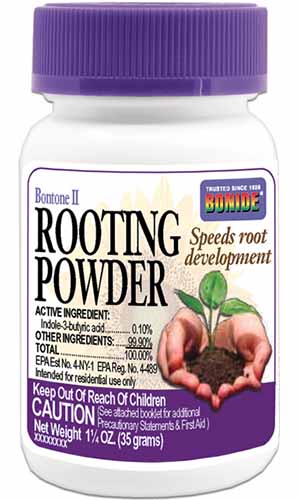
A close up vertical image of a small plastic bottle of Bonide's Bontone II Powdered Rooting Hormone isolated on a white background.A close up vertical image of a small plastic bottle of Bonide's Bontone II Powdered Rooting Hormone isolated on a white background.

Bontone II Powdered Rooting Hormone

Now let’s jump straight into it, with the details for your selected type of wood.

Softwood Cuttings

Softwood cuttings are those taken from the top of the season’s current growth on the upper parts of the mother plant.

The leaves at the end of the stem (terminal leaves) should be half-grown to nearly mature, and stems should be flexible.

If you take cuttings too early, when the terminal leaves are super soft and stems are really flexible, the cuttings may wilt before they can root.

If you take softwood cuttings too late, when the terminal leaves are mature and the second flush of growth has already started, you may see poor rooting.

A happy medium between the two will result in the fastest, best root development, perhaps a bit closer to semi-hardwood than softwood, if you want to be technical.

Cuttings can be taken in the late spring, during the first flush of growth, or from the fall flush. Spring cuttings are typically much more successful.
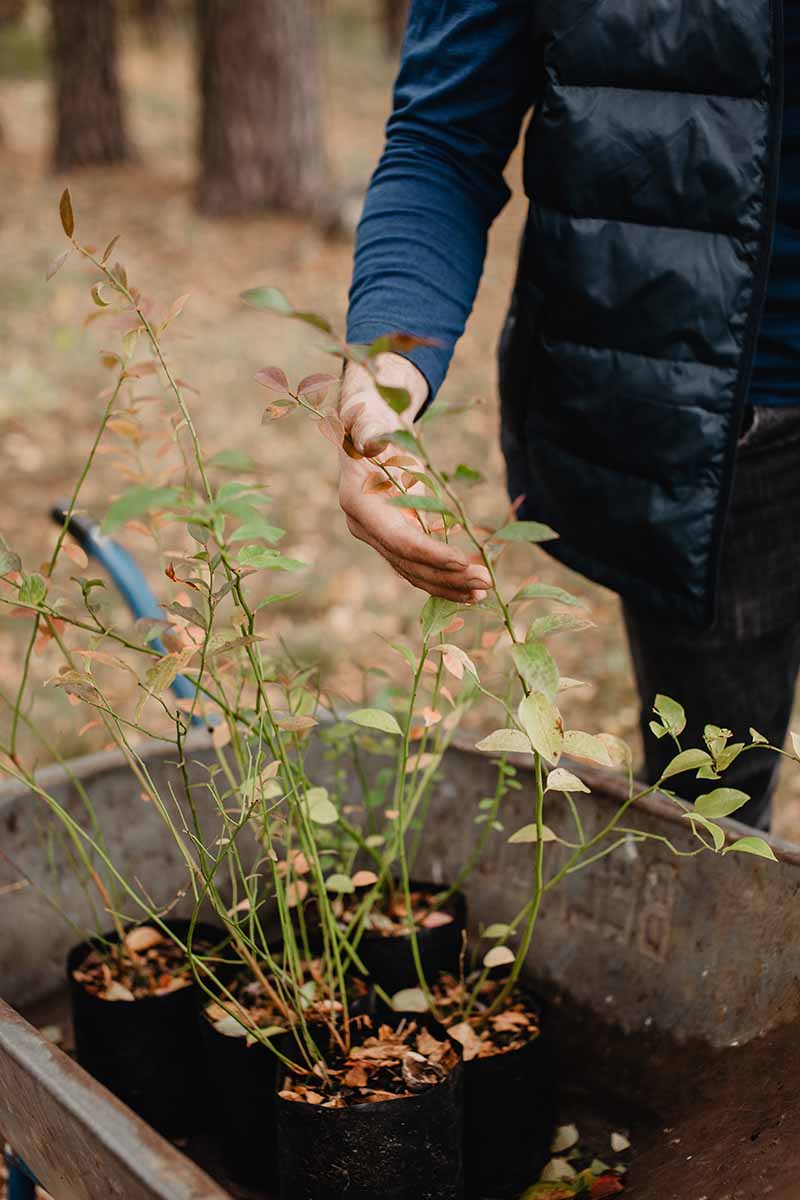
A close up vertical image of a gardener on the right of the frame inspecting small transplants before planting out in the garden in the fall.A close up vertical image of a gardener on the right of the frame inspecting small transplants before planting out in the garden in the fall.

If you’d rather take cuttings later in the year when you are less busy in the garden, you might want to take hardwood cuttings instead, covered below.

Collect cuttings early in the morning if possible. Use sharp, clean pruning shears or a knife. If you wish, you may disinfect your tools before beginning with a solution of one part household bleach to five parts water.

Cut four- to five-inch sections of stem. Remove the lower leaves, leaving three terminal leaves in place. Don’t allow them to dry out.

Keep them moist and cool during and after collection by dunking cuttings in a bucket of water, or folding them in wet burlap.

Poke individual holes in the center of the pot. Place the cuttings in the pre-prepared, moist medium to a depth of about half to two-thirds of the cutting length and firm the medium around the base.

Place in a low light area, whether indoors or in a greenhouse, where the temperature is around 70°F.

Two gloved hands cutting branches from blueberries to grow  from cuttings.Two gloved hands cutting branches from blueberries to grow  from cuttings.

Keep the medium moist. Either mist regularly to manage humidity, or cover with plastic, propped up to keep it off the leaves. Remove the plastic to let the cuttings ventilate for 10 minutes twice a week.

It can be hard to know if you are watering enough or too much during propagation. Become a sleuth to find out!

You can check whether you’re on the right track regarding moisture by gently removing the cutting from the medium and having a peek at the cut end.

If the medium is perfectly moist and aerated, the cutting should be forming a white to cream-colored callus and may have small white roots sprouting from the callus by the third week. Be careful reinserting if little roots are starting and avoid removing the cuttings once roots are developing.

If you’ve been overwatering, the cuttings won’t have formed a callus and might be sprouting sparse, weak roots. The cutting also might begin turning brown from the cut end up.

Once roots are beginning to develop, the medium will start to dry out quicker. To make sure you are providing enough moisture, press a finger into the soil. If it comes back cool and moist, perfect! If the soil is warm and your finger is dry, you’ll need to add water.

Softwood stems should root within six to eight weeks. Gently tug on a cutting to check for resistance. Resistance equals roots!

Once rooted, fertilize lightly with a complete fertilizer such as Dr. Earth Root Zone Organic and Natural Premium Starter Fertilizer, available at Nature Hills Nursery, at half the recommended rate, as young plants are salt-sensitive.

A close up vertical image of the packaging of Dr Earth's Root Zone Organic Premium Starter Fertilizer isolated on a white background.A close up vertical image of the packaging of Dr Earth's Root Zone Organic Premium Starter Fertilizer isolated on a white background.

Dr Earth Root Zone Starter Fertilizer

Continue to care for your cuttings by maintaining even moisture in the potting medium over the summer months.

In the fall, prepare the young plants for the transition from their indoor home to life outside by slowly and gradually hardening them off.

Place in an area with indirect sunlight for one hour, and add an hour of outside time each day until they can spend an entire day out.

Once hardened off, you can decide to transplant directly into their permanent positions, or into larger containers filled with milled pine bark. Many growers prefer to let their plants grow larger in containers outdoors before transplanting into the garden.

Repotting can also be done as soon as the plants are hardened off.

Mix a complete slow-release fertilizer, such as Down to Earth’s Acid Mix (4-3-6 NPK), available at Arbico Organics, into the new potting medium.

A close up square image of the packaging of Down to Earth's Acid Mix Fertilizer isolated on a white background.A close up square image of the packaging of Down to Earth's Acid Mix Fertilizer isolated on a white background.

Down to Earth Acid Mix

Water well after repotting and keep plants growing in containers in a protected spot over winter, such as a cold frame or against a south wall. Larger plants may respond better to transplanting.

If you decide to transplant directly into the garden, keep the pots near their future permanent positions until they can be transplanted, and be sure to transplant before the ground is frozen.

Mix a half cup of the Down to Earth’s Acid mix fertilizer into the backfill soil, and water well after transplanting.

Top dress both containers and in-ground plants with one or two more applications of fertilizer during the next growing season, or mix into the surface of the soil. Water in well.

Learn more about how to transplant blueberries in our guide.

Hardwood Cuttings

Hardwood cuttings are taken during the dormant season and after a sufficient chilling period. Each cultivar requires a certain number of chill hours, so make sure this has been reached before taking cuttings.

A close up horizontal image of a hand from the right of the frame holding a pair of pruning shears cutting stems from a perennial shrub in fall.A close up horizontal image of a hand from the right of the frame holding a pair of pruning shears cutting stems from a perennial shrub in fall.

I prefer to take cuttings in April, when many cultivars are finally finished chilling and temperatures are becoming ideal for rooting.

Using sharp, clean tools, cut 12 to 36-inch shoots (also known as whips) that are one-sixth of an inch in diameter, or about the thickness of a pencil.

Clip off an inch of the tip and discard it. Divide the whips into five- to six-inch sections. Cut the ends on an angle to help with insertion into the medium.

Look at which direction the buds on the stem are pointed; if they are pointed upwards you’ve got them oriented the right way.

Insert one stem into each pot filled with moist medium, about half to two-thirds of their length deep. Leave at least one shoot bud exposed and make sure each stem is placed into the medium right side up.

Firm the medium around the base of each. Set the pots outside in the shade to root, or in a greenhouse or cold frame covered with 40-70 percent shade cloth.

Bottom heat via a heat mat set at 68-70°F can help speed up rooting if you have the facilities. Make sure the area is well ventilated.

As long as the medium is kept moist, not wet, hardwood cuttings should form roots – eventually. Often, buds will break and leaves will form before they are even rooted! Keep a good eye on medium moisture during this stage, as they will die quickly if they dry out. Consider misting regularly.

Hardwood stems can take up to six months to root, so this method can be an exercise in patience. But in my experience, most of those taken in April will be rooted by mid July.

Once the cuttings are rooted – which you can check if you gently pull on the stem and feel resistance – apply a light dose of complete, diluted fertilizer with an NPK ratio of 15-30-4 or 13-36-13, or diammonium phosphate, every two weeks until the fall.

Leave the cuttings in their rooting location until the fall or early winter. Transplant into larger pots filled with milled pine bark, and let them grow for another year in the same location.

They should be strong and large enough to be planted in their permanent position by their second winter, before the ground has frozen.

Layering

Layering is a propagation method used as an alternative to taking cuttings. All you need is a flexible branch that will bend to ground level, moist soil, and some rooting hormone powder.

In the spring or fall, find a flexible young shoot, preferably on the outside of your plant. The stem needs to touch the ground at least a foot from the tip, so test the length by bending to the ground before making any cuts.

Once you have identified an appropriate stem, remove the leaves from the top 12-inch section, starting at the stem tip. Then cut a one- to two-inch-long slit in the leafless section of the stem, preferably through a leaf bud.

Sprinkle the cut with rooting hormone, such as Bontone II Rooting Powder.

Dig a shallow trench in the soil where the cut section reaches the ground, peg the shoot down and bury the cut with soil. The tip of the shoot must not be covered with soil.

Keep the buried shoot moist, but not waterlogged.

Within a year the buried section should have developed roots. The aboveground part of the plant should be green and putting on new growth, indicating that it has a good root system.

The new plant can be severed from the mother plant and either transplanted or potted up to grow on. As you would with other types of cuttings, to check for rooting, give it a gentle tug, or give it a wide berth and gently dig it up.

Either transplant to the garden or pot up to continue growing.

Seeds

You can either buy seeds or extract them from your own berries.

A close up horizontal image of a pile of blueberries set on a wooden surface with one cut in half to reveal the seeds inside.A close up horizontal image of a pile of blueberries set on a wooden surface with one cut in half to reveal the seeds inside.

Extracting your own seeds is simple enough, but you need to realize that seeds from hybrid plants won’t result in plants with the exact same qualities as the parent.

If you want a specific variety or cultivar, it is best to purchase open-pollinated heirloom seeds, but these can be hard to find.

Pre-stratified northern highbush seeds are available via Amazon.

To extract your own seeds, start with seeds from blueberries that have been frozen for 90 days, either on the bush or in your freezer.

A close up horizontal image of a blueberry shrub covered in a light dusting of frost pictured in winter sunshine.A close up horizontal image of a blueberry shrub covered in a light dusting of frost pictured in winter sunshine.

Add three-quarters of a cup of thawed berries to a blender, food grinder, or bowl, and add water until it is three-quarters full. Blend for 10-15 seconds, or mash completely, and set aside to let the seeds and pulp separate.

The seeds will sink, and the pulp will float. After 10 minutes, pour or scoop off the pulp and let it settle again. Repeat until most of the seeds have settled. Remove them from the water, and spread them out to dry on a paper towel.

A close up horizontal image of a blender filled halfway with fresh blueberries set on a wooden surface.A close up horizontal image of a blender filled halfway with fresh blueberries set on a wooden surface.

Fill a three-inch-deep flat with moistened peat moss. Sprinkle the seeds evenly over top, or sow individually, spacing one inch apart. Cover with another thin layer of peat moss.

Cover the tray with newspaper and place in a warm 60-70°F location. Keep the medium moist but not wet.

Germination will take about a month. When the tiny seedlings start emerging, remove the newspaper and place in a sunny window or in your greenhouse to continue growing. Keep moist.

Once seedlings are two to three inches tall, remove each, being especially careful with the roots, and transplant them into their own little pots.

The pots should be two to three inches deep and filled with a mix of equal parts peat, sand, and potting soil. Water well after transplanting and keep in a sunny location indoors or in a greenhouse.

After two to three weeks, fertilize lightly with a complete liquid fertilizer.

Once all danger of frost has passed you can harden off your little blueberry plants and set them outside for the summer. Keep them well watered.

Transplant into the ground, or their own containers, in the late fall or in the spring of the following year.

Suckers

If you notice your bush is sending shoots up a few inches away from the crown of the plant, you can use these to vegetatively propagate new bushes as well.

Let these suckers grow for at least two seasons before dividing them from the mother plant in the late fall or winter before the ground is frozen. To do this, use a sharp shovel to separate off the root the sucker is growing from. Carefully dig eight to 12 inches deep around the sucker to remove the root structure and then rehome it.

Suckers usually have very small and underdeveloped root systems, and their tops will need to be trimmed harshly to even out the root-to-shoot ratio. Clip the shoots to the same length as the roots before transplanting, leaving at least two leaves in place.

You can plant suckers in their permanent position immediately as you would other transplants, or pot them up and let them grow for a season before transplanting.

Treat potted suckers as you would cuttings soon after rooting, by planting in a milled pine bark medium, keeping it moist, and placing in a sheltered location.

Can’t Get Enough of that Blue!

In the case of blueberries, more is always better.

Propagating your own blueberry plants is a fun, gratifying, and cost-effective way to go from owning a few plants to tending a full row of the blue-laden bushes.

A horizontal image of rows of Vaccinium bushes, laden with fruit, pictured in bright sunshine.A horizontal image of rows of Vaccinium bushes, laden with fruit, pictured in bright sunshine.

Use cuttings, suckers, or layering to clone your best plants, or try seeds for the satisfaction of seeing tiny green sprouts emerging in your house or greenhouse.

Have you ever tried propagating your own blueberries? Tell us about your adventures in the comments section below!

Check out more of our helpful guides to growing blueberries next:

Air Fryer Chicken Tenders Recipe


Air Fryer Chicken Tenders Recipe


Privacy & Cookies Policy

Homemade Anti-Itch Spray with Menthol & Aloe

0

Summer has always been one of my favorite seasons. With an abundance of fresh produce at the farmer’s market, veggies in the garden, and summer family activities, it’s nearly perfect… Except for the bugs, poison ivy, and occasional sunburn!

Since we moved to the south years ago, I get to enjoy even more warm, summer weather. And with it comes even more mosquitoes. 

Of course, homemade bug spray helps ward off most of the mosquitoes, and homemade sunscreen helps avoid the sunburn in the first place. Still, it seems that at some point, someone forgets one or the other and ends up with itchy, irritated skin. 

I’m also one of those lucky people who happen to be a mosquito magnet. Even just a few minutes outside taking out the trash is usually enough to leave me with a few bites. Plus, I love spending time on walks with my weighted vest or soaking up midday sunshine on the lawn chair.

The solution?

Homemade Anti-Itch Spray

This anti-itch spray contains a mixture of potent natural remedies that help eliminate the itch immediately. I’ve tried it on mosquito bites, poison ivy, sunburn, chigger bites, and even stinging nettle burns with good results.

The secret ingredient is menthol crystals. I use these potent natural crystals in my pain relief lotion bars and my soothing shower melts for cold relief. Menthol is naturally cooling and soothing and is often used in salves, balms, mouthwashes, liniments, lozenges, and other remedies.

If you’ve ever sipped on peppermint tea and felt that cooling sensation on your tongue, that’s thanks to the menthol naturally found in mint. While I use mint essential oil in this cooling spray recipe, menthol crystals offer a more concentrated version. It really helps take the sting out of bug bites and irritated skin!

Just be sure to use gloves or a utensil when adding the menthol crystals to the rest of the ingredients. If you get residue on your hands and then touch your eyes (or other sensitive areas), it will burn!

Other Cooling Ingredients

I’ve also included aloe vera gel for its well known skin soothing properties. Apple cider vinegar is another staple ingredient here and is a surprising natural way to relieve inflamed skin. Lavender essential oil adds a slightly floral scent and has plenty of data backing up its anti-itch properties. 

Lastly, you can add some calendula hydrosol too if you have some on hand. Hydrosols are a great way to add some extra skin pampering and last much longer than an herbal tea.  I make this in a 4-ounce spray bottle, but you could easily double the recipe or cut it in half to fit your container size.

Cooling Anti-Itch Spray Recipe

This simple Anti-Itch Spray uses witch hazel, aloe vera gel, sea salt, menthol crystals, apple cider vinegar, and essential oils to stop the itch.

Prep Time5 minutes

Active Time10 minutes

Cooling Time10 minutes

Total Time25 minutes

Yield: 4 ounces

Author: Katie Wells

  • In a small saucepan, heat the witch hazel over low heat until warm to the touch (about 130 degrees).

  • Add the salt and stir until dissolved.

  • Using tweezers or gloves, add the menthol crystals to the witch hazel and stir until dissolved. Avoid touching menthol with your hands, as it can sting eyes or other sensitive areas if you touch them afterward.

  • When the menthol is dissolved set the mixture aside to cool.

  • When it is cool, add the aloe vera gel, apple cider vinegar, hydrosol, and essential oils if using.

  • Carefully transfer the mixture to a spray bottle for use.

  • To use, spray and let dry on itchy skin. Store in a cool place or the refrigerator for up to a month.
  • If using the optional hydrosol, you can reduce the witch hazel by 1 TBSP if needed so the final product will fit into your container.

Use & Storage

Spray and let dry on itchy skin as needed. This will store for a few weeks at room temperature, but I prefer to keep it in the refrigerator. It lasts longer and feels extra cooling on itchy skin.

Other Natural Remedies for Itchy Skin

If you don’t have all the ingredients for this anti-itch spray on hand, here are some more natural methods to try:

  • Apply a bentonite clay and water paste onto itchy skin. I also use bentonite clay in my anti-itch cream (use it like calamine lotion).
  • Crush peppermint leaves and rub them on bug bites for a natural menthol effect.
  • Mix 1 teaspoon of baking soda and water for a soothing paste.
  • Jewelweed is a traditional remedy for itchy skin, especially poison ivy rashes. Don’t feel like foraging it yourself? You can get a jewelweed salve here

While the spray is my first choice when it comes to soothing an itchy bug bite, I also like the Bug Bite Thing. Simply put the device on the bug bite and pull up to suction up the irritants! 

Ever struggled with itchy skin? What worked for you?

Julie’s Spring Garden in Georgia, Part 1

Hi GPODers!

Yesterday we enjoyed some of the earliest spring blooms in Massachusetts from Barbara Owen (check that out here if you missed it: Barbara’s Beginning of Spring in Massachusetts), but today we’re heading south! Julie Prince has shared an update on her colorful garden in Albany, Georgia. We’ve only seen Julie’s garden after months of growth in summer and fall (Check out her previous submissions: Julie’s Georgia Garden in Summer and Fall: Part 1 and Part 2, Julie’s Georgia Garden, and Julie’s Garden in Late Summer and Fall 2023), and today we get to see her space as it starts to unfurl in spring.


My favorite pictures on GPOD are those that show the landscape and layout of the garden rather than individual plant pictures. I love seeing the layout of the garden and the plant combinations. That being said, I am sharing some individual or small area photos this time.

My garden has slowly unfolded. We enjoyed (???) a rare snow event in Southwest Georgia on January 22. In our yard we measured 6.5 inches accumulation, and it hung around for several days. I had no idea what would survive and what would suffer from the cold and wet conditions. I have been pleasantly surprised! The plants emerged pretty much as they would have otherwise, but it has been one thing at the time, thus the individual pictures.

Happy Gardening!

Julie Prince

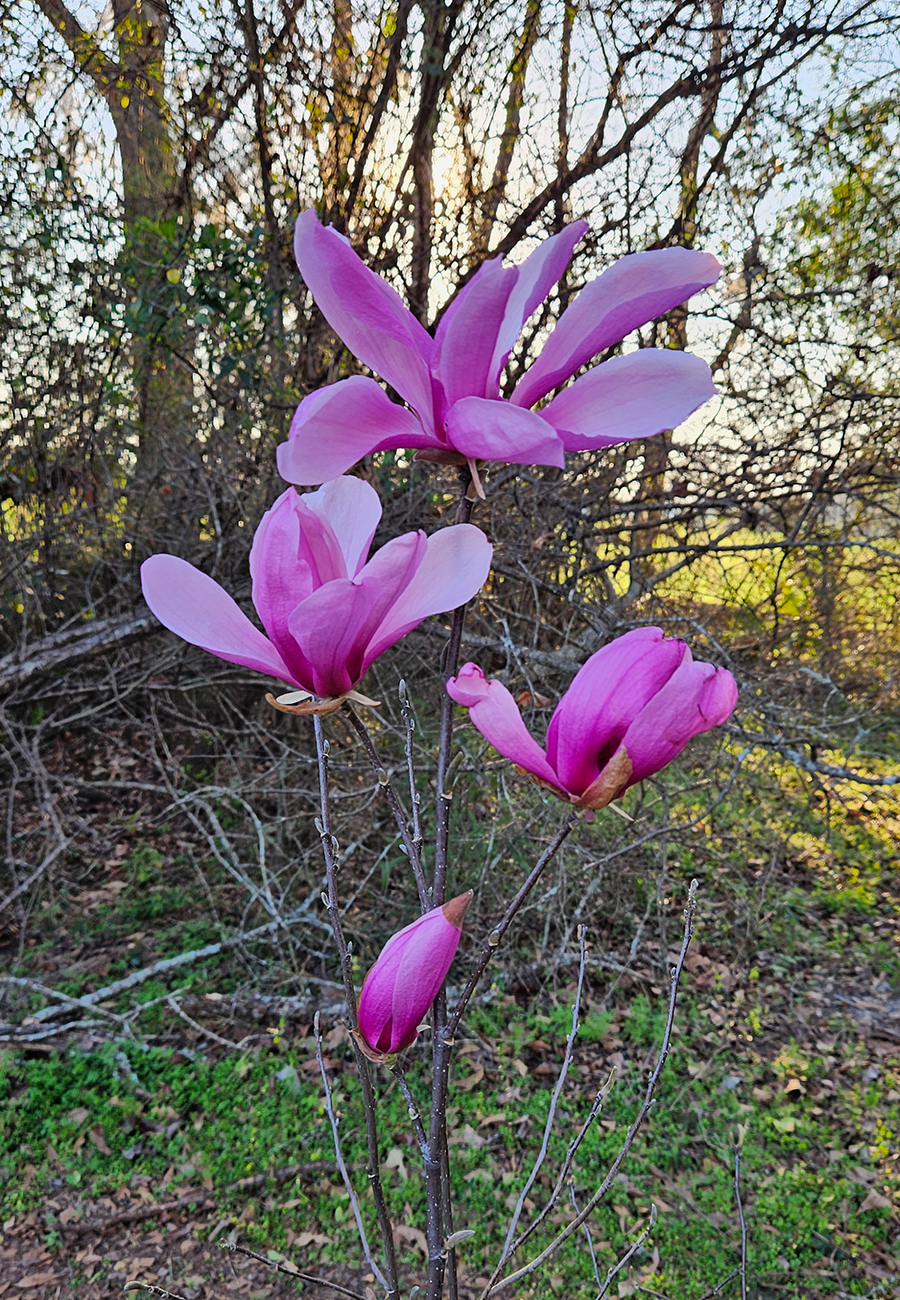
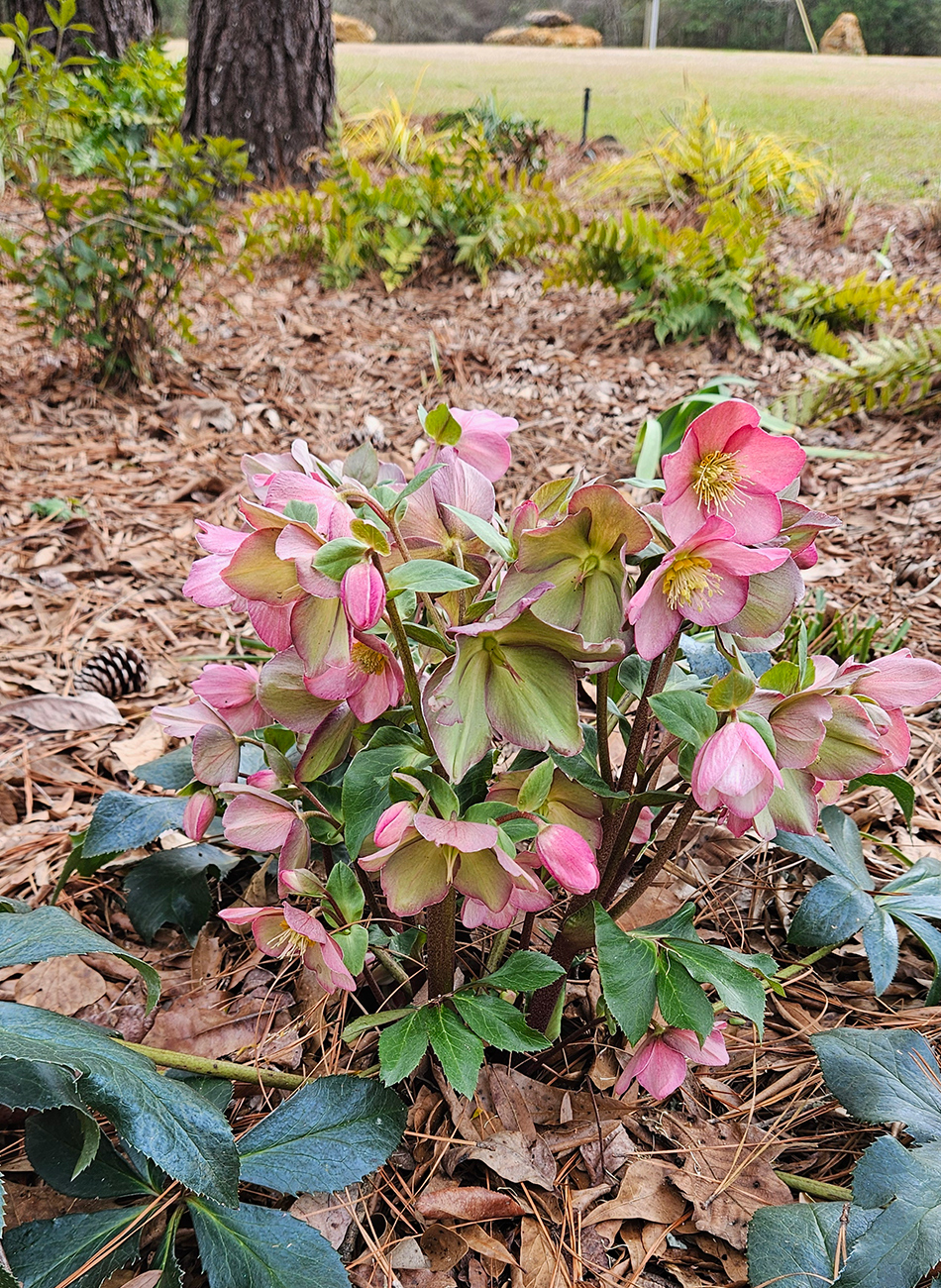
The hellebores and daffodils came first, along with a few blooms on a new Japanese magnolia.

bright pink magnolia bloomsJulie’s new tree, a young lily magnolia (Magnolia liliiflora, Zones 5–8), started her season off with bursts of glowing pink.

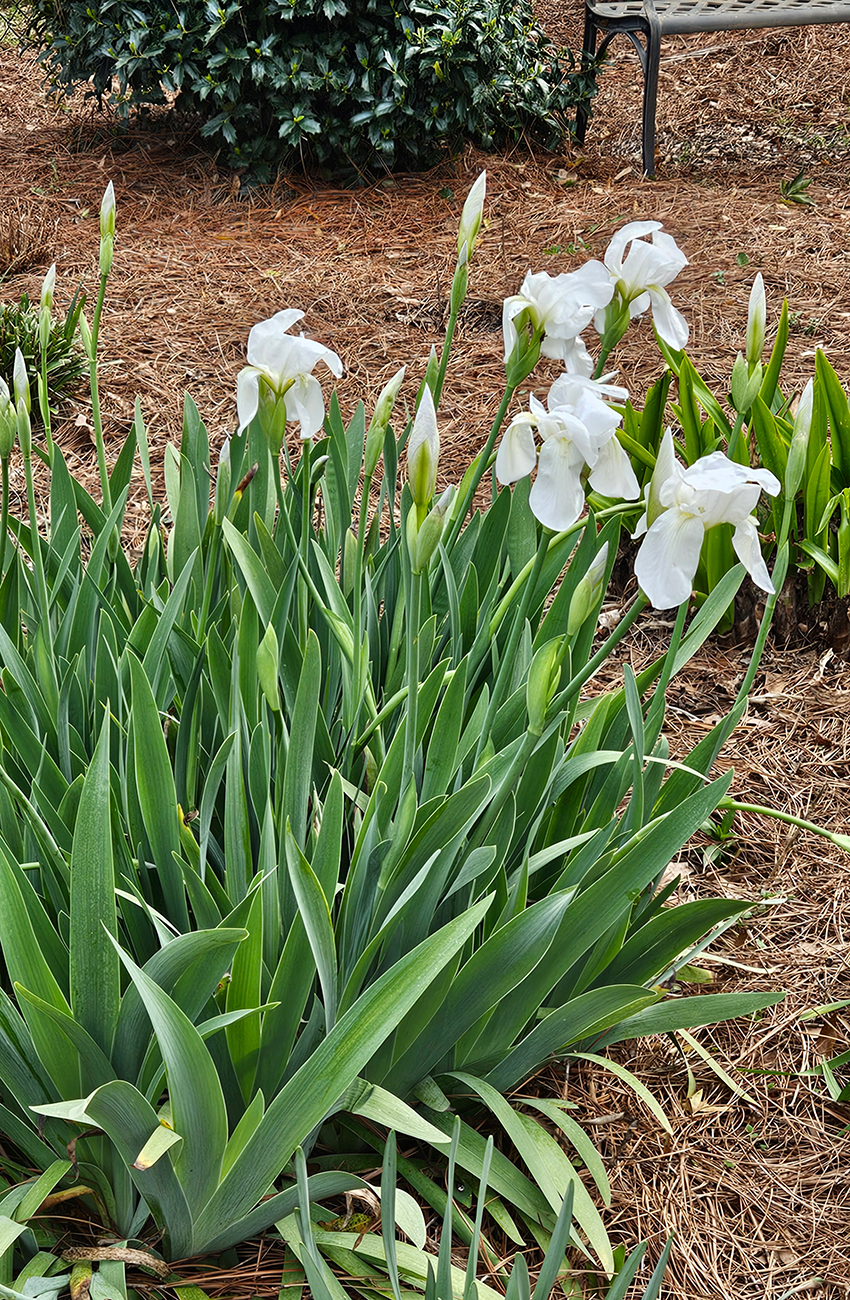
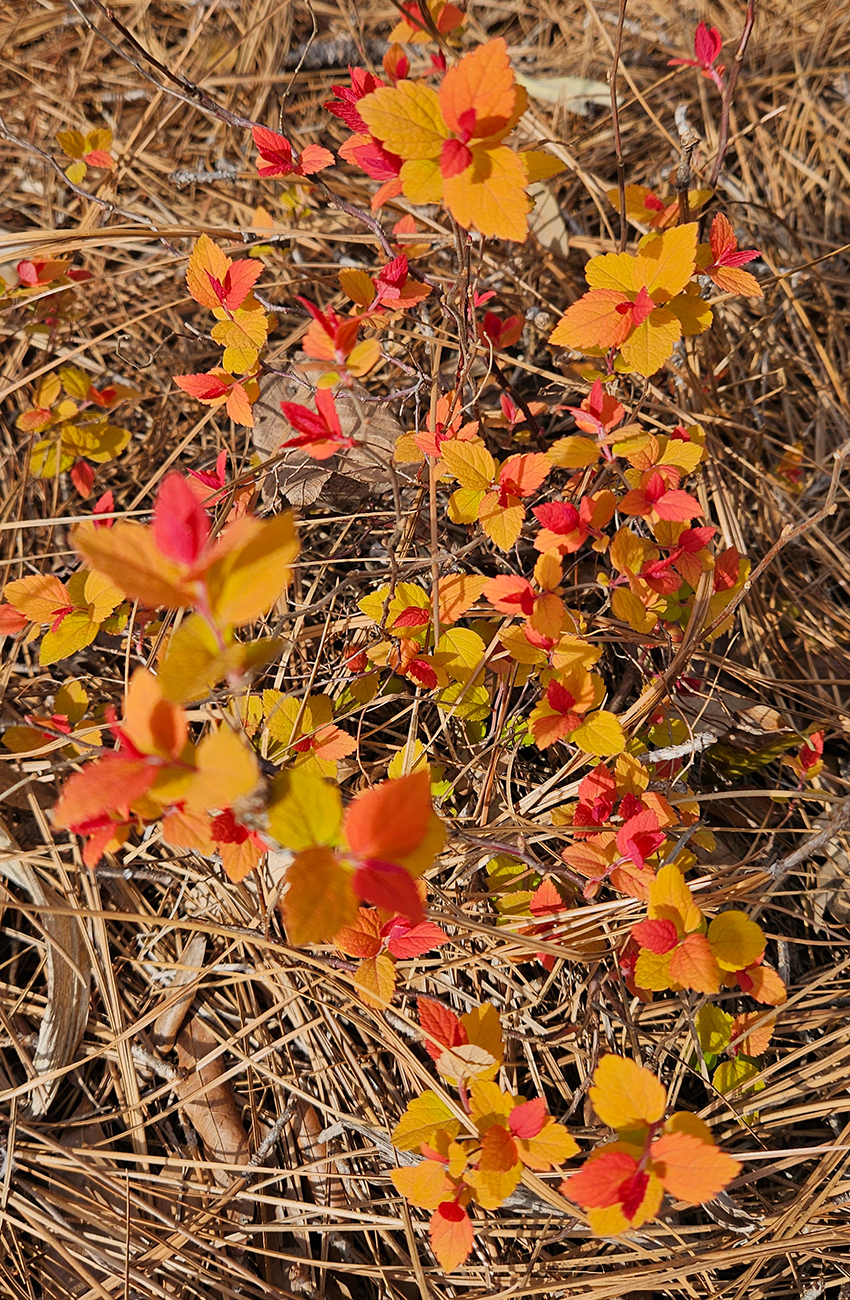
white irisesThe white bearded iris (Iris albicans, Zones 7–9) and the Candy Corn spirea (Spiraea japonica ‘NCSX1’, Zones 4–8) were spectacular!

bright orange and red foliage emerging in springThat spectacular Candy Corn spirea as it first emerges with tiny shoots of fiery foliage.

bright chartreuse and red foliage plantA little later in the season and the spirea continues to be spectacular, filling in beautifully with bright chartreuse growth.

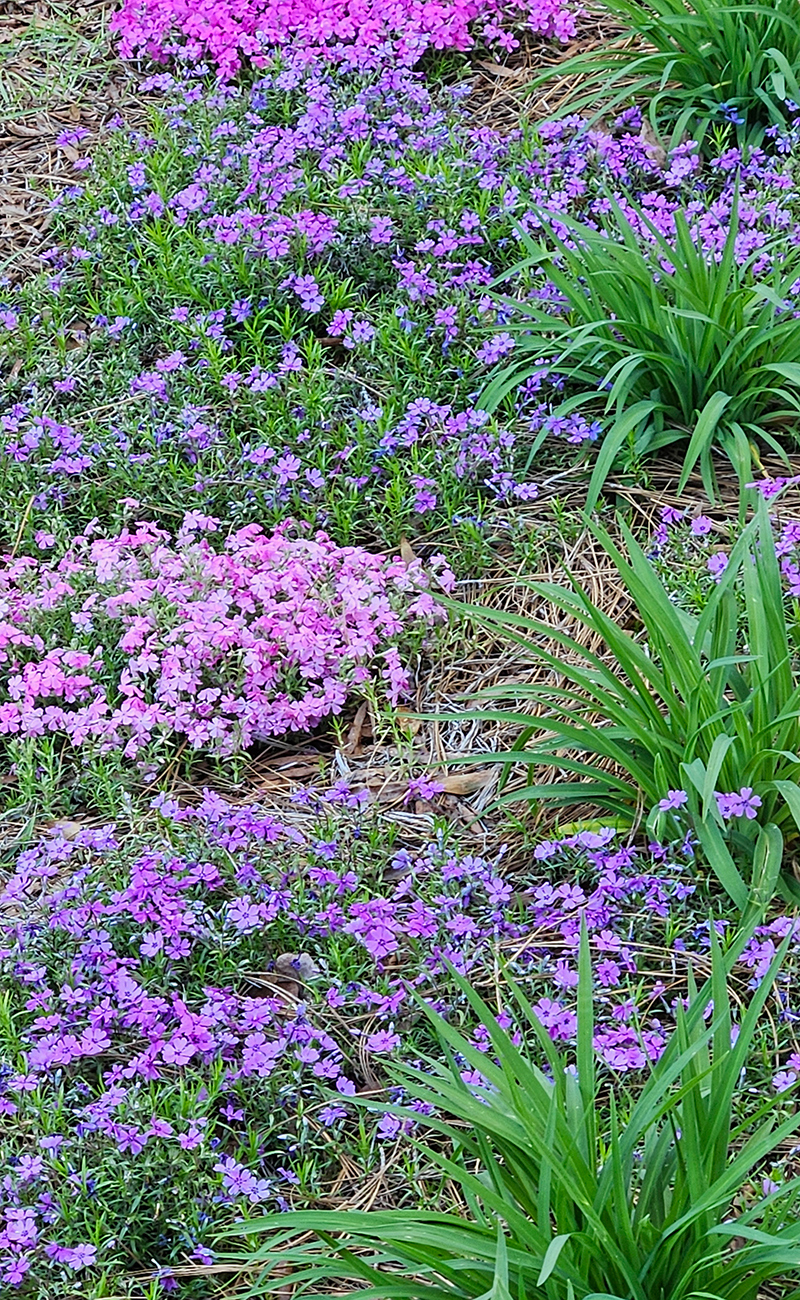
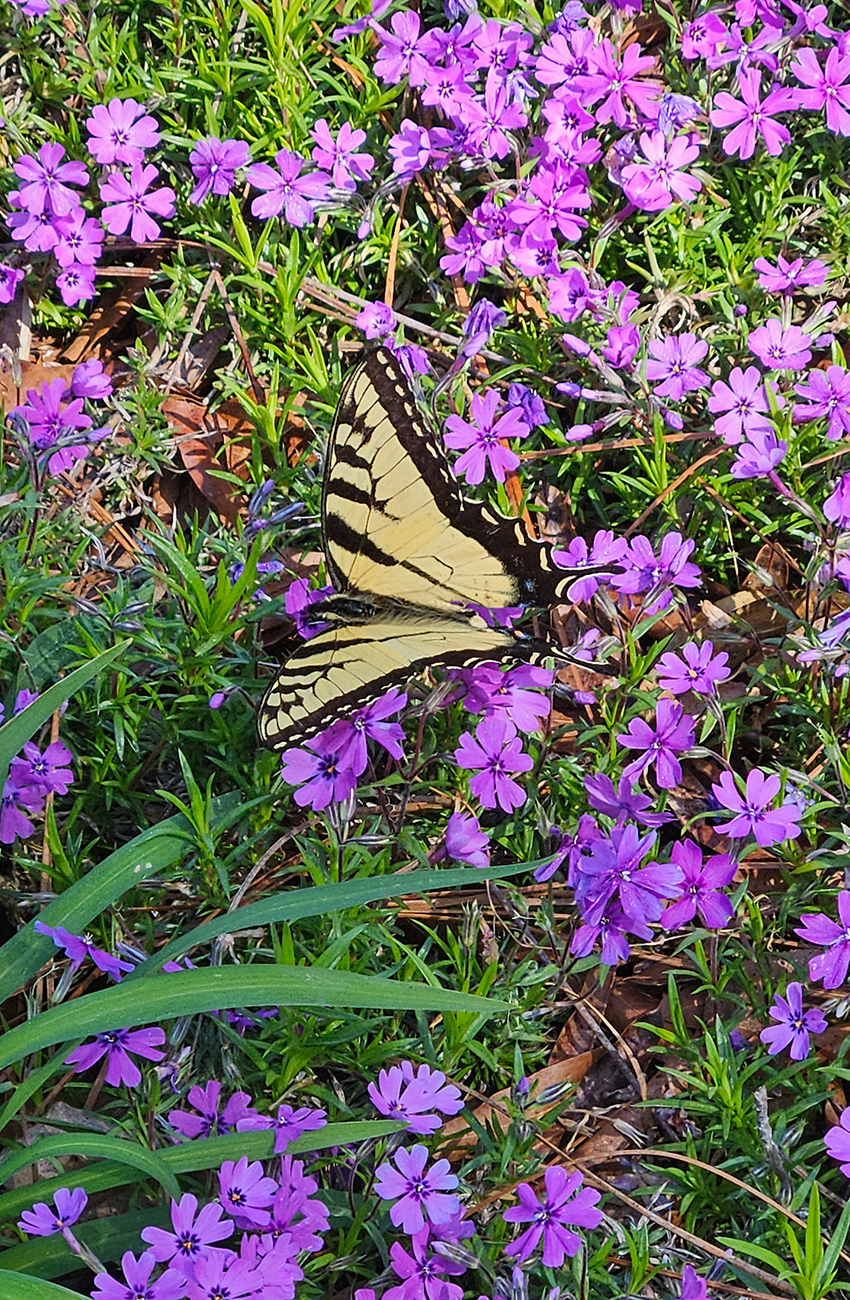
pink and purple creeping phloxThe creeping phlox (Phlox subulata, Zones 3–9) is beginning to cover a very difficult and rocky spot where a gravel driveway once was.

butterfly on purple creeping phloxThe beautiful butterfly was a surprise!

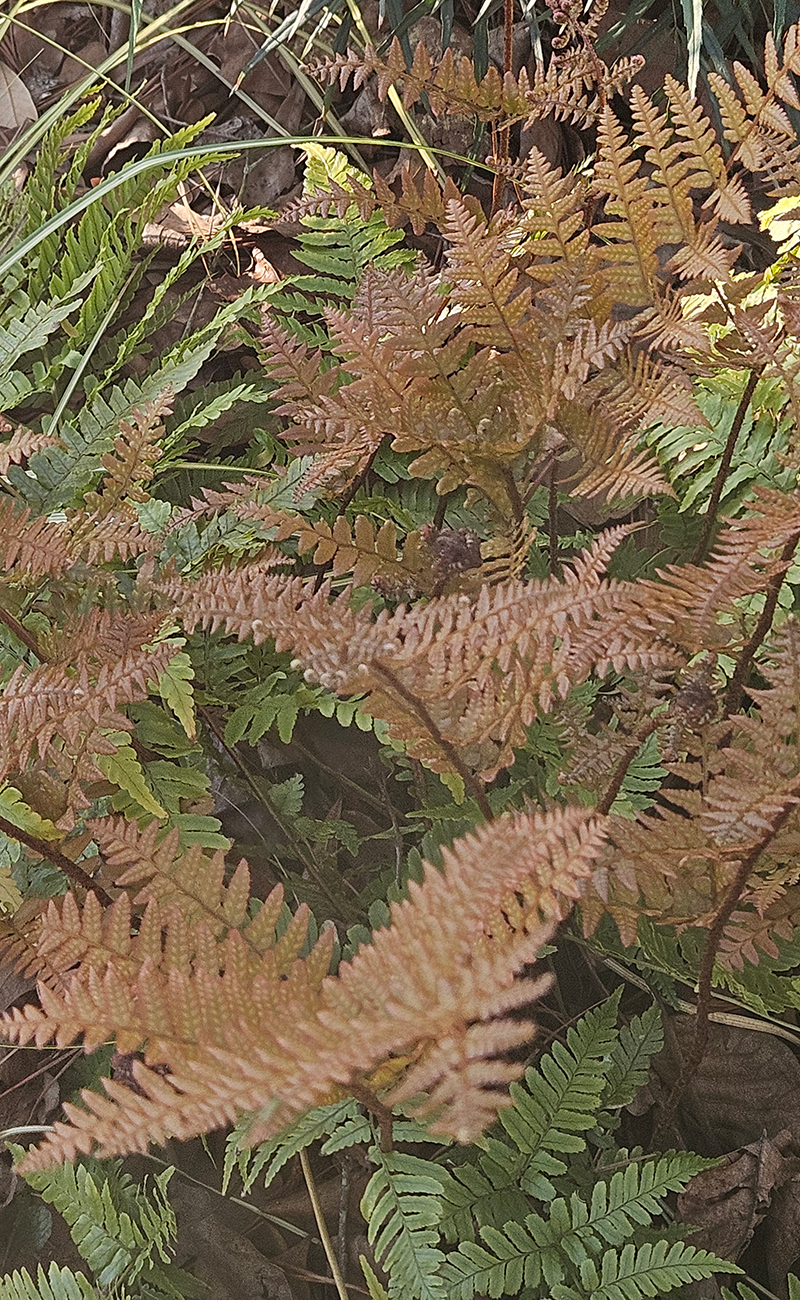
orange-brown fern frondsAutumn ferns (Dryopteris erythrosora, Zones 5–9) unfurled colorful fronds and joined the new foliage of coral bells.

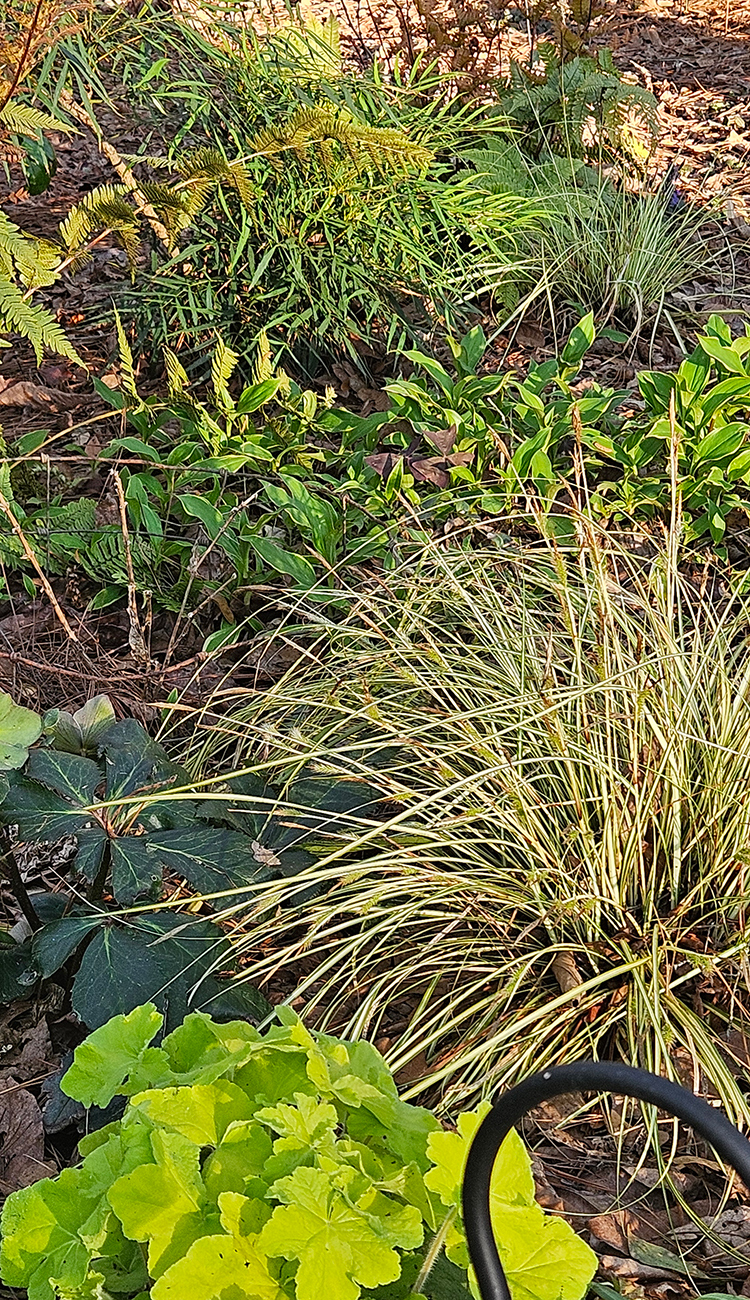
bed with foliage in different shades of greenWhile Julie’s bright and colorful flowers often grab the most attention, it’s clear she doesn’t skimp on fantastic foliage either. The vast variety of textures and shades of green in this vignette makes it endlessly interesting without a single bloom.

bright pink creeping phlox under variegated foliage plantPhlox in another bed mingled with new foliage of an abelia.

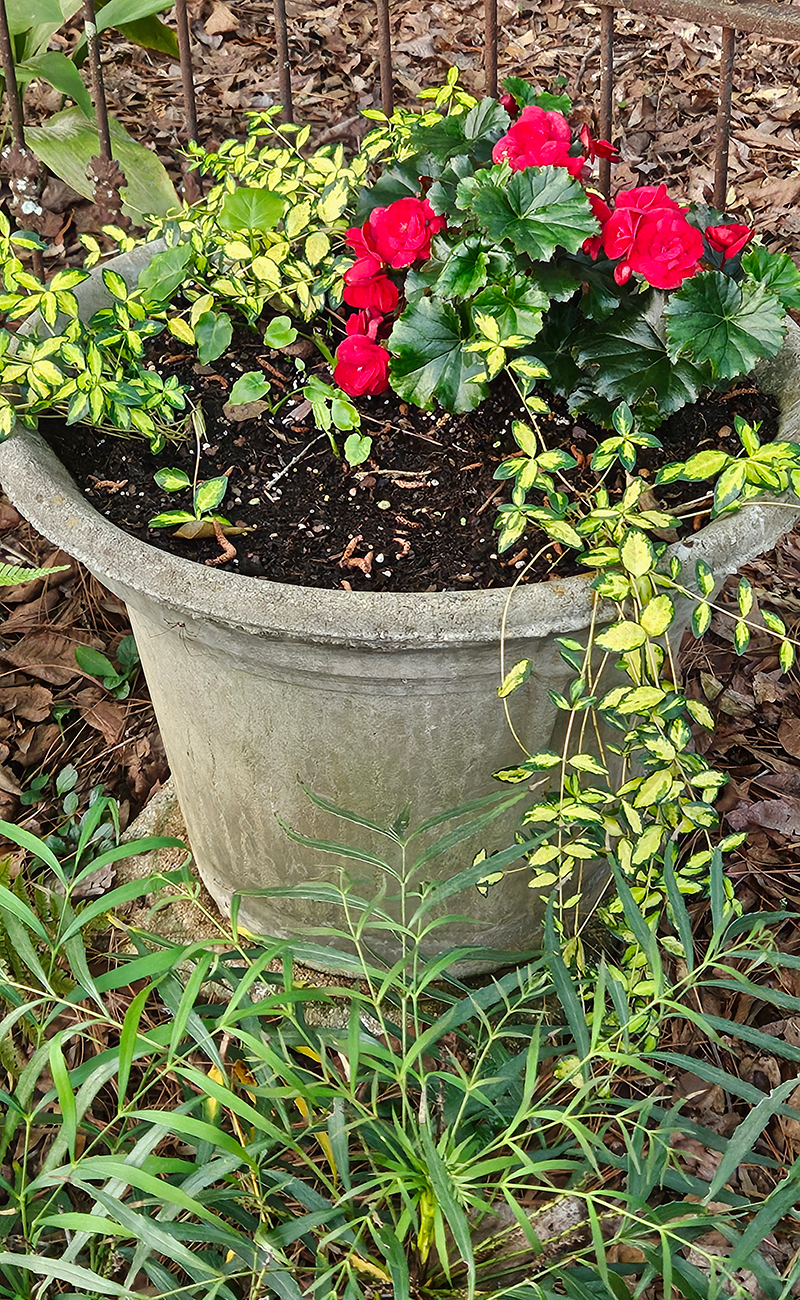
urn container with trailing foliage and red flowersThe cherries on top of all of Julie’s designs are her beautiful containers. Bright red tuberous begonias and Illumination dwarf periwinkle (Vinca minor ‘Illumination’, Zones 4–9) make for a bright and bold pairing that will demand even more attention as it grows in.

Although Julie experienced that unexpected snow last winter, her garden is absolutely thriving and already full of color. So much so, that these are only half of the photos she shared with us. We’ll be back in Georgia tomorrow to see more spring growth in her garden and Julie’s fabulous container plantings.


We want to see YOUR garden!

Have photos to share? We’d love to see your garden, a particular collection of plants you love, or a wonderful garden you had the chance to visit!

To submit, send 5–10 photos to [email protected] along with some information about the plants in the pictures and where you took the photos. We’d love to hear where you are located, how long you’ve been gardening, successes you are proud of, failures you learned from, hopes for the future, favorite plants, or funny stories from your garden.

Have a mobile phone? Tag your photos on Facebook, Instagram or Twitter with #FineGardening!

Do you receive the GPOD by email yet? Sign up here

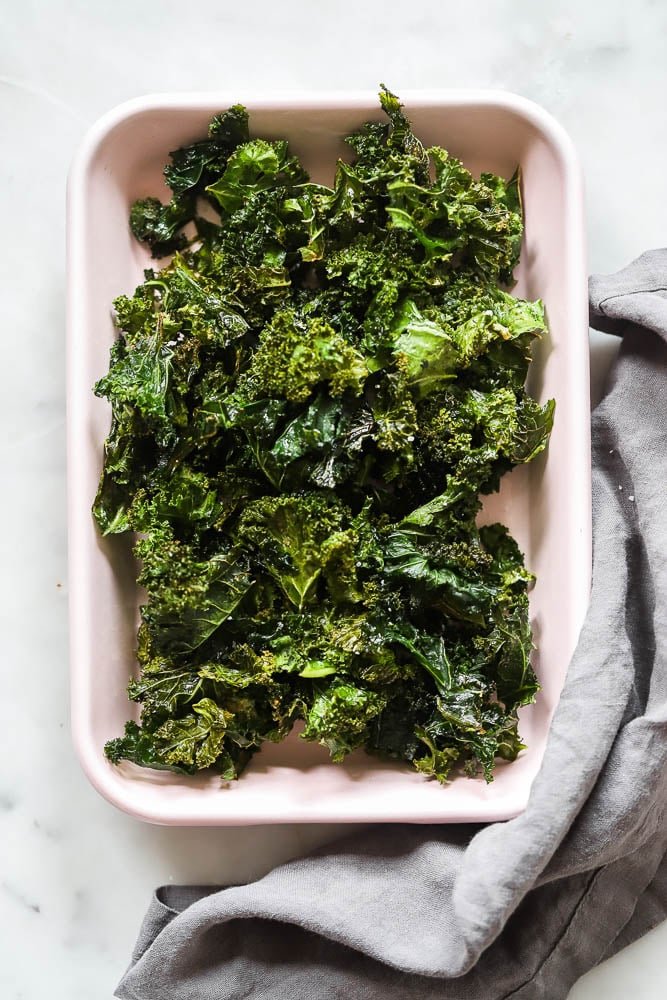
Oven Baked Kale Chips | Dietitian Debbie Dishes


Oven Baked Kale Chips | Dietitian Debbie Dishes


Trump’s EPA delays limits on “forever chemicals” in drinking water : Shots

0

The Environmental Protection Agency is backing away from recent rules that would have tightened limits on PFAS and several related chemicals in drinking water.

Catherine Falls Commercial/Moment RF/Getty Images


hide caption

toggle caption

Catherine Falls Commercial/Moment RF/Getty Images

The Environmental Protection Agency announced Wednesday that it is delaying the timeline for water utilities to comply with reducing some per- and polyfluoroalkyl substances, or PFAS chemicals, in drinking water — and reconsidering the allowable levels for others.

“The work to protect Americans from PFAS in drinking water started under the first Trump Administration and will continue under my leadership,” EPA administrator Lee Zeldin said in the announcement.

PFAS are a class of thousands of chemicals that have been used for decades to waterproof and stainproof a variety of products including clothing, cosmetics, upholstery and firefighting foams. They’re sometimes called “forever chemicals” because they contain strong molecular bonds that persist for decades. Long-term exposure to PFAS has been linked with harms to human health, such as certain cancers or damage to the liver and immune systems.

In April 2024, the EPA under the Biden Administration set limits on certain PFAS chemicals in drinking water, requiring community water systems to find alternative water sources or install filtration systems to remove them. It was the first time the agency had set enforceable caps on PFAS in drinking water, and water utilities were required to comply by 2029.

Now, the EPA is proposing to extend the compliance deadline to 2031 for two of the most common PFAS chemicals – PFOA and PFOS. And it’s rescinding and reconsidering the limits for the other four listed in the initial regulation – PFHxS, PFNA, HFPO-DA, and PFBS.

“That doesn’t mean that [the limits] gets weaker…when I go through a process and we follow the law, at the end of it, the final [levels] might be a lower number, not a higher number,” EPA administrator Lee Zeldin said at a Congressional hearing on May 14.

Some environmental advocates expressed skepticism.

“The way the issue is being framed [in the announcement] is not about providing additional protections or making it stricter,” says Anna Reade, a senior scientist with the Natural Resources Defense Council. “It’s about providing relief in terms of cost to water systems.”

Groups representing water utilities praised the move.

“We strongly support the agency’s decision to rescind the regulations…and ensure future rulemakings respect the Safe Drinking Water Act process,” read a joint email statement from the heads of the American Water Works Association and the Association of Metropolitan Water Agencies, two groups that have sued the EPA over its PFAS regulation.

They said the process requires EPA to construct rules that “maximize public health benefits in a cost-effective manner. This is critical for water systems and their communities, because the process helps ensure every ratepayer dollar is directed toward the most pressing public health risks.”

The Safe Drinking Water Act also contains a measure commonly known as the “anti-backsliding provision,” which deems it illegal to weaken a drinking water rule once it’s set, says Reade. While she’s concerned that the agency may attempt to weaken the rule regardless, “The real damage right now is that it’s delaying movement towards drinking water protections for PFAS,” she says.

The EPA estimates that 6-10% of water systems serve water with excess PFAS levels, according to the 2024 regulations, affecting some 100 million people in the U.S.

According to EPA analysis, it would cost $1.5 billion a year for water companies to comply with the regulation. The benefits of reducing PFAS in drinking water would equal or exceed the costs, the agency said, in terms of less cancer and fewer heart attacks, strokes and birth complications in the affected population.

Health advocates worry that the move will delay the removal of these chemicals from drinking water and that more people will be exposed to chemicals that may contribute to chronic health problems.

8 Lilies that Bloom all Summer

Vibrant colored blooms of lilies are prominent to bring a burst of elegance and color to your backyard garden, often grabbing the eye balls with their dramatic petals and graceful form.

While most traditional lilies produce blooms only for a short period, there are some varieties that offer extended blooming throughout the summer.

When many other flowering plants begin to fade, these long-blooming lilies continue to beautify your garden beds with their reliable colors.

There are thousands of lilies that enjoy different blooming seasons ranging from early to later summer.

You just need to choose the variety that goes well with your growing conditions.

Growing Conditions of Lilies

Before you proceed to the list, it is essential to know the growing requirements of these plants.

Sunlight Needs

Lilies typical requires 6 hours of direct sunlight. A sunny spot helps the plants grow strong stems and produce more flowers. Less light can lead to weak growth and fewer blooms.

Some varieties can tolerate light afternoon shade, especially in very hot climates. But overall, the more sun, the better the show.

Soil Requirements

Awell-drained soil that doesn’t lead to overwatering or rot is preferred by lilies.

A mix of loamy soil and compost works great. Adding organic matter improves drainage and feeds the plants.

The ideal pH is slightly acidic to neutral—between 6.0 and 7.0. You can test your soil and amend it with lime or sulfur if needed.

Watering Needs

Lilies like regular watering but don’t want their roots to sit in water. Wet feet can quickly lead to fungal problems.

Water deeply when the top inch of soil feels dry. It’s better to water less often but more thoroughly.

Early morning is the best time to water. This gives the foliage time to dry out and helps prevent disease.

Spacing and Airflow

Plant lilies with space in between to let air move freely. Crowded plants can trap moisture and invite mold or mildew.

Most lilies need about 8 to 12 inches of space between bulbs. Check the tag, as some taller types may need more room.

Good spacing not only keeps plants healthy but also lets each bloom stand out beautifully.

Also Read: 27 Best Pink Flowering Plants to Beautify Your Garden

Support and Mulching

Tall lilies can bend or fall over in wind or rain. A simple stake or small ring support helps keep them upright.

Mulch around the base with straw, bark, or compost. This helps the soil retain moisture and stay cool on hot days.

Mulching also reduces weeds and protects the bulbs during extreme heat. Just don’t pile mulch right against the stems.

9 Lilies that Bloom All Summer

Looking to enjoy lilies all season long?

Here’s a list of stunning varieties that bloom from early summer to late summer—so you can keep the color going nonstop.

By choosing lilies with staggered bloom times, you can create a garden that bursts with fresh color every few weeks. From early risers to late-season showstoppers, there’s a lily for every part of summer.

1. Asiatic Lilies

Asiatic lilies are among the earliest to bloom and come in a dazzling range of colors—red, orange, yellow, pink, and even white. They don’t have much fragrance, but their bold, upward-facing flowers more than make up for it with sheer vibrance and variety.

These lilies are easy to grow and perfect for beginners. They prefer full sun to part shade and thrive in well-drained, slightly acidic to neutral soil. Adding compost can give them an extra boost.

Asiatic lilies typically bloom in early summer, often in late May to June, depending on the climate. Their flowers last for weeks and make excellent cut flowers for indoor arrangements.

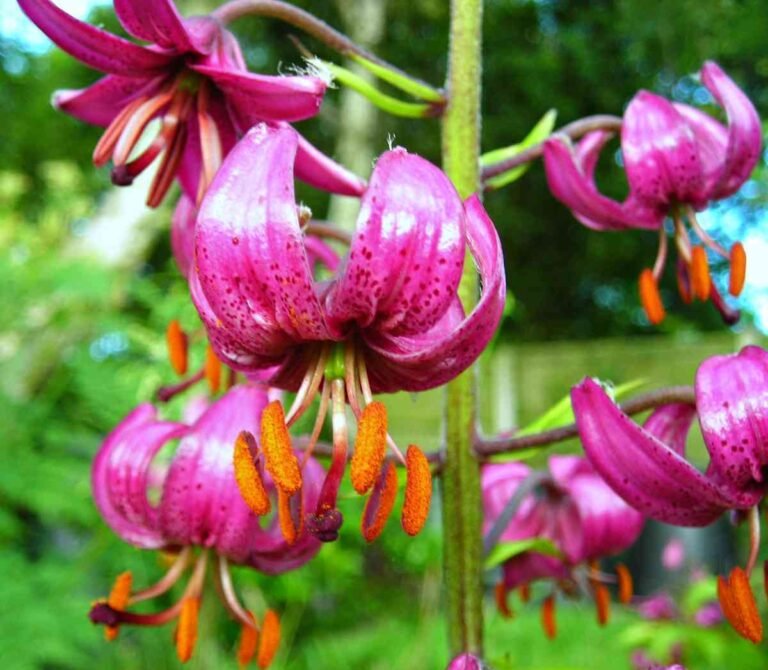
2. Lilium Martagon (Turk’s Cap Lily)

Lilium martagon stands out with its elegant, downward-facing blooms and recurved petals, often speckled with darker spots. These lilies offer a more woodland, fairy-garden charm and are incredibly graceful in appearance.

Martagon lilies grow well in part shade, making them ideal for woodland gardens. They prefer cool, moist, well-drained soil rich in organic matter. Mulching helps keep the roots cool during hot weather.

They bloom in early to mid-summer, often overlapping slightly with Asiatic lilies. The tall, slender stems can carry dozens of small blooms at once.

3. Lilium Candidum (Madonna Lily)

Lilium candidum is a timeless classic with striking white, trumpet-shaped flowers and a strong, sweet fragrance. Its pure white blooms bring a touch of serenity and old-world charm to any garden.

These lilies prefer full sun to partial shade and grow best in well-drained soil with a chalky or alkaline pH. Unlike other lilies, they form a basal rosette of leaves in fall and should be planted shallow.

Madonna lilies bloom in early to mid-summer, typically around June. Their elegant flowers rise on tall stems and are often associated with historic gardens and religious symbolism.

4. Lilium Longiflorum (Easter Lily)

Lilium longiflorum is best known for its large, trumpet-shaped white flowers and sweet fragrance. Though commonly seen as potted plants indoors during spring, they make stunning additions to outdoor summer gardens.

They thrive in full sun to part shade and need well-drained, humus-rich soil. Protect them from strong winds, as their tall stems can be delicate.

When planted outdoors, Easter lilies bloom in mid-summer rather than spring. With proper care, they return year after year with bigger and better blooms.

5. Trumpet Lilies

With their bold, trumpet-shaped blooms and rich fragrance, Trumpet lilies bring a touch of drama to the garden. Their large flowers can face outward or slightly downward, adding a sculptural look to borders and beds.

These lilies thrive in full sun and well-drained soil. They benefit from deep planting and staking, as their tall stems can become top-heavy when in full bloom. A sunny spot and light mulch help them thrive.

Trumpet lilies bloom in mid to late summer, often following Asiatic and Martagon lilies. Their showy flowers last for weeks and can reach up to 10 inches long.

Also Read: 27 Best Fall Flowering Plants to Beautify Autumn Garden

6. Orienpet Lilies (OT Hybrids)

Orienpet lilies are the result of crossing Oriental and Trumpet lilies—bringing the best of both worlds: fragrance, size, and strong stems. These hybrids boast massive blooms in warm sunset tones like peach, pink, gold, and red.

They grow well in full sun or light shade and prefer fertile, well-drained soil. Orienpets are sturdy and weather-resistant, making them ideal for exposed garden spots.

These lilies bloom in mid to late summer, often bridging the gap between mid-season and fall bloomers. Their extended bloom time makes them excellent focal points.

7. Oriental Lilies

Known for their intoxicating fragrance and oversized blooms, Oriental lilies make a luxurious statement in any garden. Their petals are often ruffled or recurved, appearing in romantic shades of pink, white, and crimson.

Orientals enjoy slightly acidic, well-draining soil and do well in full sun to partial shade. They grow slowly at first but reward patience with stunning blooms on tall stems.

These beauties bloom in late summer, typically from July into August. Their long-lasting flowers also make excellent cut flowers.

8. Species and Wild Lilies

For a more natural or woodland look, species and wild lilies bring wild elegance with their slender stems and nodding, often speckled flowers. Each type has its own charm, from the fiery Lilium superbum to the delicate Lilium pardalinum.

These lilies often prefer dappled sunlight or part shade, especially in hotter regions. They thrive in moist, rich, well-drained soil and may naturalize over time in the right conditions.

Bloom times vary depending on the species but generally range from mid to late summer. They tend to have longer blooming periods and a more relaxed growth habit.

Also Read: Why My Hibiscus Plant Not Flowering?

How to Plant Lilies?

Choose the Right Location

Pick a spot with full sun or partial shade, depending on the lily type. Most lilies need at least 6 hours of sunlight daily and good air circulation to thrive.

Prepare the Soil

Lilies prefer loose, well-drained soil that’s rich in organic matter. Mix in compost or well-rotted manure to improve fertility and drainage. Avoid heavy clay or waterlogged areas.

Planting Depth and Spacing

Plant lily bulbs 4 to 6 inches deep (about three times the height of the bulb). Space them 8 to 12 inches apart so each plant has room to grow and breathe.

Place Bulbs Correctly

Set the bulb with the pointed end facing up. Cover with soil and gently firm it down. Water thoroughly after planting to help settle the soil around the bulb.

Mulch and Water

Add a light layer of mulch to retain moisture and keep the soil cool. Water regularly during dry spells, but don’t let the soil become soggy.

Support Tall Varieties

For lilies that grow tall, add stakes or supports early to avoid damaging the plant later. This keeps the stems upright and prevents snapping in wind or rain.

Check this: How to Get Desert Rose to Bloom?

Companion Plants of Lilies

Lilies pair beautifully with plants that complement their height, color, and growing needs. Great companions include:

  • Daylilies and Coneflowers – These match lilies in sun-loving habits and bloom timing, creating a vibrant, layered display.
  • Hostas and Ferns – Ideal for part-shade or woodland gardens, they provide lush foliage contrast at the base of taller lilies.
  • Lavender and Catmint – Their scent can help deter pests, and their silvery foliage enhances the bold lily blooms.
  • Salvia and Yarrow – These drought-tolerant plants support pollinators and offer continuous color around lily bloom time.

Avoid planting lilies near aggressive spreaders or those that compete for nutrients, such as mint or overly large shrubs.

Conclusion

With the right mix of early, mid, and late-blooming varieties, you can enjoy lilies in full color all summer long. From the vibrant Asiatics to the fragrant Orientals and wild charm of species lilies, there’s a bloom for every garden style and season.

By giving them proper care and pairing them with suitable companions, lilies not only stand out but also elevate the beauty of everything around them. Plant once, and enjoy a summer filled with elegance, color, and fragrance year after year.

5 Ways to Work Out with Your Furry Friend

by Caitlin H,

Jun 10, 2024

Workout with your furry friend!

Dog owners will be the first to tell you that their beloved furball is more than just a pet to them — in many ways, it’s like a child. There’s a good reason for this. Dogs have their own unique personalities, traits, and quirks. They thrive under routines. And they are capable of loyalty and love beyond most people’s expectations.

Read on to learn more about why dogs are good for your health, plus several fun ways to work out with them.


How Dogs Impact Your Health


According to a ​​Harvard Medical School report, owning a canine provides a host of benefits that include:


  • Companionship
  • Security
  • Fitness incentive
  • Stress relief
  • Mindfulness


Several other studies focused on the benefits of owning a dog find similar results: Dogs help us feel less lonely, relieve anxiety, encourage movement and exercise, get out and be social, and even lower the risk of death by improving heart health. Dog owners must ensure their pooch gets exercise, and thankfully, there are many fun ways to do that.


5 Ways to Work Out with Your Dog


Whether you live near the ocean, on the plains, or near the mountains, there are likely trails close enough for you to explore. Most cities and suburbs create trails as part of their parks and recreation initiatives, giving you plenty of opportunities to explore new places with your dog. Build a once-weekly to twice-weekly one-hour trail excursion into your schedule, and take the time out to walk and explore with your four-legged pal.


This classic game of throwing a ball or frisbee for your dog to grab and bring back to you is an excellent way to get out and exercise. But don’t be fooled! Although it may seem like your dog is getting most of the exercise, you might be surprised by how much you find yourself jogging around grassy expanses to grab the ball or chase your dog. It’s a win-win!


Dog parks provide a safe area for pups to be social and roam free. They’re also a great place for you to get moving! Take laps around the dog park while your pooch runs around it. Dog parks are also an excellent place to meet new friends and up your social game!


Have you always wanted to challenge yourself by running a 5K? Here’s your chance! Use your dog as an excuse to train for a race—they must work their way up in mileage, too! Many cities host races specifically dedicated to you and your pup, and most races allow you to run with your dog regardless.


Most dogs love wading through rivers or splashing around in lakes or ocean waves. Take your dog to a nearby spot where you can swim and they can play in the water right along with you. Even walking in the water is a good low-impact exercise, giving you and your pooch a chance to get in some fitness.

Ultimately, you should look at your dog as the beloved family member they are — a loyal friend and the perfect workout buddy. Use them as the push you need to get in the recommended amount of exercise while enjoying the fresh air and outdoors. You’ll both be glad you did!


————————————————————————————


Author: Caitlin H

Diet-to-Go Community Manager

Caitlin is the Diet-to-Go community manager and an avid runner. She is passionate about engaging with others online and maintaining a healthy, active lifestyle. She believes moderation is key, and people will have the most weight loss success if they engage in common-sense healthy eating and fitness.


Crispy Air Fryer Frozen Green Beans – 15 Minutes

Unlike any other green bean recipe, these crispy, crunchy air fryer frozen green beans are the ultimate side dish or healthy snack. Ready in under 15 minutes, these are the green beans everyone in your family is going to be asking for going forward, especially if you serve them with a creamy sauce for dipping.

Air fried frozen green beans with white napkin on the side. Air fried frozen green beans with white napkin on the side.

The air fryer is one of my go to kitchen gadgets, helping me get a really tasty dinner on the table in 20 minutes or less. If you love the air fryer as much as I do, you have to try air fryer roasted zucchini, roasted air fryer tomatoes or air fried frozen asparagus in your next meal!

I love this recipe equally for two reasons:

  1. Its incredibly easy to make – like dump frozen veggies in basket, season and cook. So easy. And an added bonus, this recipe uses freezer and pantry staples.
  2. These crispy green beans are vegetables you actually want to eat! The air fryer works its magic on these green beans. The slightly crispy, crunch green beans are a whole different experience vs the steamed green beans I normally have. Given the choice, I would choose these air fried green beans every time.
This post contains affiliate links. As an amazon associate I earn from qualifying purchases. Click here to read my policy and more about affiliate links.

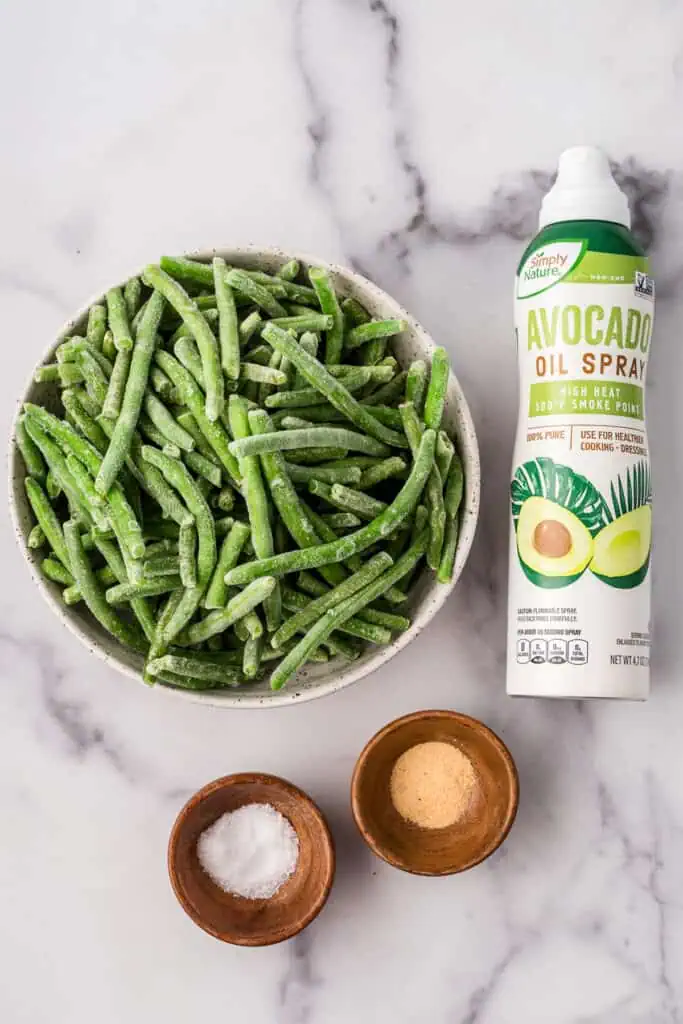
Ingredients needed

  • Frozen green beans – I prefer to use thinner green beans because they get super crunchy. The frozen green beans from Trader Joe’s are my favorite. Haricot vert are typically pretty thin too. Don’t worry if you can’t find thin frozen green beans though, they all work.
  • Avocado oil or olive oil spray – this helps coat the beans so that the salt and garlic powder will stick.
  • Spices: Salt and garlic powder – I like to keep it really simple here, trust me, these are going to be incredible!

How to make crispy frozen green beans in the air fryer

Coat in seasoning: Add the green beans to the air fryer basket. Spray with oil and sprinkle the salt and garlic powder on top.

Cook the beans: Cook at 400F for 14 minutes. After 7 minutes, pause the air fryer and shake the basket well. Pause it again with 3 minutes left and shake again.

Serve hot! These are best right out of the air fryer!

Top tips

  • As much as I would like to tell you this is an inactive recipe, it’s important that you pause cooking and shake the air fryer basket 2-3 times during cooking for the best texture.
  • These beans come out a little crunchy, if you prefer green beans closer to the texture of steamed green beans, stop the cooking at 12 minutes.
  • Be sure to use an avocado oil or olive oil spray without propellants (the only ingredient should be oil). The propellants are known to damage the coating on your air fryer basket.
  • If you have to preheat your air fryer before using it, reduce the cooking time to 8-10 minutes
Air fried frozen green beans on a white plate, lemon tahini dip on the side.Air fried frozen green beans on a white plate, lemon tahini dip on the side.

Other flavor variations

  • Everything bagel seasoning in place of the salt and garlic powder
  • Crushed red pepper flakes
  • Lemon juice – add this during the last 1-2 minutes of  cooking or right at the end
  • Parmesan or feta cheese – add this at the end of cooking
  • Balsamic vinegar – pause the air fryer with 3 minutes remaining. Transfer the beans to a bowl and toss in 1-2 tablespoons balsamic vinegar. Return back to the air fryer and continue cooking.
  • Sriracha – pour over top during the last 1-2 minutes of cooking or at the end.

What to serve with air fryer green beans

Common questions

Frozen green beans cooked in the air fryer basket.Frozen green beans cooked in the air fryer basket.

Do you defrost the green beans before cooking?

No, that is the beauty of this recipe, it uses frozen green beans, no thawing required.

Can you use canned green beans?

You can air fry canned green beans, although the texture will not be exactly the same as cooking them from frozen. If you are choose to air fryer canned green beans, drain off as much of the liquid as possible before adding them to the air fryer basket.

Note: Use less salt if the beans were canned in a salty solution.

What to do with leftover green beans

If you find that you have leftovers and are looking for fun new ways to enjoy them, try:

  • Adding them to a frittata or egg bake
  • Using them in soups or stew
  • Adding them to pasta (this would be great with some homemade pesto too)
Air fried green beans being dipped in lemon tahini sauce.Air fried green beans being dipped in lemon tahini sauce.

Storing leftovers

Fridge: Store leftover beans in the fridge in an airtight container for up to 4 days. The beans lose their crunchy texture quickly though, so leftovers won’t be quite the same.

Reheating: Reheat in the air fryer at 375F for 3-5 minutes until heated through. You can spray them with a bit of oil to try to re-crisp them.

★ Did you make this recipe? Please give it a star rating below!

  • Add frozen green beans to air fryer, spray with oil and sprinkle sat and garlic powder on top.

  • Cook in the air fryer at 400F for 14 minutes. After 7 minutes, pause the air fryer and shake the basket. Pause and shake again with 3 minutes left.

  • Serve hot for the best texture and crunch.

Top tips

  • Be sure to pause cooking and shake the air fryer basket 2-3 times during cooking for the best texture.
  • These beans come out a little crunchy, if you prefer green beans closer to the texture of steamed green beans, stop the cooking at 12 minutes.
  • Be sure to use an avocado oil or olive oil spray without propellants (the only ingredient should be oil). The propellants are known to damage the coating on your air fryer basket.
  • If you have to preheat your air fryer before using it, reduce the cooking time to 8-10 minutes

Nutrition Information

Nutrition Facts

Amount per Serving

Where does nutrition info come from? Nutrition facts are provided as a courtesy, sourced from the USDA Food Database.

Let others know by rating and leaving a comment below!

Menopause Weight Gain: What Actually Works

0

Reviewed by Helen Kollias, PhD and Brian St. Pierre, MS, RD


At some point in my mid-40s, the scale started climbing.

A pound or two turned into five, then 10, then 20.

It seemed as if I was doing all the right things: Eating less, moving more, rinse, repeat. Yet, the harder I worked, the less the scale seemed to respond.

Had perimenopause destroyed my metabolism?

It sure felt like it.

However, after asking my doctor to run a series of tests, I learned that my metabolism was, in fact, fine. Instead, like the vast majority of midlife women, the true causes of my weight gain stemmed from several subtle issues that I would have sworn, at the time, didn’t apply to me.

If, like me, you or your client are currently stuck in what feels like an eat less, gain more cycle, this article is here to help.

In this story, you’ll discover:

  • Several reasons women gain weight at midlife that have nothing to do with a “slower metabolism”
  • Why intense exercise and strict diets can backfire after menopause
  • 11 crafty ways to get a handle on midlife weight gain

First, what is menopause?

Many women refer to midlife hot flashes and inconsistent menstruation as “being in menopause” or “menopausal.”

However, menopause isn’t a phase as much as a transitional moment that separates menstruation from non-menstruation.

Once you’ve gone 12 consecutive months without a period, you’ve reached menopause. For most people, that moment arrives somewhere between ages 46 and 56.

The hot-and-dewy months and years leading up to that 12th missed period are technically known as “perimenopause.” 

Perimenopause means “around menopause.”

Some people refer to this time as the menopause transition. This is when estrogen levels fluctuate. Menstrual cycles lengthen and shorten and, at times, disappear, only to return a few months later. For many people, this marks the beginning of symptoms like hot flashes, sleep issues, vaginal dryness, mood changes, and, yes, creeping weight gain.

(For a thorough overview of the many changes that can happen during this time, read: ‘What’s happening to my body!?’ 6 lifestyle strategies to try after menopause)

How much weight do women gain during menopause?

Many women think of menopause and weight gain the same way many young parents think of two-year-olds and tantrums: Inevitable.

However, not all women gain weight during the menopause transition, explains Helen Kollias, PhD, who is an expert on physiology and molecular biology, and a science advisor at Precision Nutrition and Girls Gone Strong.

On average, in the West, women gain four to six pounds during the three-and-a-half years of perimenopause, or about one to two pounds a year.1 2

That’s double the rate of weight gain in pre-menopausal women, though it’s roughly the same amount men gain at midlife, notes Dr. Kollias.

In other words, the menopause transition may not be solely to blame for those extra pounds on the scale. Aging may play a significant role, as we explore below.

The real reasons the scale climbs

Several factors conspire to add pounds to your frame during the menopause transition.

✅ You’re not sleeping as well.

Maybe this sounds familiar: You wake repeatedly with sweat pooling under your breasts and sheets that are uncomfortably damp (or soaked).

Even if you don’t have night sweats, plenty of other issues might keep you awake.

First, there’s worry—over aging parents, teenagers with car keys, money needed to replace that leaking roof, some strange bodily sensation you’re worried might be cancer, the colonoscopy or mammogram you don’t want to schedule but also don’t not want to schedule, the sex you’re not having, and so many others.

Plus, if you’re like me and you have osteoarthritis in multiple joints, your body hurts. Or your skin might itch. Or your legs are restless. Or you’re bloated.3 4 5 6

My point: Problems that make sleep uncomfortable can multiply with age.

Because of this, I’ll sometimes wake four or more times a night, as the red sections of this readout from my smartwatch show.

These bad nights often set up a vicious cycle:

The following day, I feel as if I’m two inhales away from death. So, I keep myself going with caffeine, which makes the next night just as bad or worse.

Lack of sleep indirectly adds pounds to your frame in several ways:

  • When you’re sleep-deprived, it’s harder to cope with negative emotions, which may mean you turn to food for solace.
  • In addition, your decision-making gets compromised, so it’s harder to choose an apple when a chocolate chip cookie is also available.
  • Plus, sleep deprivation intensify both appetite and cravings (which we’ll discuss more in the next section)

(Want to get a handle on some of the sleep challenges unique to this transition? Check out: How menopause affects sleep, and what you can do about it)

✅ You’re hungry, and not for celery.

True story: When I was in my early 30s, someone once told me about her intense cravings, and I thought, “Cravings? What are those exactly?”

(Don’t hate me.)

Those days now feel foreign to me. Post-menopause, I spend most of my morning wondering how soon I can eat lunch, what I might have for lunch, whether it’s okay to have a snack now, and, if so, what it should be.

After lunch, I go on to spend the afternoon thinking about dinner.

It’s as if my appetite never flips off.

For the longest time, I thought something was wrong with my brain or metabolism.

It didn’t occur to me that the increased hunger, appetite, and cravings likely stemmed from my repeated awakenings each night.

Until I checked out the research.

In one study, people who were sleep-deprived reported higher levels of hunger and a stronger desire to eat. When provided access to snacks, they consumed twice as much fat compared to days when they weren’t sleep-deprived.7

In another study, when healthy, young study participants slept four hours a night, they consumed 350 more calories the following day.8

The annoying cycle of weight and food preoccupation

Hormonal transitions (puberty, pregnancy, menopause) often cause changes to women’s body shape and size.

Sometimes that’s welcome (“Ooh, a butt!”) and sometimes it’s not (“Darn, a butt!”).

Some women—like me—don’t worry too much about their weight or body shape. Then, we gain unexpected (and unwanted) pounds, and with that, a new (also unwanted) preoccupation with the scale.

Many women also find that as they try to get a handle on the scale, their preoccupation with food may (frustratingly and paradoxically!) shoot upwards—especially if they turn to restrictive diets or food rules for a solution. 

Interestingly, this preoccupation with food can occur whether or not someone is actually reducing their calorie intake. In other words, this phenomenon can happen when someone just thinks about reducing their food intake.

The phenomenon has a name: It’s called cognitive dietary restraint (CDR), and it can create a frustrating cycle of body image dissatisfaction, food preoccupation, and stress. 

In one study, people who used a low-carb, intermittent fasting protocol to lose weight reported more frequent episodes of binge eating and more intense food cravings.9 

In another study, postmenopausal women who scored high in CDR excreted more of the stress hormone cortisol than women who scored lower in this measure.10 Higher levels of CDR in pre- and postmenopausal women were even associated with shorter telomeres, a sign of accelerated aging.11

All this to say, leaning too hard into self-criticism and extreme dieting can backfire. Which is why the strategies we suggest later in this article focus more on adding more nutritious, appetite-regulating foods, and prioritizing things like mindfulness and movement. 

With these approaches, you’ll be less likely to feel deprived, and more likely to feel satisfied—and hopefully, empowered.

✅ You’re moving less.

As humans age, we develop chronic low-grade inflammation and weakened immune function. When combined with the crummy sleep we mentioned earlier, along with other biological changes, this can interfere with the body’s ability to recover from intense exercise.

The result: If you do too many vigorous workouts too close together, you’ll start to feel run down, sore, and unmotivated.12 13 14

Other issues that crop up around midlife can also interfere with movement, like chronic injuries or joint pain.

(A personal example: Due to osteoarthritis in my feet and spine, I switched from running to walking. This is easier on my body, but isn’t as efficient at burning calories.)

Finally, due to those pesky time-sucks known as full-time jobs and caregiving responsibilities, you might not be as active in your 40s and 50s as you were during your 20s. Plus, over the past few decades, multiple inventions (hello, binge-watching) have conspired to keep people on the couch and off our feet.

So, can you blame your hormones for anything?

Other than messing with your sleep which, in turn, messes with your appetite and energy levels, fluctuating estrogen and progesterone likely aren’t behind your extra pounds—at least, not directly.

If they were, menopause hormone therapy would help people stop or reverse weight gain. (It doesn’t.15)

However, shifting hormonal levels are responsible for where those extra pounds appear on your body. As estrogen levels drop, body fat tends to migrate away from the thighs and hips and toward the abdomen, even if you don’t gain weight

Old tactics may stop working after menopause

The “Rocky” weight loss method was my go-to when I was younger.

Whenever I wanted to drop a few pounds, I imagined I was a character in one of those “couch potato gets super fit” movies.

In addition to walking and running, I embraced the sweat-til-you-vomit workout du jour. (Remember Tae Bo?) I also cut out foods, food groups, or entire macronutrients. A couple of times a week, I skipped lunch or dinner.

It worked.

Until, of course, it didn’t.

Now, whenever I push too hard in the gym, I either get injured or feel so unbelievably tired that I must take four days off from all forms of movement. If I try to do anything extreme with my diet, I eventually eat every crunchy or sweet thing I can find, including stale crackers.

For these reasons, after midlife and beyond, the countermeasures for weight gain aren’t strict diets (looking at you, intermittent fasting) or barfy workouts.

Instead, to limit weight gain after menopause, you need to get wise about finding ways to tip calorie balance in your favor without triggering overpowering hunger, cravings, and fatigue.

Regardless of age or stage, fundamental nutrition and fitness strategies still apply—and work.

What changes after menopause is how you tackle these fundamentals.

Experiment your way to better results

The best menopause plan will look different for each person.

That’s why experiments are so important.

Precision Nutrition coaches often use experiments to help clients discover essential clues about what they need (and don’t need) to reach their goals. Based on the results you get from each experiment, you can make tiny tweaks, test them, and decide whether they work for you—until you find something that does work for you.

How to run an experiment

Health experiments are no different from the scientific method you learned about in middle school.

  • Choose a question to answer, such as, “Would I feel less munchy at night if I ate a protein-rich snack every afternoon?”
  • Run an experiment to test your question. In the above example, you’d track your hunger and cravings before adding the snack—to get a baseline—and then continue to track them for a couple weeks after adding the snack.
  • Assess what you learned. Did your ratings of hunger and cravings drop? Remain the same? Go up? What about your actual nighttime food consumption? This information can help you determine your next steps.

Below are 11 experiments worth trying during and after menopause. We’ve separated them into three categories: sleep, hunger, and energy.

(And if those 11 options aren’t enough, we’ve got more ideas here: Three diet experiments that can change your eating habits)

Experiments for improved sleep

Below, you’ll find a mere smidge of the many sleep tweaks you can try and test. For more ideas on potential sleep experiments, check out our 14-day-sleep plan and story about cognitive behavior therapy for insomnia.

Experiment #1: Reset your body’s circadian clock

As you age, your body starts to behave like an old clock that continually runs slow.

Even if you used to be a morning person, you might wake groggy, as if your body doesn’t know it’s morning. Or, your body might tell you “time for bed” at weird times, like the middle of the afternoon. Then, after spending several hours fighting the urge to nod off during work meetings, you find that, when it actually is bedtime, you’re staring at the ceiling in the dark.

This is why it’s helpful to experiment with zeitgebers, which are environmental and behavioral time cues that help to set your body’s internal circadian clock.

These experiments might include the following:

  • Get up at the same time every day, regardless of how you slept the night before.
  • Spend 10-20 minutes in the sunlight as soon as possible after you wake.
  • Take a cold shower at the same time each morning or a hot shower or bath at the same time each evening.
  • Get outside frequently during the day, especially whenever you feel sleepy.
  • Exercise at the same time daily. Try first thing in the morning or 4 to 6 hours before bed. Bonus points if you do it outdoors.
  • Eat meals, especially breakfast, at the same time every day.

Experiment #2: Remove “I’m uncomfortable” from your sleep vocabulary

How you run this experiment will depend on what’s causing discomfort. We’ve listed a few possibilities below.

  • If you tend to wake feeling uncomfortably hot: Experiment with cooling technology. This might range from the very affordable, such as turning the thermostat a degree or two cooler or using a fan, to the more expensive, such as cooling electric mattress pads.
  • If you wake feeling bloated: If you’re constipated, try some prunes, a small daily serving of beans, a little psyllium fiber, or just extra water to get things moving. Or, you might try consuming a smaller meal or avoiding fatty foods in the evening.
  • If an uncomfortable “I need to move” sensation creeps into your legs at night: Talk to your doctor about restless legs syndrome, a condition that tends to worsen with age and/or iron deficiency. A physician may also give you ideas to cope if itchy skin or joint pain is keeping you up.

Experiment #3: Time caffeine strategically

We know we’re almost picking a fight with this suggestion. However, it’s worth investigating, especially if you consume caffeine in the afternoon or evening.

If you’re like most people, it will take your body about five hours to clear half the caffeine from your system. That means about half of your 4 p.m. latte is still energizing your system at 9 p.m.

But here’s the thing: Some people metabolize caffeine much more slowly than others, taking roughly twice as long to clear it from their bloodstream.16

Interestingly, even if you had no issues with caffeine when you were younger, you might have issues now, as caffeine clearance tends to slow over time.17

To see if caffeine is a problem, you’ve got a couple of options.

  • Try slowly shifting your consumption earlier by 30 to 60 minutes. (If you usually have your last coffee at 4 p.m., cut yourself off at 3 p.m., then 2 p.m., then 1 p.m., then noon.)
  • Switch to a lower caffeine source. (Try a bean blend that’s half decaffeinated. Or, you could switch to a lower-caffeine beverage such as green tea or maté.)

(Yet more solutions to common problems: The five top reasons you can’t sleep)

Experiments to reign in hunger

The tactics below likely won’t surprise you. After all, they form the bedrock for solid nutrition and good overall health.

However, before you disregard them with a “been there, done that!” consider: How many of the below are you actually doing consistently?

Experiment #1: Add a protein serving

It may seem counterintuitive to add a serving of food to your meals when you’re trying to eat less.

However, this one tactic may help reign in appetite and hunger.

Protein takes longer to digest than does carbohydrate or fat, so it helps you feel full and satisfied for longer.

In addition, you may find, as I did, that you’re not consuming anywhere near as much protein as you think. (Find out how much you need here: ‘How much protein should I eat?’ Choose the right amount for fat loss, muscle, and health)

Try one or both of the following:

  • Consume at least 1 to 2 portions of lean protein at every single meal
  • Prioritize snacks that contain protein—hard-boiled eggs, turkey sausage links, Greek yogurt, cottage cheese—instead sweets or chips.

Experiment #2: Choose high-fiber carbohydrates over lower-fiber ones

Fibrous plant foods can help fill you up with fewer calories.

To see the difference, you might monitor how you feel after consuming a near-zero-fiber food, such as your favorite assortment of snack chips. The following day, when it’s time for the same snack or side dish, opt for something with more fiber, such as roasted nuts, a side of beans, a salad, or a piece of fruit. Notice how the fiber-rich option affects your appetite and hunger for the next few hours.

Another experiment worth trying: Include one to two portions of produce with every meal you consume. Track your sensations of hunger to see if they make a dent.

Experiment #3: Log between-meal indulgences

You may be reaching for more snacky foods and beverages than you realize.

These foods don’t need to be 100 percent off-limits; you just want to be intentional about your consumption and portion sizes.

For a couple of weeks, keep track of alcohol, sweets, and treats that you eat between intentional meals and snacks.

Review your notes at the end of each day to see if these more impulsive or less mindful eating episodes align with your memory of what and how much you consumed.

Experiment #4: Move after meals

Increased inflammation coupled with decreased muscle mass, among other factors, leads many people to become more insulin-resistant with age.18 Cells don’t respond as readily to the hormone, which means more glucose stays in the bloodstream rather than entering cells that can use it for energy.

Through a complex set of mechanisms, this can drive up hunger and overall appetite.

Consuming protein- and fiber-rich meals will help, as we mentioned earlier.

So will movement. Walking for as little as two minutes after meals can help your body process the carbohydrates you consumed, improving blood sugar levels, finds research.19 20

In addition, by removing yourself from your kitchen, you create a habit that helps to psychologically shift you away from “eating” and over to “the kitchen is closed.”

Experiments for more energy

To address midlife brain fog and fatigue, you’ll want to do all you can to encourage good sleep. In addition, see if the below suggestions make a difference.

Experiment #1: Prioritize strength training over intense cardio

This was a hard lesson for me because I love intense cardio.

However, now in my 50s, if I try to fit in two weekly strength training sessions and two weekly spin sessions, I feel drugged—as if someone spiked my coffee with tranquilizers.

When my Precision Nutrition health coach suggested I dial back on the cardio for a couple of weeks, I won’t lie. I thought about firing her.

But then I took her advice and rediscovered what it felt like to be alert.

Don’t get me wrong: I still do cardio. But I’m smart about it. I now know that I can’t do everything, at peak intensity, and expect to feel rested and alert daily. There’s a balance.

Strength training is increasingly important at midlife to protect bone strength and maintain muscle mass. Aim for at least two weekly sessions. Then, fit in cardio around those sessions.

If you feel worn out, experiment with doing low- or moderate-intensity cardio (like brisk walking, slow cycling, or swimming) over higher-intensity cardio (like an hour-long spin class).

Or, if you love higher intensities, keep doing them, but shorten your duration.

Or, just save those vigorous sessions for when you got great sleep the night before.

Experiment #2: Try active recovery

Active recovery can help increase blood circulation and the removal of waste products that may have built up in your muscles during intense exercise sessions.21

This can include light activities such as walking, swimming, yoga, or stretching. You can also try massage, foam rolling, or a long, hot bath.

Experiment #3: Consider creatine

Lots of folks think of creatine monohydrate as something people take to get jacked.

However, more and more evidence points to creatine’s benefits for people in midlife and beyond.

The supplement may be especially helpful for muscle recovery.

In research that pooled the data from 23 studies, study participants who took creatine experienced fewer indicators of muscle damage 48 to 90 hours after intense training than participants who didn’t supplement.22

The supplement may also help you to think clearly, especially after a bad night of sleep, finds other research.23

Finally, by promoting cellular energy throughout the body (including the brain), creatine may help to blunt fatigue and boost mood.24 25

A daily dose of three to five grams works for most people.

The winning midlife mindset

There’s one final experiment that I want to tell you about.

It has to do with embracing a mindset of acceptance.

Think back to other difficult phases of your life. For me, parenting an infant with colic comes to mind. Gosh, I was so tired back then that I likely would have forked over my entire 401k in exchange for one solid night of sleep.

However, I knew that the stage was temporary. That knowledge helped to keep me going.

Midlife can be similar.

You likely won’t weigh at 55 what you did at 25. That’s okay. However, the night sweats, brain fog, and fatigue are all fleeting. You will eventually establish a new normal.

In the meantime, see if you can accept that your body may look and feel different now. Shift your focus away from trying to look and feel like your younger self and toward consistently embracing new behaviors that will help you age with strength, vitality, and contentment.

After all, you have much more control over your behavior than the number on the scale.

References

Click here to view the information sources referenced in this article.

If you’re a coach, or you want to be…


You can help people build sustainable nutrition and lifestyle habits that will significantly improve their physical and mental health—while you make a great living doing what you love. We’ll show you how.


If you’d like to learn more, consider the PN Level 1 Nutrition Coaching Certification. (You can enroll now at a big discount.)