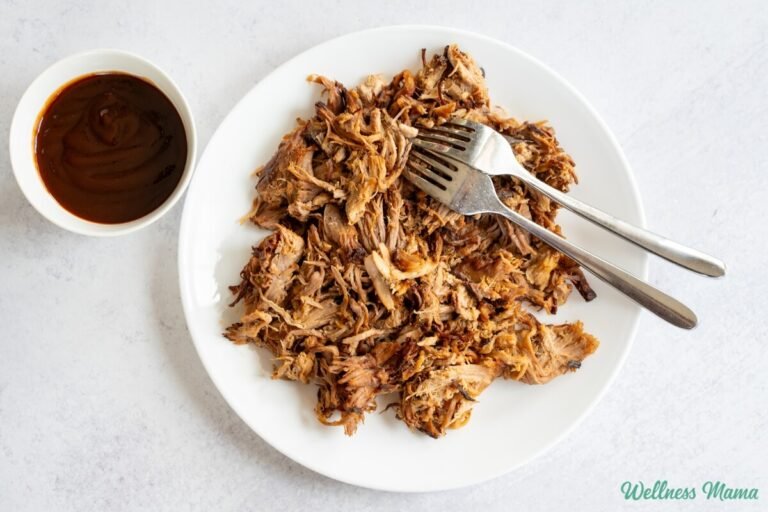
Growing up and living in the south, I’m pretty familiar with pork barbecue. I’m also familiar with the fact that most barbecue places rely on high fructose corn syrup and other non-foods in their sauce. This Boston butt pork roast recipe avoids all that and simply uses delicious, whole food ingredients for the best taste.
Boston butt is one of the easiest cuts of pork to cut and it’s also one of the most affordable. I’ve been able to find Boston butt from pastured pork at great prices, and slow cooking this recipe makes it incredibly tender. Boston butt roast in the Crockpot is also an easy recipe on days when you’re out of the house all day and need dinner to be ready when you get home. With a houseful of kids and teens in sports that happens a lot around here!
How to Serve Boston Butt Roast
For our family, one Boston butt roast lasts for about 3 meals with all of the leftovers. It’s a tasty source of protein and tastes good on its own, or repurposed into other dishes. We’ve done barbecue omelets with the leftovers. It also tastes great in tacos or for a protein-rich salad.
I like the roast alongside almost any kind of potato or vegetable dish. It’s also great with some sourdough bread, rice, or salad. Try it with some sweet potato fries, savory stuffed sweet potatoes, or roasted Brussel sprouts. Here’s a tip: batch cook some roasted whole sweet potatoes to pull out of the fridge for a fast meal. Throw some Boston butt roast BBQ on top and you’ve got an easy meal!
Use leftovers for tacos, nachos, baked potatoes, lettuce wraps, or breakfast hash.
Tips For the Best Boston Butt Roast Recipe
Store any leftovers in the remaining juices for the best flavor and tenderness. If you ever need to freeze it, freeze it with the liquid too. This protects the texture when it thaws.
If there’s too much liquid for you after cooking, then there’s an easy fix. Simmer for 10–20 minutes, stirring occasionally, until it reduces and looks glossy and slightly thick. It should coat a spoon, not run like broth.
This recipe is great for meal prepping. Use leftovers for tacos, nachos, baked potatoes, lettuce wraps, or even breakfast hash.
Slow Cooker Boston Butt Recipe
An easy slow cooker Boston Butt with flavorful spices, fruity pineapple, and smoky barbecue.
Thinly slice the onions and place them in the bottom of a 6-quart or larger slow cooker.
Rinse the Boston butt and place it on top of the onions.
Sprinkle with spices.
Pour the whole can of pineapple over it. If using fresh pineapple, peel, core, and thin chop the pineapple and place over pork.
Add the apple cider vinegar.
Put the lid on the slow cooker and cook on low for 10-12 hours or until fork tender. Don’t open until at least 8 hours and then check for tenderness.
?After cooking, shred the pork.
Spoon out ½ -1 cup cooking liquid and simmer with the BBQ sauce for 5–10 minutes. Pour the liquid back into the pork and stir to coat.
Nutrition Facts
Slow Cooker Boston Butt Recipe
Amount Per Serving
Calories 585 Calories from Fat 277
% Daily Value*
Fat 30.8g47%
Saturated Fat 11.3g71%
Cholesterol 167mg56%
Sodium 1196mg52%
Carbohydrates 30.9g10%
Fiber 1.9g8%
Sugar 23.9g27%
Protein 44.1g88%
* Percent Daily Values are based on a 2000 calorie diet.
Try leftovers on top of salads or in omelettes for breakfast!
Instant Pot Boston Butt Recipe
The recipe above is for slow cooker Boston butt, but you can easily modify it for the Instant Pot.
Instant Pot Instructions
Turn the Instant Pot to Sauté. Add a small splash of oil and cook the sliced onions for 3–4 minutes until softened. Press Cancel.
Place the Boston butt roast on top of the onions. Sprinkle evenly with all the spices.
Pour the crushed (or fresh chopped) pineapple and apple cider vinegar over the pork. Add ½ cup of water or broth to help the Instant Pot come to pressure.
Secure the lid and set the valve to Sealing. Cook on High Pressure for 75 minutes. Let the pressure release naturally for 20–30 minutes, then release any remaining pressure.
Remove the pork and shred with two forks.
Turn the Instant Pot back to Sauté and simmer the cooking liquid for 10–15 minutes until slightly thickened.
Stir in the barbecue sauce and simmer for 2–3 minutes.
Return the shredded pork to the pot, toss to coat, and serve.
Are you a barbecue fan? What’s your secret recipe? Please share below!
We’re are back in Richmond, British Columbia today, to see Part 2 of Cherry Ong’s spectacular September garden tour. If you missed it yesterday, we already saw an incredible assortment of early fall interest in Part 1, but Cherry has even more gorgeous and unique plantings to show off in this second batch of photos.
Our largest container that was planted late spring and was soon taken down after this photo.
‘Profusion’ beautyberry (Callicarpa bodinieri var. giraldii ‘Profusion’, Zones 6–8)in the front yard returned with a vengeance after significant hard pruning last year.
Closeup of those iridescent juicy berries.
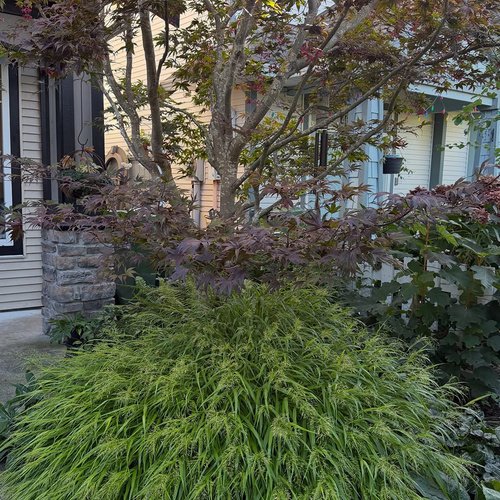
‘Moonfire’ Japanese maple(Acer palmatum ‘Moonfire’, Zones 5–9)perfectly skirted by ‘All Gold’ Japanese forest grass(Hakonechloa macra ‘All Gold’, Zones 4–9)in the front yard.
Closeup of Moonfire’s bronzy foliage.
Behind ‘Moonfire’ by the picket are the quiet gorgeous blooms of ‘Dark Beauty’ toad lily(Tricyrtis formosana ‘Dark Beauty’, Zones 4–9). Difficult to capture!
My favorite fuchsia growing in paired containers in the front yard and frequented by hummers: ‘Hawkshead’ fuchsia(Fuchsia magellanica ‘Hawkshead’, Zones 7–9).
Thank you so much for sharing these fabulous fall photos with us, Cherry! From the show-stopping plants you select for your space to the incredible combinations you create, there are always garden ideas worth stealing from your delightful designs.
What is your favorite season to look back on? Are you anticipating spring blooms with a peruse through spring photos, or do you delight in the peak season and constantly return to photos of your garden during the summer sizzle? Maybe fabulous fall foliage photos unlock your favorite garden memories. Let us know in the comments, or consider sharing photos of your favorite season with the blog. Follow the NEW directions below to submit your photos to Garden Photo of the Day!
We want to see YOUR garden!
Have photos to share? We’d love to see your garden, a particular collection of plants you love, or a wonderful garden you had the chance to visit!
You can also send 5–10 photos to [email protected] along with some information about the plants in the pictures and where you took the photos. We’d love to hear where you are located, how long you’ve been gardening, successes you are proud of, failures you learned from, hopes for the future, favorite plants, or funny stories from your garden.
Do you receive the GPOD by email yet? Sign up here
Fine Gardening Recommended Products
Planting in a Post-Wild World: Designing Plant Communities for Resilient Landscapes
Fine Gardening receives a commission for items purchased through links on this site, including Amazon Associates and other affiliate advertising programs.
Featuring gorgeous photography and advice for landscapers, Planting in a Post-Wild World by Thomas Rainer and Claudia West is dedicated to the idea of a new nature—a hybrid of both the wild and the cultivated—that can nourish in our cities and suburbs.
ARS Telescoping Long Reach Pruner
Fine Gardening receives a commission for items purchased through links on this site, including Amazon Associates and other affiliate advertising programs.
Telescopes from 4 to 7′. Cut and Hold (160) Blades. Drop forged blades for unsurpassed long lasting sharpness. Lightweight, 2.3 lbs., for continued use. Perfectly balanced for easy pruning.
Corona® Multi-Purpose Metal Mini Garden Shovel
Fine Gardening receives a commission for items purchased through links on this site, including Amazon Associates and other affiliate advertising programs.
Longer Service Life: The blade of this round small shovel is made of carbon steel, which can effectively improve the hardness by high temperature quenching, and the surface has anti-rust coating to avoid rusting. In the process of use when encountering hard objects will not bend and deformation.
Sturdy Structure: The small garden shovel with D-handle, ergonomically designed grip can increase the grip of the hand when using, the handle is made of strong fiberglass, will not bend and break under heavy pressure. Quick Digging: Well-made digging shovel has a sharp blade, and the round shovel head is designed to easily penetrate the soil and cut quickly while digging to enhance your work efficiency.
Price: $19.99 (as of Jan 20, 2026 06:24:23 UTC – Details)
Product description
The video showcases the product in use.The video guides you through product setup.The video compares multiple products.The video shows the product being unpacked. hero-video Merchant Video
KEY FOR PULL-UPS
INNSTAR PULL UP ASSIST BANDS HELPS YOU GRADUALLY BUILD STRENGTH UNTIL YOU CAN DO MULTIPLE SETS OF UNASSISTED PULL-UPS.
The pull up resistance bands are removable, so you can use three when you first start working out, then reduce it to two, one, and progressively, and finally you can do it independently from the assistance.
Natural Latex Pull-up Bands
Each resistance bands provides 55lbs of assitance for pull-up, totally 165lbs, externally wrapped high density anti-snap sleeve to prevent injury.
ABS 3 in 1 Cable Pocket
Snap on 3 pull up resistance bands for easy adjustment of different resistance while being safe and stable.
Super Sturdy Steel Buckle
High quality heavy-duty steel buckle for security and helping you keep a focused, effective pull-up session.
Military-grade Nylon Strap
There are six holes on the side for the buckle to hook. Can be adjusted to the right height by selecting the right position according to your height
Safety-Centric: Our sturdy steel buckles ensure a rock-solid hold. The protective cloth covers keep the latex in great shape and your skin safe from harm. Our bouncy ropes are super durable—they won’t break, no matter how hard you pull Total Body Workout: Our pull-up assist bands are your secret weapon for targeting arms, shoulders, back, chest, and core muscles. Ideal for home gyms or wherever you are, these bands make it easy to build strength across multiple muscle groups, giving you a full upper body workout that’s efficient and effective Scientifically Customized Pull Ups: Comes with three stretchy bands, ideal for gym pros and newbies. Start with all three to ease into it, then drop one as you get stronger. This set helps you build up your strength step by step, so you can eventually crush a full pull-up on your own Customize Your Workout: Easily adjust the length of our pull-up assist bands to match your height for a perfect fit, whether you’re on a pull-up bar or doing other exercises. The Height Adjustable Strap ensures everyone boosting PULL UP ASSIST BAND experience and workout results Lifetime After-sales Service:When you used resistance bands set, it worked great, please don’t forget to recommend it to your friend because your friends will thank you! If you give it as a gift, your friend and family will scream with joy
This velvety vegan cream of mushroom soup is a umami-rich staple, perfect by the bowl or as a base for casseroles. It comes together easily by blending savory sautéed mushrooms into a quick cashew cream, resulting in a silky purée with a concentrated flavor that far surpasses anything from a can.
My mom has always loved thick, puréed vegetable soups (or potages, as they’re known in France), and mushroom is her favorite. Her preference was the initial spark for this recipe, but I had a practical goal as well.
I wanted a wholesome, vegan version of the classic canned cream of mushroom soup that serves as a base for so many comfort food favorites, like holiday green bean casserole. The dairy-free store-bought options in this category are often underwhelming, and I knew there had to be a better way.
What I love about this method is its streamlined quality; essentially, it is a process of sautéing, then blending. You don’t need to make a separate batch of vegan cashew cream as you do for other soup recipes I’ve shared. Instead, you create a thick cashew and broth base directly in the blender, add your sautéed mushrooms, and let the appliance do the work. There are no mushroom pieces swimming around here; the soup is a savory purée that works as an elegant appetizer or a high-quality building block for nostalgic recipes.
The Dairy-Free Base
Unlike traditional recipes that rely on heavy cream, a flour-based roux, or potatoes for body, this cream of mushroom soup achieves its richness through (you guessed it) cashews.
Blending the soaked cashews with just one cup of broth first creates a thick, smooth cream foundation, ensuring the final soup is perfectly velvety.
I was inspired by a technique from Wil Yeung, in which raw cashews are blended directly into a mushroom soup mixture. Usually, I stir a few tablespoons of pre-made cashew cream into a soup at the end, but that necessitates a separate step.
You can bypass that extra work here. By blending the soaked cashews with just one cup of broth first, you create a thick, smooth cream foundation before adding the mushrooms. Because the ingredient list is minimal—just mushrooms, garlic, olive oil, and seasoning—the flavor is concentrated. This is a cream of mushroom soup that tastes truly and vibrantly of mushrooms, undiluted by dairy or starches.
A full 1.5 pounds of fresh mushrooms provide the deep, savory foundation that store-bought versions often lack.Sautéing the mushrooms until they are reduced and tender is the secret to capturing their concentrated umami flavor.
Notes on the Process
To get the most from this recipe, both in terms of texture and taste, there are a few things to keep in mind:
For tender mushrooms: Start the mushrooms in a covered pot or large sauté pan for the first two minutes. This “steam-sauté” method helps them release their juices quickly without soaking up too much oil.
The Creamy Base: Blending the soaked cashews with broth first ensures they are fully pulverized before the mushrooms are added. This eliminates the need to prepare a separate cashew cream, saving you time and at least one round of cleaning the blender.
The Right Blender: For a truly silky texture, a high-speed standing blender is best. If your blender isn’t high-speed, take an extra minute during step three to ensure the mixture is perfectly smooth. If you use an immersion blender, I recommend making cashew cream separately and stirring it in at the end; I include instructions in the recipe card.
Minimal Garnishes: I usually keep the toppings minimal to underscore the soup’s lovely simplicity. A light drizzle of olive oil and a few snipped chives are my favorite way to finish it.
Choosing Your Ingredients
I typically use mild white button or cremini mushrooms when I make the soup, but you can easily incorporate shiitake, oyster, porcini, or portobello mushrooms for deeper flavor notes.
I don’t recommend substituting the cashews; their mild, buttery flavor allows the taste of the mushrooms to shine. Look for cashews labeled as “raw” (which are actually heat-treated for safety, but unroasted and unsalted).
The flavor here is mushroom-forward but balanced; because the soup isn’t aggressively garlicky or heavy, it can be added to other recipes without overpowering their ingredients.
A bowl of the soup alongside a crusty piece of bread and a crisp green salad is a simple, nourishing lunch.
A nutritious multitasker
What I love most about this soup is its versatility. It can serve as a dinnertime appetizer, a light lunch with a sandwich, or even a savory afternoon snack to sip from your favorite oversized mug.
The soup is also a perfect base ingredient for plant-based renditions of recipes like green bean casserole or pot pie. Since the soup keeps well in the fridge for up to four days, it’s an easy component to prepare ahead of time for more intensive holiday cooking.
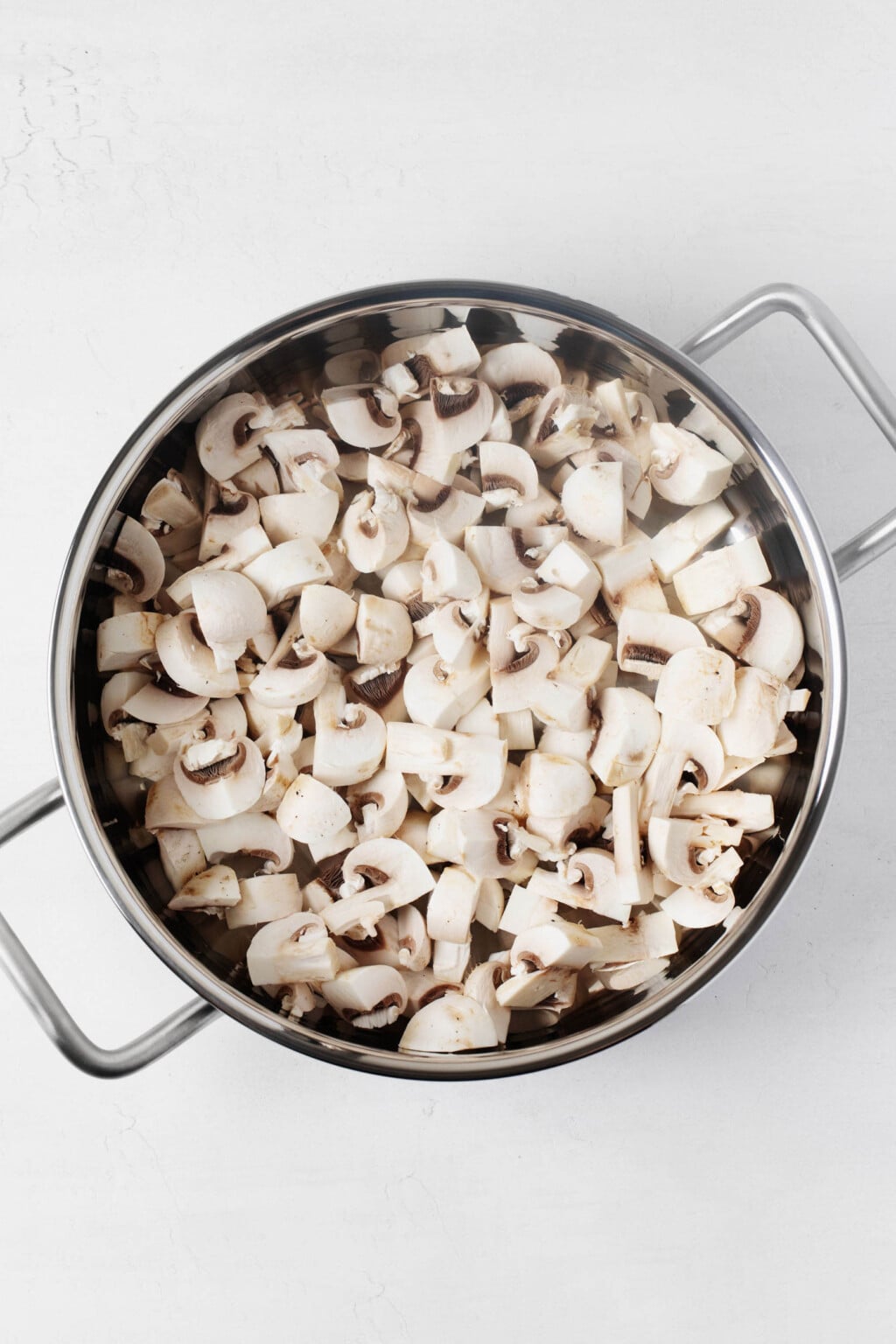
1 1/2poundscleaned and sliced or roughly chopped white button, cremini, or baby bella mushrooms(680 g)
1/8teaspoonsalt (a good pinch)
A few turnsfreshly ground black pepper
2cloves garlic, minced
4cupsvegetable broth, divided(950 mL)
1/3cupunroasted and unsalted cashews, soaked for 2 hours prior to preparation, then drained(45 g)
Snipped chives (optional, for garnishing)
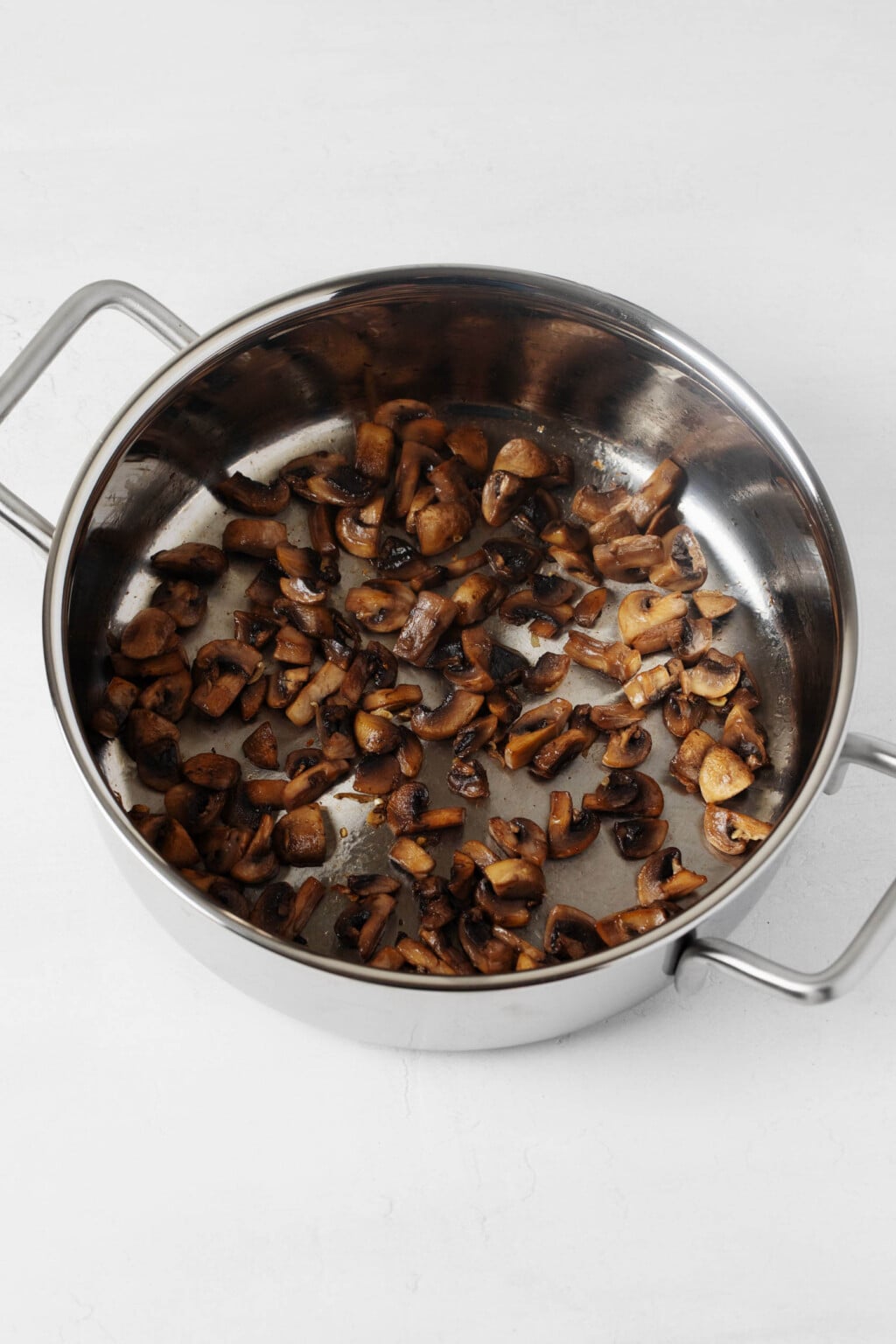
Heat the olive oil in a large, heavy-bottomed pot over medium heat. Add the mushrooms, salt, and pepper. Cover the pot and allow them to cook for 2 minutes, then uncover and stir them. Continue to cook for 3-4minutes, stirring every minute or so, until the mushrooms begin to release their juices. Add the garlic to the pot and stir.
Continue to sauté the mushrooms for another 6-8 minutes, stirring occasionally, or until the mushrooms are reduced in size and fully tender.
Place 1 cup (240ml) of broth into a powerful blender, along with the cashews. Blend for 1-2 minutes, or until the cashews are fully blended and you have a mixture that resembles a loose cashew cream.
Add the sautéed mushrooms and remaining broth to the blender. Blend for another 1-2 minutes, or until you have a smooth, puréed soup.
Pour the soup back into your soup pot over low heat. Once the soup is hot, taste it and adjust salt and pepper to your liking.
Spoon the soup into bowls and garnish with a drizzle of extra olive oil and/or some snipped chives. Serve.
Store the soup in an airtight container in the fridge for up to 4 days. I don’t recommend freezing this soup, as there tends to be some separation and change in texture with defrosting. I recommend a high-speed, standing blender to achieve a truly velvety, puréed texture. If you work with an immersion blender, then I recommend the following adjustments: 1. Add three cups / 710 mL of broth to the pot at the end of step two, then bring the mixture to a low simmer. Turn off the heat. Use your immersion blender to blend the mushrooms till the mixture is as smooth as possible. 2. If you have a food processor, skip step 3 and make a batch of all-purpose cashew cream in your food processor a day or two ahead of time. Stir 3/4 cup (180 mL) into the soup after blending the mushrooms with your immersion blender. If you don’t have a food processor, then skip step 3 and substitute 1 cup (180 mL) of unsweetened vegan creamer or coconut milk for the cashew blend. Recipe inspired by Wil Yeung’s creamy mushroom soup, as told to Food52.
Whether you’re serving the soup as an appetizer for friends or using it to simplify your next holiday casserole, I hope it’ll bring you a sense of comfort, accompanied by ease. Enjoy!
After months of dormancy, your garden is ready for a fresh start—and your front porch deserves the same attention. The long, quiet season is over, and it’s time to bring some life back into the space that welcomes you home every day.
Now’s the perfect moment to pull on your gardening gloves and dust off those tools. But before you dive into planting, giving your porch a quick decor refresh can be incredibly inspiring.
Your front porch sets the tone before you even walk inside, for both you and anyone stopping by. A few easy updates can make it feel warm, welcoming, and full of life—no need to aim for perfect.
Colors quietly shape how we feel, even when we don’t notice it happening. Soft pastels, fresh greens, and cheerful florals echo the garden and instantly bring a light, positive energy to your porch.
Adding natural touches like potted plants, flowers, or light fabrics helps bridge your garden and home. These simple details refresh the space and turn your porch into a cozy spot that celebrates the fresh start of spring.
29 Spring Front Porch Decor Ideas
Spring porch decor looks best when a few simple elements work together instead of competing for attention.
Soft colors, natural textures, and a touch of greenery create a balanced look that feels fresh without being overwhelming.
Greenery and florals always work well with natural materials like wicker, jute rugs, or wooden accents. This combination keeps the porch feeling connected to the season and the outdoors.
1. Fresh Floral Planters
Fresh flowers are one of the easiest ways to bring instant spring vibes to your front porch. They add color, life, and that just-bloomed feeling that makes everything look happier. Even a single planter by the door can make a noticeable difference.
You don’t need anything fancy—simple pots filled with seasonal blooms work beautifully. Think pansies, petunias, daisies, or whatever’s available locally. Mixing a few colors creates a relaxed, cheerful look without feeling overdone.
Place planters on either side of your door for a balanced feel, or cluster them in one corner for a more casual setup. Different pot heights can also add depth and keep the space visually interesting.
Fresh floral planters make your porch feel alive and welcoming. They quietly say “spring is here” every time you come home.
2. Potted Greenery
If flowers feel like too much maintenance, greenery is a great alternative. Lush green plants instantly freshen up your porch and give it a calm, natural look. They work well in both small and large spaces.
Plants like ferns, boxwood, snake plants, or palms are perfect for porches. They hold their shape, look full, and don’t rely on constant blooms to look good.
You can place greenery near seating areas, corners, or even line the steps for a soft, inviting feel. Neutral pots let the green stand out while keeping things simple.
Greenery adds balance to colorful spring decor and creates a peaceful vibe that never goes out of style.
A new welcome mat is one of the quickest ways to update your porch for spring. It’s the first thing people see, and it instantly sets the mood. Light colors, florals, or cheerful messages work especially well this time of year.
You can keep it playful or subtle, depending on your style. A simple “Hello Spring” or a soft botanical print adds charm without stealing attention from other decor.
For extra texture, try layering a smaller spring mat over a larger neutral rug. This adds depth and makes the porch feel more styled with very little effort.
It’s a small detail, but a fresh welcome mat makes your porch feel intentional and ready for the season.
4. Pastel Front Door
Painting your front door in a soft pastel shade is a bold move that really pays off. Colors like sage green, pale blue, blush, or light yellow instantly brighten the whole porch.
Pastels feel light and welcoming, which is exactly what spring decor is all about. They pair beautifully with natural elements like wood, plants, and neutral rugs.
If repainting feels like too much, even temporary touches like pastel wreaths or door accessories can create a similar effect. The goal is to soften the look and bring in freshness.
A pastel door becomes a standout feature that makes your porch feel cheerful before anyone even steps inside.
5. Hanging Flower Baskets
Hanging flower baskets are perfect for adding color without taking up floor space. They draw the eye upward and make your porch feel fuller and more layered.
Choose flowers that trail or spill over the sides for a soft, flowing look. Petunias, fuchsias, and begonias are popular choices and thrive in spring weather.
Hanging baskets look great near the entrance, along porch beams, or even near windows. Just make sure they’re easy to water and not in the way.
They add movement and charm, making your porch feel lively and beautifully in tune with the season.
6. Spring Wreath on the Door
A spring wreath is one of the simplest ways to refresh your front porch. Swapping out heavy winter styles for something light and floral instantly makes the space feel brighter.
Look for wreaths with greenery, faux blooms, or soft pastel accents. Even minimal designs with eucalyptus or vines work beautifully for spring.
It’s an easy update that ties the whole porch together and makes your entrance feel thoughtfully styled.
7. Cozy Porch Seating
Adding seating to your porch makes it feel more inviting and usable. A single chair, bench, or small loveseat creates a spot to relax and enjoy the fresh air.
You don’t need a lot of space—just something comfortable that fits naturally. Neutral furniture works well and lets seasonal decor shine.
Once seating is in place, your porch feels less like a pass-through and more like a place to pause.
Throw pillows are an easy way to bring in spring color without committing to big changes. Floral prints, soft pastels, or subtle patterns work especially well this season.
They instantly freshen up porch seating and make everything feel more comfortable. Even switching out winter pillows can make a big difference.
Pillows add personality and make your porch feel warm, relaxed, and lived-in.
9. Lightweight Outdoor Curtains
Outdoor curtains add softness and movement to a porch. Light, airy fabrics help create that breezy spring feeling we all love.
They also offer a bit of shade and privacy without making the space feel closed off. Neutral or white fabrics keep the look fresh.
With curtains in place, your porch feels cozy, calm, and perfectly styled for the season.
10. Decorative Lanterns
Lanterns are a timeless porch decor piece that works beautifully in spring. They add charm during the day and a cozy glow in the evening.
Place them near the door, beside seating, or grouped in corners for visual balance. Candles or solar lights both work well.
Lanterns bring warmth and character, making your porch feel welcoming at any time of day.
11. Wooden Crate Displays
Wooden crates are one of those decor pieces that just work. They’re simple, flexible, and give your porch a relaxed, rustic touch.
You can stack them, turn them sideways, or use them as mini shelves for plants and lanterns. There’s no right or wrong way to style them.
They’re great for filling empty corners and adding height without making things feel cluttered.
Old stools, ladders, crates, or small tables make great porch decor. They add character and a relaxed, collected look.
Use them as plant stands or simple accents. Nothing needs to match perfectly.
Vintage pieces make your porch feel personal and lived-in, which is exactly the vibe spring decor should have.
21. Soft Spring Color Palette
Choosing a simple color palette makes decorating your porch feel easier. Soft pastels mixed with neutrals work especially well for spring.
When your colors flow together, the space feels calm instead of cluttered. Even a few matching accents can make a big difference.
This approach keeps your porch looking fresh and effortless all season long.
22. Shade or Umbrella Accent
A little shade goes a long way on a sunny porch. A small umbrella or fabric shade adds comfort without taking away from the decor.
Stick to light or neutral colors so it doesn’t feel heavy. Spring is all about keeping things airy.
It makes your porch more usable and gives it that relaxed, laid-back feel.
23. Window Boxes with Blooms
Window boxes filled with flowers instantly boost curb appeal. They make your porch look cheerful and well cared for.
You can use real plants or faux ones if upkeep is an issue. Both can look great when styled simply.
This is one of those decor choices that always feels worth it.
24. Seasonal Door Hardware
Changing small details like door knockers or hooks can freshen up your porch. Spring-inspired or brass pieces work nicely.
It’s a subtle update, but it adds personality and charm.
Sometimes it’s the little things that make the biggest impact.
25. Candle and Lantern Groupings
Candles grouped together bring warmth to your porch, especially in the evenings. Lanterns make them feel a bit more styled.
Stick to simple holders so the look stays relaxed. Battery or solar candles work great outdoors.
This kind of lighting makes your porch feel cozy and inviting after sunset.
26. Easy DIY Spring Decor
DIY decor adds a personal touch to your porch without needing to be perfect. Painted pots, handmade signs, or simple wreaths all work great for spring.
These little projects are more about having fun than getting everything just right. Even small imperfections make them feel charming and real.
When you add something you made yourself, your porch instantly feels more meaningful.
27. Layered Textures
Mixing textures keeps your porch from feeling flat. Think wood, woven baskets, metal lanterns, soft fabrics, and greenery.
You don’t need a lot—just a few different materials working together can make the space feel cozy.
Layered textures give your porch depth while still keeping things relaxed and natural.
28. Minimal Spring Styling
If you love a clean look, less is totally okay. A couple of plants, a simple mat, and a wreath can be enough.
Minimal spring decor still feels fresh and welcoming without extra fuss. It’s perfect if you prefer calm over clutter.
This style lets the season shine without overpowering the space.
29. Personal Touches That Feel Like Home
Your porch should reflect you. A favorite chair, a sign you love, or plants you enjoy caring for make it feel special.
These personal details are what turn a styled porch into a lived-in one. They don’t have to be trendy or expensive.
When your porch feels like you, it’s a place you’ll actually want to use.
Conclusion
Spring front porch decor doesn’t have to be complicated or expensive to feel beautiful. A few thoughtful updates can completely change how the space feels.
Whether you love bold colors or simple greenery, the goal is to create a porch that feels fresh, welcoming, and happy.
Most of all, have fun with it. When your porch reflects the season and your personality, every arrival home feels a little brighter
Khaja Moinuddin, a computer science graduate, finds joy in gardening and homesteading. Join him on this blog as he shares his experiences in homesteading, gardening, and composting
Price: $6.49 (as of Jan 19, 2026 18:23:14 UTC – Details)
From the brand
When we travel, we meet so many amazing people. Long nights at hotel bars and campfires made us realise that every single person has an incredible story to tell. When we started our company, we knew that we were onto something special. Like us, our products travel the world and become part of incredible stories themselves.
Incredible products. Incredible stories.
For everyone. Insonder.
VERSATILE RESISTANCE: No worries about resistance levels or sizes! Our workout bands, made of 100% Durable Natural Latex, cater to your every need. From physical therapy to full-body workouts, these elastic bands are your all-in-one fitness solution. ANYTIME & ANYWHERE WORKOUT: Break free from the gym! With these versatile bands, you can exercise wherever you please. Be it legs or booty, these bands adapt to your workout routine. Experience the ultimate freedom in your fitness journey. PHYSICAL THERAPY CHAMP: Ideal for rehabilitation, our bands aid in recovery from injuries or chronic pain. The elastic characteristics make them effective for targeted exercises, ensuring a seamless transition from injury to fitness. Your go-to for physical therapy bands. BOOTY BOOSTER: Get maximum value with our booty bands! Crafted from 100% Durable Natural Latex and available in vibrant color palettes, these bands promise durability and style. Elevate your leg workouts with these resistance bands, perfect for exercising and toning. COLORFUL AND DURABLE: Beyond just effective, our bands bring style to your workouts. With multiple color palettes, these exercising bands not only enhance your routine but also ensure longevity. Elevate your fitness game with these mini bands, loop bands, and more!
Price: $419.99 - $79.00 (as of Jan 19, 2026 06:21:59 UTC – Details)
HYPERTENSION NOTIFICATIONS — Apple Watch Series 11 can spot signs of chronic high blood pressure and notify you of possible hypertension.* KNOW YOUR SLEEP SCORE — Sleep score provides an easy way to help track and understand the quality of your sleep, so you can make it more restorative. EVEN MORE HEALTH INSIGHTS — Take an ECG anytime.* Get notifications for a high and low heart rate, an irregular rhythm,* and possible sleep apnea.* View overnight health metrics with the Vitals app* and take readings of your blood oxygen.* STUNNING DESIGN — Thin and lightweight, Series 11 is comfortable to wear around the clock — while exercising and even when you’re sleeping, so it can help track your key metrics. A POWERFUL FITNESS PARTNER — With advanced metrics for all your workouts, plus features like Pacer, Heart Rate Zones, training load, Workout Buddy powered by Apple Intelligence from your nearby iPhone,* and more. Series 11 also comes with three months of Apple Fitness+ free.* BIG BOOST IN BATTERY LIFE — With up to 24 hours of normal use.* And fast charge for up to 8 hours of normal use in just 15 minutes.* BUILT TO LAST — With a superdurable glass display that’s 2x more scratch resistant than Series 10.* Series 11 also has a water resistance rating of 50m and is IP6X dust resistant.* SAFETY FEATURES — Series 11 can detect a hard fall or severe car crash, automatically help connect you with emergency services, and notify your emergency contacts.* Check In can automatically notify a loved one when you’ve arrived at your destination. STAY CONNECTED — Send a text, take a call, listen to music, use Siri, and get notifications. Series 11 (GPS) works with your iPhone or Wi-Fi to keep you connected. * LEGAL DISCLAIMERS — This is a summary of the main product features. See below to learn more.
These air fryer chicken tacos are the kind of tacos you make once and then never stop making. They’re simple, fast, and incredibly reliable, which is exactly why they’ve become my go-to anytime tacos are on the menu. The chicken cooks quickly in the air fryer, stays juicy every single time, and works perfectly with whatever toppings you already have on hand. If your family has a default taco night, this is the chicken that’s about to take over.
I make this chicken at least once a week, and every single time Dave says it’s the best chicken I’ve ever made. I’ve even made it for my in-laws, and they were genuinely surprised by how good it was given how little effort goes into it.
Boneless, skinless chicken thighs are incredibly forgiving, and the air fryer does something special here. Between the red wine vinegar and taco seasoning, the chicken gets beautifully caramelized on the outside while staying juicy inside. Like my Instant Pot dinners, this is one of those recipes where the air fryer earns its keep when cooking feels like a lot but tacos still need to happen.
If easy taco-style dinners are your thing, you’ll probably love a few of my other low effort favorites too. My buffalo chicken tacos and 10-minute taco skillet chicken both come together fast with just a few minutes at the stove and very little prep. And if you are looking for another simple air fryer chicken recipe, these air fryer chicken cubes are always in rotation. Same simple approach, different ways to use them, and dinner still gets done without a lot of thought.
This post contains affiliate links. As an amazon associate I earn from qualifying purchases. Click here to read my policy and more about affiliate links.
Key Ingredients
Boneless, skinless chicken thighs – This is the ingredient that makes this recipe so reliable. Chicken thighs stay juicy, are hard to overcook, and work especially well in the air fryer. I make this with thighs on repeat, but you can use chicken breasts if that’s what you have. Just make sure they aren’t too thick. If they are, slice them in half so they cook evenly and don’t dry out.
Red wine vinegar – There’s not much vinegar in this recipe, but it makes a big difference. It helps the chicken caramelize in the air fryer and adds a little acidity that cuts through the taco seasoning so the flavor doesn’t feel flat.
Taco seasoning – Use a taco seasoning you actually like. Since the ingredient list is short, the seasoning does a lot of the heavy lifting here. Any store-bought taco seasoning works, so go with your favorite. You can also make your own homemade taco seasoning if you don’t have any on hand.
Step by step process
Tips for success
Use a wire rack for oven-style air fryers. Placing the chicken on a rack set over a baking sheet allows airflow underneath while catching drips, which helps with even cooking and cleanup.
Use the lower rack in oven-style air fryers. Cooking on the lower rack reduces grease splatter on the top heating element and helps keep your air fryer cleaner.
Welcome to the Cooking Burnout Club
This recipe is meant to be flexible, not perfect. Use what you have, skip what you don’t, and keep it simple. That’s the whole point of the Cooking Burnout Club.
If you want more stupid-simple, low-effort dinners like this, this recipe is part of my weekly meal plans designed for nights when cooking feels like too much. No complicated steps, no extra decisions, just food that works in real life.
★ Did you make this recipe? Please give it a star rating below!
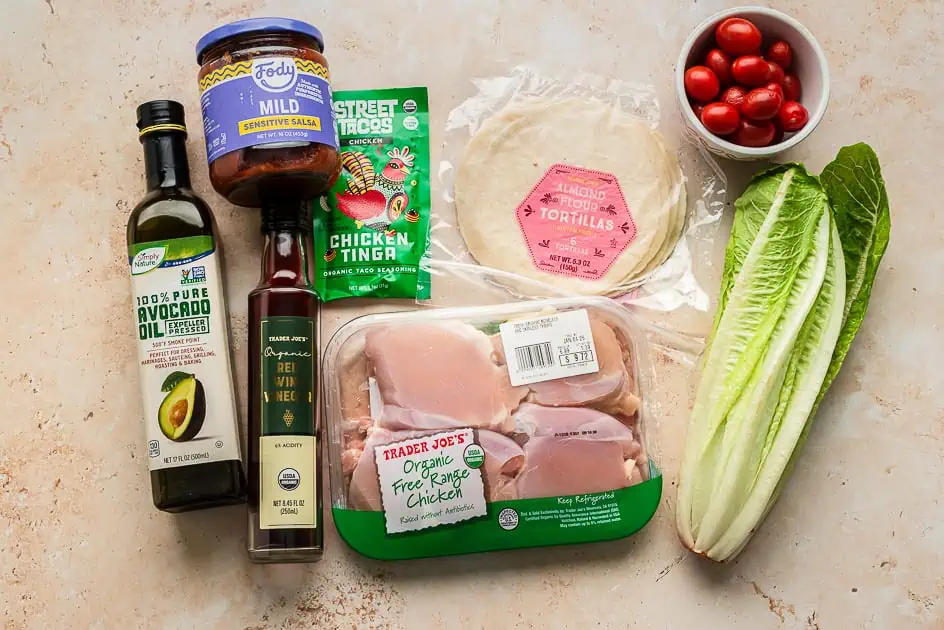
Add boneless, skinless chicken thighs to a bowl. I recommend trimming away any of the excess fat you see. Drizzle with avocado oil, red wine vinegar, salt and taco seasoning and stir well until the chicken is well coated on all sides.
Once chicken is well coated, add to air fryer. If using an air fryer basket: make sure it’s in a single layer. If using a oven style air fryer: preheat it to 425F. Add the chicken to a baking sheet with a rack attachment and put the chicken in a single layer.
Cook the chicken. For basket style: cook at 375F for 10-12 minutes. For oven style: Cook in preheated 425F oven for 13 minutes.
Once the chicken is done cooking (check the thickest part of the chicken it should read close to 165F – remember there will be some carryover cooking too). Remove it from the air fryer and let it rest for 3-4 minutes.
After 3-4 minutes of rest, thinly slice the chicken and serve in tortillas with toppings of choice. I used sliced lettuce, tomatoes and salsa to keep things easy.
8 medium tortillas, 1 head romaine lettuce, finely sliced, ½ cup cherry tomatoes, sliced, 1/2 cup salsa
Trim excess fat and skin first – Check boneless, skinless chicken thighs and snip off any large pieces of fat or leftover skin with kitchen shears. This helps prevent excess grease and promotes even cooking.
Cook in a single layer – Whether you’re using a basket-style or oven-style air fryer, don’t overlap the chicken. Crowding causes steaming instead of air frying.
Adjust cook time based on air fryer type and thickness – Chicken thighs vary in size, so start checking early.
Basket-style air fryer: 375°F for 10–12 minutes, check around 10 minutes
Oven-style air fryer: 425°F (preheated) for about 13 minutes
Thicker thighs may need an extra 1–2 minutes.
Check internal temperature – Chicken is done when it reaches 165°F in the thickest part.
Rest before slicing – Let the chicken rest for 3–4 minutes after cooking, then slice thinly. This keeps the chicken juicy and makes it easier to serve.
Store leftovers: Store chicken in the fridge for up to 3 days in a well sealed container.
Nutrition Information
Nutrition Facts
Amount per Serving
Where does nutrition info come from? Nutrition facts are provided as a courtesy, sourced from the USDA Food Database.
SHARE THIS POST!
If you liked this post, share it with your friends and family!
Course: dinner
Cuisine: Mexican
Keyword: air fryer chicken tacos, air fryer taco chicken
Let others know by rating and leaving a comment below!
Ways to Serve Air Fryer Chicken Tacos
These are tacos, so the best way to serve them is with whatever you already have. There’s no “right” topping combo here, just what sounds good and feels easy.
Simple Toppings
Start with one or two and call it done:
Lettuce or cabbage for crunch
Tomatoes, salsa, or pico for freshness
Sour cream, Greek yogurt, or guacamole for creaminess
You don’t need all of these. Use what you have and skip the rest.
Add a Slaw (Optional)
If you want something a little extra but still low effort, a simple slaw works well:
Both can be made ahead and are easy to adjust based on what’s in your fridge. If making slaw feels like too much, just stick with taco toppings and move on.
Dr. Elyse Stevens, left, attends a community breakfast at a New Orleans nonprofit, with her former patient Ronald Major who says Stevens treated him like family.
Aneri Pattani/KFF Health News
hide caption
toggle caption
Aneri Pattani/KFF Health News
NEW ORLEANS — Dr. Elyse Stevens had a reputation for taking on complex medical cases, including people who’d been battling addiction for decades. Some were chronic-pain patients on high doses of opioids; others were sex workers and people living on the street.
“Many of my patients are messy, the ones that don’t know if they want to stop using drugs or not,” said Stevens, a primary care and addiction medicine doctor.
While other doctors avoided these patients, Stevens — who was familiar with New Orleans from her time in medical school at Tulane University — sought them out. She regularly attended 6 a.m. breakfasts for homeless people, volunteered at a homeless shelter clinic on Saturdays, and, on Monday evenings, visited an abandoned Family Dollar store where advocates distributed supplies to people who use drugs.
Award-winning care
One such evening about four years ago, Charmyra Harrell arrived there limping, her right leg swollen and covered in sores. Emergency room doctors had repeatedly dismissed her, so Harrell said she eased the pain with street drugs.
Stevens cleaned her sores on Mondays for months until finally persuading Harrell to visit the clinic at University Medical Center New Orleans. There, Stevens discovered Harrell had diabetes and cancer.
She agreed to prescribe Harrell pain medication — an option many doctors would automatically dismiss for fear that a patient with a history of addiction would misuse it.
But Stevens was confident Harrell could hold up her end of the deal.
“She told me, ‘You cannot do drugs and do your pain meds,'” Harrell recounted on a Monday evening in October. So, “I’m no longer on cocaine.”
Charmyra Harrell credits Dr. Elyse Stevens with diagnosing her diabetes and cancer and helping her stop using cocaine.
Aneri Pattani/KFF Health News
hide caption
toggle caption
Aneri Pattani/KFF Health News
Stevens’ approach to patient care has won her awards and nominations in medicine, community service, and humanism. Instead of seeing patients in binaries — addicted or sober, with a positive or negative drug test — she measures progress on a spectrum. Are they showering daily, cooking with their families, using less fentanyl than the day before?
But not everyone agrees with this flexible approach that prioritizes working with patients on their goals, even if abstinence isn’t one of them. And it came to a head in the summer of 2024.
“The same things I was high-fived for thousands of times — suddenly that was bad,” Stevens said.
Flexible care or slippery slope?
More than 80% of Americans who need substance use treatment don’t receive it, national data from the Substance Abuse and Mental Health Services Administration shows. Barriers abound: high costs, lack of transportation, clinic hours that are incompatible with jobs, fear of being mistreated.
Some doctors had been trying to ease the process for years. The pandemic accelerated that trend. Telehealth appointments, fewer urine drug tests, and medication refills that last longer became the norm.
The result?
“Patients did OK and we actually reached more people,” said Brian Hurley, the past president of the American Society of Addiction Medicine. The organization supports continuing flexible practices, such as helping patients avoid withdrawal symptoms by prescribing higher-than-traditional doses of addiction medication and focusing on recovery goals other than abstinence.
But some doctors prefer traditional approaches that range from zero tolerance for patients using illegal drugs to setting stiff consequences for those who don’t meet their doctors’ expectations. For example, a patient who tests positive for street drugs while getting outpatient care would be discharged and told to go to residential rehab. Proponents of this method fear loosening restrictions could be a slippery slope that ultimately harms patients. They say continuing to prescribe painkillers, for example, to people using illicit substances long-term could normalize drug use and hamper the goal of getting people off illegal drugs.
Progress should be more than keeping patients in care, said Keith Humphreys, a Stanford psychologist, who has treated and researched addiction for decades and supports involuntary treatment.
“If you give addicted people lots of drugs, they like it, and they may come back,” he said. “But that doesn’t mean that that is promoting their health over time.”
Flexible practices also tend to align with harm reduction, a divisive approach that proponents say keeps people who use drugs safe and that critics — including the Trump administration — say enables illegal drug use.
The debate is not just philosophical. For Stevens and her patients, it came to bear on the streets of New Orleans.
“Unconventional” prescribing
In the summer of 2024, Stevens’ supervisors started questioning her approach.
In emails reviewed by KFF Health News, they expressed concerns about her prescribing too many pain pills, a mix of opioids and other controlled substances to the same patients, and high doses of buprenorphine, a medication considered the gold standard to treat opioid addiction.
Stevens’ supervisors worried she wasn’t doing enough urine drug tests and kept treating patients who used illicit drugs instead of referring them to higher levels of care, such as inpatient rehab.
“Her prescribing pattern appears unconventional compared to the local standard of care,” the hospital’s chief medical officer at the time wrote to Stevens’ supervisor, Dr. Benjamin Springgate. “Note that this is the only standard of care which would likely be considered should a legal concern arise.”
Dr. Elyse Stevens and her husband, Aquil Bey, a paramedic, discuss patient cases at a breakfast for homeless people in New Orleans. Bey founded Freestanding Communities, an organization to help vulnerable people.
Aneri Pattani/KFF Health News
hide caption
toggle caption
Aneri Pattani/KFF Health News
Springgate forwarded that email to Stevens and encouraged her to refer more patients to methadone clinics, intensive outpatient care, and inpatient rehab.
Stevens understood the general practice but couldn’t reconcile it with the reality her patients faced. She wondered how someone living in a tent, fearful of losing their possessions, would trek to a methadone clinic daily.
Stevens sent her supervisors dozens of researchstudies and nationaltreatmentguidelines backing her flexible approach. She explained that if she stopped prescribing the medications of concern, patients might leave the health system, but they would still be sick.
“They just wouldn’t be getting care and perhaps they’d be dead,” she said in an interview with KFF Health News.
Both University Medical Center and LSU Health New Orleans, which employs Stevens and other physicians at UMC, declined repeated requests for interviews. They did not respond to detailed questions about addiction treatment or Stevens’ practices.
Instead, they provided a joint statement from Dr. Richard DiCarlo, dean of the LSU Health New Orleans School of Medicine, and Dr. Jeffrey Elder, chief medical officer of University Medical Center New Orleans.
“We are not at liberty to comment publicly on internal personnel issues,” they wrote.
“We recognize that addiction is a serious public health problem, and that addiction treatment is a challenge for the health care industry,” they said. “We remain dedicated to expanding access to treatment, while upholding the highest standard of care and safety for all patients.”
Not black-and-white
KFF Health News shared the complaints against Stevens and the responses she’d written for supervisors with two addiction medicine doctors outside of Louisiana, who had no affiliation with Stevens or her employers. Both found her practices to be within the bounds of normal addiction care, especially for complex patients.
Dr. Stephen Loyd, an addiction medicine specialist and the president of Tennessee’s medical licensing board, said doctors running pill mills typically have sparse patient notes that list a chief complaint of pain. But Stevens’ notes detailed patients’ life circumstances and the intricate decisions she was making with them.
“To me, that’s the big difference,” Loyd said.
Some people think the “only good answer is no opioids,” such as oxycodone or hydrocodone, for any patients, said Dr. Cara Poland, an addiction medicine specialist and associate professor at Michigan State University.
But patients may need them — sometimes for things like cancer pain — or require months to lower their doses safely, she said. “It’s not as black-and-white as people outside our field want it to be.”
Humphreys, the Stanford psychologist, had a different take. He did not review Stevens’ case but said, as a general practice, there are risks to prescribing painkillers long-term, especially for patients using today’s lethal street drugs too.
Overprescribing fueled the opioid crisis, he said. “It’s not going to go away if we do that again.”
“The thing that kills people”
After months of tension, Stevens’ supervisors told her on March 10 to stop coming to work. The hospital was conducting a review of her practices, they said in an email viewed by KFF Health News. Overnight, hundreds of her patients were moved to other providers.
Luka Bair had been seeing Stevens for three years and was stable on daily buprenorphine.
Luka Bair holds a film of buprenorphine, a daily medication considered the gold standard to treat opioid addiction.
Aneri Pattani/KFF Health News
hide caption
toggle caption
Aneri Pattani/KFF Health News
After Stevens’ departure, Bair was left without medication for three days. The withdrawal symptoms were severe — headache, nausea, muscle cramps.
“I was just in physical hell,” said Bair, who works for the National Harm Reduction Coalition and uses they/them pronouns.
Although Bair eventually got a refill, Springgate, Stevens’ supervisor, didn’t want to continue the regimen long-term. Instead, Springgate referred Bair to more intensive and residential programs, citing Bair’s intermittent use of other drugs, including benzodiazepines and cocaine, as markers of high risk. Bair “requires a higher level of care than our clinic reasonably can offer,” Springgate wrote in patient portal notes shared by Bair and reviewed by KFF Health News.
But Bair said daily attendance at those programs was incompatible with their full-time job. They left the clinic, with 30 days to find a new doctor or run out of medication again.
“This is the thing that kills people,” said Bair, who eventually found another doctor willing to prescribe their buprenorphine.
Springgate did not respond to repeated calls and emails requesting comment.
University Medical Center and LSU Health New Orleans did not answer questions about transferring and discharging Stevens’ patients.
“Reckless behavior”
About a month after Stevens was told to stay home, Haley Beavers Khoury, a medical student who worked with her, had collected nearly 100 letters from other students, doctors, patients, and homelessness service providers calling for Stevens’ return.
One student wrote, “Make no mistake — some of her patients will die without her.” A nun from the Daughters of Charity, which ran the hospital’s previous incarnation, called Stevens a “lifeline” for vulnerable patients.
Beavers Khoury said she sent the letters to about 10 people in hospital and medical school leadership. Most did not respond.
In May, the hospital’s review committee determined Stevens’ practices fell “outside of the acceptable community standards” and constituted “reckless behavior,” according to a letter sent to Stevens.
The hospital did not answer KFF Health News’ questions about how it reached this conclusion or if it identified any patient harm.
Meanwhile, Stevens had secured a job at another New Orleans hospital. But because her resignation came amid the ongoing investigation, University Medical Center said it was required to inform the state’s medical licensing board.
The medical board began its own investigation — a development that eventually cost Stevens the other job offer.
In presenting her side to the medical board, Stevens repeated many arguments she’d made before. Yes, she was prescribing powerful medications. No, she wasn’t making clinical decisions based on urine drug tests. But national addiction organizations supported such practices and promoted tailoring care to patients’ circumstances, she said. Her response included a 10-page bibliography with 98 citations.
In October 2025, Dr. Elyse Stevens decided to leave New Orleans. Before she left, she and her family burned her old prescription pads as “a ceremonial death of an old life and birth of a new beginning,” she says.
Aneri Pattani/KFF Health News
hide caption
toggle caption
Aneri Pattani/KFF Health News
Liability
The Louisiana state board’s investigation into Stevens is ongoing. Its website shows no action taken against her license as of late December. The board declined to comment on both Stevens’ case and its definition of appropriate addiction treatment.
In October, Stevens moved to the Virgin Islands to work in internal medicine at a local hospital. She said she’s grateful for the welcoming locals and the financial stability to support herself and her parents.
Dr. Elyse Stevens says goodbye to her mom, Mary Chaput, as they part ways on one of Stevens’ final days in New Orleans.
Aneri Pattani/KFF Health News
hide caption
toggle caption
Aneri Pattani/KFF Health News
But it hurts to think of her former patients in New Orleans.
Before leaving, Stevens packed away handwritten letters from several of them — one was 15 pages long, written in alternating green and purple marker — in which they shared childhood traumas and small successes they had while in treatment with her.
Stevens doesn’t know what happened to those patients after she left.
She believes the scrutiny of her practices centers on concerns over liability more than patient safety.
But, she said, “liability is in abandoning people, too.”
KFF Health News is a national newsroom that produces in-depth journalism about health issues and is one of the core operating programs at KFF.
It is unlikely that an indoor specimen will bloom. However, you can try to mimic nature and encourage flowering.
Provide 12 hours of sunlight with the aid of a grow light, and less than 12 hours of darkness during the last six weeks of the dormant fall and winter period.
It is also essential to withhold fertilizer and water minimally during this time.
Soil
The ideal potting medium for flapjack paddle kalanchoe is gritty and well-draining. Cactus and succulent soil is appropriately formulated to meet the need for pH in the 6.5 to 7.5 range.
Hoffman Organic Cactus and Succulent Soil Mix is composed of organic compost and peat moss to provide optimal nutrition, inorganic sand for rapid drainage, and limestone to maintain a slightly acidic pH.
Because succulents are prone to rotting in overly wet soil, it’s best to let the pot dry completely before watering. Use a moisture meter as your guide.
During dormancy, moisture needs are greatly reduced as the flapjack plant is not actively growing.
You can find variegated flapjack paddle plant ‘Fantastic’ available in two-gallon pots from Planet Desert.
Maintenance
Flapjack paddle plant prefers a snug-fitting pot with about an inch of space between the foliage and the container rim to accommodate a watering can spout.
When it spreads to fill the vessel completely and/or roots poke from the drainage holes, go up one pot size.
Whether or not you need to increase the size of the container, it’s beneficial to change the potting mix every two years or so.
This avoids soil compaction that adversely affects the ability of the roots to efficiently absorb nutrients and water.
Additional maintenance includes the removal of damaged or dead leaves, a prime breeding ground for common houseplant pests and diseases, which we discuss below.





























![Apple Watch Series 11 [GPS 46mm] Smartwatch with Space Gray Aluminum Case with Black Sport Band – M/L. Sleep Score, Fitness Tracker, Health Monitoring, Always-On Display, Water Resistant](https://wrwofficial.com/wp-content/uploads/2026/01/71bEG0kDTWL._AC_SL1500_-768x911.jpg "Apple Watch Series 11 [GPS 46mm] Smartwatch with Space Gray Aluminum Case with Black Sport Band – M/L. Sleep Score, Fitness Tracker, Health Monitoring, Always-On Display, Water Resistant")