35.7 F
Klamath Falls
Sunday, March 15, 2026
Home Blog Page 27

As more seniors become homeless, shelters try to adapt : Shots

0

The Medically Vulnerable People (MVP) shelter in Sandy, Utah, is a remodeled two-story brick hotel. It serves people ages 62 and older, as well as people with health conditions that make it hard to live in a typical homeless shelter.

Aaron Bolton/Montana Public Radio


hide caption

toggle caption

Aaron Bolton/Montana Public Radio

Just outside Salt Lake City, in Sandy, Utah, there’s an old, two-story brick hotel — now given new life as a homeless shelter for older adults.

The Medically Vulnerable People shelter, or MVP shelter for short, is for people ages 62 and older. But it also serves younger adults who have chronic health issues.

Instead of sleeping in a large, shared space with multiple beds or bunks, the MVP shelter has semiprivate rooms designed to accommodate wheelchairs or other mobility needs. Each small room has its own bathroom, allowing dignity and privacy for older adults who struggle with incontinence.

Unlike the MVP shelter, most homeless shelters aren’t equipped to help older people, especially those 65 and above. They are the fastest-growing homeless population nationwide, according to Dennis Culhane, a researcher at the University of Pennsylvania. Not only are people who struggle with chronic homelessness aging, but many older adults are becoming homeless for the first time in their lives.

Getting in and out of bunks, managing medications and making it to a shared bathroom in time are among the major challenges of shelter life for older people. Staff at traditional shelters sometimes ask older adults to leave if they’re unable to care for themselves.

The MVP shelter is unusual because it provides on-site medical care to better serve its residents as they age.

When Jamie Mangum tripped and fell in her room at the MVP shelter, she didn’t have to go far for help. Mangum, who is in her 50s and has lung cancer, needed only to make it downstairs, where she saw an emergency medical technician in the clinic. Her swollen wrist was quickly wrapped, and she returned to her room. She said that this wouldn’t have been possible at other shelters she has stayed in.

“There, I’d have to wait hours as opposed to come in here — be seen,” Mangum said.

In this photo, MVP shelter resident Jamie Mangum is seated in a chair with her left arm extended out, while emergency medical technician Emily Woolsey wraps Mangum's wrist.

On-site emergency medical technician Emily Woolsey wraps the swollen wrist of MVP shelter resident Jamie Mangum after a fall. Mangum says that in other shelters, she would likely have had to find her own way to an urgent care office to get treatment. She credits the shelter for helping her deal with all her medical issues.

Aaron Bolton/Montana Public Radio


hide caption

toggle caption

Aaron Bolton/Montana Public Radio

In other shelters, Mangum said, she would probably have had to find her own way to an urgent care office or get an ambulance ride. At the MVP shelter, specialized case managers have also helped her arrange treatment for her lung cancer.

The shelter can handle clients with complex medical needs. “We have clients that need memory care. Maybe they were living independently before, but they were unable to maintain that and got evicted due to dementia or different things like that,” said Baleigh Dellos, who manages the MVP shelter for The Road Home, a local nonprofit.

Immediate care and assistance are provided by EMTs and the specialized medical case managers, but primary care doctors and therapists visit weekly. Residents can even receive physical therapy in private spaces on-site.

A path to better health, and stability

The MVP shelter partners with the Fourth Street Clinic in Salt Lake City to offer medical care on-site.

The first thing most new residents need help with is medication, according to Matt Haroldsen, with the Fourth Street Clinic.

When people are living on the streets, regular medications can be lost or stolen. “Their medications get jacked when they’re in their camps,” Haroldsen said.

Diabetes patients who are homeless often bury their insulin to keep it cold. But they might forget where they buried it, or the vials can get too warm and spoil, he added.

Helping MVP shelter residents get and maintain their medications can stabilize their health conditions, Haroldsen explained. That allows them to turn their focus to other priorities, such as getting an ID or other documents they need to apply for disability, Social Security and various support programs that can eventually help them secure more permanent housing.

Nonprofits and local governments have opened similar shelters in Florida, California and Arizona to meet the needs of older homeless adults.

Having access to specialized shelters can be the difference between life and death, said Caitlin Synovec, assistant director of the National Health Care for the Homeless Council.

In cold-weather states, denying older people a bed because of mobility and other health issues can be especially risky. In 2022, an older adult in Bozeman, Mont., froze to death after he was asked to leave a shelter because of incontinence.

Complex medical needs can pose a danger to other residents that most shelters aren’t prepared to manage.

“A typical shelter doesn’t allow somebody on oxygen to come in because that’s such a fire hazard and risk,” she said.

Giving older adults better access to health care inside shelters is the best way to help them succeed once they do get access to more permanent housing, Synovec said. That’s because health issues are a common reason older people can’t afford or maintain housing, she said.

Senior-focused shelters popping up in other states

The MVP shelter model is showing promise, both in Utah and elsewhere.

“Over 80% of the people who’ve stayed in our program this past year have moved into stable or permanent housing,” said Jacob Torner, vice president of programs for the TaskForce for Ending Homelessness in Fort Lauderdale, Florida. The nonprofit runs a shelter called Elder Haven.

Jeff Gregg bends down, with his back hunched over, as he reaches for a tennis ball that's in the mouth of his dog, Ruffy, whose fur is mostly black, with a bit of white fur at the front of the neck.

Jeff Gregg plays fetch with his dog, Ruffy, outside the MVP Shelter in Sandy, Utah. He says the specialized medical services helped him stop using opioids and get surgery for chronic back pain. He hopes that this will allow him to get a job and afford an apartment.

Aaron Bolton/Montana Public Radio


hide caption

toggle caption

Aaron Bolton/Montana Public Radio

The MVP shelter near Salt Lake City is also marking success. It was able to permanently house 36 older adults in the first 11 months of 2025.

Still, more older people are in need of shelter than it can accommodate. Dellos, the shelter’s manager, said the waitlist hovers around 200 people. The shelter prioritizes people based on medical need, she said, not time spent on the waitlist.

A place to reset and recover

For residents who do get a room, the opportunity can be life-changing.

Outside the shelter, 62-year-old Jeff Gregg was playing fetch with his dog, Ruffy.

Because of an old back injury, Gregg stayed hunched over as he threw the ball. The injury also fueled a decades-long addiction to opioids, he said, creating a cycle that was hard to escape.

“Fighting that, having a job, insurance, then losing the job, not having insurance, going out to the streets and being back in that crap, and I’d be back in the same position,” he said.

Gregg said sobriety took a back seat to his more immediate needs, such as finding food and a bed in a shelter. For him, the shelter became the first place where he could relax and focus on recovery.

“I was able to get clean. It took me a couple months, but I just kept plucking away,” he said.

He said the experience paved the way for him to get back surgery. He hopes that with less back pain, he can eventually get a job that will help him pay for an apartment.

This story comes from NPR’s health reporting partnership with Montana Public Radio and KFF Health News.

How to Bottom Water Houseplants

0

If you want to keep your plants alive, there are a few things you have to do: give them light, feed them now and then, and – of course – water them.

Watering seems pretty straightforward to me. You fill a jug or can, bring it over to your plant, and dump the liquid in, right? Not much room to run into trouble.

But despite that, I’ve managed to find trouble so many times, and I can pretty much guarantee that you have as well.

A close up horizontal image of a collection of houseplants by a window with sun streaming in.

Fortunately there’s a different way, and it can help take the guesswork out of figuring out how much to provide. That means healthier, happier plants.

Plus, it can protect your floors and shelves (and books!) from overzealous watering.

Up ahead, here’s what we’ll discuss to help you figure out the art of bottom watering.

What Is Bottom Watering?

To put it simply, bottom watering (sometimes called reverse watering) is giving your plant’s roots hydration from the bottom up.

Instead of dumping liquid onto the top of the soil of your container plants, you allow the soil to soak it up into its roots from the drainage holes in the bottom of the pot.

A close up horizontal image of. houseplant in a black plastic pot set in a saucer on a terra cotta tiled surface.A close up horizontal image of. houseplant in a black plastic pot set in a saucer on a terra cotta tiled surface.

This isn’t the same thing as wick watering. That’s when you use a central container like a bucket to slowly wick moisture via ropes into nearby containers.

It’s a super handy skill to have in your back pocket if you travel a lot, but not what we’ll be covering here.

Why Use This Technique?

I warped my hardwood floors when I spilled an entire watering can once.

But beyond architectural disasters, I’ve also managed to drown my plants, and to chronically underwater them.

A close up horizontal image of two hands from the left of the frame hydrating a houseplant set on a windowsill.A close up horizontal image of two hands from the left of the frame hydrating a houseplant set on a windowsill.

And don’t tell me you haven’t overwatered to the point where the drainage plate overflows and you’re frantically trying to find a towel before it runs everywhere… just me? I don’t think so!

Let’s not even discuss the time I decided it was a brilliant idea to put a bunch of houseplants on my wire shelves above a collection of leather bound books…

Okay, so it’s pretty straightforward to understand, but why would you want to water from the bottom? Doesn’t pouring it on the top work perfectly well?

Yes, there is nothing wrong with top watering (aside from occasional mishaps), but there are times when it isn’t ideal. For instance, some plants suffer if they have moisture on their leaves.

It’s hard to avoid splashes and mistakes altogether, even when you’re careful.

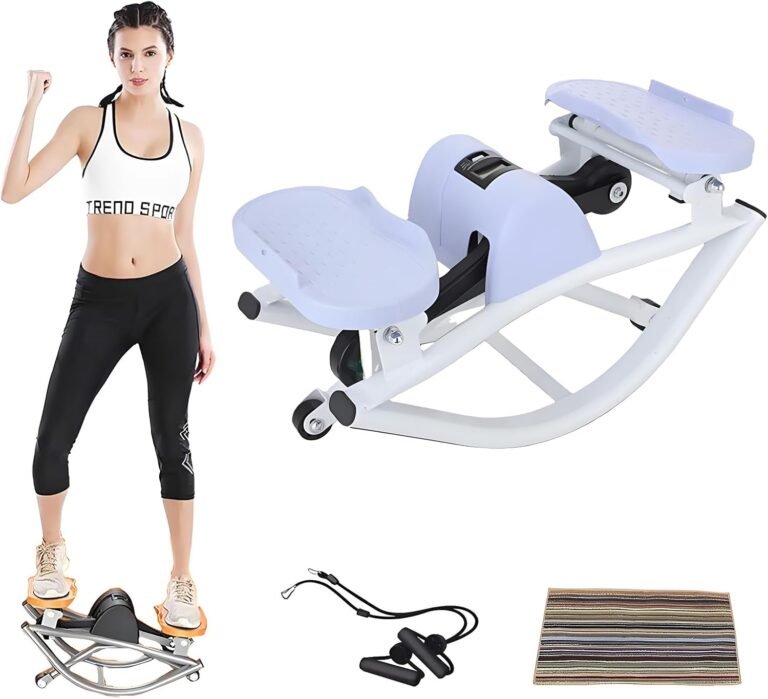
Rock Stepper Step Side-to-Side Lateral Rocking Fitness Stepper with Digital Monitor/Resistance Bands Machine for Home Workout

0


Price: $99.99 - $79.99
(as of Jan 16, 2026 18:11:37 UTC – Details)


Looking for a convenient and effective way to exercise at home? Our mini stepper is the perfect solution for your daily workout needs. As a compact and practical fitness device, its clever design easily integrates into your home life. Whether you want a quick workout before work or to unwind after a long day, it meets your needs.
Safety is our top priority. This stepper features anti-slip pedals with textured surfaces and a sturdy high-carbon steel frame, ensuring you can exercise with peace of mind without worrying about slipping or wobbling. The anti-slip strips on the bottom and optional anti-slip mat further enhance stability and protect your floors from scratches, making it ideal for any room in your home – be it the bedroom, living room, or even a small home gym.
Product Name: Swing Stepper
Product Dimensions: 19.3in (49cm) × 10.6in (27cm) × 9in (23cm)
Accessories: Swing Stepper, Resistance Bands, Towel
Suitable for: Home living room, bedroom, study, etc.
The perfect gift for women!
Note:
Due to factors such as lighting, shooting, and monitor settings, the color of the image may differ slightly from the actual product. Please refer to the actual product.
This product is measured manually, and there may be an error of 1-3 cm. Please refer to the actual product for specific dimensions.
100% Satisfaction Guarantee. We guarantee you won’t regret your purchase. If you have any questions, please feel free to contact us, and we will resolve your issue within 24 hours.

Non-Slip & Safe Design for Home WorkoutsThis mini stepper features a non-slip raised dot surface on the pedals (and non-slip strips at the bottom), boosting foot adhesion and preventing slips—perfect for safe exercise at home. The high-carbon steel frame ensures strong load-bearing capacity, making it a reliable piece of fitness equipment for daily use.
Quiet & Movable for Convenient UseEquipped with rubber wheel design, this stair stepper is wear-resistant, low-noise, and easy to move around your home. Pair it with the included soft anti-slip mat (70*40cm) to protect floors and reduce noise further—ideal for quiet, hassle-free workouts.
Multifunctional Digital MonitorTrack your progress in real time with the built-in computer display: it shows scan data, workout time, step count, calories burned, and average steps per minute. This helps you stay on top of your fitness goals while using this practical workout equipment.
Compact & Space-Saving for Home FitnessWith dimensions of 19.3in(49cm)×10.6in(27cm)×9in(23cm), this mini stepper is compact enough to fit in small spaces (like bedrooms or living rooms). It’s a great choice for steppers for exercise at home, especially for those with limited space.
Ideal Workout Gifts for WomenThis versatile stair stepper doubles as effective workout equipment for women (supports full-body steps + optional resistance band exercises). Its sleek design and practical functions make it a thoughtful fitness gift for women who love home workouts.

TenCloud 10Pack Compatible with FITVII H56/FT26 Fitness Tracker 1.7 inch Bands 22mm, Replacement Breathable Lightweight Soft Silicone Sweat Resistant Sport Wristbands Band for FITVII H56

0


Price: $13.98
(as of Jan 16, 2026 06:11:05 UTC – Details)


Attention: Please confirm both your FITVII watch band wide size is 22mm and the screen size is 1.7inch to avoid bought by mistake.10-Pack Compatible with FITVII/KALINCO Slim Fitness Tracker 1.7 inch Bands 22mm, Replacement Breathable Lightweight Soft Silicone Sweat Resistant Sport Wristbands Band for FITVII H56/FT26 ( Not for FITVII HM08 and H86.)
Strap Width:22mm
Suitable Watch Model:
Compatible with FITVII H56 smart watch bands 1.7 inch
Compatible with FITVII FT26 Fitness Tracker 1.7 inch
Adjustable Size: Fit wrist size: 5.5’’-8.0’’ inch wrist.
Package: ONLY the Bands Replacement(no watch)
Package Dimensions ‏ : ‎ 7.83 x 5.79 x 1.38 inches; 6.38 ounces
Department ‏ : ‎ Men Women
Date First Available ‏ : ‎ June 2, 2023
Manufacturer ‏ : ‎ TenCloud
ASIN ‏ : ‎ B0C6XP8Y5S
Product Warranty: For warranty information about this product, please click here
Best Sellers Rank: #85,330 in Electronics (See Top 100 in Electronics) #135 in Wearable Tech Wristbands
Customer Reviews: 4.2 4.2 out of 5 stars (26) var dpAcrHasRegisteredArcLinkClickAction; P.when(‘A’, ‘ready’).execute(function(A) { if (dpAcrHasRegisteredArcLinkClickAction !== true) { dpAcrHasRegisteredArcLinkClickAction = true; A.declarative( ‘acrLink-click-metrics’, ‘click’, { “allowLinkDefault”: true }, function (event) { if (window.ue) { ue.count(“acrLinkClickCount”, (ue.count(“acrLinkClickCount”) || 0) + 1); } } ); } }); P.when(‘A’, ‘cf’).execute(function(A) { A.declarative(‘acrStarsLink-click-metrics’, ‘click’, { “allowLinkDefault” : true }, function(event){ if(window.ue) { ue.count(“acrStarsLinkWithPopoverClickCount”, (ue.count(“acrStarsLinkWithPopoverClickCount”) || 0) + 1); } }); });

Homemade Baby Balm Skin Cream Recipe

0

When I was pregnant with my first child, my friends and relatives literally gave me 11 bottles of baby lotion. The smell reminded me of my own childhood. I loved that it was specially formulated for babies, so of course, the ingredients had to be natural and safe. Right?

… and then I actually read the ingredients.

What’s in Baby Lotion?

Ingredients like petroleum, artificial fragrances, and propylene glycol weren’t something I wanted on my baby’s skin. I searched for natural baby balm options and found a few great ones. There are even more options available now if you’re not in the DIY mood. 

This Everyday Baby Balm from Motherlove or this one from Badger have clean ingredients and work well. I still preferred making my own baby balm though because I could easily customize the ingredients and it was a lot cheaper. 

Choosing Natural Ingredients For Baby Balm

I decided to make my own from food-safe ingredients. And I even had many of the ingredients on hand already for my homemade lotion bars and other beauty products.

This baby balm recipe uses:

  • Cocoa Butter – High in antioxidants and skin moisturizing fatty acids. It leaves a barrier on the skin to help prevent moisture loss and keep things like urine from irritating sensitive skin. 
  • Shea Butter – A natural source of vitamin A and other nutrients, shea butter is highly nourishing and protective to the skin.
  • Olive Oil– Attracts moisture to the skin and repairs damaged skin. It’s also a major source of plant-based squalene, a lipid our skin cells make to lubricate and protect the skin. 
  • Castor Oil– High in ricinoleic acid and skin protective. 
  • Essential Oils – You can use any diluted baby-safe essential oils you prefer, but I use frankincense, chamomile, and rose. 

Important Note on Essential Oil Safety and Babies

I love essential oils and use them daily for cleaning, aromatherapy, skincare, and more. They are highly concentrated though and not every essential oil is safe or appropriate for every purpose. 

Frankincense, lavender, chamomile, and rose are all gentle options and generally considered safe for babies 3 months and older. Essential oils should always be diluted for little ones and generally should not be more than .25% of the recipe. For this recipe that translates to about 7 drops of essential oils total

Herbal Infused Oil

If you have a baby under 3 months or just prefer to skip the essential oils, then an herb-infused baby balm is a great alternative. Here are detailed instructions for how to make an herbal infused oil. 

Lots of herbs will work in a baby balm, but here are some of my favorites. They have natural skin soothing and healing properties and are safe for babies (barring any allergies).

Here’s how to make my favorite homemade baby balm!

Homemade Baby Balm Recipe

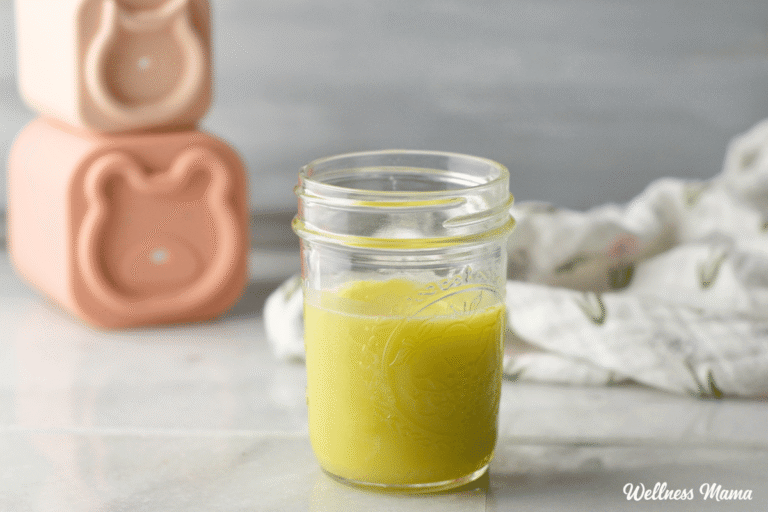
This moisturizing baby balm helps protect baby’s delicate skin with natural ingredients.

Prep Time5 minutes

Active Time10 minutes

Cooling Time2 hours

Total Time1 hour 15 minutes

Yield: 5 ounces

Author: Katie Wells

  • Heat all of the ingredients (except essential oils) in a double boiler or in a glass jar or bowl over a small pan of boiling water.

  • Stir carefully until melted.

  • Remove from heat and add essential oils if using.

  • Pour into a glass jar and let it cool in the fridge for several hours or until firm.

  • Store at room temperature and use a small amount as needed for baby’s skin (or adult skin)

Use herb infused olive oil to make the recipe if desired. Check the article for ideas of what to use.

Shelf Life and Storage

Since this baby balm is oil based it has a much longer shelf life than baby lotion with water-based ingredients. It should last 1-2 years when stored away from direct light and heat. 

The baby balm takes a few minutes to absorb into the skin and you only need to use a tiny bit. I’ve had friends say it was incredibly helpful for eczema and skin problems as well.

What did you use on your little ones? Ever made your own? Share below!

GPOD on the Road: Jardins de Métis

0

Happy Friday, GPODers!

Are you a snowbird, or do you like to hit the road the second summer weather hits? No matter what season you prefer to travel, there is likely a public garden that would make an excellent addition to your getaway. If you find yourself traveling to the eastern shores of Canada this summer, Gloria Timmons from Beaconsfield, Quebec, has shared a garden worthy of a spot on your itinerary. Jardins de Métis/Reford Gardens is a designated historic site in Grand-Métis, Quebec, with a surrounding landscape that is as stunning as the cultivated spaces within its grounds. Designed in the abundant English style, these gardens are filled with amazing plants, interesting art, and fascinating history.

I thought many of your readers may be planning some road trips for the summer. This garden is situated in one of the most beautiful areas of Quebec, Canada. It is at the entrance of a loop road that circles a peninsula that protrudes into the Gulf of St. Lawrence, known as La Gaspésie. 

This public garden at the entrance to the Gaspé peninsula of Eastern Canada in Quebec province is a little jewel. It was rescued in 1995 by Alexander Reford, great-grandson of Elsie Reford, its creator. Post surgery, she was told by her doctor to avoid strenuous activities like fishing, hunting, and horseback riding. Elsie took up gardening!

digital painting of blue poppy flowers in vaseThis is a digital painting by T. M. Glass, Toronto artist in residence, 2018, of the famous Himalayan blue poppy (Meconopsis betonicifolia, Zones 4–7). The blue poppy made its debut at the Chelsea Flower Show in 1926, and many historical gardeners were anxious to cultivate it. Elsie must have recognized a microclimate in Métis (the garden is in Zone 4), as she was one of the few successful gardeners to grow and harvest seeds of this rare beauty.

Himalayan blue poppy nursery plantsUnfortunately, I have never visited the gardens during July when it flowers, but here are the nursery plants. I have visited the garden many times but always on my way to visit my family in Percé during August. 

large planting of Virginia bluebells before they turn blueVirginia bluebells (Mertensia virginica, Zones 3–8) along a pathway. Early summer plants can be found even in August in this part of the country.

bonsai conifer on tree stumpMosses and a “bonsaied” conifer growing in a creative way on an old tree stump, and a millstone.colorful plexiglass sculptureThroughout the garden, there are works of art by local artists. This is a plexiglass and aluminum sculpture by Marie Claude Hamel. It is an ode to the garden’s emblem; it gleams when the sun is shining.

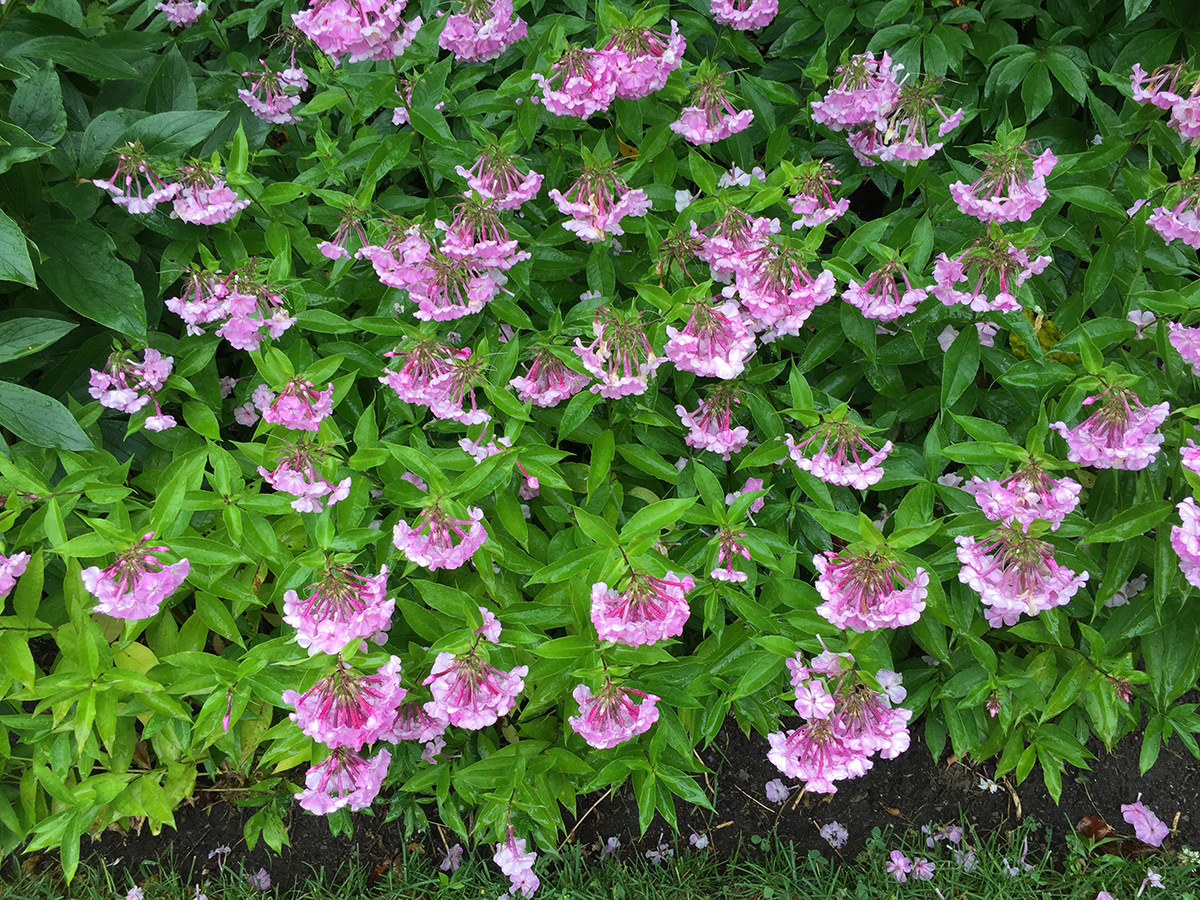
border garden with blue, red and white flowersThe growing season is very short in this part of the country (June through September). A mixed border of common traditional flowers: everything seems to bloom at the same time.

Blue Globe ThistleThese blue globe thistles (Echinops ritro, Zones 3–8) growing along a wilder pathway that leads to the International Garden Festival Grounds: Each year, international artists are invited to present their interpretation of a theme. The theme for 2025 was “Borders,” rather significant for Canadians at this time.

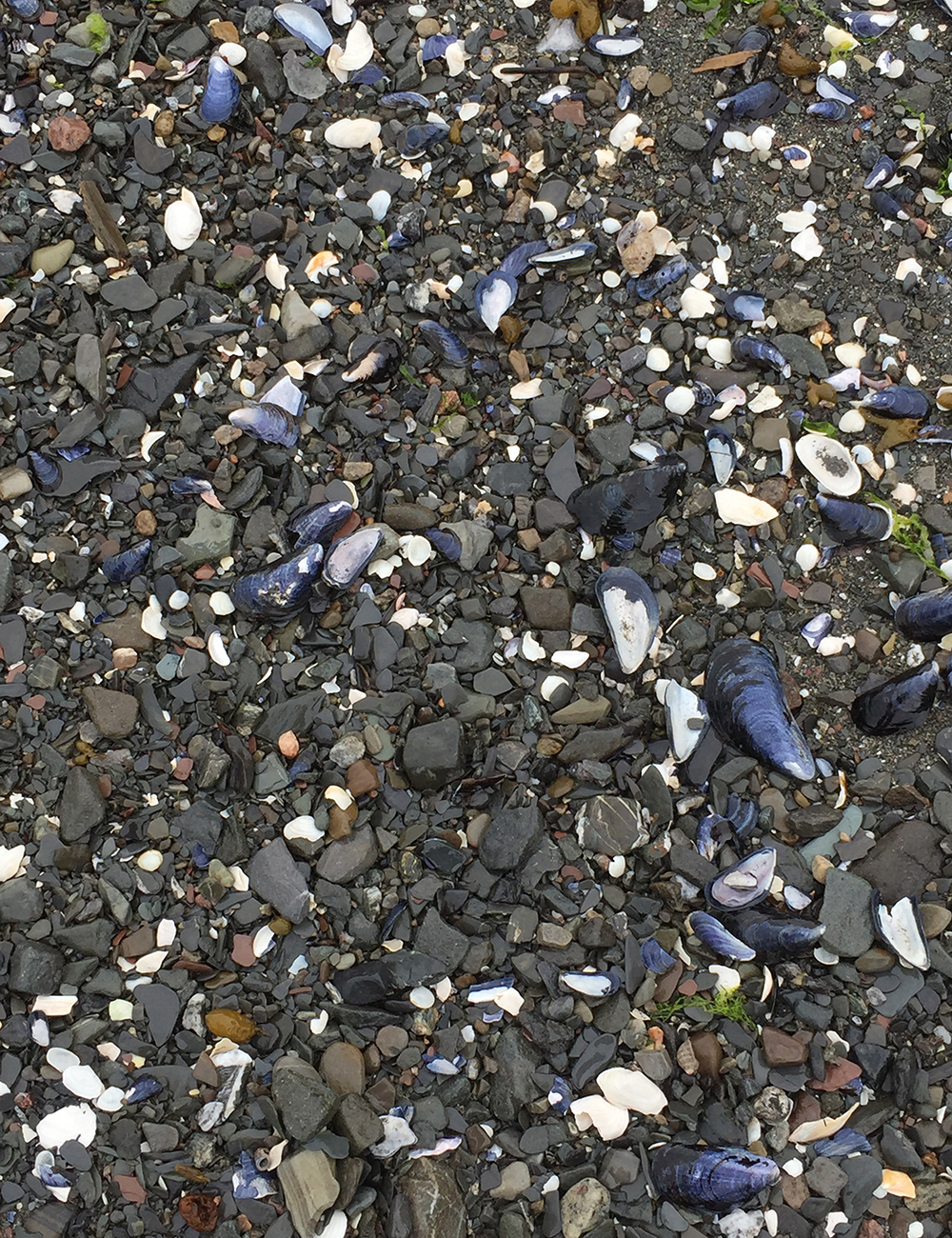
mussel shells in gravel pathThe lodge and gardens are situated at the junction of the Métis River and the St. Lawrence River. Elsie used these mussel shells, which she crushed, to create a pathway she called the Long Walk. It is a traditional English perennial border.

Thank you so much for sharing this spectacular garden with us, Gloria! As someone who is constantly looking for lesser-known gardens to explore, Jardins de Métis just found a spot on my garden bucket list.

Is there a public garden near you that deserves more attention? Please consider sharing photos of your favorite public garden with the blog. Follow the NEW directions below to submit your photos to Garden Photo of the Day!


We want to see YOUR garden!

Have photos to share? We’d love to see your garden, a particular collection of plants you love, or a wonderful garden you had the chance to visit!

To submit, fill out the Garden Photo of the Day Submission Form.

You can also send 5–10 photos to [email protected] along with some information about the plants in the pictures and where you took the photos. We’d love to hear where you are located, how long you’ve been gardening, successes you are proud of, failures you learned from, hopes for the future, favorite plants, or funny stories from your garden.

Do you receive the GPOD by email yet? Sign up here

Multi-Function Tension Rope – 4 Tube Resistance Bands with Handles – Sit Up Exercise Equipment Home Gym Tummy Trainer for Men Women

0


Price: $12.55
(as of Jan 15, 2026 18:09:05 UTC – Details)


Founded in 2020, PEN&H is a young and passionate brand, which focuses on decoration or storage for your sweet house.
Workout equipment : This Exercise Ropes is perfectly for exercising your muscles in different parts of the arms, waist, abdomen, hips and legs,improve the flexibility of your joints.
Sit-Up Exercise Equipment: This resistance band is lightweight and easy to carry, So you can easily take it out and exercise anywhere, at home, gym, office, etc.
Fitness anytime,anywhere:This ab workout equipment use for Home, hotel rooms, offices, and even outdoors Anytime, anywhere you want to start a sporting event or sport you want
Non-slip: This foot pedal resistance bands are made of TPE, their materials and designs can effectively avoid slipping caused by sweating.
Portability and Convenience: This resistance bands are lightweight, portable, and easy to store, making them ideal for home workouts, travel, or outdoor exercise.

RFK Jr.’s new dietary guidelines end ‘the war on saturated fats’ : Shots

0

The Trump administration has unveiled a new food pyramid that stresses protein and whole foods and calls for an end to “the war on saturated fats.”

izzetugutmen/U.S. Department of Health and Human Services


hide caption

toggle caption

izzetugutmen/U.S. Department of Health and Human Services

Health Secretary Robert F. Kennedy Jr. has announced new dietary guidelines for Americans focused on promoting whole foods, proteins and healthy fats.

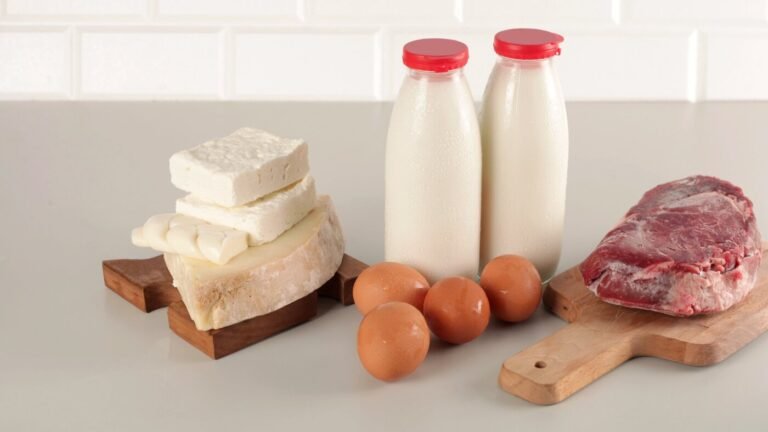
At a press conference Wednesday, the administration unveiled a new food pyramid with red meat, cheese, vegetables and fruits pictured at the top.

Kennedy described the guidelines as the most significant reset on nutrition policy in history, calling for an end to policies that promote highly refined foods that are harmful to health.

The guidelines will set limits on added sugar and encourage diets that include meat and dairy.

“Protein and healthy fats are essential and were wrongly discouraged in prior dietary guidelines,” Kennedy said. “We are ending the war on saturated fats.”

And they called for a “dramatic reduction” in the consumption of “highly processed foods laden with refined carbohydrates, added sugars, excess sodium, unhealthy fats, and chemical additives.”

In an introduction to the new guidelines, Kennedy and Agriculture Secretary Brooke Rollins said, “we are reclaiming the food pyramid and returning it to its true purpose of educating and nourishing all Americans.”

The new food pyramid puts meat, cheese, dairy and vegetables at the top.

The new food pyramid replaces the ‘my plate’ icon and turns the old pyramid on its head.

U.S. Department of Agriculture/U.S. Department of Health and Human Services


hide caption

toggle caption

U.S. Department of Agriculture/U.S. Department of Health and Human Services

A food pyramid, which was narrow on the top and wide at the bottom, was introduced in the early 90s. Grains were at the bottom — a signal to eat plenty of them, and oils and fats were at the top, a signal to eat them sparingly. The USDA retired the entire pyramid concept in June 2011, replacing it with the simpler ‘MyPlate’ visual, introduced by First Lady Michelle Obama. Now, the plate has been retired, and the pyramid has made a come-back — but this time it’s turned upside down.

“This approach can change the health trajectory for so many Americans,” Kennedy and Rollins wrote, pointing out that more than 70% of American adults are overweight or obese due to a diet that has “become reliant on highly processed foods and coupled with a sedentary lifestyle.”

For years, Americans have been advised to limit saturated fat, and the new pyramid is facing criticism.

“I’m very disappointed in the new pyramid that features red meat and saturated fat sources at the very top, as if that’s something to prioritize. It does go against decades and decades of evidence and research,” says Christopher Gardner, a nutrition expert at Stanford University. He was a member of the Dietary Guidelines Advisory Committee, which reviewed all the nutrition evidence. He’s in favor of increasing plant-based sources of protein, such as beans, rather than emphasizing animal protein.

Both the American Heart Association and the Academy of Nutrition and Dietetics, which includes thousands of nutrition professionals, point to evidence that excess saturated fat is linked to heart disease. And the new guidelines do still include a long held recommendation to limit saturated fat to 10% of your daily calories.

The guidelines also elevate cheese and other dairy to the top of the pyramid, paving the way for the option of full-fat milk and other dairy products in school meals. There’s growing evidence, based on nutrition science, that dairy foods can be beneficial.

“It’s pretty clear that overall milk and cheese and yogurt can be part of a healthy diet,” says Dariush Mozaffarian, a cardiologist, a public health scientist and the director of the Food is Medicine Institute at Tufts University. “Both low-fat and whole-fat dairy versions of milk, cheese and yogurt have been linked to lower cardiovascular risk,” he says.

“What’s quite interesting is that the fat content doesn’t seem to make a big difference,” Mozaffarian says.

And while whole grains are pictured at the smallest point at the bottom of the new pyramid, the guidelines instruct Americans to “prioritize fiber-rich whole grains.” There’s now a sharp distinction between whole grains and refined grains. The guidelines recommend two to four servings per day of whole grains, while significantly reducing the consumption of highly processed, refined carbohydrates, such as white bread, ready-to-eat or packaged foods.

Mozaffarian says he supports the recommendations to lower consumption of highly processed foods. “Highly processed foods are clearly harmful for a range of diseases, so to have the U.S. government recommend that a wide class of foods be eaten less because of their processing is a big deal and I think a very positive move for public health,” he says.

While the guidelines do not use the word ultra-processed, they do stress that Americans should eat, “real food that nourishes the body.” And they recommend no amount of added sugar for children under the age of 10.

The new guidelines also include changes to alcohol recommendations, removing specific daily limits, previously up to one drink a day for women and two for men. Instead, the guidelines simply state: “Consume less alcohol for better health” — without specifying any amounts.

In addition, the guidelines lists who should completely avoid alcohol including pregnant women, people recovering from alcohol use disorder and those who are unable to control the amount they drink, and people taking medications or with medical conditions that can interact with alcohol.

Though most Americans don’t read the dietary guidelines, they are highly influential in determining what’s served in school meals and on military bases, as well as what’s included in federal food aid for mothers and infants, as the guidelines set targets for calories and nutrients.

Is Epsom Salt Good for Peace Lily?

0

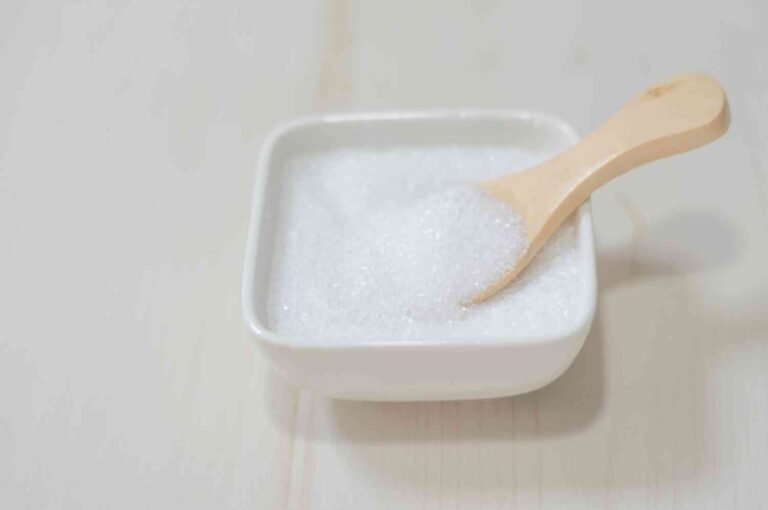
You can use Epsom salt diluted in a gallon of water to improve the peace lily plant. Magnesium and sulfur residing in Epsom salt improve a plant’s nutritional intake and make its foliage green.

Adding magnesium sulphate to peace lily can help eliminate yellow and curly leaves. 

Chemically, Epsom salt is known as magnesium sulphate, one of the best organic fertilizers to enrich your plant.

Prominent for its green foliage and white blossoms, the peace lily is grown to purify the air and add aesthetic appeal to your indoors.

Like human peace lily plants need food & medicine. While water and fertilizers are food, Epsom salt is medicine for peace lily.

Unlike edible plants, peace lily doesn’t need to be fertilized extensively. Conduct a soil test before adding magnesium sulphate to the growing medium.

Yellowing of leaf veins, curling and early leaf fall are signs of magnesium deficiency.

Adding Epsom salt will improve the photosynthetic ability of the peace lily and eventually contribute to the healthy growth of the plant.

Is Epsom Salt Good for Peace Lily – Benefits

Epsom salt can indeed be beneficial for Peace Lilies when used sensibly.

This natural ingredient can provide nutrients like sulfur and magnesium to your soil, encouraging green foliage, healthy growth, and better nutrient uptake.

Apart from this, Epsom salt can encourage abundant flowering, enhancing the visual appeal of your Peace Lily.

But, excess use of Epsom salt can result in nutritional imbalance and root damage.

To avoid such a situation, you should follow recommended dosages and consider alternative care practices alongside Epsom salt application to maintain your Peace Lily’s overall well-being.

1. Magnesium Makes Foliage Greener

Magnesium found in Epsom salt is known to increase chlorophyll production and encourage green foliage.

This study states that a deficiency of Mg can result in poor or yellowing of leaves.

Magnesium is the central core of chlorophyll molecules, and adding it activates a specific enzyme that contributes to green leaves.

Mix one tablespoon of Epsom salt in a gallon of water and spray it with peace lily leaves.

2. Epsom Salt Eliminates Yellow Leaves

This report states that due to deficiency in magnesium and sulfur, plants undergo stress and won’t be able to utilize nutrients available in the potting soil.

This is why a deficiency in these nutrients can result in yellowing and early fall of peace lily leaves.

Add diluted Epsom salt solution once a month to make peace lily plant look vibrant.

3. Avoids Peace Lily Leaf Curling

Magnesium deficiency can result in interveinal chlorosis in plants. This means leaf veins stay green, but other leaf regions turn yellow.

It first affects lower peace lily leaves, and sulfur deficiency makes the leaves curl upwards.

Adding Epsom salt can help to eliminate these deficiencies, and you’ll be able to revive your plant.

4. Improves Nutritional Intake of Peace Lily

High magnesium and sulfur levels in Epsom salt contribute to photosynthesis and improve plant’s ability to absorb macronutrients like nitrogen, potassium and phosphorus from the growing medium.

Thus, adding Epsom salt will indirectly contribute to the healthy growth of the peace lily plant.

5. Encourage Blooming

Applying Epsom salt is known to encourage blooming in peace lily plants.

Add two tablespoons of Epsom salt to a gallon of water and spray it once a month. It eventually promotes healthy growth and encourages plants to produce blossoms.

6. Epsom Salt can help to get rid of snails and pests

Epsom salt can effectively deter snails and pests from your peace lily plant.

Sprinkling Epsom salt around your plants can act as a natural pest repellent. Snails and certain pests find it uncomfortable to crawl over the sharp and abrasive texture of the salt crystals.

But remember that this method may not work for all pests, and it’s essential to reapply the Epsom salt after rain to maintain its effectiveness.

Also, excess use of Epsom salt can result in over-fertilization of peace lilies.

How to Use Epsom Salt for Peace Lily?

Epsom salt is a compound of sulfur, oxygen and magnesium. This naturally occurring mineral is known to benefit plants by making them bushier.

Note: Use Epsom salt on peace lily after confirming that the soil is deficient in magnesium and sulfur.

Most potting soil mixes are rich in magnesium, and peace lily plants won’t need much of this nutrient.

However, if you notice the lower leaves turning yellow and the peace lily foliage losing its colour, add Epsom salt to the lily.

Epsom Salt Council recommends mixing two tablespoons of Epsom salt into a gallon of water monthly for houseplants.

If you’re watering your plant frequently, add 1 tbsp of magnesium sulphate to a gallon of water.

You can use it as a spray of leaves or water at the base of a peace lily plant.

Pros and Cons of Using Epsom Salt for Peace Lily Plant

Using Epsom salt for Peace Lily has several benefits, as listed above.

  • It provides magnesium, which keeps your peace lily plant’s leaves vibrant and green, making it look beautiful.
  • Magnesium housed in Epsom salt improves Peace Lily’s ability to absorb essential nutrients like nitrogen, phosphorus, and iron, promoting overall plant health.
  • This naturally occurring product encourages photosynthesis and contributes to the blooming of peace lilies.
  • If your plant’s leaves turn yellow due to magnesium deficiency, Epsom salt can quickly restore health.

Cons

Adding Epsom salt to sufficient soil can impact a plant’s ability to absorb calcium intake.

Let me clarify: Epsom salt is a partial pack of nutrients your plant needs. It can only benefit plant soil with a deficiency in magnesium and sulfur.

But it would help to consider other essential plant nutrients like nitrogen, phosphorus and potassium.

Incorrect or over-application can result in salt build-up and stunted plant growth.

How Often do you use Epsom Salt on Peace Lilies?

Once in a month.

Conduct soil tests to identify the nutritional needs of the peace lily plant.

Most plants, including peace lily, need essential nutrients like nitrogen, phosphorus and potassium to thrive.

Most plant soil is often rich in magnesium, so you don’t have to add it frequently.

If you notice a deficiency of magnesium or sulfur, then mix one tablespoon of Epsom salt with a gallon of water and spray it on the peace lily plant.

Use this solution once a month.

Alternatives to Epsom Salt 

By now, you must have understood that Epsom salt is used to eliminate magnesium deficiency.

To avoid Epsom salt, you can use kelp meal, manure or compost to fix magnesium deficiency.

Apart from this, NPK-rich fertilizer also contains magnesium as a secondary nutrient.

Below mentioned are alternatives to Epsom salt.

  • Add fresh manure to the compost pile to enrich the peace lily after decomposition.
  • Fish emulsion
  • Kelp meal
  • Organic mulch like dry leaves, wood chips and compost add essential nutrients to the soil.
  • Liquid seaweed extract is derived from seaweed and contains micronutrients, vitamins, and growth hormones that benefit plant health.

What is the Best Fertilizer for Peace Lily?

Peace lily plants need balanced fertilizer to thrive.

As indoor plants don’t receive significant sunlight compared to plants in the backyard, they don’t need to be extensively fertilized.

You can make your homemade fertilizer to enrich the peace lily plant.

Peace Lily Care Guide

To have a successful, peace lily plant, you should take care of the following things:

  • Peace lily needs indirect sunlight, so choose a location in your room that gets bright and indirect light exposure.
  • Water peace lily plant when you notice the top soil surface is dry. Avoid overwatering the peace lily plant; it eventually results in root rot.
  • You should maintain adequate humidity to have a healthy, peace lily plant. Mist peace lily leaves with water to increase humidity levels.
  • A potting soil mix of peace lily should be well-drained and nutrient-rich.
  • Fertilize peace lily with well-balanced liquid fertilizer once a month.
  • Removing yellow leaves encourages plants to produce new leaves. Prune the peace lily plant to keep it looking healthy.
  • Maintain an ideal temperature between 65 to 85F.
  • Avoid watering or fertilizing peace lily in winter, as the plant undergoes dormancy in colder seasons.

Conclusion

Epsom salt is prominent in making plants bushier and improving the nutritional intake of the plant.

You can use Epsom salt to peace lily plant, but experts recommend conducting soil tests first.

Adding this natural ingredient to magnesium-rich soil can inhibit calcium intake and result in over-fertilization of peace lily.

Mix one tablespoon of Epsom salt with a gallon of water and spray it on the peace lily plant.

Use Epsom salt solution only when you notice magnesium deficiency in peace lily.

Stir Fry Sauce

0

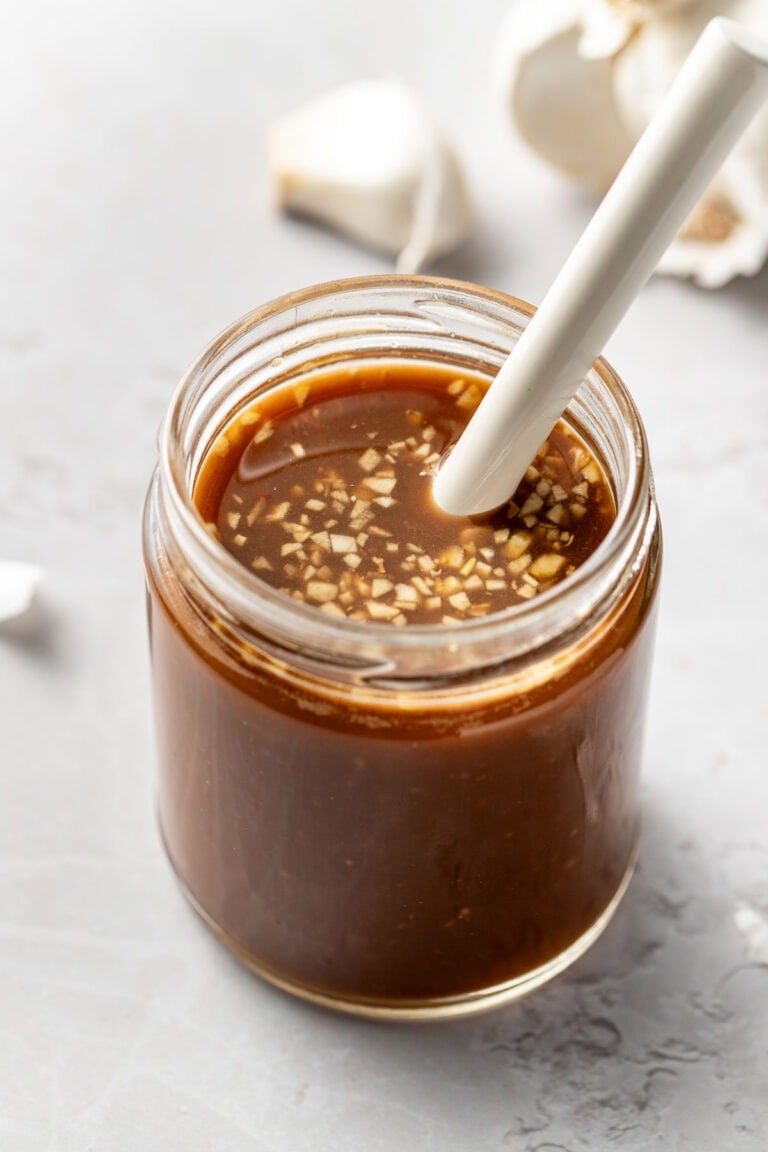
Overhead view of a glass jar of Stir Fry Sauce with a whisk in the jar.Learn how to make this sweet and savory stir fry sauce in minutes. Perfect for steak, beef, chicken, pork, seafood, or veggie stir fries, and easy to prep ahead for healthy weeknight dinners.