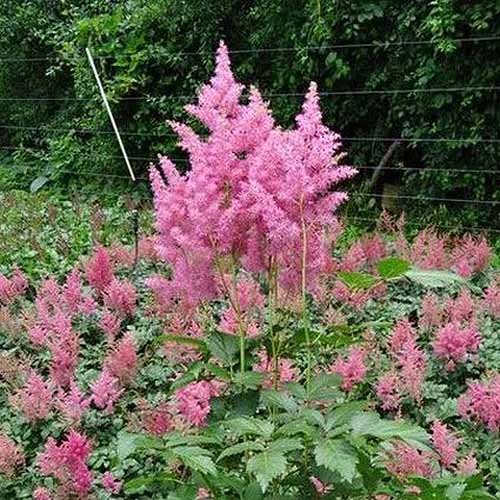
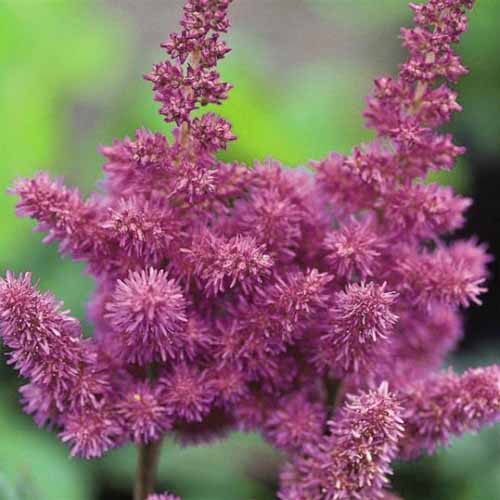
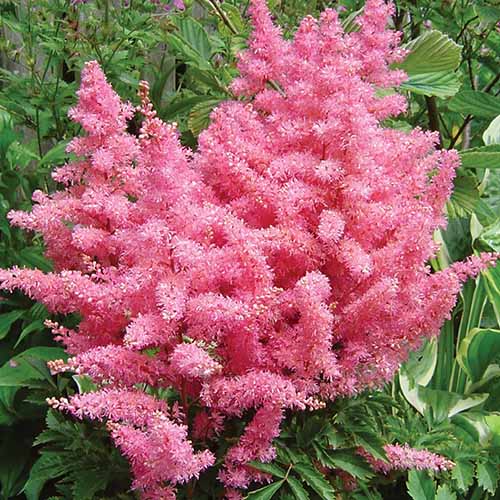
A. chinensis ‘Maggie Daley’ is best known for its bright purple clusters of flowers that appear atop bright green foliage.
It’s a late-flowering variety, producing flowers toward the middle to end of summer. It grows to about 28 inches tall and 20 inches wide.
Photo by David J. Stang, Wikimedia Commons, via CC BY-SA.
It is hardy in Zones 4 to 9 and is best grown in full to partial shade.
Although all types of astilbe varieties are known for their ability to attract butterflies and other pollinators, this variety has one of the best reputations for doing so.
7. Peach Blossom
If you are looking for early season bloomers, Japanese hybrids, A. x japonica, should suit you nicely.
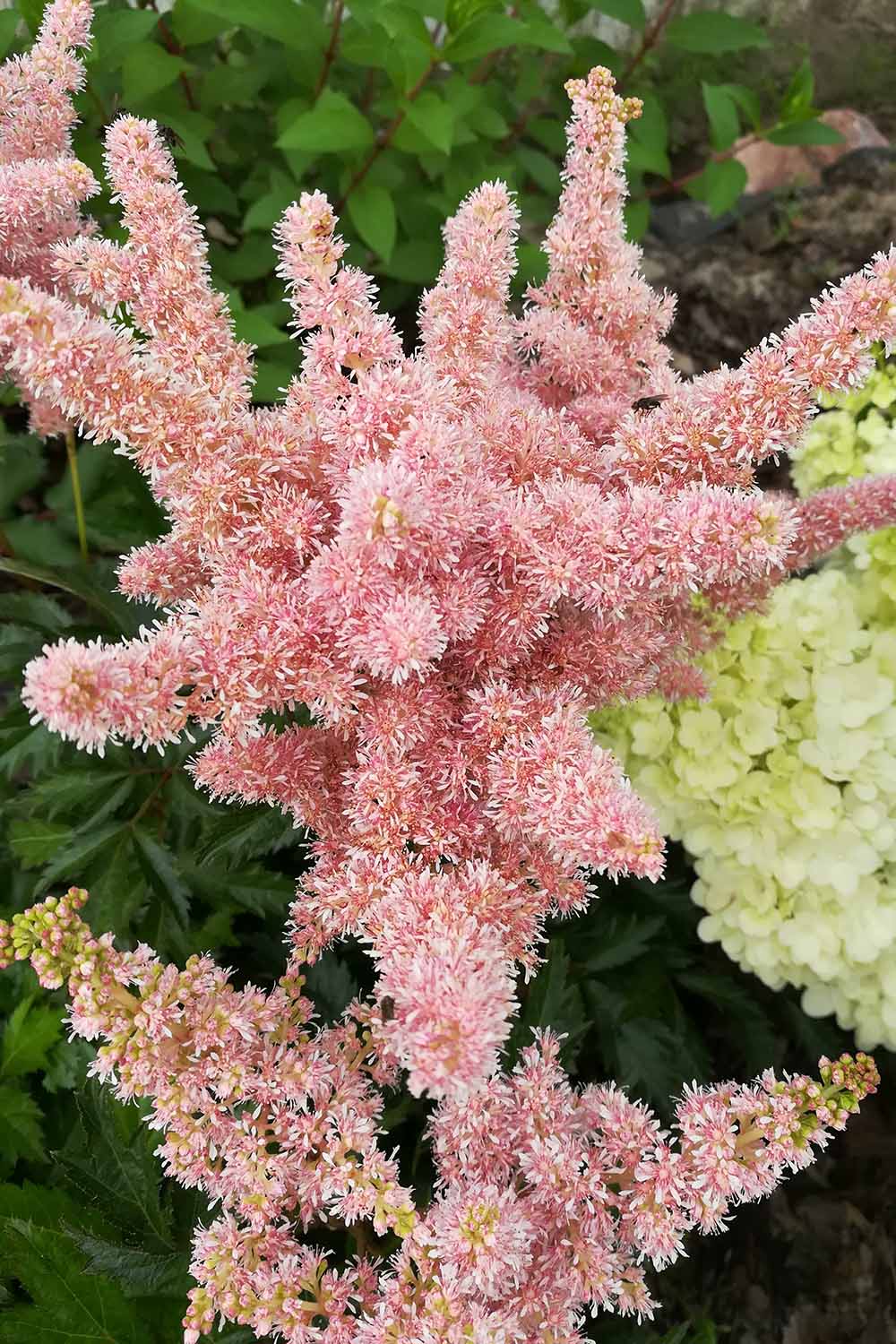
There’s nothing quite as charming as a peach blossom, and this cultivar truly lives up to its name.
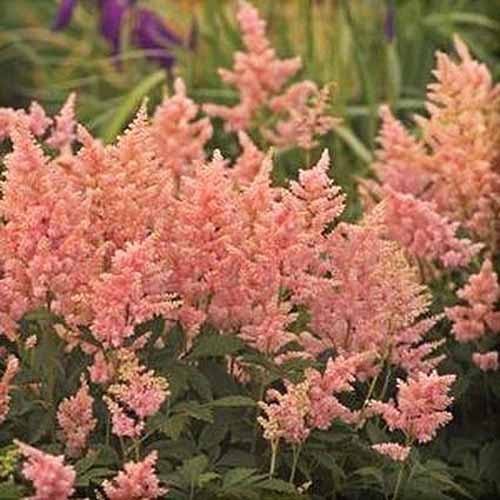
A graceful clumping perennial, ‘Peach Blossom’ produces elegant plumes of pale pink flowers in the spring and early summer months.
With glossy green divided foliage, this cultivar can be grown in full sun or partial shade.
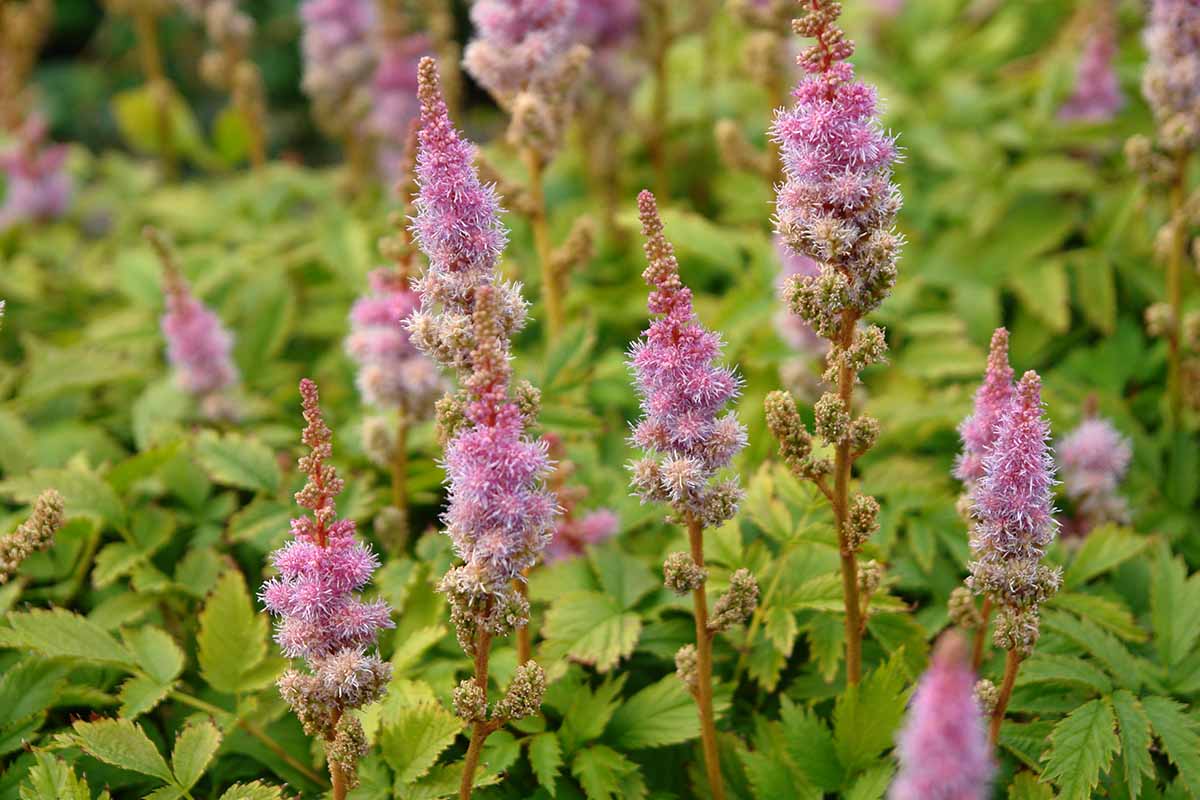
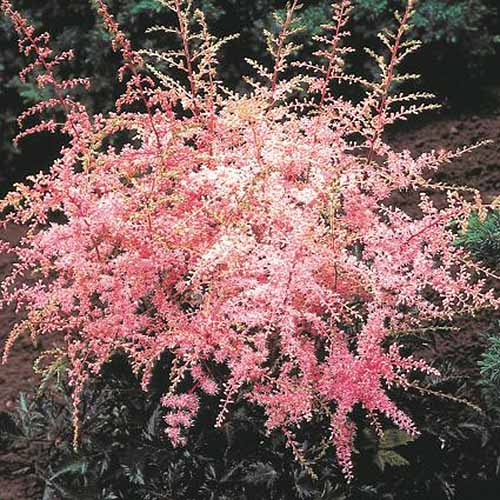
A. chinensis var. pumila is sure to brighten up your garden in late summer. A dwarf variety, it is aptly named, since pumila means “small” in Latin.
This variety produces elegant, slender clusters of pink or purple flowers and fine fern-like foliage.
Only reaching mature heights of about eight to 12 inches tall and 12 to 16 inches wide, this cultivar won an Award of Garden Merit from the Royal Horticultural Society in 1993.
It is hardy in Zones 4 to 9 and can be planted in full sun if you live in an area with cool summer temperatures.
9. Red Sentinel
A. x japonica ‘Red Sentinel’ makes a serious impact when grown among other perennial plants.
It offers eye-catching clusters of bright scarlet flowers that appear as early as the beginning of summer in lacy plumes.
It grows in 18-inch-wide clumps that reach mature heights of more than two feet tall.
This cultivar grows best in full shade to partial sun. It is a marvelous flower to choose if you are interested in cut flowers to enjoy in a vase indoors.
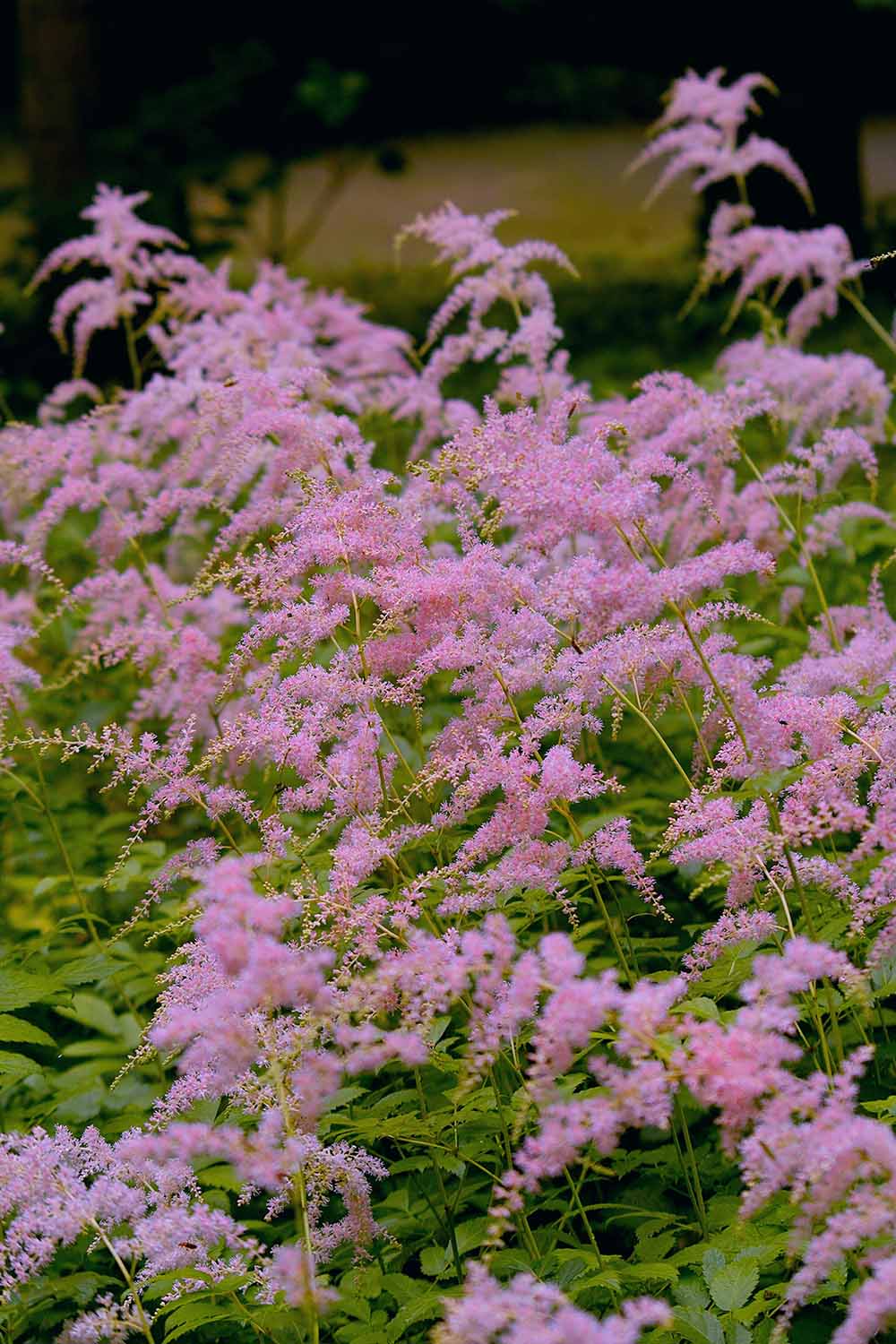
A showy, elegant perennial for shady environments in Zones 4 to 8 or perhaps even Zone 9, A. x arendsii ‘Rheinland’ has feathery pink blossoms and mounds of dark green foliage that give it a light, fairytale-like quality.
A. simplicifolia ‘Sprite’ is another cultivar that received an Award of Garden Merit from the RHS in 1993. It produces lovely flowers in coral pink.
This is a dwarf type with tiny, delicate blooms. As you might guess from the plant’s name, this hybrid only reaches about two feet or so in both height and width at maturity.
A. x arendsii ‘Sister Theresa’ is a fast-growing variety that is suitable for cultivation in Zones 3 to 9.
This cultivar grows from 20 to 24 inches tall and spreads just as wide, blooming early in the summer.
‘Sister Theresa’ is best known for her cotton-candy colored plumes and fine, dark-green foliage.
13. Straussenfeder
Also known as ‘Ostrich Feather,’ this A. thunbergii cultivar has coral plumes of flowers that bloom in June and July.
Most plants grow to about three feet tall and just one or two feet wide at maturity, with lovely dark green, mounded foliage. You may find that new foliage is tinged with bronze.
This cultivar is hardy in Zones 4 to 9.
14. Visions
A. chinensis ‘Visions’ is a feathery variety that produces blooms in shades of raspberry pink.
It has bronze-green glossy foliage that contrasts nicely with its warmer blossoms. It grows to about 10 inches tall and wide.
Like most Chinese astilbes, this variety is more tolerant of dry soil than some, but growers should still avoid allowing it to dry out as a rule.
It also produces fragrant flowers, something that is not found with all varieties of astilbe. The flower spikes usually appear in midsummer when grown in Zones 3 to 8.
Younique™ is a newer series of astilbe plants that can be found with blossoms in numerous colors, including red, white, and pink, as well as cerise, lilac, salmon, silvery pink, and carmine.
Best grown in clusters with other shade-loving plants like ferns, heucheras, and hellebores, Younique™ offers color from the spring to the end of summer.
Hardy in Zones 4 to 9, plants in this series grow to a mature height of around 16 to 20 inches with a spread of about 14 to 18 inches.
The flowers also look wonderful when cut for bouquets or dried arrangements.
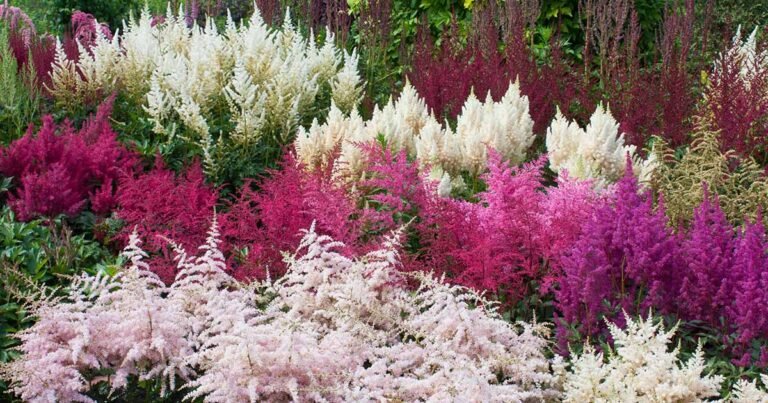
Astilbe is an extraordinary flowering plant, available in a variety of shapes, sizes, and colors – and you’re sure to find one that fits your gardening needs.
Are you growing astilbe? What’s your favorite variety? Let us know in the comments section below, and feel free to share a picture!
Price: $29.00 (as of Jul 05, 2026 15:43:09 UTC – Details)
Product description
Stocking Stuffer That Delivers Joy
Patchology Cozy Comforts Holiday Skincare Gift Set is the ideal stocking stuffer for anyone who loves a little cozy self-care. This soothing bundle delivers instant hydration and calm with barrier-boosting sheet masks, cooling eye gels, and a milky facial mist—making it easy to treat dry winter skin at home or on the go. Thoughtfully packaged for gifting, it’s a delightful way to share comfort, softness, and a glow that lasts all season.
Visibly Calms Redness
Let your skin feel soothed and balanced with our calming blend of ectoin and probiotics, designed to gently comfort redness and restore harmony. Experience a sense of relief and confidence, even on the most demanding days, and bring the spa right inside your home.
Hydrates & Strengthens
Wrap your skin in lasting moisture and support with our ceramide-rich formula, helping to lock in hydration and reinforce your skin’s natural barrier. Stay soft, supple, and resilient all season long, with comfort that feels like a cozy hug for your complexion.
Restores Bounce
Revive and replenish your skin’s natural bounce with our hydrating trio, formulated to deeply nourish and refresh. Enjoy a complexion that feels plump, supple, and ready for anything, with results that’ll have you stocking up (and sneaking into stockings) this season.
Fragrance Free
Our gentle, fragrance-free formula is made for sensitive skin, delivering pure hydration and care without irritation. Treat yourself and the ones you love to comfort that feels as good as it looks, with a soothing touch that’s perfect for every skin type.
The Ideal Holiday Gift Set
Wrap up the season with the Patchology Cozy Comforts Kit, featuring soothing eye gels, barrier-boosting sheet masks, and a calming milky mist for deep hydration and comfort. Specifically designed to pamper stressed, winter-weary skin, this trio floods your complexion with moisture and calms irritation in just minutes—making it an essential for holiday gifting, at-home self-care days, or travel-ready prep.
Powerful Skincare Ingredients
Restore resilience to dry or sensitive winter skin with a potent blend of ectoin, probiotics, ceramides, and botanicals in the Cozy Comforts Kit. Each ingredient works to calm redness, boost skin barrier health, soothe puffiness, and deliver lasting hydration—so you can hop into the new year feeling like a brand new you.
Upgrade Holiday Gifting
Upgrade gifting this season with Patchology Holiday Kits—curated collections designed to bring self-love to you and thoughtful gifts to the ones you love. Whether choosing the perfect stocking stuffer picks, or treating yourself this season, these skincare kits combine must-have skincare essentials into one beautifully packaged set. From cozy comforts to lasting hydration, each kit delivers a special spa-like experience, turning every gift (or goodie for you) into care and not clutter.
Add to Cart
Add to Cart
Add to Cart
Customer Reviews
4.0 out of 5 stars 37
4.7 out of 5 stars 34
4.3 out of 5 stars 57
Price
$15.00$15.00 $6.18$6.18 $9.58$9.58
Type
no data
no data
no data
Primary Benefit
no data
no data
no data
Ideal For
no data
no data
no data
Uses
no data
no data
no data
Application Time
no data
no data
no data
Package Dimensions : 8.03 x 4.49 x 2.2 inches; 7.83 ounces UPC : 818262027822 Manufacturer : Rare Beauty Brands ASIN : B0FSSVKWTZ Best Sellers Rank: #509,823 in Beauty & Personal Care (See Top 100 in Beauty & Personal Care) #1,763 in Bath & Shower Sets #12,313 in Bath & Bathing Accessories Customer Reviews: 5.0 5.0 out of 5 stars (6) var dpAcrHasRegisteredArcLinkClickAction; P.when(‘A’, ‘ready’).execute(function(A) { if (dpAcrHasRegisteredArcLinkClickAction !== true) { dpAcrHasRegisteredArcLinkClickAction = true; A.declarative( ‘acrLink-click-metrics’, ‘click’, { “allowLinkDefault”: true }, function (event) { if (window.ue) { ue.count(“acrLinkClickCount”, (ue.count(“acrLinkClickCount”) || 0) + 1); } } ); } }); P.when(‘A’, ‘cf’).execute(function(A) { A.declarative(‘acrStarsLink-click-metrics’, ‘click’, { “allowLinkDefault” : true }, function(event){ if(window.ue) { ue.count(“acrStarsLinkWithPopoverClickCount”, (ue.count(“acrStarsLinkWithPopoverClickCount”) || 0) + 1); } }); }); BE A WISE SHOPPER: Patchology makes holiday shopping a breeze! Our kits are ready to gift, easy to love, and perfect for last-minute surprises. Give joy and glow without the chaos—smarter shopping that lets you enjoy the season stress-free. COZY COMFORTS AWAIT: This winter trio wraps your skin in soothing care with hydrating under-eye gels, nourishing sheet masks, and calming mist. It’s a cozy seasonal hug that refreshes and comforts skin for a radiant, well-rested look all winter long. DEEP HYDRATION POWER: Enriched with ceramides, ectoin, and probiotics, this kit delivers a powerhouse of moisture and barrier support. It’s designed to nurture and protect winter-stressed skin, leaving your complexion feeling soft, supple, and cared for. MINI-SPA WHEREVER YOU GO: Perfect for travel, home spa days, or those hectic mid-week evenings. This compact, effective set ensures your skin stays hydrated, balanced, and ready to face the world—no matter where the holidays take you. SIMPLE & EFFECTIVE SELF-CARE: In just 5 to 20 minutes, this kit hydrates, soothes, and pampers your skin with no fuss. It’s the perfect little holiday ritual to help busy you find moments of calm, rest, and renewed glow throughout the season.
Price: $39.99 (as of Jul 05, 2026 03:41:26 UTC – Details)
Dickies Medical Nurse Scrubs | Advanced Fabric and Features Hospital scrubs enter a new era of style and sport performance with Dickies Dynamix. This short sleeve V-Neck top mixes elevated functionality with our favorite athletic features. Light polyester/spandex fabric blend and textured dobby construction was inspired by sports apparel. Matching rib-knit neckband is comfortable and sporty looking. Bungee ID loop on right side of neckline. Welt chest pocket and sleeve pocket for storage. Sleeve pocket includes zipper closure to keep small items secure. Back yokes for style, fit and shaping. Side vents. Coverstitch detail throughout garment provides extra athletic appeal. Discrete tonal logo heat transfer on left sleeve. Heat transfer neck label for comfort. Tired of the same old nurse shirt? Try our Dickies Dynamix V-Neck mens scrub tops with chest pocket for a polished and professional look. This V-Neck is just what you’re looking for: Perfect for doctors, physician assistants, nurses, radiology techs and physical therapists. For scrubs men will wear again and again, shop the entire Dickies Dynamix collection. Dickies Dynamix: Inspired by sport, designed for the way you work. Men’s fit. Moisture wicking finish moves moisture away from the body to keep you comfortable through a long work shift. Wrinkle resistant. Body: 91% polyester / 9% spandex textured dobby Rib-knit trim: 96% polyester / 4% spandex Center back length (size M): 29″ Item model number : DK610 Department : mens Date First Available : August 1, 2017 Manufacturer : Dickies ASIN : B0CJ3FDZM9 Product Warranty: For warranty information about this product, please click here Best Sellers Rank: #61,893 in Clothing, Shoes & Jewelry (See Top 100 in Clothing, Shoes & Jewelry) #19 in Men’s Medical Scrub Shirts Customer Reviews: 4.6 4.6 out of 5 stars (3,500) var dpAcrHasRegisteredArcLinkClickAction; P.when(‘A’, ‘ready’).execute(function(A) { if (dpAcrHasRegisteredArcLinkClickAction !== true) { dpAcrHasRegisteredArcLinkClickAction = true; A.declarative( ‘acrLink-click-metrics’, ‘click’, { “allowLinkDefault”: true }, function (event) { if (window.ue) { ue.count(“acrLinkClickCount”, (ue.count(“acrLinkClickCount”) || 0) + 1); } } ); } }); P.when(‘A’, ‘cf’).execute(function(A) { A.declarative(‘acrStarsLink-click-metrics’, ‘click’, { “allowLinkDefault” : true }, function(event){ if(window.ue) { ue.count(“acrStarsLinkWithPopoverClickCount”, (ue.count(“acrStarsLinkWithPopoverClickCount”) || 0) + 1); } }); });
Last week I shared some photos from the trip I took to White Sands National Park this spring (GPOD on the Road: Spring at White Sands National Park), and encouraged you all to share photos of flowers you have found out in the wild this year. Little did I know, Gail Bromer in Black Mountain, North Carolina had already beat me to the chase. We already saw Gail’s incredible collection of daylilies this week (Gail’s Daylilies in North Carolina), and those photos made me initially miss her submission of wildflower photos from her trip to Rocky Mountain National Park in Colorado. This large national park has many iconic landmarks, but one trail—the Tundra Communities Trail—offered stunning views and a feast of fabulous wildflowers for plant lovers to enjoy. Located at high elevation and above the treeline, this is another extreme climate for these flowers to endure, but it is the exact conditions they need to grow.
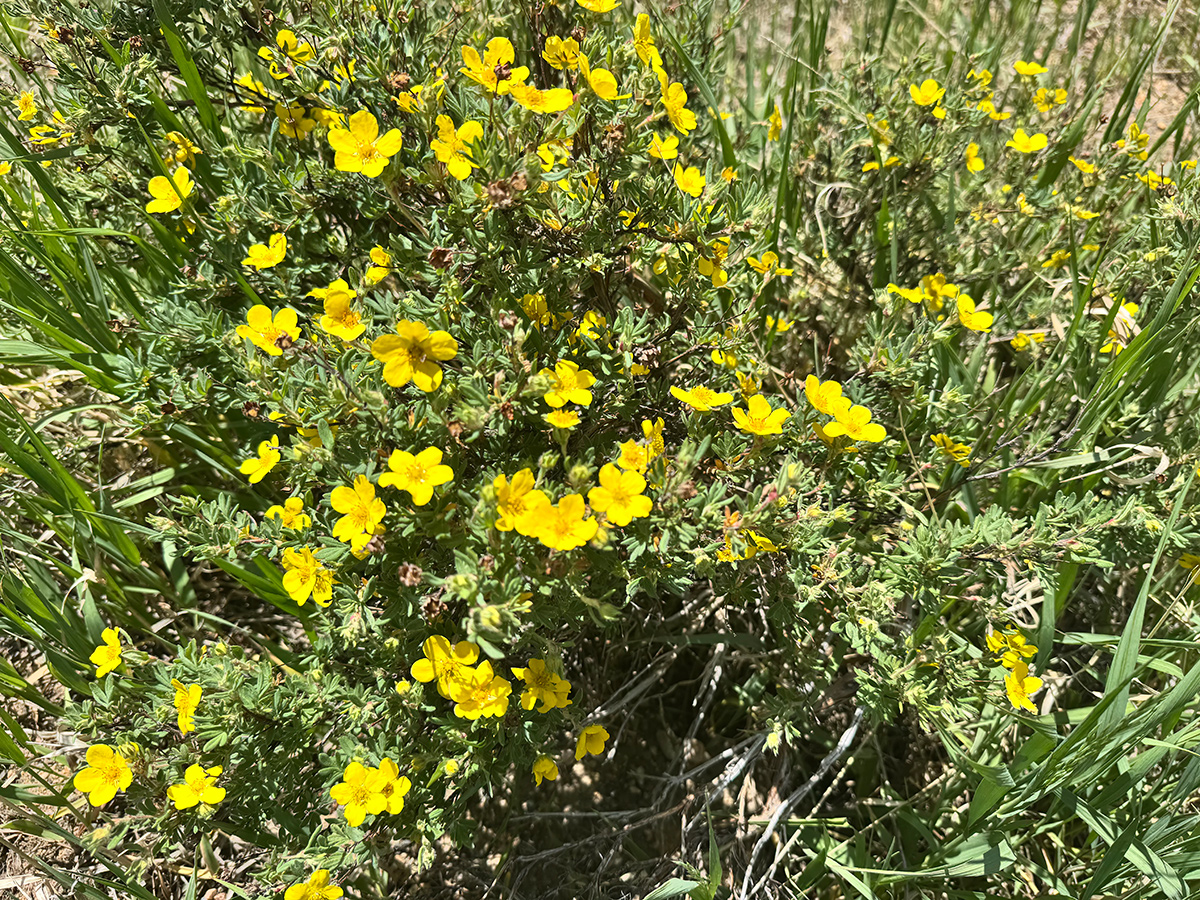
While it would be easy to assume that the flowers that grow in this extreme environment are unlike anything we grow at our homes, the majority of these plants are relatives to common garden plants we love. This shrubby cinquefoil (Dasiphora fruticosa, Zones 2–7) is a perfect example, showing off its familial resemblance to the cinquefoil shrubs and perennials that are enjoyed in gardens across North America.
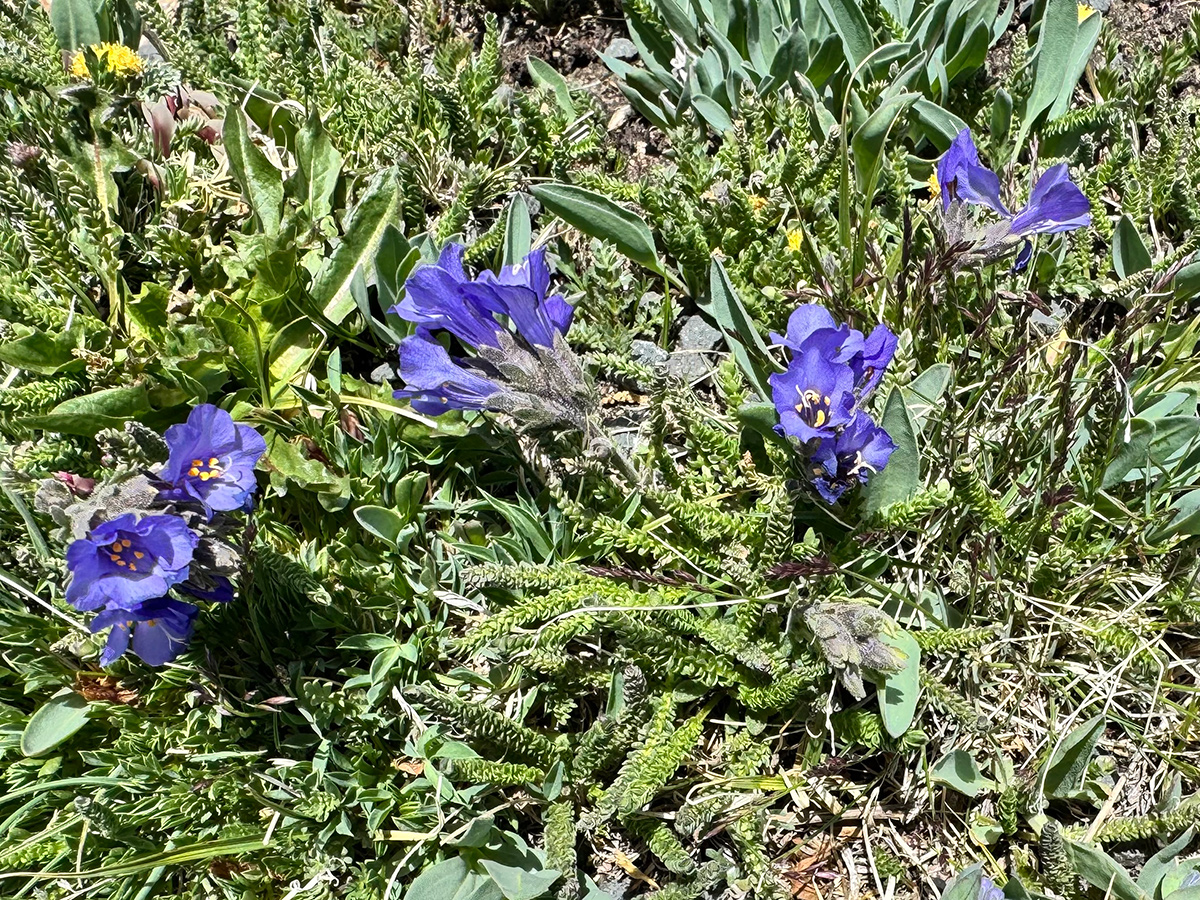
Most of the flower forms on these plants are consistent with their non-alpine relatives, it is the growing habit that evolves to the harsh landscape. Sticky polemonium (Polemonium viscosum, Zones 3–8) has flowers very similar to its relative, Jacob’s ladder (Polemonium caeruleum, Zones 4–8), but grows only 6 inches tall to protect itself from strong wings and has succulent-like leaves that help retain water.
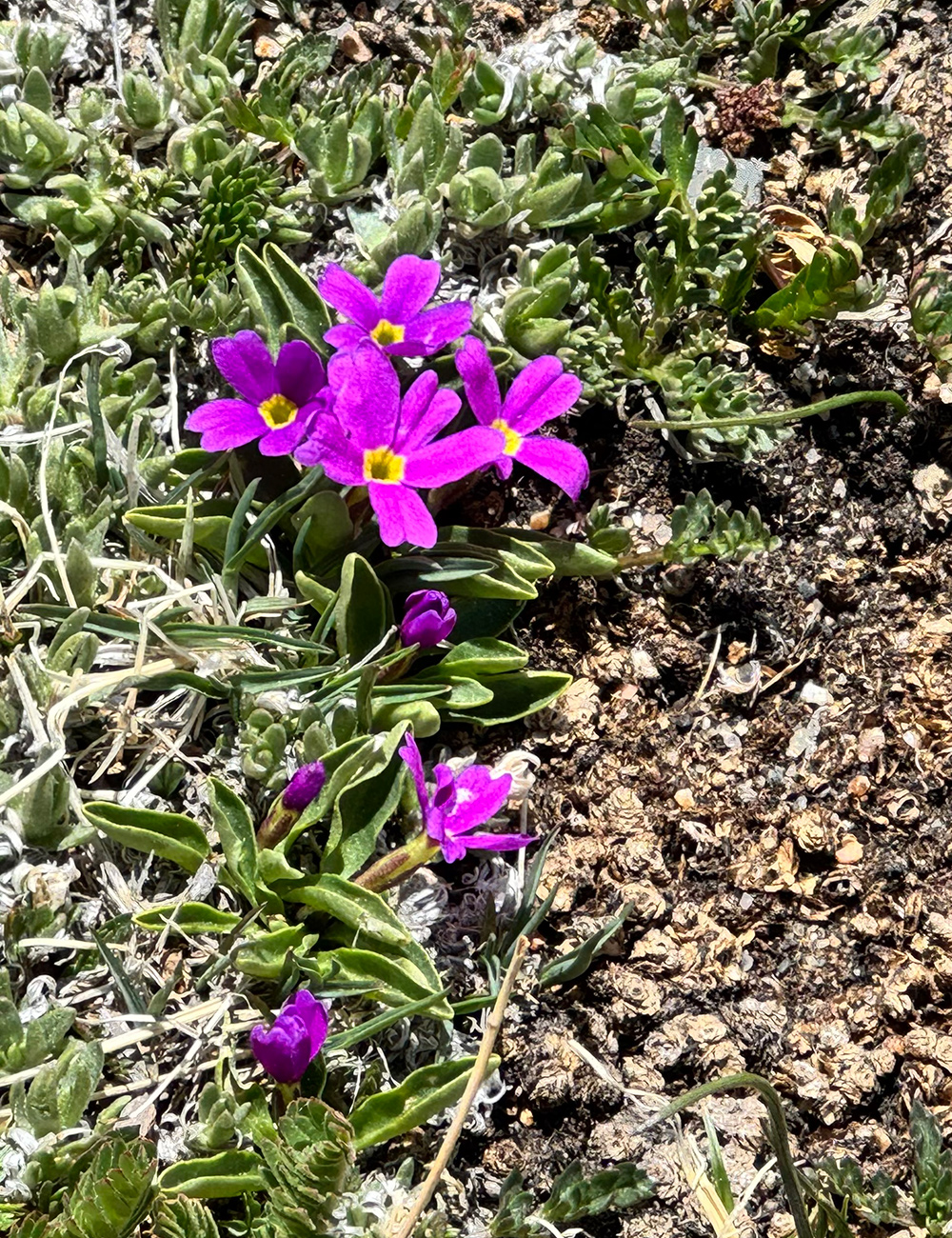
There are several species of primroses that are native to North America, but this special little guy can only be found in Colorado and northern New Mexico: the alpine primrose (Primula angustifolia, Zones 3–7). The bright magenta flowers could easily be mistaken for Parry’s primrose (Primula parryi, Zones 4–8), which grows from the subalpine zone to alpine tundra in the Rocky Mountains, but its short stature indicates its true identity.
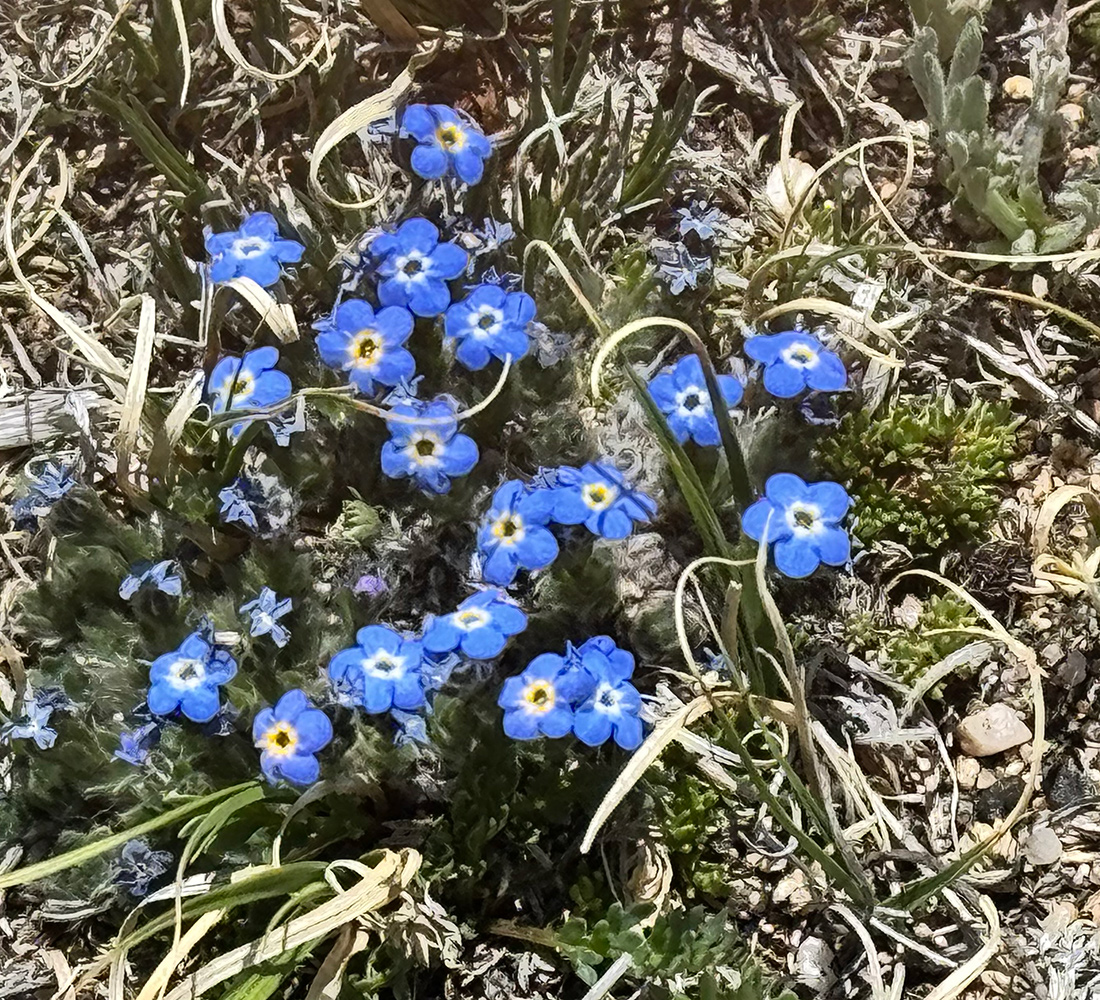
Woodland forget-me-not (Myosotis sylvatica, Zones 2–8) is an invasive in much of North America, making it onto some states’ restricted plant lists. However, there are a few forget-me-nots that are native to North America, including the alpine forget-me-not (Eritrichium nanum, Zones 2–8).
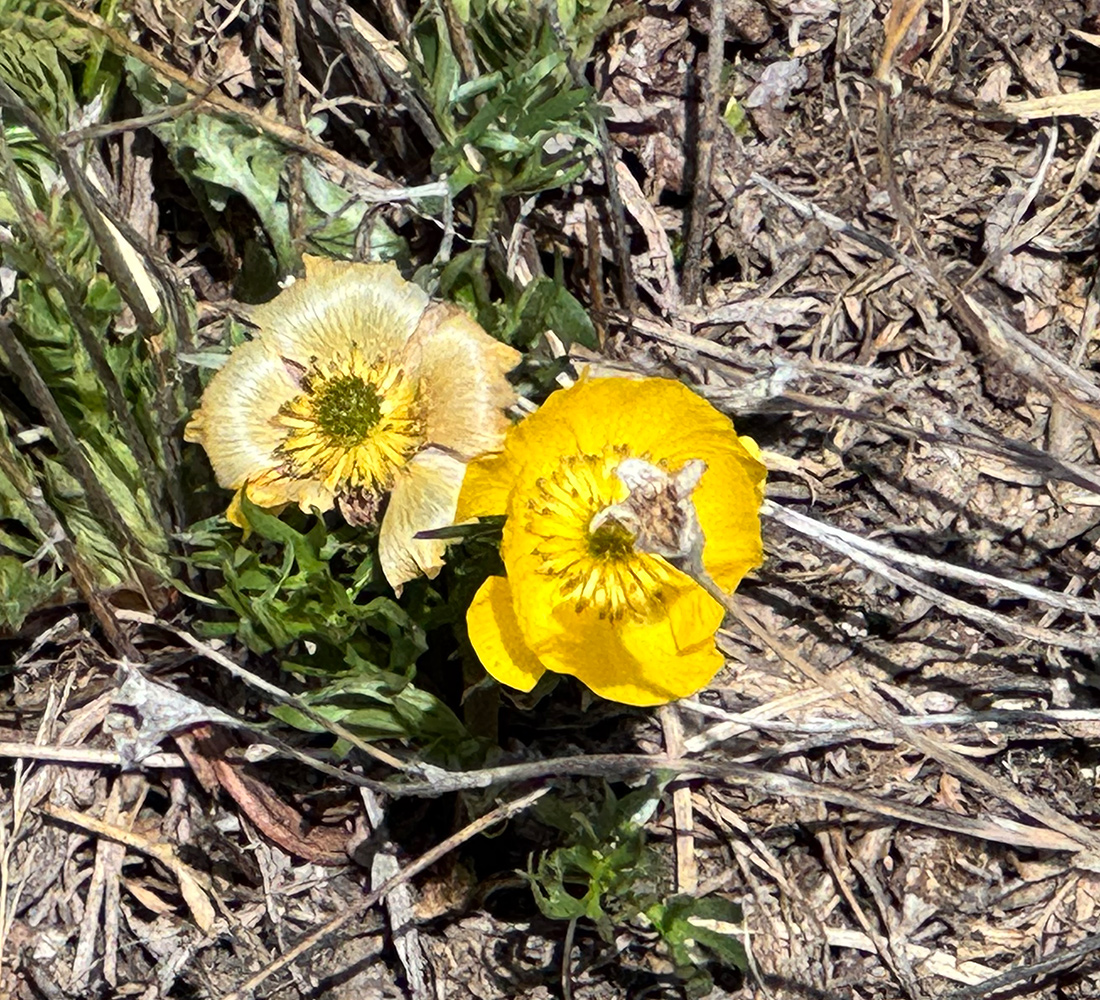
Buttercups are known for their full blooms that make wonderful cut flowers, but the simple blooms of alpine buttercups (Ranunculus adoneus, Zones 2–5) are just as eye-catching in bright yellow—and much more appreciated by pollinators.
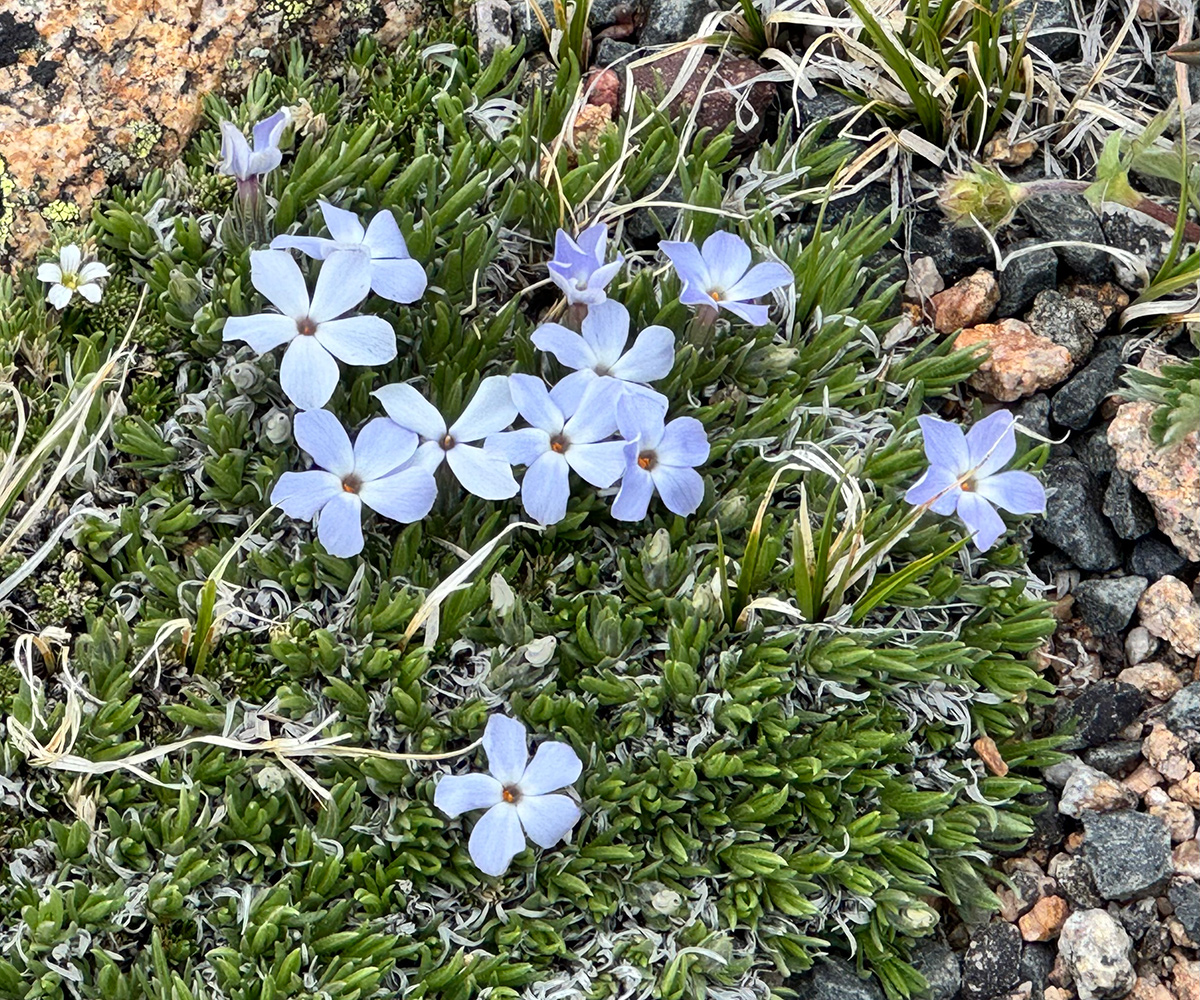
Creeping phlox (Phlox stolonifera, Zones 3–9) is popular in many spring gardens for the carpet of bright blooms it creates, but there is another ground cover phlox that is native to North America: spreading phlox (Phlox diffusa, Zones 3–8). Creeping phlox is native to central and eastern North America and spreading phlox call the western part of the continent home, but both can be grown in many types of habitats.
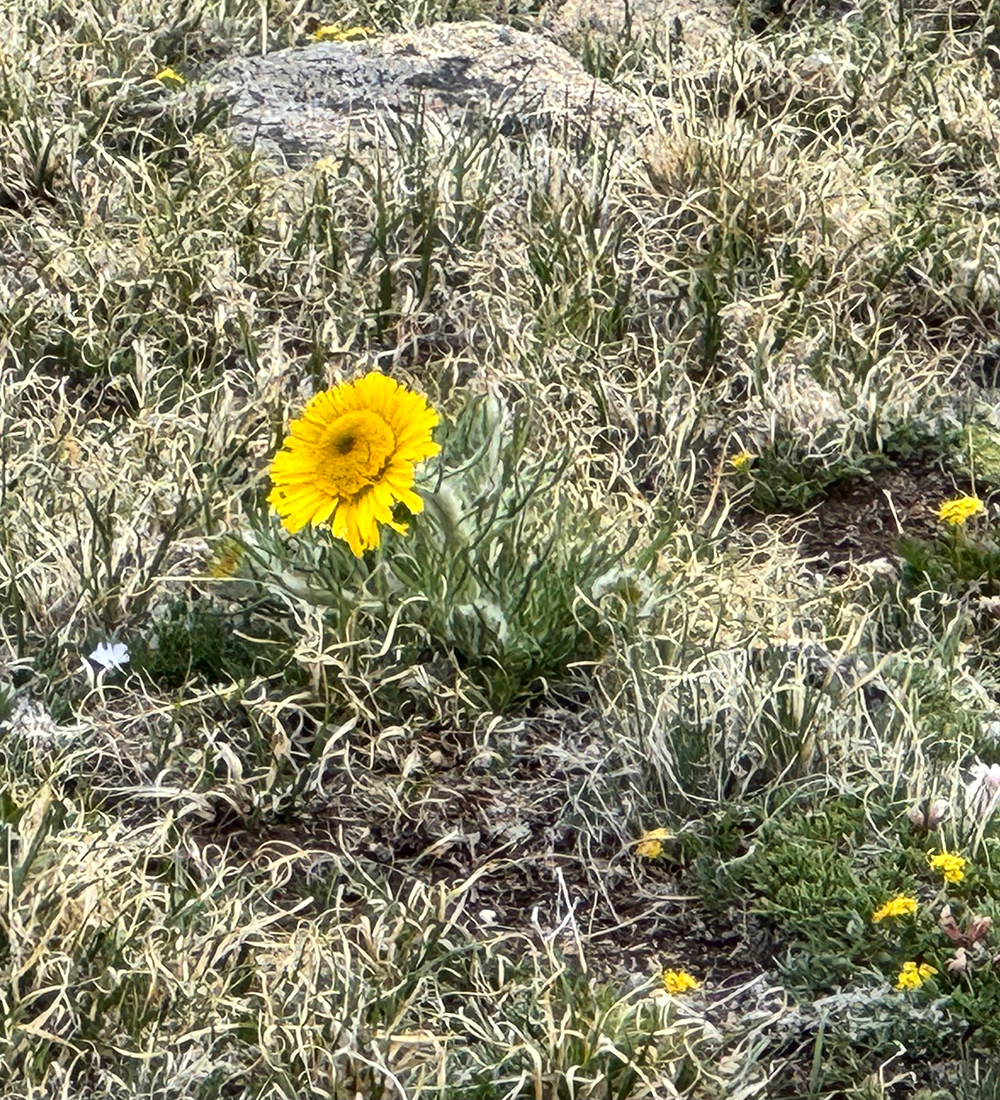
Old-man-of-the-mountain (Tetraneuris grandiflora, Zones 3–8) is a very silly name for this cheerful plant in the sunflower family. Also known as the alpine sunflower, the other common name comes from the white hairs that cover the plant’s stem, which you can faintly see in this photo.
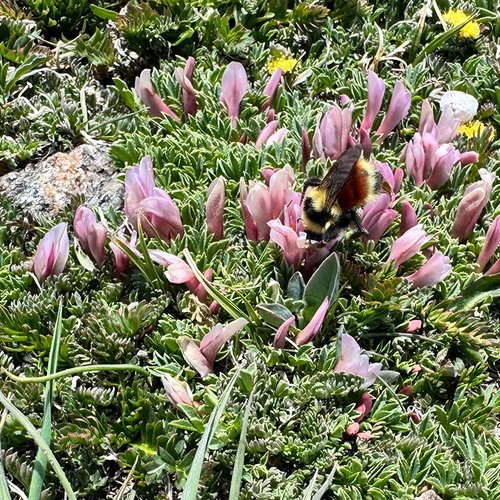
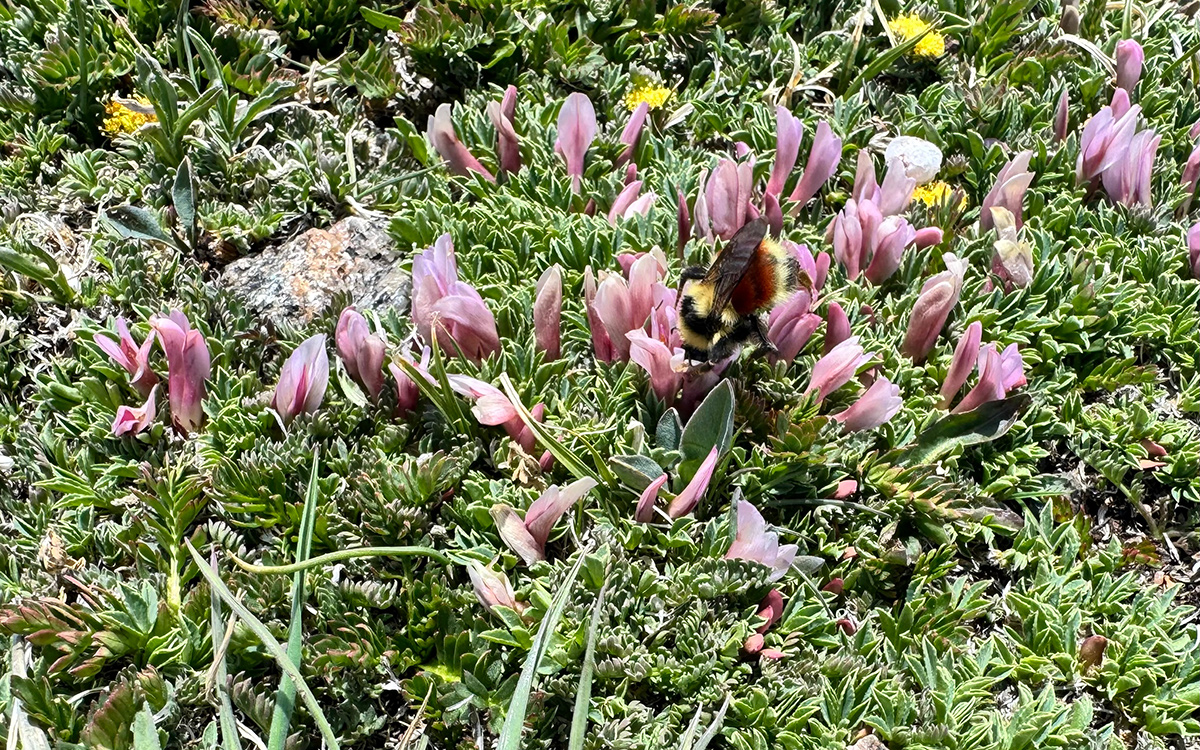
Gail clearly had a keen eye for these diminutive plants, as many other hikers surely walked right past these small pops of color. Growing up to only 2 inches tall, it’s easy to miss dwarf clover (Trifolium nanum, Zones 2–7), but those sweet pink petals are worth getting a closer look at.
The flowers all grew along this path.
Thank you so much for sharing these wonderful wildflower photos with us, Gail! You introduced us to some really interesting alpine plants as well as an incredible spot to go flower finding.
Have you spotted any wildflowers during travels or daily walks this year? Let us know in the comments where you like to do some flower finding, or consider sharing your wildflower photos with the blog. Follow the directions below to submit your photos to Garden Photo of the Day!
We want to see YOUR garden!
Have photos to share? We’d love to see your garden, a particular collection of plants you love, or a wonderful garden you had the chance to visit!
You can also send 5–10 photos to [email protected] along with some information about the plants in the pictures and where you took the photos. We’d love to hear where you are located, how long you’ve been gardening, successes you are proud of, failures you learned from, hopes for the future, favorite plants, or funny stories from your garden.
Do you receive the GPOD by email yet? Sign up here
Fine Gardening Recommended Products
Johnny’s Selected Seeds Connecta® Cultivation Kit
Fine Gardening receives a commission for items purchased through links on this site, including Amazon Associates and other affiliate advertising programs.
Choose the right tool head for the job and switch out quickly with a simple push-button release. Includes the Connecta receiver, Connecta Collinear 4 head, Connecta Collinear 7 head, Connecta Contour Wire 4 head, Connecta Contour Wire 6 head, a sustainably harvested oiled ashwood handle, and a stainless-steel carrying clip.
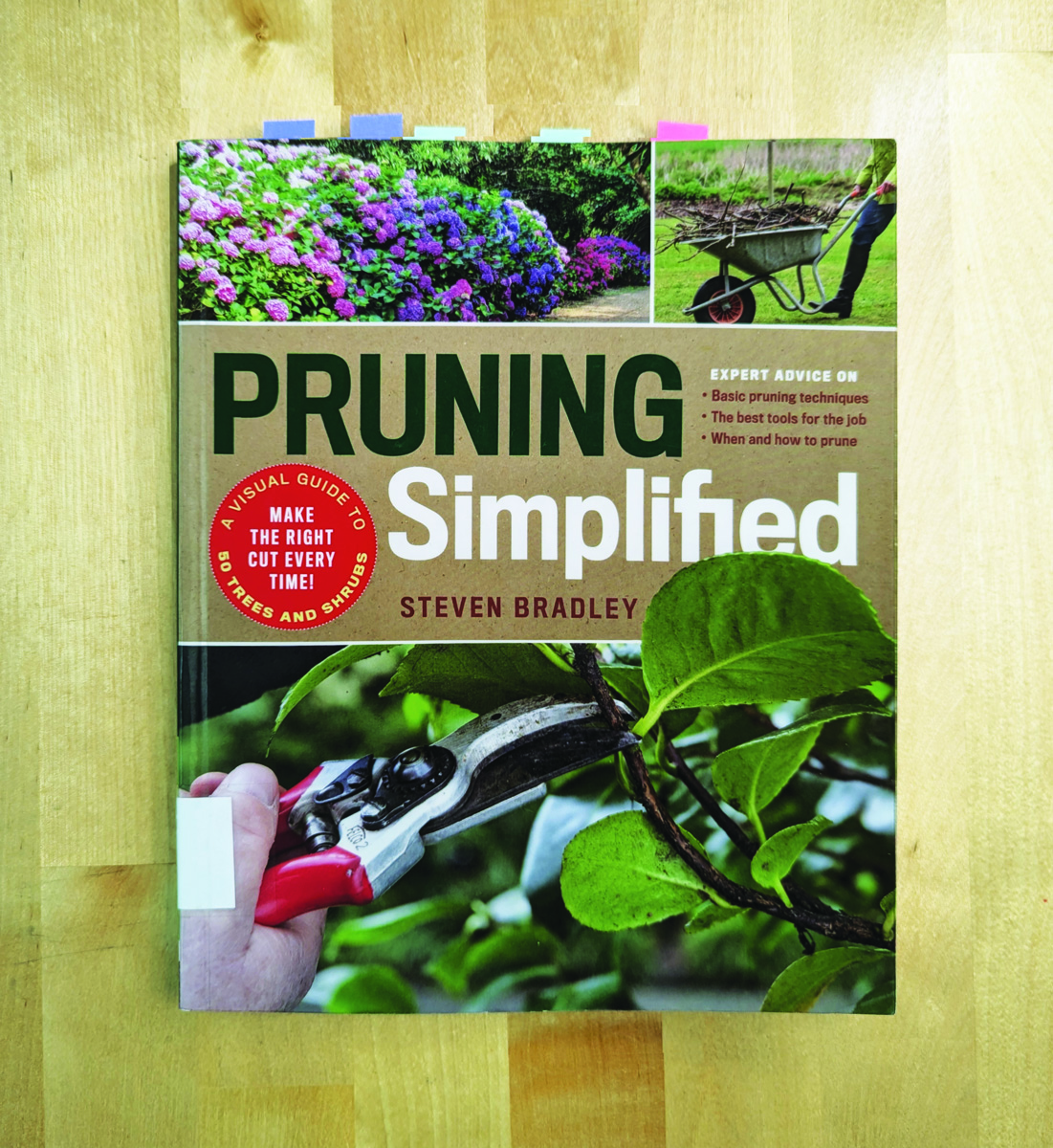
Pruning Simplified: A Step-by-Step Guide to 50 Popular Trees and Shrubs
Fine Gardening receives a commission for items purchased through links on this site, including Amazon Associates and other affiliate advertising programs.
Pruning Simplified shows you exactly how to do it. This must-have guide offers expert advice on the best tools for the job, specific details on when to prune, and clear instructions on how to prune. Profiles of the 50 most popular trees and shrubs—including azaleas, camellias, clematis, hydrangeas, and more—include illustrated, easy-to-follow instructions that will ensure you make the right cut the first time.
Lee Valley Garden Knife
Fine Gardening receives a commission for items purchased through links on this site, including Amazon Associates and other affiliate advertising programs.
These knives have a trowel-like blade with a sharp edge to let you use the same tool for digging, planting and cutting. The blade is sharpened on both sides, with serrations on one edge to help with cutting tough roots or dividing perennials. Deeply stamped markings on the blade (in 1/2″ and 5mm increments) help you set the correct planting depth for seeds and bulbs.
Price: $8.00 (as of Jul 04, 2026 15:40:35 UTC – Details)
Christmas Pharmacy Tech Ready to Press Sublimation Transfer, Ready to Use, Pharmacy Technician, Hospital, Pills, Sub Image Ready to Press TRANSFER ONLY —TRANSFER ONLY–TRANSFER ONLY–PLEASE READ BEFORE ORDERING Items required for any of below transfers : Heat Press….A HOUSEHOLD IRON WILL NOT WORK WITH THIS PRODUCT ***SUBLIMATION TRANSFERS*** Sublimation transfers must be used with recommended 65% polyester are higher (higher the polyester count more vibrant colors will appear), some do use with as low as 50% polyester count on white and/or light colored garments. Many designs can be sublimated onto other items (Sublimation blanks–mugs, garden flags, etc. please see a sublimation blank vendor site for other options) Christmas pharmacy technician sublimation transfer Christmas pharmacy tech sublimation transfer Christmas pharmacy sublimation transfer ready to press sublimation transfer pharmacy technician
Most people spend their free time scrolling on their gadgets, but as a gardener, I prefer planting.
As spring, the main gardening season, comes to an end, I find myself wondering how to spend my time. Fortunately, there are plenty of plants I can grow in July and expect to harvest by fall.
Though July might feel too late to start anything new, the warm soil and longer days are actually favorable for a bunch of vegetables.
Choose plants that are heat-loving and fast to mature, so they can settle in quickly and still have enough time to produce before the first frost.
Think of July planting as a reset button.
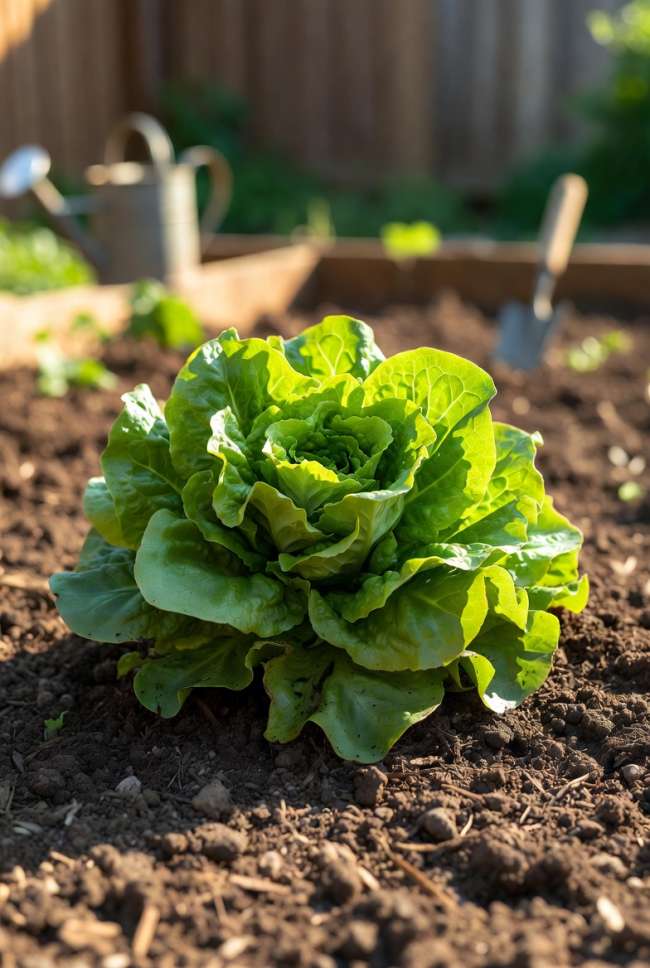
Maybe your lettuce bolted in the June heat, or that empty patch where your peas used to be is just sitting there doing nothing. This is your chance to fill those gaps and put your garden back to work.
The best part is you skip the slow spring wait. Seeds go into warm soil and pop up fast, so you’ll see progress within days.
Is July Too Late to Plant?
Not at all. Warm soil actually speeds up germination, so seeds you plant now can sprout faster than the ones you planted back in spring.
Your real success depends on two things: your first frost date and picking the right plants for this window. Fast-maturing crops have plenty of time to grow and produce before the cold sets in.
Not sure where you stand? Check your USDA Hardiness Zone. It’ll give you a good sense of how much growing time you have left and which plants are worth putting in the ground right now.
29 Vegetables and Flowers You Can Still Plant in July
Vegetables and flowers aren’t just sharing garden space, they’re helping each other out.
Flowers draw in pollinators for better fruit set and pests away, while vegetables return the favor with shade and ground cover that keep the soil cool and moist.
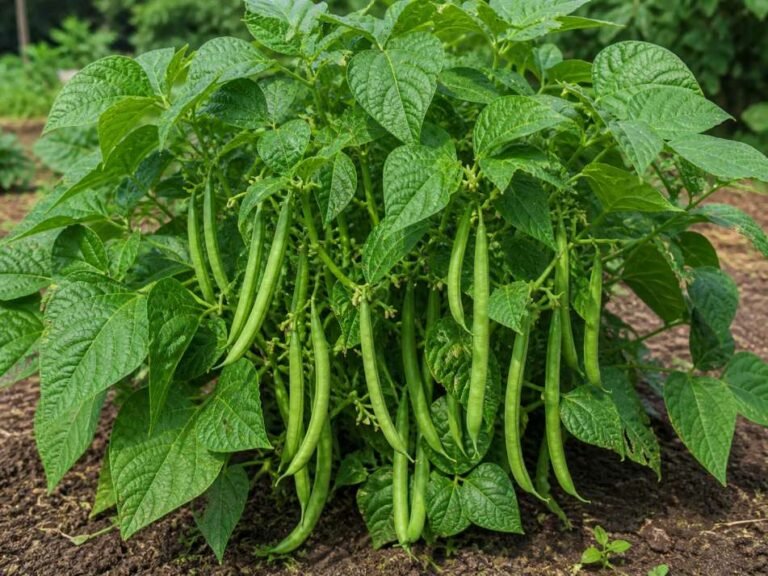
1. Bush Beans
Bush beans love the heat, and July’s warm soil gets them sprouting fast without much fuss. They’re ready to harvest in about 50 to 55 days, so you’ll still have plenty of time before the first frost hits.
For best results, keep the soil consistently moist while the seeds germinate. A light mulch layer helps hold that moisture in during the hottest stretches of summer.
2. Cucumbers
Cucumbers thrive in July’s heat and grow fast once the soil warms up. They’re ready to harvest in about 50 to 65 days, giving you fresh cucumbers well before fall arrives.
Keep the soil evenly watered since cucumbers are mostly water themselves and dry spells can turn them bitter. A trellis also helps keep the vines up off the ground and the fruit cleaner.
Summer squash is one of the fastest producers you can plant in July, often ready to harvest in just 45 to 55 days. The warm soil helps seeds germinate quickly, so you won’t be waiting long to see results.
Give plants plenty of space since they spread out more than you’d expect. Regular watering and a spot with full sun will keep the harvest coming steadily.
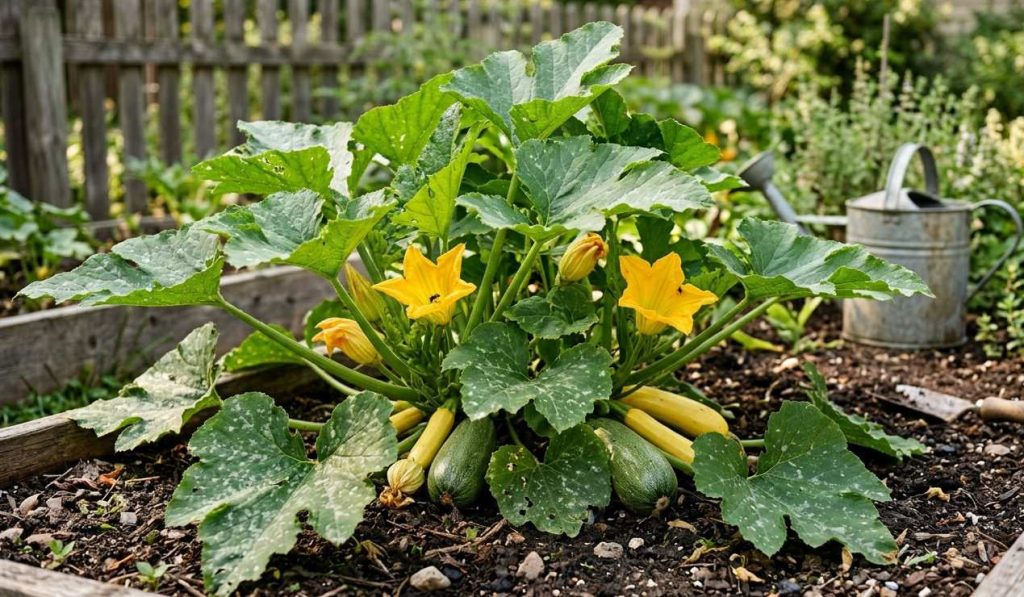
4. Zucchini
Zucchini practically explodes with growth once July heat kicks in, usually ready to harvest in 45 to 55 days. It’s a reliable choice if you want a fast, generous harvest without much hassle.
Check plants every couple of days once they start producing since zucchini can go from perfect to oversized overnight. Consistent watering keeps the fruit from turning bitter.
5. Carrots
Carrots settle in nicely once the summer heat softens and the days start easing toward fall.
Sow them directly in loose, well-draining soil since they don’t handle transplanting well. They typically take 60 to 80 days to mature, and a bit of cooler weather toward harvest actually makes them sweeter.
Keep the soil consistently moist while seeds germinate, since carrot seeds are notoriously slow and picky about drying out.
Beets are a solid double win, giving you both roots and greens from a single planting.
They mature in about 50 to 60 days, making them a great fit for a July start with plenty of time before frost. Thin the seedlings early so the roots have room to bulk up properly.
Water regularly and keep the bed weed-free, since beets don’t compete well with overcrowded neighbors.
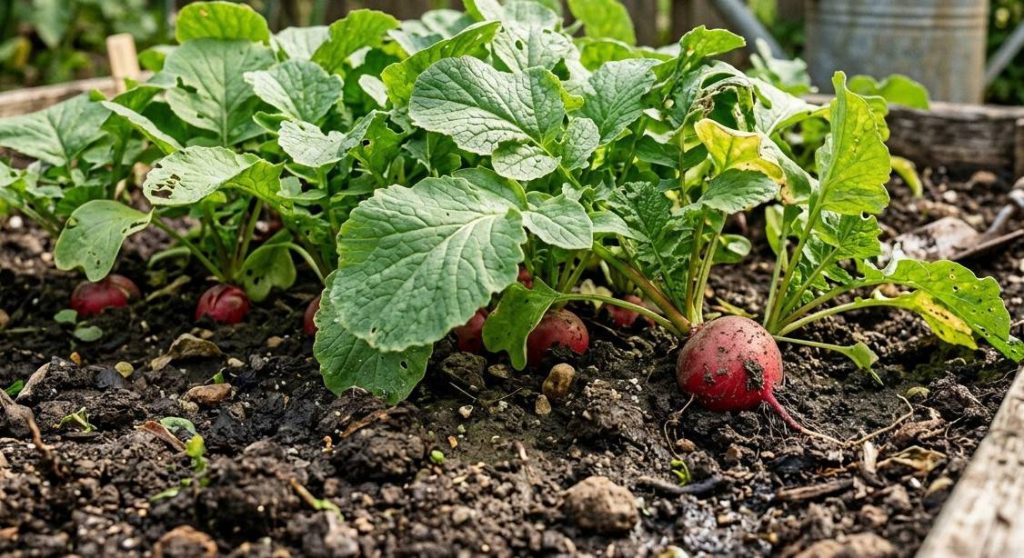
7. Radishes
Radishes are the fastest reward you’ll get from a July planting.
Some varieties are ready in just 3 to 4 weeks, so you can even sneak in a couple of rounds before fall settles in. They prefer cooler soil, so a bit of afternoon shade in peak summer heat helps them along.
Keep the soil moist and harvest promptly once they mature, since radishes turn woody and lose flavor if left too long.
8. Turnips
Turnips are an easy, low-maintenance crop that rewards you with both roots and greens.
They mature in about 50 to 60 days, fitting comfortably into a July planting window. Thin seedlings early to give the roots enough space to develop properly.
Keep the soil evenly moist, and don’t skip harvesting the greens too, since they’re just as tasty as the roots.
9. Kale
Kale actually gets better as the weather cools, making it a smart pick for a July start.
It takes about 50 to 65 days to mature, and a light frost later in the season only sweetens the flavor. Give it consistent watering through the hottest part of summer to keep it from getting bitter.
Space plants out enough for good airflow, which helps keep pests and disease at bay as the leaves fill in.
Swiss chard handles heat better than most leafy greens, which makes it a dependable July pick. It matures in about 50 to 60 days and keeps producing right through fall if you harvest the outer leaves and let the center keep growing.
11. Spinach (late July in cooler areas)
Spinach struggles in full summer heat, so it’s best saved for late July if you’re in a cooler region. Wait for temperatures to start dipping before sowing, and expect a harvest in about 40 to 45 days once the plants get going.
Shade cloth during the first couple of weeks can make a real difference here, since spinach bolts fast in warm soil.
12. Lettuce (heat-tolerant varieties)
Regular lettuce bolts in July heat, but heat-tolerant varieties can still give you a solid harvest. Look for types bred to resist bolting, and expect them ready in about 45 to 55 days.
Planting in a spot with afternoon shade helps a lot, and keeping the soil consistently moist prevents the leaves from turning bitter.
13. Arugula
Arugula grows fast and doesn’t ask for much, ready to harvest in as little as 30 to 40 days. It does best with a bit of afternoon shade during peak summer heat, since too much sun can push it to bolt early and turn the leaves sharp and spicy.
Bok choy is a great pick if you want something quick and low-fuss, maturing in about 45 to 55 days. It prefers consistent moisture and a bit of shade during the hottest part of the day.
For best flavor, harvest before it bolts, especially if a heat wave rolls through mid-growth.
15. Mustard Greens
Mustard greens grow fast and don’t mind a bit of summer heat, ready to harvest in about 30 to 40 days. The leaves get spicier as temperatures rise, so if you prefer a milder flavor, plan to harvest them young.
16. Green Onions
Green onions are practically foolproof for a July planting, ready in about 60 to 70 days. They don’t need much space and can be tucked into gaps between other vegetables without any trouble.
Keep the soil consistently moist, and you can even snip a few early for fresh flavor while the rest keep growing.
17. Cilantro
Cilantro bolts fast in summer heat, so plant it in a spot with afternoon shade to stretch out your harvest window. It’s ready in about 45 to 50 days, though you can start snipping leaves earlier as needed.
18. Dill
Dill handles heat reasonably well and grows quickly, ready to harvest in about 40 to 50 days. Let a few plants flower and go to seed if you want a second round popping up on their own later in the season.
19. Basil
Basil is practically made for July, thriving in the heat and growing fast once the soil warms up. It’s ready to start harvesting in about 30 to 60 days, and regular pinching keeps the plant bushy and productive all summer.
Avoid letting it flower too early, since that shifts the plant’s energy away from producing tender, flavorful leaves.
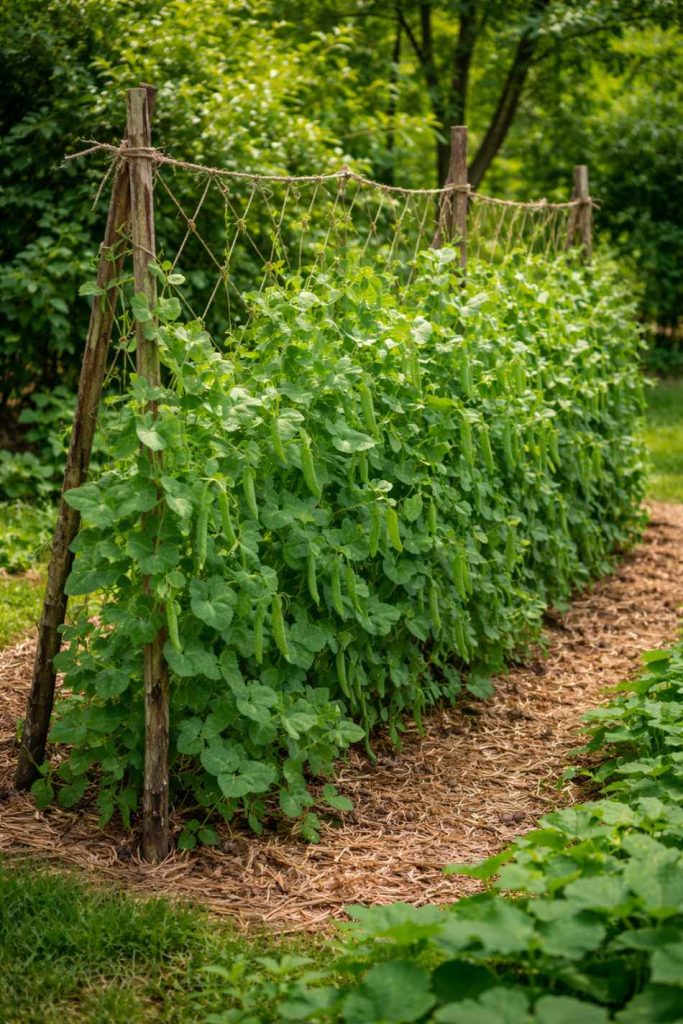
20. Peas (late July in cooler regions)
Peas don’t love summer heat, so late July works best if you’re in a cooler climate looking ahead to a fall crop. They take about 60 to 70 days to mature, and a bit of afternoon shade helps them push through any lingering warm spells.
Flowers You Can Plant in July
July heat doesn’t scare these blooms off, it just gets them growing.
21. Sunflowers
Sunflowers practically thrive on summer heat, pushing up fast once the soil warms. Most varieties bloom in about 60 to 70 days, giving you tall, cheerful color well before fall.
Give them full sun and sturdy support if you’re growing taller varieties, since they can get top-heavy once the blooms open.
22. Zinnias
Zinnias are about as low-maintenance as flowers get, blooming in just 60 to 70 days from seed. They love full sun and keep producing new blooms right up until frost if you deadhead the spent flowers regularly.
23. Cosmos
Cosmos handle heat and neglect better than almost anything else in the garden, blooming in about 50 to 60 days. They actually do better in average soil, so skip the extra fertilizer and let them do their thing.
24. Marigolds
Marigolds are a July favorite for good reason, blooming in just 45 to 50 days with barely any care. They handle heat well and keep flowering steadily through summer into fall.
25. Nasturtiums
Nasturtiums grow fast and bloom in about 35 to 65 days, thriving in poorer soil where other flowers might struggle. They spread easily too, so give them room or let them trail if you want a bit of natural ground cover.
26. Calendula (cooler climates or late July)
Calendula prefers milder temperatures, so it does best in cooler climates or planted late in July as the heat starts to ease. It blooms in about 50 to 55 days once temperatures cooperate.
27. Sweet Alyssum
Sweet alyssum is a low, spreading bloomer that fills in garden gaps nicely, flowering in just 40 to 45 days. It prefers a bit of afternoon shade in peak summer heat and rewards you with a light, honey-like fragrance.
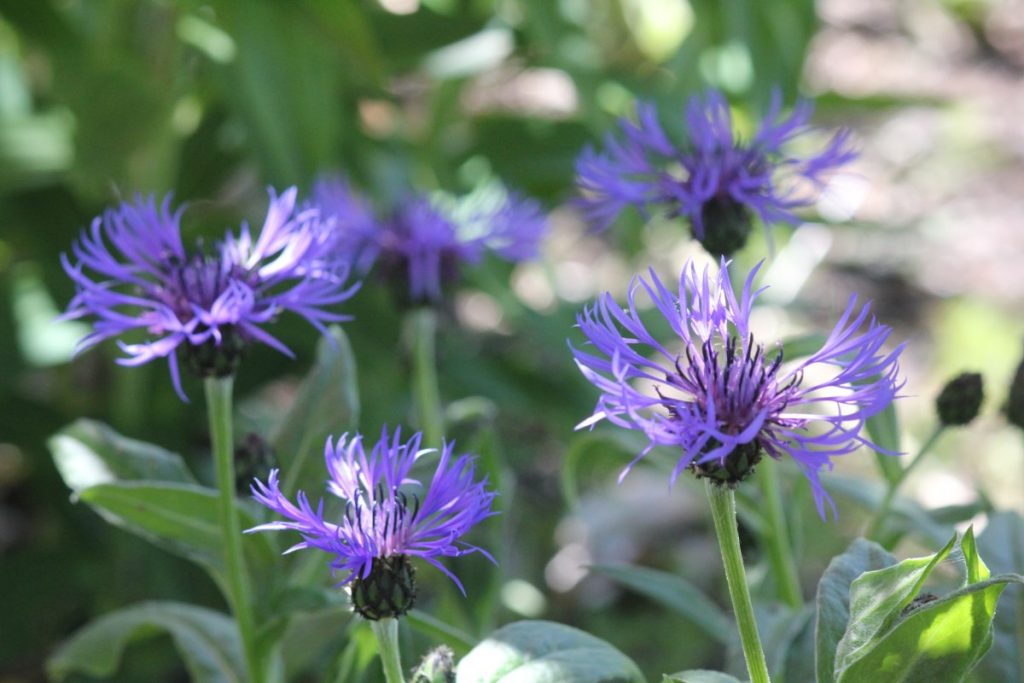
28. Bachelor’s Buttons (late July for fall blooms in some areas)
Bachelor’s buttons do best with a late July planting in most areas, timed for a fall bloom once the weather cools slightly. They take about 65 to 70 days to flower and don’t ask for much beyond well-draining soil.
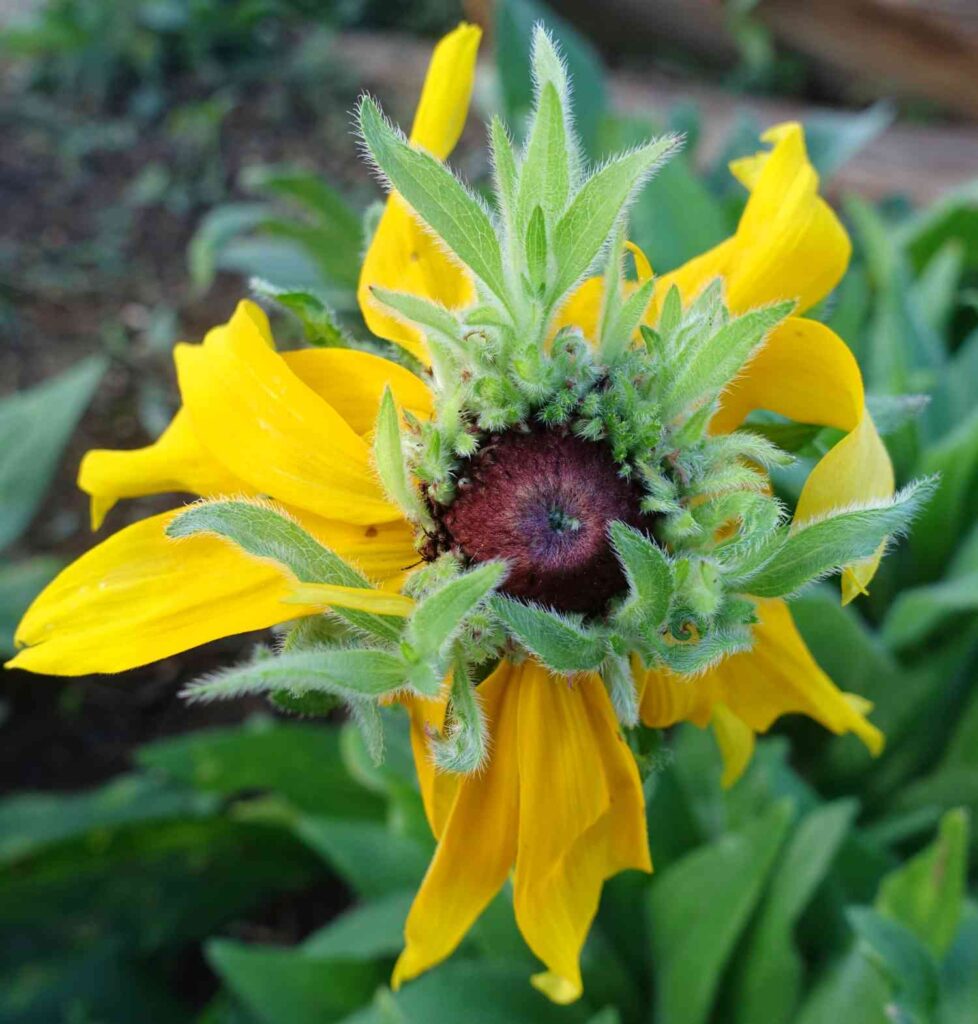
29. Black-Eyed Susan
Black-eyed Susans are tough, cheerful bloomers that handle summer heat without complaint, flowering in about 65 to 70 days. They’re a great pick if you want reliable color that keeps going well into fall.
July Planting Tips for Better Harvests
A few small habits can make a big difference in how well your July garden performs.
Water deeply rather than often. Frequent shallow watering encourages roots to stay near the surface, where they dry out fast in summer heat. A deep soak a few times a week builds stronger, more resilient plants.
Time your planting for early morning or evening. Putting seeds or seedlings in the ground during the cooler parts of the day reduces stress and helps them settle in without wilting.
Keep an eye on pests. Summer heat brings out more insects, so check your plants regularly and deal with problems early before they spread.
Don’t skip succession planting. Since many July crops mature quickly, you can often fit in a second round before fall, especially with radishes, lettuce, and greens.
Conclusion
July might not be the season most gardeners think to start something new, but as you can see, it’s far from too late. With the right vegetables and flowers, this can be one of the most rewarding stretches of your gardening year.
So instead of reaching for your phone during these warm afternoons, grab your trowel. A little effort now means a garden full of color and fresh harvests well into fall.
Khaja Moinuddin, a computer science graduate, finds joy in gardening and homesteading. Join him on this blog as he shares his experiences in homesteading, gardening, and composting
Price: $12.99 (as of Jul 04, 2026 03:39:48 UTC – Details)
【features】 Designed On Both Sides Of The Cup There Are 11 Ounces Of Coffee And Tea Lovers. Hand washable 【package】 Innovative Ideas, Individually Packaged In A Colorful Gift Box. 【use】 Suitable For Bars, Kitchens, Restaurants, Clubs, Parties, Weddings, Valentine’s Day, Father’s Day, Mother’s Day, Christmas And Other Occasions. Best Gifts For Father, Mother, Wife, Husband, Grandparents, Children, Friends. Can Be Used As A Gift, Suitable For All Occasions, More Styles Are Welcome, If You Have Any Questions, Please Consult Us. Enjoy your morning coffee, tea, or juice in one of our 11-ounce ceramic mugs, great for cold drinks and hot drinks alike. Start a great day with our mug, perfect for everyday use. 11oz ceramic mug, double-sided printing, round handle is easy to hold Perfect gift: the best gift for family and friends, suitable for birthday, anniversary, Valentine’s day, Christmas, Halloween, father’s day, mother’s day, children’s day, Thanksgiving Day Environmentally friendly and durable, healthier than paper cups, with interesting ideas, suitable for every season It can be used in kitchen, restaurant, school, office, party, coffee shop, bar, wedding and other occasions Made of high quality smooth scratch resistant ceramics, easy to clean, enjoy life with your family and friends!
Price: $26.99 (as of Jul 03, 2026 15:38:23 UTC – Details)
Medical graduation ceremony Medical, Veterinary, and Dental Student Designs. White Coat Ceremony Gifts – Earned the Right to Wear White. Perfect white coat ceremony present for pharmacists, physical therapist, doctor, veterinarian, nurse or any occupation where a white coat ceremony gift is needed. This saying could even be part of your white coat party decor. If you have been searching for the perfect gift for a white coat ceremony, this design will not disappoint! Perfect white coat ceremony present for pharmacists, physical therapist, doctor, veterinarian, nurse or any occupation where a white coat ceremony gift is needed. This saying could even be part of your white coat party decor. If you have been searching for the perfect gift for a white coat ceremony, this design will not disappoint! Dual wall insulated: keeps beverages hot or cold Stainless Steel, BPA Free Leak proof lid with clear slider
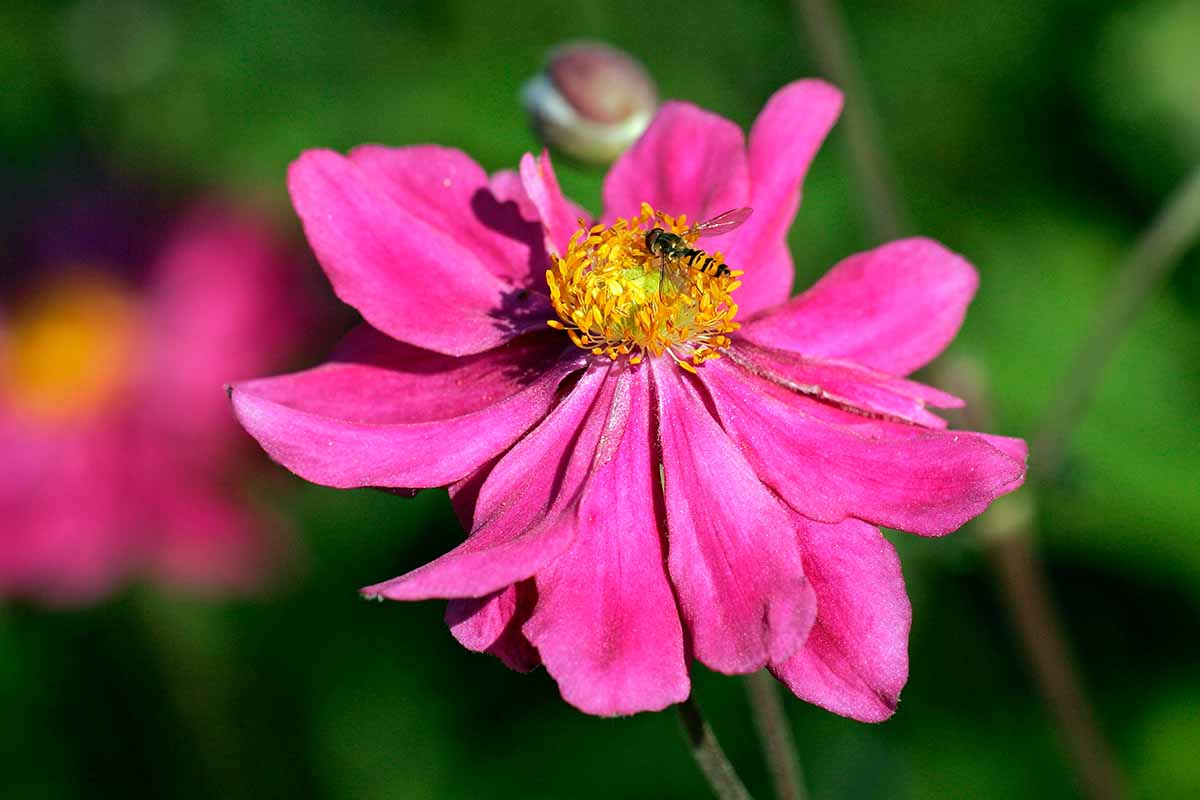
Butterflies and other pollinators are attracted to the flowers, and many of the summer and fall-flowering species have pretty, cottony seed heads – a nesting material favored by hummingbirds and small songbirds.
A Note of Caution: all parts of anemone plants are toxic when ingested and should be kept away from children and pets.
Anemones also enjoy a variety of growth patterns:
Tuberous Species
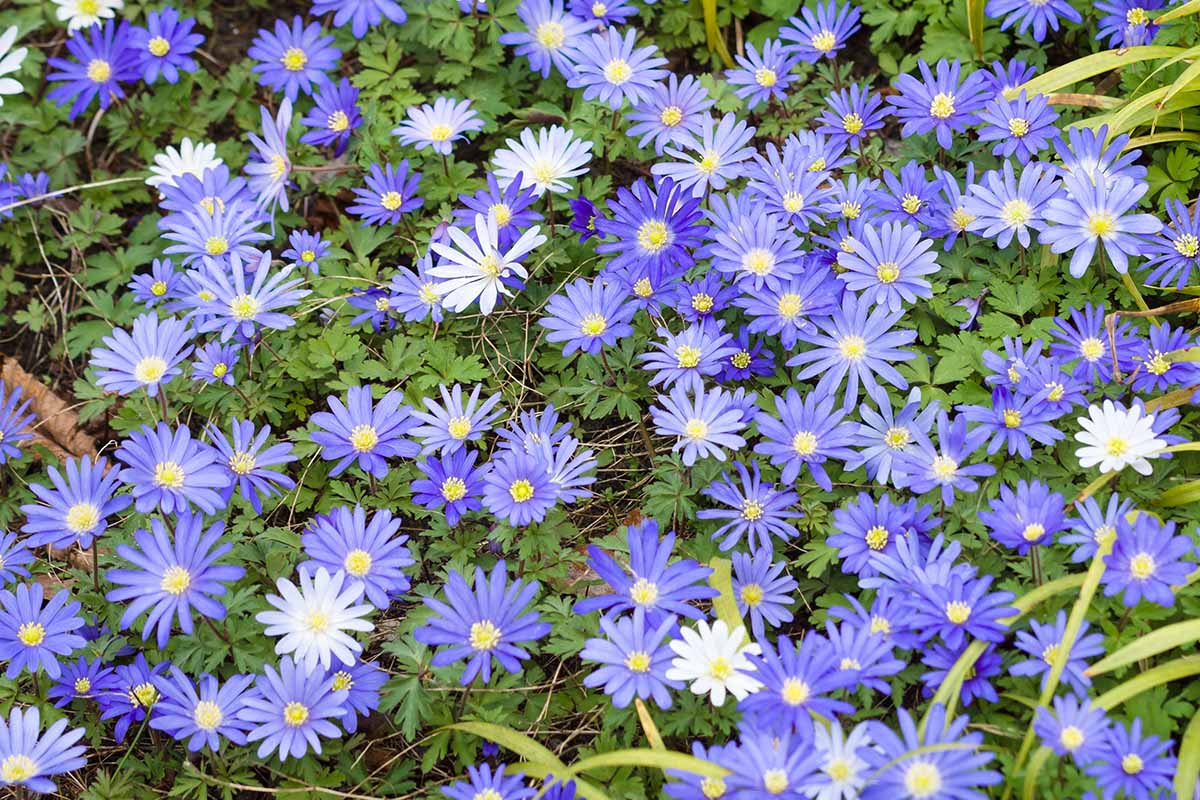
Tuberous species typically bloom in spring and early summer, and include A. blanda aka Balkan or Grecian windflowers, and A. coronaria.
A. blanda.
A. coronaria cultivars are commonly divided into two main groups: ‘De Caen’ and ‘St. Brigid.’ The ‘De Caen’ cultivars are single-petalled, while the ‘St. Brigid’ types are doubles.
Native to Eurasia, these are low to mid-sized species that grow from hard, gnarly corms or rhizomes.
The early A. blanda varieties can be grown in full or part sun and like a humus-rich, well-draining soil with consistent moisture.
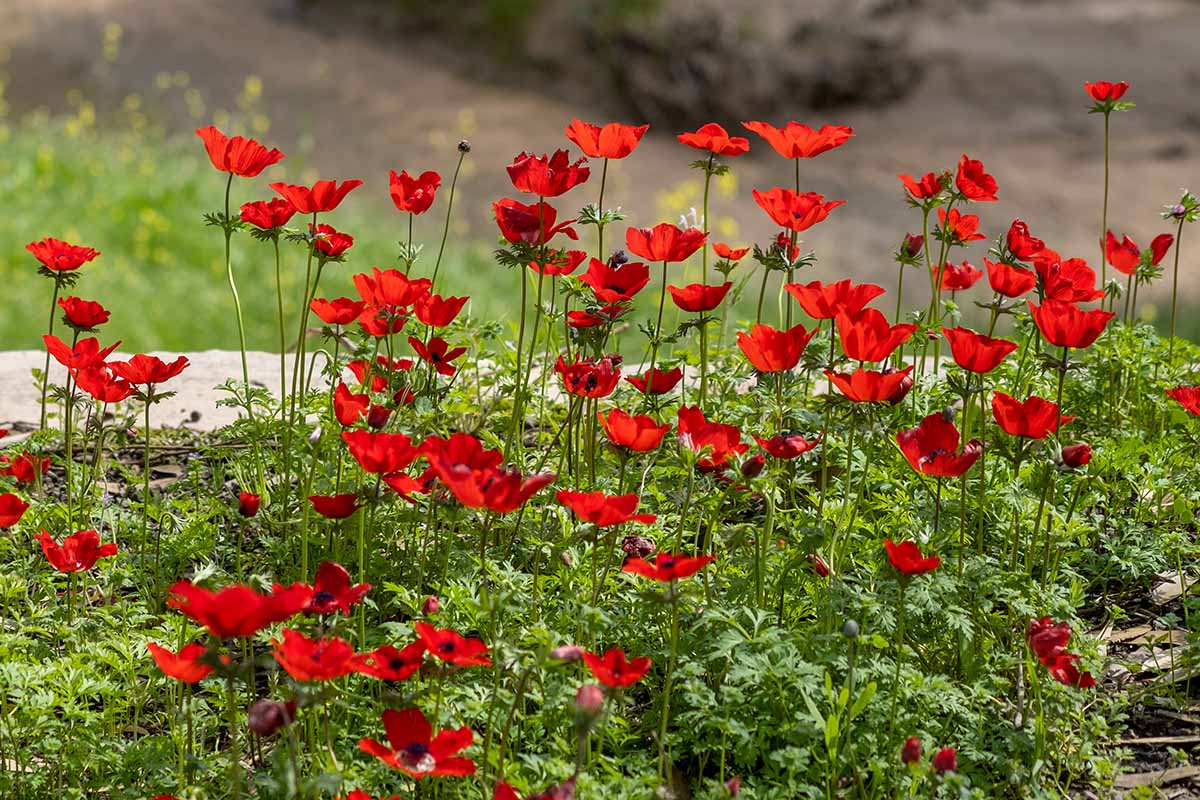
The poppy-like A. coronaria cultivars, blooming in late spring and early summer, enjoy more heat and prefer a full sun location.
A. coronaria
A. blanda typically thrives in USDA Hardiness Zones 5 to 9, but A. coronaria is hardy only in Zones 7 to 10.
Although they provide a longer bloom time when planted in fall, they can be successfully grown as annuals in cooler locations when put in the ground in early spring.
Fibrous Rooted Species
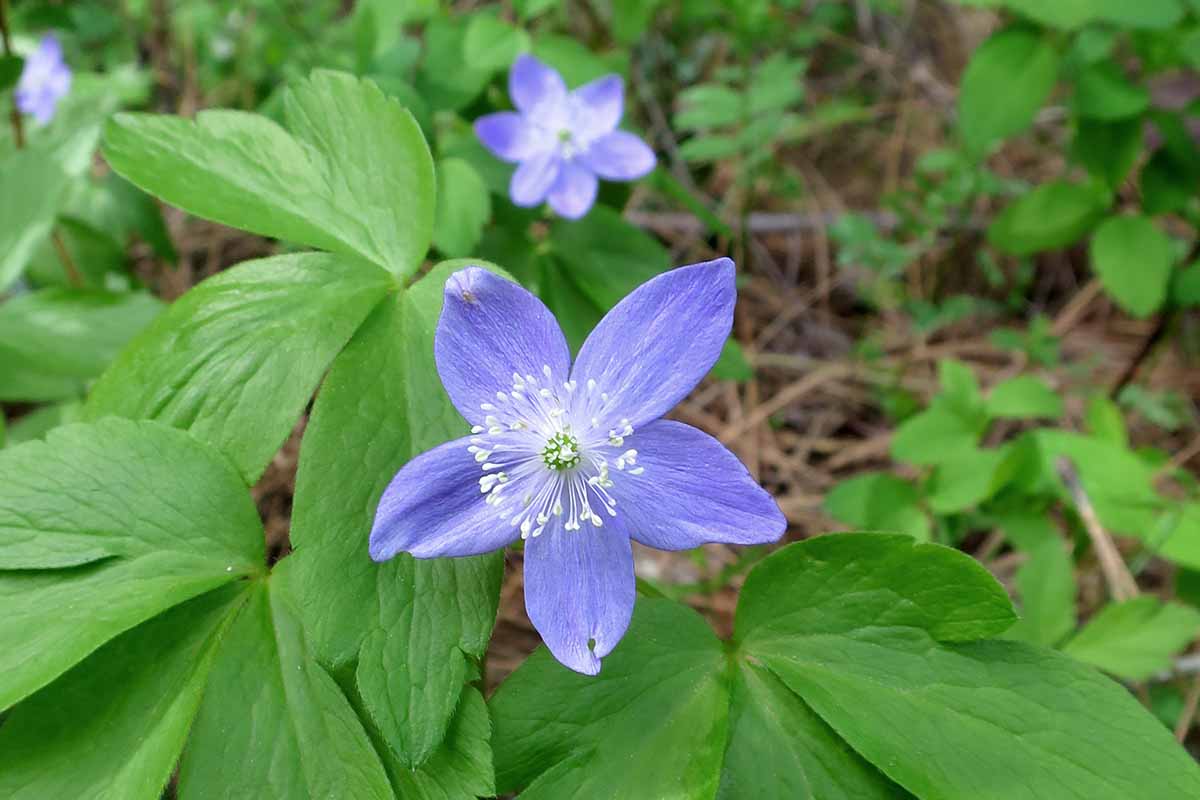
Fibrous-rooted species are typically the alpine or woodland varieties, with several species that are native to North America.
A. oregana.
These are low growing or mid-sized plants that flower in spring and early summer, and grow from fibrous roots or clumps of thin, rhizomatous roots.
Many of these species, like A. canadensis and A. oregana, are hardy in Zones 3 and 4, and one Arctic species, A. parviflora, is hardy down to a frigid Zone 1!
A. canadensis.
These species can be hard to find in garden centers. But many can be sourced from local botanical gardens and horticultural schools, or from rare and native species websites.
Fall Flowering Species and Hybrids
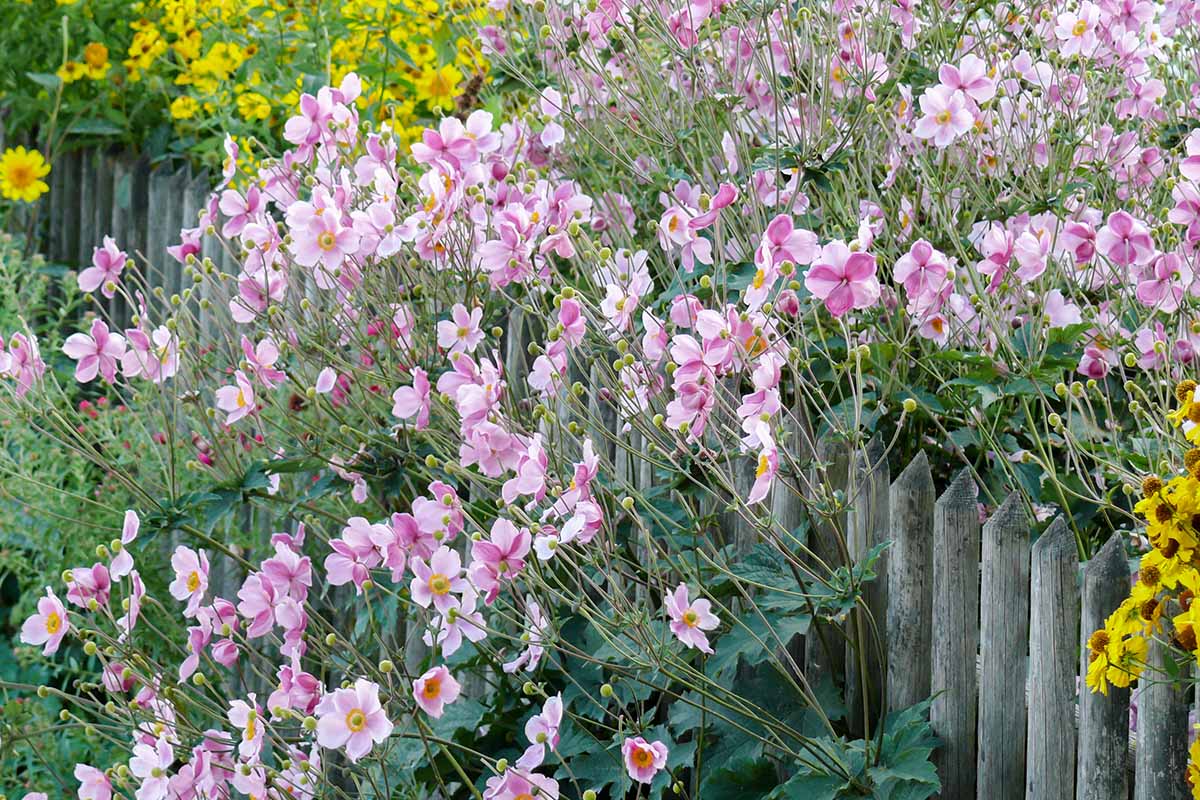
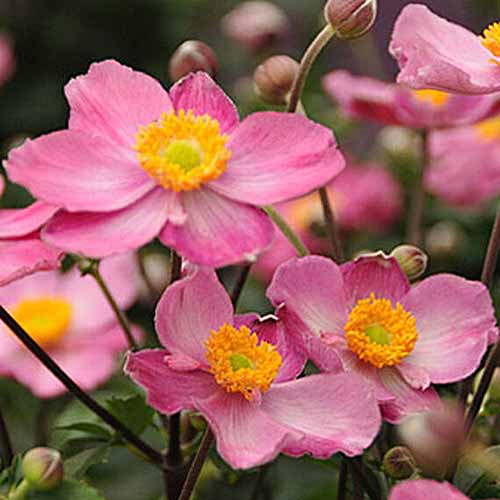
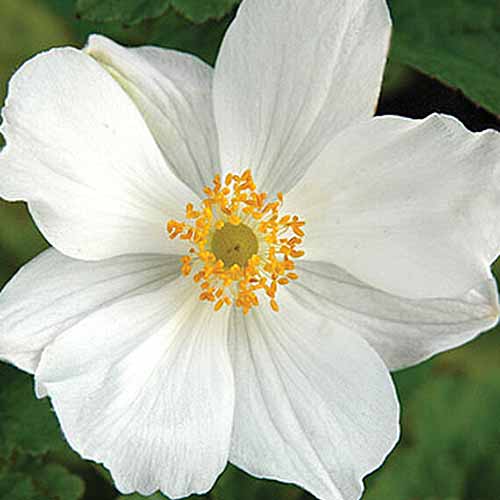
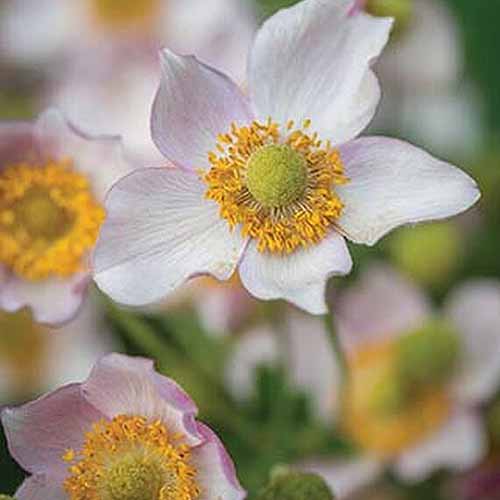
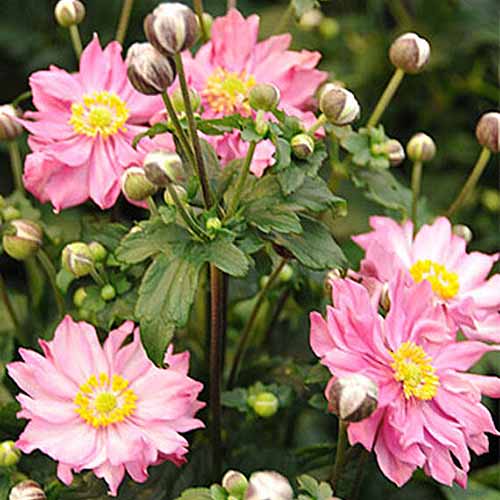
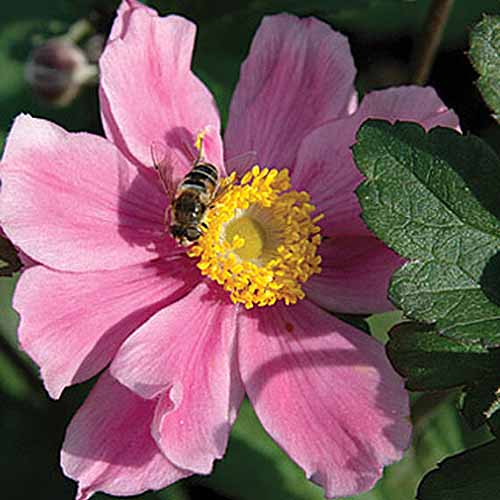
Chinese or Japanese anemones, A. hupehensis, A. tomentosa, and A. vitifolia are fall flowering species that bloom in late summer and early autumn.
They typically feature saucer-shaped flowers in shades of pink, rose, and white.
A. hupehensis.
Cultivated hybrid varieties are typically bred from one A. hupehensis parent and are collectively called A. x hybrida.
These are tall species that can grow up to four feet and make wonderful cut flowers, with many cultivars hardy in Zones 3 to 5.
They prefer a lightly shaded location, or morning sun with afternoon shade, and require organically rich, well-draining soil that’s kept evenly moist.
Tuberous varieties are popular for spring and early summer.
1. Blanda Mix
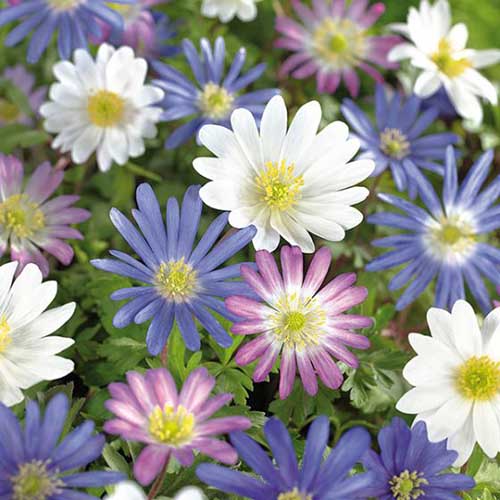
Blanda Mix is a mixture of A. blanda bulbs that deliver a showy display of daisy-like flowers in shades of periwinkle blue, dusty pink, and white, with a fresh, green-gold center.
Low growing, with a mature height of only three to five inches, the mixed colors provide an attractive display when mass planted under deciduous trees and in naturalized settings, or grouped in beds, borders, containers, and rockeries.
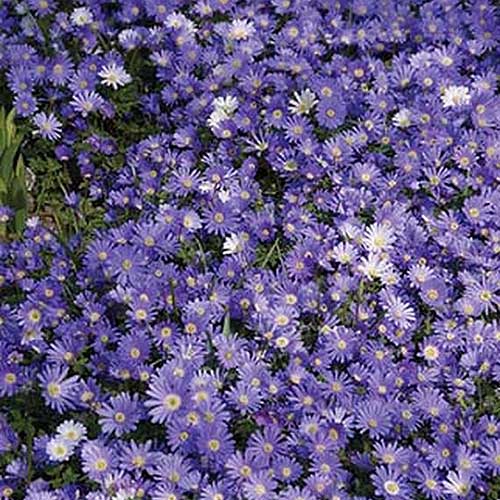
An early spring classic, A. blanda ‘Blue Shades’ flowers in blue tones ranging from powder to periwinkle, with charming, bright white eyes and ferny foliage.
The low growing plants reach only four to six inches high at maturity and look terrific when mass planted singly or with other early bloomers like daffodils, grape hyacinth, and crocus.
Plant the corms in fall and locate at the front of beds and borders, in containers, or scattered in woodlands and under deciduous trees.
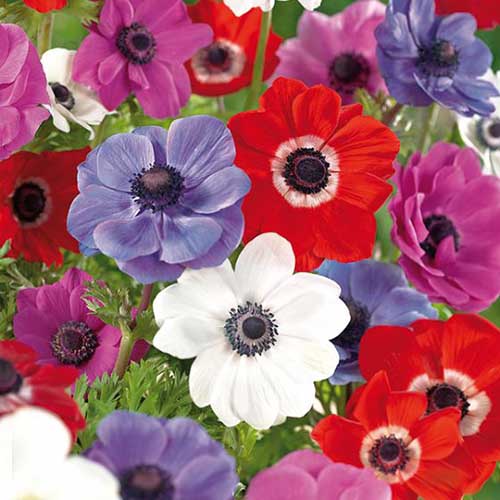
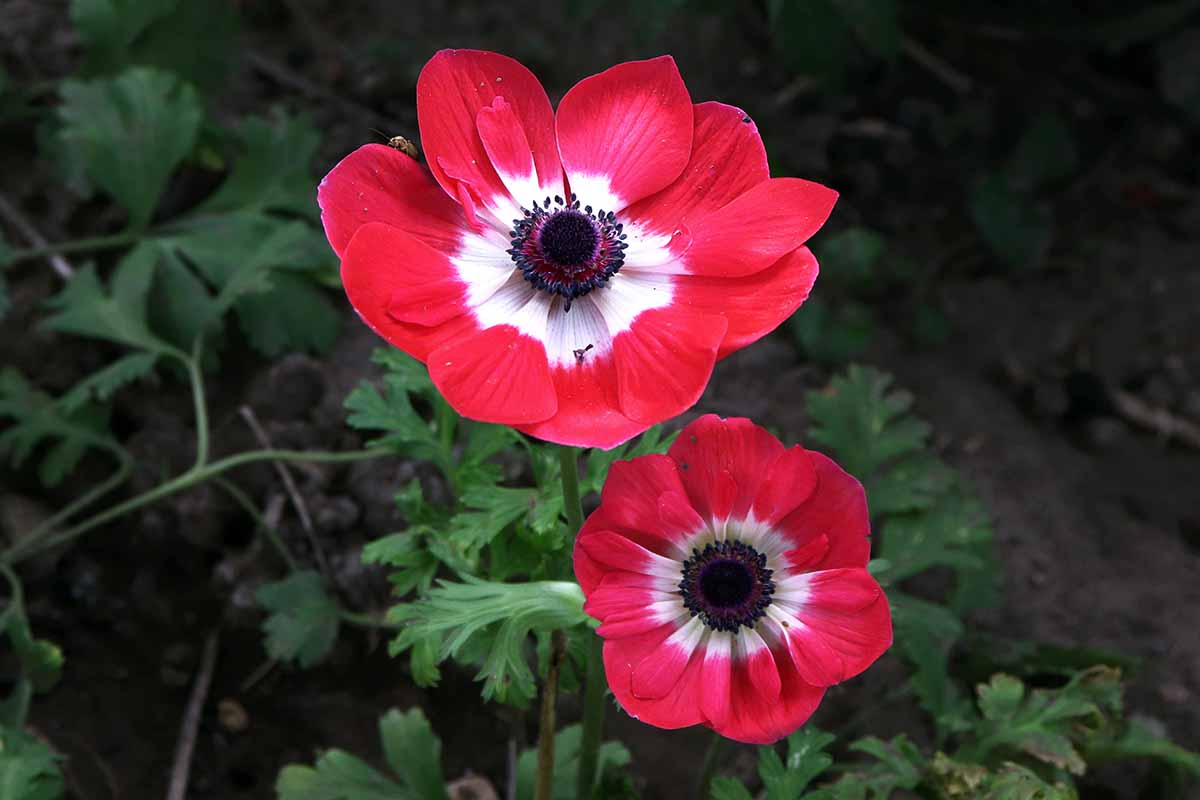
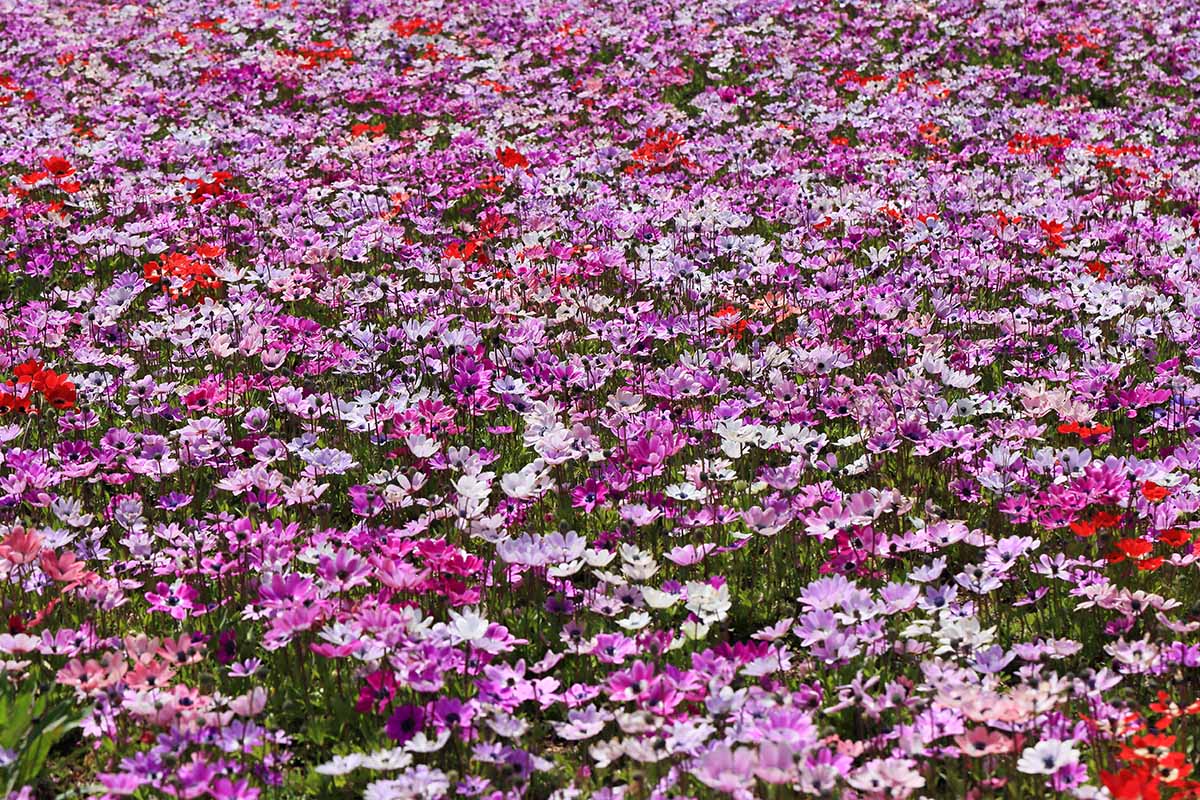
A. coronaria De Caen mix produces large, buttercup flowers in fantastic shades of scarlet, rosy pink, violet, and white that bloom from mid to late spring.
Hardy in Zones 7 to 10, plants grow to mature heights of eight to 10 inches and spread rapidly when grown in a full to part sun location in loamy, evenly moist soil.
They make a charming ground cover for lightly shaded areas and look spectacular in beds, borders, and containers, or planted in alpine, cottage, and rock gardens.
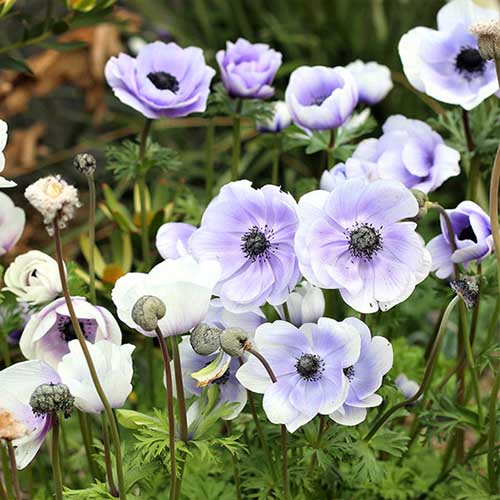
A. coronaria De Caen Blue White delivers lovely bicolored blooms, emerging from the dark center as a deep, azure blue that fades to white at the petal edges.
The low-growing plants reach mature heights of 10 to 12 inches and have a long bloom time of eight to 10 weeks, flowering from late spring into early summer.
For a striking statement, A. coronaria ‘Hollandia’ delivers a vibrant display of scarlet flowers with black and white centers that bloom all spring.
Delightful as cut flowers, cut stems are quickly replaced with new flowers.
Fantastic when mass planted in beds, borders, containers, and rockeries or when allowed to spread as a ground cover in naturalized settings like meadows and woodland fringes.
‘Hollandia’ grows eight to 10 inches tall and requires loamy, well-draining soil in a full to part sun location. Hardy in Zones 7 to 10.
6. Mona Lisa
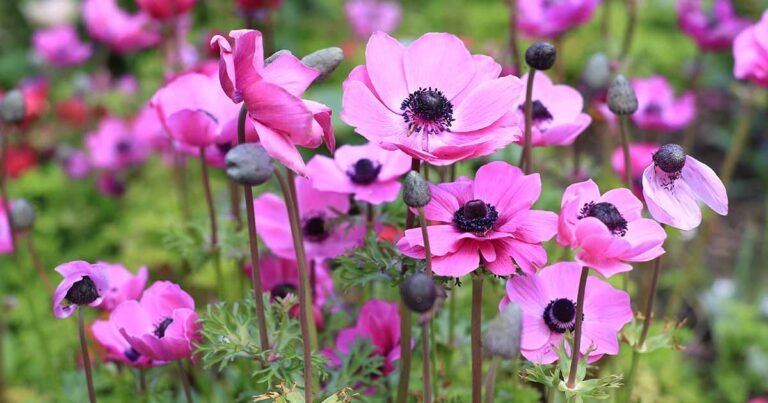
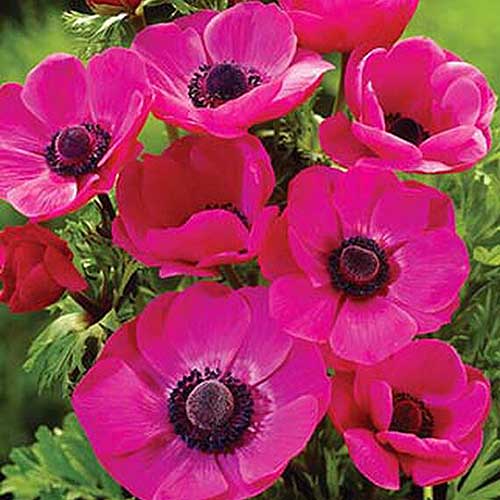
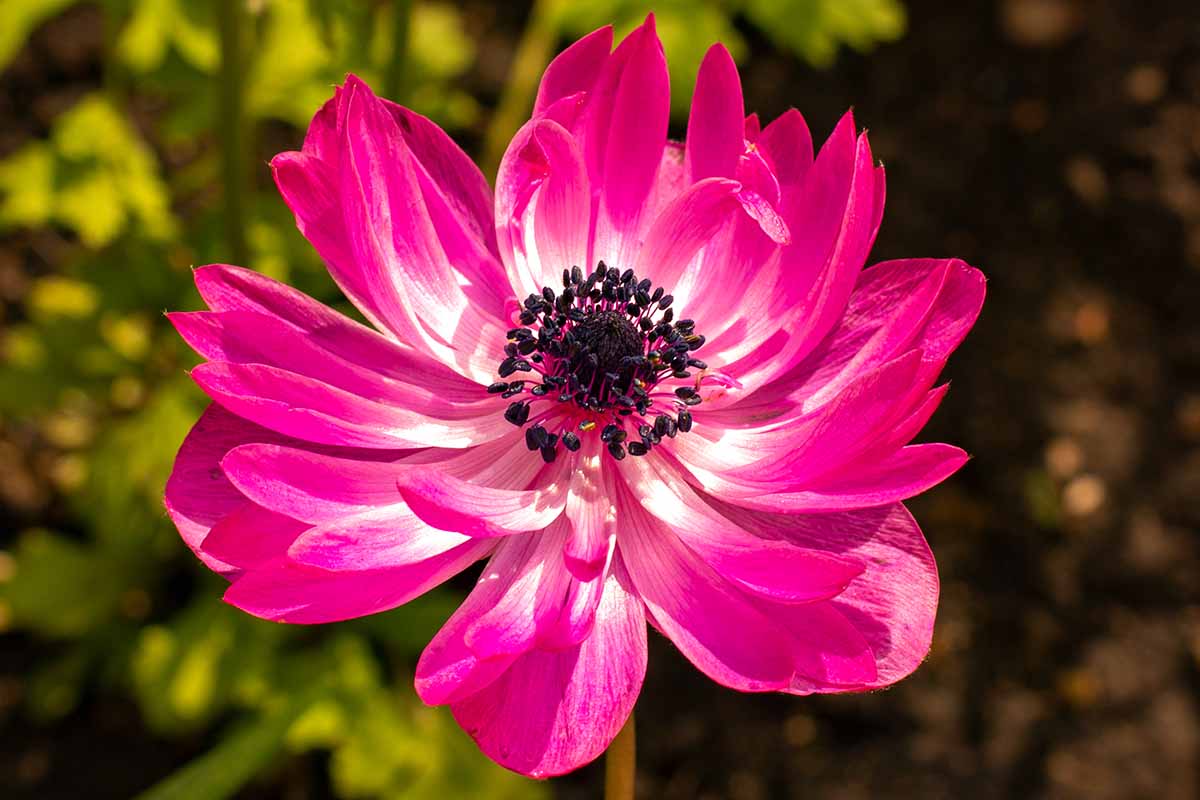
Highly prolific, A. coronaria ‘Mona Lisa’ features poppy-like flowers in hot pink with dazzling, dark eyes that sit atop long stems.
The spring blooms are ideal as long-lasting cut flowers, and they make a striking statement in beds, borders, containers, and alpine or rock gardens.
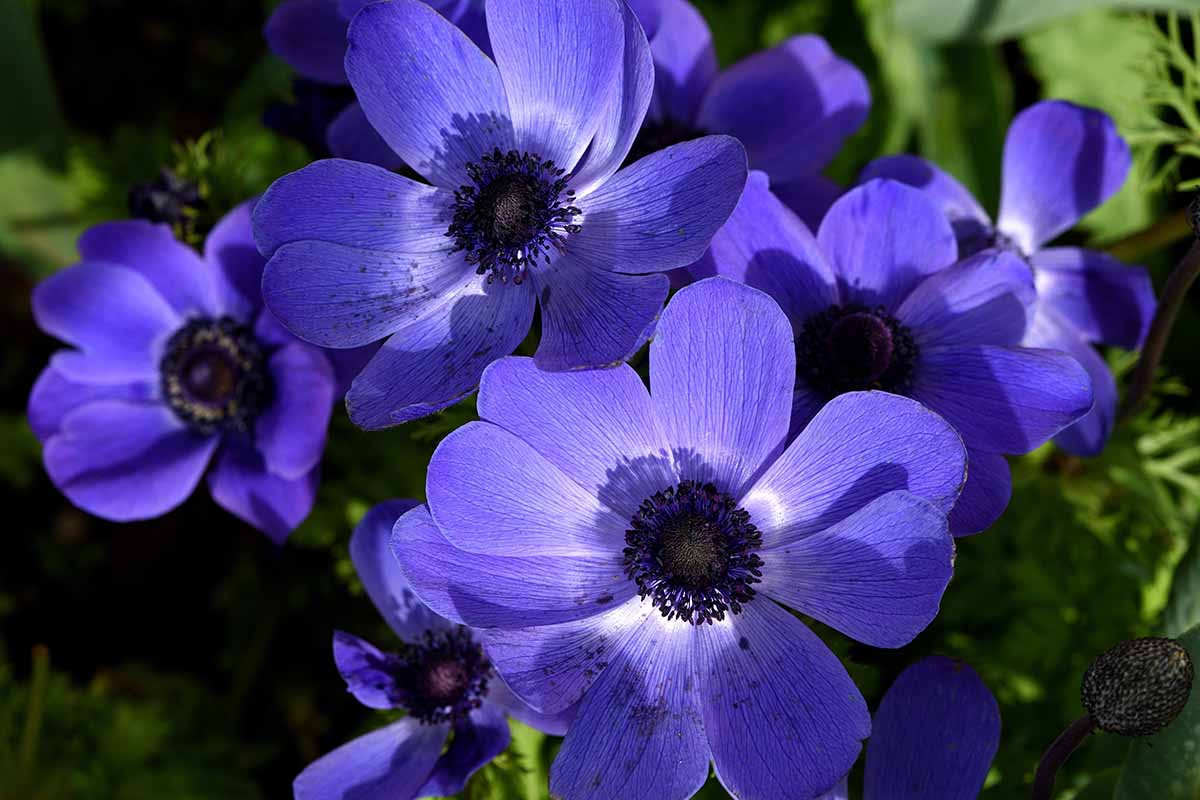
A. coronaria ‘Mr. Fokker’ features spectacular velvety purple-blue flowers with charming black button eyes that bloom from mid to late spring.
Hardy in Zones 7 to 10, these clump-forming plants grow eight to 10 inches tall and do best in a full sun location and sandy, well-draining soil.
They make delightful cut flowers and add their reliable appeal to beds, borders, containers, or in alpine, cottage, or rock gardens.
8. Rainbow Pastel Mix
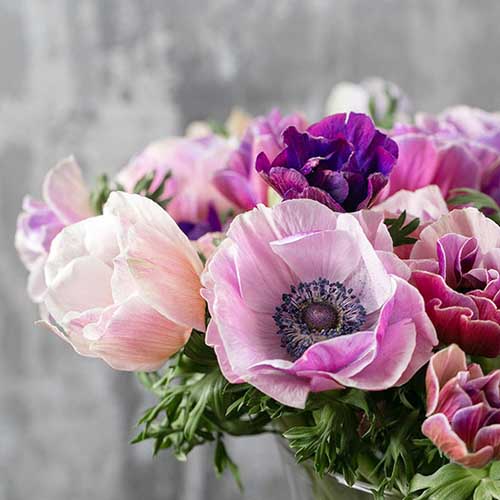
A. coronaria Rainbow Pastel Mix is a sweet mix of pastel, bicolored poppy-like blooms in shades of lavender, rosy pink, and violet, with almost-white flowers tinged in mauve and pink.
All colors have striking dark eyes of deep indigo or black.
Prolific bloomers, these 10- to 12-inch-tall plants often produce up to 20 flowers per bulb, blooming in late spring to early summer.
They are ideal for the cutting garden, or as a naturalized ground cover in meadows and lawn fringes.
Use for large specimen grouping or scattered throughout beds, borders, and in containers.
The brightly hued and lightly ruffled double blooms of A. coronaria ‘St. Brigid’ float above fern-like foliage, adding delightful color to the late spring garden.
Brilliant, long-lasting shades of blue, mauve, pink, scarlet, and white have contrasting dark or self-colored centers, and make excellent cut flowers in a spring bouquet.
A natural in alpine or rock gardens, they shine in beds, borders, containers, or naturalized in meadows.
Plants prefer a full to part sun location with moist and loamy, well-draining soil. Hardy in Zones 7 to 10.
Fall Flowering Cultivars to Select
There are many outstanding fall cultivars, with flowers appearing in August and flowering through October.
10. Cinderella
Outstanding from mid-summer to October, A. x hybrida ‘Cinderella,’ part of the Fantasy™ series, has tall, branching stems with princess-pink flowers and frilly yellow stamen.
After flowering, fluffy white seed heads add fall interest to the garden.
Plants grow 12 to 18 inches tall, making them a superb addition to the cutting garden.
Stately and elegant, A. hupehensis ‘Honorine Jobert’ shines in the late summer garden, with brilliant white flowers tinged in pink, and eye-catching golden stamen.
The three to four-feet-tall plants look marvelous when mass-planted in beds, containers, cottage and cutting gardens, and woodland settings.
Another cultivar in the A. hupehensis Fantasy™ series, the double-petaled ‘Pocahontas’ puts on a glorious, ruffled display in bubblegum pink with bright, sunshine-yellow eyes.
They bloom for months, from midsummer to almost the middle of autumn.
The sturdy stems grow to a mature height of 12 to 18 inches and plants colonize readily, making them ideal for cottage and cutting gardens.
Or massed in beds, borders, containers, and naturalized settings like meadows or woodlands.
Vigorous and prolific, A. x hybrida ‘September Charm’ produces multitudes of luminous, silvery-pink flowers with a deeper, purply-pink reverse and a frothy, golden center.
The display lasts from mid-summer to mid-autumn and plants grow to a height of 24 to 48 inches.
Gorgeous for cottage and cutting gardens or mass planted at the rear of beds, in borders or large containers, and in woodland settings.
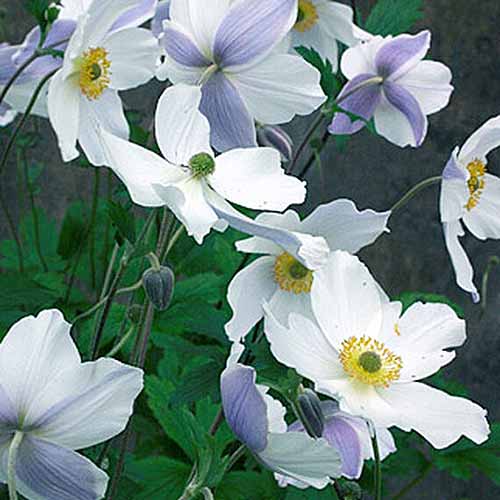
Outstanding in the late summer and fall garden, A. x hybrida ‘Wild Swan’ puts on a radiant display of large, white petals with violet-blue reverse sides and golden centers.
Wonderfully prolific, it also has one of the longest bloom times, flowering from early summer to mid-autumn.
Growing to a mature height of 16 to 18 inches, they make stunning cut flowers.
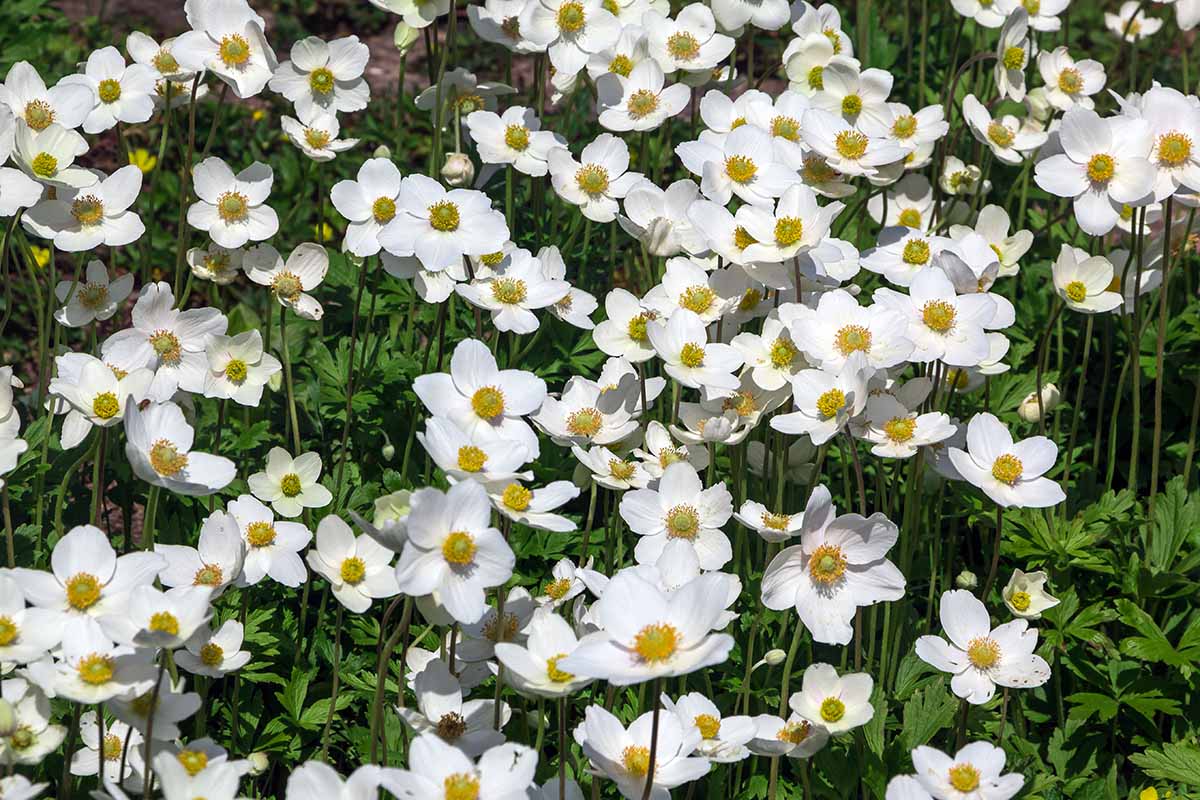
With beautiful, bright flowers that sway in the wind, anemones make a great addition to the spring, summer, or fall garden.
Wonderfully low maintenance, they grow in full sun or light shade.
And with such a wide selection of species and cultivars, there’s bound to be one (or more!) suitable for almost any location. Plus, they make fantastic cut flowers!
I’ve decided the De Caen mix needs a home in my garden… and more Grecian windflowers!
How about you, which varieties will you grow? Let us know in the comments section below!