41.7 F
Klamath Falls
Saturday, March 14, 2026
Home Blog Page 130

So Much Spring in Angie’s Arkansas Garden

Hi GPODers!

The week is winding down, but spring gardens are really starting to heat up. Angie Caruthers in Arkansas has submitted her spring garden, exemplifies the rapid growth of the season. We saw Angie’s garden for the first time back in 2020 (July in Arkansas) and again in spring of 2022 (Dogwood Season). Today, she’s showing off garden highlights from spring so far, as well as some exciting new additions that are already sporting incredible blooms.

Lots of gorgeous spring color in my Zone 6b garden in Northwest Arkansas!

My spring color palette consists of primarily violet, lavender, and white flowers, which create such a soothing, dreamy feel that just makes my soul happy.

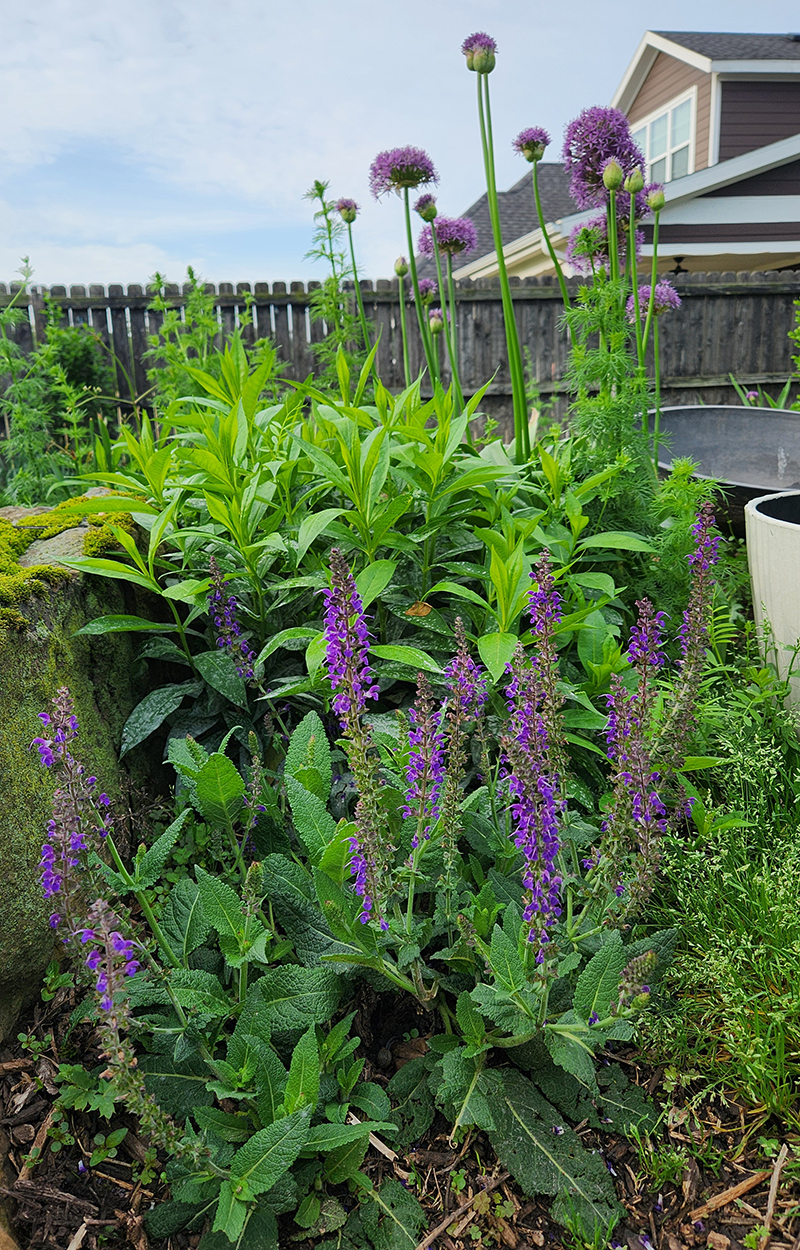
May Night salvia (Salvia × sylvestris ‘Mainacht’, Zones 4–8) in the foreground and Globemaster allium (AlliumGlobemaster’, Zones 5–8) in the rear, with David tall garden phlox (Phlox paniculataDavid’, Zones 4–8) and purple larkspur getting ready for their turn to show off.

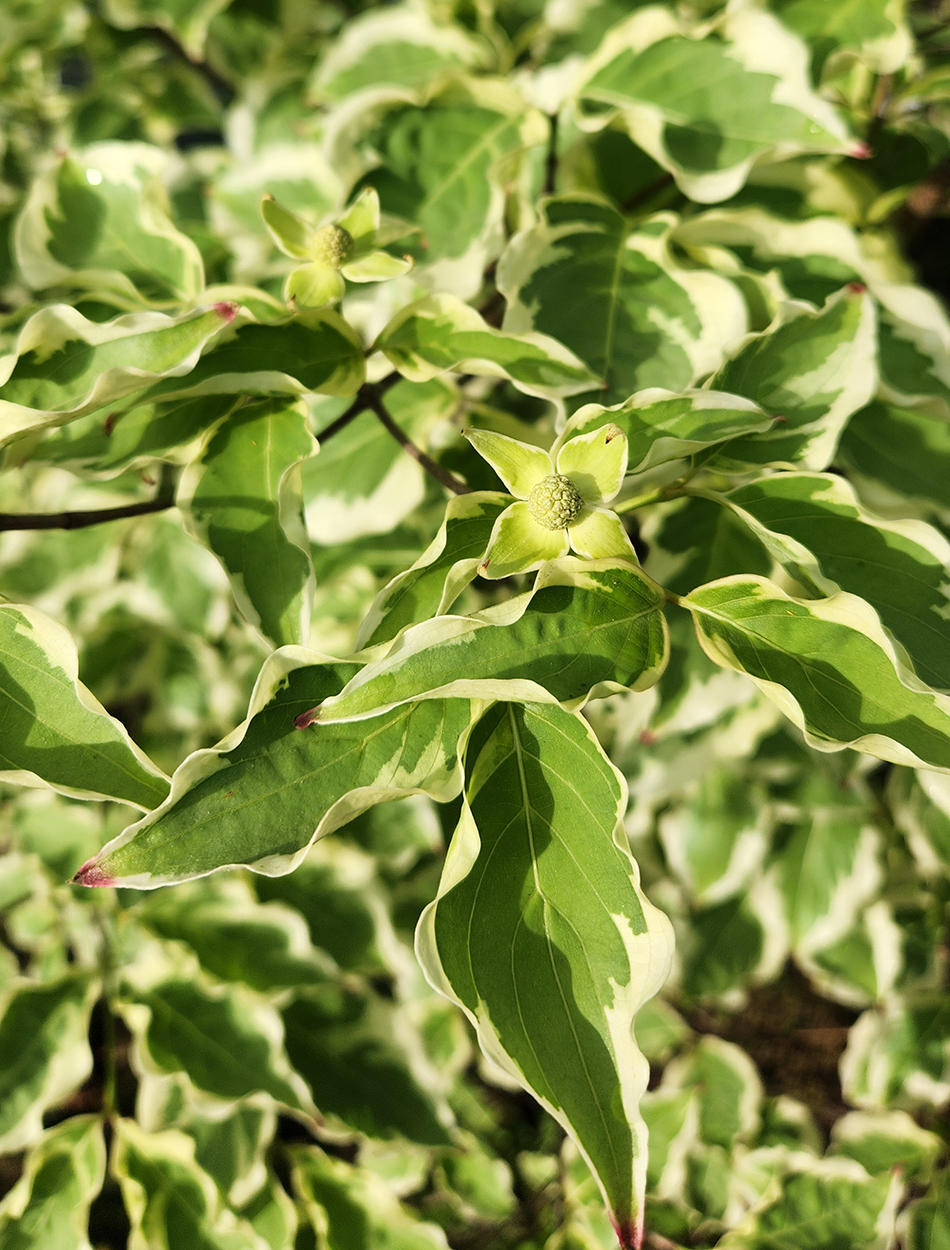
close up of variegated foliage with curled edgesClose-up of ‘Wolf Eyes’ variegated kousa dogwood (Cornus kousa ‘Wolf Eyes’, Zones 5–8) . . .

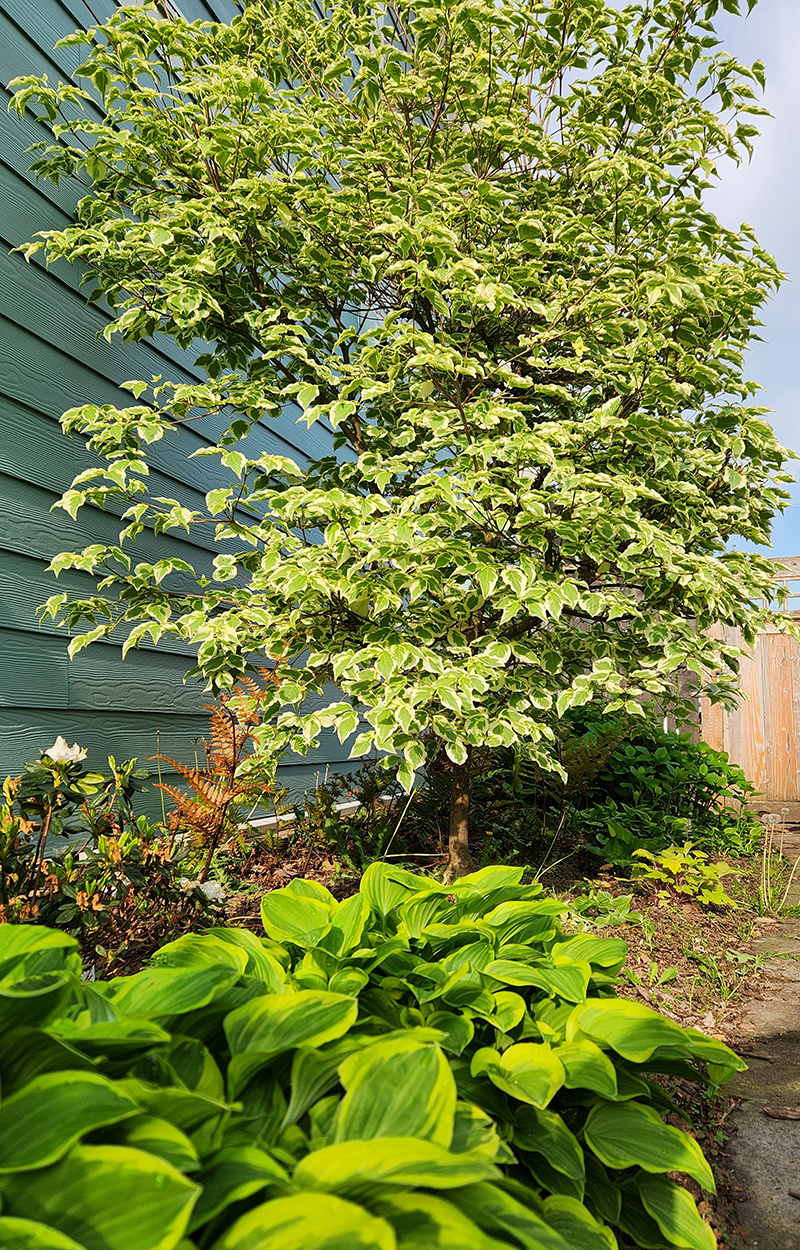
small tree with variegated foliage behind hostas. . . and a wider view of the full tree, with Golden Tiara hosta (Hosta × ‘Golden Tiara’, Zones 3–9).

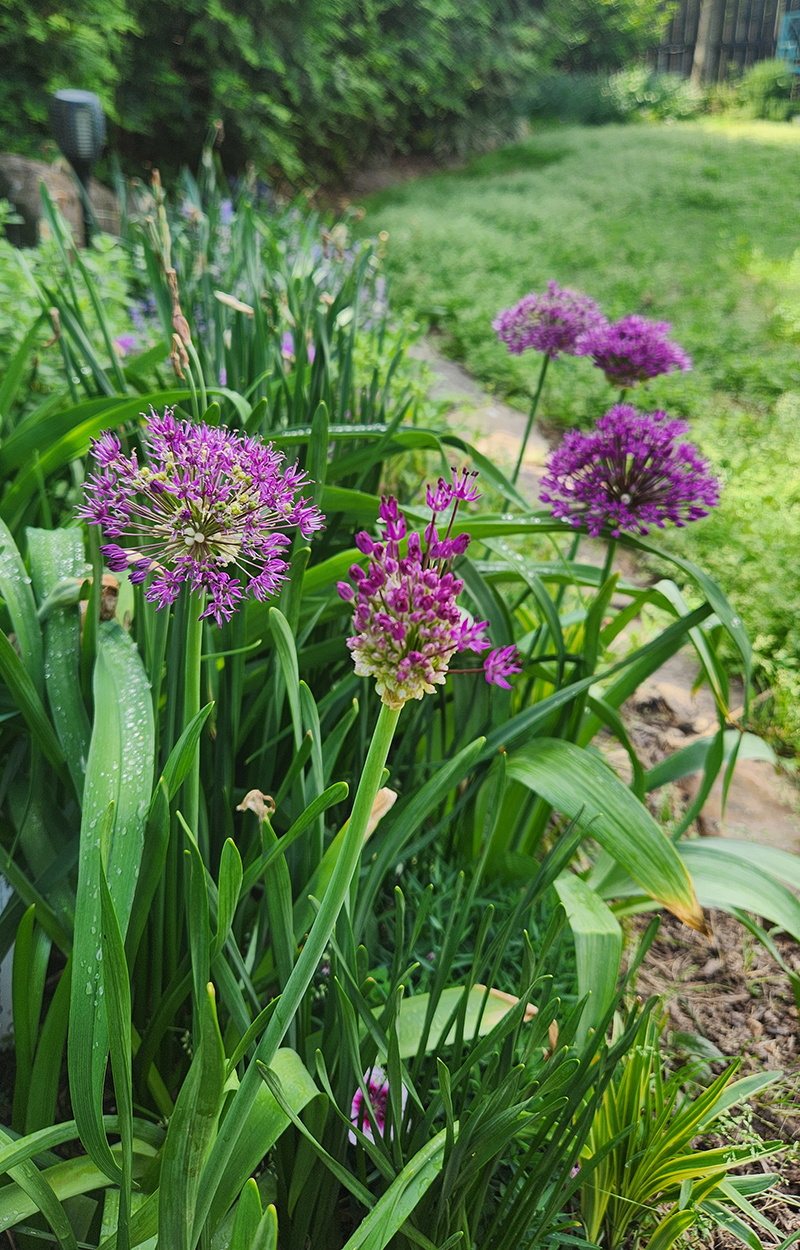
bright purple allium bloomingNew in my garden this year is Millenium allium (Allium ‘Millenium’, Zones 5–8). 💜

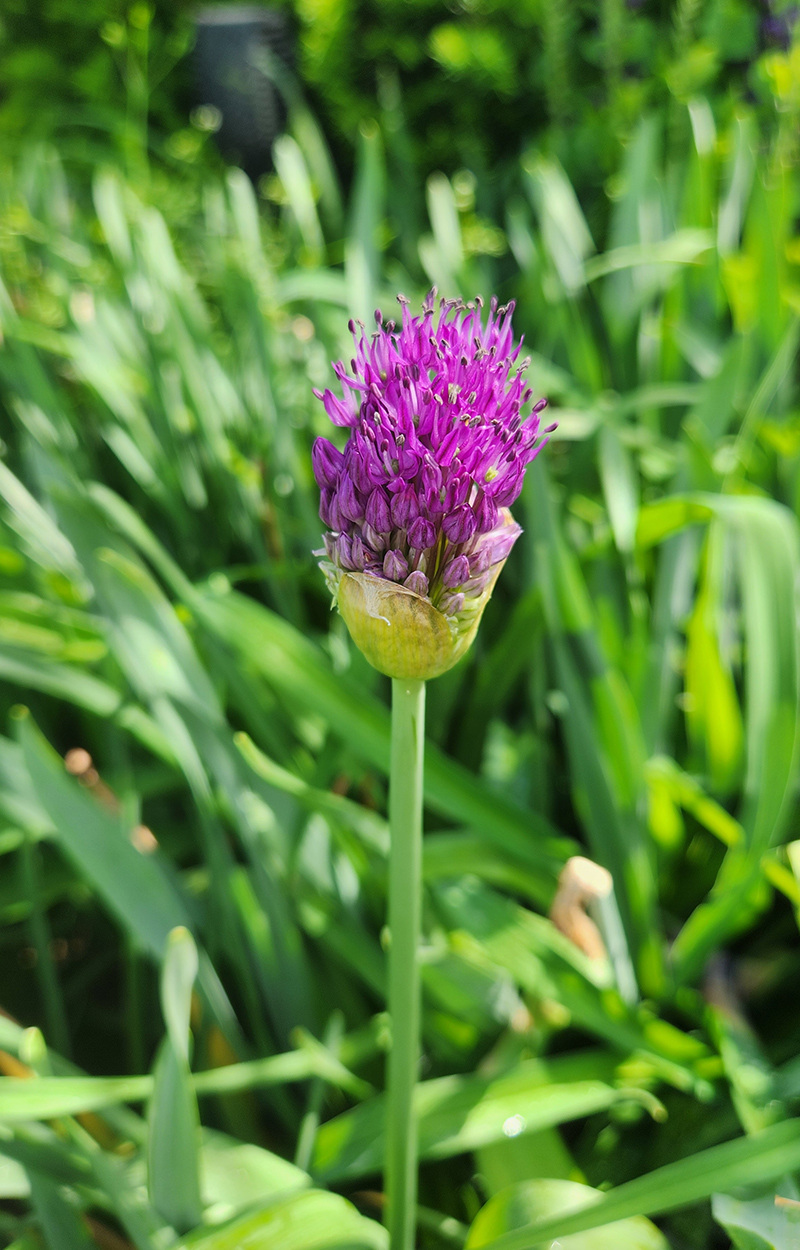
allium flower openingA close-up of a bloom from that new allium—it’s brand-new but already sending up bursts of bright purple.

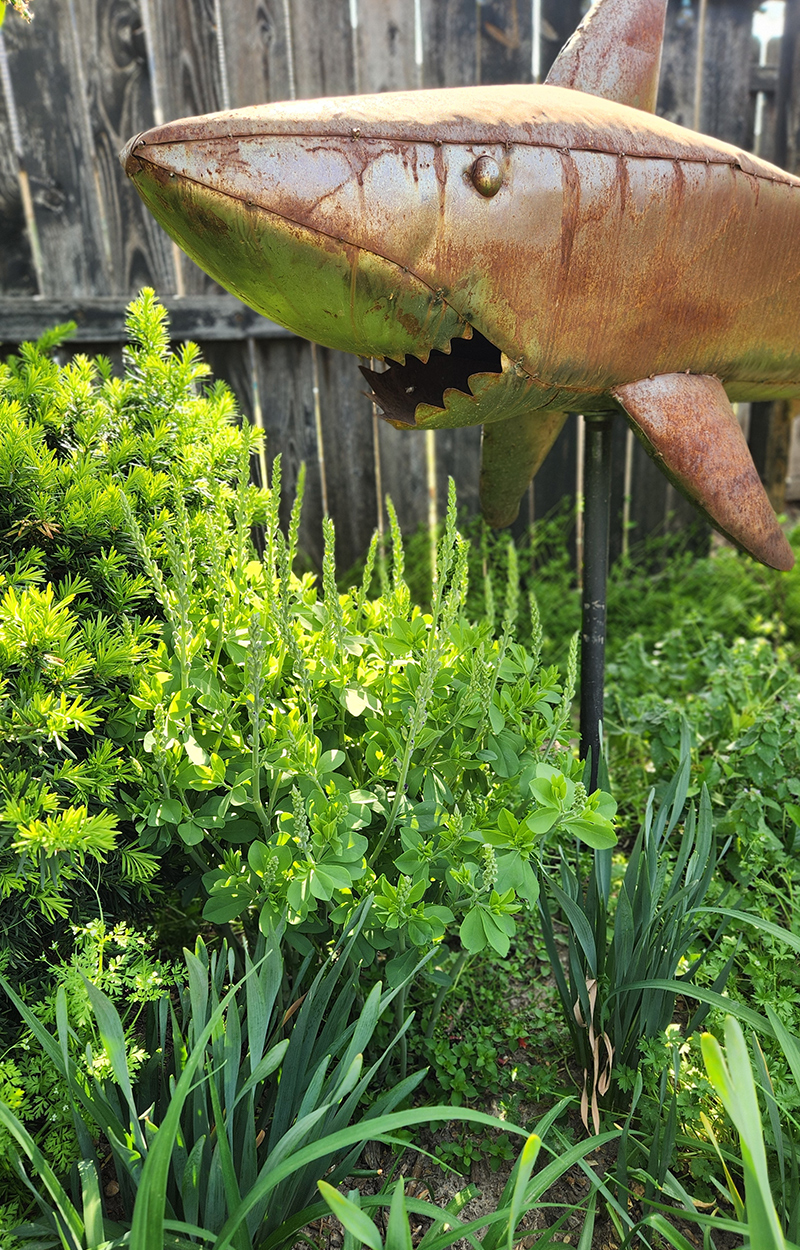
a metal shark sculpture floating about various green plantsContinuing the violet, lavender, and white color scheme, my Decadence® Sparkling Sapphire baptisia (Baptisia ‘Sparkling Sapphires’, Zones 4–9) is showing mega growth in just one week. The above photo is from Friday, April 18 . . .

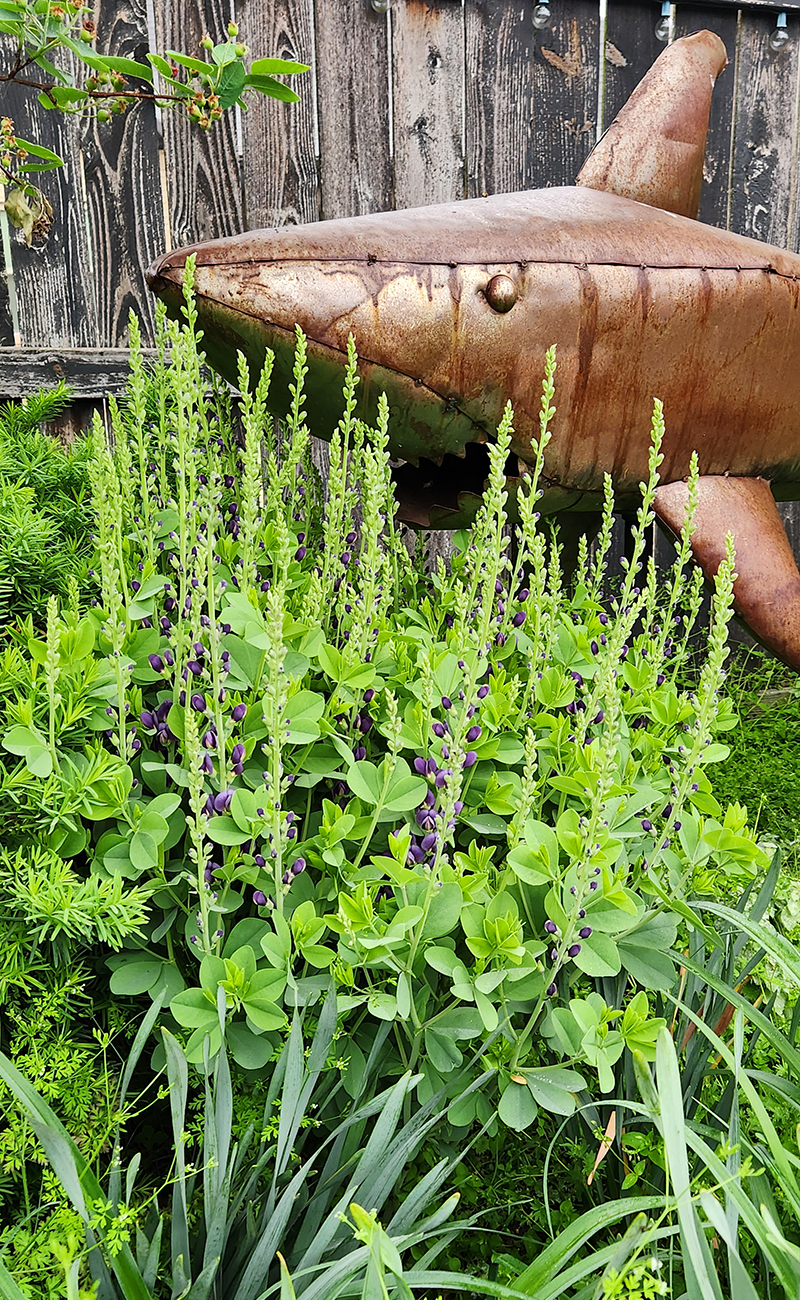
Sparkling Sapphire. baptisia starting to bloom. . . and here they are on Friday, April 25. Side note: I love how the baptisia makes it look like the shark is swimming through an ocean bed of seaweed!

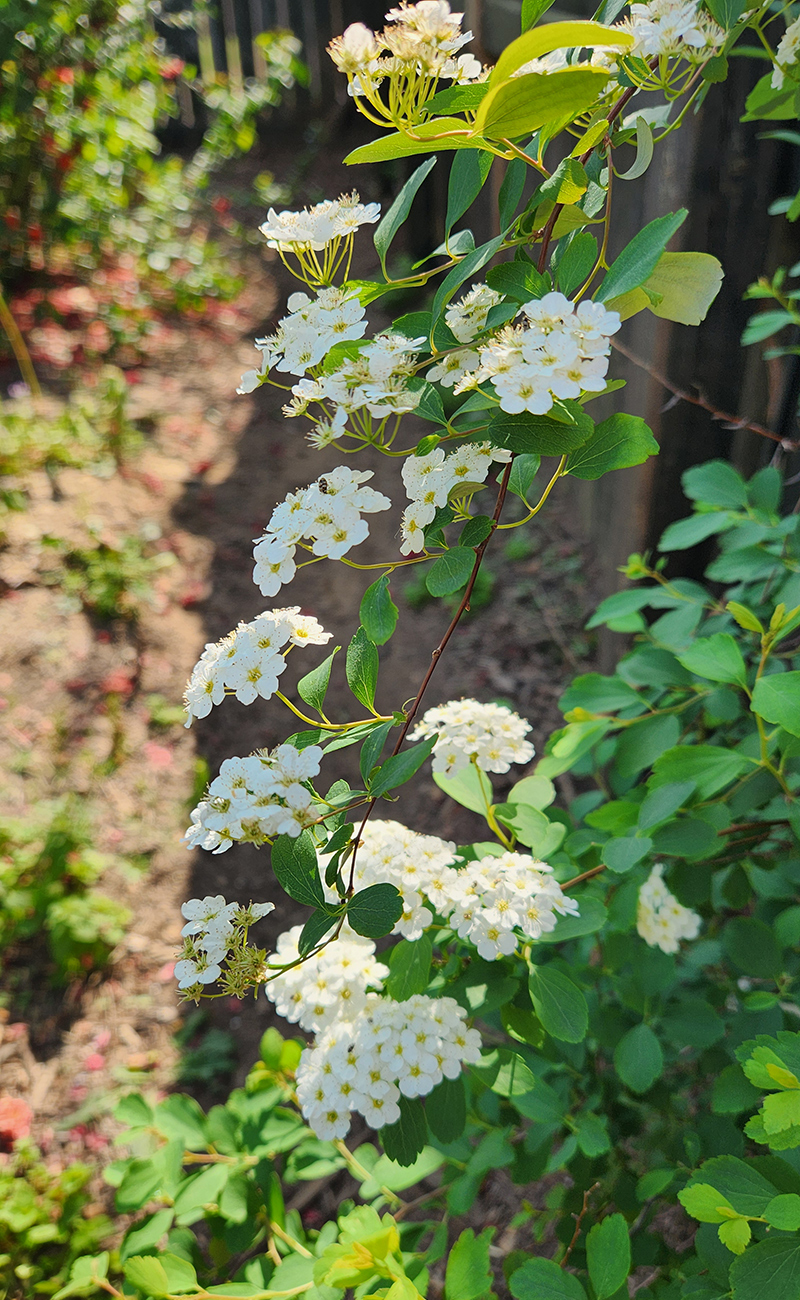
branch with cascading clusters of white bloomsSome additional plants new to my garden this year are the white Vanhoutte spirea (Spiraea × vanhouttei, Zones 3–8) . . .

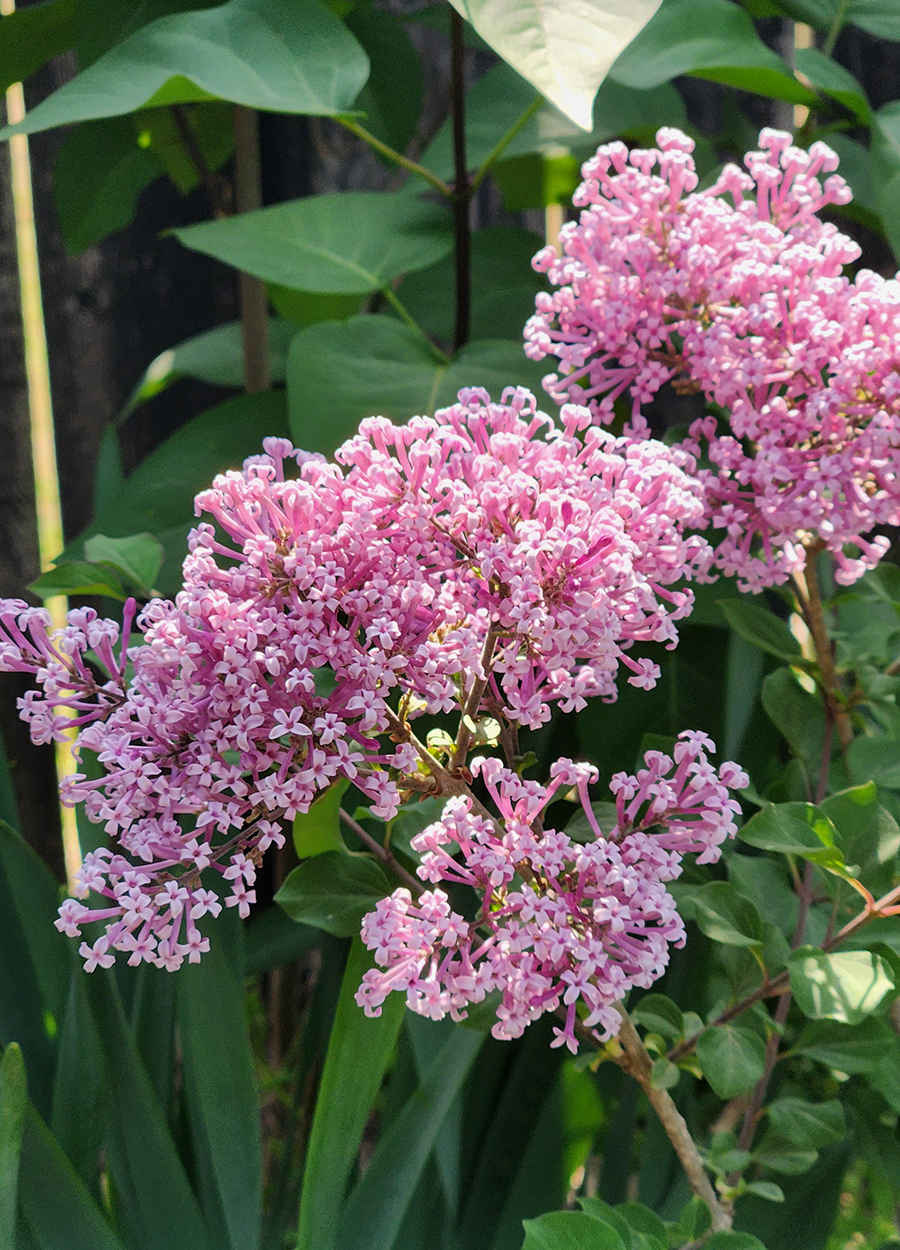
lilac with pink flowers. . . and Red Pixie lilac (Syringa ‘Red Pixie’, Zones 3–8). I’m so excited to see their blooms this year and look forward to seeing how they grow for next year’s bloom time.

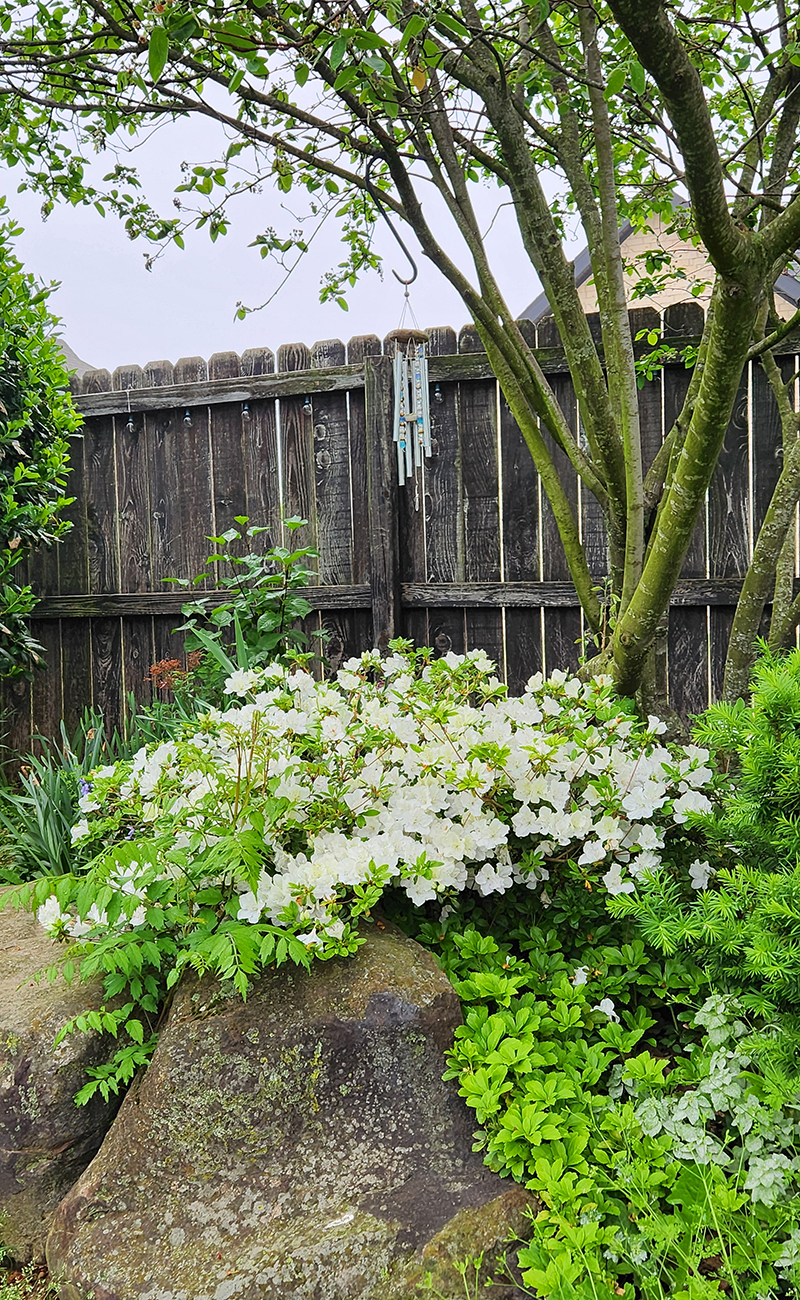
white azalea under a tree against a fenceLastly, we have Girard’s Pleasant White azalea (Rhododendron ‘Girard Pleasant White’, Zones 5–8) at the base of my Autumn Brilliance serviceberry tree (Amelanchier × grandiflora ‘Autumn Brilliance’, Zones 4–9). I love these white azaleas and this year decided to add some new (to me) white azalea varieties (Irish Cream and Delaware Valley White) in other areas of the garden—hopefully I will have some additional lovely photos to share next spring. In this photo you can also see some trumpet vine (Campsis radicans, Zones 4–9) springing up through the boulders—while I think the trumpet vine is lovely, it seems impossible to contain. It’s even springing up in the middle of the lawn. It’s not something I intentionally planted—must have been a hitchhiker in some other plant. Any tips on how to corral it are much appreciated, lol! 

Till next time,
Angie

Thank you so much for this incredible springtime tour of your garden, Angie! Your color palette is absolutely sublime, and it all comes together to create a serene plant oasis, even with a ferocious garden shark on the prowl. 😉

What is your springtime plant palette? Do you cultivate calm with shades of purple and white, like Angie does? Or do you opt to start the season on a bright note, with hot pinks and bold blues? Maybe you like your colors to reflect the weather, with warm reds and yellows welcoming the rise in temperature, or perhaps you’re happy with any and all colors that decide to make an appearance. No matter your style, we’d love to see your favorite spring colors on Garden Photo of the Day. Follow the directions below to submit photos via email, or send me a DM on Instagram: @agirlherdogandtheroad.


We want to see YOUR garden!

Have photos to share? We’d love to see your garden, a particular collection of plants you love, or a wonderful garden you had the chance to visit!

To submit, send 5–10 photos to [email protected] along with some information about the plants in the pictures and where you took the photos. We’d love to hear where you are located, how long you’ve been gardening, successes you are proud of, failures you learned from, hopes for the future, favorite plants, or funny stories from your garden.

Have a mobile phone? Tag your photos on Facebook, Instagram or Twitter with #FineGardening!

Do you receive the GPOD by email yet? Sign up here

25 Minute Sheet Pan Crispy Black Bean Tacos

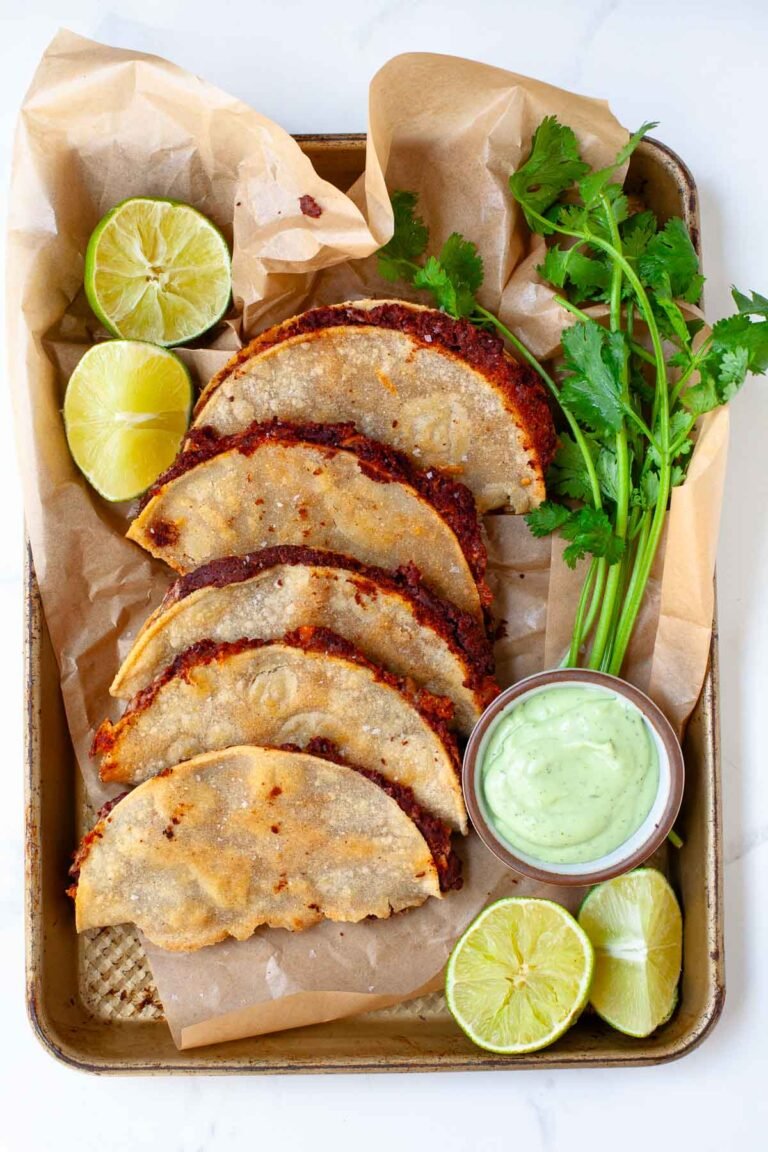
Ready in just 25 minutes, this quick vegetarian meal is about to become a new weeknight favorite. Baked in the oven on a sheet pan, these crispy black bean tacos with cheese are extra delicious when dipped into my tangy Avocado Lime Crema.

Why this recipe is chef’s kiss!

These tacos are a game-changer for busy weeknights.

They’re ready in less than 30 minutes and can be customized with any desired toppings like cilantro, sour cream, avocado, pico de gallo or my corn avocado salsa.

I’ve been taking the extra 5 minutes to whip up this quick avocado lime crema which adds a creamy, tangy twist and takes these tacos to the next level. I love dipping every taco bite into this delicious Greek-yogurt based sauce!

As a registered dietitian, I am always looking to add more plant-based protein to my diet, and these tacos are the perfect recipe to do just that.

With melty cheese and a crispy, crunchy texture from the corn tortillas, this recipe is sure to deliver a nourishing, satisfying meal the whole family will enjoy. Even my three year old approved it!

Ingredients You’ll Need

graphic of ingredients for crispy black bean tacos on white marble surface with black text overlaygraphic of ingredients for crispy black bean tacos on white marble surface with black text overlay

Notes on Ingredients

black beans: Have an earthy, slightly nutty flavor. If you’re using canned black beans (I do!) be sure to drain and rinse them before using.

olive oil: Used to coat the tortillas to contribute to their crispy texture.

taco seasoning: Adds some spice and Mexican flavor.

mild salsa: Tangy, slightly spicy kick, adds freshness to the filling.

lime juice: Provides a zesty, citrusy touch, enhances flavors and adds brightness.

Mexican shredded cheese: Has a creamy, mild flavor, and melts well.

corn tortillas: I like using corn tortillas in this recipe because I find they crisp up nicely. They tend to break pretty easily, but still taste delicious!

Black Beans are nourishing!

As a registered dietitian, I love that black beans are an excellent source of plant-based protein and fiber.

If you want to get specific, they are rich in soluble fiber which has been found to help lower cholesterol by binding with it in the body and preventing it from being absorbed into the bloodstream.

They’re also rich in vitamins and minerals such as manganese, magnesium, potassium, B vitamins, phosphorus, and iron. Woot, woot! Let’s hear it for the beans!

Equipment You’ll Need (affiliate links – if you make a purchase I receive a small commission)

Food Processor

How to Make Crispy Black Bean Tacos

  1. Making filling. In a food processor, add beans, taco seasoning, salsa, and lime juice and pulse until smooth and creamy, about 45 seconds.
  2. Assemble tacos. Place tortilla on greased baking sheet and spread black bean mixture over one side then top with shredded cheese. Fold tortilla over to create a taco. Repeat with remaining tortillas.
  3. Bake tacos. Bake tacos for about 8-10 minutes, then flip them over and bake until golden-brown and crispy, about another 8 minutes. Let cool on the pan for about 2-3 minutes before serving with Avocado Lime Crema and any other desired toppings.

Tips from the expert (thaaaat’s me!)

  1. I use a food processor to incorporate all of the filling ingredients together, but if you don’t have one you can also use a high-speed blender
  2. Corn tortillas break easily. Warming them in the microwave beforehand will help but you may find they crack a little as they cook – they’ll still taste just as delicious!
close up of crispy black bean tacos with avocado lime crema, sliced lime, and cilantroclose up of crispy black bean tacos with avocado lime crema, sliced lime, and cilantro

Storage and Preparation

Leftovers can be stored in an airtight container in the refrigerator for 3-4 days.

Tacos can be stored in an airtight bag or container in the freezer for up to three months. Defrost overnight in the refrigerator before reheating.

To reheat, place in the microwave for about 60 seconds or until heated through. Or, preheat the oven to 350 degrees F and bake on a baking sheet for about 10-15 minutes, or until heated through.

Recipes That Pair Well

Avocado Lime Crema

The Best Mexican Street Corn Dip

Vegetarian Nachos

Corn Avocado Salsa

Blackened Corn

black bean taco dipped into avocado lime cremablack bean taco dipped into avocado lime crema

For more taco inspiration, check out my other recipes below! 

20-Minute Blackened Salmon Tacos with Cotija Cheese

Buffalo Cauliflower Tacos with Ranch Slaw

Instant Pot Jackfruit Tacos

Vegan Butternut Squash and Tempeh Tacos with Salsa Verde

If you like this recipe, please be sure to comment and give it a 5 star rating below. If you make it, share it on Instagram and tag me @karalydonrd and I’ll re-share it with my followers! If you want to save this recipe for later, be sure to pin it on Pinterest!

Don’t ever miss a recipe! Sign up to receive my monthly newsletter with a round-up of recipes from the previous month and get my FREE guide when you sign upRediscover the Joy in Eating: 5 Simple Steps to Stop Stressing Over Food + Enjoy Every Bite


Print

clock clock iconcutlery cutlery iconflag flag iconfolder folder iconinstagram instagram iconpinterest pinterest iconfacebook facebook iconprint print iconsquares squares iconheart heart iconheart solid heart solid icon

Description

Ready in just 25 minutes, this quick vegetarian meal is about to become a new weeknight favorite. Baked in the oven on a sheet pan, these crispy black bean tacos with cheese are extra delicious when dipped into my tangy Avocado Lime Crema.


  • 2 tablespoons olive oil
  • 1 can black beans, rinsed and drained
  • 1/2 teaspoon taco seasoning
  • 1/2 cup mild salsa
  • 1 tablespoon lime juice
  • 1.5 cups Mexican shredded cheese
  • 8–10 corn tortillas
  • 2 tablespoons olive oil
  • Avocado Lime Crema, for serving


  1. Preheat oven to 450 degrees F. Grease a large baking sheet with olive oil.
  2. In a food processor, add beans, taco seasoning, salsa, and lime juice and pulse until smooth and creamy, about 45 seconds.
  3. Place tortillas on a microwave-safe plate and cover with a damp paper towel. Microwave for 1 minute and place in a zipper storage bag so they retain their moisture until ready to use, making them more pliable to work with and less prone to breaking.
  4. Working with one tortilla at a time, place tortilla onto the greased baking sheet, making sure its covered in oil. Spread black bean mixture over one side of the tortilla and top with shredded cheese. Fold tortilla over to create a taco. Flip taco so the side with the cheese is closest to the baking sheet (this will help the taco stay closed). Repeat for the remaining tortillas.
  5. Bake tacos for about 8-10 minutes, then flip them over and bake until golden-brown and crispy, about another 8 minutes.
  6. Let cool on the pan for about 2-3 minutes before serving.
  7. Serve with Avocado Lime Crema and any other desired toppings like cilantro, sour cream, avocado or pico de gallo.

Notes

  1. Corn tortillas break easily. Warming them in the microwave beforehand will help but you may find they crack a little as they cook – they’ll still taste just as delicious!

  • Prep Time: 9 minutes
  • Cook Time: 16 minutes
  • Category: Dinner
  • Method: Sheet Pan
  • Cuisine: Mexican

Cozy Vegan Mushroom Bourguignon | The Full Helping

This cozy vegan mushroom bourguignon is the deeply savory and comforting dish you’ll want to eat all winter long. Mixed mushrooms offer a hearty texture and umami in addition to high nutritional value. The mushrooms are stewed with red wine, garlic, pearl onions, and herbs. The result is in an ultra-flavorful finished dish that can be served over mashed potatoes, polenta, toast, or a cooked whole grain.

When I tasted my first bite of this vegan mushroom bourguignon, I exclaimed “YUM” out loud, alone in my apartment.

I hadn’t been sure about a vegan attempt at this classic dish. I’d thought about making it in the past and had considered a number of ingredients to use in place of boeuf: seitan, tempeh, and so on.

In the end, hearty and earthy mushrooms were the perfect choice for a plant-based expression of the deeply savory, wine-infused, wintery stew.

Of course, you could make the mushroom bourguignon at any time of year, whenever you’re craving wholesome comfort food.

But I think that it’s a perfect dish for evoking coziness through the colder months of the year. It can be a great vegan crowd-pleaser for holiday meals, too. So, let me say a little more about how it comes together.

What is bourguignon?

When you see a recipe for bourguignon, your might immediately hear Julia Child’s lilting voice, exclaiming “boeuf bourguignon!”

In fact, bourguignon isn’t a specific recipe, but rather a preparation style. It includes onions and mushrooms that have been simmered in red wine.

Usually that wine is red Burgundy, hence the classification of this recipe as a Burgundian dish. And the simmering liquid is usually seasoned with a bouquet garni: a cluster of bay leaves, parsley stems, and thyme sprigs.

A protein, like beef or veal, can be added to the stew. Alternatively, if one simmers mushrooms and onions in a savory red wine sauce and pours it over a filet of beef, then the meat becomes beef “à la bourguignonne.”

What stands out to me here is that the vegetables—mushrooms and onions—are what give bourguignon its character.

Bourguignon may have become associated with meat over time, but it’s fundamentally a mushroom dish.

This is why a plant-based expression of the recipe makes so much sense and feels so authentic.

Mushroom bourguignon ingredients

Mushrooms are of course the star of the show in this recipe, but there are a few other key components.

Mushrooms

My bourguignon calls for a pound and a half of mushrooms. This is a lot of mushrooms, of course, but mushrooms cook down so much that it won’t feel overwhelming once the dish is finished.

As a dietitian I’m a big skeptical of the term “superfood.”

However, we can use the word as a means of talking about exceptional nutrient density. In that context, it points us to a lot of worthy plant-based ingredients.

Beans, kale, and beets, for example, are superfoods. And by that definition, mushrooms earn superfood status, too.

Mushrooms rich in phytonutrients that are associated in disease prevention, a well as fiber, folate, Vitamin D, selenium, potassium, and some protein.

Even better, these benefits aren’t limited to a seasonal, rare, or especially expensive type of mushroom. White, or button, mushrooms are sources of the above.

You can use a mix of your favorite mushrooms for the mushroom bourguignon. I almost always use chopped portobello caps, sliced baby Bella, and sliced white mushrooms. Shiitake mushrooms and oyster mushrooms are also delicious additions to the stew.

Pearl onions

Growing up, I always ate pearl mushrooms around the holidays. But why only then? Pearl mushrooms are so sweet and delicious, and I love that it’s easy to find them frozen.

I usually use frozen pearl mushrooms when I make the bourguignon, but you can of course use fresh ones if they’re in season and easy to find.

Red wine

For the record, I don’t pour nice red Burgundy into my mushroom bourguignon, even if that’s the traditional choice!

A dry red wine—preferably something full or medium-bodied—will work just fine in the recipe.

If you prefer not to cook with wine, then you can skip the step in the recipe where wine is added and then cooked down. Instead, add a little extra broth (I give instructions for this in the recipe card).

Broth

Vegetable broth is the type of broth that I keep in my house most regularly. Yet I find it very helpful to also store vegan chicken-style and beef-style broth or bouillon as well.

These types of broth can add distinctive flavor to soups. For example, I really like to use a vegan chicken-style broth in my chickpea noodle soup. And I think that a beef-style broth works best for mushroom bourguignon.

There are a number of vegan beef broth bases out there. Orrington Farms makes one, as does the Gardein brand and Better Than Bouillon.

If you can’t find an option for beef flavoring, then vegetable broth will work well in the mushroom bourguignon, too.

Tomato paste

On first inspection tomato paste might not seem to make sense here. However, it’s included in Julia Child’s classic beef bourguignon recipe, and who am I to question Julia?

Actually, tomato paste really does make sense in the stew: it’s very rich in umami, a savory taste that we tend to associate with protein rich foods. The tomato paste helps to create a rich, salty sauce.

Bragg Liquid Aminos

Also on the topic of umami, and saltiness, Bragg Liquid Aminos adds both to the recipe.

I think that liquid aminos has a distinctive flavor of its own, and for dishes that are supposed to be meat-like, I prefer its unique savoriness to either soy sauce or tamari.

That said, you can definitely substitute soy sauce for liquid aminos if that’s what you have at home.

Herbs

I don’t actually use a bouquet garni in the mushroom bourguignon, though you’re welcome to! Instead, I add chopped fresh thyme and rosemary leaves.

Parsley can be a good addition to or substitute for either of the others.

How to make vegan mushroom bourguignon

This isn’t an ultra-quick recipe to make, but it’s not a difficult recipe to make.

As with making risotto or caramelizing onions, the key here is to summon up some patience and be content with quite a bit of simmering and stirring.

The finished dish is worth it, I promise.

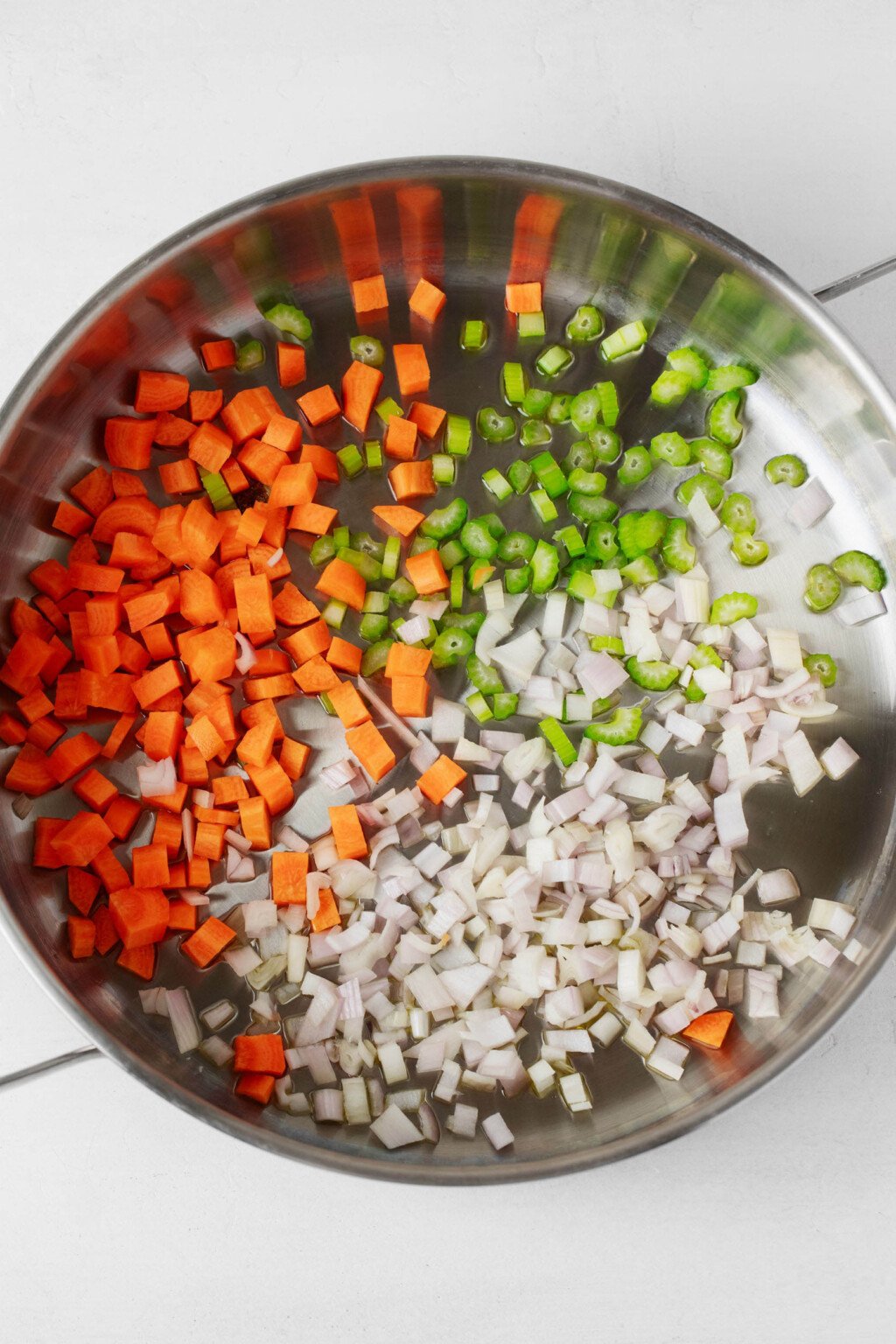
Step 1: Sauté onion, carrot, and celery

Mushrooms and onions aren’t the only veggies in the bourguignon: a traditional soup base of onion, carrot, and celery is included, too.

These vegetables should be sautéed for about six minutes, or until just tender.

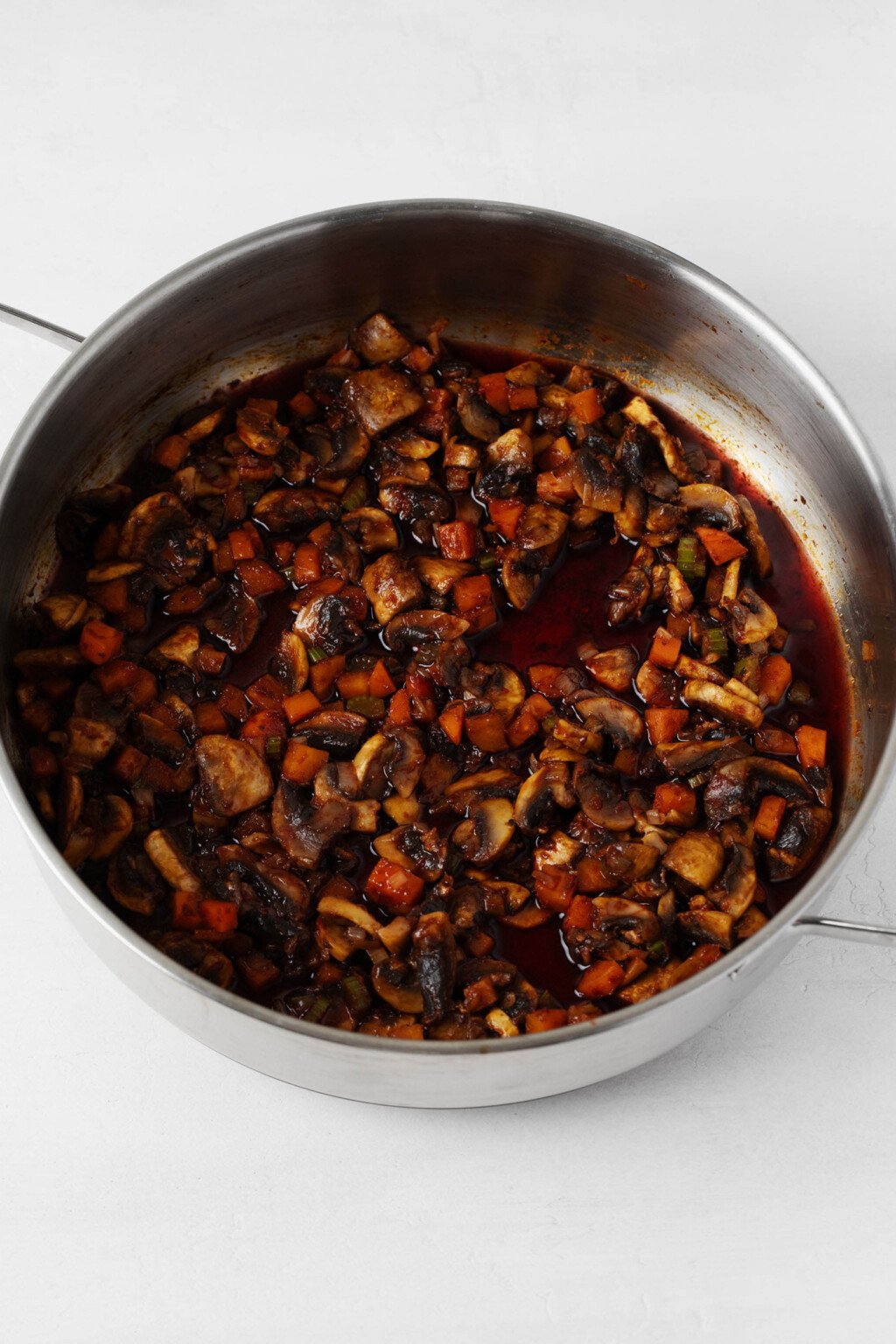
Step 2: Add and cook down your mushrooms

Next, you’ll add your many, many mushrooms to the skillet or pot that you’re using (I like my sauté pan for this).

Cook them down until they’ve released most of their juices and are greatly reduced in size. Next, you’ll stir in the tomato paste, and then deglaze everything with red wine.

The wine should be simmered until it’s reduced by about three quarters. If you aren’t cooking with wine, then you can use a quarter cup of broth to deglaze the pan and move on with the recipe.

Step 3: Add onions, broth, and seasonings to the stew

Next, you’ll add your pearl onions, broth, liquid aminos, and herbs to the skillet. Bring everything to a gentle simmer.

Cover the bourguignon and cook for about 10 minutes, or until the onions are tender. Then, uncover the skillet or pot and allow the stew to simmer for five minutes more. This will thicken the dish a little before you serve it.

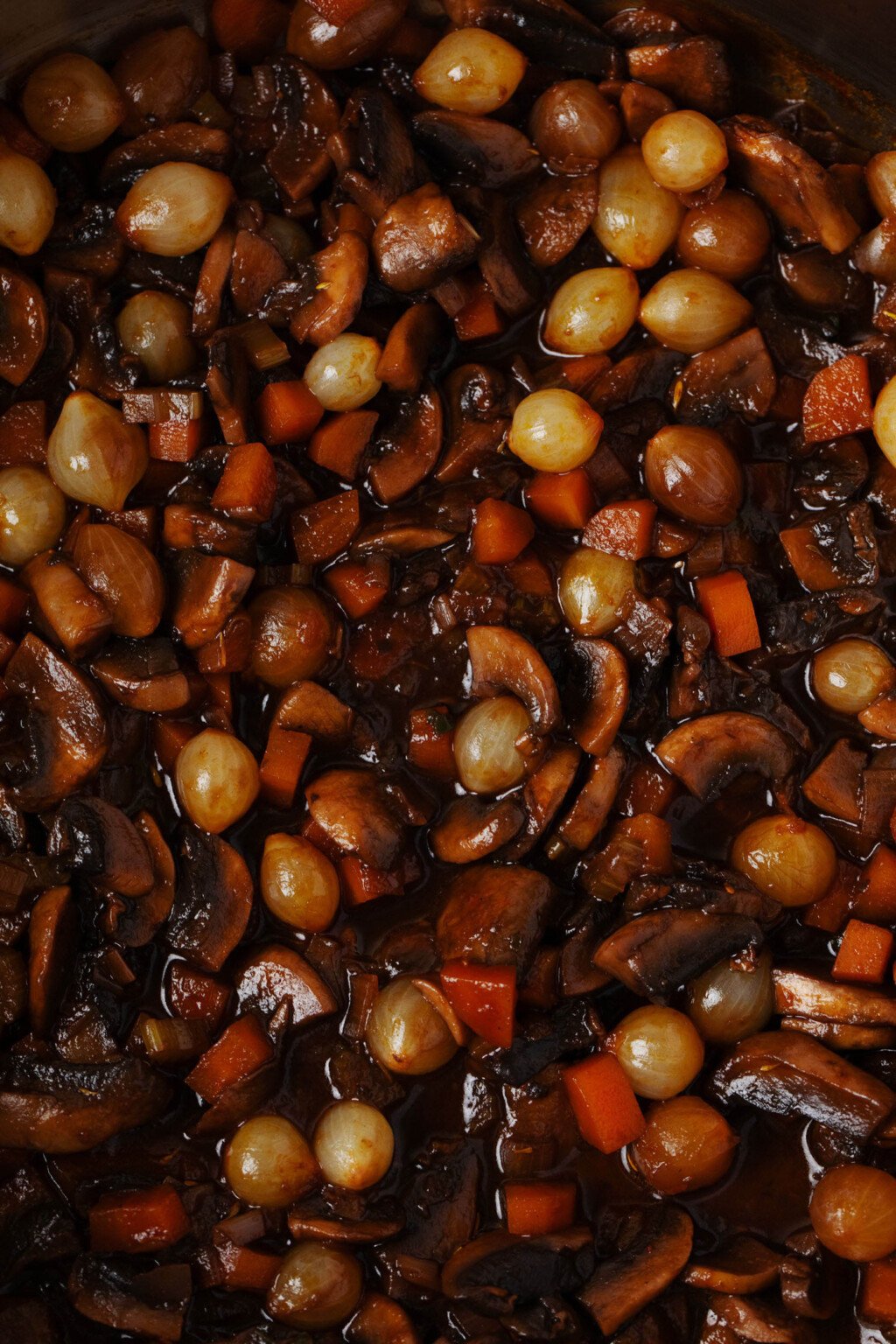
A vegan mushroom and vegetable stew, stained dark red with the addition of wine to the broth, cooks in a large silver skillet.A vegan mushroom and vegetable stew, stained dark red with the addition of wine to the broth, cooks in a large silver skillet.
After adding pearl onions and broth, continue to simmer the bourguignon till you have a unified, thick and hearty stew.

If you’re using pearl onions that are frozen, be sure to thaw them before you make the mushroom bourguignon. If they’re not thawed and drained, they might dilute the stew and prolong its cooking time.

Step 4: Season to taste and serve

Finally, taste the stew and add black pepper. If you like, you can add a little extra liquid aminos.

If the stew is too thick for your liking, you can add a splash of broth. And if you’d prefer it to be thicker, you can simmer it for another five minutes or so, allowing more liquid to reduce.

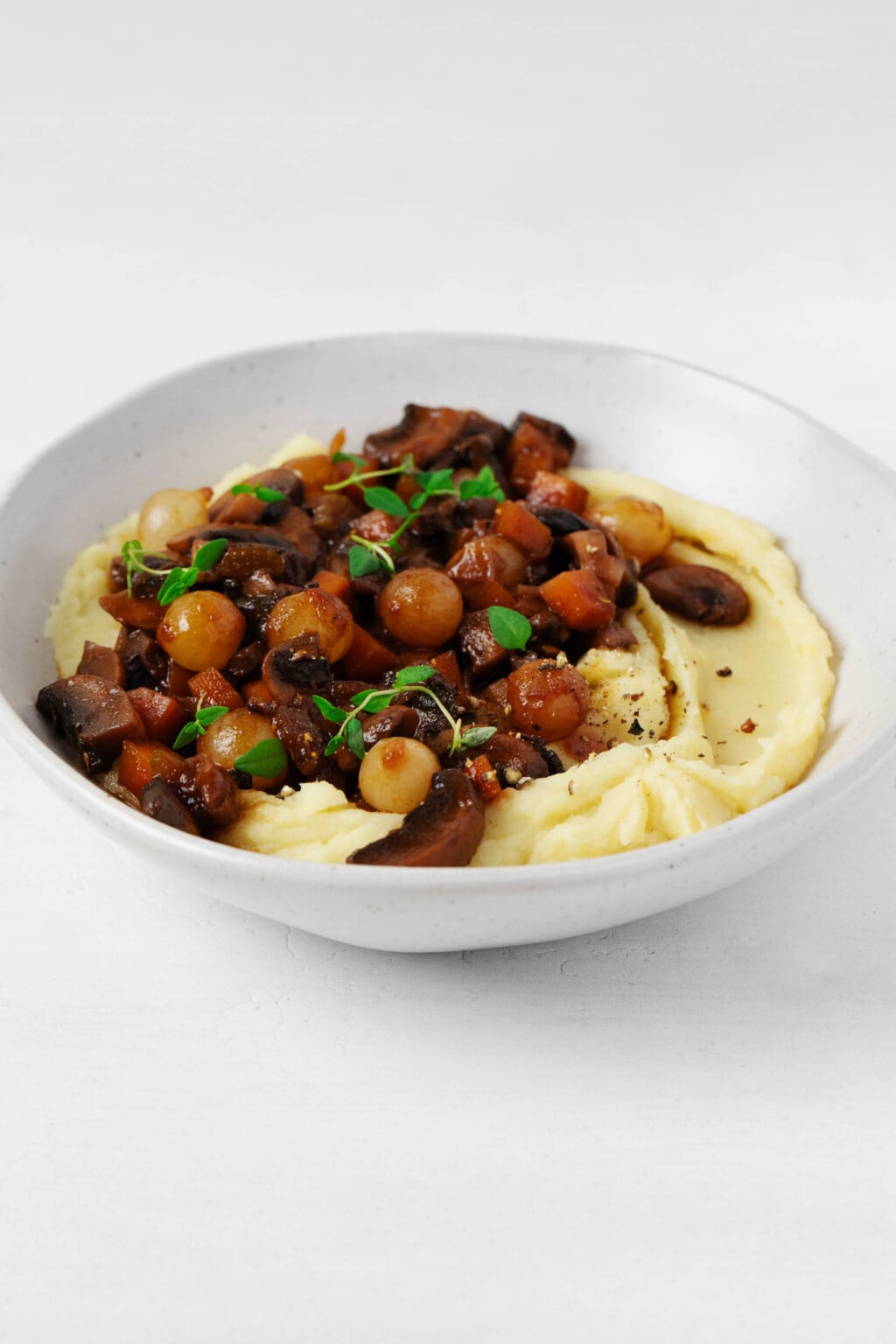
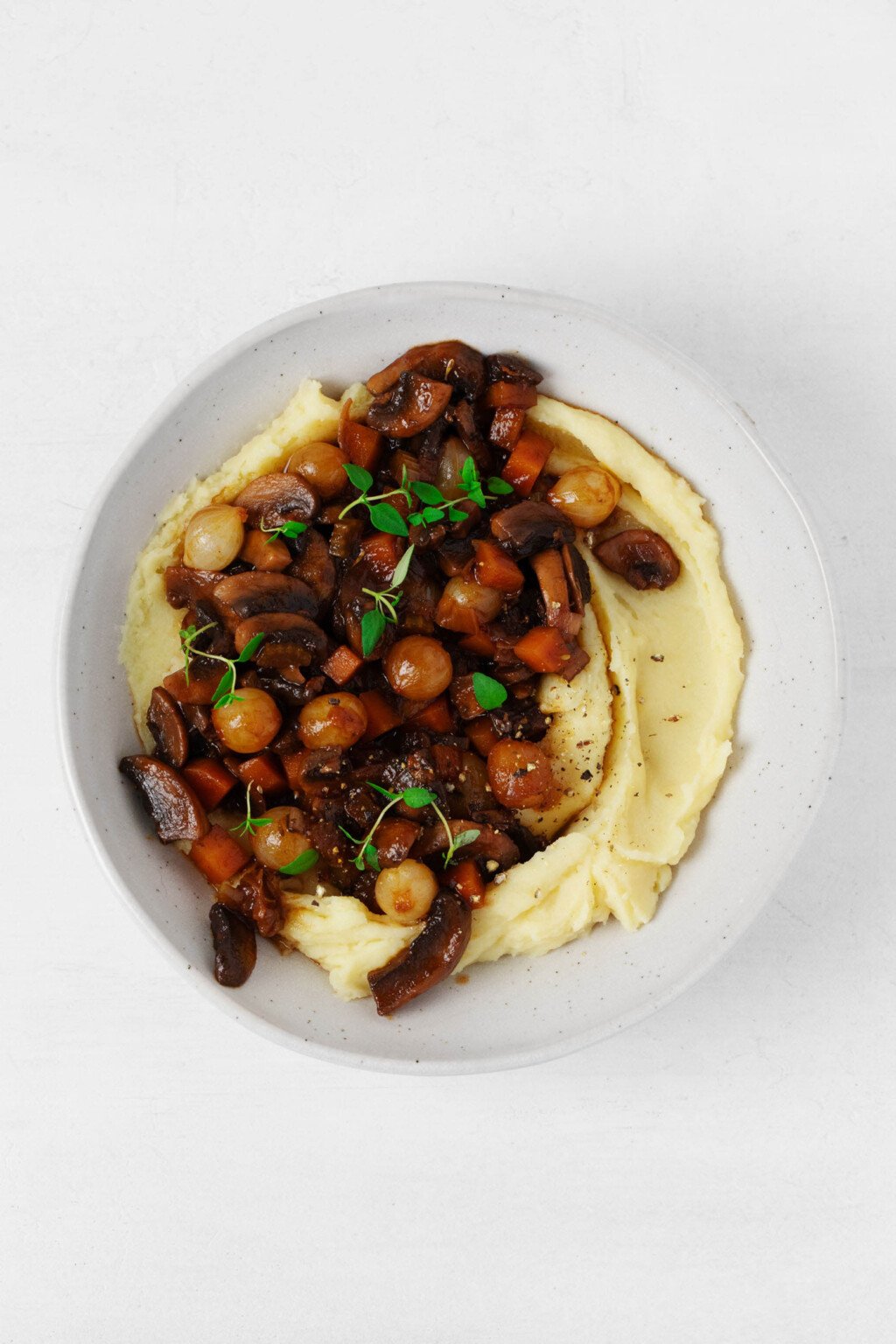
A close-up, overhead image of a hearty vegan mushroom bourguignon with pearl onions.A close-up, overhead image of a hearty vegan mushroom bourguignon with pearl onions.

Serving suggestions

There are many ways to serve the mushroom bourguignon. Here are some ideas:

  • Over mashed potatoes
  • On top of a bed of pasta
  • With a cooked whole grain, like quinoa or farro
  • Over a some soft polenta
  • With a few slices of bread or focaccia

Personally, I like the mashed potato option best. My perfectly fluffy vegan mashed potatoes are a pillowy base for the stew, and they complement its comfort food energy.

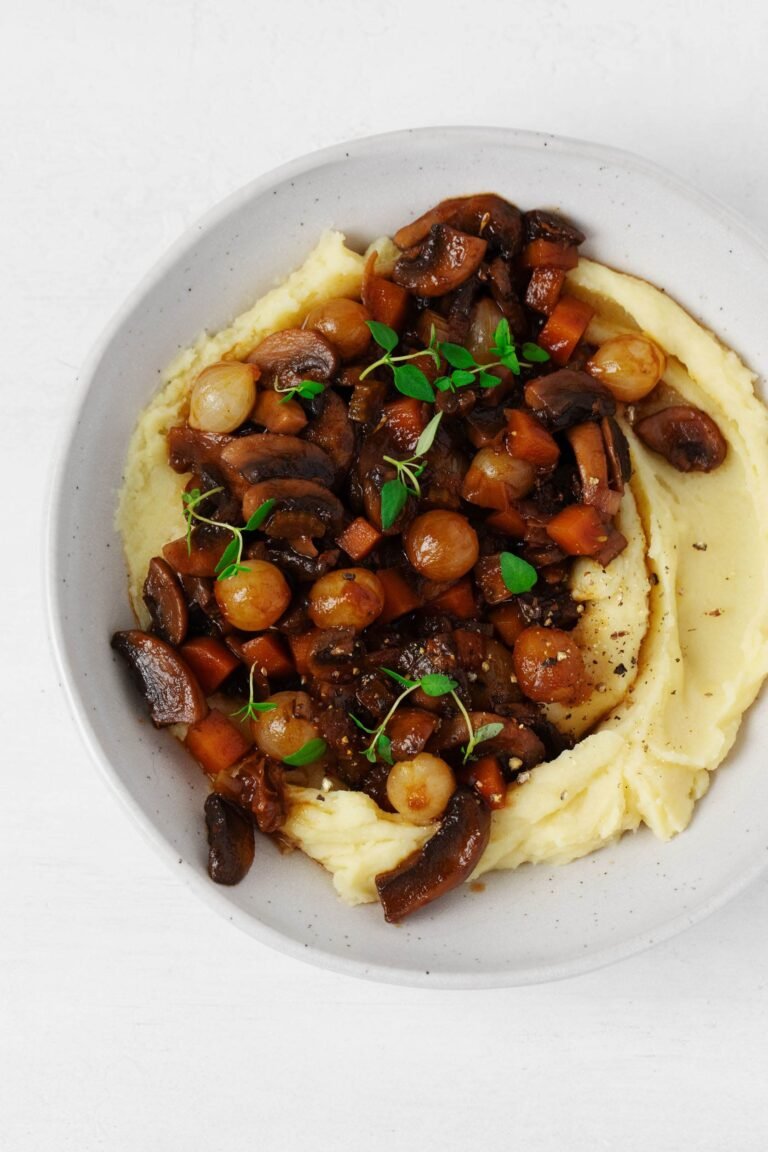
An overhead image of a dish of mashed potatoes, which have been topped with a vegan mushroom bourguignon.An overhead image of a dish of mashed potatoes, which have been topped with a vegan mushroom bourguignon.

Meal prep & storage

Mushroom bourguignon, like most stew recipes, is great for making ahead. You can store it in an airtight container in the fridge for up to five days and freeze it for up to eight weeks.

The dish becomes even more flavorful as you store it.

An overhead image of a dish of mashed potatoes, which have been topped with a vegan mushroom bourguignon.

Prep Time: 20 minutes

Cook Time: 45 minutes

Total Time: 1 hour 5 minutes

Yields: 4 servings

  • 2 tablespoons olive oil
  • 3 shallots, chopped (substitute 1 yellow onion, chopped)
  • 2 stalks celery, trimmed and chopped
  • 2 carrots, trimmed, cleaned or scrubbed, and chopped
  • 4 cloves garlic, minced
  • 1 1/2 pounds cleaned mushrooms of choice (I like to use portobello caps, sliced baby Bella, and sliced white mushrooms) (680g)
  • 2 tablespoons tomato paste
  • 1 cup red wine* (240ml)
  • 1 1/2 tablespoons Bragg Liquid Aminos or tamari
  • 2 teaspoons fresh thyme leaves (substitute 1 teaspoon dried thyme)
  • 1 tablespoon chopped fresh rosemary leaves (substitute 1 1/2 teaspoons dried rosemary)
  • 1 1/2 cups vegetable or vegan beef-style broth (360ml)
  • 1 1/2 cups pearl onions, fresh or frozen (thawed and drained prior to using)
  • Freshly ground black pepper, to taste
  • Fluffy vegan mashed potatoes (optional, for serving; alternatively, soft polenta or pasta)
  • Heat the olive oil in a large, deep, lidded skillet, sauté pan, or heavy-bottomed pot over medium heat. Add the shallots or onion, celery, and carrots. Sauté these vegetables for 5-6 minutes, stirring often, or until the onions is translucent and carrots are becoming tender. Add the garlic to the skillet and sauté for one more minute, stirring often.

  • Add the mushrooms to the skillet. Cook, stirring once every minute or so, for 10-15 minutes, or until the mushrooms have released their juices. They will be tender and greatly reduced in size.

  • Stir in the tomato paste. Add the red wine to the skillet and continue cooking the vegetables, stirring occasionally, for 8-10 minutes, or until the wine has reduced by about three quarters.*

  • Add the broth, liquid aminos or tamari, thyme, rosemary, and onions to the skillet. Bring the mixture to a simmer, then turn the heat to low. Cover and simmer the mushrooms for 10 minutes, or until the onions are tender. Uncover and simmer for another five minutes, or until the stew appears thick and hearty.

  • Taste the mushrooms and add freshly ground black pepper to taste. Add a little extra liquid aminos or tamari if additional salt is desired.

  • Serve the mushrooms over mashed potatoes (alternatively, over soft and creamy polenta, a whole grain of choice, or pasta), and enjoy.

*If you prefer not to cook with wine, then skip adding the wine in the third step of this recipe. Instead, add an additional 1/4 cup / 60ml broth to deglaze the pan. Rather than waiting for the liquid to reduce, you can move on right away to step 4.

An overhead image of a dish of mashed potatoes, which have been topped with a vegan mushroom bourguignon.An overhead image of a dish of mashed potatoes, which have been topped with a vegan mushroom bourguignon.

I love this recipe so much, and I’m already thinking about when I’ll make it again (maybe Christmas Eve?).

It’s joining my mashed potato bowls with tempeh gravy, skillet lasagna, and chickpeas à la king in the category of favorite comfort food classics, made vegan.

I hope you’ll feel the same!

xo

How to overcome barriers to better health

0

“I just bought a new BPA-free tupperware set.”

This comment, coming from my friend Anna, caught me off guard.

Anna’s a highly competent law professional. She’s a critical thinker and she fights in the heavyweight division when it comes to cutting through BS.

But the Anna I knew was falling into some painful traps that seemed to be bypassing her inner hawk-like skeptic.

She’s wanted to lose around 15lbs for some time now and came to me to share how stuck she was feeling in this goal.

She brought up an avenue she was exploring: the new BPA-free tupperware set.

“Interesting. What inspired you to focus on that?” I asked.

“Well, I’ve been reading about how microplastics in food containers can mess up our hormones and cause weight gain,” she said.

I squinted.

To backtrack, this is right after she told me how she’d been struggling to be consistent at the gym, had been relying on takeout too often, and had been sacrificing boring old sleep for adrenaline-inducing doom scrolling.

So I asked:

“What about trying to get more consistent with your workouts, or prepping more homemade meals during the week?”

And Anna said:

“Yeah, but I’ve tried that a thousand times. If it were that simple, it would have worked already.”

We’ve all done this before.

Ignored or delayed those hard-but-worthwhile habit changes in favor of some ultra-specific, niche magic bullet that’s supposed to “change everything.”

Spent hours of research on the ultimate, most optimal workout instead of devoting those hours to just doing the basic workout you already know how to do.

Waited to feel more inspired, motivated, or just less busy.

Why do we do this?

Buying new gear or a popular supplement feels like making progress.

Consuming YouTube videos or articles about stuff you can change feels like you’re doing something.

And waiting until the “right time” feels, well, right.

Except, nothing actually changes until we take real, consistent action.

We’re clever, us humans. And we’ve come up with lots of sneaky ways to avoid the basic, unsexy, difficult actions we need to take that actually drive change.

In this article, we’ll explore how to take an honest and compassionate look at why you might be distracting yourself from taking impactful action.

You’ll learn:

  • What the most impactful health habits actually are
  • Three common barriers to making sustainable progress
  • A 4-step process you can apply to start taking positive, productive action
  • How to keep yourself consistent—and achieve your goals

The stuff you know you should do (but probably aren’t doing consistently)

We all know what those basic, fundamental health habits are:

▶ Exercising, ideally 30 minutes a day, putting in moderate-to-vigorous amounts of effort, with a mix of aerobic and resistance training.

Eating mostly nutritious, minimally-processed foods. If 80 percent of your diet comes from whole or minimally-processed foods, you’re doing an excellent job. (Translation: “Perfection” isn’t required; pizza can be part of a healthy diet.)

Eating enough protein to support muscle mass, appetite regulation, and body recomposition goals, if you have them. Aim for about 1.2 to 2.2 grams of protein per kilogram of body weight (for most people, this adds up to about 4-6 palm-sized portions of lean protein per day).

▶ Prioritizing getting seven to eight hours of quality sleep. You can’t always control how well you sleep, but having some wind-down time before bed can help, as can waking up at the same time every day.

Avoiding or at least reducing excessive consumption of alcohol or drugs, including cigarettes. No fun, we know. But it’s for a good cause.

Easily, we could add stuff like prioritizing positive, nurturing social relationships, managing stress, and probably others, but just the above list is uncommonly met.

In fact, only six percent of Americans perform all five of the following basic health behaviors:1

  • Meet physical activity recommendations
  • Don’t smoke
  • Consume alcohol in moderation (or not at all)
  • Sleep at least seven hours
  • Maintain a “normal” BMI

If you’re doing the math, that means close to 94 percent of Americans aren’t doing the basics.

Yet, these foundational behaviors also help us achieve a long list of common goals, whether that’s reaching a healthy weight, improving athletic ability, or just living a longer, healthier life.

So why do we struggle so much to do them?

Here are three common barriers we see among clients (and coaches!), plus potential solutions to overcome them.

By the way, ambivalence is normal.

That push-and-pull feeling you have when you think about making a change?

It has a name, and it’s called ambivalence.

Ambivalence describes the mix of feelings you have when you contemplate, say, waking up earlier so your mornings are less stressful, or cutting down on TV time.

We naturally and normally feel ambivalence about change—“I want this, and at the same time, that.”

(For example, wanting to eat healthier, and also wanting to have your favorite treats whenever you want without constraint.)

We also naturally and normally feel resistance towards change—“I want this, and at the same time, not.”

(For example, wanting to stop using your phone as a mindless distraction, but not wanting to deal with the anxiety you get whenever you’re left with your own thoughts.)

These contradictory emotions can seem frustrating, puzzling, or “illogical.” Yet, ambivalence and resistance are fundamental parts of the change process.

The higher the stakes of change, the more likely we are to feel a mix of strong and unexpected emotions, pushback, rebellion, angst, and other types of resistance and ambivalence.

Rather than signaling that the change is a wrong move, strong ambivalence and resistance tend to signal that this change matters to us.

In a sense, it’s good news.

It tells us we care.

Basics Barrier #1: You have ambition overload.

Maybe you’ve decided you want to be healthier. So you declare that, starting Monday, you’re going to exercise for an hour everyday and “eat clean” at every meal and sleep eight hours every night.

(Currently, you don’t have a regular exercise habit, don’t particularly like vegetables, and regularly stay up past midnight.)

Now, let’s be honest: You’re asking yourself to change a lot of stuff at once.

And the last time you created an elaborate plan for overhauling your life…

… Did it work?

Probably not.

(And that’s okay.)

When we feel frustrated or stuck in our current situation, making a plan filled with idealistic dreams can provide us temporary relief.

And our brain has several (normal) cognitive biases that prevent us from judging the future accurately.

We often think we’ll have more time, energy, attention, and motivation in the future than we really do.2 3 4 5

There’s a powerful, instantaneous comfort that comes with overloading our future self. (Because after all, we won’t start the plan until Monday.)

The problem with this is:

Big, complex plans often don’t fit into our already busy, complex lives.

We under-estimate how many smaller tasks are hidden in the bigger plans.

When we (almost inevitably) are unable to execute these ambitious goals, we blame ourselves, our personality traits, our “willpower” or “discipline,” and build a pitiable story about how we “struggle with consistency.” Or how living this way is “impossible”.

Then, sadly, we fulfill that prophecy.

Basics Barrier #2: You think only hardcore, “industry-secret,” or “cutting-edge” stuff works.

This barrier comes from the following common belief:

“If getting healthy just took eating, sleeping, and exercising moderately well, then everyone would be healthy.”

Because everyone knows they should eat their vegetables, get seven to eight hours of sleep per night, and stay active, right?

(We’d agree.)

But let’s go back to the previously mentioned statistic:

Only 6 percent of Americans are consistently performing the most basic health and fitness behaviors.

If we add on slightly more advanced—but still very basic—behaviors like eating five servings of fruits and vegetables every day, optimizing protein intake, and effectively managing stress, that number would shrink significantly.

So, the first thing is to believe that these simple behaviors work. Because they do. It’s just that most people (probably close to 99 percent of us) are not doing them all simultaneously and consistently.

The second thing is to accept that these simple behaviors are a little bit boring. Because they are. Part of the reason we’re attracted to new diets or “magical” supplements is because we just want something more interesting to try.

That’s especially true if we’ve already sort of tried the “eat more vegetables” thing and it didn’t “work” for us in the way we expected.

With something new and cutting-edge, there’s also the possibility of a new outcome, a new us.

And of course, that’s incredibly appealing.

Thing is, most hardcore, “industry secret,” or “cutting edge” tools and strategies are, respectively: unsustainable, inaccessible, or ineffective (or unproven).

They’ll take your effort, your time, and often your money, but without giving you a good return on your investment—all the while distracting you from the stuff that actually works.

Basics Barrier #3: You think your efforts (and your results) have to be perfect.

Another lie in the health and fitness industry is that you have to be “perfect” to maintain great health. You know, eat only organic salads and chia seeds, be able to run a marathon, and wake up at 5 am every day to meditate and write in your gratitude journal.

The truth is, perfection definitely isn’t required.

Depending on how you look at this, this could be a relief to hear, or a disappointment.

On the one hand, it’s nice to know that you don’t have to have it “all together” to be healthy—even above-average healthy.

On the other hand, many of us pursue better health with the belief that our optimal or even “perfect” self will one day, with the right plan or routine, be attainable.

But “perfect” health is an illusion.

Humans, even exceptionally healthy ones, get sick, get weird rashes, have digestive problems, need reading glasses, get into slumps, or just otherwise have a series of bad days.

None of us are “safe” from those life events, and accepting that can feel a little… vulnerable.

It’s much more comfortable to believe that if you just take this powdered algae supplement, or follow this specific morning routine, you’ll be immune to any kind of painful human experience.

The irony is, to achieve your realistic “best self,” you probably have to accommodate your “worst self” too. You know, the one who’d rather watch another episode of Love is Blind than work out, or eat a party-size bag of Doritos and call it dinner.

Because life happens.

Work gets busy.

Or your kid goes through a “phase.”

Or it’s pie season.

Any number of obstacles, distractions, and competing demands make it impossible for perfection to be maintained with any kind of consistency.

Which is why we need to let go of the illusion that a “perfect” self exists—the one who always has the energy, will, and option to make the ideal choice—and support what our real self wants and needs.

We’ve got four steps below to help you.

4 steps to start taking effective (and realistic) action

Now that we know what’s potentially getting in the way of taking productive action, here are four steps to get unstuck.

Step #1: Explore the why before the how.

Before you (or a client) start undertaking something you want to change, it’s helpful to understand your deeper motivations first.

Do a little investigating by asking questions like:

  • What about this change is important to you?
  • How serious or pressing is this for you?
  • Why not continue doing what you’re already doing?

You can also go through one of our favorite motivation-mining exercises, The 5 Whys.

When you know why you want to change something, and you’re clear on the consequences of not taking action, you’ll be more likely to feel that deeper, more sustaining push to keep going, even when things get tough.

Step #2: Prioritize the most effective actions.

We can do all the things!! Really!! We just can’t do all the things… all at once.

Effective change means being able to realistically:

  • Identify all the tasks, trade-offs, and commitments involved
  • Prioritize what matters for the results you want
  • Figure out what to do first

What are the essentials in relation to your goal? Regardless of all goals, they likely include a movement practice, a nutrition practice, and/or a recovery practice.

If you want some guidance on how to select the most effective action for your goal, check out our Skills, Practices, and Daily Actions Cheat Sheet.

Here’s how to use it:

▶ Start with the domain you’re most interested in improving (such as “Nutrition” or “Stress”).

▶ Then, get specific about what skill within that domain you’d like to improve (for example, “Eat well intuitively”), plus the practice that most appeals to you within that skill (say, “Eat to satisfied”).

▶ Lastly, choose a daily action from the list of examples under your chosen practice. (For example, “Record hunger and fullness levels at the start and end of meals.”)

Once you choose your action, make it work for you by following step 3, below.

Step #3: Make sure you can take action, even on your worst day.

“I like to challenge a client to set a pathetic goal. If it’s so pathetic, then obviously you can do it, right?” says Kate Solovieva, PN Super Coach and Director of Community Engagement.

Sound inspiring?

Maybe not.

But if you’ve been struggling with consistency, it’s exactly where to start.

Ask yourself:

  • What can I do on my absolutely worst day where everything goes wrong? How much time, effort, or enthusiasm will I realistically have?

Five minutes of walking? 10 push-ups? One extra portion of veggies? Three conscious deep breaths before every meal? Nothing is too small; it just has to be something.

Now you’ve got your floor.

Then ask yourself:

  • What can I do on my best day, when I feel on top of the world and circumstances are on my side? How much time, effort, or enthusiasm will I realistically have?

One-hour of all-out effort at the gym? Two hours of meal prep that will feed you and your family for the next three days? A 45-minute guided meditation?

This is your ceiling.

Now that you’ve identified your “floor” and your “ceiling,” you’ve defined a flexible range of actions that can adapt to your fluctuating, unpredictable, real life.

But applying this range requires a paradigm shift:

Your health habits aren’t an “on” or “off” switch; they’re on a dial.

When life is sweet and smooth, you can turn your exercise, nutrition, and sleep dials way up—if you want. Bust through your PRs at the gym, eat all the arugula, meditate like a monk.

But if life gets nuts, you don’t have to switch off completely.

Just turn the dial down a little.

The below is a visual representation of how this might work for exercise, but you can apply this same thinking to your nutrition, sleep, stress management, or whatever you’re working on.

The important part: Even if you do your “floor” or “dial level 1” action—even if it’s for days on end—it still “counts.”

You still get the gold star.

Doing the bare minimum isn’t failing.

It’s succeeding, in the context of a real, messy, beautiful life.

Step #4: Create an ecosystem that supports you.

Health and fitness professionals often forget how different their lives are from their clients.

For example, many coaches work at gyms, enjoy being physically active, and hang out with other active people. Exercising regularly is almost easier to do than not do, because, as Coach Kate says, “they’ve built a life that makes that habit seamless.”

So if you want to make your health goals more likely, Coach Kate offers this advice:

“Build an ecosystem that makes failing nearly impossible.”

When they want to make a change, many people assume that good intentions and willpower will be enough to carry them through. (And when they fail, naturally, they blame themselves for being “bad” or “weak.”)

We often forget about the context and environment that shapes our behaviors—making certain actions more likely or less likely to occur.

A recent review from Nature Reviews Psychology ranked different behavior change strategies and found that access was the number one influencer of people’s behaviors. (People who lived in neighborhoods with affordable grocers close by ate better, just like people who had to drive a long distance to the closest gym were less likely to exercise.6)

Not everyone can change neighborhoods, but most people have some degree of control over their more immediate environments, and can leverage this power to shape desired behaviors.

One example is the “kitchen makeover,” where you make sure foods you want to eat are washed, prepped, and at the front of the fridge, ready to eat on a whim. Meanwhile, foods that don’t support your goals get tossed, or relegated to the highest cupboard. (When you need a stepladder from the basement to reach the cookies, you might find you eat them less.)

(If you want to try it out, check out our Kitchen Set-up Assessment worksheet.)

Think about the goal you want to achieve, and the behaviors that support it. Then, evaluate how you might make small changes to your environment by:

  • Using a trigger: Sometimes called a “cue” or a “prompt,” a trigger is simply a reminder to do a desired action. For example, you might block the door of your home office with a kettlebell, reminding you that, every time you leave or enter the office, you have to do ten kettlebell swings. If you’re trying to cut down on mindless phone time, you can install an app that reminds you to shut things down after 20 minutes on social media.
  • Decreasing “friction”: Supermarkets put candy next to the checkout, making it easy to slip that chocolate bar into your cart while you’re standing in line, likely bored and hungry. You can be equally sneaky about encouraging positive behaviors too, such as putting fruit on your counter, ready for a quick snack, or packing your gym bag the night before, so it’s ready to grab on your way out the door before you change your mind.
  • Constraining available options: Whether it’s deleting time-sucking apps off your phone, removing foods you know you lose control around from your kitchen, or heck, creating a capsule wardrobe so you waste less time in the morning getting dressed, constraint can actually free up a lot of time, brain power, and energy.

Invest your energy building the ecosystem that nudges you to make desired actions the obvious choice. This requires a little more work on the front end, but the payoff will be greater for less overall work.

Embrace C+ effort.

If you’re a perfectionist, or a former straight-A student, that line hurt to read.

(Don’t worry. This C+ won’t result in your parents telling you that they’re disappointed.)

But what all of the above barriers and solutions have in common, is that they recognize and work with our inherent imperfection.

None of us is perfect, and expecting as much often results in failure (or at best, short bursts of success, followed by a crash).

Adopt an attitude of compassion and acceptance towards your human self—who’s most likely trying their hardest—and work with your vulnerabilities, instead of constantly expecting yourself to grit your teeth against them.

There will be times you’re getting “A’s” in fitness. That’s awesome. And you also don’t need to aim for C+. Just don’t think of yourself as a failure when you have to dial it down.

Living a healthy, meaningful life means constantly striving to do our best—while also allowing for flexibility, mistakes, and bad days (or seasons).

You’ll be surprised at how much better “good enough” is than nothing. Especially in the long run.

References

Click here to view the information sources referenced in this article.

If you’re a coach, or you want to be…


You can help people build sustainable nutrition and lifestyle habits that will significantly improve their physical and mental health—while you make a great living doing what you love. We’ll show you how.


If you’d like to learn more, consider the PN Level 1 Nutrition Coaching Certification. (You can enroll now at a big discount.)

Bokashi Composting: An Ultimate Step-by-Step Guide

Composting kitchen leftovers is one of those things that not just reduce wastage but provides essential nutrients to your garden.

But, urban gardeners may find it difficult. Most people think about compost pile but hesitate due to concrete jungle and lack of space.

Traditional composting can feel a bit intimidating, especially with the smells, the turning, and the “no meat, no dairy” rules.

That’s where Bokashi composting comes in and totally changes the game. It’s a super simple, low-maintenance method that lets you recycle almost all of your kitchen waste—including stuff like meat, cheese, and cooked leftovers. No more tossing scraps in the trash and feeling guilty!
Originally developed in Japan, Bokashi works through fermentation instead of the usual rotting or decomposition.

All you need is a sealed bin, a sprinkle of Bokashi bran, and your daily food scraps. The process happens in an airtight container, which means no odors and no bugs—perfect for small spaces or even under the kitchen sink.

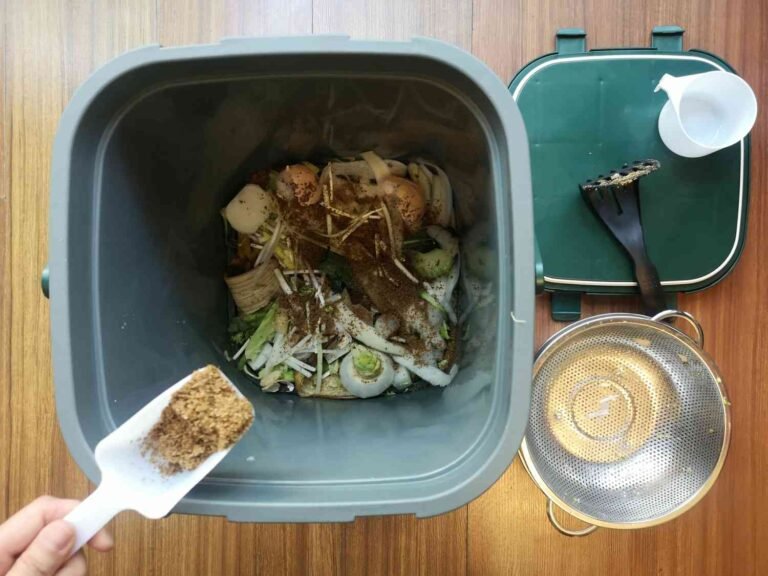
Bokashi composting starts by adding food scraps to a special airtight bin. Each time you add waste, you sprinkle Bokashi bran on top and press it down to remove air.

Once the bin is full, you seal it and let it sit for about two weeks to ferment. After that, the contents can be buried in soil, where it quickly breaks down and feeds your plants.

How Does Composting Benefit the Soil?

Composting does more than just reduce kitchen waste—it helps bring tired soil back to life.

As organic matter breaks down, it releases essential nutrients like nitrogen, phosphorus, and potassium. These are crucial for strong, healthy plant growth.

What makes compost so valuable is its slow-release nature. It feeds plants gradually over time, unlike synthetic fertilizers that act quickly and then fade.

Compost also improves the structure of the soil. It helps the ground retain moisture and allows air to circulate better around plant roots.

Another big win? It boosts beneficial microbial life in the soil. These microbes support root development and help fight off harmful diseases.

Over time, regular composting turns dry, compacted dirt into rich, dark soil full of life and energy—exactly what plants need to thrive.

Check this: How to Make Compost at Home Using Kitchen Waste?

What Is Bokashi Composting?

Bokashi composting is a special method that uses fermentation—not decomposition—to break down food waste.

It relies on Effective Microorganisms (EM), a mix of good bacteria and yeasts, to kick-start the process. These microbes are combined with a dry carrier like bran, sawdust, or wheat husks to make what’s called Bokashi bran.

The process happens in a sealed, airtight container. Each layer of food waste you add is sprinkled with Bokashi bran to keep fermentation active.

Unlike traditional composting, Bokashi doesn’t need oxygen. It’s an anaerobic process, which means no turning, no smells, and no mess.

The microbes work by fermenting the food scraps, not rotting them. This helps preserve nutrients and creates a stable, pre-compost material.

Once the fermentation is complete, the mixture can be buried in soil, where it quickly finishes breaking down and enriches the earth.

Bokashi is fast, compact, and super efficient—perfect for small spaces and busy households.

Bokashi Composting vs. Traditional Composting

The biggest difference between Bokashi and traditional composting is how the waste breaks down. Traditional composting relies on oxygen and a balanced mix of browns and greens. It generates heat and can take several months to turn scraps into usable compost.

Bokashi works very differently. It doesn’t need turning, outdoor space, or even oxygen. Instead, it ferments food in a sealed bin using beneficial microbes. This process is much faster and cleaner—and it doesn’t smell.

Another bonus? Bokashi can handle things like meat, dairy, and bread—foods you normally can’t compost. The result isn’t finished compost right away but a fermented mix that needs to be buried in soil to fully break down.

How to Make Bokashi Compost?

Getting started with Bokashi composting is surprisingly simple and doesn’t require a big setup or special skills.

With just a few basic supplies and a little routine, you can turn your daily kitchen scraps into a nutrient-rich soil booster—right from your countertop.

Step 1: Gather the Right Supplies

Before you get started, you’ll need a few basic supplies. The most important is a Bokashi bin with an airtight lid and a drainage spigot to collect the liquid. You’ll also need Bokashi bran, which is available for purchase or can be made at home.

This bran contains beneficial microorganisms that kickstart the fermentation process. A masher or pressing plate will help you compress the food waste to remove air pockets, and it’s a good idea to chop food scraps into smaller pieces to speed up fermentation.

Also Read: How to Build a Compost Bin with Pallets?

Step 2: Prepare the Bin

Start by sprinkling a thin layer of Bokashi bran at the bottom of the empty bin. This layer activates the microbes, setting up the bin for fermentation.

Every time you add a new layer of food waste (around 1–2 inches thick), sprinkle 1–2 tablespoons of Bokashi bran on top to ensure an even fermentation.

The bran helps to break down the waste quickly and keeps odors in check. Repeat this process as you continue adding food scraps, creating layers of food and bran.

Step 3: Add Food Waste in Layers

Once your bin is ready, begin adding your kitchen scraps gradually—try to keep the layers around 1–2 inches thick. After each layer of food, sprinkle more Bokashi bran on top.

Press down each layer firmly to remove any air pockets, as Bokashi fermentation works best in an anaerobic (oxygen-free) environment. The less air in the bin, the better the process will be. Continue this daily layering routine until the bin is full.

Step 4: Keep It Airtight

After adding your food scraps and bran, always make sure to seal the lid tightly. The Bokashi microbes need an anaerobic environment (no air), so leaving the bin open or allowing it to be exposed to air could disrupt the fermentation process.

Avoid opening the bin too frequently to ensure that the conditions remain stable. By keeping the lid sealed, you maintain the right environment for fermentation.

Step 5: Drain the Liquid Regularly

Every couple of days, drain the liquid that collects at the bottom of the bin. This liquid, known as Bokashi tea, is rich in nutrients and beneficial microbes.

It’s essential to remove this liquid regularly to prevent excess moisture from accumulating and potentially spoiling the contents of the bin.

The tea can be used for plants (diluted with water) or poured down drains to help with cleaning. Keep an eye on the liquid levels and make sure to drain it consistently.

Step 6: Let It Ferment

Once the bin is full, it’s time to let it rest undisturbed for about 10–14 days. During this time, the Bokashi microbes will continue breaking down the food waste through fermentation. While the bin rests, you should still drain the Bokashi tea every few days.

As fermentation progresses, the contents will start to smell pickled, and you may notice some white mold growing on the scraps—this is completely normal and part of the process.

Once the waiting period is over, the food waste will be fully fermented and ready to be used in your garden or compost bin.

Also Read: How Do You Make Worm Tea Fertilizer?

How to Use Bokashi Compost in the Garden?

Once fermentation is complete, the material is ready to be incorporated into soil. It won’t look like finished compost—it’s still recognizable food, just fermented. But once mixed with soil, it breaks down rapidly.

Dig a trench 6–8 inches deep in your garden, flowerbed, or large pot. Empty the fermented material into the trench, mix it lightly with soil, and then cover it with soil. Within two to four weeks, the microbes in the soil will break it down fully, enriching the earth and feeding your plants.

You can also add Bokashi pre-compost to your outdoor compost pile to boost microbial activity and speed up decomposition. If you have limited space, bury it in planters or containers that will sit undisturbed for a few weeks.

How to Maintain Your Bokashi Properly?

A well-maintained Bokashi system should have little to no odor and work smoothly with minimal effort. The key is consistency.

Keep your bin sealed tightly when not in use. Always press down food scraps to remove air and add enough Bokashi bran with each layer.

Monitor moisture levels—if the contents are too wet, add some shredded newspaper or dry bran to absorb excess liquid. Drain the Bokashi tea every few days to keep conditions ideal for fermentation.

Clean your bin thoroughly between batches to avoid cross-contamination or buildup of bad bacteria. A rinse with vinegar or mild soap usually works well.

Troubleshooting Bokashi Issues

If something goes wrong, don’t worry—most issues are fixable.

Foul Odors: If your bin smells rotten or putrid, the fermentation has failed. This is usually due to too much air exposure or not enough Bokashi bran. Start a new batch and be more generous with the bran.

Green or Black Mold: This is a sign of spoilage, not fermentation. Healthy fermentation produces white mold, which is harmless. Discard spoiled batches and clean the bin before restarting.

Leaking Liquid or Soggy Contents: This happens when food is too watery or the bin isn’t drained often enough. Use dry scraps when possible and add absorbent material if needed.

Flies or Pests: These are rare in sealed bins but can occur if the bin is opened too often or left unsealed. Always secure the lid and store the bin in a cool, shaded place.

Other Ways of Using Bokashi Compost

Bokashi isn’t just for gardens. The fermented material can be used in several creative ways.

Soil Reviver: Mix the fermented waste into tired soil and let it sit for a few weeks. This revitalizes the soil and prepares it for new planting.

Potted Plants: For container gardening, bury small amounts of Bokashi compost in pots and allow it to break down before planting. It’s a fantastic way to recycle kitchen waste into nutrient-rich potting soil.

Worm Bin Additive: Once the material has had time to ferment, you can add small amounts to your worm bin. Just introduce it gradually to avoid overwhelming your worms.

Compost Booster: Add Bokashi to traditional compost heaps to introduce beneficial microbes and speed up the overall composting process.

How to Make Bokashi Tea?

Bokashi tea is a byproduct of the fermentation process. It contains water-soluble nutrients and beneficial microbes, making it useful for your plants and even your drains.

To collect it, open the spigot on your Bokashi bin every 2–3 days and let the liquid drain into a container. Use it fresh—it’s most effective within 24 hours.

For plants, dilute the tea with water at a 1:100 ratio (1 tablespoon per liter of water). Water the base of your plants—never the leaves—as the undiluted tea is acidic. You can also pour it undiluted down kitchen or bathroom drains to keep them clean and odor-free, thanks to its antimicrobial properties.

Conclusion

Bokashi composting is a quick, easy, and space-saving way to transform kitchen scraps into nutrient-rich soil conditioner.

By using beneficial microbes and fermentation, you can compost almost any food waste without the mess or odor typically associated with traditional composting.

Whether you have a full garden or just a few plants on a balcony, Bokashi helps you create a sustainable cycle between your kitchen and soil.

Once you get the hang of layering and fermenting, it becomes a seamless part of your routine, offering huge benefits for your plants, soil, and the environment.

Easy Air Fryer Cod


Easy Air Fryer Cod


Privacy & Cookies Policy

BBQ Salmon Tacos (15 Minute Meal)

BBQ salmon tacos are sweet, salty, tangy, crunchy and the ultimate weeknight meal. Ready in 15 minutes, these salmon tacos with bbq sauce have just 8 ingredients (all pantry/fridge staples). This is the recipe for people who don’t love the taste of salmon but know they should eat more.

After you try these barbeque salmon tacos, you should also make honey chipotle salmon (it’s sweet and spicy) and this simple salmon with mango salsa recipe. Both of these recipes are ready in 15 minutes and incredibly simple to make.

Three barbecue salmon tacos on a plate, a bowl of slaw and bbq salmon in the background.Three barbecue salmon tacos on a plate, a bowl of slaw and bbq salmon in the background.
This post contains affiliate links. As an amazon associate I earn from qualifying purchases. Click here to read my policy and more about affiliate links.

BBQ salmon taco highlights

  • Easy to make
  • 15 minutes
  • 8 ingredients
  • Great summer recipe
  • Easy weeknight dinner

Ingredients spotlight

  • Salmon – use skin on or skin off salmon. If the salmon has the skin on, cook it that way, then the skin will slide off after cooking.
  • BBQ Sauce – be sure to use your favorite bbq sauce, it’s what gives this recipe all the flavor. I personally love the Organicville BBQ Sauce, it’s so sweet and pairs perfectly with the salmon.
  • Greek yogurt (or dairy free plain yogurt) – this makes for a tangy, creamy slaw dressing. If you don’t love the idea of using Greek yogurt, you could also use mayo.

How to make salmon bbq tacos

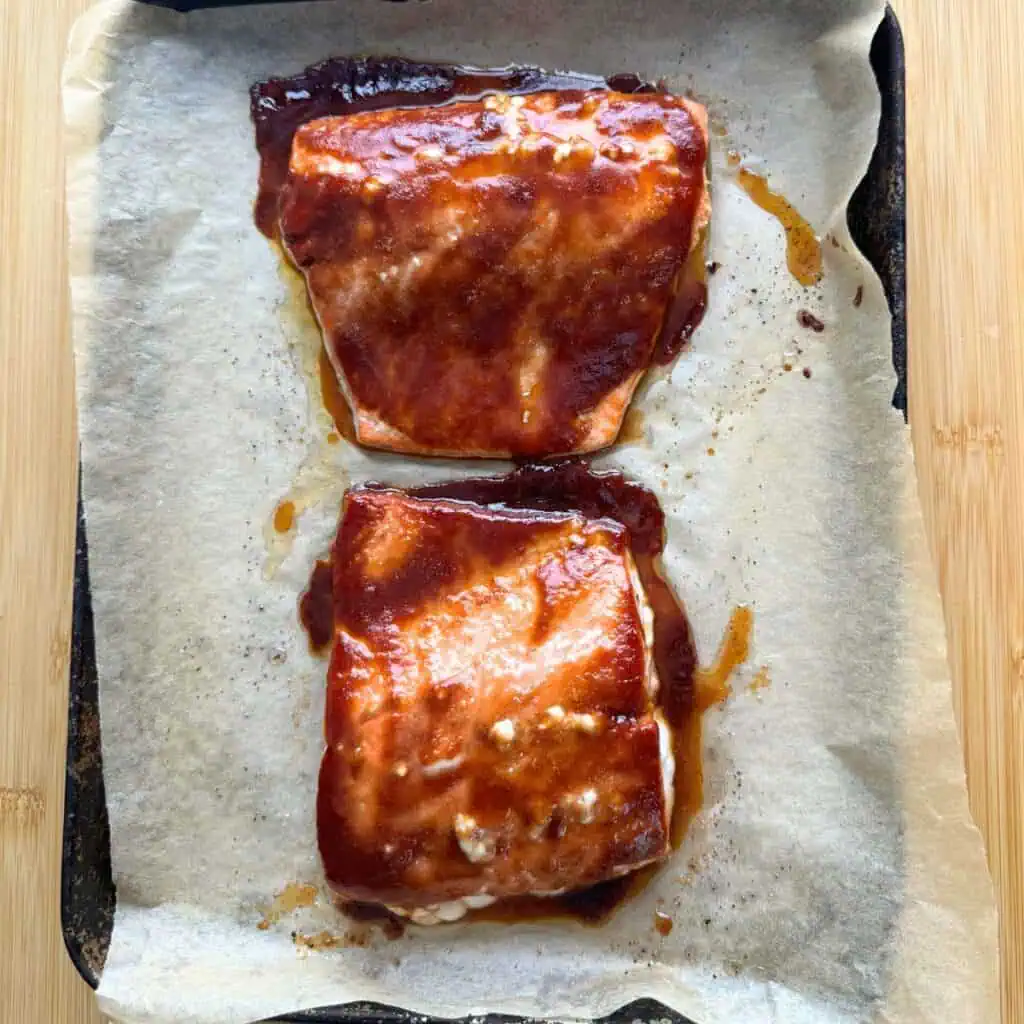
Preheat the oven to 425F. Place salmon (skin side down) on parchment paper lined baking sheet. Coat with salt, garlic powder and 2 tablespoons of bbq sauce. Bake at 425F for 12 minutes.

BBQ salmon after baking in the oven.BBQ salmon after baking in the oven.

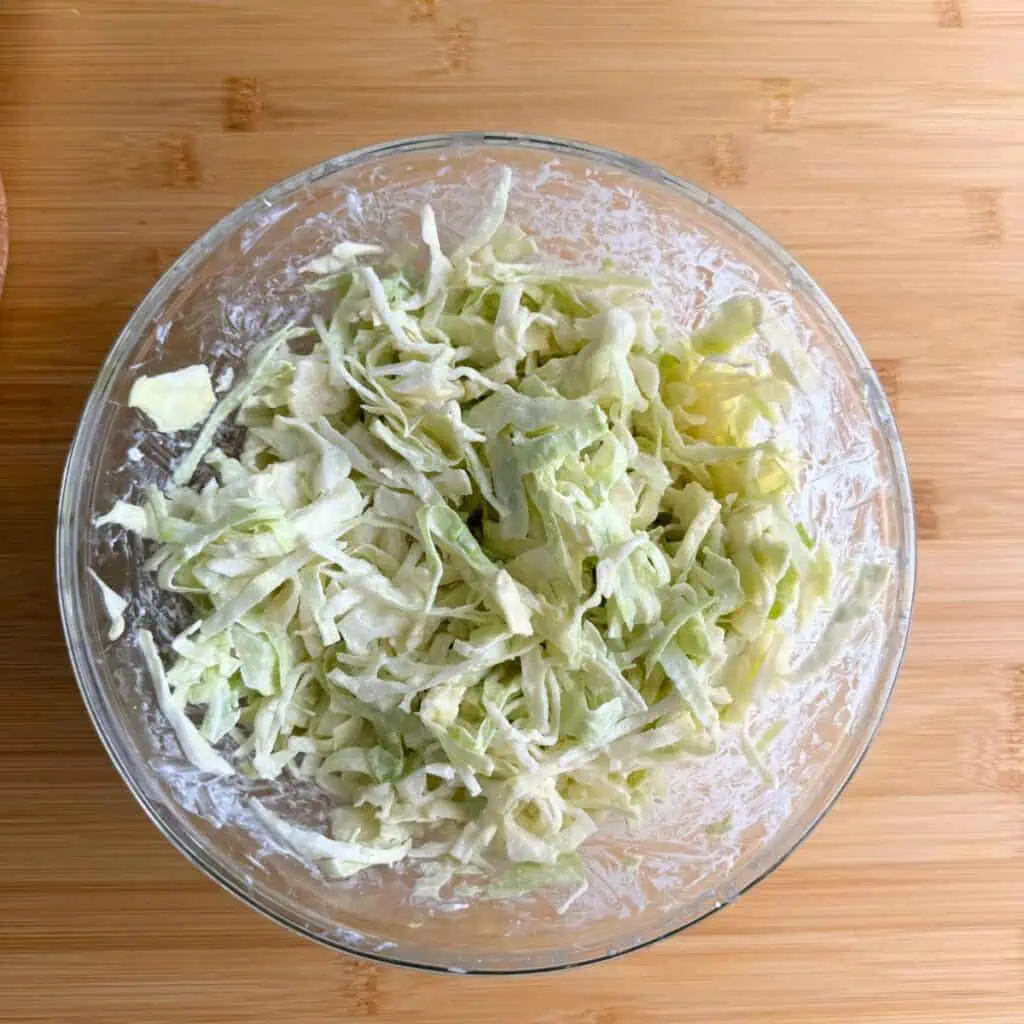
While salmon is cooking, make the slaw.  Start by making the dressing in a large bowl (simply whisk together the Greek yogurt, apple cider vinegar, salt and garlic powder). Thinly slice the cabbage and add it to the yogurt mixture. Toss well with tongs until fully coated.

Greek yogurt slaw in a glass bowl.Greek yogurt slaw in a glass bowl.

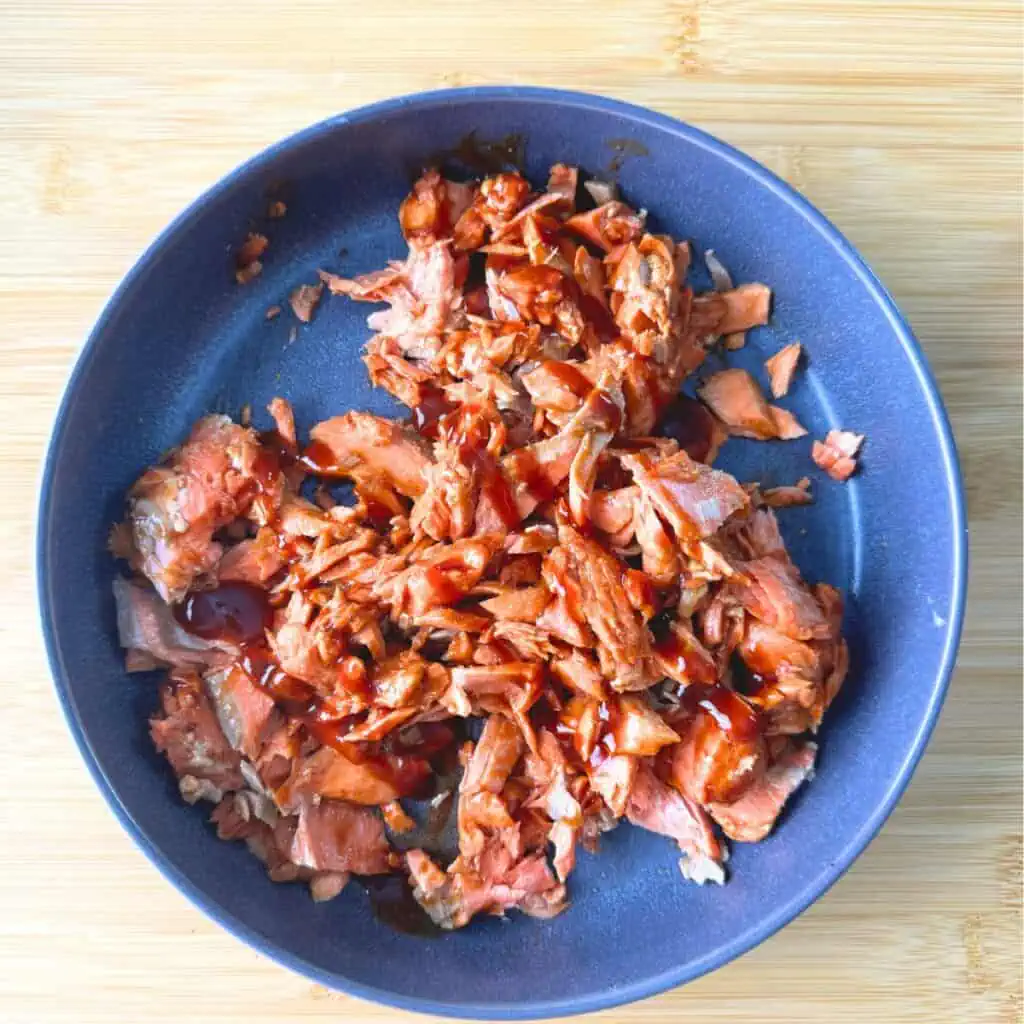
When salmon is done cooking, take it out of the oven and pour ¼ cup of bbq over the salmon. Flake it with a fork.

Salmon flaked in a blue bowl, bbq sauce poured over the top.Salmon flaked in a blue bowl, bbq sauce poured over the top.

Tip: To ensure your soft taco tortillas are pliable, warm them up for 1-2 minutes in the oven or on the stove top over medium low heat.

Assemble your tacos: Add slaw, bbq salmon, sliced avocado and any other toppings you enjoy. I recommend pouring just a little more bbq sauce over top and serving.

Don’t feel like turning on the oven?

Use the air fryer! You can cook the salmon in the air fryer, be sure to add the bbq sauce to the salmon before cooking. You could also make air fryer salmon bites, which cook in just 6 minutes if you are short on time!

Hand picking up a bbq salmon taco from a white plate.Hand picking up a bbq salmon taco from a white plate.

Other additions

  • Sliced jalapeno (add to tacos or add to the slaw)
  • Pickled red onions
  • Thinly sliced radish
  • Sliced green onion
  • Mango salsa
  • Cilantro

Other ways to enjoy this recipe

  • Serve as a taco bowl instead of tacos with some black beans and rice
  • Use bbq salmon on salad instead of in tacos
  • Serve bbq salmon and slaw with sweet potato fries for a whole new meal

Best way to store leftovers

Store the salmon and slaw separately in airtight containers. Reheat the salmon in the oven, in a toaster oven or in a skillet over medium low heat until warmed through. Assemble the tacos (don’t forget to add some extra bbq sauce) and enjoy!

★ Did you make this recipe? Please give it a star rating below!

  • 1.25 pounds salmon
  • 1/2 cup bbq saucedivided
  • 1/2 tsp salt
  • 1/2 tsp garlic powder
  • 2 medium avocado
  • 8-12 small tortillasI used almond flour
  • Preheat the oven to 425F.

  • Place salmon (skin side down) on baking sheet lined with parchment paper. Sprinkle salmon with salt and garlic powder then pour 2 tablespoons of bbq sauce over. Use the back of a spoon to push the bbq sauce around, fully coating the salmon.

  • Bake salmon in 425F oven for 12 minutes.

  • While salmon is baking, make the slaw. Combine greek yogurt, salt, garlic powder in a large bowl. Whisk well to combine.

  • Thinly shred the cabbage (or take a shortcut and use bagged slaw mix). Add cabbage to bowl with yogurt dressing and toss well with tongs until fully coated.

  • When salmon is done baking, take out of the oven and pour 1/4 cup of bbq over top. Flake salmon with fork.

  • Assemble the tacos adding slaw, bbq salmon, and avocado to tacos. Drizzle remaining bbq sauce over the top.

Tips:

  • If you don’t want to use greek yogurt in the slaw, you can use mayo. 
  • To make your tortillas more pliable, put them in the oven for 1-2 minutes.
  • Make sure you really love the flavor of the bbq sauce you are using, it’s really the main flavor. I love Organicville BBQ sauce.  

Don’t want to turn on the oven? Use the air fryer! 
Cook the salmon in the air fryer, be sure to add the bbq sauce to the salmon before cooking. You could also make air fryer salmon bites, which cook in just 6 minutes if you are short on time!

Nutrition Information

Nutrition Facts

Amount per Serving

Where does nutrition info come from? Nutrition facts are provided as a courtesy, sourced from the USDA Food Database.

Let others know by rating and leaving a comment below!

My Balancing Morning Routine (and How to Create Your Own)

0

Years ago I shared our family’s morning routine and how I juggled toddlers, preschoolers, and crazy days. Now with teenagers in the house, my mornings have gotten a little slower. Yes, my kids still practice gymnastics in the house, and we recently added a bird to the pet menagerie, but I still have some quiet time to myself.

Mornings used to be the busiest time of day for me—kids to feed, school, chores, and a quick workout (if I could fit it in). I prioritized getting up 30 minutes early to get a little self-care and hygiene in before the kids got up. Since then, I’ve switched my mindset when it comes to my morning routine. Now, I see it not as a to-do list, but as a sacred space. A chance to tune into my body.

A Morning Routine Rhythm

I want to take you behind the scenes of my actual morning routine. Not because I think it’s perfect or that you should copy it step for step. Everyone is at a different stage, but doing even just a few healthy habits in the morning can give you a positive start to the day. This morning routine has helped me reconnect with my body, feel more energetic, and reset my nervous system. Think of this as inspiration, not instruction. Some of these might be things you already do. Others might be tiny tweaks that cause big shifts.

So let’s walk through what I do before I check a screen, before coffee, and what my non-negotiables are.

Light + Minerals: My Morning MVPs

Before I do anything else (yes, that means coffee!) I step outside within 30 minutes of waking up. Ideally I’m barefoot and I usually have a jar of mineral-rich water in hand.

This one shift, simple as it is, has been the most transformative. It’s free, it’s easy to try, and it’s about syncing your body with what it already knows how to do: wake up with the sun.

Why Sunlight First?

Getting natural light in the first 30-60 minutes after waking helps reset your circadian rhythm. This is the internal clock that regulates everything from sleep cycles to hormone balance. Early sunlight helps your body know, “Hey, it’s morning,” which supports melatonin suppression and a healthy rise in cortisol. I track my health metrics and I’ve noticed the biggest shift simply by adding healthy light.

There’s been a lot of talk about cortisol recently, but it’s not all bad. The goal isn’t to lower it across the board, but to regulate it. Cortisol is meant to spike in the morning and gradually taper off and morning sunlight is the trigger for this.

Studies show early sun exposure can improve sleep, support mood, and regulate blood sugar and metabolism. With our screen-saturated, indoor-centric modern lives, these simple, primal cues are often missing. I think of this as more of a bio-harmonizing practice than a biohack. We’re not upgrading the body, but helping it support itself.

 Hydration (With Minerals)

Someone wise once said, we’re basically houseplants with emotions. Just like our hormones need light to function, our cells crave water. While I’m soaking up sunlight I like to rehydrate. I’ll keep a quart jar of water on my nightstand within easy reach. Some days it has salt in it, other days I use fulvic/humic minerals or a blend of magnesium, potassium, and sodium.

Here’s why: we lose water and minerals during sleep, mostly through our breath. That’s why you often weigh slightly less in the morning. You didn’t burn fat overnight (unfortunately), you just lost water. Replenishing our minerals supports:

  • Cellular hydration
  • Energy production
  • Nervous system balance
  • Healthy muscle and nerve function

Magnesium is a big one for me. Statistically, most of us are deficient in magnesium and sodium. These also happen to be two of the most essential minerals for our cells to function.

I take Magnesium Breakthrough in the morning (I’m what’s called an inverse modulator, so I do better with magnesium in the a.m. Many people prefer it at night). I also keep salt water and minerals on my nightstand so I can hydrate before even leaving the bedroom.

Detox Your Mouth Before Your Inbox

Next, I focus on oral care. Since our oral health is so closely tied with health in general, this is one thing I really try to prioritize. I like to say I detox my mouth before I detox my inbox. I’ll start with oil pulling, rinse with saltwater, tongue scrape, then brush and floss.

Our oral microbiome is the front line of our gut health. We talk a lot about the gut microbiome but rarely about the mouth, yet they’re intimately connected. Imbalances in oral bacteria have been linked to everything from bad breath to cardiovascular issues to cognitive decline.

Oil pulling is an ancient Ayurvedic practice. While clinical research is limited, I have noticed my teeth feel cleaner and look whiter when I do it consistently. Tongue scraping helps remove overnight buildup of bacteria and dead cells and might even support gut health downstream.

A gentle reminder: if you oil pull, spit in the trash or outside, not down your sink. Your plumbing will thank you!

Gentle Movement & Lymph Support

While I do prioritize exercise, this isn’t my workout for the day. This is about gently waking up my body and supporting the lymphatic system. Unlike the heart, the lymph system doesn’t have a pump and relies on movement. Morning is the perfect time to get our drainage and detox network flowing after a night of stillness.

Here are a few lymph supportive things I rotate through. I don’t do all of these every morning, I just focus on what my body feels like it needs at the moment.

  • Rebounding on a mini-trampoline)
  • Lymphatic self-massage on all the drainage points
  • Dry brushing (I usually do this before a shower)
  • Fascia release or mobility flow (like CARS)
  • A simple 10-minute walk outside (also a great way to get morning light!)

I’ve also found that gentle fascia work in the morning helps release stored tension. If you’ve ever read The Body Keeps the Score, you know emotions can get “stuck” in the body. Gentle stretching, rolling, or sound therapy can help shake off that emotional residue before the day begins.

Supplements on an Empty Stomach

Once I’ve moved and hydrated, I take a few supplements that work best on an empty stomach. These include magnesium, Masszymes (or other enzymes), and Pectasol (modified citrus pectin).

Why these?

  • Magnesium supports hundreds of biochemical processes in the body—stress response, detox, muscle recovery, and more. Most people are deficient, and it’s one I think is beneficial across the board.
  • Proteolytic enzymes, taken without food, may help break down inflammatory proteins, support immune modulation, and assist in recovery. I used these heavily when healing from autoimmune issues and still find them helpful.
  • Pectasol binds to excess Galectin-3, an inflammatory marker. It also binds to heavy metals and environmental toxins. I learned about it from Dr. Isaac Elias and find it helpful in calming inflammation and supporting detox pathways.

Protein and Fiber For Blood Sugar Support

Before coffee, I try to eat a solid breakfast with at least 40 grams of protein and a healthy dose of fiber. This is one of the newer shifts I’ve made, and it’s been a game changer. Not only have I noticed better energy levels and hormone balance, but it helps with mood, focus, and blood sugar regulation.

Considering the typical American breakfast is basically dessert (with a healthy dose of caffeine), this can be a significant positive change that affects the whole day.

My breakfast go-tos include things like:

  • Pastured eggs
  • Grass-fed meats or seafood
  • Fiber-rich veggies like artichokes, sauerkraut, cucumbers
  • A smoothie with beef isolate or whey protein, collagen, and chia seeds

Collagen adds glycine and proline, which support skin, joints, and gut health. Studies even suggest that combining collagen with protein improves muscle synthesis after a workout.

I also wait a bit before drinking coffee, which I do most days (but not all). Caffeine on an empty stomach can spike cortisol and lead to crashes later. Waiting 60–90 minutes after waking, eating, and hydrating helps caffeine work for you, not against you. This also gives your adenosine levels (which regulate sleepiness) time to reset.

When I do drink coffee, I often blend it with other things that nourish my body. These can include collagen powder, functional mushrooms, healthy fats, and adaptogens, like ashwagandha or cacao.

Breakfast Supplements

Some supplements I take first thing on an empty stomach, but others I take with food. During breakfast I’ll grab B vitamins (methylated for better absorption), omega-3s, and choline. After genetic testing, I found that I personally feel best taking extra choline. Experiment and tweak your supplements to take what your body needs!

Fat-soluble vitamins like D, K2, A, and E are best absorbed with fat containing meals, so breakfast is my delivery window for those as well.

The Power of Not Doing

Honestly, one of the most impactful parts of my morning isn’t what I do, but what I don’t do. No screens. No work. No reactive mode. Not until I’ve checked in with my body first.

This boundary alone has improved my focus, clarity, and creativity. Studies suggest that screen exposure in the first 30 minutes of waking increases anxiety and lowers productivity. So for me, it’s worth the delay.

A Bonus Tool: Ice Water Face Dunk

This one’s not a daily habit for me, but a creative and effective reset: dunking your face in a bowl of ice water for 10–30 seconds. It activates the mammalian dive reflex, which slows heart rate and helps activate our parasympathetic nervous system for more calm.

Some other benefits include:

  • De-puffing the face
  • Increasing alertness
  • Supporting vagus nerve tone
  • Mimicking some benefits of cold exposure, without the full-body stress

If you’re not up for a cold plunge, this might be a more approachable alternative. While I do cold therapy plunges sometimes, I do skip them at certain times of my cycle.

The Bigger Picture of a Morning Routine

It’s not about doing everything every day, and I’m not suggesting you need to either. It’s not about building the “perfect” morning routine, but creating margin in your morning. Creating space to check in with your body before the world checks in with you.

Some days that looks like 90 minutes of morning rituals. Other days it’s just water, sunlight, and breath before diving into the day. Start where you are and try just adding one simple thing and see how that feels. It doesn’t need to be overwhelming!

Even if you have little ones running underfoot, taking 2 minutes to breathe and set your mind for the day can have a huge impact. And take the kids outside with you to run around while you sip your mineral water! It’s often the simplest shifts that can have the biggest impact.

What does your morning routine look like? What would you like to add to it (or stop doing!)? Leave a comment and let us know!

How to Use Straw Mulch in the Vegetable Garden

The right mulch can do wonders to improve your veggie garden.

Straw in particular offers a wide range of benefits that can make a drastic difference for the health and productivity of plants while saving you money and reducing labor.

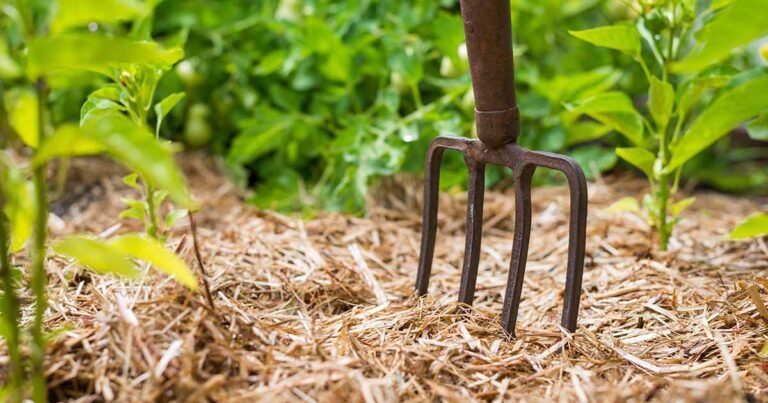
A close up horizontal image of a gardening fork set upright in the veggie garden.A close up horizontal image of a gardening fork set upright in the veggie garden.

Continue reading to learn more about using straw mulch in your vegetable garden.

What Exactly Is Straw?

Before going into the advantages of using straw to mulch your vegetable garden, it is useful to understand what exactly it is that you will be working with.

“Straw” refers to the dry stalks that are left behind after crops such as barley, rice, oats, or wheat have been harvested. After the heads are removed to make grain, the stalks are dried and bundled in bales.

A close up horizontal image of bales of pine straw set on the ground next to a vegetable garden.A close up horizontal image of bales of pine straw set on the ground next to a vegetable garden.

These bundles can be broken up and applied to the garden as mulch, or used as a material that is layered on the soil surface in a garden to provide a number of benefits to growing plants.

Benefits to the Garden

Straw is an ideal mulch material for many reasons. It is light and easy to work with, fairly inexpensive, and readily available from local farms and garden centers.

It helps regulate moisture and temperature, reduces necessary weeding, and builds healthy soil. All of this equals less labor for you!

Let’s take a closer look at the benefits:

Lock in Moisture

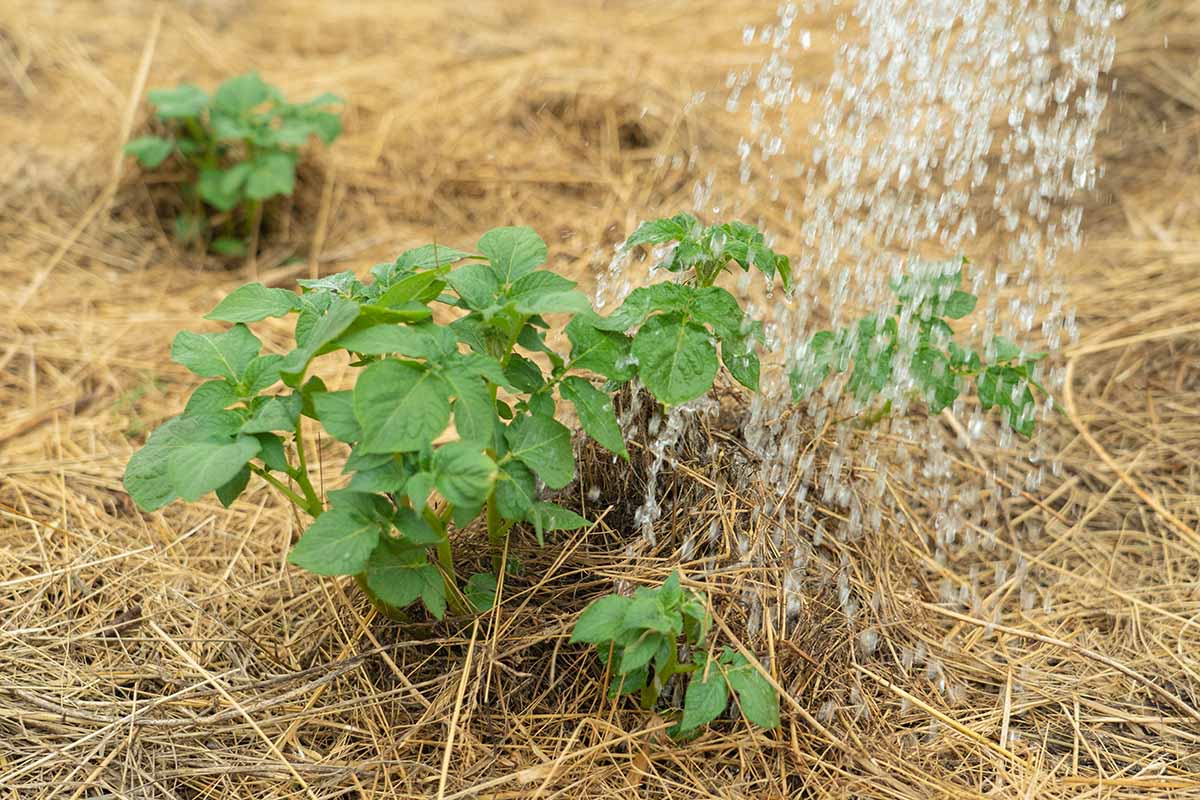
Straw is particularly beneficial for helping to keep the soil evenly moist, which means better drainage and more protection for plants in times of drought or flood.

A close up horizontal image of water pouring on a seedling growing in the garden.A close up horizontal image of water pouring on a seedling growing in the garden.

Because it helps to slow evaporation, you will find yourself watering much less often – think once a week, rather than every day or two.

At the same time, water will filter more slowly into the ground, lessening the impacts of flooding and preventing overly soggy soil.

Regulate Soil Temperatures

Mulching helps to maintain steady soil temperatures.

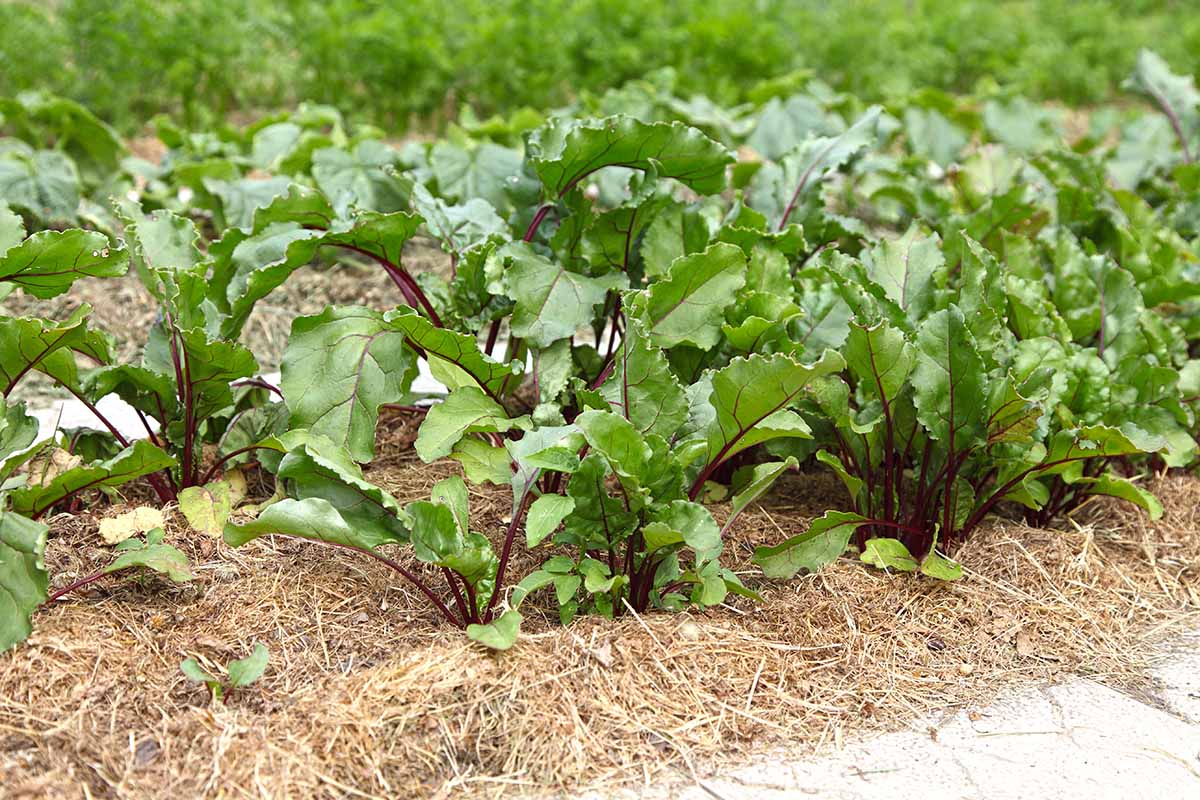
A horizontal image of rows of beets growing in the garden with hay used as mulch.A horizontal image of rows of beets growing in the garden with hay used as mulch.

It acts as an insulating blanket for the soil, keeping plants cooler during hot summers and warmer during cold weather. This results in healthier plants and a longer growing season.

Less Time Weeding

While I have yet to see any organic mulch that is completely weed free, straw can come pretty close.

This is because it typically comes from crops that have previously had the seed heads harvested for grain. It is advantageous to the grower to remove as many of the seed heads as possible before the stalks are dried and baled.

When thickly applied, it can also cut down on weeding significantly by blocking the sun from reaching the soil, thus preventing weed seeds from germinating, and killing those seedlings that do manage to sprout.

Protect and Build Soil

Leaving the soil bare can harm those important microorganisms and beneficial insects that make it a healthy, nutrient-rich environment for plants to grow.

Think about it: When you go outside, you wear a hat and sunglasses to protect your skin and eyes from the sun. Just like us, worms and microbes also need protection from the sun.

A close up horizontal image of a small melon plant growing in the vegetable garden surrounded by straw mulch.A close up horizontal image of a small melon plant growing in the vegetable garden surrounded by straw mulch.

Have you ever noticed how a forest floor is protected by a thick layer of fallen leaves? We can easily provide the same benefit to our gardens by mulching.

Bare earth also means more erosion and nutrient leaching. When soil is unprotected, rain runs off quickly, carrying important nutrients with it. Mulching prevents runoff and helps to keep soil in place.

Not only can straw provide protection to microbes and reduce erosion, it actually helps improve the soil over time.

It breaks down relatively quickly, and as the material decomposes, it builds soil mass and releases nutrients that can nourish your plants as they grow.

Healthier soil means healthier plants, with less need for amendments or synthetic fertilizers.

Other Common Mulches

There are a number of other materials commonly used for mulch, such as bark, shredded leaves, hay, grass clippings, and even plastic.

While any type of mulch is typically better than using nothing at all, there are several reasons why straw is my personal go-to for the vegetable garden.

A horizontal image of pea plants growing in rows in the garden pictured in evening sunshine.A horizontal image of pea plants growing in rows in the garden pictured in evening sunshine.

Many people confuse straw with hay. While these two materials may seem similar upon first glance, they are actually different in a few key ways.

While straw is a byproduct of grain crops, hay is a grass grown primarily as feed for livestock. It is often made from a combination of plants, and it is rarely cut before at least some of it has gone to seed.

In simple terms, hay is much more likely to contain weeds and invasive plants. It is also more likely to attract snails and slugs to your garden, especially if you live in a wet climate.

A close up horizontal image of a slug crawling along the ground.A close up horizontal image of a slug crawling along the ground.

Straw is also a much better option than plastic. Not only is plastic a non-renewable resource, but it doesn’t provide many benefits other than weed suppression.

In order to make sure water can penetrate through to plant roots, you would need to buy plastic that is porous, which is expensive, and in my experience can actually make weeding more difficult when tougher weeds do manage to penetrate it.

Plastic also doesn’t build soil mass or provide any nutritive benefits to growing plants.

Bark is another common material that is very useful for mulching perennials and trees, but not the best option for annual veggies.

A horizontal image of a row of vegetable surrounded by plastic for weed suppression.A horizontal image of a row of vegetable surrounded by plastic for weed suppression.

Bark breaks down slowly and it ties up some of the nitrogen in the soil, making it less available to plants until it has a chance to decompose, which can take a couple of years.

While this is no problem for slow-growing trees and perennials with deep roots, it isn’t ideal for your tomatoes.

Potential Downsides of Mulching with Straw

While straw is a great option overall for veggie gardens, there are a couple of potential drawbacks to be aware of. Fortunately, most of these have easy fixes.

This warm, fluffy, and soft material can be an attractive home for rodents, which is something to keep in mind especially if you tend to have issues with these pests. Regular watering can help keep rodents at bay.

A close up horizontal image of a small rodent in the garden.A close up horizontal image of a small rodent in the garden.

Not a major issue, but because it is light it is more likely than some other materials to blow away when you first lay it down.

This can easily be avoided by applying it on a calm day and watering soon afterwards to help weigh it down a bit.

Another thing to keep in mind is that straw is mostly carbon based. While it certainly adds some nutrients to the soil as it breaks down, it isn’t actually an amazing source of nitrogen for the garden.

This just means it is important to have sufficient nitrogen in your soil to avoid a nutrient imbalance.

One easy way to do this is to spread a layer of nitrogen-rich material around the bed prior to laying down straw. Compost, aged manure, or fresh grass clippings are all great sources of nitrogen.

Find a Source You Can Trust

Straw is readily available from local farmers and garden supply stores.

It comes in bales of various sizes, often somewhere around a few feet long by a foot or two wide and high. When purchasing bales, the most important thing is to know and trust your source.

A horizontal image of a large field with straw bales pictured in the evening sunshine.A horizontal image of a large field with straw bales pictured in the evening sunshine.

Look for something that is advertised as weed-free, and find out whether it has been treated with any pesticides or herbicides, especially if you are an organic gardener.

Keep in mind that any chemicals it has been sprayed with will wind up in your garden. If possible, source from a certified organic grower.

It is also a good idea to examine the bales before you take them home to make sure they are clean and not moldy or damp.

How to Mulch with Straw

Mulching a veggie garden with straw is easy. 

You are ready to mulch a bed once your seedlings have been growing for at least a few weeks and are a few inches in height.

A horizontal image of a wheelbarrow filled with straw in the garden.A horizontal image of a wheelbarrow filled with straw in the garden.

Do not apply mulch on top of seeds or tiny seedlings, so as not to smother them.

One exception to this is that just after seedlings sprout, you may sprinkle a very thin layer of straw on top of the bare soil to help protect it, but wait a few more weeks before mulching fully.

Before you begin, it is a good idea to add an inch or so of organic material such as compost, aged manure, worm castings, or grass clippings first, to ensure the soil is well balanced.

This is especially important if you know your soil to be deficient in nitrogen to begin with. Conducting a soil test can help to reveal any deficiencies.

Next, set the bale at the edge of a garden bed and cut the rope to open it up. Bales are made up of tightly packed layers of straw. Remove layers one at a time, and use your hands to fluff them up a bit.

Lay the material several inches thick between plants and in the walkways between rows, always leaving a couple of inches bare around the stems of each plant to allow for airflow and reduce the risk of disease.

In addition to using it around growing vegetables, you can also use straw to cover up fallow beds or to protect your garden during the winter.

You can choose to either remove it before planting and throw it in the compost, or you can simply push it to the side until you are ready to mulch again and then reuse it, adding a bit of fresh material on top.

As long as it isn’t visibly moldy, it is fine to let it decompose directly in the garden bed.

A World of Difference

If you can get your hands on some straw bales this season, you absolutely should try using it to mulch your vegetable garden.

A horizontal image of rows of salad greens mulched with straw.A horizontal image of rows of salad greens mulched with straw.

You will likely find it makes a world of difference for the health of your crops, and it will drastically reduce your workload at the same time.

Have you tried mulching your veggie garden with straw? Share your experience in the comments below!

Want to dig deeper into using mulch to improve soil and reduce labor? Check out these articles for more ideas:

Sweet Corn Pizza | Dietitian Debbie Dishes


Sweet Corn Pizza | Dietitian Debbie Dishes