49 F
Klamath Falls
Saturday, May 2, 2026
Home Blog Page 159

How to Use Fitness Trackers without Losing Touch with Yourself

0

While our ancestors relied on their senses to assess how they were doing, increasingly, we rely on gadgets.

Today, if you’re curious enough, you can measure your heart rate, your step count, your exercise intensity, and your sleep quality—sometimes all on one sleek device.

In the best cases, these devices offer a bridge between what you subjectively feel and what you can objectively measure.

This is generally a really cool and amazing thing.

Our subjective feelings and assessments matter, but they’re not always the most reliable. Us humans just aren’t particularly skilled at quantifying our experiences and behaviors with cold precision.

Take, for example, a colleague of mine. He believed he was eating within a narrow caloric window, but after careful tracking, he learned that he was putting away a bonus 500 Calories a day—in barbecue sauce.

That said, some of us are better than others.

Ben Johnson, the Canadian sprinter, was reported to have been able to call out his 100 metre time within a tenth of a second of the stopwatch readout.1

That’s outlier performance, to be clear, but it still makes you wonder:

How good are you at assessing yourself?

And, how can you improve your accuracy through the wise use of technology—like fitness trackers—to help you make better decisions about your health?

In the following article, we’ll tackle the above, plus we’ll address:

  • How accurate are data trackers in the first place?
  • When is tracking helpful? (And when is it not?)
  • Can you train yourself to more accurately assess things by feel?

Let’s get into it.

First, how accurate are data trackers anyway?

Not all data is created equal.

Some brands produce better products than others. This is not just hardware but also the quality of their software and datasets.

Beyond that, not all things are equally easy to quantity.

For example, heart rate and step-count data are generally reliable,2 but many other types of outputs—from calories burned to movement velocity—have substantial margins for error.

The below chart shows the reliability of various tracking devices.

(If you’re curious, we cover the accuracy of various progress indicators in more detail here: Are Fitness Trackers Worth It?)

Next, when is tracking actually helpful?

The good: Tracking devices offer us more data about our behaviors and bodies than ever before.

The bad: Tracking devices offer us more data about our behaviors and bodies than ever before.

“What’s really remarkable,” says Samantha Kleinberg, a computer scientist who studies decision-making, “is that even a tiny amount of surplus information has a big negative effect on our decision-making.”3

That’s the paradox of tracking: Too little detail makes it tough to make the right decision, but so does too much. A graph showing 'The Effect of Information on Decision Making' with an inverted U-shaped curve. The x-axis shows 'Amount of relevant information available' and the y-axis shows 'Ability to make decisions'. The peak of the curve is labeled 'Sweet spot', suggesting an optimal amount of information for decision-making, with performance declining when there's either too little or too much information.

This can be expressed as an inverted U, with the sweet spot at the top of the curve.

Today, it’s surprisingly easy to have too much information.

Consider the analysis paralysis you feel after scanning hundreds of reviews from the various taco places in your neighborhood. (All you wanted was a decent el pastor, but now you don’t know which taqueria to pick!)

Finding just enough information to make good decisions is an art form—especially in the world of health and fitness, where it seems like everyone is trying to outdo each other when it comes to providing more science, more customization, and more complexity.

But when all that information starts to blur together with no clear path forward, what should you do?

For starters, you can ask yourself a simple question:

Does tracking increase my wellbeing and performance?

If the answer is a clear yes or no, you know what to do. (Either continue tracking as you were, or drop the gadget and walk away.)

If you’re a little fuzzy, here are three signs to watch for to help you determine if tracking is helpful—or not.

Sign #1: Tracking is decreasing your stress and validating your method(s).

When Zak’s coach raved about the benefits of zone 2 cardio, it sounded logical. But when the rubber on his running shoes hit the road, Zak second-guessed everything. Zak prided himself on his ability to grind, and simply didn’t trust that something that felt easy could also be effective.

Yet, the data didn’t lie. As the weeks went by, Zak watched his resting heart rate drop—along with his recovery time from hard runs. With that reassurance, Zak began to relax about the process—and his resting heart rate dropped further.

Zak hadn’t trusted his feelings, but he did trust the data from his heart rate monitor.

Using a tracking device enabled Zak to calibrate his own perceptions so they were more accurate and realistic.

If you’re a coach who has a client like Zak who’s high performing but doesn’t know it, tracking can help build confidence and reduce the anxiety that they’re “not good enough.”
Here, you empower them by shining a spotlight on existing performance. Expert assurance can go a long way but can also be bolstered by reliable data.

(Recently, many people have begun using continuous glucose monitors, or CGMs, in order to “optimize” their blood sugar levels. This can help “validate” certain food choices… but it can also be a waste of time. Read more: Should people without diabetes use CGMs?)

Bad omen: Tracking is increasing stress or negatively affecting performance.

Sometimes, data can stress you out without any upside—like when you receive poor scores about things beyond your control.

Take the new parent of a newborn who gets a poor sleep quality score.

Tracking has a time and a place. When scores are beyond your control or your priorities lie elsewhere, tracking can create unnecessary stress and is counterproductive.

You can always revisit tracking when circumstances or priorities change.

Sign #2: Clear feedback from data is enhancing your motivation and ability.

For a behaviour to take place, you need three things4:

  • Motivation: A compelling reason or desire to take action toward achieving something. This can come from external sources (your spouse is urging you to quit smoking) or internal drives (you’ve always dreamed of running a marathon).
  • Ability: You have a combination of skills, plus opportunities to express them. (For example, you know how to do a simple resistance training routine, and you have 20 minutes a day to execute it.) This may involve overcoming constraints like time, money, mental and/or physical effort, social pressures, and changes to routine.5
  • Prompt: A prompt is a cue or instruction that elicits an action. (For example, when your GPS tells you to turn left, or when your restless legs “remind” you you’re due for a walk.) Critically, even with high levels of motivation and ability, you may not take action—or the right kind of action—without a prompt.

Fitness trackers shine when you’ve got plenty of motivation and ability—and just lack the prompt.

Take my client, Margaret. She used to have a glass of wine most nights, believing it helped her sleep better. Once she started wearing a sleep tracker though, she saw that her sleep quality was much poorer the nights she imbibed. Once she received this prompt—her sleep score—she adjusted her behavior.

When you highlight important data, the right choices become clearer.

When it comes to changing behaviours, sometimes all it takes is one key piece of data. As they say, “Once you see it, you can’t un-see it.”

(PN’s CEO Tim Jones used the feedback he got from various lifestyle trackers to finally reduce his genetically high cholesterol levels—and built a richer, more meaningful life in the process. Read more: How This Guy Cut His Cholesterol in Half Without Drugs)

Bad omen: Data collection is decreasing motivation or ability.

When Jan, an avid recreational cyclist, found out he could view—then demolish—the records set on local biking trails, he set to work. But as those records were destroyed, so too was his ability to ride for enjoyment. His focus on speed left him under-recovered and eventually led to burnout.

If workouts have become more about the numbers and less about technique, experience, or even enjoyment, tracking is likely no longer helpful.

Sign #3: Tracking is helping you understand yourself better.

The harder you work, the better your results.

Right?

Not necessarily.

This belief tends to get grinders like Zak into trouble because they think they’re making progress—but really they’re just getting in their own way, even inhibiting performance and recovery.

Meanwhile, there are also many people who chronically underestimate their effort and capacity, and would benefit from turning up the heat. Here, data can help us more accurately understand our own potential.

Let’s look at high-intensity interval training (HIIT) as an example. HIIT workouts alternate fixed periods of intense effort with fixed periods of rest. However, these fixed periods of rest are just estimates of recovery times.

Heart rate data can create a more individualized picture of actual recovery needs, which may be faster or slower than you expect.

Sometimes, the mind says yes but the heart says not quite yet.

A good coach does more than just simply ask for more. They also help keep clients out of the unproductive “junk volume” zone, where fatigue accumulates but performance doesn’t improve (and maybe even worsens).

By looking at real-time metrics of output, fatigue, and recovery, you can better understand yourself and your clients, and help keep everyone training and recovering efficiently.

Bad omen: Over-reliance on data is making you lose touch with your own senses.

When you become overly reliant on data, you risk losing touch with your own sense of how you feel, whether that’s hunger and fullness levels, energy and fatigue, or something else.

A relevant example is “The Great My Fitness Pal Blackout.”

In January of 2019, the calorie-tracking app (with a reported 200 million subscribers!) went down for a day. Pretty minor—unless you happened to be tracking your macro and caloric intake and waiting for the app to tell you exactly how much you could eat that day… which I was.

When the app wouldn’t load, I recognized the mild panic I felt was unhelpful. My overreliance on the app had disconnected me from my own internal signals, and without it, I felt adrift. Since then, I’ve shifted my focus to how energetic I feel and one of the oldest tracking technologies available: the mirror.

(If you feel like you’re lost without your besties—your phone and your apps—there’s a name for that. There are also ways to develop a healthier relationship with your tech. Read more: What is nomophobia?)

3 ways to use fitness trackers to help you make more accurate self-assessments

Before we get to how to do the above, let’s talk about why assessing things by feel can be so important.

Whether it’s body fat percentage or movement speed, even supremely motivated and capable clients will experience diminishing objective results from their training.

The scale stops dropping, the number of plates you’re able to load on the bar plateaus, or—gasp—your race time even regresses.

Motivation based purely on progress or other extrinsic goals6 will fall away during these times.

However, exercisers who focus on feelings of mindfulness7, mastery, meaning8, and success9 develop a more resilient practice. They also enjoy the process more, whether that’s the process of running, lifting, winding down for a good night’s sleep, or just enjoying a meal.

So, although objective data can provide essential feedback and guidance, you’ll only reap the full benefits of your practice—that is, enjoyment and results—if you maintain connection with your felt experience.

And good news: You can actually use fitness trackers to calibrate and even improve your ability to accurately sense what’s happening in your body.

Here are three ways to do it.

1. Check in with yourself before you check the data.

Can you imagine asking someone how their vacation was and then waiting for them to look at their photos to be able to answer? That’s what it’s like when you rely purely on external data about your own experience.

Whatever the metric—how far you biked, how many calories you consumed, or how fast your heart was beating—the simplest way to work mindfully with tracker data is to pause, breathe, and then tune into the powerful (if not always accurate) prediction-making powers of your brain.

Once you’ve checked in with yourself, you can calibrate your self-assessment by comparing the detailed (if not always accurate) outputs of your fitness tracker.

Over time, you may be able to narrow the gap between two.

(Note: Don’t forget to regularly update your app. Algorithms and data sets are regularly adjusted for better predictive accuracy.)

2. Develop mental shortcuts that can occasionally stand in for objective measures.

The coaches I work with regularly ask people to estimate the boundaries of their strength (such as how many reps they can do at a given weight until failure).

Novices are often terrible at estimating this—and regularly off the mark by five or more reps. However, the use of objective trackers can help calibrate their understanding, and most people can reduce their margin of error dramatically.

In theory, you might use fancy tools like accelerometers or blood lactate measurements, but our coaches just ask, “For a million dollars a rep, how many more reps do you think you could do?”

Though there’s nothing objective about this question, most clients are able to use the prompt as a kind of shortcut to understand maximal effort. (After all, that last rep may be worth seven figures!)

The question also leverages the rate of perceived exertion (RPE)—your perception of how hard you’re working—which is one of the most validated sensory-driven approaches.

Not everyone is automatically good at estimating RPE, but most people can improve their skills by mapping their felt experience with occasional calibration with objective data.

3. Keep developing your ability to dial into your senses.

Trackers have components like accelerometers, GPS, and gyroscopes to sense data about speed, distance, and more.

But humans are no slouches either.

We have…

  • Mechanoreceptors that respond to pressure, vibration, and the joint angles change
  • A vestibular system that monitors balance and angle changes
  • Proprioceptors that clock the speed and rate of length-change of muscle spindles
  • Thermoreceptors that register register warming or cooling
  • Chemoreceptors that detect chemical changes, such as scent or taste, as well as changes in the bloodstream
  • Nociceptors—part of the body’s alarm system—that sense threat and send signals of potential harm or distress

And that’s only a partial list.

You have access to an incredibly rich network of sensory information—something that technology cannot begin to touch.

All of this information is fed into the powerful pattern-recognition machine of your nervous system.

To continue honing your ability to use this rich network of sensory information, regularly check in with what and how you’re feeling.

When you learn to calibrate your own senses with objective data, you can leverage all the cool advances in wearable tech—while still keeping your own experience front and centre.

References

Click here to view the information sources referenced in this article.

If you’re a coach, or you want to be…


You can help people build sustainable nutrition and lifestyle habits that will significantly improve their physical and mental health—while you make a great living doing what you love. We’ll show you how.


If you’d like to learn more, consider the PN Level 1 Nutrition Coaching Certification. (You can enroll now at a big discount.)

5 Ways to Propagate Your Own Forsythia

0

Forsythia is an iconic shrub in USDA Hardiness Zones 5-8, where its late winter to early spring blooms shatter winter’s icy grip with their bold yellow blossoms.

In our guide to growing forsythia, we discuss all you need to know to cultivate this classic in your landscape.

A close up horizontal image of a forsythia hedge in full bloom in the spring garden, pictured on a soft focus background.A close up horizontal image of a forsythia hedge in full bloom in the spring garden, pictured on a soft focus background.

This article focuses on five easy ways to propagate more shrubs from the ones you already have.

Here’s the lineup:

This is fun, so let’s get right to it!

If you already have a forsythia bush, you can easily make more with one of the following methods:

1. Air Layering

One way to start a new shrub is to force one of its stems, or canes, to sprout roots.

This technique works with any size bush that is over a year old, because it requires “old wood,” or last year’s growth that has hardened off.

A close up vertical image of a bag of soil attached to a shrub's stem to propagate by a process called air layering.A close up vertical image of a bag of soil attached to a shrub's stem to propagate by a process called air layering.

Here’s how to do it:

  1. In the spring, select a cane that is almost finished flowering, but hasn’t leafed out yet.
  2. Choose a place where there is at least one leaf node, and the cane is straight and firm.
  3. As though you were whittling, hold a paring or pocket knife parallel to the cane, and starting about an inch below the leaf node, pare away a thin layer of the outer bark.
  4. Cut straight through the leaf node to create a flap of bark that is still attached at the upper end, just above the leaf node.
  5. Snip off all other leaf nodes, so that it is bare for six inches above and below the “wound” you created with your knife.
  6. Gently lift the flap and press some rooting hormone powder into the inner wood.
  7. Place a bit of sphagnum moss under the flap as well, and close it down.
  8. Wrap sphagnum moss around the wound site to achieve a thickness of about four inches, two above and two below. The length should be three to four inches.
  9. Cut a piece of black trash bag to a size of about five by five inches.
  10. Wrap the plastic around the moss bulge, overlapping it for complete coverage.
  11. Secure the plastic at each end with duct tape, for a snug package.
  12. In late summer, open the package, and you should find that the cane has grown roots. If it hasn’t, replace the plastic and tape, and allow them to stay in place until late next spring.
A close up horizontal image of the branch of a shrub demonstrating roots growing out of the leaf nodes after propagation by tip layering.A close up horizontal image of the branch of a shrub demonstrating roots growing out of the leaf nodes after propagation by tip layering.
Photo by Nadiatalent, Wikimedia Commons, via CC BY-SA.
  1. Cut the rooted stem off at its point of origin.
  2. Make cuts in the rooted stem three to four inches above and below the sprouted roots.
  3. Plant the rooted stem two inches deep in soil that has been worked to a depth of six to 12 inches and drains well. It will sprout and have time to harden off before winter dormancy.

Provide an inch of water per week in the absence of rain until the first frost.

2. Division

Another way to make one shrub into two is by dividing it in the spring, after it flowers.

This method works best with small shrubs that have had a chance to establish themselves for two to three years. They have substantial hard wood and are able to withstand the shock of unearthing.

To divide a forsythia:

  1. Use a pitchfork to loosen the soil around the shrub in a circle about one foot out from the base.
  2. As you walk the circle, push the pitchfork in with your foot, and bend it back to loosen and lift the roots. Take it out and do the next section, until you have gone completely around.
  3. Lift the bush out and lay it on its side on flat ground.
  4. Use an axe or other sharp tool to chop through the crown, where the canes meet the roots, to create two independent shrubs.
  5. Replant where desired, taking care to set the crown at ground level, covering the roots with about two inches of soil.
  6. Maintain one inch of water per week in the absence of rain.

By fall, the young bushes will be well-established and ready for winter dormancy.

3. Soil-Rooted Stem Cuttings

This is my favorite way to make new forsythias from old.

It reminds me of a little story that you may already know if you follow my articles…

My sister-in-law was the first grandchild in her family, and her gardener grandfather loved it when she visited.

He’d give her a lollipop to eat, and when she was finished, they’d go out to the yard and “plant” the stick in the garden.

And – you guessed it – when she returned the next time, a fresh lollipop had “grown” and was waiting for her.

Rooting hardwood stem cuttings in soil is that easy!

Here’s how:

  1. In late fall, when shrubs are dormant, choose a sturdy cane.
  2. Snip off the top two inches to remove the weakest, narrowest part.
  3. Cut the cane at its point of origin, to remove it from the shrub.
  4. Lay the cane down and find the leaf nodes. These are not the flower buds, but the bumps where the foliage will sprout.
  5. You can get multiple cuttings from a long cane. Make your bottom cuts about a quarter of an inch below a leaf node, so that each stem section has a leaf node near its base. Make your top cuts a quarter of an inch above a leaf node, so that each has a node near its top, as well.
  6. Dip the base of each stem section into rooting hormone powder.
  7. Plant the cuttings in a container of compost or sterile potting medium, about four to six inches apart.
  8. Keep the container indoors or in a greenhouse.
  9. Maintain even moisture, but don’t oversaturate.
  10. When the danger of frost has passed in the spring, transplant the rooted stems to the landscape in groups of three to five, with about four to six inches between them, for a sturdy shrub base.
  11. Provide an inch of water per week in the absence of rain.

Another way that’s even easier is to use the clippings you have gathered when you prune your forsythia in the spring

Rather than throw them on the compost heap, use the firm “old” wood that was last year’s growth to make your cuttings.

  1. If the leaves have already sprouted, use them as a guide for cutting above and below the leaf nodes.
  2. Snip off the foliage to redirect energy toward root growth.
  3. Make your stem sections, and dip each into rooting hormone.
  4. Plant the hardwood cuttings directly into the ground in groups of three to five placed four to six inches apart.
  5. Keep the soil evenly moist.

When foliage sprouts, you’ll know you’ve got roots, and can water once a week if it doesn’t rain.

4. Water-Rooted Stem Cuttings

In addition to starting stem cuttings in soil, there’s another approach you can take.

A close up horizontal image of a small glass vase et on a wooden table with sprigs of yellow flowers pictured on a soft focus background.A close up horizontal image of a small glass vase et on a wooden table with sprigs of yellow flowers pictured on a soft focus background.

While your forsythia is still dormant in late winter, you can cut stems to force indoors.

Choose long canes and place them in tall vases with four to six inches of water.

The warm home environment and the water will cause the stems to break dormancy and bloom.

When the flowers begin to fade, the leaves will sprout.

Be sure to keep fallen flowers and leaves out of the water, and change the water daily, for a healthy environment conducive to root formation.

When the danger of frost has passed, transplant rooted stems into the landscape.

Work the soil to a depth of six to 12 inches, until it’s crumbly.

Place clusters of three to five stems approximately four to six inches apart for sturdy shrubs.

5. Tip Layering

This method is so easy, weeping forsythia varieties do it all by themselves.

And, it’s really fun for gardening with children, because all it takes is bending a stem to the ground and keeping it there.

A large forsythia bush in full spring bloom with masses of yellow flowers.A large forsythia bush in full spring bloom with masses of yellow flowers.

If your forsythia has gracefully arching canes with tips that drag on the ground, they are likely to self-root.

You can cut these fledgling bushes away from their mother by snipping the canes that join them at the point where they originate, to encourage a new, long cane to grow on the mother shrub.

Then, you can dig up the babies, cut the long canes to within a few inches from the rooted shrublets, and move them wherever you like.

For bushes that don’t reach the ground themselves, bend a cane, bury the top four inches of the tip in two inches of soil, weigh it down with a rock or brick, and it will grow roots.

How will you know?

When you lift the weight, the stem won’t budge, and it will likely have a flush of foliage at the tip.

It’s best to do this very early in the growing season, so you have time to get the baby transplanted and hardened off for winter.

If you get a late start, just leave everything where it is – rock and all – until next spring.

A Word on Seeds

Starting shrubs from seed takes a long time, but you can jump-start the growing process by starting seeds indoors at any time of year.

Some forsythia types do not produce seeds, as they are sterile hybrids. In addition, when there are viable seeds, they may not produce results that are identical to the parent shrub from which they came, either in vigor or characteristics.

A close up horizontal image of the yellow blossoms of forsythia fading and setting seed pictured in light sunshine on a soft focus background.A close up horizontal image of the yellow blossoms of forsythia fading and setting seed pictured in light sunshine on a soft focus background.

That being said, for those who enjoy a challenge, you may want to try your hand at seed propagation.

Harvest your own seeds by collecting the brown pods that appear after the flowers finish blooming in the spring, just as the foliage is sprouting. If there are no pods, you have a sterile hybrid.

Inside each pod are a few teeny-weeny seeds that you can collect and store in an airtight jar for up to a year.

Sow them in sterile potting medium at a depth of one-eighth of an inch, with four to six inches between them. You can over-sow to increase the chances of germination and thin later if desired.

Place the seed containers in bright but indirect sunlight.

Some folks put plastic wrap over seed starter cells, or a plastic bag over a flower pot, to increase the ambient humidity and speed up germination.

Once the seeds sprout, remove the plastic, or the seedlings may overheat and die.

Keep the soil evenly moist, but not soggy, during germination.

Transplant the seedlings to the garden in late spring, after the danger of frost has passed.

Provide one inch of water per week if it doesn’t rain.

Punch Up the Color

If you already have a forsythia bush, why buy more when you can propagate your own? It’s cost effective, easy, and fun for the whole family.

Close up of a weeping forsythia branch with yellow spring flowers.Close up of a weeping forsythia branch with yellow spring flowers.

Try your hand at air layering, dividing, rooting stem cuttings, and tip layering.

Take your forsythia display from okay to “No way!” with multiple shrubs for masses of yellow blooms that don’t just say spring, they shout it.

Have you tried any of these propagation methods? Let us know in the comments section below!

And for more information on cultivating forsythia in your landscape, we suggest you take a look at the following guides next:

No Bake Lemon Cheesecake Bars

0


No Bake Lemon Cheesecake Bars – The Real Food Dietitians


Privacy & Cookies Policy

Pesto Shrimp Orzo – Bites of Wellness

0

Pesto shrimp orzo is an easy, flavorful, creamy meal that is ready in just 20 minutes with 4 main ingredients. This orzo pasta is coated with pesto and paired with plump shrimp and tomatoes for a simple weeknight dinner. Perfect for weekday meals but also perfect to feed a crowd.

If you love quick and easy recipes like this, you should try my Pesto Tuna Pasta recipe or try this Pesto Chicken Skillet with rice or pasta on the side for a simple meal.

This post contains affiliate links. As an amazon associate I earn from qualifying purchases. Click here to read my policy and more about affiliate links.

Recipe highlights

  • 4 ingredients
  • 20 minutes
  • Easy to make
  • Crowd pleasing meal
  • Great for busy weeknights
  • Versatile
Ingredients to make pesto orzo shrimp on marble countertop.Ingredients to make pesto orzo shrimp on marble countertop.

Ingredients

  • Orzo – this small pasta looks like rice but it’s pasta. Sometimes finding a gluten free orzo can be tough, so you could also use gluten free pasta.
  • Pesto – use your favorite pesto or make your own.
  • Shrimp – I like to use large Argentinian Pink Shrimp from Trader Joe’s. I like this because it’s peeled and deveined. Be sure to allow the shrimp to defrost completely before cooking.
  • Tomatoes – I love adding tomatoes to any dish with pesto. It’s a great pop of color and the flavors pair perfectly.

How to make pesto orzo with shrimp

Cook orzo: Bring water to a boil, cook orzo according to the package directions.

Cook the shrimp. Heat a medium to large skillet over medium heat. When hot, spray with avocado oil (or olive oil) and add shrimp, salt and garlic powder. Cook 2-3 minutes, flip and cook 1-2 more minutes. Turn off heat.

Shrimp in a stainless steel pan.Shrimp in a stainless steel pan.

Cut tomatoes in half.

Reserve pasta water: When orzo is done cooking, reserve 1/4 – 1/2 cup of the pasta water before draining.

Assemble the dish: Drain orzo, add shrimp, pesto and tomatoes to the pot. Add 2-3 tablespoons of the pasta water and stir well. Add more pasta water if needed.

Top tips

  • Make this with shrimp, chicken, chickpeas or salmon.
  • Use store bought pesto to make this super simple. If you have an excess amount of basil at home, make your own pesto!
  • To save time, be sure to buy peeled, deveined shrimp. I always buy frozen and defrost in under an hour or overnight (if you remember to defrost the night before).
  • If you forget to defrost your shrimp, you can cook frozen shrimp in the air fryer.

Variations

  • Add more veggies: Add cooked zucchini, broccoli, bell peppers, asparagus, roasted red peppers, baby spinach, kale, artichoke hearts
  • Spice: Add crushed red pepper flakes
  • Other protein: You can use cooked chicken (diced chicken or shredded chicken), chickpeas, Italian tofu or salmon bites.
Orzo shrimp pesto being spooned out of a pot by a large wood spoon.Orzo shrimp pesto being spooned out of a pot by a large wood spoon.

What to serve with pesto orzo

Common questions

Where to find gluten free orzo

Orzo is pasta that is cooked short and resembles rice. Until recently, there were not a ton of gluten free options. However, I have found 2 really delicious gluten free options:

Forkful of pesto shrimp orzo over white bowl.Forkful of pesto shrimp orzo over white bowl.

Can you use homemade pesto

Yes! If you have an abundance of basil and would prefer to use homemade, use your favorite recipe or you can try:

What if you don’t have orzo?

If you don’t have orzo pasta, you can use rice, pasta, spaghetti squash, or cauliflower rice.

★ Did you make this recipe? Please give it a star rating below!

  • 1 pound large shrimppeeled and deveined
  • 1 cup pesto
  • ½ teaspoon salt
  • ½ teaspoon garlic powder
  • 8 oz orzo
  • 1 cup cherry tomatoescut in half
  • ¼ cup pasta water
  • Bring water to a boil, cook orzo according to the package directions.

  • While orzo is cooking, cook the shrimp. Heat a medium to large skillet over medium heat. When hot, spray with avocado oil (or olive oil) and add shrimp, salt and garlic powder. Cook 2-3 minutes, flip and cook 1-2 more minutes. Turn off heat.

  • Cut tomatoes in half.

  • When orzo is done cooking, reserve 1/4 – 1/2 cup of the pasta water before draining.

  • Drain orzo, add shrimp, pesto and tomatoes to the pot. Add 2-3 tablespoons of the pasta water and stir well. Add more pasta water if needed.

  • Serve hot or at room temperature.

Top tips:
  • Make this with shrimp, chicken, chickpeas or salmon.
  • Use store bought or homemade pesto. 
  • To save time, be sure to buy peeled, deveined shrimp. If frozen, defrost in under an hour or overnight.
  • If you forget to defrost your shrimp, you can cook frozen shrimp in the air fryer.
Storing leftovers:
    • Fridge: Store leftover shrimp orzo pesto pasta in the fridge for up to 3 days in an airtight container.
    • Freezer: You can freeze leftovers in a freezer safe container, however I don’t love the texture of the shrimp when frozen and defrosted after being cooked.

Nutrition Information

Nutrition Facts

Amount per Serving

Where does nutrition info come from? Nutrition facts are provided as a courtesy, sourced from the USDA Food Database.

Let others know by rating and leaving a comment below!

DIY Natural Conditioner Bar For Hair

0

In recent years I’ve done a lot of travel, from Texas to Iceland and everything in between. And while I love experiencing new things, I don’t always love travelling with liquid conditioner and shampoo. This nourishing conditioner bar recipe is great for traveling or even for use at home!

The best conditioners are ones that detangle hair, are moisturizing, and don’t have sketchy ingredients. I have this homemade hair conditioner I like, but sometimes it’s nice to have a solid conditioner bar.

What’s in a Conditioner Bar?

Shampoo bars have been in style for a while now for hair care routines. I shared a post years ago with a recipe for a hydrating shampoo bar. It’s basically handmade soap that lathers and cleans hair with natural ingredients. Conditioner bars are similar but use more moisturizing ingredients instead of soaps and detergents. They’re popular as a more eco-friendly (and even zero waste) alternative to regular shampoo & conditioner.

There are lots of cleaner versions out there, but most of them still contain behentrimonium methosulfate or chloride. This chemical is made from canola oil (often GMO) and is extracted with solvents (also not a healthy option). While the end result is technically safe, it’s certainly not very natural. There are mixed reviews on this ingredient, but the safety data is a little lacking. So I wanted to create a conditioner bar that skipped it.

I like that DIY conditioner bars are an easy way to skip the parabens, silicones, and sulfates found in conventional shampoos. You can even make a fragrance-free conditioner bar. They’re also single use plastic-free since you can skip the plastic bottles.

It’s easy enough to create a bar that’s completely oil based. These work well for damaged hair, dry hair, curly hair, and frizzy hair. For certain hair types though, like those with thinning hair or fine hair, they can be too heavy. And if you use too much, it can leave hair feeling weighed down, greasy, or frizzy.

Natural Conditioner Bar Ingredients

Some of my daughters and I have long hair, so I wanted something that would work well without making it greasy. And while some of us are blessed with natural curls, my hair is definitely straight and finer.

This conditioner bar recipe incorporates some lighter ingredients, like glycerin and aloe into the mix. And instead of beeswax, it uses cocoa butter and mango butter to harden the bar. I also added hair loving oils like jojoba (or argan) oil and lavender and rosemary essential oils. These promote healthy hair and make it smell nice! If you want an unscented version you can leave the essential oils out, but they do add potent health benefits.

Since the recipe uses both water and oil soluble ingredients, I also use emulsifying wax. This helps to combine all of the ingredients together. Usually when I make lotion bars (a similar process) I simply pour the hot liquid into my silicone molds when done. For this recipe, you have to stir as it cools to prevent the mixture from separating.

This recipe is pretty simple and basically involves melting, stirring, and pouring. It leaves hair feeling soft and smells amazing! Try it along with this DIY shampoo bar.

Natural Solid Conditioner Bar

This DIY natural conditioner bar is portable and helps hair stay soft and nourished.

Prep Time5 minutes

Active Time10 minutes

Cooling Time5 hours

Total Time5 hours 15 minutes

Yield: 4 bars

Author: Katie Wells

  • Add the cocoa butter, mango butter, jojoba oil, and emulsifying wax to the top of the double boiler. Heat over medium-low heat or until completely melted, whisking occasionally.

  • While the oils are heating on the stove, combine the aloe vera, glycerin, and essential oils in a separate small bowl.

  • Once the oils are completely melted, turn off the heat and slowly pour in the water based ingredients. Whisk continuously while pouring.

  • Let the mixture cool in the fridge for about 30-40 minutes. Stir or whisk every 10 minutes until it’s creamy looking, opaque, and the consistency of thick batter.

  • Spoon the mixture into your molds and smooth out the top.

  • Let cool in the fridge for at least 4 hours or until hardened. I left mine overnight.

  • Use after shampooing (see more directions below). These also make a great skin lotion bar!

  • From the research I’ve done this should be safe for color-treated hair. However, ask your hairstylist if you’re unsure.
  • You can also apply a light layer of this to really dry hair for use as a leave-in conditioner.

How to Use a DIY Conditioner Bar

A little bit goes a long way! Avoid using too much conditioner or your hair can feel greasy. And since the scalp naturally produces oils, most people don’t need to condition it.

  1. Rub a layer of conditioner bar on your hands.
  2. Rub your hands on the ends of your hair and work up. Avoid the scalp.
  3. Use very warm water to rinse, which will help the oils further disperse.

Have you ever used a shampoo or conditioner bar before? Leave a comment and let us know!

Steve’s Springtime in Atlanta – Fine Gardening

0

Happy Monday, GPODers!

I hope you all had a fabulous weekend and that spring is coming to life in your gardens even a fraction as vividly as what Steve Schmidt has experienced over the past month. We got our first tour of Steve’s garden in Atlanta, Georgia, back in December (check out that post here: Steve Says Goodbye to Summer in Atlanta), where we were introduced to his fabulous combinations and lush designs. Steve is back today to share the beautiful blooms and vibrant colors that fill his garden before the real heat of the peak season sets in.

Steve Schmidt in Atlanta submitting some new pictures. Here are a few of my better pictures from mid-March to mid-April as spring rapidly transitions in Atlanta. We’re now experiencing well-above average temperatures . . .

Flowering of the matsuzaki stachyurus (Stachyurus praecox var. matsuzakii, Zones 8–10).

close up of large white flowerNuccio’s Gem camellia (Camellia japonica ‘Nuccio’s Gem’, Zones 8–10). Always iffy in February & March, because if the temp gets around freezing or below the flowers turn brown and drop.

spire of small white and pink flowers‘Vancleave’ buckwheat tree (Cliftonia monophylla ‘Vancleave’, Zones 7–10) flowering.

white and yellow spring flowersBicolor epimedium (Epimedium × versicolor ‘Sulphureum’, Zones 5–9) and star of Bethlehem (Ornithogalum umbellatum, Zones 4–9).

shrub with small white flowersPrague viburnum (Viburnum × pragense, Zones 5–8) with Dream Catcher® beauty bush (Kolkwitzia amabilis ‘Maracdo’, Zones 4–8) behind.

bright fuchsia flowers over smaller white flowers Formosa azalea (Rhododendron indica ‘Formosa’, Zones 6–9)—from one I have propagated a few more to populate the yard—with star of Bethlehem.

shrub with only bright red flowersJake’s Red Oconee azalea (Rhododendron flammeum ‘Jake’s Red’, Zones 6–9). Phone camera not good at dealing with intense reds and pinks, and to some extent orange. This is a young shrub so look forward to it gaining more size.

shrub with bright orange flowers‘Rising Sun’ Florida azalea (Rhododendron austrinum ‘Rising Sun’, Zones 7–9). This particular native azalea gets the most sun and does better than 4 of the 5 other varieties (Jake’s Red also gets more direct sun, so outperforms the other four). A work in progress getting the siting right.

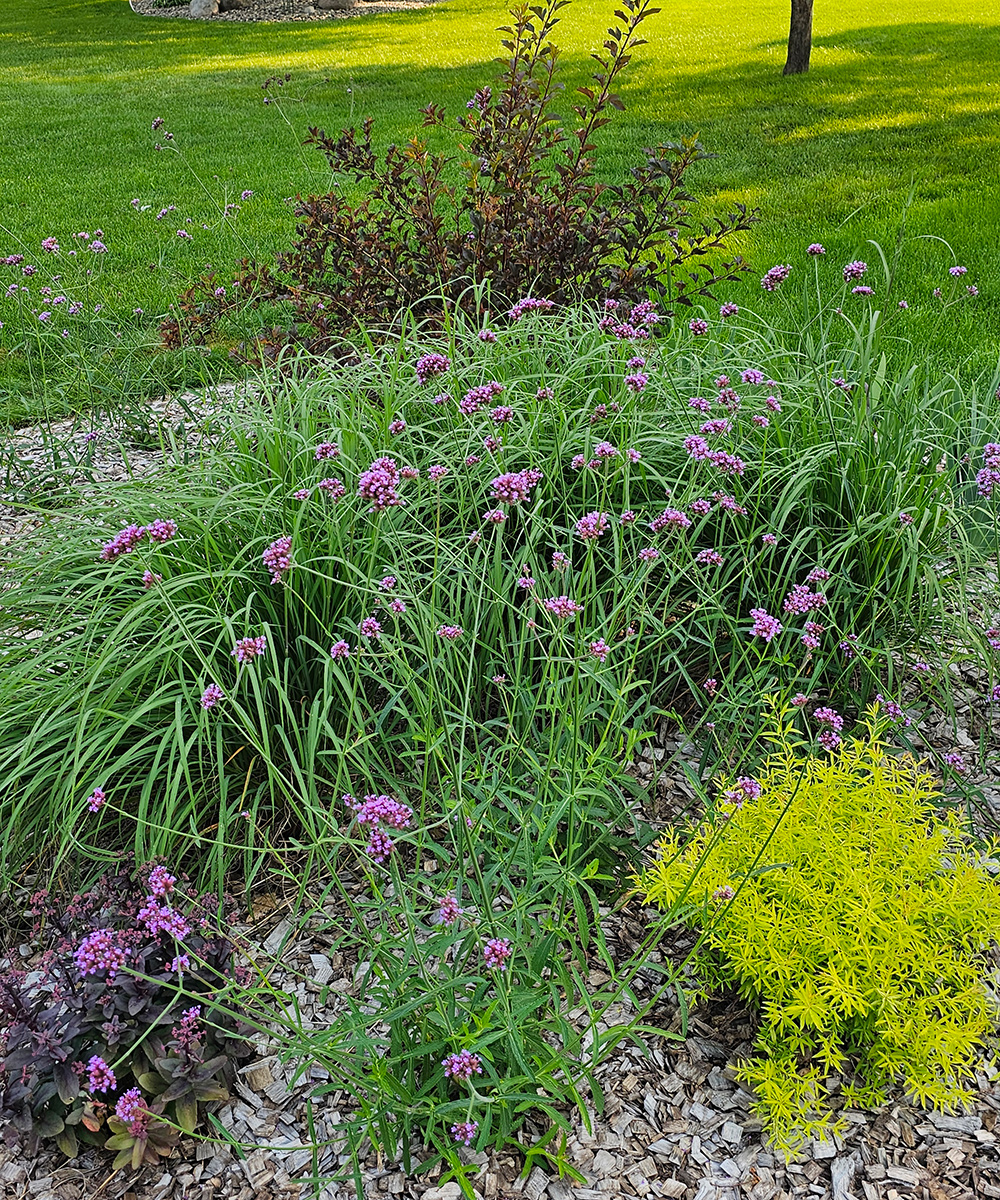
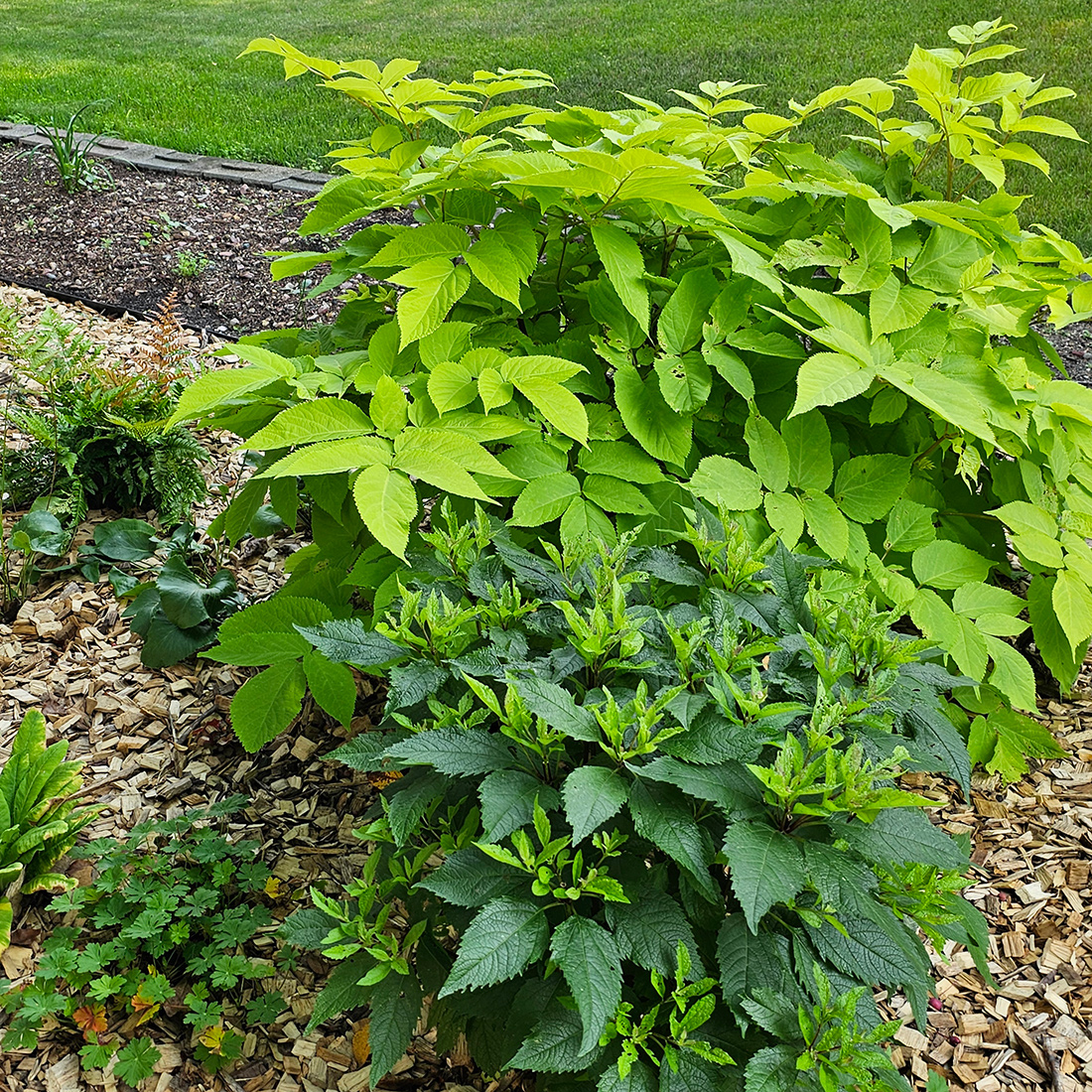
lush shade garden with spring flowersSome of the plants filling in around the eventual sunken garden: ‘Asian Beauty’ linden viburnum (Viburnum dilatatum ‘Asian Beauty’, Zones 4–8), Florida Sunshine illicium (Illicium parviflorum ‘Florida Sunshine’, Zones 8–9), red buckeye (Aesculus pavia, Zones 4–8), volunteer maroon acer, and hemlock. In the broken pot used as part of stacked stone retaining wall around the sunken garden is American ipecac (Gillenia stipulata, Zones 4–8) (lower right). A new addition last year so looking forward to seeing it grow and flower this year.

plant with red foliageLastly, can’t resist a picture of one of the critters—a Carolina anole (Anolis carolinensis) on the leaf of ‘Georgia Peach’ heuchera (Heuchera x ‘Georgia Peach’, Zones 4–9). The seed heads of one of the native weeds I encourage, ragwort, is in the foreground.

Thank you so much for sharing your vibrant spring garden with us, Steve! Your thoughtful plant selections and design choices always spark intrigue and inspiration, I hope we get to see more from your garden this year.

While Steve has been enjoying big blooms and fabulous foliage for the past month, I know many spring gardens are just starting to pick up speed. No matter what stage your garden is in right now, we’d love to see what’s growing and glowing. Follow the directions below to submit photos of your spring garden via email, or send me a DM on Instagram: @agirlherdogandtheroad.


We want to see YOUR garden!

Have photos to share? We’d love to see your garden, a particular collection of plants you love, or a wonderful garden you had the chance to visit!

To submit, send 5–10 photos to [email protected] along with some information about the plants in the pictures and where you took the photos. We’d love to hear where you are located, how long you’ve been gardening, successes you are proud of, failures you learned from, hopes for the future, favorite plants, or funny stories from your garden.

Have a mobile phone? Tag your photos on Facebook, Instagram or Twitter with #FineGardening!

Do you receive the GPOD by email yet? Sign up here.

Buffalo Hummus | Dietitian Debbie Dishes

0


Buffalo Hummus | Dietitian Debbie Dishes


Quick Air Fryer Mushrooms | The Full Helping

0

These air fryer mushrooms are ready in less than fifteen minutes and are so easy to prepare! Made with cremini or baby bella mushrooms, they’re simple, savory, and versatile. You have the option to give them additional seasoning with herbs or balsamic vinegar, and you can add them to many types of dishes.

One of the beauties of having an air fryer is the ability to cook vegetables in less time than roasting or sautéing.

These quick air fryer mushrooms have become one of my favorite vegetables to prepare at a moment’s notice or when I’m in a rush to get dinner ready.

I love mushrooms, in all of their umami-packed, savory, ultra-nutritious goodness. For a long time I prepared them almost exclusively by sautéing. Then I switched over to sheet pan roasting.

There’s a time and a place for both of those methods. And there’s a time and a place for shortcuts.

I can’t think of an easier way to prepare mushrooms flavorfully. If you have an air fryer and a taste for funghi, then I recommend it highly!

A savory and nutrient-dense topping

Like many plant-based eaters, I make a lot of recipes that include mushrooms.

Mushrooms are hearty and firm; they also have naturally occurring glutamate, the amino acid that’s associated with umami, or savoriness.

For all of these reasons, mushrooms are often described as being “meaty.” Whether you see it that way or not, they’re a great ingredient for crafting satisfying, plant-based meals.

Mushrooms find their way into my cozy vegan mushroom bourguignon, creamy vegan mushroom pasta, and my savory mushroom farro.

When they’re not playing a starring role in a recipe, mushrooms can also be an easy, savory “add-on” for something else.

What I mean by that is that you can use them as a topping or an instant means of adding more texture, more savoriness, or more heft to a dish that’s otherwise simple.

I like piling my air fryer mushrooms onto think spaghetti marinara, avocado or hummus toast, or a butter side lettuce salad.

And what a nourishing add-on they are: mushrooms are rich in B Vitamins, fiber, potassium, and Vitamin D2. They’re superfoods in the sense of the word that I stand by: nutrient-dense, versatile, and delicious.

What type of mushrooms should I use?

When I make air fryer mushrooms, I usually use halved cremini or baby bella mushrooms. These are two of my favorite varieties.

However, they’re quite similar in shape to humble white button mushrooms. And you can certainly use button mushrooms in the recipe instead.

You can also use halved shiitake mushroom caps—they work nicely in the air fryer! If you use them, you may need only 10 minutes of air frying time.

Air fryer tricks of the trade

My air fryer recipes are written for a four-liter capacity, basket-style air fryer. You can of course convert it to fit a toaster oven style air fryer, if that’s what you have.

And if you also have a basket-style air fryer, but with a larger or smaller capacity than mine, you can scale the recipe up or cut the amounts in half to make it work.

When I make veggies in my air fryer, including these air fryer mushrooms or my cubed air fryer sweet potatoes, I follow a few rules of thumb.

First, I always stop to shake the basket of my air fryer once halfway through the cook time. This helps to avoid any vegetables sticking or uneven cooking.

I also try to avoid over-crowding my appliance. Four liters sounds roomy, and for a solo-dweller it works well. But it’s not a ton of capacity, and if I pile in too many vegetables, they’ll lose some of their crispiness. (They may also take longer to cook.)

Seasoning options

Most of the time, I keep my air fryer mushrooms super simple: olive oil, salt, pepper, and garlic powder.

If I’m in the mood for variation, the two seasoning additions that I turn to are usually balsamic vinegar or fresh herbs, such as thyme, oregano, or rosemary. I’ve included both options in the recipe card.

Other seasonings that I’ve added to the mushrooms before they get air fried:

  • Truffle salt
  • Crushed red pepper flakes
  • Smoked paprika
  • Lemon juice or zest

After the air fryer mushrooms are fully cooked, you can also season them with a dressing or sauce. Some ideas:

Of course, these are only ideas. There’s lots of room for possibility here!

How to make air fryer mushrooms

Making air fryer mushrooms couldn’t be easier. When I meal prep them, I nearly always do a double batch. Even when I think I won’t use them all up by the end of the week, I do.

Step 1: Season the mushrooms

First, you’ll put your halved baby bella or cremini mushrooms into a mixing bowl. Add olive oil, salt, pepper, and garlic powder, then mix them well.

Raw, halved mushrooms have been placed into a white mixing bowl.Raw, halved mushrooms have been placed into a white mixing bowl.
Begin by seasoning your mushrooms with olive oil, salt, pepper, and garlic powder. If it’s helpful to use an olive or avocado oil spray for even dispersement of seasoning, that’s fine.

I prefer garlic powder to minced garlic for this recipe for two reasons: first, it’s easier to distribute and mix evenly into the mushrooms than fresh garlic. Second, minced garlic can easily burn in an air fryer, turning bitter.

If you have a mister or spray bottle of either olive or avocado oil at home, you can also use it to season the mushrooms. Oil spray is often easier for evenly coating vegetables than a spooned measurement.

Step 2: Air fry for 10-12 minutes

You’ll air fry for a total of 10-12 minutes, but you need to stop midway through the cook time to shake the air fryer basket. This ensures that the mushrooms cook evenly.

One more step to consider: if you’d like to season the mushrooms, you can do so about four minutes before the end of cooking time.

As you can see above, fresh thyme leaved and a drizzle of syrupy balsamic vinegar are my favorite seasonings here.

Shake the basket of the air fryer again, then continue with the last few minutes of air frying. At this point, your mushrooms are ready.

A white bowl rests on a white surface. It holds browned, roasted mushrooms.A white bowl rests on a white surface. It holds browned, roasted mushrooms.
The mushrooms will be tender yet chewy and gently browned once done.

Serving suggestions

You may make a batch of the air fryer mushrooms with a specific purpose in mind: putting them into a vegan pasta dish, for example.

Once you have them in the fridge, though, I bet you’ll find yourself wanting to add them to everything.

I routinely sprinkle them onto bowls of savory oats, crostini with cashew cheese, the top of a bowl of mushroom bulgur bean chili, or a cup of vegan potato leek soup.

You’ll find your own favorite uses. And as you do that, you can rest assured that you’re coming up with new ways to enjoy an especially nutritious veggie.

Meal prep & storage

The air fryer mushrooms can be stored in an airtight container in the fridge for up to four days.

The recipe makes only two servings (easily doubled), and I almost never have reason to freeze them. But you can freeze them, for up to six weeks.

An asymmetrical white bowl is holding deep brown, air fryer mushrooms. The mushrooms are dotted with bright green herbs.An asymmetrical white bowl is holding deep brown, air fryer mushrooms. The mushrooms are dotted with bright green herbs.
An asymmetrical white bowl is holding deep brown, air fryer mushrooms. The mushrooms are dotted with bright green herbs.

Prep Time: 10 minutes

Cook Time: 12 minutes

Yields: 2 servings

  • 8 ounces baby bella or cremini mushrooms, brushed and halved
  • 1 tablespoon olive or avocado oil (substitute olive or avocado oil spray)
  • Salt
  • Freshly ground black pepper
  • 1/4 teaspoon garlic powder
  • 1 1/2 tablespoons fresh thyme or rosemary leaves (optional)
  • 2 teaspoons balsamic vinegar (aged or commercial-grade)
  • Transfer the mushrooms to a large mixing bowl. Drizzle them with the oil, then season them to your liking with salt and pepper (I prefer a generous hand with both) and the garlic powder. Toss everything together. In place of the tablespoon oil, you can spray the mushrooms generously with an olive or avocado oil spray, then add the seasonings as directed. This helps to disperse the oil more evenly. 

  • Transfer the mushrooms to the basket of an air fryer. Air fry them at 400°F / 200°C for 10-12 minutes, shaking them vigorously in the basket once halfway through roasting. The mushrooms should be soft, gently browning, and greatly reduced in size once done.

  • If you like, add the herbs and balsamic vinegar to the mushrooms 4 minutes before they finish air frying, then give the basket a shake to disperse. Continue cooking them with these additional seasonings for their last 4 minutes in the air fryer.

  • Serve the mushrooms or store them in an airtight container in the fridge for up to four days. 

Within the vegetable kingdom, mushrooms can be a little intimidating to cook. This recipe is an approachable starting point, and I hope you’ll find it useful!

xo

Gut bacteria may play a role in the rise in colon cancer in young adults : Shots

0

Escherichia coli or E. coli is a part of family of bacteria that are commonly found in the human gut. Scientists found that a toxin the bacteria release is linked to some cases of colorectal cancer.

Kateryna Kon/Science Photo Libra/Getty Images


hide caption

toggle caption

Kateryna Kon/Science Photo Libra/Getty Images

It’s unclear why colon cancer cases have doubled in people under 55 over the past two decades, a staggering rise that has alarmed doctors and cancer researchers.

But part of the story could be colibactin, a toxin made by certain strains of E. coli and other bacteria. In a study out this week, researchers have identified a strong link between this DNA-damaging toxin and colon cancer among younger patients.

The team, based at the University of California, San Diego, analyzed tissue samples from close to 1,000 colorectal cancer patients across four continents. They found the majority had cancers bearing mutations that signaled a past encounter with colibactin.

“You can think of it as the weapon system of a bacteria to fight other bacteria and to defend themselves,” says Ludmil Alexandrov, the lead author of the study, which was published in Nature this week.

Strikingly, those under the age of 40 with early-onset colon cancer were three to five times more likely to have these mutations than those in their 70s and older.

The thinking goes that in some people, this bacterial weaponry — technically called a “genotoxin” — can get directed at their gut cells, seeding mutations that put them at increased risk of developing colorectal cancer.

According to their data, this exposure isn’t ongoing when the cancer is diagnosed. Instead, it appears to have happened during childhood.

“Our estimate is that it happens within the first 10 years of life,” Alexandrov says. “So if you get that mutation at age 5, that puts you 20 to 30 years ahead of schedule for getting colorectal cancer.”

While the study shows a strong association, the data can’t prove colibactin caused these patients to develop cancer at a younger age. And researchers in the field don’t expect E. coli, or any single microbe for that matter, to be the skeleton key for the surge in colorectal cancer.

“That would be too simple,” says Christian Jobin, a microbiome researcher at the University of Florida.

More likely, he says, colibactin — studied closely in E. coli but produced by other bacteria, too is one “hit” among many to our microbiome, which together may place some people on a faster trajectory for developing cancer.

What triggers a DNA-damaging toxin

The study is a new clue into the rise in colorectal cancer in the young. Scientists believe some confluence of environmental factors, including diet, a sedentary lifestyle, medication and so on, is driving this steep rise.

These could be having downstream effects on the microbes in our gut like E. coli.

“It’s been really perplexing,” says Dr. Neelendu Dey, a gastroenterologist whose lab focuses on the gut microbiome at the Fred Hutchinson Cancer Center. “The microbes that may contribute to cancer risk are tricky to understand.”

The family of microbes to which E. coli belongs is actually the most prevalent type of bacteria in your gut during the very early stages of life.

About 20% to 30% of people have strains of E. coli that can synthesize this toxin, but that doesn’t mean it’s necessarily having “deleterious effects,” says Jobin, whose lab has pioneered related research.

In other words, it’s not some new infectious agent that simply needs to be eliminated.

Adding to the puzzle: Not everyone with colorectal cancer has these signatures of colibactin-related mutations.

There’s something provoking the bacteria to behave this way, perhaps giving it an advantage to grow in more abundance. “What triggers this weapon or the deployment?” Jobin says. “We don’t know but we have to consider the environment.”

“We know that some of these E. coli that produce colibactin are influenced by diet, inflammation, and medication,” he adds.

Jobin says the new research is “fantastic” because it bridges early preclinical research in animals with “real life humans,” and opens new avenues for research.

Studies conducted on animals have shown colibactin exposure can drive cancer development.

For example, deleting the genetic region responsible for producing this toxin in E. coli can actually incapacitate the bacteria from promoting cancer in animals. Feeding them more or less fiber can affect tumor growth. And stopping inflammation can also fend off cancer in these lab studies of colibactin.

Antibiotics use and nutrition, could be at play

Because they sequenced the genome of cancer from patients all over the globe, Alexandrov says the researchers could tell these mutations related to colibactin are actually quite rare in more “rural, non-industrialized” regions of Africa and Asia, whereas they turn up more frequently in the U.S. and Western Europe.

That evidence, coupled with the findings that it’s a result of early childhood exposure, gives them a handful of hypotheses about what could be at play.

He says some of their top suspects are the mode of birth (cesarean section vs. vaginal delivery), breastfeeding, the use of antibiotics and nutrition, for example whether children were fed ultra processed foods.

All of these factors are known to substantially affect the microbiome and there is some evidence they may impact this [colibactin producing] bacteria, but we really need to investigate each one carefully.”

Dey views all of these as plausible, particularly antibiotics, given that other research teams have linked early-life antibiotic use to increased risk of colorectal cancer later on.

More broadly, he says he hopes researchers can eventually find microbes that serve as “biomarkers” for identifying people at risk of developing pre-cancers. And, perhaps down the line, drugs can be designed to target toxins like colibactin to counter their harmful effects.

Of course, it sounds simple, but we have to acknowledge the ecological lessons learned in other contexts,” he says. “When you try to take out, or introduce a species, it can have effects that you didn’t anticipate, so this all needs to be done very thoughtfully.”

How to Pickle Cucumbers with Vinegar and Sugar?

0

When your taste buds crave for something tangy, then two slices of pickled cucumbers make your meal delightful.

Keep aside the taste; pickled cucumbers are super low in calories and great for your gut thanks to the probiotics. Plus, they’ve got a bit of vitamin K, which helps keep your bones and blood in good shape.

Pickling cucumbers last for months in the fridge, especially if they’re stored in a sealed jar. That long shelf life means you always have a tasty, gut-friendly snack ready to go.

No preservatives are added in this recipe as the vinegar and salt create a naturally acidic environment that safely preserves the vegetables and keeps them fresh for weeks.

The recipe I’ll share below is one of the easiest and most satisfying ways to preserve the fresh crunch of summer produce. With vinegar, sugar, salt, and cucumbers, you can make zesty pickles perfect for snacks or meals.

Unlike traditional canning methods, this technique doesn’t require specialized equipment or long boiling times.

Instead, you’ll make simple brine, pour it over the cucumbers, and let time do the rest.

Ingredients for Pickled Cucumbers

This recipe yields approximately 2 to 3 pint-sized jars of pickles, depending on how tightly you pack the cucumbers and what size you cut them.

Main Ingredients:

  • 4 to 5 small cucumbers (Kirby cucumbers are ideal for pickling due to their firmness and size)
  • 1 medium onion, thinly sliced (optional, adds a sweet-savory layer of flavor)

For the Pickling Brine:

  • 1 cup white distilled vinegar (with 5% acidity for proper preservation)
  • 1/2 cup water
  • 1/2 to 3/4 cup granulated white sugar (adjust depending on desired sweetness)
  • 1 tablespoon pickling salt or kosher salt (avoid table salt with additives)

Optional Flavorings:

  • 1 teaspoon mustard seeds
  • 1/2 teaspoon celery seeds
  • 1/2 teaspoon ground turmeric (adds color and mild flavor)
  • 1/2 teaspoon crushed red pepper flakes (for a spicy kick)
  • 3 cloves garlic, peeled and lightly smashed
  • Fresh dill sprigs, bay leaves, or ginger slices for added aroma and depth

Step 1: Prepare the Cucumbers

Start by thoroughly washing the cucumbers to remove any dirt or wax. Dry them completely with a clean towel. Next, decide on your preferred pickle shape. You can cut them into thin rounds for sandwich chips, thicker coins for snacking, or lengthwise spears for a classic pickle shape.

If you’re using onions, slice them thinly and set them aside.

Tip: For crisper pickles, soak the sliced cucumbers in a bowl of ice water for 1 to 2 hours before pickling. Drain and pat them dry before packing into jars.

Step 2: Make the Pickling Brine

In a medium saucepan, combine the vinegar, water, sugar, and salt. Add any spices or aromatics you’re using—mustard seeds, garlic, turmeric, and red pepper flakes all enhance the flavor.

Place the pan over medium heat and stir the mixture until the sugar and salt dissolve completely.

Once the brine begins to simmer and is fully blended, remove it from the heat and allow it to cool slightly.

You don’t want it to be boiling hot when pouring over the cucumbers, as this can soften them too much.

Step 3: Pack the Jars

Using clean, sterilized glass jars (pint-sized mason jars work perfectly), pack in the cucumber slices. You can alternate layers of cucumber and onion for an attractive presentation and well-balanced flavor.

Pour the warm brine over the cucumbers, making sure they are fully submerged. Leave about 1/2 inch of space at the top of the jar. Tap the jars gently on the counter to release any trapped air bubbles.

Wipe the rims clean with a damp cloth and screw on the lids tightly.

Step 4: Let the Pickles Cure

Allow the jars to cool to room temperature before placing them in the refrigerator. These are quick pickles, also called refrigerator pickles, and they do not require boiling water canning.

For best results, let the cucumbers sit in the fridge for at least 24 hours before tasting.

The flavor will continue to develop over the next few days, becoming more complex and well-rounded. The pickles will keep in the refrigerator for up to 3 to 4 weeks.

Flavor Variations to Try

Pickling is a highly customizable process. Try some of these ideas to make your pickles unique:

  • Sweet and Dill: Add several sprigs of fresh dill to each jar for a fresh, herbaceous touch.
  • Spicy-Sweet Pickles: Increase the red pepper flakes or add a sliced fresh jalapeño to the brine.
  • Zesty Onion Pickles: Use red onion instead of white for a sharper, more colorful twist.
  • Garlic Lovers: Add extra garlic cloves to intensify the savory bite.
  • Ginger Infused: Add a few slices of fresh ginger for a sweet-spicy Asian-inspired variation.

Tips for Success

  • Always use non-reactive cookware such as stainless steel, glass, or ceramic when making the brine. Aluminum can react with vinegar and alter the flavor.
  • If storing pickles longer term, always keep them refrigerated and use a clean fork each time to avoid introducing bacteria.
  • For extra crispness, you can experiment by adding a grape leaf, horseradish leaf, or a pinch of alum—traditional methods for maintaining crunch.
  • Label your jars with the date you made them so you know how long they’ve been curing.

Conclusion

Making homemade pickles with vinegar and sugar is a wonderfully simple kitchen project that yields flavorful, crunchy results. Whether you’re new to pickling or looking for a fresh variation on a classic recipe, this method offers a versatile base for countless flavor profiles.

Once you’ve mastered this version, feel free to experiment with other vegetables like carrots, radishes, or green beans. Pickling is part science, part art—and all delicious.