49.9 F
Klamath Falls
Saturday, March 14, 2026
Home Blog Page 16

27 Low Budget DIY Chicken Coop Ideas

0

Getting chickens was one of the best decisions I ever made, but I’ll be honest — the price of ready-made coops nearly scared me off.

Many of them looked cute, yet they cost a small fortune and still didn’t seem big or sturdy enough. So I decided to build my own, and it turned out to be far easier (and cheaper) than I expected.

The truth is, hens aren’t picky about fancy designs. They care about having a dry place to sleep, good airflow, protection from predators, and comfortable spots to lay eggs.

Once those basics are covered, you can get creative and use whatever materials you can find — pallets, old doors, leftover fencing, even things like trampolines or playhouses.

I also love that DIY coops grow with you. You can start simple, learn what works, and upgrade later. Every improvement makes chicken keeping easier and more fun.

Below are low-budget chicken coop ideas that regular backyard keepers have used successfully.

Some are quick weekend builds, others are brilliant recycling projects, and all of them can save you a lot of money.

27 Low-Budget DIY Chicken Coop Ideas

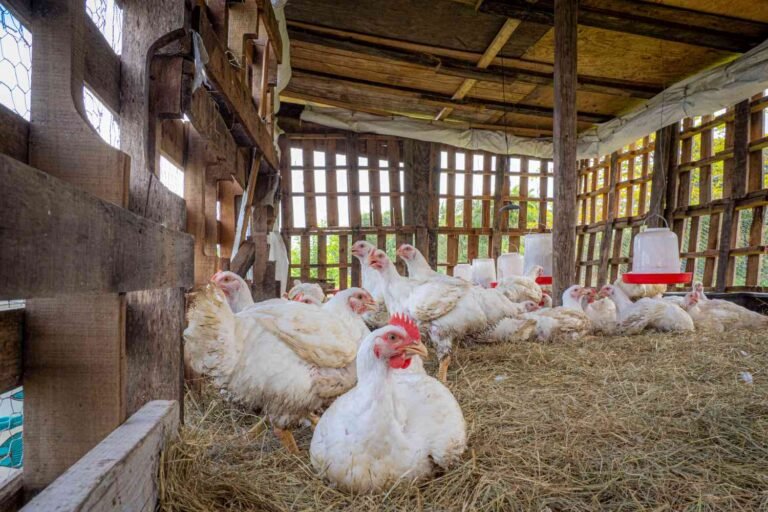
Chickens don’t need anything fancy — just a solid roof, dry bedding, and protection from whatever’s lurking out there.

With some grit, a little creativity, and reused materials, you can build them a good home without spending much.

1. Pallet Wood Chicken Coop

Start by gathering a few sturdy pallets and deciding whether you want to use them whole or take them apart for boards. Stand them up to form the walls, brace the corners, then add a simple roof, a pop door, and hardware cloth anywhere predators might sneak in.

The best part? Pallets are usually free, which keeps your build super affordable. They’re strong, weather-tough, and perfect for creating a coop without buying loads of lumber.

It might not look fancy, but your hens won’t mind one bit. Add bedding, a couple of roosts, and a nesting area, and they’ll settle in like it’s home.

2. Old Shed Conversion

If you’ve got a shed sitting around full of forgotten tools and spider webs, you’re already holding prime chicken real estate. Clear it out, sweep it up, and imagine where the roosts and nest boxes could go.

Most sheds are sturdy, roofed, and built to handle weather, which saves a huge amount of effort. Instead of framing walls, you’re mainly adding chicken-friendly features like ventilation, perches, and a small pop door.

Another big win is space. Sheds usually give birds more room to move, which helps prevent pecking issues and keeps the flock calmer.

With a run attached outside, you’ll have a setup that feels professional without the professional price tag.

3. A-Frame Chicken Tractor

Want something simple, lightweight, and easy to build? An A-frame might be your best friend. The triangle shape uses less wood but stays strong, making it great for beginners.

Build two triangular ends, connect them with boards, then cover sections with wire and a bit of roofing. Add handles or small wheels so you can shift it around the yard.

Moving the coop regularly gives chickens fresh grass, new bugs to chase, and cleaner ground. It can also cut down on feed costs over time.

It’s practical, efficient, and kind of fun to use — like rotating pasture on a mini scale.

Also Read: How to Build a Door for Chicken Coop?

4. PVC Pipe Chicken Coop
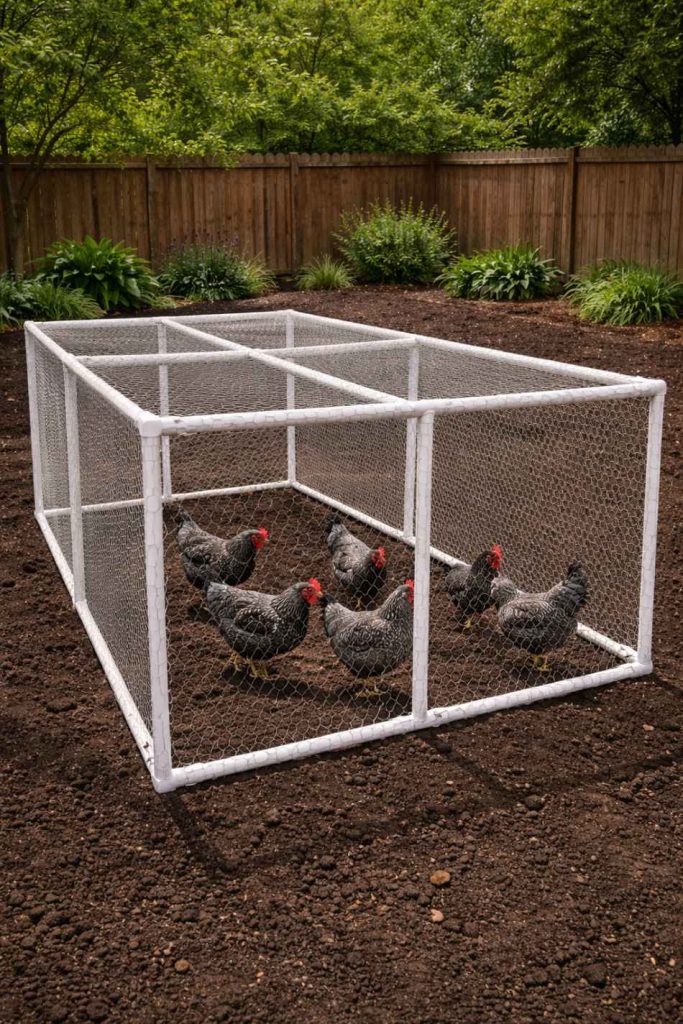
This one is perfect if you want fast, cheap, and beginner-proof. Grab some PVC pipes, connectors, and build a simple frame — boxy or hoop-shaped both work great.

Once the skeleton is up, wrap it with hardware cloth and secure a tarp or metal sheet on top for shade and rain protection. You’ll be surprised how quickly it comes together.

Because it’s lightweight, you can shift the coop without a wrestling match. That makes cleaning easier and gives your hens fresh ground more often.

It’s not fancy carpentry, but it’s practical, affordable, and gets the job done without stress.

5. Dog House Chicken Coop

Sometimes the easiest builds are hiding in plain sight. An old dog house can turn into a chicken shelter in an afternoon with just a few tweaks.

Raise it slightly off the ground if needed, toss in dry bedding, and install a perch across the inside. If you’re feeling handy, attach a nesting box to the outside wall to free up space.

These little houses are already built to handle outdoor weather, so you skip most of the hard work. Plus, they’re cozy, which chickens tend to love.

For a tiny backyard flock, it’s a simple, budget-friendly solution that works better than you might expect.

6. Trampoline Frame Chicken Coop

If there’s an old trampoline rusting away in the yard, here’s your chance to give it a second life. Remove the mat, keep the metal frame, and you’ve instantly got the outline for a big, airy chicken space.

Wrap the sides with hardware cloth and secure it tightly so nothing can push in or dig under. Most people place a smaller wooden shelter inside where the hens can roost and lay.

The circular shape gives birds plenty of room to wander, scratch, and flap around without feeling cramped. It’s especially nice for active flocks.

It’s a creative reuse, saves a pile of money, and turns backyard junk into something genuinely useful.

Check this: 19 DIY Movable Chicken Coop Plans

7. Reclaimed Door Chicken Coop

Using old doors is a smart way to create strong, ready-made walls without cutting tons of lumber. Since doors are already rectangular and solid, framing the structure becomes much quicker.

Stand the doors upright, fasten them at the corners, and reinforce with simple supports. Many even come with windows, which can help with natural light and ventilation.

This approach reduces waste, lowers material costs, and produces a sturdy coop that holds up well in bad weather.

With proper predator-proofing and a good roof, a door-built coop can last just as long as a traditional build.

8. Chicken Coop from Scrap Lumber

This is the build where you use what you’ve got and make it work. A few leftover boards from a fence, part of an old deck, maybe something your neighbor was tossing — suddenly you’re in business.

Nothing may match, and that’s part of the charm. Chickens aren’t judging your design skills; they just want shelter and safety.

Put your energy into strong wire, tight latches, and a roof that doesn’t leak. The rest can look as patchwork as it wants.

Funny enough, these thrown-together coops often become the toughest ones in the yard.

9. Plastic Barrel Chicken Coop

If you can get your hands on a large food-grade barrel, you’ve got the start of a tough, weatherproof mini coop. Lay it on its side or keep it upright, then cut out an entrance big enough for your hens.

Drill or cut a few ventilation openings near the top to keep fresh air moving. Toss in straw or pine shavings, and you’ve created a snug sleeping area in almost no time.

One of the biggest advantages here is durability. Plastic won’t rot, absorb moisture, or attract mites the way wood sometimes can.

These barrel shelters are especially handy inside a fenced run, giving birds a dry place to retreat when the weather turns rough.

Check this: How to Heat Chicken Coop without Electricity?

10. Tiny House Style Coop

Some folks want practical, others want practical and adorable. A tiny house coop lets you keep costs reasonable while still building something that looks special in the yard.

Use basic plywood or reclaimed boards for the frame, then add simple touches like a small window, shutters, or a cheerful paint color. You can keep the structure straightforward without going overboard on details.

Inside, stick to the essentials: roost bars, nesting spots, and good airflow. The fancy look is mostly for you — the chickens will be happy either way.

In the end, it’s a fun project that gives your flock a solid home and gives you bragging rights every time someone visits.

11. Lean-To Chicken Coop

A lean-to coop is one of those ideas that makes you wonder why you’d build any other way. You’re borrowing strength from something that already exists — a barn wall, garage, shed, or even a sturdy fence.

Because one side is done, you’ll use fewer posts, fewer boards, and way less time. Add two side walls, frame the front, and slope a roof so rain runs away from the structure. Simple and efficient.

It also tends to be warmer and more protected from wind, especially in colder months. Chickens appreciate that more than fancy paint.

For budget builders, this design hits the sweet spot between easy and reliable.

12. Hoop House Chicken Coop

If you like quick builds with big results, a hoop house setup is hard to beat. Bend cattle panels or flexible pipe into an arch, secure them to the ground, and suddenly you have a roomy frame.

Cover it with tarp, metal, or poly, and wrap the ends with hardware cloth. The curved roof sheds rain nicely and stands up well to rough weather.

Inside, you can keep things very basic — a small roosting shelter, feeders, and water. The birds get tons of space to move around.

It’s affordable, surprisingly strong, and goes up faster than most traditional coops.

13. Greenhouse Chicken Coop Combo

This is where gardening and chicken keeping shake hands. By sharing space, you can make better use of your backyard while giving your flock something interesting to explore.

Chickens help by eating bugs and adding natural fertilizer, and in cooler months they can even contribute a bit of warmth. Just be sure to block off plants you don’t want scratched up.

You don’t need a fancy structure for this to work. Even a simple partition inside an existing greenhouse can do the trick.

Done right, it becomes a productive little ecosystem that benefits both your birds and your crops.

Also Read: How to Clean and Disinfect the Chicken Coop?

14. Rabbit Hutch Conversion

Rabbit hutches already come with many features chicken keepers need, which makes them an easy starting point. They usually include framed walls, wire sections, and doors, so you’re not building from scratch.

To make it work for hens, replace or reinforce any weak flooring, then add a proper roost and a nesting area. You’ll also want to check that predators can’t reach through the wire or dig underneath.

This setup is best for a very small flock, but for beginners or limited spaces, it can be a practical and affordable option that requires minimal effort.

15. Playhouse Turned Chicken Coop

When children outgrow a backyard playhouse, it can quickly become prime poultry housing. These buildings are typically sturdy, weather resistant, and already designed to sit outdoors year-round.

A few adjustments make a big difference. Install ventilation openings, add roost bars, and create nesting boxes where toys once lived. The transformation is usually simpler than people expect.

You end up with a roomy, charming coop without the cost of new materials, and the structure often looks far better than many budget builds.

16. Milk Crate Nesting System

Instead of building complicated wooden nest boxes, many chicken keepers rely on milk crates. They’re strong, uniform, and incredibly easy to clean or replace.

Slide them into a frame, stack them along a wall, or secure them slightly off the ground. Add bedding, and the hens will claim them quickly.

This approach saves time, reduces lumber use, and makes egg collection straightforward. It’s a small change that can simplify your entire coop design.

17. Mobile Coop on Wheels

A coop that moves gives you flexibility that fixed structures can’t match. By adding wheels or placing the build on an old trailer base, you can shift the birds whenever the ground needs a break.

Fresh pasture helps with odor, flies, and parasite buildup. It also keeps chickens entertained as they explore new spots.

While the initial setup might take a bit more thought, the long-term benefits make daily management easier and healthier for the flock.

18. Fence Panel Chicken Coop

Fence panels can act as instant walls, saving hours of measuring and cutting. Stand them upright, secure the corners, and you’ll have the frame of a coop in no time.

Because they’re built to survive outdoors, they already have decent durability. You simply add a roof, predator-proof wire where needed, and a door.

This method is efficient, beginner friendly, and often cheaper than buying individual boards, especially if you find panels secondhand.

19. Tarp-Covered Frame Chicken Coop

Need something quick, affordable, and functional? A tarp-covered coop might be the fastest way to get birds under shelter. Build a simple wooden cube or rectangle, secure wire on the sides, then stretch a heavy-duty tarp across the top and part of the walls.

This design works especially well if you’re in a mild climate or need temporary housing while planning something bigger. The tarp keeps rain off, blocks harsh sun, and can be replaced cheaply if it wears out.

You can customize how enclosed it feels by adjusting how much of the frame you cover. More tarp means more wind protection; more wire means better airflow.

It’s not glamorous, but it’s practical and can be built in a weekend without draining your wallet.

Also Read: How to Build a Chicken Coop for 20 Chickens?

20. Closet or Cabinet Chicken Coop

Old wardrobes, armoires, or storage cabinets often have more life left in them than people realize. With a little modification, they can become compact but comfortable chicken homes.

Start by removing shelves or repositioning them into nesting areas. Cut ventilation openings, reinforce the back if needed, and make cleaning easier by adding a removable floor tray.

Because the structure is already built, you skip most of the heavy carpentry. It’s more about adapting than constructing.

For urban keepers or small spaces, this can be a clever, space-saving solution that feels surprisingly sturdy.

21. Shipping Crate Chicken Coop

Large shipping crates are built to carry heavy loads, which makes them excellent candidates for coop conversions. Many stores are happy to give them away just to avoid disposal.

Once you have one, the framework is mostly finished. Add a door, create openings for ventilation, and install roost bars and nesting spots inside.

Their thick wood offers good protection from wind and predators, and the boxy shape makes them easy to modify or expand later.

With a bit of effort, a simple crate can turn into a long-lasting coop at a fraction of retail prices.

22. Straw Bale Chicken Coop

If you live where straw or hay is easy to find, this method can be incredibly budget friendly. Instead of traditional walls, you stack bales like giant building blocks and create an enclosed shelter in a matter of hours.

The natural insulation is the real star here. Straw helps trap warmth in winter and can keep the interior surprisingly comfortable when temperatures drop. Chickens often appreciate the quieter, draft-free environment.

You’ll still need a solid roof and good ventilation, but the amount of lumber required is minimal. Over time, some bales may break down, yet they’re simple to replace.

It’s rustic, practical, and feels right at home on a homestead.

23. Minimalist Open-Air Coop

In warmer climates, heavy construction isn’t always necessary. Many keepers find that their birds spend most of their time outside anyway, so the focus shifts toward shade and safety rather than thick walls.

An open-air design usually includes a roof, strong wire boundaries, and a sheltered corner for roosting and laying. Airflow stays excellent, which helps reduce moisture and odor.

Because you’re building less, you’re also spending less. Materials go toward predator protection instead of decorative extras.

It’s a reminder that sometimes the simplest solution is more than enough.

24. Recycled Metal Chicken Coop

Leftover roofing sheets or metal panels can become extremely tough coop walls. When attached to a basic wooden frame, they create a structure that stands up well to weather, chewing pests, and time.

Metal is particularly useful in areas with heavy rain or snow because it doesn’t absorb moisture. It also tends to be harder for predators to damage compared to thinner materials.

You can mix metal with wood to balance cost and appearance, using reclaimed pieces wherever possible. Paint can help soften the industrial look if you prefer something more traditional.

Strong, long-lasting, and often sourced cheaply — it’s a practical builder’s choice.

25. Under-Deck Chicken Coop

Look at the space under a raised deck or porch and you might be staring at a ready-made roof. Instead of building a full structure from the ground up, you’re really just enclosing what’s already there.

Add framed sides, hardware cloth, and a secure door, and the job becomes far less intimidating. The overhead cover protects against rain and harsh sun without extra expense.

Chickens usually appreciate the natural shade, especially in summer. It can stay cooler there than in open yard setups.

For homeowners trying to save money and maximize unused space, this is a smart, efficient solution.

26. Tree-Supported Chicken Coop

Why set posts if nature already did it for you? Strong, well-placed trees can act as anchors for fencing, roofing, or even elevated roosting areas.

You might build small platforms between trunks or wrap the perimeter with wire to create a protected zone. The setting often feels more natural, and birds love scratching around roots and fallen leaves.

Because the environment provides part of the framework, material costs can drop significantly. You spend less on lumber and more on securing the boundaries.

It’s a creative approach that blends your coop into the landscape instead of forcing it to stand apart.

27. Basic Box Chicken Coop

At the end of the day, a chicken coop can be wonderfully simple. Four walls, a roof, ventilation, and safe places to roost and lay are really all that’s required.

A straightforward box design is easy to measure, easy to build, and easy to expand later. Beginners often find confidence in starting with something uncomplicated.

You can improve it over time by adding paint, a bigger run, or extra features once you understand your flock’s habits.

Plain doesn’t mean poor — it means practical, dependable, and built to work.

Conclusion

Building a chicken coop on a budget isn’t about cutting corners — it’s about putting your money where it matters most. As long as your hens have security, ventilation, and a dry place to rest, they’ll be perfectly content.

One of the best parts of going the DIY route is flexibility. You can start small, reuse what you have, and improve the setup as your flock grows or your experience increases.

Some of the most dependable coops come from simple ideas and secondhand materials. They may not win design awards, but they keep birds safe and egg baskets full.

In the end, a practical coop built with care will always beat an expensive one that doesn’t fit your needs.

2026 New 21 Fitness Resistance Bands-4 Tube Pedal Ankle Puller, Resistance Band with Handle, Detachable and Adjustable Pedal Resistance Device for Arm Weights Exercise Equipment

0


Price: $35.99 - $14.99
(as of Feb 09, 2026 19:48:49 UTC – Details)


2026 New 21 Fitness Resistance Bands-4 Tube Pedal Ankle Puller, Resistance Band with Handle, Detachable and Adjustable Pedal Resistance Device for Arm Weights Exercise Equipment


🏋️ Full-body training
🎒 Portable compact kit


Specifications:
Item Name: Fitness Resistance Bands-4 Tube Pedal Ankle Puller
Dimensions: 10 x 17 inches
Features: 4-tube resistance, foam handles, portable design
Package Include: 1/2Pcs
Detachable Pedal Design: The adjustable ankle puller securely attaches for lower body workouts, then detaches for versatile upper body and arm training with resistance handles.
Multi-Function Resistance System: Combines four adjustable resistance tubes with ergonomic handles and pedal attachments for complete strength and flexibility development.
Customizable Resistance Levels: Easily modify workout intensity by adjusting tube length or combining tubes, creating tailored resistance for progressive fitness routines.
Versatile Exercise Applications: Perfect for arm strengthening, leg workouts, core engagement, and full-body routines, supporting diverse fitness goals in one compact system.
Portable Training Solution: Lightweight components pack neatly for home gyms, travel workouts, or outdoor sessions, providing professional-grade equipment without bulk.


Pilates Bar Kit with Resistance Bands, Multifunctional Yoga Pilates Bar with Heavy-Duty Metal Adjustment Buckle, Portable Home Gym Pilates Resistance Bar Kit for Women Full Body Workouts

0


Price: $30.99 - $24.99
(as of Feb 09, 2026 07:47:38 UTC – Details)


nylon
Imported
[Superior Yoga Pilates Bar Kit]: COFOF Pilates bar composed of 3 steel pipes, with high-density non-slip protection pad, and can perform stable & safe exercises even if sweat during exercise. 6 resistance bands equipped are made of natural latex, and three kinds of resistance can be freely matched with different intensities to 20-150 LBS. 2 Handles have soft padding to prevent chafing against your skin, suitable for 5.2’-5.8’tall beginners or professionals to practice.
[Upgraded Metal Adjustment Buckle]: Our pilates bar come with newly upgraded heavy-duty metal adjustment buckle and nylon rope with clear graduations. Just press the button easily, you can adjust the nylon rope to the desired length more quickly and accurately when training different movements. The adjustable ranges from 4.3 inches to 18 inches. Our pilates bar kit with resistance bands are suitable for those who are between 5.2′-5.8′ height to practice.
[Easy Installation and Disassembly]: Pilates bar with three circle threaded , ten seconds to complete the connection and disassembly of the stick, very easy to operate. It won’t break as easily as a button broken and doesn’t need to be twisted too many times. The included portable bag allows you to easily store all the accessories of the multifunctional pilates bar kit and save a lot of space. You can take it with you when exercise outdoors or travel, and all accessories weigh only 2.87 pounds.
[Multifunctional Pilates Bar Kit]: Upgraded pilates bar set can be used for yoga, pilates, stretching, fitness and other training programs, exercising your arms, legs, buttocks, waist, neck and back. As long as you use it to do different movements, you can shape and maintain a perfect figure. 20lbs, 25lbs and 30lbs of resistance bands can be combined into 20lbs to 150lbs of resistance to meet the needs of various exercises. Door anchor, handles, and ankle straps enrich your exercise methods.
[COFOF Pilates Resistance Bar Kit]: Our portable pilates bar kit includes 3 sections of screwed steel pipes, 6 resistance bands can be replaced & combined, 2 handles with soft high-density padding, 2 foot straps, 1 door anchor, 2 Ankle Straps, and 1 portable bag. We provide pilates bar workout posters and detailed instruction. Any questions about quality or use method, we will quickly provide you with an answer. Your complete satisfaction is our ultimate goal.

25 of the Best Early Spring Blooming Flowers

0

16. Hellebore

Hellebore, Helleborus spp., is a large genus of winter- to spring-blooming flowers known best for their nodding heads and ability to bloom even in the snow.

Colors range from pinks and purples to whites, yellows, and greens. There may be a single row of sepals or an additional inner row of petals, as in varieties known as “doubles.”

A close up of hellebore flowers growing in the garden on a soft focus background.

Foliage is deeply divided in palmate (radiating), or pedate (foot-like) fashion. It ranges from deciduous, matte, soft-textured, light green leaves to evergreen, shiny, leathery, dark green leaves.

Hellebore thrives in part to full shade with organically rich, well-draining soil that has a neutral to slightly alkaline pH.

There are six classifications of hellebores encompassing approximately 20 species.

A close up of a pink and white picotee hellebore flower called 'Peppermint Ice' pictured on a soft focus background.A close up of a pink and white picotee hellebore flower called 'Peppermint Ice' pictured on a soft focus background.

Winter Jewels® ‘Peppermint Ice’

Heights range from 12 to 18 inches, making it suitable for mid-bed or border placements. It also looks lovely in a drift all its own.

Hellebore exhibits exceptional winter hardiness and frost tolerance in Zones 4 to 9.

Find Winter Jewels® ‘Peppermint Ice’ plants now from Burpee. This is a double pale pink and white variety with dark pink edges called “picotee.”

Learn how to grow hellebores here.

17. Pigsqueak

Pigsqueak, Bergenia cordifolia, has panicles, or drooping clusters, of dark pink blossoms.

The leaves are shiny, leathery, and heart-shaped, and arranged in rosettes. They squeak if you rub them, hence the name.

A close up of pink pigsqueak flowers with foliage in soft focus in the background.A close up of pink pigsqueak flowers with foliage in soft focus in the background.

New spring growth has red stems, and the foliage is evergreen, deepening to burgundy in the fall.

This is a ground-covering plant that grows in dense clumps from seeds or fleshy rhizomes.

It’s taller than most, topping out at 12 to 18 inches. Give it room to roam on sloped areas where it can both beautify the landscape and inhibit erosion at the same time.

A close up square image of the pink flowers of pigsqueak growing in the garden.A close up square image of the pink flowers of pigsqueak growing in the garden.

Pigsqueak

Cultivate in full to part shade with average soil, a slightly acidic to neutral pH, and good drainage. Pigsqueak thrives in Zones 3 to 8.

See our article on flowering ground covers for other seasonal bloomers.

Find pigsqueak plants now from Nature Hills Nursery.

Read more about growing bergenia here.

Shrubs

Early shrubs contribute much to the season’s watercolor look, with sensual blossoms in soft hues.

Here are some glorious plants for that mid-space between the canopy of trees budding above, and the blooming bulbs and perennials below.

18. Dwarf Flowering Almond

Dwarf flowering almond, Prunus glandulosa, has abundant pink to white single- or double-petal blossoms along its many stems.

After blooming, serrated light green deciduous leaves appear.

A close up horizontal picture of the pink and white flowers of Prunus glandulosa, on a soft focus background.A close up horizontal picture of the pink and white flowers of Prunus glandulosa, on a soft focus background.

This shrub does best in full sun to partial shade with organically rich soil that drains well. The pH may vary from slightly acidic to neutral.

Perhaps the most noteworthy cultivar is ‘Rosea Plea,’ aka ‘Sinensis.’

It is a pink double variety with the freeform shape and four- to five-foot height typical of the species.

A close up of the pink flowers of the dwarf flowering almond shrub, on a soft focus background.A close up of the pink flowers of the dwarf flowering almond shrub, on a soft focus background.

‘Rosea Plea’

For your best chance of success, cultivate this shrub in Zones 4 to 8.

Find ‘Rosea Plena’ plants now from Nature Hills Nursery.

19. Flowering Quince

Flowering quince, Chaenomeles speciosa, is a large deciduous shrub that bears small yellow-green edible fruit that you may like to make into jam, jelly, or preserves.

The blossoms are similar to those of a cherry tree, and have salmon-pink to red single or double petals.

The foliage consists of shiny, oval leaves that appear as the flowers drop. The branches are dense and often thorny.

A close up of a red flowering quince bloom on a soft focus background.A close up of a red flowering quince bloom on a soft focus background.

There are varieties suitable for Zones 4 to 9. Provide full sun to part shade, with average, acidic soil that drains well.

The overall shape tends to be rounded. Average heights are between six and 10 feet. Best uses include hedging and stand-alone plantings.

‘Scarlet Storm’ is a particularly attractive variety with double-petal dark crimson flowers that bloom on four- to five-foot shrubs. This cultivar has no thorns.

A close up of a bright red flower with a yellow center of the flowering quince plant, on a soft focus background.A close up of a bright red flower with a yellow center of the flowering quince plant, on a soft focus background.

Double Take ™ ‘Scarlet Storm’

Find Double Take™ ‘Scarlet Storm’ quince plants now from Nature Hills Nursery. Choose from a sprinter (starter) pot, quart container, or #3 container.

Read more about growing flowering quince here.

20. Forsythia

Forsythia, Forsythia x intermedia, aka border forsythia, is a tall, deciduous shrub with slender, arching branches dotted with yellow blossoms.

Flowers spring directly from the stems, nodding their star-shaped yellow heads before most other blooms have awakened.

A close up vertical picture of the yellow flowers of forsythia on a soft focus background.A close up vertical picture of the yellow flowers of forsythia on a soft focus background.

Narrow elliptical leaves sometimes appear before the flowers fall.

Best suited to Zones 5 to 8, forsythia grows to a mature height of eight to 10 feet, with a slightly rounded shape. The leaves may turn bronze in the fall.

You can use this plant for hedging. Prune it to the height of your choice, or leave it to its own devices.

Or, give it room to spread its arching branches like fountains of yellow in a large drift of its own.

A square image of forsythia growing next to concrete steps in full bloom.A square image of forsythia growing next to concrete steps in full bloom.

Forsythia

It’s also attractive lining walkways and fences, especially with bright bulbs and perennials in the foreground.

Find forsythia plants now from Fast Growing Trees in one-, two-, and three-gallon pots.

Read more about growing forsythia here.

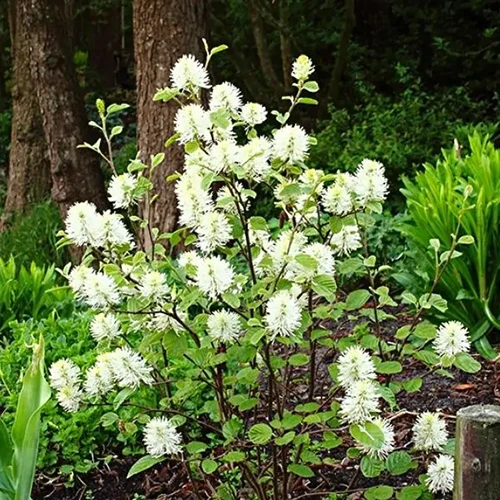
21. Fothergilla

Fothergilla, Fothergilla x intermedia, has sweetly scented white flowers that resemble bottle brushes.

The foliage consists of small, elliptical leaves with prominent diagonal veining.

A close up of small white fothergilla flowers and delicate green leaves on a soft focus background.A close up of small white fothergilla flowers and delicate green leaves on a soft focus background.

To grow this plant, select a full sun to part shade location. The soil should be acidic, organically rich, and well-draining.

Fothergilla varieties vary in height. Some dwarf types grow three to five feet tall, while larger ones can reach six to 10 feet at maturity.

Most varieties are suitable for growing in Zones 4 to 8.

In addition to the pretty flowers, fothergilla provides lovely fall color in shades of orange, red, and yellow.

A square image of 'Mount Airy' fothergilla in full bloom, growing in the backyard.A square image of 'Mount Airy' fothergilla in full bloom, growing in the backyard.

‘Mount Airy’ Fothergilla

The ‘Mount Airy’ cultivar is an early type best suited to Zones 5 to 8.

It reaches a height of three to five feet at maturity. Use it for loose hedging along walkways, fences, and property perimeters.

Place it in the back of beds with bulbs and perennials in the foreground.

Find ‘Mount Airy’ in #3 containers from Nature Hills Nursery.

Find more tips on fothergilla care here.

22. Japanese Camellia

Japanese camellia, Camellia japonica, aka the rose of winter, has flowers that resemble flouncy, cottage garden English roses.

It comes in shades of pink, purple, red, white, and yellow. The smooth, shiny, oval foliage is evergreen in Zones 7 to 9, where it grows best.

A garden scene with a large camellia bush with bright red flowers pictured in bright sunshine.A garden scene with a large camellia bush with bright red flowers pictured in bright sunshine.

For cultivation, provide a location with part to full shade that is sheltered from strong winds. The soil should be acidic, organically rich, and well-draining.

There are numerous cultivars with mature heights ranging from seven to 12 feet tall. The Japanese varieties grow a bit more slowly than other types.

One you may like is ‘Korean Fire.’ It has rose-red flowers and tops out at 10 to 12 feet tall.

A close up square image of a red 'Korean Fire' camellia flower with foliage in soft focus in the background.A close up square image of a red 'Korean Fire' camellia flower with foliage in soft focus in the background.

‘Korean Fire’ Camellia

Find ‘Korean Fire’ plants now from Fast Growing Trees in one-gallon pots.

Learn more about growing camellia here.

23. Korean Spice Viburnum

Korean spice viburnum, Viburnum carlesii, has reddish buds that open to showy, rounded clusters of tiny white flowers, similar to those of hydrangea.

They have a spicy scent.

A close up of the delicate pink and white flowers of viburnum, surrounded by foliage, pictured in bright sunshine.A close up of the delicate pink and white flowers of viburnum, surrounded by foliage, pictured in bright sunshine.
Viburnum carlesii ‘Diana’

The foliage consists of elliptical leaves with prominent veining, sometimes tinged with red. They deepen to a delightful bronze color in fall.

To grow viburnum, choose a site in full sun to part shade with average, slightly alkaline soil that drains well.

With a mature height of four to six feet, these plants thrive in Zones 4 to 7.

A close up square image of the flowers of Korean spice viburnum growing in the garden pictured in bright sunshine.A close up square image of the flowers of Korean spice viburnum growing in the garden pictured in bright sunshine.

Korean Spice Viburnum

You are likely to come across named cultivars and unnamed, “generic” varieties as you shop.

Find Korean spice viburnum plants now from Fast Growing Trees in three-gallon containers.

Check out our guide to growing viburnum here.

24. Pussy Willow

Pussy willow, Salix caprea, can grow as a shrub or a small tree. The long, bare stems of male plants bear furry gray and white catkins for intriguing early season interest.

A vertical close up picture of the wispy white flowers of the pussy willow, on a soft focus green background.A vertical close up picture of the wispy white flowers of the pussy willow, on a soft focus green background.

Find a spot with full sun to part shade for growing pussy willow. I had a beautiful small tree at one time, on the south side of my house.

It provided me with armloads of long stems for stunning floral arrangements.

Pussy willow reaches a mature height of 15 to 25 feet tall. By trimming the new canes (fresh spring stems) each year, I was able to maintain a manageable size.

To grow as a tree, trim away the side branches to establish a trunk. Plant bulbs and perennials around your tree for a pleasing focal point.

For cultivation as a bush, allow the lower branches to remain. This is a useful option for property perimeter plantings, hedgerows, or specimen planting in an island bed of its own.

A close up square branches of pussy willow pictured on a soft focus background.A close up square branches of pussy willow pictured on a soft focus background.

Pussy Willow

Pussy willow requires soil that is acidic, organically rich, and well-draining. It thrives best in Zones 4 to 8, where it grows quickly.

In addition to Salix caprea, there’s a North American native variety, Salix discolor, with smaller flowers.

Find pussy willow plants now from Fast Growing Trees in a variety of sizes.

Learn about growing pussy willow here.

25. Spring Heath

Spring heath, Erica x darleyensis, is also known as winter heath.

It’s an evergreen ground cover with multiple overlapping stems that bear rows of tiny bright pink to red cylindrical flowers. The foliage consists of bright green needles.

A close up of the pink flowers of spring heather growing in the garden, pictured in bright sunshine.A close up of the pink flowers of spring heather growing in the garden, pictured in bright sunshine.

Spring heath prefers full sun and organically rich, well-draining, acidic soil. However, it has a high tolerance for poor acidic soil, as well.

Heights range from 12 to 15 inches tall at maturity.

COFOF Weight Lifting Wrist Strap, Double Layer Leather Wrist Strap for Deadlift and Powerlifting, Adjustable Neoprene Padded Gym Workout Lifting Hooks (Pair)

0


Price: $19.97 - $14.97
(as of Feb 08, 2026 19:47:05 UTC – Details)


TIPS:
We use high-quality leather material, theprocess of transportation and packaging mayproduce some odor, when you encounter thissituation, you can place the product in theventilation to dry a day time, will help youeliminate the smell, you can even put someorange peel or lemon slices, will help absorb theodor.
Why Choose Our COFOF Weight Lifting Wrist Straps?
1. Our gym wrist straps are produced by a professional manufacturer with over 30 years experience in producing leather.
2. Extra padding around the D-shaped metal ring clasp keep your wrist from being squeezed and feel painful.
3. Weightlifting strap with high-density hook and loop can be easily worn on the wrist, and take off and put on freely by yourself.
4. Widened neoprene pad makes you feel comfortable.
Upgraded Weightlifting Wrist Strap: Our lifting wrist straps are made of double layers soft leather which is high quality and ergonomically designed to fit your hands and provide better grip. Adding extra padding around the D-shaped metal ring clasp keep your wrist from being squeezed and feel painful. Weightlifting strap with high-density hook and loop can be easily worn on the wrist, and take off and put on freely by yourself. Widened neoprene pad makes you feel comfortable.
Enhanced Grip: Professional leather deadlift straps can protect your hands from not only preventing calluses, but also peeling off existing calluses on your hands. Lifting straps take the pressure off your wrists and hands and help you lift heavier weights. More importantly, it improves your ability to exercise larger muscle groups.
Perfect Size Weightlifting Wrist Straps: Leather of our gym wrist hooks straps is 8.46 inches long and fits Palm Circumference 8.11 inches and above. Leather with double layers of sewing design thickness of 0.19 inches, not only soft but also safe and comfortable. The neoprene padding is 7.48 inches long, 2.56 inches wide and 0.2 inches thick to better protect the wrist from injury. The adjustable high-density hook and loop length is 16.7 inches and fits wrist circumferences of 6.3 to 8 inches.
Perfect fitness partner: Wrist workout straps are great for weightlifting, strength training, bodybuilding, pull-ups, hard pulls, shrugs, barbell rowing and upright rowing. Not only is the cow suede sweat-wicking and non-slip, but it is also constructed to last and resist up to 480 lbs without tearing. The wrist straps weighs only 0.5 pounds, so you can carry it with you, using it at home, in the gym or in the outdoors.
Wrist Wraps Strap Brand: Our gym weight lifting straps includes 1 pair of weightlifting workout wrist strap, 1 Instruction Manual. We are committed to providing a satisfactory experience. If you have any questions, please feel free to reach out to us.

Special Netherlands Garden Tour Q&A Webinar with Annie Guilfoyle

0

Celebrate the first day of spring with Fine Gardening on March 20, 2026, during a special live webinar that looks ahead to one of our most anticipated travel experiences of the year: the Stunning Gardens of the Netherlands tour in September 2026. Join Annie Guilfoyle, acclaimed UK garden designer and co-host of the upcoming tour, along with Fine Gardening editors Danielle Sherry and Carol Collins, for an engaging, behind-the-scenes conversation about Dutch garden design, travel inspiration, and what makes this journey so special.

This interactive webinar is your chance to ask questions directly, hear insider stories, and get a closer look at the gardens, designers, and cultural experiences that will shape the Netherlands tour. Annie and company will share insights you won’t find in the itinerary alone. Whether you’re already considering joining us in the Netherlands or love learning about lesser-known horticultural gems, this spring-kickoff event offers inspiration, expert perspective, and a preview of what promises to be an unforgettable garden travel experience.

March 20th, 2026 10am EST

Or learn more about the Netherlands Garden Tour with Fine Gardening here.


About Annie Guilfoyle

Award-winning garden designer, RHS Chelsea Flower Show judge

Garden Masterclass co-founder Annie Guilfoyle combines running a successful garden design consultancy with lecturing and writing on the subject around the globe. Her design work has been featured on several television programs, including Small Town Gardens on the BBC. She is a garden course consultant at West Dean College near Chichester, West Sussex, and teaches a monthly course called The Art and Craft of Garden Design at Great Dixter House and Gardens. Annie’s down-to-earth personality and witty sense of humor make her popular in international horticulture circles.

Joey Thurman AB Mat for Core Training with Lower Back Support, Ergonomic Foam Design for Ab Crunches and Sit Ups

0


Price: $29.99
(as of Feb 08, 2026 07:43:56 UTC – Details)


Joey Thurman’s Ab Mat is a foam core training accessory designed to provide lower back support during floor-based abdominal exercises. Its contoured shape is intended to sit beneath the lower spine, supporting the natural curve of the back during movements such as ab crunches and sit ups. When placed on the floor, the ab mat positions the lower back against its curved surface rather than allowing the spine to rest flat. This structure enables the torso to move through a curved range during abdominal exercises while maintaining contact with the mat throughout the movement. The design is intended for bodyweight core workouts performed on a flat surface. The gym floor mat for abs is constructed from high density EPE foam and covered with a PVC outer layer. The foam provides firm yet cushioned support that maintains its shape during repeated use. The PVC exterior adds durability and features a textured surface that helps reduce sliding on most floor surfaces during exercise. With dimensions of 37 x 30 x 7.5 cm or 14.4 x 11.7 x 2.9 inches, the ab mat is sized to fit under the lower back without occupying excessive space. Its compact footprint allows it to be stored easily between workouts and used in a variety of training environments, including home workout areas and gym floors. This ab mat is intended for men and women performing abdominal and core exercises that require lower back support. It is suitable for beginners learning proper positioning as well as experienced users incorporating floor-based core movements into their fitness routines. The product is a simple foam ab mat and does not include electronics, straps, handles, or moving parts.
ERGONOMIC LOWER BACK SUPPORT: Joey Thurman’s ab workout equipment is a must have, with a contoured shape to support the natural curve of the lower back during ab crunches and sit up exercises. The shape of this sit up mat allows the torso to move through a curved path rather than resting flat on the floor during abdominal workouts.
PREMIUM FOAM CONSTRUCTION: Made with high density EPE foam and a durable PVC outer layer, the workout mat provides firm yet cushioned back support that maintains its shape and stability throughout abdominal exercises and repeated use
OPTIMIZED SIZE AND SHAPE: This fitness mat 37 x 30 x 7.5 cm or 14.4 x 11.7 x 2.9 inches. The size and thickness of our padded mat are designed to fit under the lower back during floor-based abdominal exercises without taking up excessive workout space.
NON SLIP AND COMPACT DESIGN: The PVC outer surface features a textured finish that helps reduce sliding on most floor surfaces during abdominal exercises. The compact dimensions of our abs workout equipment allow for easy storage and use in home or gym workout spaces.
VERSATILE CORE TRAINING TOOL: This core strengthening equipment is suitable for use during ab workout, sit ups, leg lifts, and other floor-based core exercises where lower back support is needed. Our ab exercise equipment is designed for bodyweight abdominal workouts performed on the floor.

Joey Thurman’s Walk Belt, Waist Trimmer for Men and Women Weight Loss for Walking Black with 3 Mini Resistance Bands and 21-Day Walking Challenge Plan

0


Price: $26.13
(as of Feb 07, 2026 19:42:00 UTC – Details)

Product description

tone abstone abs

resistanceresistance

walk challengewalk challenge

WALK BELTWALK BELT

DURABLE

Made with premium polyester, neoprene, and latex for lasting use. The workout belt and workout bands are built to handle daily wear.

WALK BELTWALK BELT

COMFORTABLE

This waist belt for women and men is designed with adjustable straps and stretchy materials to provide secure compression and all-day comfort.

WALK BELTWALK BELT

ONE SIZE FITS MOST

At 44″ long and 5″ wide, this waist trimmer for women and men fits most body types snugly, stays in place, and helps you move with stability and confidence.

WALK BELTWALK BELT

LIGHTWEIGHT

Compact and lightweight so you can take your fitness on the go.

strong core,walkstrong core,walk

Product Dimensions ‏ : ‎ 44 x 5 x 0.04 inches; 12.31 ounces
Department ‏ : ‎ unisex-adult
Date First Available ‏ : ‎ May 19, 2025
ASIN ‏ : ‎ B0F942YZML
Product Warranty: For warranty information about this product, please click here
Best Sellers Rank: #229,658 in Sports & Outdoors (See Top 100 in Sports & Outdoors) #268 in Waist Trimmers
Customer Reviews: 4.1 4.1 out of 5 stars (43) var dpAcrHasRegisteredArcLinkClickAction; P.when(‘A’, ‘ready’).execute(function(A) { if (dpAcrHasRegisteredArcLinkClickAction !== true) { dpAcrHasRegisteredArcLinkClickAction = true; A.declarative( ‘acrLink-click-metrics’, ‘click’, { “allowLinkDefault”: true }, function (event) { if (window.ue) { ue.count(“acrLinkClickCount”, (ue.count(“acrLinkClickCount”) || 0) + 1); } } ); } }); P.when(‘A’, ‘cf’).execute(function(A) { A.declarative(‘acrStarsLink-click-metrics’, ‘click’, { “allowLinkDefault” : true }, function(event){ if(window.ue) { ue.count(“acrStarsLinkWithPopoverClickCount”, (ue.count(“acrStarsLinkWithPopoverClickCount”) || 0) + 1); } }); });

12 Plants that Like Epsom Salt

0

Scientifically known as Magnesium Sulphate, epsom salt provides magnesium and sulfur nutrients to plants that in turn will increase chlorophyll production.

This natural fertilizer improves your plants ability to absorb essential nutrients like nitrogen and phosphorus from the soil making them greener.

However, according to the University of Minnesota Extension, you need to conduct soil tests before applying epsom salt. As overuse of magnesium sulphate can lead to calcium deficiency.

So, you can’t readily go around throwing epsom salt at the base of the plant and wait for the miracle to happen.

Apart from checking magnesium and sulphur consistency in the soil, there are few plants that don’t like epsom salt.

You must keep magnesium sulphate away from such plants.

How Does Epsom Salt Help Your Plants?

Dilute epsom salt with water

As mentioned earlier, Epsom salt helps plants by supplying magnesium, an essential nutrient for chlorophyll production.

When plants have enough magnesium, their leaves stay greener, photosynthesis improves, and overall growth looks healthier—especially in magnesium-loving plants like tomatoes, peppers, and roses.

It also helps plants use nutrients more efficiently.

Magnesium supports the movement of nitrogen and phosphorus within the plant, which can lead to stronger stems, better flowering, and improved fruit development when a real magnesium deficiency exists.

12 Plants that Like Epsom Salt

Magnesium sulphate is a natural mineral and it’s an integral nutrient of chlorophyll synthesis.

However, the requirement of this micro nutrient is small.

The problem arises when you dump the granulated epsom salt directly at the plant base. You need to first dilute it with water and apply to the plant that needs the trace element.

Below I listed plants that like epsom salt, but use it with care.

1. Tomatoes

Most common vegetables in your backyard can benefit from this natural mineral, but you need soil tests to ensure the garden soil lacks the required amount of magnesium and sulfur.

Epsom salt can help tomato plants by giving them a magnesium boost, which keeps leaves green and supports healthy growth.

It may also help with flowering and fruit set—but only if your soil is actually low in magnesium.

Mix 1 tablespoon of Epsom salt in 1 gallon of water and use it to water the soil around the base of the plant.

Apply it once a month, and only if your tomatoes show signs of magnesium deficiency.

Using too much Epsom salt can mess up the soil, stop plants from taking in calcium, and actually make them weaker instead of healthier.

2. Peppers

Peppers don’t need Epsom salt by default, but in magnesium-poor soil, a small dose can make a noticeable difference. Yellowing leaves are often the first sign that something’s missing.

When magnesium is low, Epsom salt can help peppers maintain greener foliage and support smoother nutrient flow inside the plant.

This can result in healthier plants and better pepper formation—but only when a deficiency is present.

3. Roses

Epsom salt for rose plants

Flowering plants like roses can respond well to Epsom salt, but only when the soil is actually low in magnesium. A quick soil test helps avoid overdoing it and keeps nutrients balanced.

Epsom salt can support roses by improving magnesium levels, which helps leaves stay green and encourages better bloom production.

It may also strengthen canes and improve overall plant vigor when there’s a real deficiency.

Also Read: Is Epsom Salt Good for Hydrangeas?

4. Potatoes

You might not expect it, but potatoes can really benefit from a little Epsom salt when the soil is low in magnesium. Since they grow underground, healthy roots and steady nutrient flow make a big difference.

Epsom salt supplies magnesium and sulfur that support strong foliage above ground, which directly affects how well tubers develop below the soil.

As potato plants grow, they need consistent nutrients to size up properly and avoid weak, stressed growth.

Used the right way, Epsom salt can help improve plant vigor and support better-quality, well-formed potatoes at harvest.

5. Spinach

Spinach is a fast grower, and when magnesium is missing, it shows almost immediately through pale or yellowing leaves. In magnesium-poor soil, Epsom salt can help bring back that deep green color spinach is known for.

A small, well-timed dose supports chlorophyll production and keeps leaf growth steady. When used correctly, it helps spinach stay lush and productive instead of thin and stressed.

6. Beans

Beans are generally easygoing plants, but they still rely on balanced nutrients to grow strong. If magnesium levels drop, growth can slow and leaves may lose their healthy green tone.

Epsom salt can step in by supporting nutrient movement within the plant, helping beans grow evenly and set pods more reliably. Used only when needed, it can give bean plants a gentle boost without pushing them too hard.

7. Geraniums

Support stronger growth and richer leaf color by using Epsom salt when soil magnesium is low, especially during active growth.

Geraniums respond well when nutrients are balanced, and magnesium helps them maintain healthy foliage and steady blooming.

Used sparingly, Epsom salt can keep plants looking vibrant without overstimulating growth.

8. Cucumbers

Cucumbers grow fast and need a steady supply of nutrients to keep vines healthy and productive. When magnesium levels drop, leaves may start to yellow, which can slow growth and reduce yields.

Epsom salt can help by supplying magnesium that supports chlorophyll production and keeps cucumber leaves green. Healthier leaves mean better photosynthesis, which fuels flowering and fruit development.

Used only when the soil is low in magnesium, Epsom salt may also support better nutrient movement within the plant, helping cucumbers grow evenly and produce cleaner, well-formed fruits.

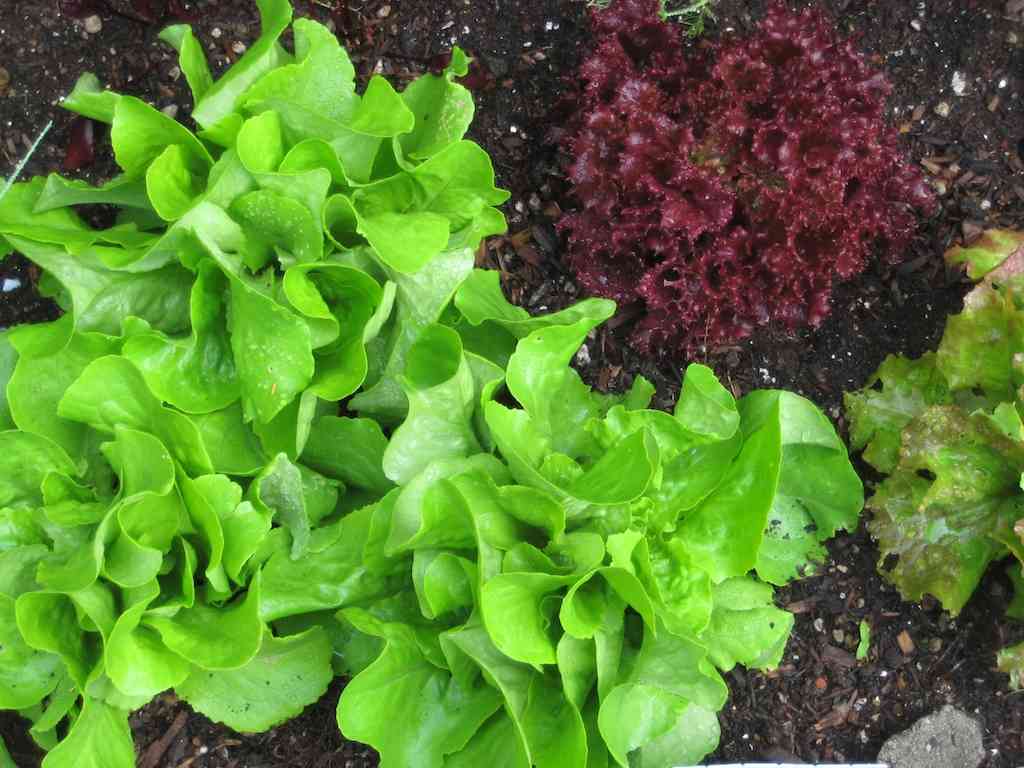
9. Lettuce

Encourage greener, fuller leaves by applying Epsom salt early in the growing stage if magnesium deficiency is present.

Since lettuce grows quickly, even small nutrient gaps can show up fast.

A light magnesium boost can help maintain leaf quality and support consistent growth.

10. Eggplants

Eggplants can sometimes struggle if the soil is low in magnesium, and that’s when Epsom salt can help. It supports greener leaves and steadier growth, which the plant needs to produce healthy fruit.

When used in small amounts, Epsom salt can also help eggplants flower better and develop stronger fruits. Just remember—it works best only when there’s a real magnesium deficiency, not as a regular fertilizer.

11. Radish

Epsom salt can support radish growth by improving magnesium availability, which helps plants grow more evenly and stay healthy. When used correctly, it may lead to better root development and overall plant balance.

Radishes are quick-growing root crops, so even small nutrient gaps can affect their size and shape. Magnesium plays a role in enzyme activity and nutrient movement, which helps the plant direct energy toward forming firm, well-shaped roots instead of weak foliage.

However, radishes don’t need heavy feeding. Epsom salt should only be used when soil tests show low magnesium levels, as excess magnesium can interfere with calcium uptake and negatively affect root quality.

Also Read: 19 Best Vegetables to Plant in Spring?

12. Palms and Ferns

Houseplants like palms and ferns can respond well to Epsom salt when they’re low on magnesium. A common sign is pale or yellowing leaves, especially on older growth.

Magnesium helps these plants keep their leaves deep green and supports steady, healthy growth. Since palms and ferns are mainly grown for their foliage, this can help them look fuller and healthier.

That said, they don’t need it often. Using Epsom salt only once in a while—and only when there’s a real deficiency—helps prevent salt buildup in pots, which can stress houseplants instead of helping them.

Important Tips

Don’t use Epsom salt as a regular fertilizer for all plants. It only helps when there’s a real magnesium deficiency, otherwise it can do more harm than good.

Avoid applying Epsom salt without testing your soil first. Guessing can lead to excess magnesium, which blocks calcium and affects overall plant health.

Never overapply or use it too often. Frequent or heavy use can build up salts in the soil or pots, stressing roots and weakening plants instead of helping them grow.

Conclusion

Epsom salt can be helpful for certain plants, but it’s not a cure-all. It works best when your soil is actually low in magnesium and the plant has a real need for it.

Used the right way and in the right amount, it can support greener leaves, better growth, and healthier plants. When used blindly or too often, though, it can upset soil balance—so a little care goes a long way.

Classic Meatloaf Recipe

0

Overhead view of a loaf pan filled with freshly baked meat loaf topped with a tomato topping and sliced for serving.This classic, easy meatloaf recipe is freezer-friendly, quick to prep, and ideal for busy weeknights, with leftovers you can enjoy throughout the week.