41 F
Klamath Falls
Saturday, March 14, 2026
Home Blog Page 5

How to Get Rid of Ants Naturally

0

Ants, ants, everywhere! Those pesky insects have a way of finding every little crack and opening right into your home. When spring comes around I’ll see an ant scout here and there and I want to nip it in the bud before they take over my life (and my kitchen counter).

Every spring I start getting questions about how to get rid of ants in the house, especially when they show up quickly and seem to multiply overnight. Sometimes they’re tiny and barely noticeable. Sometimes they’re small black ants marching in a perfect line. Occasionally they even have wings.

With little kids and pets spending plenty of time on the floor, I’m not about to sprinkle a pesticide around my home that will put them in danger.

But the ants…

Thankfully there are plenty of ways to get rid of ants without putting your family at risk. I’ve talked before about natural pest control, but today I am going to focus specifically on ants. How to get rid of ants in the kitchen, how to get rid of ants permanently, and even how to get rid of carpenter ants (if you suspect a larger infestation).

How Do Ants Come Into the House?

Ant colonies send out scouts to locate food sources. Those little bugs will zig and zag and probe their way until they find food to bring back to their colony, leaving a trail of pheromones behind them. Other ants will follow the trail leaving their own pheromones, making the trail stronger. Eventually all the little foragers are marching along, back and forth, taking all your goodies back to their home.

Fascinating and annoying all at once.

If you’ve ever wondered why you see one ant and then suddenly dozens, this is why. That single scout found something appealing on your counter, under the stove, or even tucked behind a plant on the windowsill. Soon, the whole crew is trekking inside your house like they’ve decided to move in. 

And it isn’t always obvious what they’re after. Sugar ants are often blamed for invading our honey jars or maple syrup, but ants are opportunistic. They’ll go after crumbs in the carpet, sticky spots on the floor, pet food bowls, and even residue left in the bathroom. I’ve found them near toothpaste drips and damp areas more than once.

Understanding how they operate is the first step in learning how to get rid of ants in the house for good.

How to Get Rid of Ants (Naturally, of Course!)

There are several approaches to naturally get rid of ants. First, repel them from coming into your home in the first place, then control and eradicate them once they are in. Finally, kill them at their source.

If you’re dealing with a larger species like carpenter ants (which can damage wood in bedroom walls or other structural areas), your strategy may need to be more aggressive. I’ll touch more on how to get rid of carpenter ants specifically below. For most common household ants, though, prevention is the best place to start. 

How to Repel Ants

The first step is to make sure any sweet ingredients in your home are sealed tight. Clean up the dribbles down the side of the honey jar and make sure your maple syrup lid is on tight. It’s also recommended to keep floors swept and all counters free of any food or drips, but that’s not usually practical or possible in a busy home like mine. Just do the best you can with this one.

When I’m focused on how to get rid of ants in kitchen, I pay special attention to:

  • Crumbs under appliance
  • Sticky cabinet handles
  • Pet food dishes
  • The trash can area
  • Any food prep areas on the counter

Even a small smear can attract a line of tiny visitors. Some ants are attracted to oils or proteins, so pay attention to all food, not just sugary ones. Here are some more ideas to prevent ants from coming into your home:

Create a Barrier

Many people have luck creating a barrier of something ants generally don’t like or won’t cross. Some examples would be drawing a chalk line or sprinkling cinnamon, cayenne pepper, or coffee grounds along common entry points.

This works especially well along door thresholds, window sills, and baseboards. If you’ve noticed ants coming in from the yard or from cracks that lead outside, treat those spots first.

  • Citrus Peels – Ants are also repelled by citrus (plus it smells great!). Oranges, lemons, grapefruits, etc. contain D-limonene, which is effective at killing ants. I like to save my orange or lemon peels and dry them out. I’ll then pulse them in the food processor to make a powder and sprinkle this along entry points in the home. You can also sprinkle these around your garden or near plants outside.
  • Essential Oils – I’ve had good results deterring ants that were determined to come in under my screen door with an essential oil spray. Fill a small spray bottle with water and add about 20 drops of peppermint oil. Shake well and spray along doorways and window sills. It repels the ants and covers the scent of any food and pheromones.
  • Cotton Balls – You can also put several drops of peppermint, orange, or lemon oil on a cotton ball and place it in cabinets to deter ants from snooping around in search of food. This is one of my go-to methods when I want to deal with the problem quickly, especially if I notice them trailing across the kitchen floor.
  • Vinegar – Spraying vinegar along doorways and window sills is another option. This has the same effect as the peppermint oil spray. Mix vinegar 50/50 with water in a spray bottle. Add peppermint oil or a citrus oil to make it even more effective. You can also soak citrus peels in the vinegar for a few weeks, strain, then use this vinegar to spray with. Vinegar is especially helpful for erasing pheromone trails so other black ants or sugar ants can’t follow the same path.

What if Ants Are Already In Your Home?

The ants are already in. Now what?

First, find out where they’re coming in from and where they’re going so you can figure out the best way to tackle their removal. Something attracted them and that will need to be cleaned up. Then find their entry point so that you can use one of the tips from above.

If you’re trying to figure out how to get rid of ants in the house, this detective work is essential. Are they in the kitchen? The bathroom? Crawling along a baseboard in the bedroom? I once found a trail disappearing behind a bookshelf in the living room, and sure enough, there was a tiny gap in the trim that led to the outside.

Once you’ve found point A and point B, move on to clean up. You’ll obviously need to remove the ants from your counter, floor, cabinet or wherever they are. You can wipe them up with a cloth (or paper towel if you don’t want to try to remove them from your cloth).

It’s also really important to remove the pheromone trail. You can use soapy water, a 50/50 water and vinegar mix, or the essential oil spray. If you don’t clean up the trail, other ants will be able to find the same food source.

How to Get Rid of Ants Permanently (By Targeting the Colony)

I don’t know about you, but my first instinct is to kill any bugs I see in my house (or call for my adventurous daughter to do it for me). However, this may not always be the most effective way to rid your home of ants in the long term.

If you truly want to know how to get rid of ants permanently, you have to think bigger than the few crawling across your floor. The real goal is eliminating the colony. Although, there are some reports that if an ant smells another ant that’s been squished, they’ll alert the colony of the danger and stay away. 

The most effective way is to make an ant poison they will take back to their colony and feed to all of their friends. It requires a little bit of patience but pays off in the end.

Option 1: Borax Ant Trap

This doesn’t immediately remove the ants from your kitchen, but it works well in the long term. It may seem like it attracts more at first, which is actually a good thing here Borax helps eliminate the entire colony and not just the ants entering your home.

Mix equal parts Borax and corn syrup and spread it on an index card. The ants are attracted to the corn syrup and carry it back to their nest. All the ants that feed on the corn syrup mixture will be killed by the Borax. I’ll put this in a location away from curious pets and kids. (I cover the safety of using Borax here.)

If you’re searching for how to get rid of carpenter ants, this method can also be helpful, though carpenter ants sometimes require locating and directly treating their nest in wood structures as well.

Option 2: Baking Soda

If you’re uncomfortable with Borax, you can try baking soda. Mix equal parts baking soda and powdered sugar and place it in a lid near where you think the ants are coming in. The powdered sugar will attract them, but since they’re unable to differentiate between the sugar and the baking soda, they will carry both back to their nest.

When ants eat baking soda it reacts with the acidic substance in their bodies and is fatal to them. Again, not an immediate fix, but very beneficial in the long term.

Other Ant Killing Tips to Try

Castile soap will also compromise the waxy coating that protects the ants. Make a spray with 1 quart water and 1/4 cup liquid castile soap. Spray along doorways and window sills and anywhere else you see ants coming in. Repeat several times a day until the problem is resolved.

Diatomaceous Earth

Food grade diatomaceous earth is highly effective at getting rid of ants and other pests that crawl, rather than fly. This includes most black ants and other small household varieties, though not typically flying ant scouts until they land.

DE is a fine powder made from the fossilized remains of diatoms, a type of algae. Because it’s so fine, it’s perfectly safe for humans and animals and is actually beneficial to consume. Ants, however, become dehydrated when they come into contact with DE because it damages their waxy coating which will kill them. They won’t take it back to their colony but it will stop them from making any progress into your home.

Sprinkle DE along doorways and window sills, and any other points of entry, in trash cans, and along cabinets and baseboards. I have also sprinkled it liberally on my carpet during a particularly bad ant invasion. After a few days the ants were gone and I just vacuumed up the DE.

Use extreme care if you will be using this outside and avoid any areas that may have honey bees. The DE will stick to their legs and they will consume it when they’re grooming. DE is sharp to small insects and will kill them. We want to kill the ants and fleas, but NOT the honey bees!

A Quick Note on Flying Ants and Wings

If you notice ants with wings gathering near windows or light fixtures, you may be seeing reproductive ants. These can sometimes be confused with termites. If you’re unsure, it may be worth having a professional identify them, especially if you suspect structural damage.

In many cases, though, it means the colony is reproducing and taking out the whole colony will resolve the issue (see methods above).

Dealing With More Than Ants?

If you have other pests plaguing you there are other natural pest control options for your home and some organic ideas for your garden and yard.

Ants are persistent, but they’re not invincible. With a bit of patience, you can learn how to get rid of ants in the house and kitchen, and even how to get rid of ants permanently without compromising your family’s health. If you’ve ever dealt with ants popping up in the house, these tried and true methods can really make a difference. 

How do you deal with ants? Did I miss any effective tips that have worked for you? Leave a comment and let us know!

How to Grow and Care for Flowering Maple (Abutilon)

0

Flowering maples can tolerate too much water for a short time, but lack of moisture will stress or even kill them.

Temperature

Even though abutilons make happy houseplants, they flower and perform best if allowed to experience a period of chilly temperatures in the winter.

Not freezing, of course, but temperatures around 50 to 60°F for part of the day during the winter. During the growing season, don’t worry about the heat.

While temperatures around 60 to 70°F are ideal, flowering maples will tolerate outside of this range as well.

You can grow them outdoors year-round in Zones 9 to 10 and some in Zone 8. I grow my hybrid, ‘Red Tiger,’ in Zone 8b.

It has even been exposed to a hard freeze multiple times and on it carries.

A few times, it has lost a few branches, but I trim these off and it always rebounds spectacularly in the spring.

Fertilizer

Part of what makes abutilon so charming is its near-constant flowering. But that also makes it a hungry plant.

You might need to feed as often as twice a month during the spring, summer, and fall.

If you haven’t tested your soil or you’re using a potting mixture, just go for a product formulated for flowering plants. A houseplant food works, too.

You want a fertilizer that has more phosphorus than nitrogen or potassium.

Down to Earth’s Rose & Flower fits the bill, with an NPK ratio of 4-8-4. It can be used indoors and out.

A close up of the packaging of Down to Earth Rose and Flower Mix isolated on a white background.

Down to Earth Rose and Flower

You can find it in one-, five-, and 15-pound boxes available at Arbico Organics.

Species and Cultivars

The various hybrids are classified as Abutilon Hybridum (A. × hybridum) and often come from unknown parentage, though they likely include some redvein (A. pictum), Darwin’s (A. darwinii), or trailing (C. magapotamica) in their lineage. Most are frost tender.

There are a few lesser-known species, like Chilean mallow (C. vitifolium) that are hard to find, but worth seeking out.

The flowers on this species look like hibiscus and the shrub itself grows to 25 feet or more.

Here are some suggestions to get you started:

Bella

Bell is a hybrid abutilon series in shades ranging from creamy yellow to deep red, with apricot, pink, and orange in between.

A close up horizontal image of red pendulous abutilon flowers growing in the garden.A close up horizontal image of red pendulous abutilon flowers growing in the garden.

Bred to stay petite, they only grow to about 18 inches tall, which makes them ideal for growing as houseplants.

Canary Bird

‘Canary Bird’ has bright yellow blossoms that linger on the branches for a good long while.

A close up horizontal image of yellow abutilon flowers pictured on a soft focus background.A close up horizontal image of yellow abutilon flowers pictured on a soft focus background.

The shrub itself grows to about 15 feet tall outdoors, though you can grow it indoors, where it will stay much smaller.

The Royal Horticultural Society gave ‘Canary Bird’ the coveted Award of Garden Merit in 1993.

Gold Dust

‘Gold Dust’ is a charming hybrid that features large orange blossoms with dark red veins.

A close up horizontal image of a hand from the bottom of the frame holding orange abutilon aka flowering maple flowers.A close up horizontal image of a hand from the bottom of the frame holding orange abutilon aka flowering maple flowers.

The leaves are speckled in yellow on a green base, giving it extra visual appeal even when it’s not in bloom, which is rare.

This abutilon stays under 10 feet tall and wide outdoors, making it an appealing option for growing indoors as a houseplant, as it will stay more compact that many others.

The variegated foliage also means that it thrives in lower light than other varieties.

Nabob

A cross between a redvein (A. pictum) and a trailing (C. megapotamica), ‘Nabob’ has glossy, dark green foliage and large, deep maroon flowers.

A close up horizontal image of a bright red flower pictured on a soft focus background.A close up horizontal image of a bright red flower pictured on a soft focus background.

Outdoors, it will reach up to 10 feet tall, and about half that indoors. Of course, you can always prune it to whatever smaller size you like.

‘Nabob’ was given the Award of Garden Merit by the Royal Horticultural Society in 1993.

Orange Hot Lava

This abutilon hybrid featuring C. megapotamica parentage is a stunner.

Xtend Scivation EAA + BCAA Powder | Muscle Recovery & Lean Muscle Growth | 9 Essential Amino Acids for Intra Workout or Post Workout Recovery | 10g EAAs Per 2 Servings | Mango 40 Servings

0


Price: $27.46 - $2.01
(as of Mar 05, 2026 21:21:15 UTC – Details)


Build and Preserve Lean Mass with XTEND Essential Amino Acids supplement powder. Enhance athletic recovery with XTEND EAAs – crafted with all 9 essential amino acids for a complete protein source, XTEND EAAS are a simple way to get a full suite of aminos to help grow muscle mass. Elevate your routine with zero sugar and a variety of delightful, sugar-free flavors.
Product Dimensions ‏ : ‎ 5.91 x 3.94 x 3.94 inches; 11.57 ounces
Item model number ‏ : ‎ XT-XTEA40M
Date First Available ‏ : ‎ March 22, 2024
Manufacturer ‏ : ‎ Nutrabolt
ASIN ‏ : ‎ B0CYVW51DV
Best Sellers Rank: #6,445 in Health & Household (See Top 100 in Health & Household) #17 in Branched Chain Amino Acids Nutritional Supplements
MUSCLE GROWTH UNLOCKED – Amino Acids for muscle growth with 10g per 2 servings of EAAs for unlocking your best results.
BUILD & PRESERVE MUSCLE MASS – Supports growth and lean muscle mass with essential amino acids and BCAAs for optimal workout recovery.
MUSCLE GROWTH & RECOVERY – 9 Essential Amino Acids for a complete protein source for muscle growth and recovery.
ESSENTIAL AMINO ACIDS FOR ATHLETIC RECOVERY – Boosts athletic recovery and vitality with essential amino acids, electrolytes, and muscle recovery complex.
SUGAR-FREE BRANCHED CHAIN AMINO ACIDS – XTEND EAA Essential Amino Acid supplement powder contains zero sugar, zero calories, and zero carbs in every delicious servings.

Xtend Scivation EAA + BCAA Powder | Muscle Recovery & Lean Muscle Growth | 9 Essential Amino Acids for Intra Workout or Post Workout Recovery | 10g EAAs Per 2 Servings | Lemon Lime 40 Servings

0


Price: $27.99 - $26.49
(as of Mar 05, 2026 09:18:26 UTC – Details)


Hydrate, repair, and recover with great-tasting amino acids and electrolytes. XTEND® Original BCAAs deliver the refreshing support your body craves before, during, or after training to help you push harder and bounce back faster. Trusted by athletes and fitness enthusiasts alike for more than a decade, it’s the go-to amino formula built to support optimal recovery — without the sugar or unnecessary fillers.*
Product Dimensions ‏ : ‎ 5.91 x 3.94 x 3.94 inches; 11.85 ounces
Item model number ‏ : ‎ XT-XTEA40LL
Date First Available ‏ : ‎ March 22, 2024
Manufacturer ‏ : ‎ Nutrabolt
ASIN ‏ : ‎ B0CYW4K7HY
Best Sellers Rank: #6,764 in Health & Household (See Top 100 in Health & Household) #18 in Branched Chain Amino Acids Nutritional Supplements
REPAIR & RECOVER — Boost everyday muscle recovery with 7g of BCAAs in clinically studied ratios.*
DAILY HYDRATION — Keep your body feeling its best with essential electrolytes that help replenish what you lose in sweat.*
GLP-1 SUPPORT — Use as a complement to a GLP-1 protocol with BCAAs to support muscle retention and electrolytes to support hydration.*^
INCREDIBLE FLAVORS — Available in a variety of mouthwatering flavors with zero sugar or artificial colors.
THE OG — XTEND Original is the category leading Aminos product that has been trusted by consumers for more than 15 years.
^BCAAs are shown to support muscle retention in calorie-restricted diets.
* Packaging may vary

Roses and More in Connie’s Montana Garden

0

Hi GPODers!
There are many different kinds of gardeners, but some would argue that we all fall into one of two camps: designers or collectors. While designers focus more on the bigger picture and how all of their plants will come together (even if that means planting a lot of the same plant for cohesion and coordination), a collector strives to acquire every plant that they find interesting and worries about arrangement later. However, I would argue that most of us fall somewhere in the middle, and Connie Klingaman in Helena, Montana (Zone 3/4) is a perfect example of that. Connie has decades of gardening experience and certainly knows how to craft a stunning landscape design, but also has acquired a fascinating and wide range of plants over the years.

I’ve been gardening for over 40 years, this latest garden is 9 years growing. I have over 350 cultivars of trees, shrubs, perennials, and roses, and a vegetable garden. I’ve been growing roses here after hearing that you can’t grow roses in Montana, over 40 varieties. And just about anything else that will possibly grow here! Besides roses, my favorite plants to grow are flowering trees, from lindens to crabapples to hawthorns. Two years ago we had a several snowstorms where the snow melted and formed a layer of ice over everything. I lost more plants than ever before, even iris and several young trees that are normally perfectly hardy. Usually, we have no snow cover so dryness is a bigger issue. But one thing my gardens do for me is to keep me young, hopeful and stronger and it’s an outlet for my creativity. All the iron work, fences, and art in the garden are made by my husband and I. About an acre and a half of gardens and lawns will do that! There are many pictures of my gardens on Facebook at Terra Bella Tales and a stories on terrabellatales.com. Welcome to Montana!

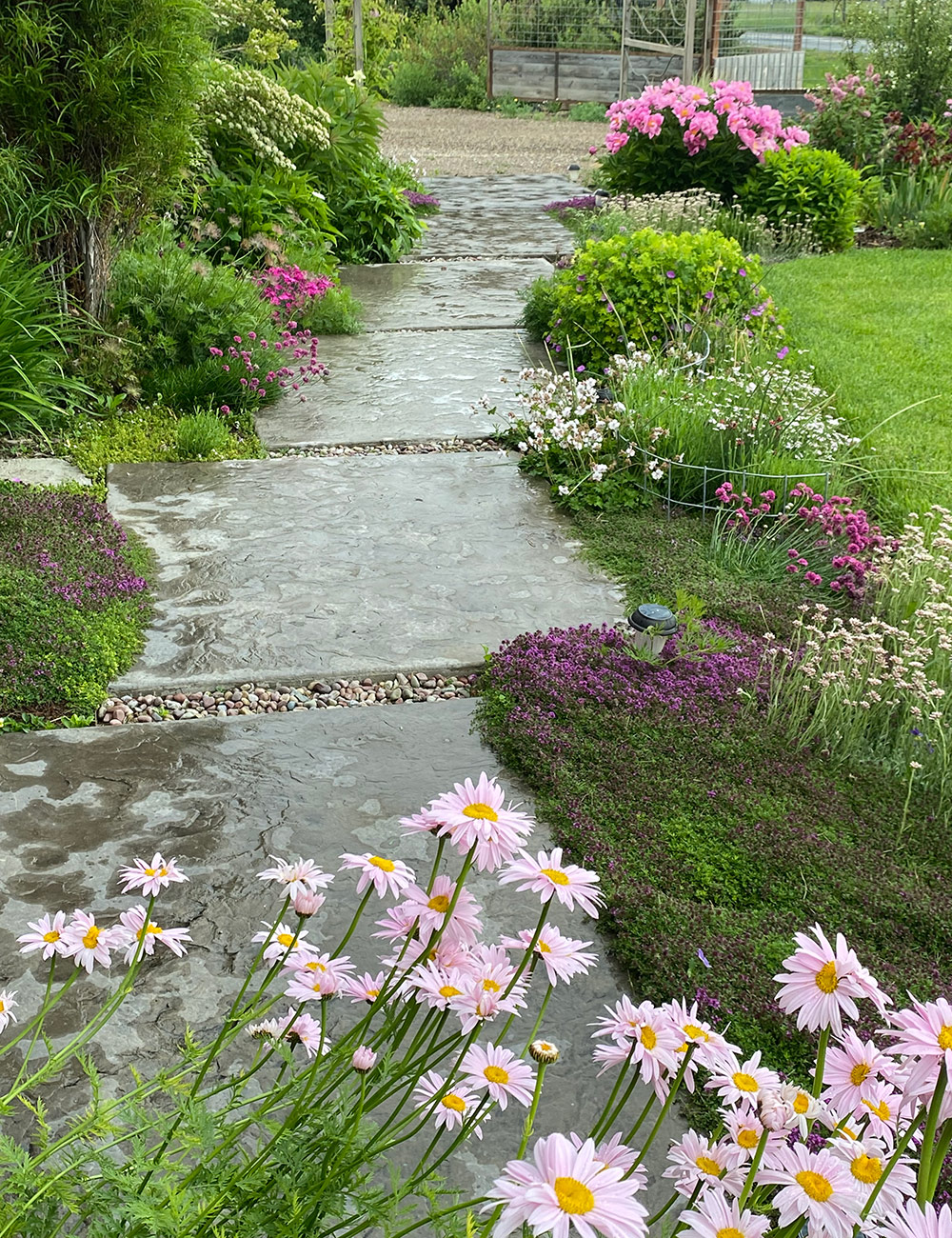
Our front sidewalk of stamped concrete: Marguerite daisy (Argyranthemum frutescens, Zones 10–11 or as an annual), creeping thyme (Thymus serpyllum, Zones 4–8), pussytoes (Antennaria plantaginifolia, Zones 3–8), armeria, ‘Biokovo’ geranium (Geranium x cantabrigiense ‘Biokovo’, Zones 4–8), dianthus, ninebark (Physocarpus opulifolius, Zones 4–8), ‘New Hampshire Purple’ geranium (Geranium sanguineum ‘New Hampshire Purple’, Zones 3–8), ‘Sparkling Star’ peony (Paeonia ‘Sparkling Star’, Zones 3–8), and iris

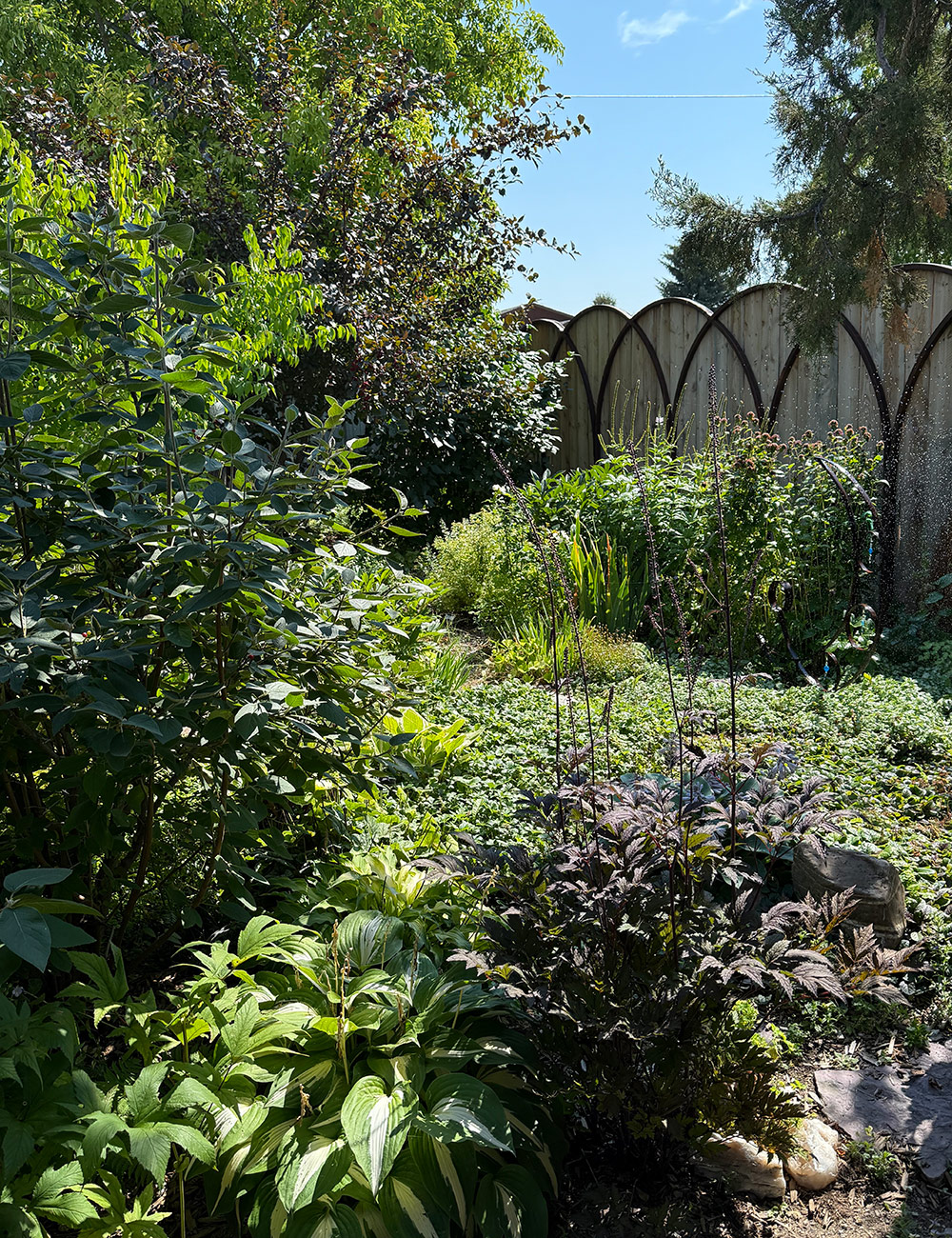
shade garden with lush foliage plantsThis garden gets shade most of the day, the plants are: hostas, black snakeroot (Actaea racemosa, Zones 3–8), viburnum, bee balm (Monarda didyma, Zones 4–9), ‘White Nancy’ lamium (Lamium maculatum ‘White Nancy’, Zones 3–8), ‘Montrose White’ calamint (Calamintha nepeta ‘Montrose White’, Zones 5–9), veronicastrum, obedient plant (Physostegia virginiana, Zones 3–9), and ‘Thunderchild’ crabapple (Malus ‘Thunderchild’, Zones 3–7).

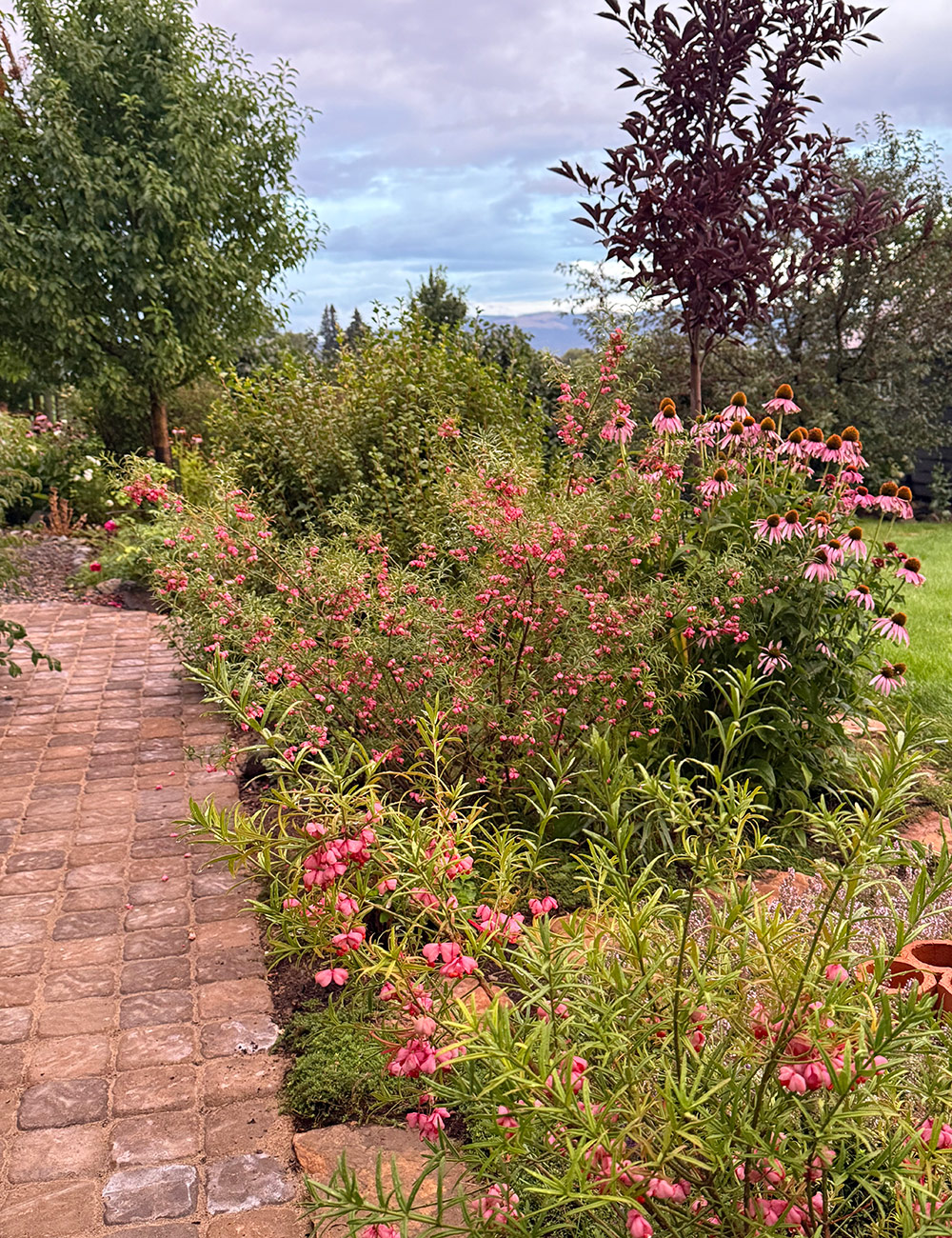
various pink flowers along brick pathA perfect after storm light, plants are Turkestan burning bush (Euonymus nanus ‘Turkestanicus’, Zones 3–7), purple coneflowers (Echinacea purpurea, Zones 3–9), ‘Canada Red’ chokecherry (Prunus virginiana ‘Canada Red’, Zones 2–10), ‘Spring Snow’ crabapple (Malus ‘Spring Snow’, Zones 4–8), alpine currant (Ribes alpinum, Zones 2–7).

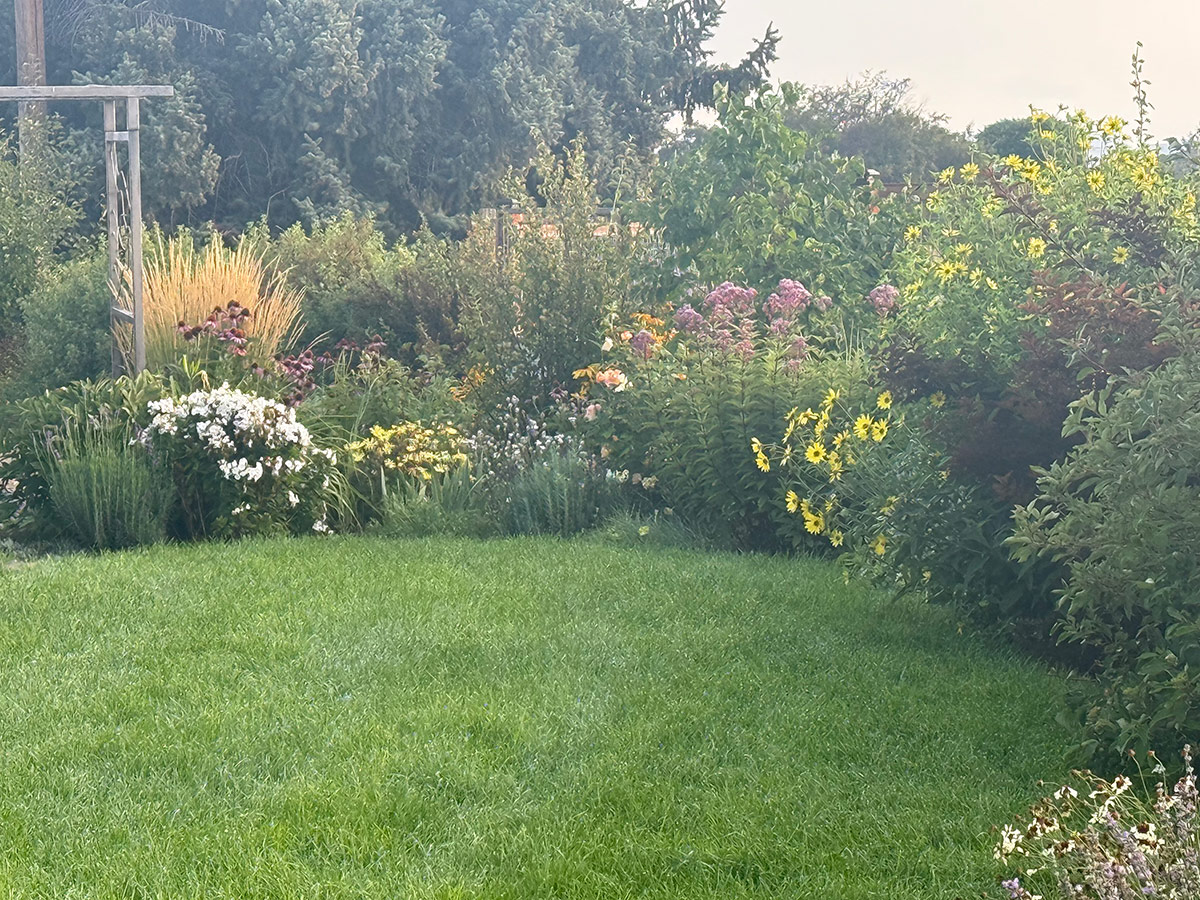
colorful garden borderA rare August foggy morning-the plants are ‘David’ phlox (Phlox paniculata ‘David’, Zones 3–8), purple coneflower, ‘Overdam’ feather reed grass (Calamagrostis x acutiflora ‘Overdam’, Zones 4–9), yellow columbine (Aquilegia chrysantha, Zones 4–9), rudbeckia, ‘Morden Sunrise’ rose (Rosa ‘Morden Sunrise’, Zones 3–7), ‘Baby Joe’ Joe Pye weed (Eutrochium dubium ‘Baby Joe’, Zones 3–9), mock orange, ‘Miss Kim’ lilac (Syringa pubescens subsp. patula ‘Miss Kim’, Zones 4–8), ‘Lemon Queen’ sunflower (Helianthus ‘Lemon Queen’, Zones 4–9), Diabolo® ninebark (Physocarpus opulifolius ‘Monlo’, Zones 3–7), dogwood and annual coreopsis (Coreopsis tinctoria, annual).

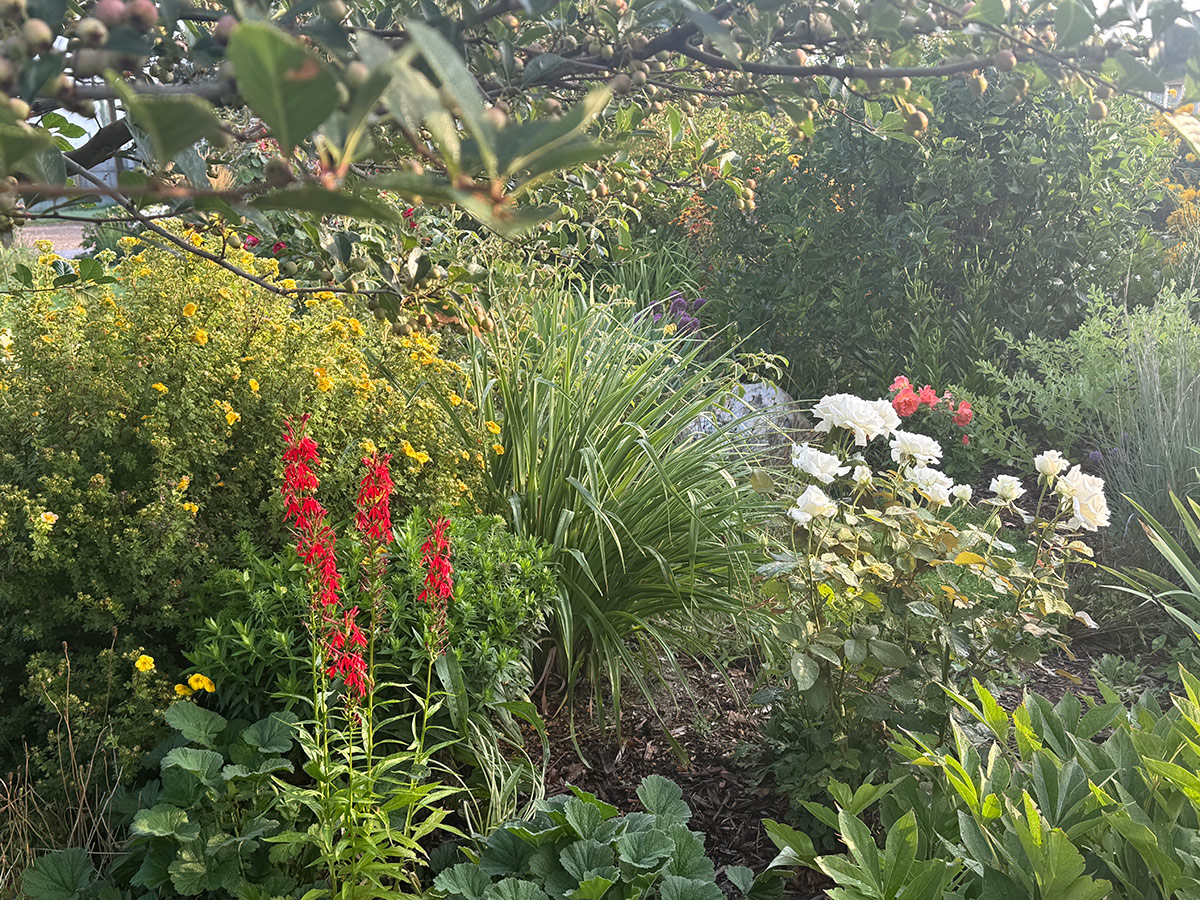
sunny garden with red and white flowersSunrise Garden on the east side of my front yard, plants are: Thornless cockspur hawthorn (Crataegus crus-galli var. inermis, Zones 3–7), lobelia,’Snowdrift’ rose (Rosa ‘BAIrift’, Zones 4–9), ‘Double Down Orange’ rose (Rosa ‘JACedocaing’, Zones 5–9), Mandarin Tango® potentilla (Potentilla fruticosa ‘Jefman’, Zones 2–6), baptisia, ‘Bleeding Hearts’ false sunflower (Heliopsis helianthoides var. scabra ‘Bleeding Hearts’, Zones 3–9).

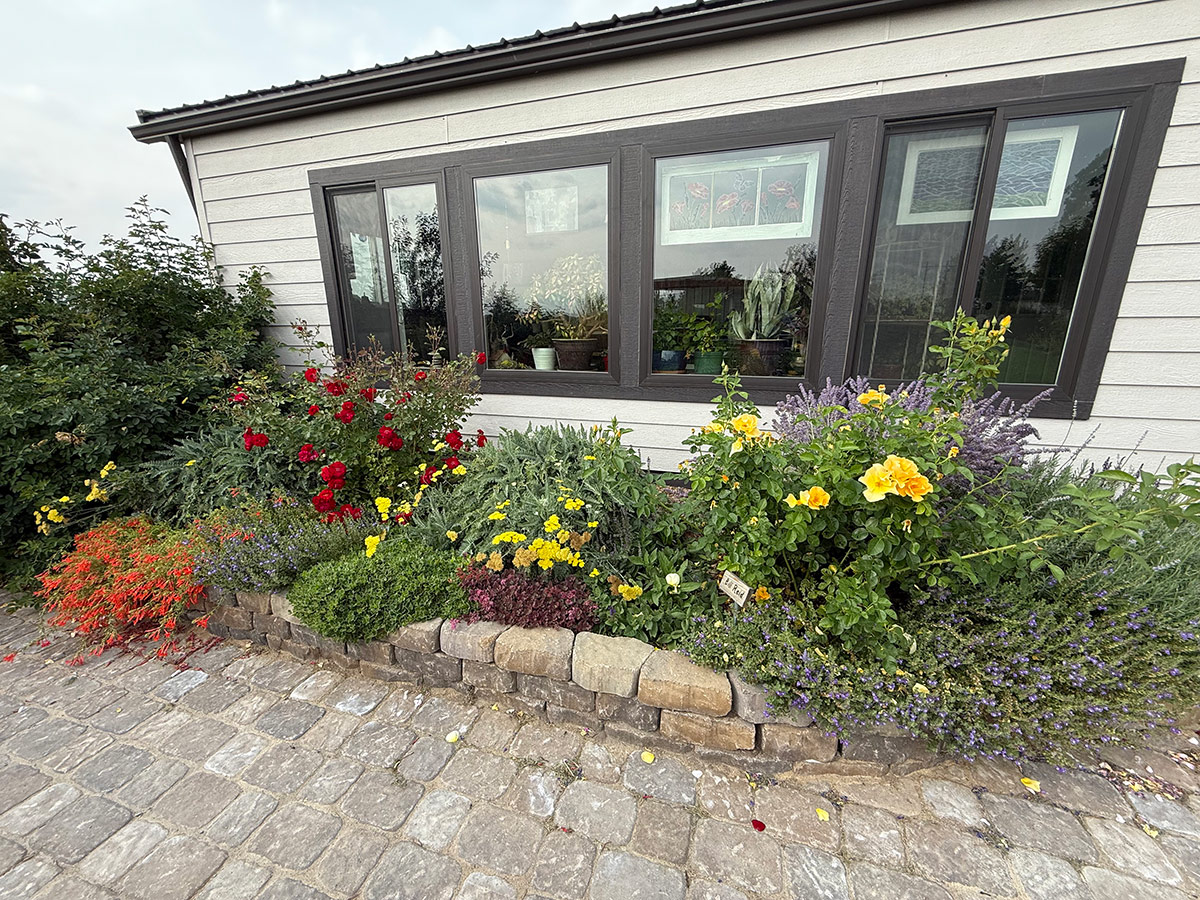
sunny foundation bed in front of windowHot sun area on the south side of my sun/plant room. From left to right: Above and Beyond™ rose (Rosa ‘ZLEEltonStrack’, Zones 3–7) just starting it’s second bloom in September, ‘Moonshine’ yarrow (Achillea ‘Moonshine’, Zones 3–9), zauschneria, ‘Smoky Hills’ skullcap (Scutellaria resinosa ‘Smoky Hills’, Zones 4–9), ‘Champlain’ rose (Rosa ‘Champlain’, Zones 3–8), sedum, Kannah Creek® buckwheat (Eriogonum umbellatum var. aureum ‘Psdowns’, Zones 3–8), ‘Bill Reid’ rose (Rosa ‘Bill Reid’, Zones 3–9), ‘Denim ’N Lace’ Russian sage (Perovskia atriplicifolia ‘Denim ‘n Lace’, Zones 4–9) and lavender.

bee on pink poppy bloomsTwo bees on an Iceland poppy (Oreomecon nudicaulis syn. Papaver nudicaule, Zones 3–10), they bloom for months here.

deep red roses‘Hope for Humanity’ rose (Rosa ‘Hope for Humanity’, Zones 3–9) and a Hot Wings® Tatarian maple (Acer tataricum ‘Garann’, Zones 4–10) behind it. A little symbol of my love for plants and the Boulder Mountains in the distance.

painting with garden poem andAnd a poem I wrote that speaks to all gardeners I should hope! Complete with a Fibonacci spiral found everywhere in nature-check out those unfurling fern fronds.

Thank you so much for sharing your stunning garden with us, Connie! Your passion for plants is palpable, and the landscape you have crafted is something any gardener can envy.

What plants have defied expectations in your garden? Have you made a plant work that is considered impossible to grow in your area or did you find joy in a species you never had interest in before? Let us know in the comments, or consider sharing photos of that plant putting on a peak performance in your garden. Follow the NEW directions below to submit your photos to Garden Photo of the Day!


We want to see YOUR garden!

Have photos to share? We’d love to see your garden, a particular collection of plants you love, or a wonderful garden you had the chance to visit!

To submit, fill out the Garden Photo of the Day Submission Form.

You can also send 5–10 photos to [email protected] along with some information about the plants in the pictures and where you took the photos. We’d love to hear where you are located, how long you’ve been gardening, successes you are proud of, failures you learned from, hopes for the future, favorite plants, or funny stories from your garden.

Do you receive the GPOD by email yet? Sign up here

Xtend Scivation EAA + BCAA Powder | Muscle Recovery & Lean Muscle Growth | 9 Essential Amino Acids for Intra Workout or Post Workout Recovery | 10g EAAs Per 2 Servings | Blood Orange 40 Servings

0


Price: $27.46
(as of Mar 04, 2026 21:17:39 UTC – Details)


Build and Preserve Lean Mass with XTEND Essential Amino Acids supplement powder. Enhance athletic recovery with XTEND EAAs – crafted with all 9 essential amino acids for a complete protein source, XTEND EAAS are a simple way to get a full suite of aminos to help grow muscle mass. Elevate your routine with zero sugar and a variety of delightful, sugar-free flavors.
Product Dimensions ‏ : ‎ 5.91 x 3.94 x 3.94 inches; 11.99 ounces
Item model number ‏ : ‎ XT-XTEA40BO
Date First Available ‏ : ‎ March 22, 2024
Manufacturer ‏ : ‎ Nutrabolt
ASIN ‏ : ‎ B0CYVP793L
Best Sellers Rank: #6,486 in Health & Household (See Top 100 in Health & Household) #17 in Branched Chain Amino Acids Nutritional Supplements
Customer Reviews: 4.5 4.5 out of 5 stars (1,129) var dpAcrHasRegisteredArcLinkClickAction; P.when(‘A’, ‘ready’).execute(function(A) { if (dpAcrHasRegisteredArcLinkClickAction !== true) { dpAcrHasRegisteredArcLinkClickAction = true; A.declarative( ‘acrLink-click-metrics’, ‘click’, { “allowLinkDefault”: true }, function (event) { if (window.ue) { ue.count(“acrLinkClickCount”, (ue.count(“acrLinkClickCount”) || 0) + 1); } } ); } }); P.when(‘A’, ‘cf’).execute(function(A) { A.declarative(‘acrStarsLink-click-metrics’, ‘click’, { “allowLinkDefault” : true }, function(event){ if(window.ue) { ue.count(“acrStarsLinkWithPopoverClickCount”, (ue.count(“acrStarsLinkWithPopoverClickCount”) || 0) + 1); } }); });
MUSCLE GROWTH UNLOCKED – Amino Acids for muscle growth with 10g per 2 servings of EAAs for unlocking your best results.
BUILD & PRESERVE MUSCLE MASS – Supports growth and lean muscle mass with essential amino acids and BCAAs for optimal workout recovery.
MUSCLE GROWTH & RECOVERY – 9 Essential Amino Acids for a complete protein source for muscle growth and recovery.
ESSENTIAL AMINO ACIDS FOR ATHLETIC RECOVERY – Boosts athletic recovery and vitality with essential amino acids, electrolytes, and muscle recovery complex.
SUGAR-FREE BRANCHED CHAIN AMINO ACIDS – XTEND EAA Essential Amino Acid supplement powder contains zero sugar and zero carbs in every delicious servings.

19 Cheap DIY Raised Garden Bed Ideas to Build

0

Raised garden beds can make your backyard look neat and organized. It is also proven that these beds can double your harvest.

So, how to build a raised garden bed in your small backyard?

Instead of burning your wallet on expensive store bought kits, you can make your own sturdy raised garden bed with little creativity.

With the right materials and simple building methods, your raised bed can last for years. You can use affordable wood, bricks, blocks, or even recycled items to build something strong and practical.

In fact, many inexpensive raised garden beds are made from reused or recycled materials like old pallets, leftover lumber, or extra bricks that can easily be turned into a durable garden bed.

19 Cheap DIY Raised Garden Bed Ideas

Cheap doesn’t mean your raised garden bed will be fragile or short-lived.

With the right materials and a little smart planning, you can build beds that are strong, stable, and made to last for years.

Here are 19 cheap DIY raised garden bed ideas that prove you don’t need a big budget to grow a beautiful and productive garden.

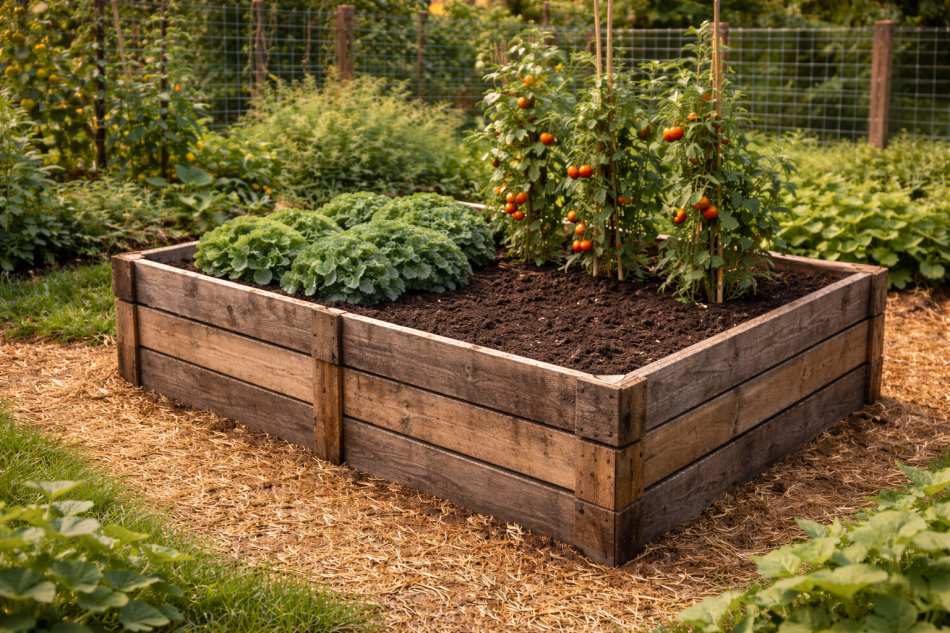
1. Pallet Wood Raised Garden Bed

Old wooden pallets are one of the cheapest materials you can use to build a raised garden bed.

Many times, you can get them for free from local stores or warehouses. When you choose heat-treated pallets (look for the “HT” stamp), the wood is safe to use and strong enough to hold soil.

If the boards are thick and in good condition, your raised bed can last for several years.

  • To build it, first take the pallets apart carefully and remove all nails.
  • Cut the boards to the size you need and make a simple rectangular frame.
  • Use screws to join the corners tightly so the frame is strong and stable.

Once the frame is ready, place it on flat ground. You can add landscape fabric at the bottom if you want to block weeds.

Then fill it with good soil and compost. It’s an easy, low-cost way to build a sturdy raised garden bed without spending much money.

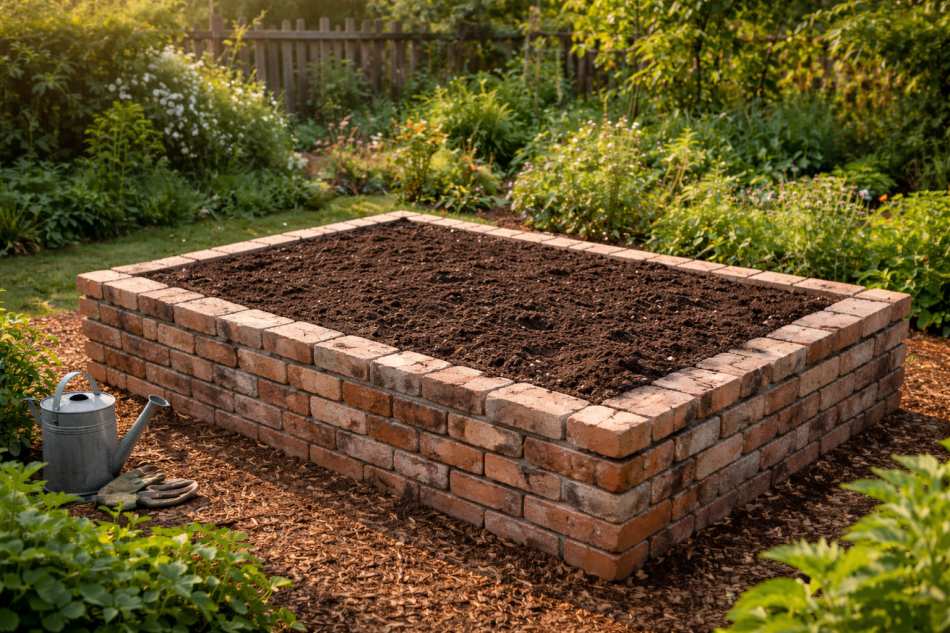
2. Recycled Brick Raised Garden Bed

If you have old bricks lying around, don’t throw them away. They can easily be turned into a strong and long-lasting raised garden bed.

You might even find leftover bricks at construction sites or from home renovation projects for a very low price. Bricks are solid and durable, and they don’t rot like wood, so they can last for many years.

  • First decide the size and shape you want.
  • Lay the bricks in a square or rectangle on level ground.
  • You can simply stack them without cement for an easy setup, or use mortar if you want a more permanent and stable structure.

After stacking the bricks to your desired height, make sure the sides are even and steady. 

Then fill the space with good soil and compost. It’s a simple, budget-friendly way to create a neat and sturdy raised bed.

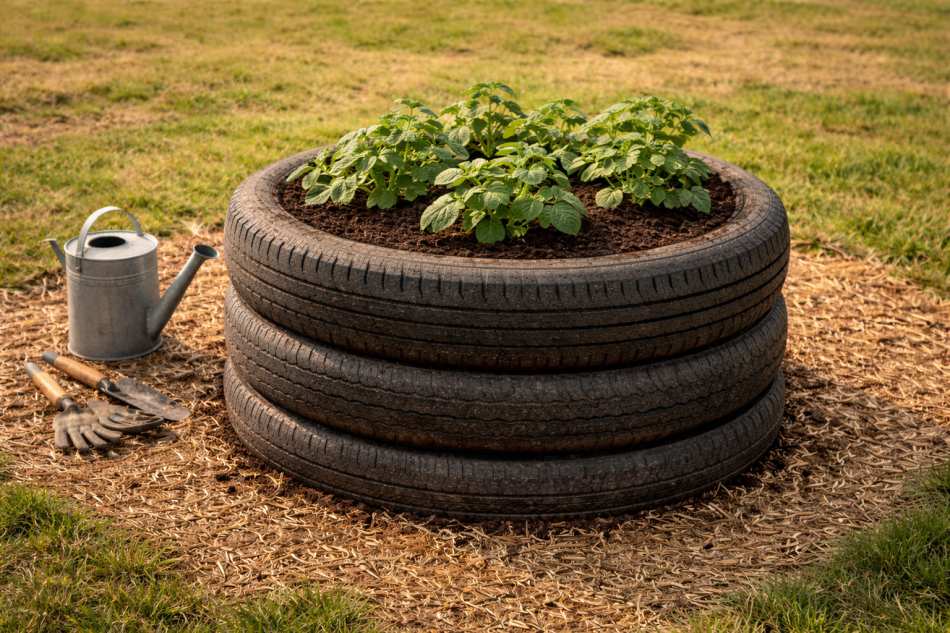
3. Old Tire Raised Garden Bed

Don’t let old tires go to waste. They can be reused to create a simple and sturdy raised garden bed.

Tires are strong, weather-resistant, and can hold soil firmly in place. They are especially useful for small gardens and can last for many years without breaking down.

  • Prepare the tire – Clean the tire properly and place it on level ground in a sunny spot. You can paint it if you want to make it look more attractive.
  • Position and secure – If you want a taller bed, stack two tires on top of each other. Make sure they are stable and not wobbling.
  • Fill with soil – Add good-quality soil and compost inside the tire. Level the soil and start planting your vegetables or flowers.

It’s a quick, low-cost way to create a durable raised bed using recycled materials.

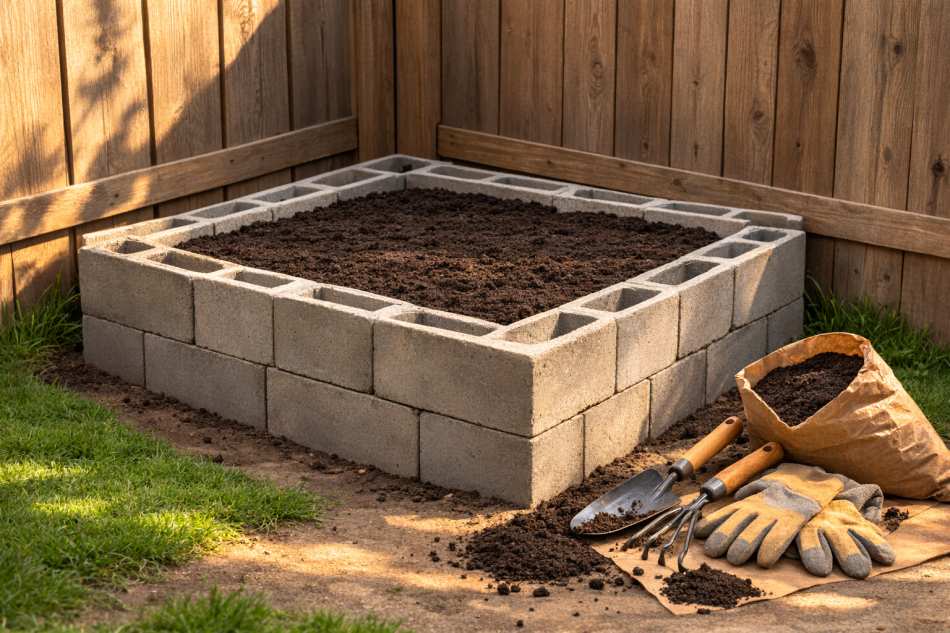
4. Cinder Block Raised Garden Bed

Cinder blocks are one of the easiest and most budget-friendly materials you can use. They are strong, long-lasting, and can handle heavy soil without shifting.

You can often find leftover blocks from construction sites or buy them at a low price from hardware stores.

  • Choose your layout – Decide the size of your bed and arrange the cinder blocks in a rectangle or square on flat ground.
  • Stack if needed – For a taller bed, stack another layer of blocks on top. Make sure they are lined up evenly and sitting firmly.
  • Fill and plant – Add soil and compost inside the frame. You can even fill the holes in the blocks with soil and plant herbs or small flowers in them.

Cinder block beds are very sturdy, simple to build, and perfect for gardeners who want something durable on a small budget.

Check this: 11 Common Raised Bed Gardening Mistakes to Avoid

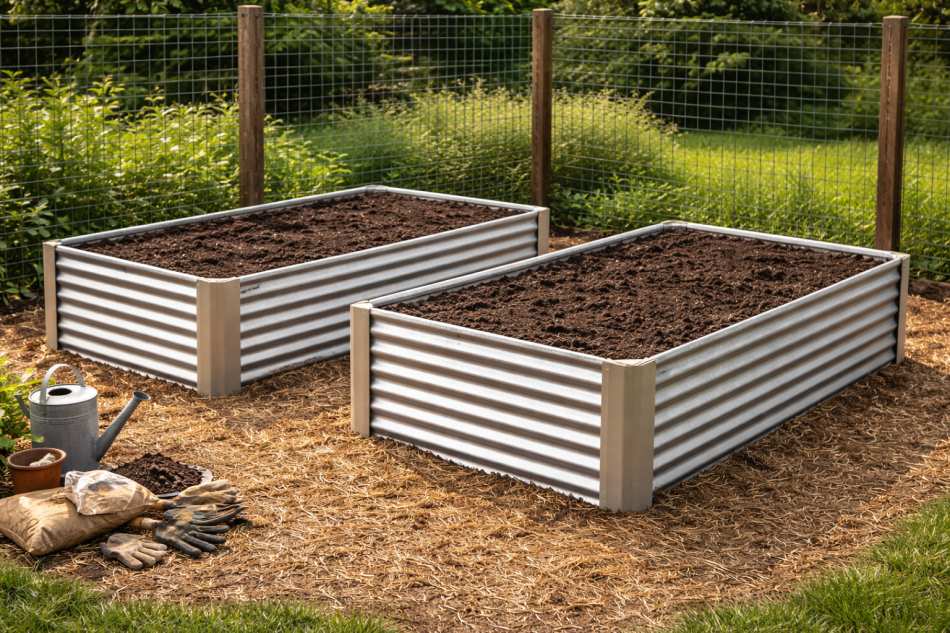
5. Corrugated Metal Raised Garden Bed

If you like a modern farmhouse look, corrugated metal sheets are a great budget-friendly option. You can often reuse leftover roofing sheets or buy them at a low cost.

When combined with a simple wooden frame, corrugated metal creates a very strong and long-lasting raised bed. The metal does not rot and can handle different weather conditions easily.

  • Build the frame – Make a simple rectangular frame using affordable wooden boards. Secure the corners tightly with screws.
  • Attach the metal sheets – Cut the corrugated metal to the right size and screw it to the outside of the wooden frame. Make sure all edges are secure and safe.
  • Place and fill – Set the bed on level ground, add landscape fabric if needed, and fill it with good soil and compost. Then it’s ready for planting.

6. Old Wooden Crate Raised Garden Bed

Wooden crates can easily be turned into small raised garden beds. You might already have some at home, or you can find them at fruit markets for a low price

Crates are lightweight but sturdy enough to hold soil, especially for herbs, lettuce, or small vegetables.

  • Check and prepare – Make sure the crate is strong and not broken. Line the inside with landscape fabric to hold the soil in place.
  • Place properly – Set the crate on flat ground or even on a patio or balcony.
  • Fill and plant – Add soil and compost, then plant your seeds or seedlings. It’s perfect for small spaces and beginners.

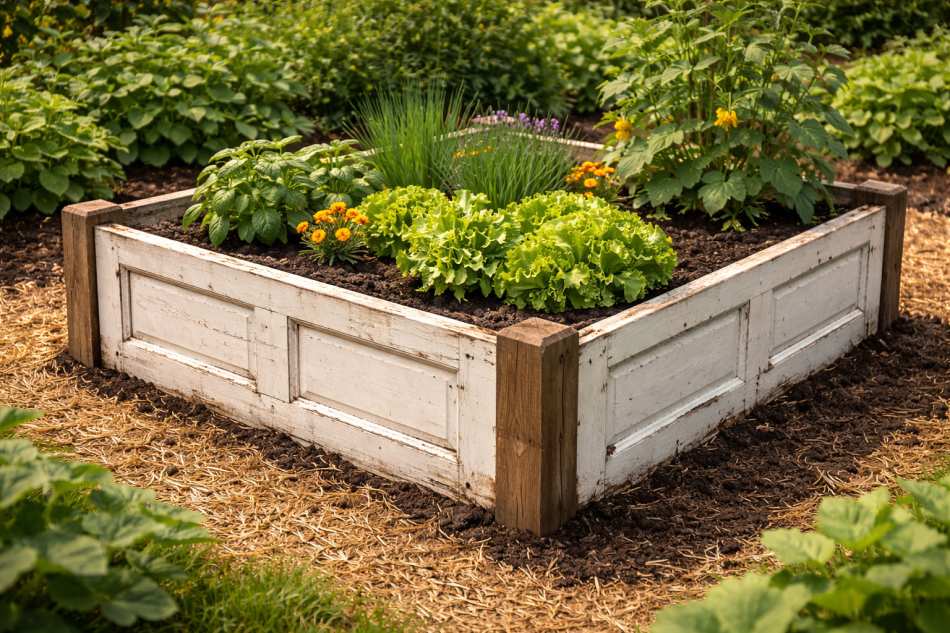
7. Recycled Wooden Door Raised Garden Bed

An old wooden door can be reused to create a wide and sturdy raised bed. Solid wood doors are thick and strong, making them a durable option.

Instead of throwing the door away, you can give it a second life in your garden.

  • Cut and frame – Cut the door into panels and use them as the sides of your raised bed. Attach the panels together to form a rectangle.
  • Secure the corners – Use wooden posts inside each corner to make the structure strong and stable.
  • Set and fill – Place the bed on level ground, add soil and compost, and start planting.

This is a creative and low-cost way to build a large, sturdy raised garden bed using recycled material.

Also Read: 26 Beautiful Spring Flower Bed Ideas for Your Garden

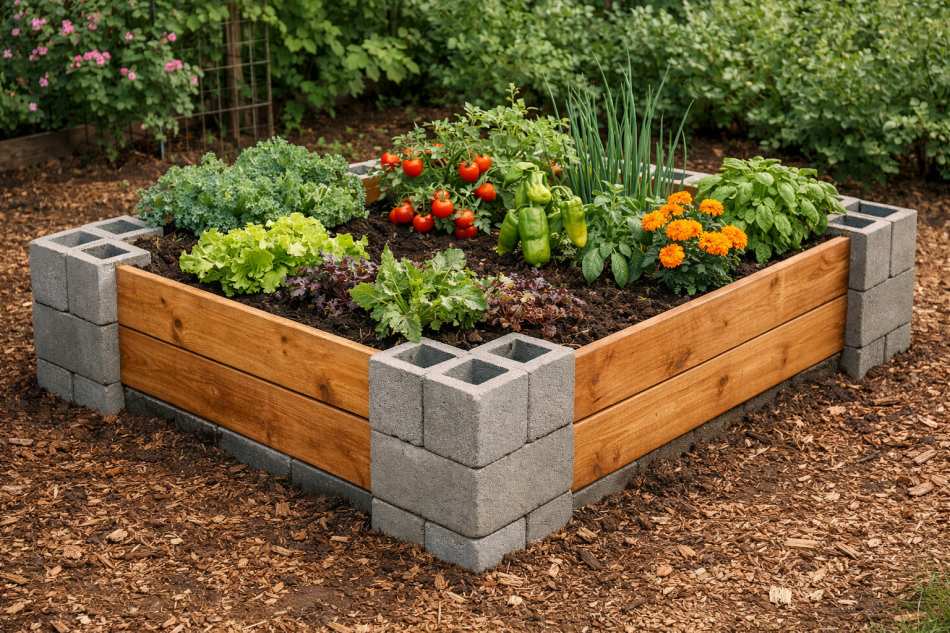
8. Concrete Block and Wood Raised Garden Bed

If you want something strong but still affordable, combining concrete blocks with wooden boards is a smart idea.

The blocks give solid support, while the wood adds structure and height. Both materials are budget-friendly and easy to find.

  • Lay the blocks – Arrange concrete blocks in a rectangle on level ground to form the base.
  • Insert the boards – Slide wooden boards into the block openings to create the sides of the bed.
  • Fill and plant – Make sure everything is steady, then fill the bed with soil and compost before planting.

This design is sturdy, simple, and doesn’t require many tools.

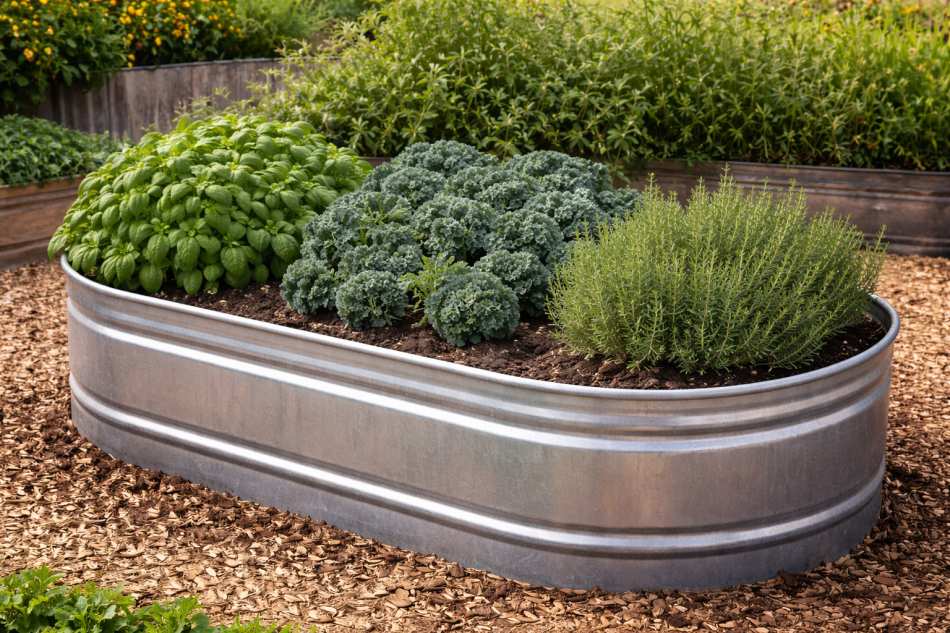
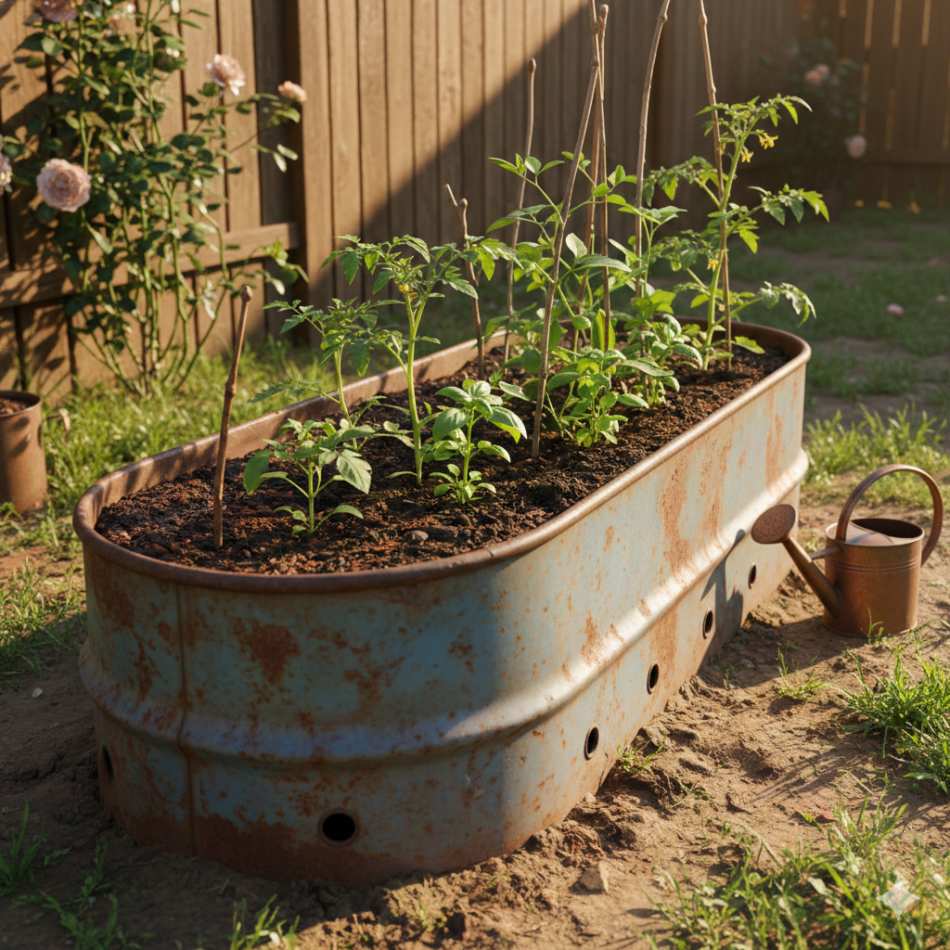
9. Galvanized Stock Tank Raised Garden Bed

Old galvanized stock tanks can make excellent raised garden beds. They are very durable, weather-resistant, and can last for many years without rotting.

You may find used ones at farms or online marketplaces for a reasonable price.

  • Add drainage holes – Drill a few holes at the bottom if there aren’t any to allow water to drain.
  • Position the tank – Place it in a sunny, level spot in your yard.
  • Add soil layers – Fill the bottom with small rocks for drainage, then add soil and compost on top.

It’s a strong, long-lasting option that also gives your garden a clean and organized look.

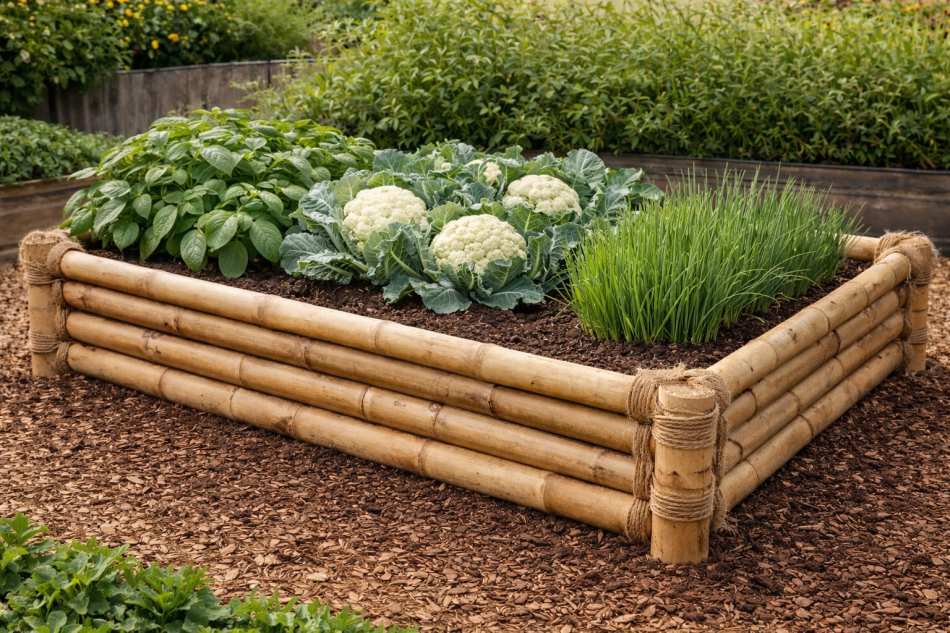
10. Bamboo Raised Garden Bed

Bamboo is an affordable and eco-friendly material that works well for simple raised beds.

It is lightweight but surprisingly strong when tied together properly. In many areas, bamboo is easy to find and costs much less than treated lumber.

  • Create the frame – Cut bamboo poles to the same length and arrange them in a rectangle or square shape.
  • Tie securely – Use strong rope or wire to tie the corners tightly so the structure stays firm.
  • Line and fill – Add landscape fabric inside to hold the soil, then fill with soil and compost.

This option is natural-looking, budget-friendly, and perfect for small gardens.

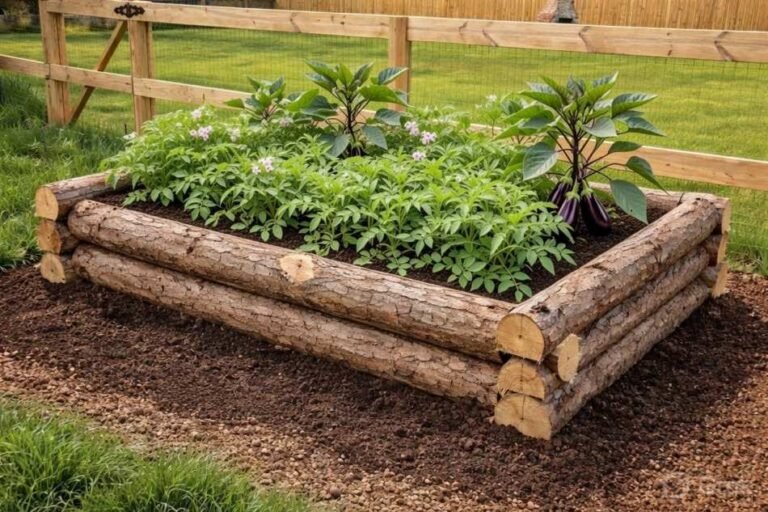
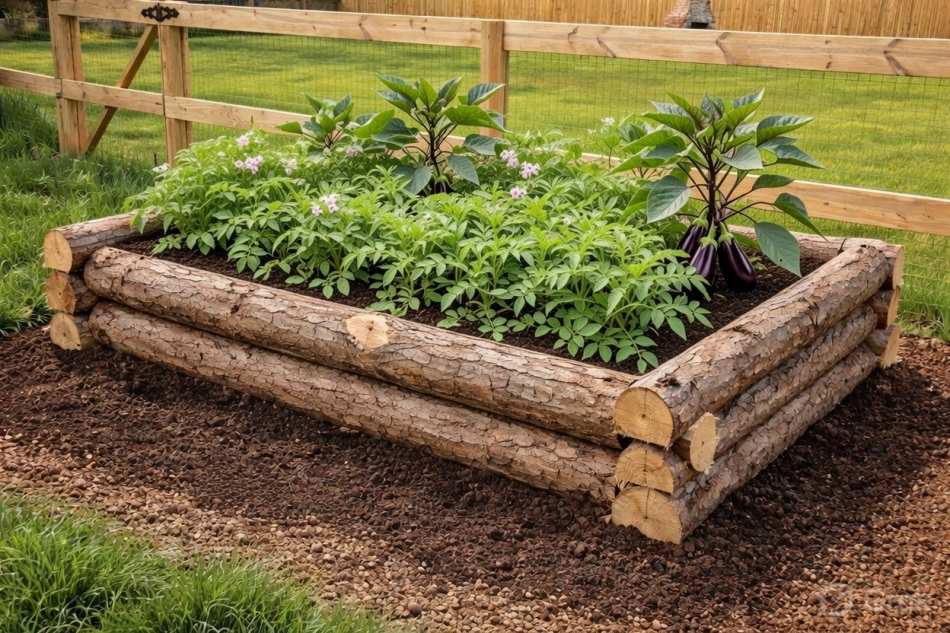
11. Log Raised Garden Bed

If you have fallen branches or cut tree logs in your yard, you can reuse them to build a rustic raised bed.

Thick logs are sturdy and can hold soil well. This is a great way to recycle natural materials without spending money.

  • Choose solid logs – Pick logs that are thick and not rotten.
  • Arrange in shape – Lay them in a square or rectangle, stacking if you want more height.
  • Stabilize and fill – Make sure the logs are stable, then fill the inside with soil and compost.

It’s a simple and natural way to create a durable raised garden bed using what you already have.

Also Read: 60 Popular Cut Flower Garden Ideas

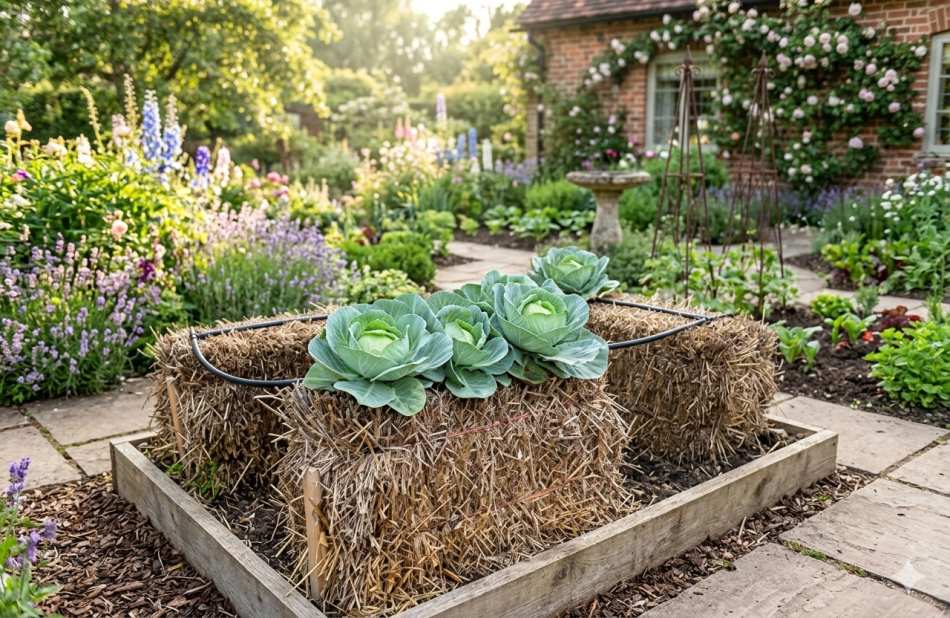
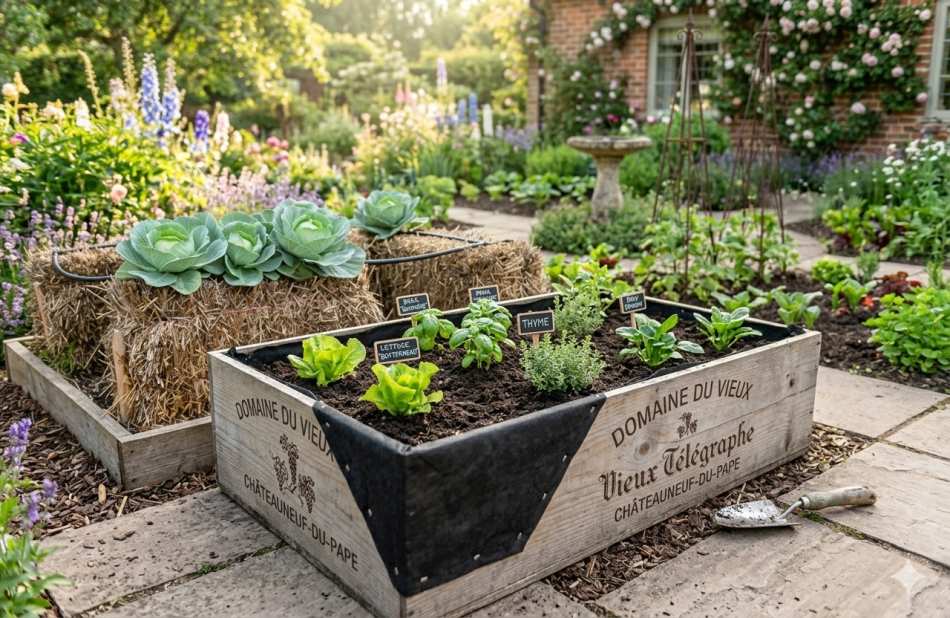
12. Straw Bale Raised Garden Bed

Straw bales are a very affordable and simple way to create a temporary raised garden bed. They are easy to find at farm stores and cost much less than wood or bricks.

Straw bales also provide natural insulation and slowly break down, adding nutrients to the soil over time.

  • Arrange the bales – Place the straw bales in a rectangle or square shape on level ground.
  • Condition the bales – Water them for several days and add a little compost on top to help them settle.
  • Add soil and plant – Spread a layer of soil on top and plant directly into it.

This is a quick and low-cost option, especially for beginners.

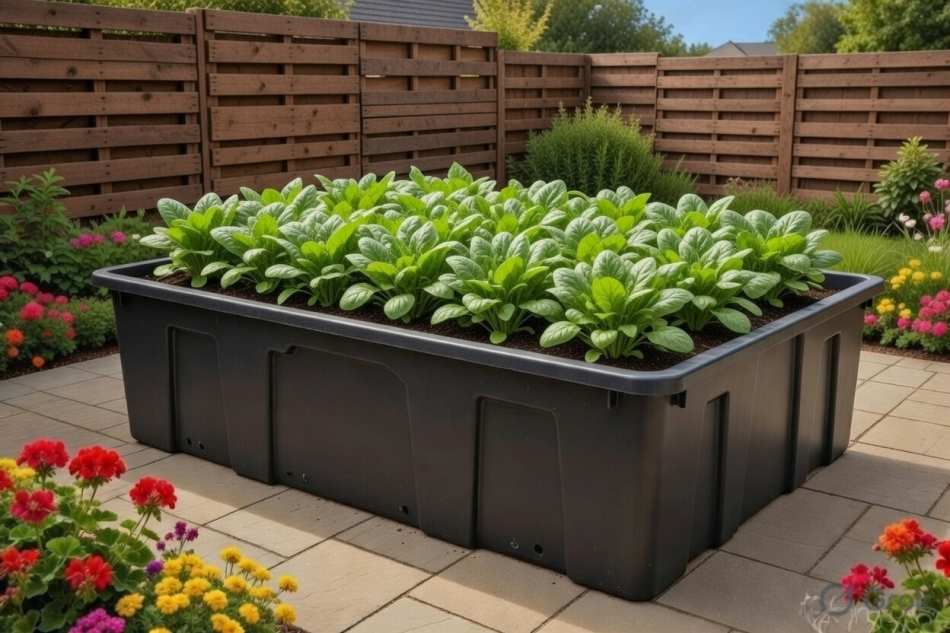
13. Plastic Storage Bin Raised Garden Bed

Large plastic storage bins can easily be turned into small raised beds. They are lightweight, affordable, and great for patios or small backyards.

Since plastic does not rot, the container can last for many seasons.

  • Drill drainage holes – Make several holes at the bottom so excess water can drain out.
  • Place in sunlight – Set the bin in a bright and level area.
  • Fill and grow – Add good-quality soil and compost, then plant your vegetables or herbs.

This is one of the easiest and cheapest ways to start gardening in a small space.

14. Wine Crate Raised Garden Bed

Old wine crates can make charming and affordable raised garden beds.

They are usually made from solid wood and are strong enough to hold soil for herbs, lettuce, or small vegetables. You may find them at local stores, markets, or online at a low price.

  • Check the strength – Make sure the crate is sturdy and not cracked.
  • Line the inside – Add landscape fabric or plastic with drainage holes to hold the soil in place.
  • Fill and plant – Add soil and compost, then plant your favorite herbs or greens.

It’s a simple, decorative, and budget-friendly option for small spaces.

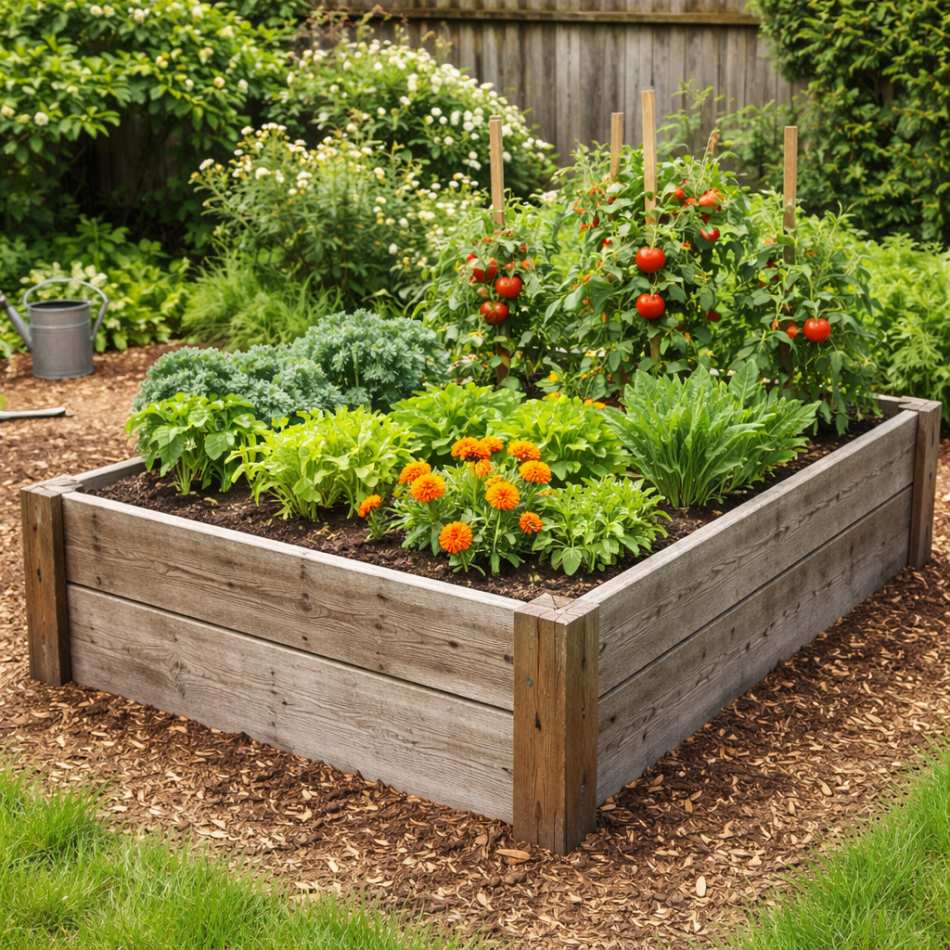
15. Reclaimed Fence Board Raised Garden Bed

Old fence boards are another great recycled material for raised beds. If you are replacing a fence or know someone who is, you can reuse the boards instead of throwing them away.

Solid fence wood can create a strong and long-lasting garden bed when properly secured.

  • Cut to size – Trim the boards to the length you need.
  • Build the frame – Attach the boards together to form a rectangle, securing the corners tightly with screws and wooden posts.
  • Set and fill – Place the bed on level ground, add soil and compost, and start planting.

This is a smart way to recycle old materials and build a sturdy raised bed without spending much money.

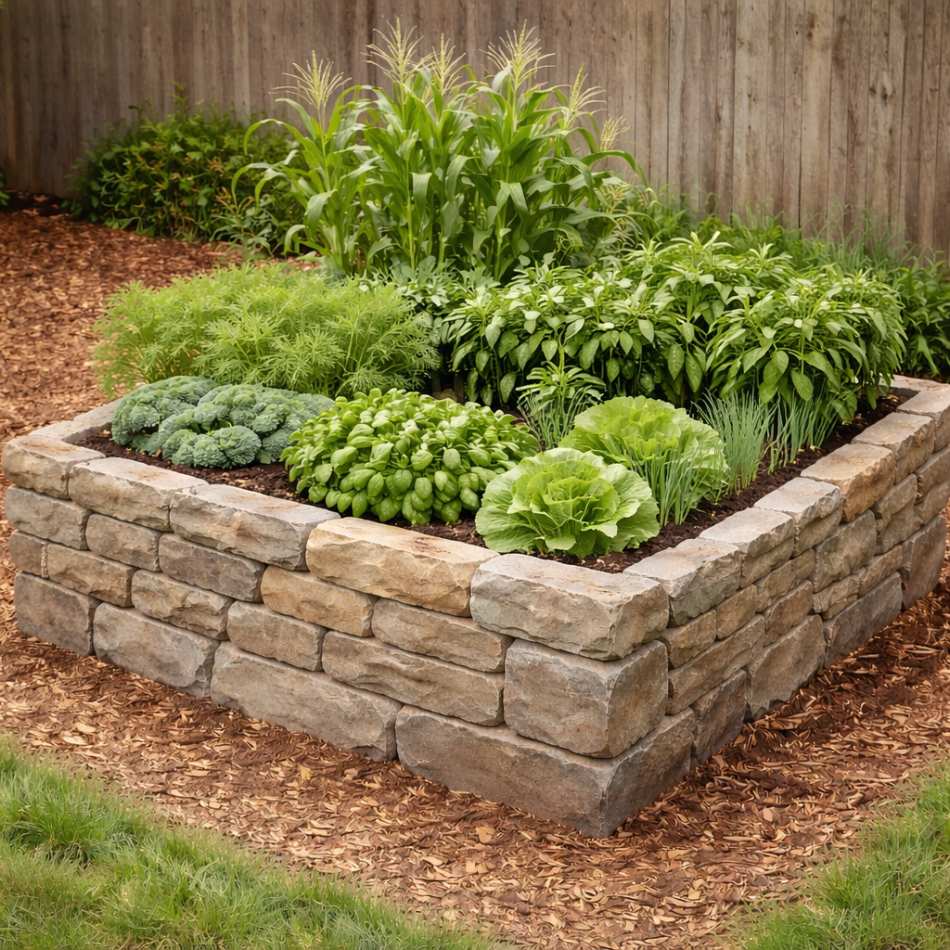
16. Stone Raised Garden Bed

If you have extra stones in your yard, you can turn them into a strong and natural-looking raised bed.

Stones are very durable and can last for many years without damage. This option works especially well in rustic or cottage-style gardens.

  • Collect solid stones – Choose medium to large stones that are flat and stable.
  • Stack carefully – Arrange them in a square or rectangle shape, stacking them evenly to create height.
  • Fill the center – Once the walls feel stable, fill the inside with soil and compost.

This method costs very little if you already have stones available.

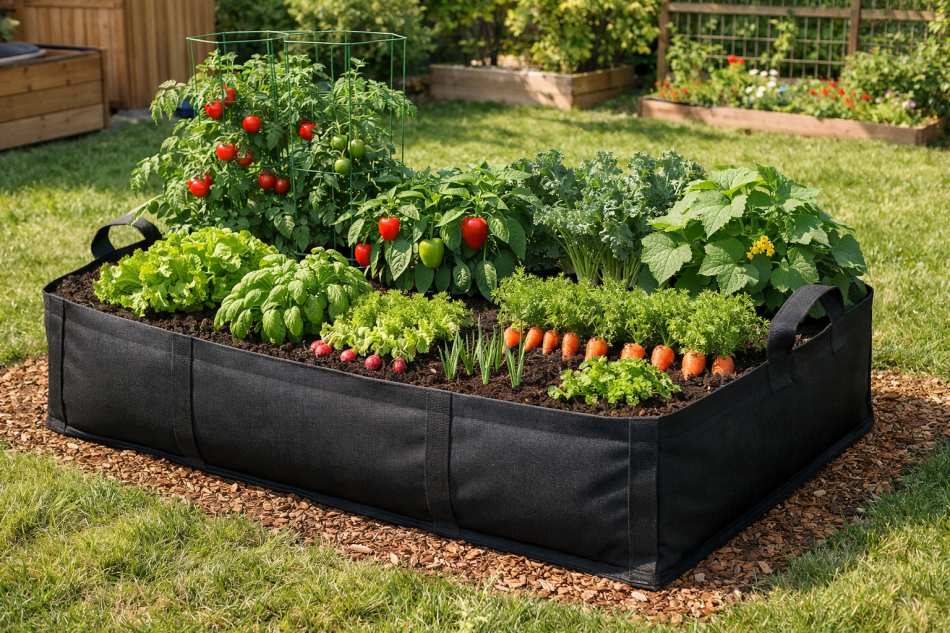
17. Fabric Grow Bag Raised Garden Bed

Fabric grow bags are a simple and affordable alternative to traditional raised beds. They are lightweight, breathable, and easy to move around.

You can buy them at a low price, and they are perfect for small backyards or patios.

  • Choose the size – Pick large grow bags depending on what you want to grow.
  • Place in a sunny spot – Set them on level ground with good sunlight.
  • Add soil and plant – Fill with soil and compost, then plant your vegetables or flowers.

This is one of the easiest and most budget-friendly ways to start growing right away.

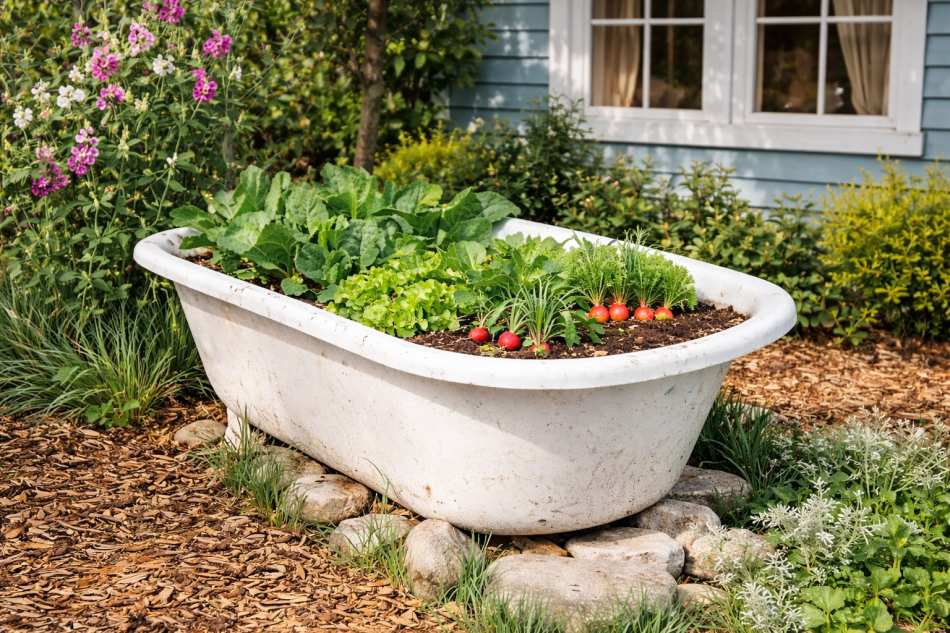
18. Old Bathtub Raised Garden Bed

An old bathtub can become a deep and sturdy raised garden bed. Since bathtubs are made to hold water, they are strong and long-lasting.

You might find one during home renovations or at salvage yards for a low price.

  • Check drainage – Make sure the drain hole is open so extra water can flow out. If needed, drill a few small holes.
  • Place properly – Set the tub in a sunny and level area of your yard.
  • Fill and grow – Add a layer of small stones at the bottom, then fill with soil and compost before planting.

It’s a creative and durable option that gives your garden a unique look.

19. Reclaimed Metal Drum Raised Garden Bed

An old metal drum or barrel can be turned into a strong and long-lasting raised garden bed. Many factories, workshops, or farms sell used drums at a low price.

Metal drums are sturdy and can hold a large amount of soil, making them great for vegetables or even small shrubs.

  • Cut safely – Cut the drum in half lengthwise (for two beds) or use it whole for a deeper bed. Smooth any sharp edges.
  • Add drainage holes – Drill holes at the bottom so extra water can drain properly.
  • Place and fill – Set it in a sunny, level spot, add soil and compost, and start planting.

It’s a durable and creative way to build a raised garden bed on a small budget.

Conclusion

Building a raised garden bed doesn’t have to be expensive or complicated. As you’ve seen, there are many cheap DIY options that are strong, practical, and built to last.

From recycled materials like pallets, bricks, and metal drums to simple budget-friendly choices, you can create a garden bed that fits your space and your budget.

With the right materials and a little effort, your raised bed can stay sturdy for years while helping you grow healthy vegetables, herbs, and flowers.

3PCS Fitness Resistance Band for Fitness and Yoga,Resistance Bands for Stretching,Dance Stretch Band,8-Section Elastic Training Bands,Suitable for Full Body Stretching Shaping (Purple, Pink, Blue)

0


Price: $13.99
(as of Mar 04, 2026 09:15:24 UTC – Details)

Product description

mlomlo

dgrdgr

33

ssss

With spring just around the corner, is it making you want to exercise and stay fit? I believe our product can help you get in better shape this spring.Product Specifications:Name: Fitness Resistance BandsSuitable exercises: Yoga, dance, stretching, PilatesColors: Purple, Pink, BlueSize: 1.6*35.4 inchesThickness: 2cmIncludes: 3 fitness resistance bandsProduct Features:1. 8-level adjustable resistance to suit different fitness needs2. Durable and non-slip material for long-lasting use3. 3 resistance bands, suitable for use with family members4. Easy to carry5. Suitable for various fitness activities such as Pilates, yoga, and stretchingNotes:1. Please allow an error of approximately 2.5cm due to manual measurement.2. Due to differences in monitors and shooting angles, the actual color of the product may vary slightly. Thank you for your understanding!

Designed specifically for yoga and fitness: This Fitness Resistance Band is tailored for yoga and fitness enthusiasts. Made of soft, highly elastic material, it enhances User flexibility and is ideal for yoga and fitness stretching exercises.
8-Level Adjustable Resistance: This fitness resistance bands features 8 different lengths with clear numerical markings. Whether you’re a beginner or a fitness enthusiast, you can choose the resistance level according to your workout needs to suit different exercises and intensities.
Comfortable and Durable: Made from a blend of polyester and cotton, this fitness resistance bands maintains its softness and elasticity while remaining durable and resistant to damage, ensuring optimal stretching even after prolonged use.
Ergonomic Design: This fitness resistance bands focuses on the actual user experience for fitness enthusiasts. Each resistance level has a handle for better gripping and exertion.
Portable and Compact: This soft and easily foldable fitness resistance bands is perfect for carrying around when exercising outdoors.

2PCS Fitness Resistance Band for Stretching and Yoga, Numbered Resistance Band with Clear Markings, 8-Section Elastic Training Bands for Yoga, Stretching, Pilates, Fitness

0


Price: $11.99 - $9.99
(as of Mar 03, 2026 21:12:21 UTC – Details)


Fitness Resistance Band for Stretching and Yoga, Resistance Bands with Handles for Arms, Fashion Puller Exercise, Resistance Bands for Working Out, Exercise Bands, Adjustable Bands for Full Body Stretching Shaping
Numbered Resistance Bands for Glutes Workout Bands Stretch Strap Elastic Tension Band Exercise Pull Rope Stretch Rope 8 Segment Pilates Stretching Band Female Resistance Training Equipment Fitness Exercise Resistance with Number
✔ Fashion Puller Exercise: Perfect for yoga, Pilates, stretching, and fitness training. This resistance bands for women helps improve flexibility, strength, and mobility for all fitness levels.
✔ 8-Section Adjustable Resistance: Features clear numeric markings, allowing you to track your progress and adjust the resistance easily for different exercises and intensity levels.
✔ Comfortable & Easy to Use: Made from high-quality elastic material, this fitness resistance bands provides optimal stretch without compromising comfort. Ideal for at-home workouts, gyms, or on-the-go training.
✔ Multi-Purpose for All: Great for beginners, advanced practitioners, or anyone in between. Whether you’re rehabbing or enhancing your workouts, this exercise bands is a perfect addition to your routine.
✔ Portable & Compact: Lightweight and easy to carry, this resistance bands can be folded to fit in your gym bag, making it convenient for traveling or working out at home.
Specification:
Name: Fitness Resistance Bands
Color: Red, Blue
Dimensions: 4*90 cm
Thickness: 2.25 mm
Package includes:
2PCS * Numbered Resistance Band

8-Level Adjustable Resistance & Targeted Stretching: Our fashion puller exercise features clear numeric markings (1-8) for precise length/resistance adjustments—perfect for tailoring intensity to your yoga, Pilates, or dance routines. Track progress easily and target specific muscle groups (legs, arms, core) with the segmented design, whether you’re a beginner or advanced fitness enthusiast
Fitness Resistance Band for Stretching and Yoga: Crafted from premium polyester cotton with reinforced elastic, this numbered resistance band with stands repeated stretching, toning, and resistance training. Sturdy, long-lasting construction ensures it holds up to rigorous daily use (at home, gym, or while traveling)—no fraying, snapping, or loss of elasticity over time
Comfort-First Design (No Chafing, Easy Grip): Soft, smooth edges prevent skin irritation, even during extended stretches or high-movement workouts (like Latin dancing or rehab exercises). The flexible, lightweight material conforms to your body without pinching, while the intuitive design lets you set up or adjust resistance in seconds
Versatile for Every Fitness Goal: More than a stretching tool: use exercise bands for yoga flexibility drills, Pilates toning, resistance training, dance warm-ups, or post-workout recovery. Ideal for all fitness levels—beginners can build foundational strength, while advanced users boost mobility and muscle definition
Portable & Travel-Friendly: Compact and lightweight (folds to fit in any gym bag), this resistance bands for women lets you work out anytime, anywhere—no bulky equipment needed. Keep it at home for daily stretches, toss stretch strap in your luggage for travel workouts, or take it to the studio for pre-class warm-ups

Homemade Jalapeño Salt (Easy Mineral-Rich Spicy Seasoning)

0

Sometimes you just need to spice things up a little. This jalapeno salt recipe will do just that. With simple ingredients it’s full of healthy minerals and the perfect seasoning for meats, veggies, or even fruit.

You can easily control the spice level here and either use a little or a lot on your foods. Even my older kids like sprinkling some on their meals.

How to Make Jalapeno Salt

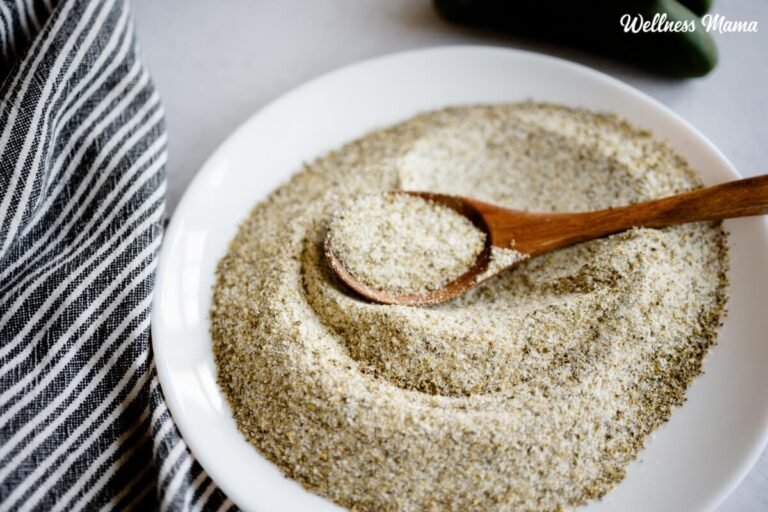
This homemade jalapeno salt is exactly what it sounds like: mineral-rich salt blended with dried jalapeños for a simple but flavorful seasoning. It’s one of those small kitchen upgrades that makes everyday meals feel special without adding extra work.

The process is surprisingly straightforward. Slice the peppers, dry them completely until they’re brittle, then blend with salt until finely ground. That’s it. The salt pulls the flavor from the jalapenos and also helps keep the peppers dry. 

Homemade Jalapeno Salt Seasoning

Jalapeno seasoning is like an all-purpose finishing salt with a kick. I love it sprinkled over grilled chicken, roasted vegetables, scrambled eggs, or sliced avocado. It’s also delicious on fresh fruit like mango or watermelon if you like that sweet-and-spicy combination.

You can try it for margaritas too. If you’re the type who likes margaritas, it makes a great rim salt before serving. You can also stir a small amount into soups or taco meat for an easy flavor boost without needing multiple spices. 

The nice thing about homemade jalapeno salt is that it’s easy to be in control. For a milder blend, remove the seeds and membranes before drying the peppers. If you prefer more heat, keep them in. 

And if you’re sensitive to spice, wear a mask while blending since the fine jalapeño dust can be surprisingly strong. I also recommend wearing gloves when cutting up the peppers! The oils from the hot peppers can quickly start to burn your hands. Also, don’t touch your eyes when cutting. That’s never a fun thing to experience!

If you’re using Celtic sea salt, keep in mind that it’s naturally more moist than other mineral salts. If it feels damp, spread it on a baking sheet to air dry for several hours or warm it gently in the oven on the lowest setting for 10–15 minutes before blending. Excess moisture can lead to clumping and shorten shelf life.

Jalapeno salt is an easy and delicious way to turn up the heat on your favorite foods!

Jalapeno Salt

Jalapeno salt is a delicious spicy seasoning that adds a flavorful kick to meat, veggies, and even fruits like watermelon and mango.

  • Wash and dice fresh jalapeños. Spread evenly on dehydrator trays and dehydrate at 125°F for 6–10 hours, until fully dry and brittle.

  • Add dried jalapeños to a food processor and pulse 2–3 times to break them into smaller pieces. (Skip if you prefer a very fine salt.)

  • Add mineral salt to the processor.

  • Pulse until fully combined and the texture is to your liking. Less blending keeps it chunky; more blending creates a finer seasoning.

  • Transfer to an airtight container and store in a cool, dark place.

Nutrition Facts

Jalapeno Salt

Amount Per Serving (0.5 tsp)

Calories 0.4

% Daily Value*

Fat 0.004g0%

Polyunsaturated Fat 0.002g

Sodium 786mg34%

Potassium 3mg0%

Carbohydrates 0.1g0%

Fiber 0.01g0%

Sugar 0.1g0%

Protein 0.02g0%

Vitamin A 9IU0%

Vitamin C 1mg1%

Calcium 1mg0%

Iron 0.02mg0%

* Percent Daily Values are based on a 2000 calorie diet.

  • If you’re starting with already dehydrated jalapenos, then use 1/2 cup. 
  • This recipe yields about 1 and 1/2 cups of jalapeno salt.

Flavor Twist Options

Once you know how to make jalapeno salt, it’s easy to customize. Here are some more flavor options to try. 

  • Smoked jalapeno salt –  To make smoky jalapeno salt, lightly roast the jalapeños at 250°F for 20–30 minutes before dehydrating for deeper flavor.
  • Garlic jalapeno salt – Add 1–2 teaspoons of garlic powder after blending.
  • Citrus jalapeno salt –  Mix in 1 teaspoon of fully dried lemon or lime zest for brightness
  • Herbal jalapeno salt – Mix in ½–1 teaspoon dried oregano or cilantro

Storage and Shelf Life 

Store the finished salt in an airtight container in a cool, dark cupboard. Thanks to salt’s natural preserving qualities, it keeps well for over a year when stored properly.

What are your favorite seasonings to use on food? Leave a comment and let us know!